Loading...
Contents
How to Negotiate a Business Analyst Offer
When HR Says "The Budget Is Fixed"
May 13, 202624 min readUpdated Oct 5, 2026
There is a moment every Business Analyst candidate dreads. You have cleared all the rounds. The technical interview went well. The case study was solid. The hiring manager liked you. And then HR calls with the offer and says a number that is lower than what you expected. You gather your courage and say you were hoping for something higher. And then they say it. "I understand, but unfortunately the budget for this role is fixed. This is the best we can do." The conversation feels over. Most candidates say okay and accept. Or they say they need to think about it and then accept anyway. But here is what most people do not know. "The budget is fixed" is almost never the complete truth. It is a negotiation position. And knowing how to respond to it the right way can often move the number by ten to twenty percent or add significant value through other benefits.
FREE TO USE
25K+ INTERVIEWS4.8★ RATING68% IMPROVEMENT
Crack Your Dream Job
Real Interviews. Real Pressure. Practice until it feels easy.
- Seamless Interview Experience
- Resume & JD Questions
- Instant Personalized Feedback
Why Salary Negotiation Feels Especially Hard for Business Analysts
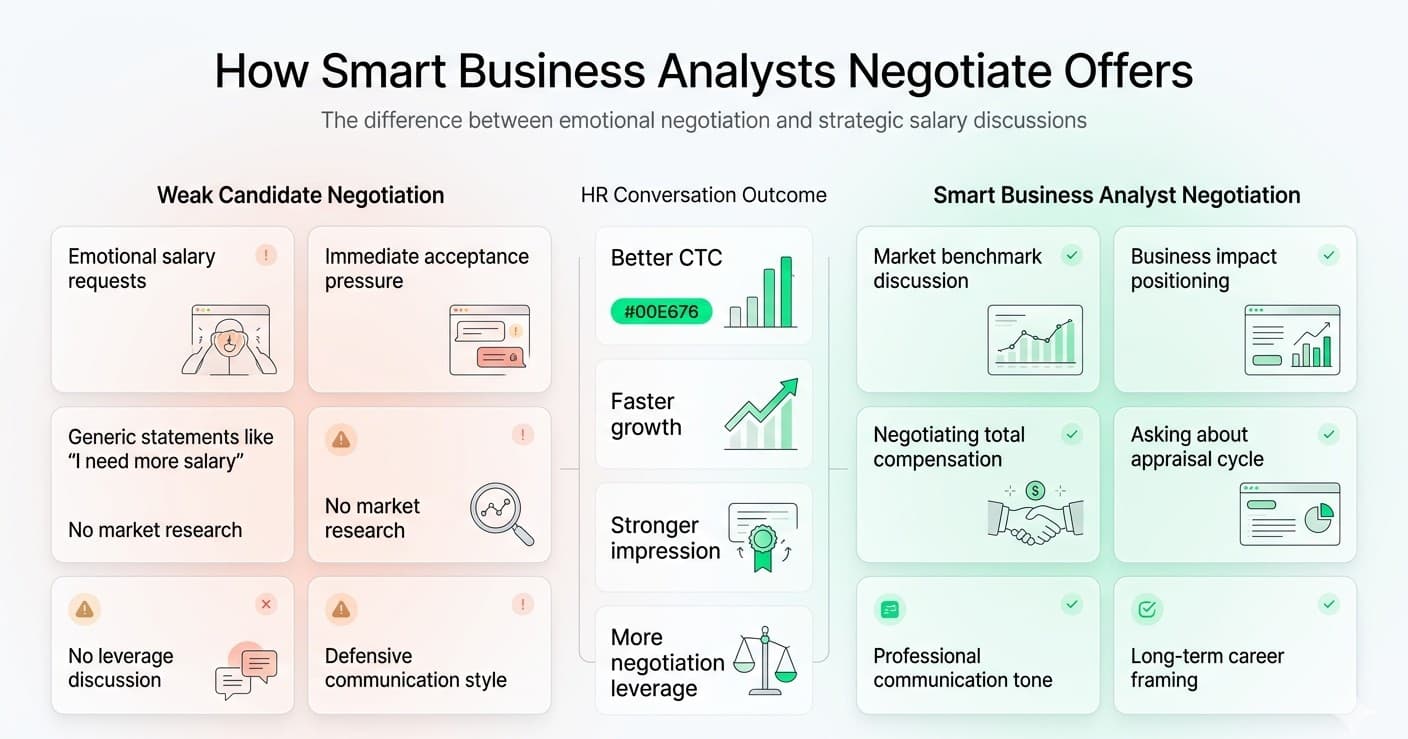
Before we get into tactics, let us understand why this is particularly tricky for BA roles. Business Analysts sit in a unique position. The role is not always clearly defined from one company to the next. One company's junior BA is another company's senior BA. The skills required, tools used, and business impact delivered can vary enormously. This ambiguity actually works in your favour during negotiation, but only if you know how to use it. Because the role definition is flexible, so is the salary range. Companies often post a range internally that is wider than what they quote initially. The first number they give you is rarely the top of that range. It is usually the middle or lower end. There is also a common misconception that asking for more will make you look greedy or cause them to pull the offer. In reality, professional salary negotiation is expected. Most HR professionals negotiate salaries dozens of times a month. It does not offend them. What matters is how you do it.
Before the Negotiation: Do This Research First
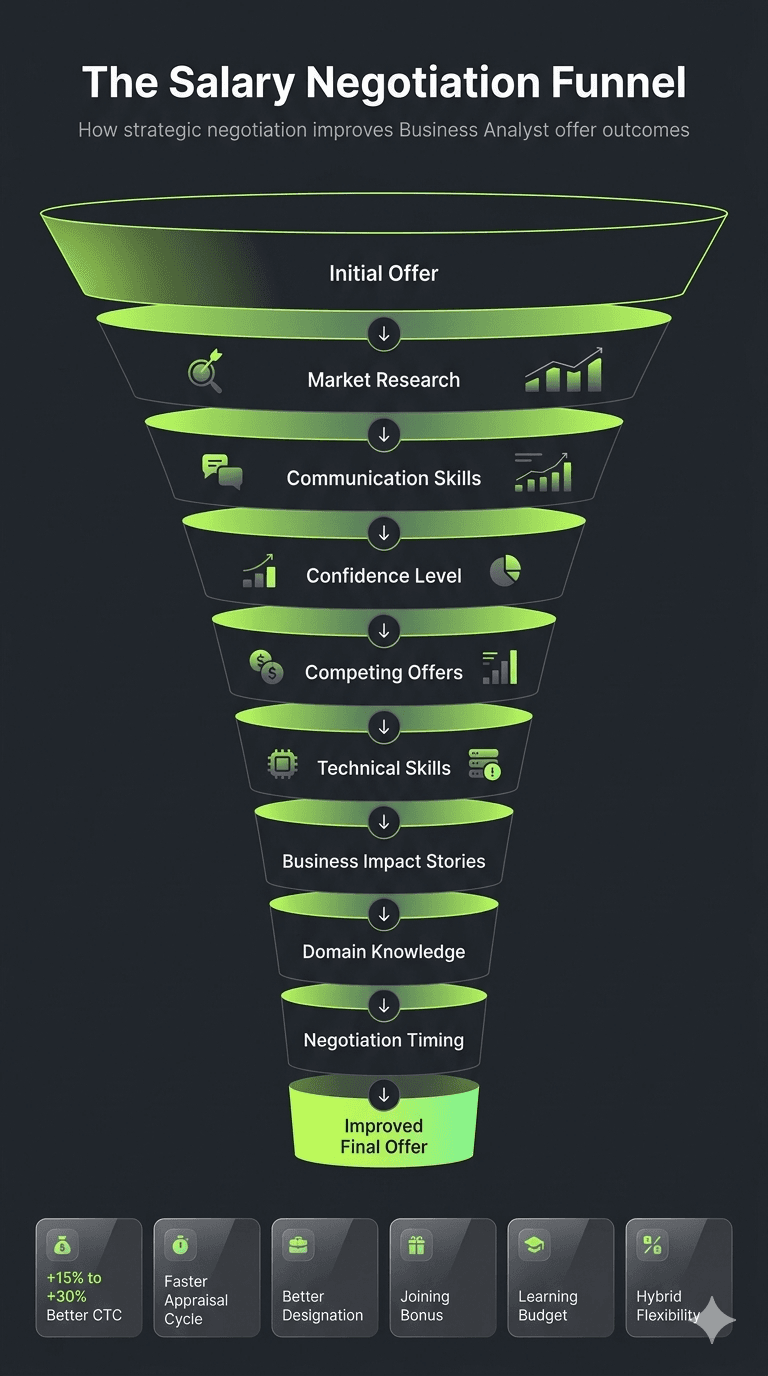
Walking into a salary negotiation without data is like walking into a business case presentation without numbers. You will not be taken seriously. Here is what to research before you negotiate: Know the market rate for your exact level and city. Look at platforms like Glassdoor, LinkedIn Salary, AmbitionBox, Levels.fyi, and PayScale. Search specifically for "Business Analyst" with the years of experience you have, in the city where the job is located, in the same or similar industry. In India in 2026, a fresher BA earns roughly 4 to 6 LPA. With two to three years of experience the range moves to 7 to 11 LPA. A senior BA with five plus years in BFSI, consulting, or product companies can command 13 to 20 LPA or more. These numbers vary significantly by company size and location. In the US market, entry-level BAs typically earn between 60,000 and 80,000 dollars annually. Mid-level BAs earn 85,000 to 110,000 dollars. Senior BAs and Lead BAs at large firms often exceed 120,000 to 140,000 dollars. Know your number before the call happens. Decide on three numbers before the negotiation begins. Your ideal number, which is what you actually want. Your realistic target, which is what you expect to land at with some negotiation. And your walk-away point, below which you genuinely will not accept the offer. Having all three clear in your mind before you speak prevents you from being caught off guard. Know what the company recently paid. If you can find Glassdoor reviews from the last six months, look at what current or former employees at this company report for similar roles. This tells you what the company actually pays versus what they say they pay.
How to Negotiate Salary in an Interview as a Business Analyst
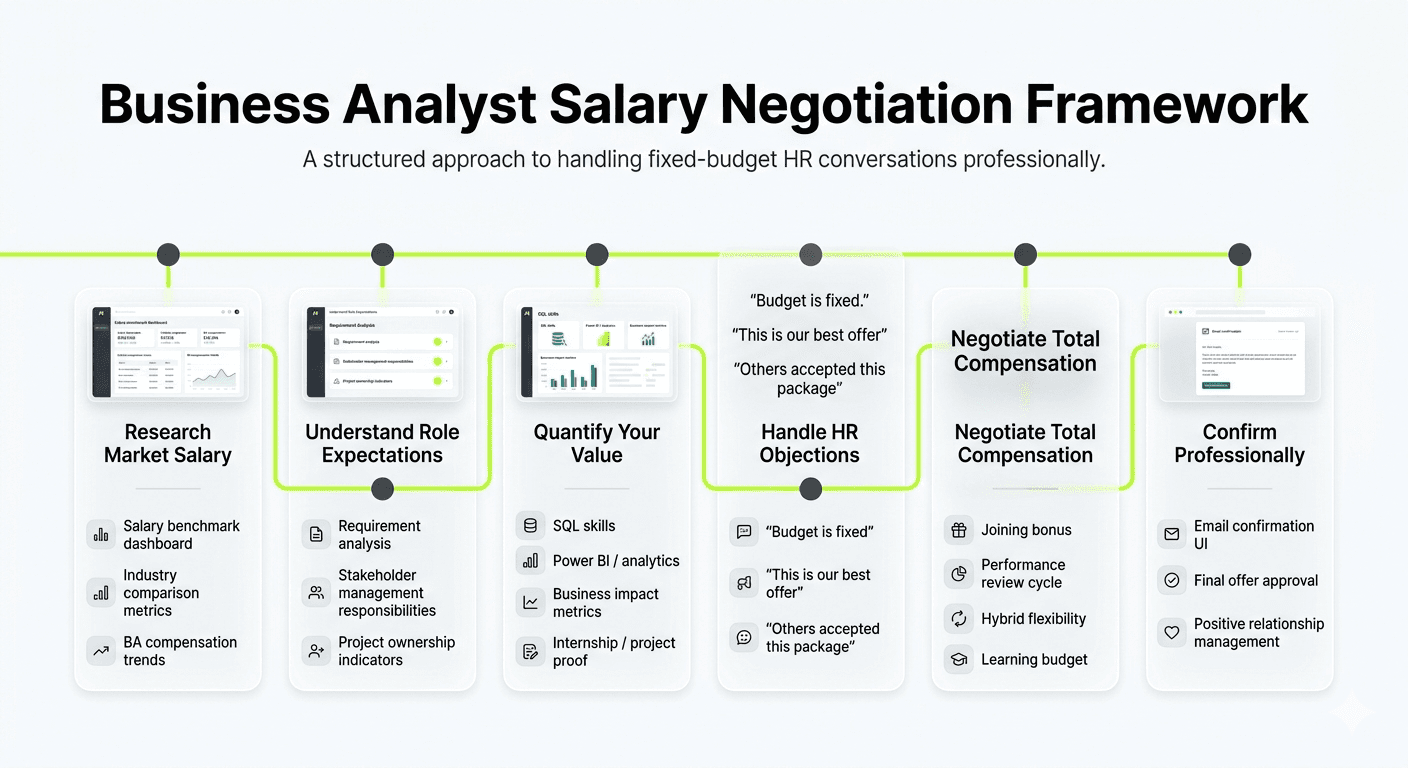
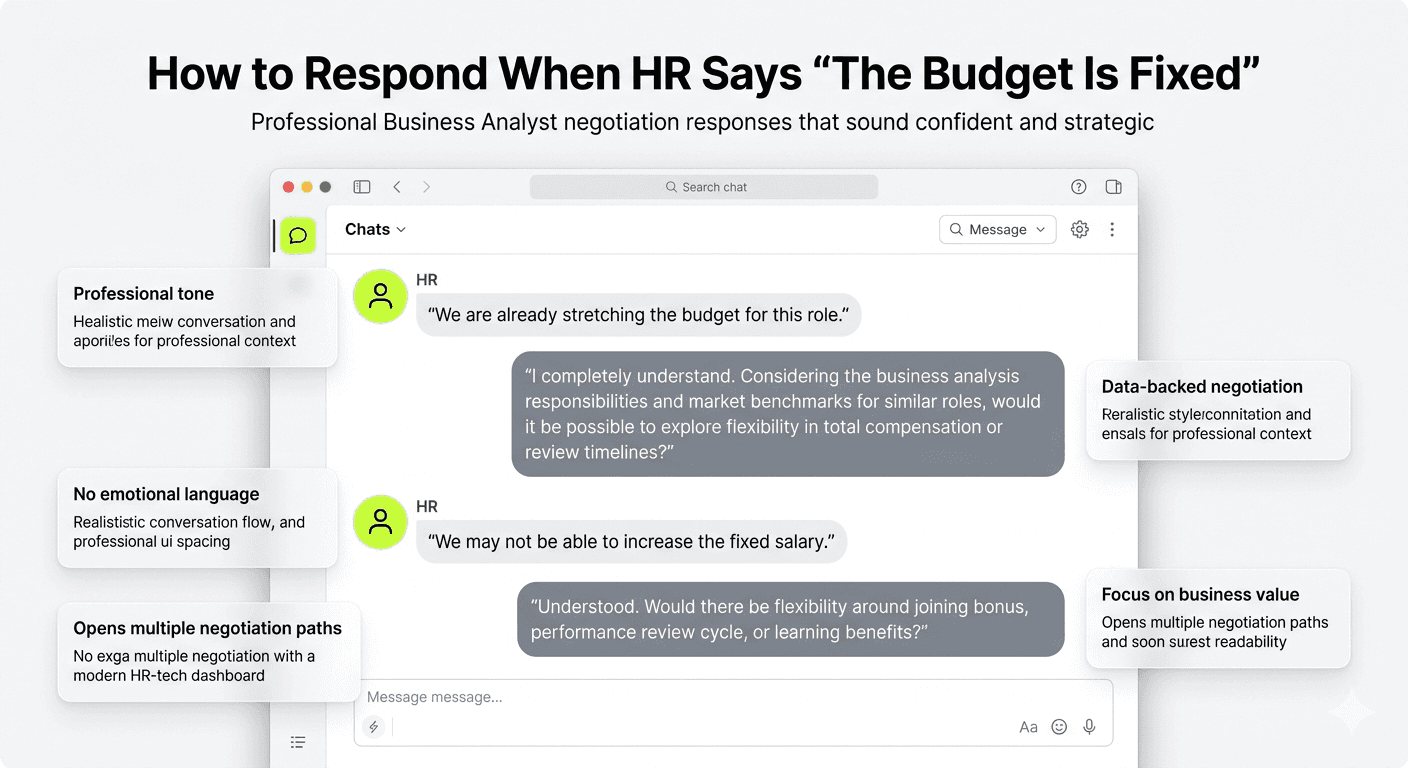
The negotiation often starts before the formal offer call. Here is how to handle each stage. This is the question almost everyone gets wrong. Most candidates either give a specific number too early, which anchors the negotiation at a lower point than necessary, or they say something vague like "I am flexible" which signals that you have not done your homework. The best response when asked your expected salary during an interview round is to redirect it gracefully. You can say something like: "I am definitely open to discussing compensation. Before I give a specific number, could you share the budgeted range for this role? I want to make sure we are both on the same page and that it makes sense for both sides." This does two things. It shows professionalism and it makes them reveal their range first. Once you know their range, you can position your ask at the top of it or just above it, which is a far stronger position than guessing blind. If they push you and say they need a number first, give a range rather than a specific figure. Make the bottom of your range where you actually want to land. So if you want 9 LPA, say "I am looking at something in the range of 9 to 11 LPA based on my research and experience." When HR calls with the formal offer, do not respond immediately. Even if it sounds good, do not say yes on the spot. A simple and professional response is: "Thank you so much, I really appreciate the offer and I am genuinely excited about this opportunity. Could I have a day or two to review the full details before I get back to you?" This pause is not stalling. It is standard professional behaviour. It also gives you time to prepare your counter. If the offer is lower than what you were hoping for, the first thing to do is get the full picture. Ask HR to send you the complete compensation breakdown including base salary, performance bonus, joining bonus if any, stock or ESOPs, health insurance, leave policy, and any other benefits. Sometimes the base looks low but the total package is competitive when you factor in everything. And sometimes it confirms that you need to negotiate. This is the moment most people give up. When HR says the budget is fixed, the right response is not to argue with them. Arguing makes them defensive. Instead, you want to show curiosity, acknowledge their constraint, and then open a different door. Here is a phrasing that works well in practice: "I really appreciate your transparency on that. I understand budgets have constraints and I respect that completely. I want to make this work because I am genuinely excited about the role and the team. Could I ask a few questions to understand the full picture a little better?" Then you ask one of these follow-up questions depending on your situation: "Is there any flexibility in the structure of the offer, even if the base itself is fixed? For example, a joining bonus or a performance-linked variable?" "What does the typical review cycle look like, and is there a defined increment path for BAs at this level?" "Are there any skill-based or certification allowances that could be added to the package?" These questions shift the conversation from "yes or no on salary" to "how do we make this work creatively." That shift often unlocks options that HR never mentioned because you did not ask.When They Ask About Your Salary Expectations During the Interview
When You Receive the Formal Offer
How to Respond When They Say "The Budget Is Fixed"
Salary Negotiation Tips That Work Specifically for Business Analysts
Here are practical tactics that are specifically relevant to BA roles and BA salary conversations. Anchor your ask to your deliverable, not just your experience. Generic negotiation advice says to cite your years of experience. As a BA, you can do better. BAs are hired to solve business problems. If you can show that your work has driven measurable outcomes in past roles, you have a much stronger negotiation position. Say something like: "In my last role, the requirements I gathered and the process improvements I mapped led to a 30 percent reduction in turnaround time for our operations team. I believe I can bring that same rigour here and I want my compensation to reflect the value I drive, not just the title." That is a different conversation than "I have three years of experience." Use competing offers without being aggressive. If you have another offer or are in process elsewhere, you can mention it professionally without making it feel like a threat. "I want to be upfront with you. I do have another process ongoing and I expect to hear from them this week. I am genuinely more excited about this role and this team, which is why I want to see if we can get to a number that makes it an easy decision for me." This is honest, it creates gentle urgency, and it does not burn the relationship. Ask for a faster review cycle instead of a higher base. If the base truly cannot move, ask for a performance review at six months instead of twelve. That is a guaranteed path to a higher salary sooner. Many companies will agree to this because it protects them too. They only pay more if you perform. For you, it means a potential raise in six months instead of a year. "If the base is fixed right now, would the company be open to scheduling my first performance review at six months rather than twelve? That way we both have a clear checkpoint to reassess based on what I have delivered." Negotiate the variable component separately. Most BA offers include a variable component or performance bonus, often ten to twenty percent of the base. If the base will not move, ask about the conditions for earning the full variable. Sometimes companies have vague conditions for payout. Asking for clarity, and asking for the variable to be guaranteed in the first year as a joining incentive, can significantly increase your first year total.
FREE TO USE
8k+ SESSIONS92% FLUENCY4.9★ RATING
Speak With Confidence
Real Conversations. Real Scenarios. Speak until it feels natural.
- Real-Time Speaking Practice
- Guided Conversation Flows
- Instant AI Feedback
What to Say at Every Stage: A Practical Script
Here is a simple script you can adapt for your actual conversation. When the offer comes in lower than expected: "Thank you so much for the offer. I really appreciate it and I am excited about this role. I have reviewed the details carefully and based on my research on current market rates for BA roles with my background, I was expecting something closer to [your number]. Is there any room to move closer to that?" When they say the budget is fixed: "I completely understand that and I respect the constraint. Can I ask whether there is flexibility in other parts of the package, perhaps a joining bonus, a faster review cycle, or a higher variable component? I really want to make this work and I am happy to be creative about how we get there." When they come back with a small increase: "I genuinely appreciate you going back and getting that additional amount. It means a lot. I am still a little short of where I was hoping to land. If we could get to [your target], I am ready to accept today and I am very excited to get started." When they hold firm and you decide to accept: "Alright, I appreciate everything you did to try to make this work. I am going to accept the offer. I would just like to confirm that we can schedule the first performance review in six months so we have an early opportunity to revisit the compensation based on my contribution."
Common Mistakes to Avoid During Business Analyst Salary Negotiation
Most negotiations are not lost because of what you ask for. They are lost because of how you ask. Avoid going silent after they give the offer. Silence feels like acceptance. Always respond with a question or a counter, even if it is just asking for time to review. Avoid making it emotional. Phrases like "I really need this money" or "I have a loan to pay" do not help your case. Salary negotiation is a business conversation. Keep it professional and data-driven. Avoid negotiating by email if you can help it. A real conversation, even on the phone, allows you to read the tone, ask follow-up questions, and build rapport in a way that email simply cannot match. Avoid accepting and then trying to renegotiate later. Once you accept in writing, the negotiation is over. Make sure you are satisfied before you sign. Avoid comparing your salary expectations to a colleague's pay. That information is often inaccurate and it immediately puts HR on the defensive.
How to Negotiate When You Are a Fresher BA
Freshers have less leverage in negotiation but they are not powerless. Here is how to approach it. Lead with your skills rather than your title. If you have certifications like CBAP, PMI-PBA, ECBA, or even Agile or Scrum certifications, mention them specifically. These add verifiable value to a fresher candidate. Lead with your internship impact. If you did a meaningful internship, frame it in terms of what you contributed, not just what you did. "I spent three months documenting user journeys for a fintech product and the requirements I produced were used directly in the sprint planning" is far more powerful than "I did a BA internship." Ask for a learning and development budget. Even if the base cannot move, many companies will agree to fund a certification or a training course for a new hire. Over a year, this can be worth 20,000 to 50,000 rupees in value. Ask about the salary review timeline and increment structure clearly. Some companies have a fixed increment cycle. Knowing when yours falls and what the typical percentage is gives you a realistic picture of where you will be in twelve months.
After the Negotiation: Regardless of Outcome
Whether you got what you wanted or you accepted less, here is what to do after the conversation is over. Get everything in writing. Any verbal commitment about a review date, a bonus, or a certification allowance should appear in the offer letter or in an email from HR. A verbal promise that is not documented often disappears when the manager changes or when the organisation restructures. Start strong. The best way to set yourself up for a faster raise is to make an impact quickly. BAs who deliver clean requirements, build strong stakeholder relationships, and reduce rework within their first three months earn credibility fast. Credibility leads to better ratings. Better ratings lead to better increments. Keep your market knowledge current. Even after you join, continue watching what the market pays for your level. If you get a below-market offer and nothing changes internally in twelve to eighteen months, you will have the information and the confidence to either negotiate internally or move to a better opportunity.
Conclusion
When HR tells you the budget is fixed, they are not lying. But they are also not telling you the full truth. Almost every salary offer has some flexibility somewhere. In the base, in the variable, in the joining bonus, in the review timeline, in the benefits. Your job as a Business Analyst, which is essentially a role about asking the right questions and finding solutions where others see blockers, is to find that flexibility. The same skills that make you good at your job make you capable of negotiating well. You know how to ask structured questions. You know how to understand constraints and work around them. You know how to bring two sides to an agreement. Use those skills in the negotiation room the same way you would use them in a stakeholder meeting. Be professional. Be data-driven. Be creative. And never accept the first number unless it is genuinely everything you wanted.