Loading...
Contents
Why Your STM32 LED Project Isn't Getting You Interviews at Product Companies
Jun 30, 202613 min readUpdated Oct 3, 2026
You built the LED blink project. Then the button-controlled LED. Then the UART communication demo. You got into timers, PWM, and maybe even touched I2C with a sensor. Your GitHub has five or six STM32 repositories and you have been applying to embedded roles at product companies for two months.
Still nothing.
No calls. No responses. The occasional auto-rejection.
If this sounds familiar, the issue is not that your skills are bad. The issue is that the projects you are showing are proving the wrong things to the wrong audience. This blog is going to explain exactly why STM32 projects for beginners often fail to move the needle in a serious job search, and what to build and show instead.
FREE TO USE
25K+ INTERVIEWS4.8★ RATING68% IMPROVEMENT
Crack Your Dream Job
Real Interviews. Real Pressure. Practice until it feels easy.
- Seamless Interview Experience
- Resume & JD Questions
- Instant Personalized Feedback
What Recruiters and Hiring Managers at Product Companies Actually See
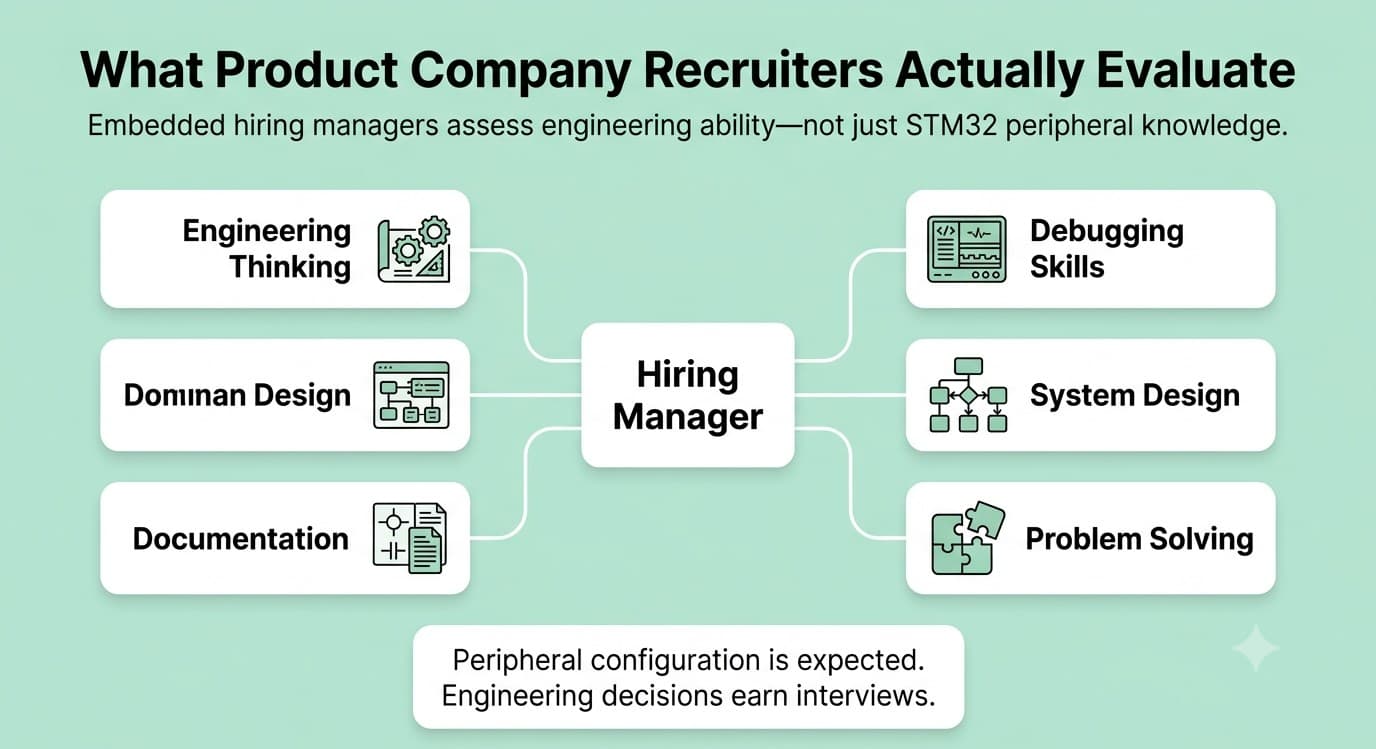
Before talking about what to build, it helps to understand who is evaluating your profile and what they are looking for.
At a product company building a physical device, a medical wearable, an industrial sensor, a consumer IoT product, the hiring manager for an embedded role is almost always a senior embedded engineer or an engineering manager. They are not a generalist recruiter. They review your GitHub before or alongside your resume because they actually know what they are looking at.
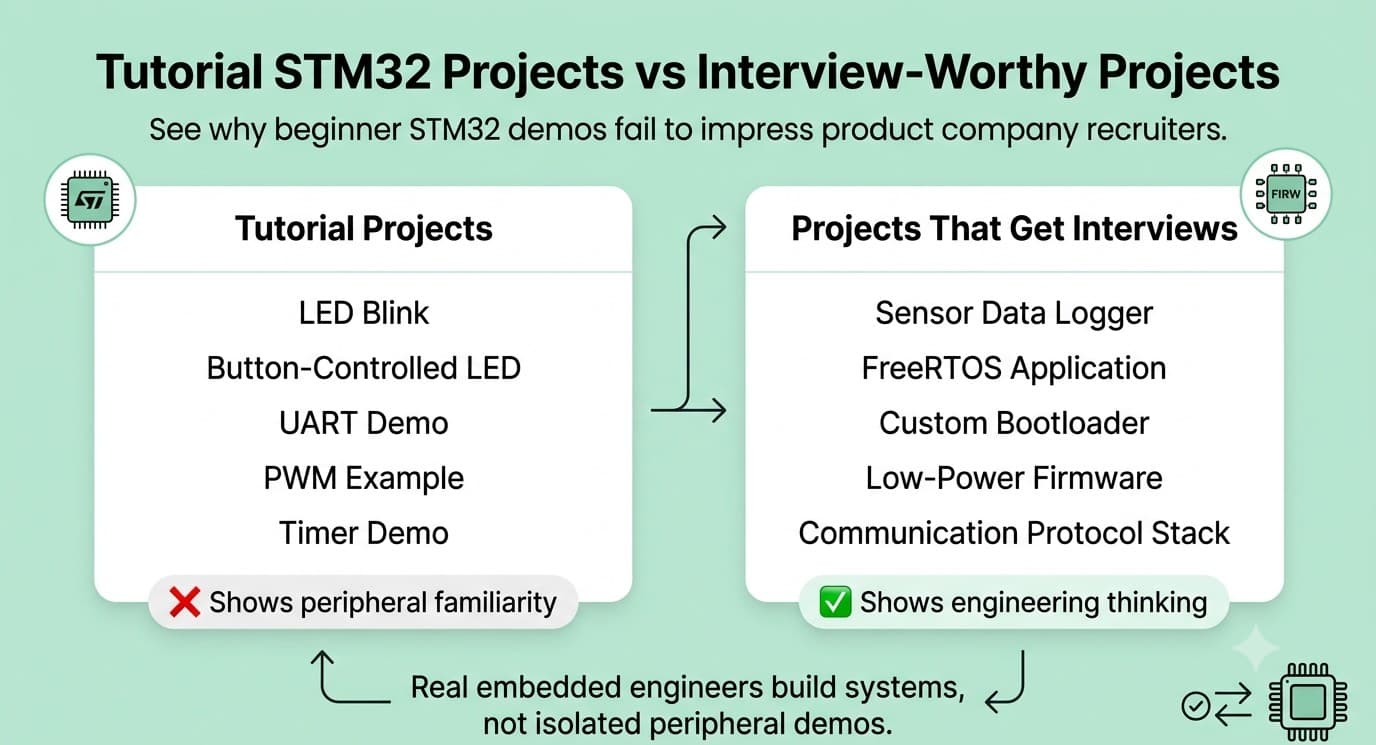
And when they open an STM32 repository called "LED_Blink" or "UART_Test," they close it in ten seconds.
Not because LED blink is bad. Every embedded engineer has built it. It is the embedded equivalent of a "Hello World" program. But it proves nothing beyond the ability to follow a tutorial and get a development board working. That is a starting point, not a signal that you can solve real embedded engineering problems.
Why Tutorial-Level STM32 Projects Don't Get You Interviews
Here is the uncomfortable truth about most beginner STM32 projects. They demonstrate familiarity with tools but not engineering judgment.
A hiring manager at a product company needs to answer one question when they look at your profile: can this person solve the kinds of problems we actually face?
Those problems include things like:
A blinking LED project answers none of these questions. Neither does a basic UART loopback or a PWM duty cycle demo. They show you can configure a peripheral. They do not show you can engineer a solution.
This is the core of why embedded systems GitHub projects at the tutorial level fail to generate interviews at serious product companies.
- Making a sensor reading reliable over a noisy power rail
- Reducing interrupt latency in a timing-critical application
- Designing a state machine that handles unexpected inputs gracefully
- Optimising firmware to run on a constrained memory budget
- Building a bootloader that survives a power failure mid-update
- Implementing a communication protocol correctly, not just sending bytes
A blinking LED project answers none of these questions. Neither does a basic UART loopback or a PWM duty cycle demo. They show you can configure a peripheral. They do not show you can engineer a solution.
This is the core of why embedded systems GitHub projects at the tutorial level fail to generate interviews at serious product companies.
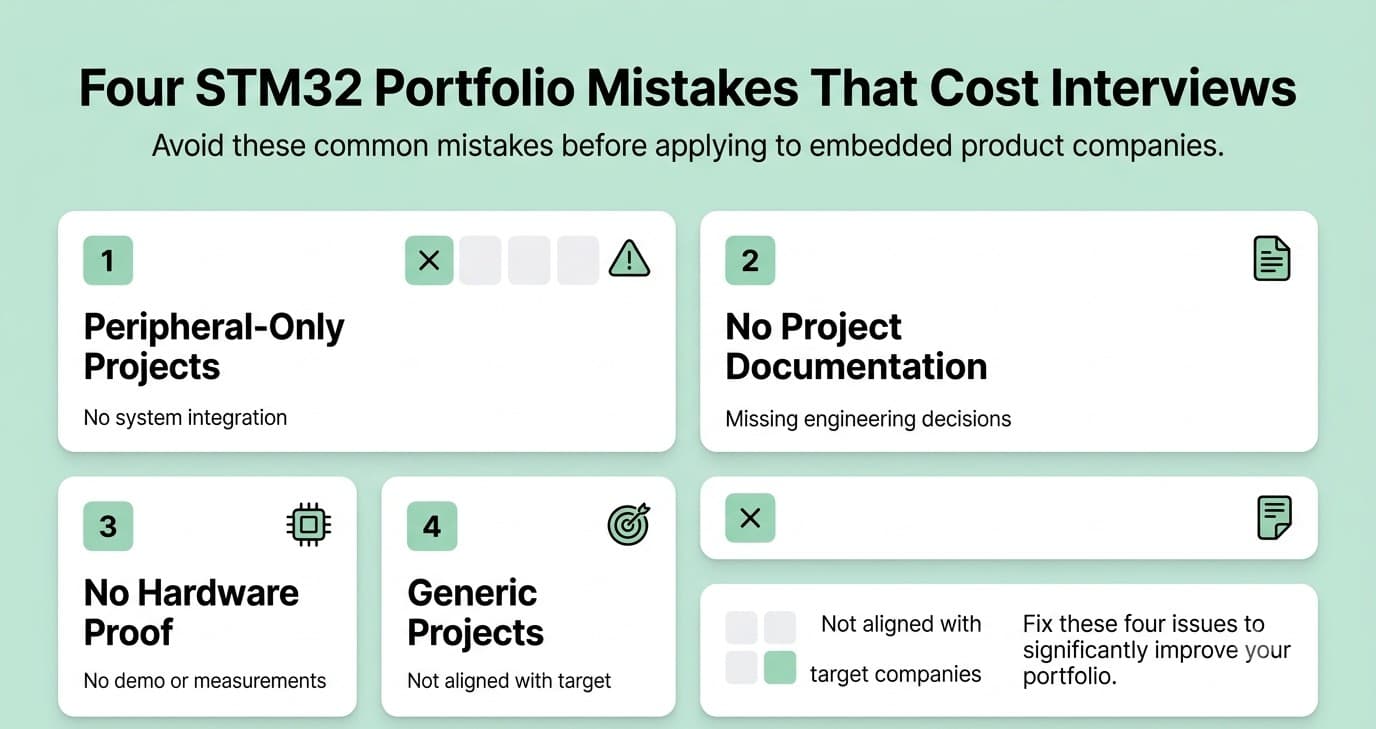
The Specific Mistakes Most Beginners Make With STM32 Projects
Mistake 1: Building isolated peripheral demos instead of systems
Most tutorial projects test one peripheral at a time. An LED here, a UART there, an ADC reading somewhere else. Real embedded products integrate all of these together and the interesting problems live in those integrations.
When your SPI sensor reading occasionally glitches because you have an interrupt conflict with your UART receive handler, that is a real embedded problem. Solving it and documenting how you solved it is what an interviewer wants to see.
Mistake 2: No explanation of design decisions
A repository with code and no README tells a hiring manager nothing useful. They cannot see why you made the choices you made. They do not know what constraints you were working under, what tradeoffs you considered, or what problems you ran into and solved.
Every embedded systems project for your resume should have a README that explains the problem being solved, the hardware setup, the key design decisions, and at least one specific challenge you encountered and how you addressed it.
Mistake 3: No evidence the project actually works
Code that compiles is not the same as code that works reliably on hardware. Include a short video of your project running. A thirty-second clip of your hardware doing something real, something measurable, something clearly functional, is worth more than fifty lines of polished code with no proof of execution.
Mistake 4: Wrong projects for the role being targeted
A project that shows deep knowledge of STM32 low-power modes is excellent if you are targeting battery-powered IoT devices. It is less relevant if the company you are applying to builds high-speed industrial motor controllers.
Before building your portfolio projects, look at what three or four of your target companies actually make. Build towards those problem domains.
STM32 Projects That Actually Impress Recruiters
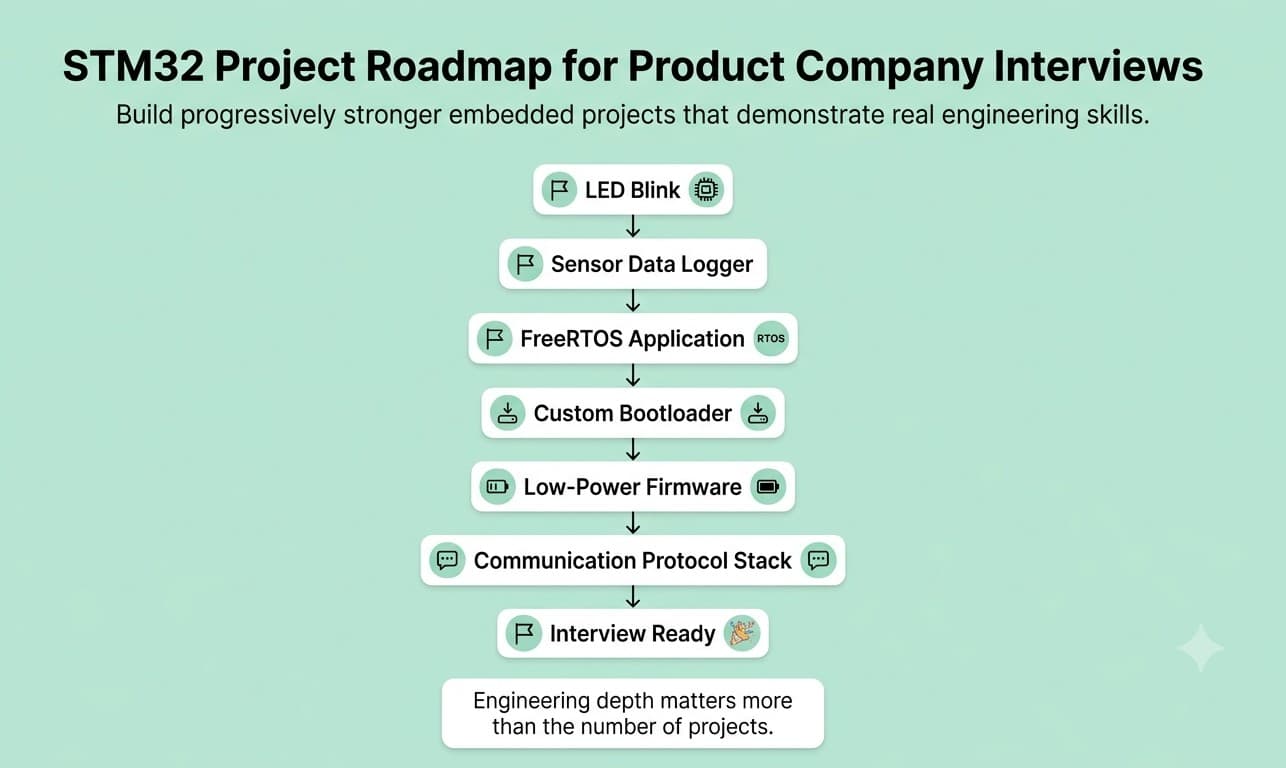
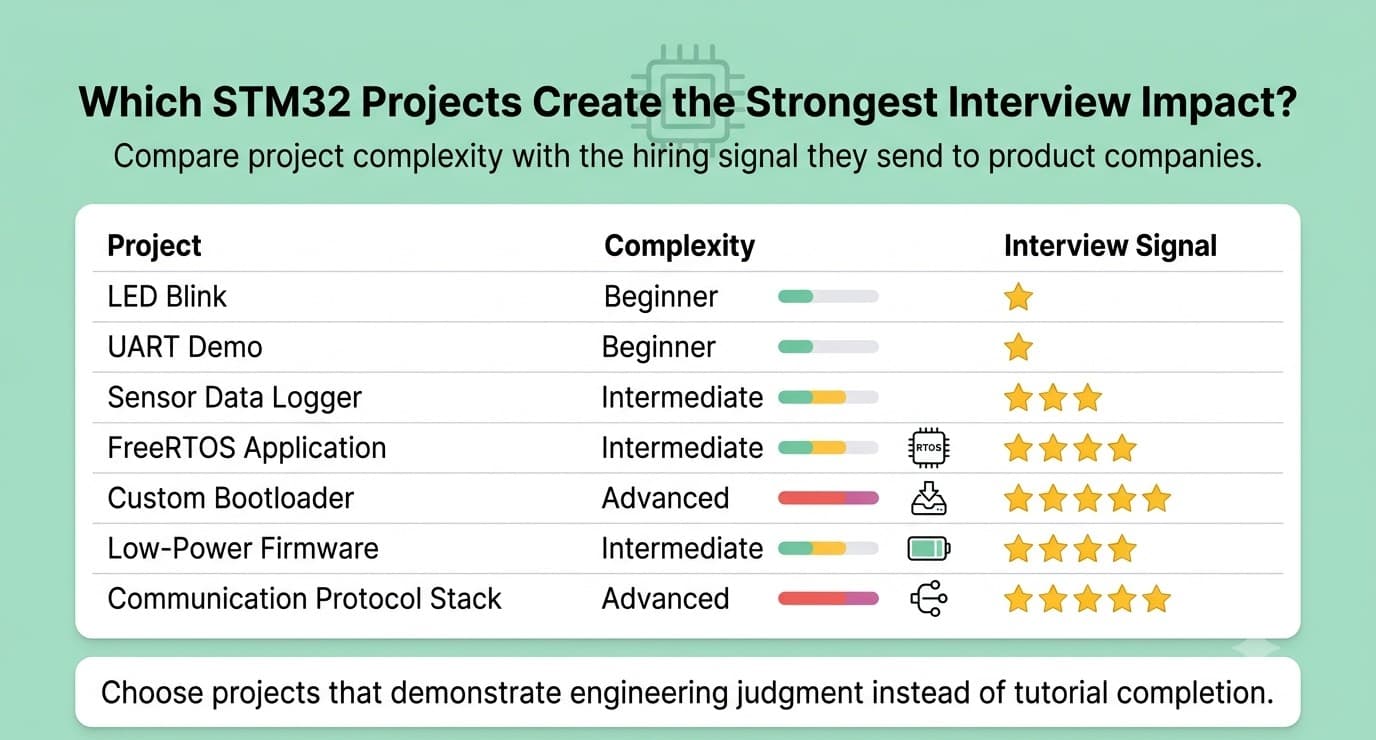
Here are the categories of STM32 projects that impress recruiters at product companies. These are not beyond a motivated beginner or intermediate developer. They are just meaningfully more complex than blinking an LED.
1. A Sensor Data Logger With Error Handling
Connect a real sensor, a temperature and humidity sensor, an IMU, or an environmental sensor, read data over I2C or SPI, store it reliably on an SD card or external flash, and handle error conditions explicitly. What happens when the sensor does not respond? What happens when the storage is full? What happens if power is lost mid-write?
These are the questions a product engineer thinks about. Answering them in code and documenting them in your README is what makes this project stand out.
2. A RTOS-Based Multi-Task Application
Most real embedded products run on an RTOS. FreeRTOS is the most common and it runs on STM32 without issues. Build a small application that uses at least two tasks communicating via a queue, add a timer-based task, and handle task synchronisation correctly.
Include a diagram in your README showing the task structure, priorities, and communication paths. This single addition separates your project from anything tutorial-level and shows you understand how real firmware is structured.
3. A Custom Bootloader (Even a Simple One)
Building a bootloader teaches you more about embedded systems in a week than three months of peripheral demos. A basic bootloader that checks for a valid application, jumps to it, and can receive a new firmware image over UART is genuinely impressive. It requires understanding memory maps, linker scripts, and the STM32 startup sequence.
It does not need to be production-grade. A well-documented, working bootloader that you can explain end to end is the kind of project that generates real conversation in interviews.
4. A Power-Optimised Firmware Application
If you are targeting IoT or battery-powered device roles, build a project that demonstrates power awareness. Configure stop or standby modes on the STM32. Measure the actual current consumption in different states with a current meter or a Nordic PPK. Document the measurements. Show the tradeoff between sleep depth and wake-up time for your application.
Most beginners never measure power. Engineers who have measured it, thought about it, and designed around it are immediately more credible to hiring managers at low-power product companies.
5. A Communication Stack Implementation
Pick a real protocol and implement it properly. Modbus RTU over UART, a custom framed packet protocol with CRC validation, or a simplified MQTT client layer. The goal is to show you can think about reliability, error detection, and protocol state machines, not just send bytes between devices.
FREE TO USE
8k+ SESSIONS92% FLUENCY4.9★ RATING
Speak With Confidence
Real Conversations. Real Scenarios. Speak until it feels natural.
- Real-Time Speaking Practice
- Guided Conversation Flows
- Instant AI Feedback
How to Present Embedded Systems Projects for a Resume
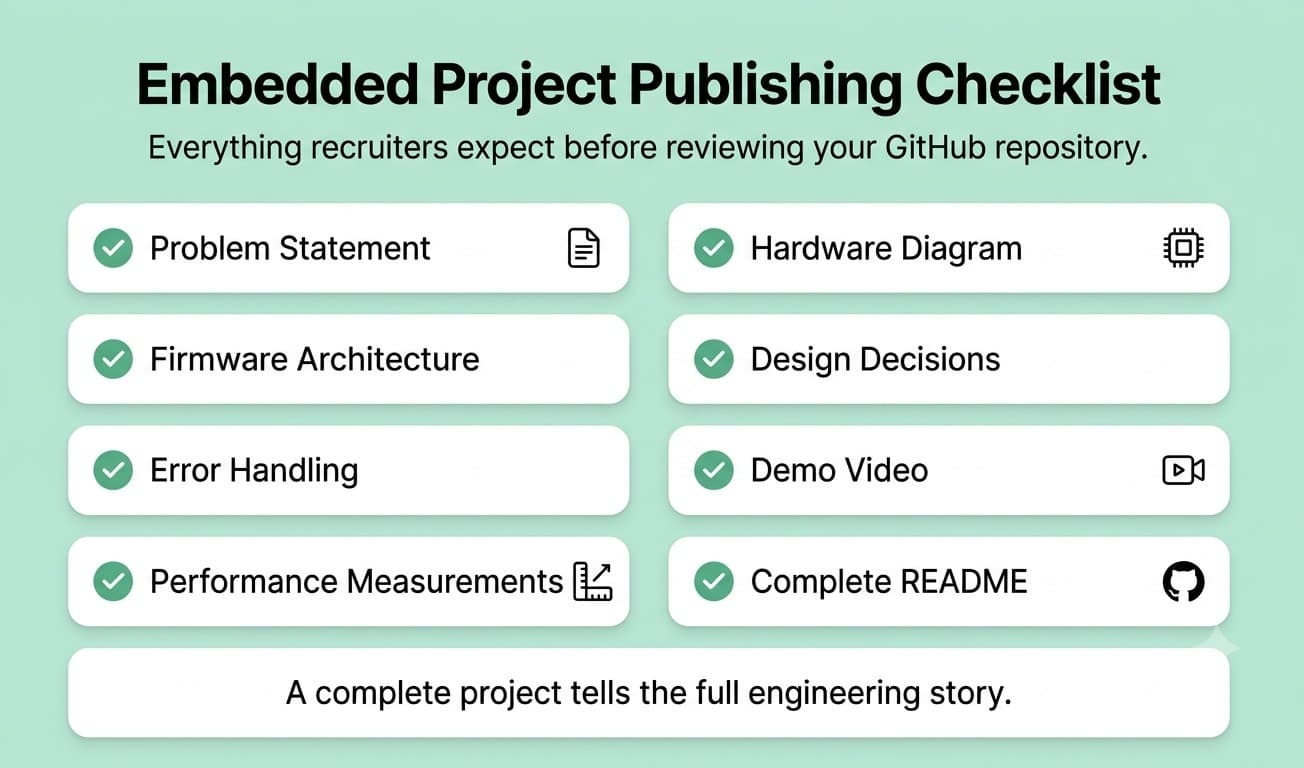
Even a genuinely impressive project will be overlooked if it is presented poorly. Here is what every embedded systems project idea for resume submission should include. A clear problem statement in the README. One paragraph that explains what the project is trying to do, why it is interesting or challenging, and what constraints you were working within. Hardware cost limit, power budget, memory constraint, whatever applies. A hardware setup section. List the microcontroller, the peripheral ICs, and the power supply arrangement. Include a simple schematic or at minimum a connection diagram. A section on key technical decisions. Why did you choose FreeRTOS over bare-metal? Why DMA instead of polling for the ADC? Why is your buffer sized the way it is? These are exactly the questions an interviewer will ask. Answer them in writing first. A short video of the hardware running. Upload it to YouTube as unlisted and link it in the README. Thirty seconds of the board doing something clearly functional is worth more than any description. Actual measurements where relevant. Power consumption figures, timing measurements from a logic analyser, latency numbers. Real data from real hardware is compelling in a way that code alone is not.
What Role Are You Actually Targeting?
The words "product company" cover a wide range of actual embedded problems. A company making a Bluetooth-enabled fitness wearable needs a developer who understands BLE stacks, low-power state machines, and sensor fusion. A company building industrial PLCs needs someone comfortable with real-time constraints and deterministic timing. A company making medical devices needs engineers who understand safety-critical design. Before deciding which projects to build, look at the job descriptions of three to five roles you genuinely want. Note the specific technologies, protocols, and application domains they mention. Build towards those. A targeted project that demonstrates exactly what a specific company works on will always outperform a generic peripheral demo, no matter how clean the code is.
The One Thing That Changes Everything
Building better projects matters. Presenting them well matters. Targeting the right companies matters. But the thing that changes everything is being able to talk about your projects with depth and honesty in an interview. Every technical decision you made. Every problem you ran into. Every measurement you took. Every simplification you made and why. Everything you would do differently if you built it again. That conversation is what an embedded systems interview is really about. The project is the starting point. Your understanding of it is what gets you the offer. Build projects that give you something real to talk about. Then talk about them with the same rigour you applied when building them.
Quick Reference: Projects by Impact Level
More Blogs



Sep 30, 2026
React Developer Interview Preparation Guide: A Complete Roadmap for 2026
31 min read
