Loading...
AI-Powered Mock Interview Practice
Ace Frontend Developer Interview with AI
Prepare for frontend developer interviews with realistic AI-powered mock interviews covering HTML, CSS, JavaScript, React, coding challenges, frontend architecture, and behavioral questions. Receive instant feedback and improve with every practice session.
Real-Time AI Voice Interviews
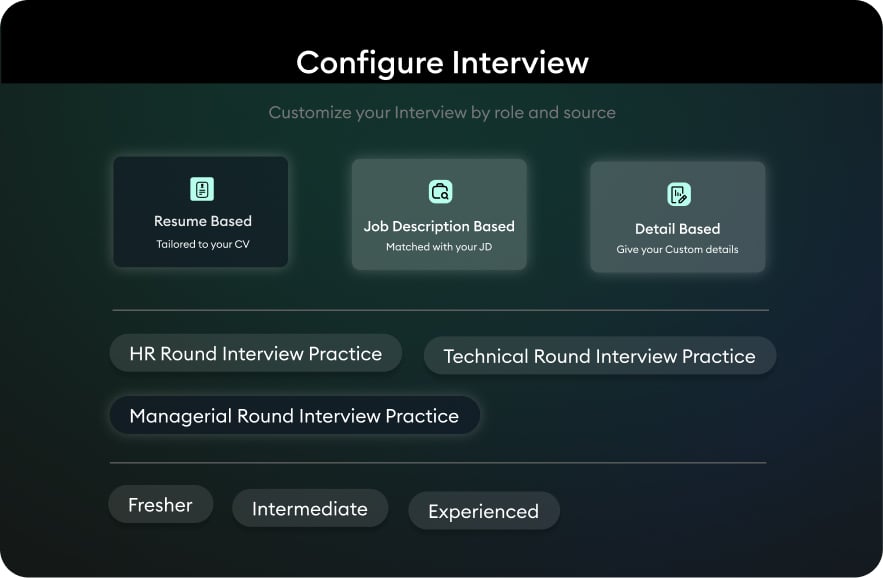
Role-Specific Interview Questions
Adaptive Follow-up Questions
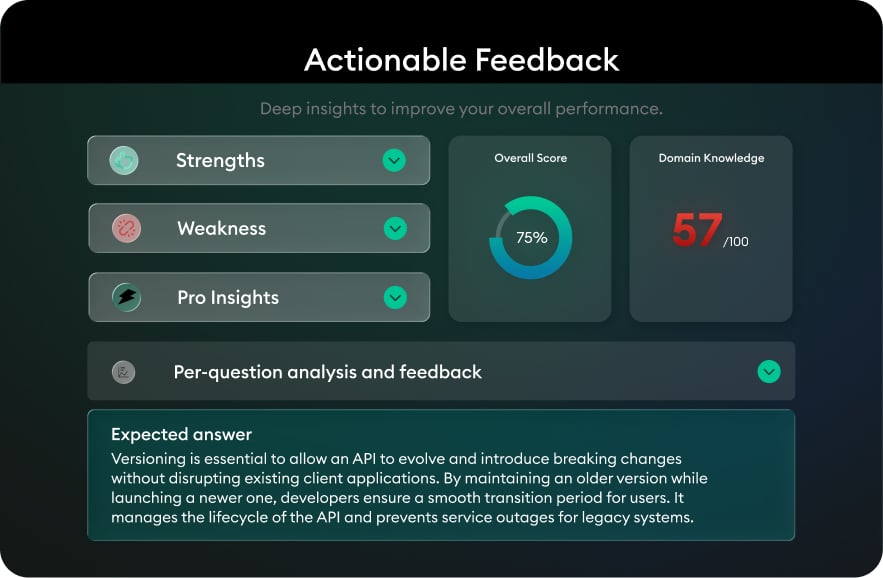
Question-by-Question AI Insights


4.8/5
• Loved by 10K+ Candidates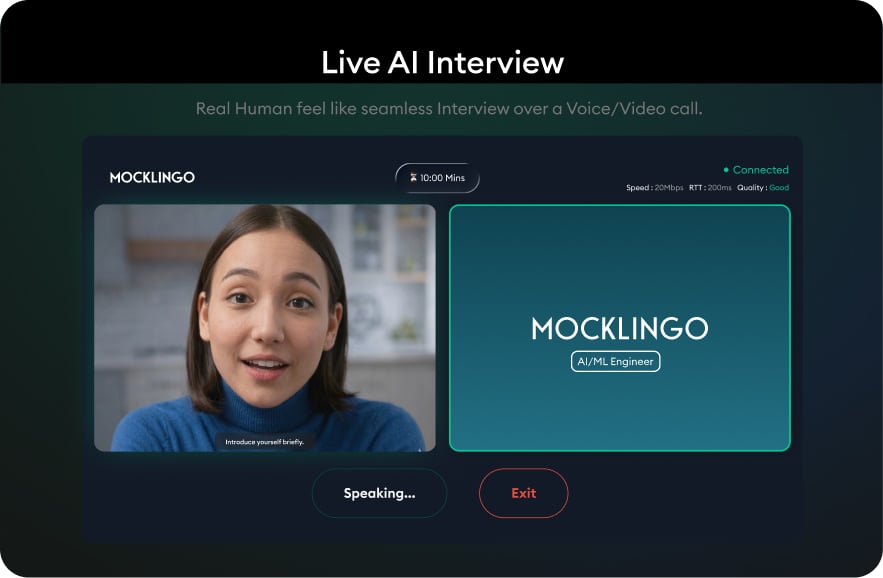
10,000+
Engineers Practicing
50,000+
Mock Interviews Done
85%
Interview Success Rate
4.8/5
Average Rating
Browse by Topics
1 / 4
Browse by Interview type
1 / 2
Trusted by Students and Professionals
See how users built confidence, improved their interview skills, and cracked interviews with Mocklingo's AI-powered feedback.
I practiced for a week before my interviews. The follow-up questions felt surprisingly real, and I finally cracked my first Software Engineer role.
Aarav Sharma
Software Engineer @ Infosys
Emily Carter
5/5
The AI challenged me just like a real interviewer. After practicing here, I received two job offers within the same month.
"
The personalized feedback showed exactly where I was losing marks. I improved my answers and got shortlisted for three interviews.
Priya Nair
Product Manager
HISTORY-BACKED PERSONALIZED INTERVIEWS
The history-backed interviews remembered my weak areas and kept testing them. I felt much more confident in my final interview.
Rahul Verma
Data Analyst
Daniel Wilson
Backend Engineer
PERSONALIZED PER-QUESTION FEEDBACK WITH EXPECTED ANSWERS
Every session felt different. The AI asked realistic follow-up questions that helped me prepare for unexpected scenarios.
I had never faced a technical interview before. After practicing on Mocklingo, I received my first campus placement offer.
Neha Gupta
Graduate Trainee
Sakshi Jain
UI/UX Designer
PERSONALIZED PER-QUESTION FEEDBACK WITH EXPECTED ANSWERS
I loved that the interviews adapted based on my previous sessions. It actually felt like having a personal interview coach.
Rohan Kulkarni
Full Stack Developer
I struggled with communication more than coding. Practicing aloud every day made a huge difference, and I landed my dream role.
HISTORY-BACKED PERSONALIZED INTERVIEWS
The AI feedback was specific and actionable. My confidence improved with every mock interview.
Sophia Martinez
Business Analyst
Aarav Sharma
Software Engineer @ Infosys
I practiced for a week before my interviews. The follow-up questions felt surprisingly real, and I finally cracked my first Software Engineer role.
Emily Carter
Frontend Developer
The AI challenged me just like a real interviewer. After practicing here, I received two job offers within the same month.
Priya Nair
Product Manager
The personalized feedback showed exactly where I was losing marks. I improved my answers and got shortlisted for three interviews.
Rahul Verma
Data Analyst
The history-backed interviews remembered my weak areas and kept testing them. I felt much more confident in my final interview.
Daniel Wilson
Backend Engineer
Every session felt different. The AI asked realistic follow-up questions that helped me prepare for unexpected scenarios.
Neha Gupta
Graduate Trainee
I had never faced a technical interview before. After practicing on Mocklingo, I received my first campus placement offer.
Michael Brown
Software Developer
The detailed feedback after every question helped me improve faster than watching interview videos online.
Sakshi Jain
UI/UX Designer
I loved that the interviews adapted based on my previous sessions. It actually felt like having a personal interview coach.
Trusted by 10,000+ Job Seekers
Beat the ATS. Get More Interview Calls.
Upload your resume to receive an ATS score, keyword analysis, formatting checks and AI-powered recommendations that help you get shortlisted faster.
🔒 Your data is secure & confidential
92/100
ATS Score
PASSED ATS
Optimized for most
applicant tracking systems.
Alex Johnson
Software Engineer
alex@email.com
+91 9876543210
Bangalore
SUMMARY
Full Stack developer with experience building scalable React, Node.js and cloud-based applications.
EXPERIENCE
Software Engineer • Tech Corp
EDUCATION
B.Tech Computer Science
Frequently Asked Questions
Most frontend developer interviews include HTML, CSS, JavaScript, framework-specific questions, coding exercises, debugging tasks, and behavioral discussions. Many companies also evaluate responsive design, accessibility, API integration, and problem-solving skills. Practicing with AI mock interviews helps simulate these real interview scenarios.
Focus on JavaScript fundamentals such as closures, promises, asynchronous programming, event handling, array methods, and DOM manipulation. Interviewers often ask coding problems that test logical thinking and clean code. Regular mock interviews help reinforce these concepts under realistic conditions.
Yes. Many companies use React for modern web development, making React interview questions common. Expect topics like Hooks, state management, component lifecycle, routing, Context API, and performance optimization. Practicing these concepts improves confidence during technical interviews.
Many employers conduct live coding sessions where candidates build UI components, solve JavaScript problems, debug existing code, or implement responsive layouts. AI-powered interview practice can help you become comfortable explaining your thought process while solving coding challenges.
Responsive design is a core frontend skill. Interviewers may ask about media queries, Flexbox, CSS Grid, mobile-first development, and cross-browser compatibility. Demonstrating how you create user-friendly interfaces across devices can strengthen your interview performance.
Yes. Interviewers often assess your understanding of page speed, rendering, lazy loading, image optimization, caching, bundle size reduction, and Core Web Vitals. Knowing how to improve website performance shows practical frontend development expertise.
AI mock interviews simulate realistic frontend interview conversations, evaluate your technical and communication responses, identify improvement areas, and provide instant feedback. Repeated practice helps you build confidence before attending actual frontend developer interviews.
A frontend developer interview evaluates technical knowledge, communication, project experience, and problem-solving through conversations and coding discussions. A frontend coding test focuses primarily on completing programming tasks within a time limit. Preparing for both improves your overall interview readiness.
Yes. A portfolio helps interviewers evaluate your practical frontend development skills. Include responsive websites, React applications, JavaScript projects, and GitHub repositories that demonstrate clean code, accessibility, performance optimization, and problem-solving rather than only showcasing visual design.
The framework depends on the job description, but React remains the most commonly discussed. If you've worked with Angular, Vue.js, Next.js, or Svelte, explain where you used them, why they were chosen, and the challenges you solved instead of simply listing technologies.
Employers may provide a design mockup and ask you to recreate it using HTML, CSS, and JavaScript. They assess layout accuracy, responsiveness, accessibility, reusable components, semantic markup, and how well you organize your codebase for long-term maintenance.
Yes. Although modern browsers share many standards, interviewers still expect you to understand browser rendering differences, polyfills, feature detection, CSS fallbacks, and testing strategies to ensure applications work consistently across devices and browsers.