Loading...
AI-Powered Mock Interview Practice
Practice Your Data Science Interview with AI
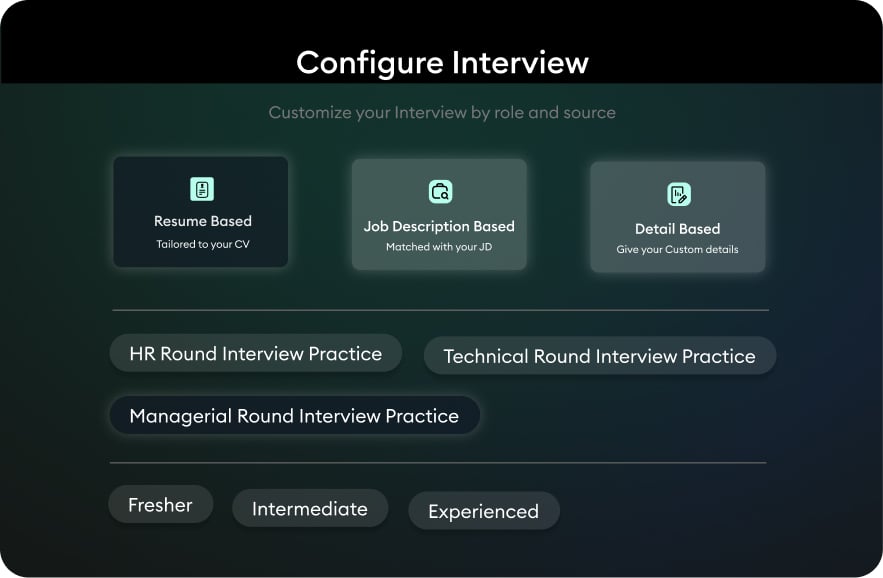
Prepare for data science interviews with AI-powered mock interviews covering Python, SQL, machine learning, statistics, case studies, and behavioral rounds. Get personalized feedback to improve your technical knowledge, communication, and interview confidence.
Real-Time AI Voice Interviews
Role-Specific Interview Questions
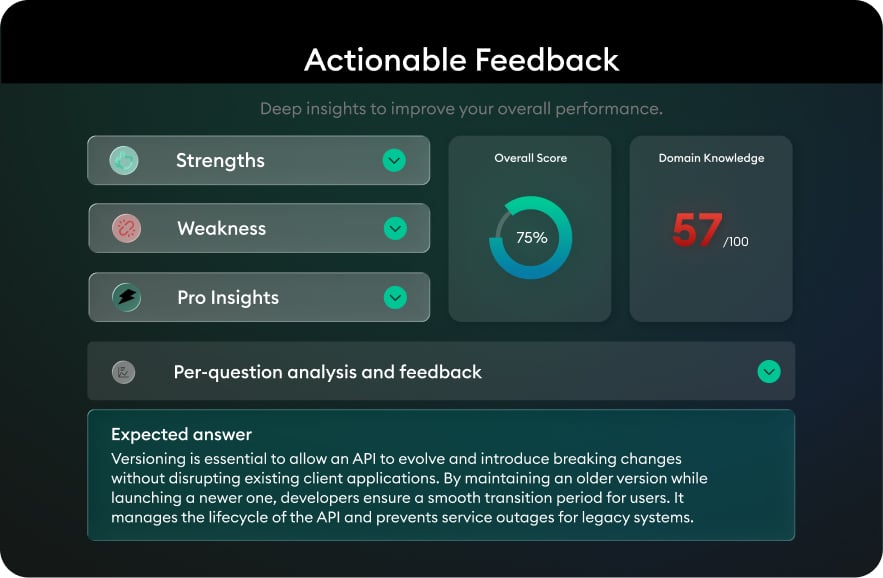
Question-by-Question AI Insights
Adaptive Follow-up Questions


4.8/5
• Loved by 10K+ Candidates
10,000+
Engineers Practicing
50,000+
Mock Interviews Done
85%
Interview Success Rate
4.8/5
Average Rating
Browse by Domain
1 / 4
Browse by Interview Type
1 / 2
Trusted by 10,000+ Job Seekers
Beat the ATS. Get More Interview Calls.
Upload your resume to receive an ATS score, keyword analysis, formatting checks and AI-powered recommendations that help you get shortlisted faster.
🔒 Your data is secure & confidential
92/100
ATS Score
PASSED ATS
Optimized for most
applicant tracking systems.
Alex Johnson
Software Engineer
alex@email.com
+91 9876543210
Bangalore
SUMMARY
Full Stack developer with experience building scalable React, Node.js and cloud-based applications.
EXPERIENCE
Software Engineer • Tech Corp
EDUCATION
B.Tech Computer Science

Frequently Asked Questions
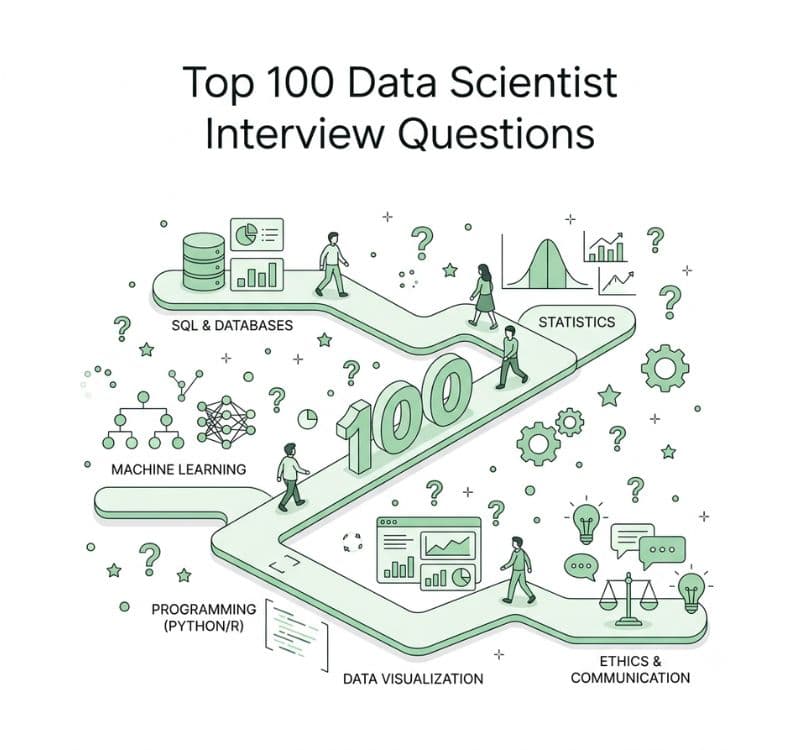
Data science interviews typically cover Python, SQL, machine learning, statistics, probability, data preprocessing, feature engineering, and model evaluation. Many companies also include business case studies and behavioral questions to assess how you solve real-world data problems and communicate insights.
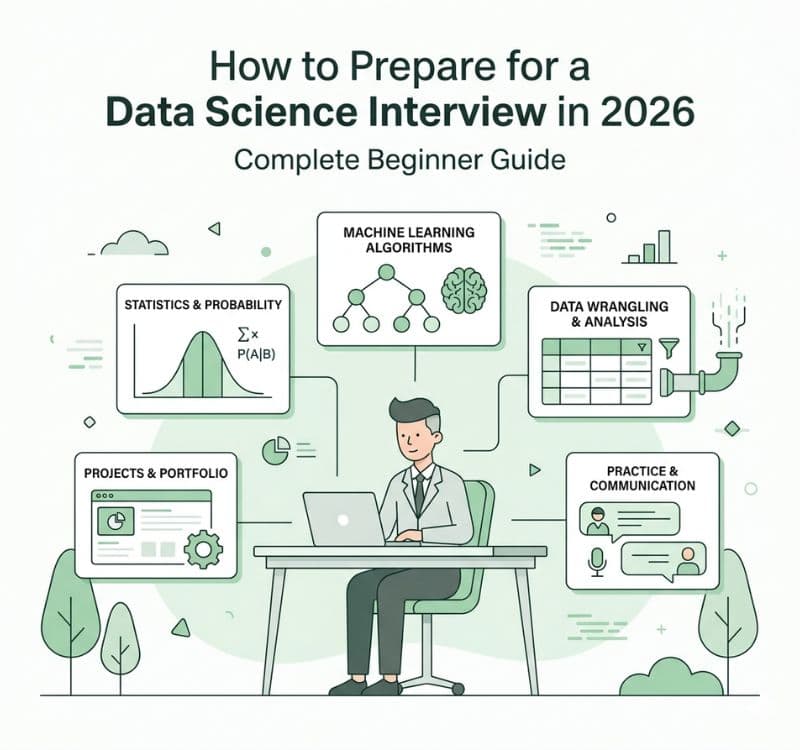
Focus on understanding algorithms instead of memorizing definitions. Be ready to explain when to use different models, how to evaluate them, prevent overfitting, handle imbalanced data, and improve model performance. Practicing AI mock interviews helps you explain these concepts clearly.
SQL is essential for extracting, cleaning, and analyzing data. Interviewers often test joins, aggregations, window functions, subqueries, and query optimization to evaluate your ability to work efficiently with large datasets in business environments.
Yes. Many employers use case studies to assess analytical thinking and business decision-making. You'll be expected to interpret datasets, identify meaningful insights, recommend solutions, and explain how data supports your conclusions rather than simply writing code.
Statistics forms the foundation of data science. Interviewers frequently ask about probability distributions, hypothesis testing, confidence intervals, regression, sampling, and statistical significance to evaluate whether you understand how models and experiments produce reliable insights.
Absolutely. Employers often ask candidates to explain project objectives, datasets, feature engineering decisions, model selection, evaluation metrics, deployment challenges, and business outcomes. Being able to clearly communicate your project experience demonstrates practical problem-solving skills.
AI mock interviews simulate realistic technical and behavioral conversations, helping you practice explaining machine learning concepts, analytical approaches, coding decisions, and project experiences. Instant AI feedback highlights areas to improve before your actual interview.
A data science interview emphasizes statistical analysis, experimentation, business insights, and predictive modeling, while machine learning engineer interviews place greater focus on software engineering, model deployment, scalability, APIs, and production-ready ML systems. Both require strong Python skills but evaluate different responsibilities.
Yes. Interviewers often care more about your thought process than the final model. Explain the business objective, data preprocessing, feature selection, model choice, evaluation metrics, limitations, and how your solution impacted the business or project goals.
You should understand metrics such as accuracy, precision, recall, F1-score, ROC-AUC, RMSE, MAE, and confusion matrices. Interviewers often ask why a particular metric is suitable for a specific machine learning problem rather than expecting definitions alone.
Absolutely. Data preprocessing is a critical part of data science. Be prepared to discuss handling missing values, feature scaling, categorical encoding, outlier detection, feature engineering, and preparing datasets before model training.
Instead of focusing only on algorithms, explain how your analysis improved decision-making, reduced costs, increased revenue, optimized operations, or solved customer problems. Employers value candidates who connect technical solutions with measurable business outcomes.