Loading...
Contents
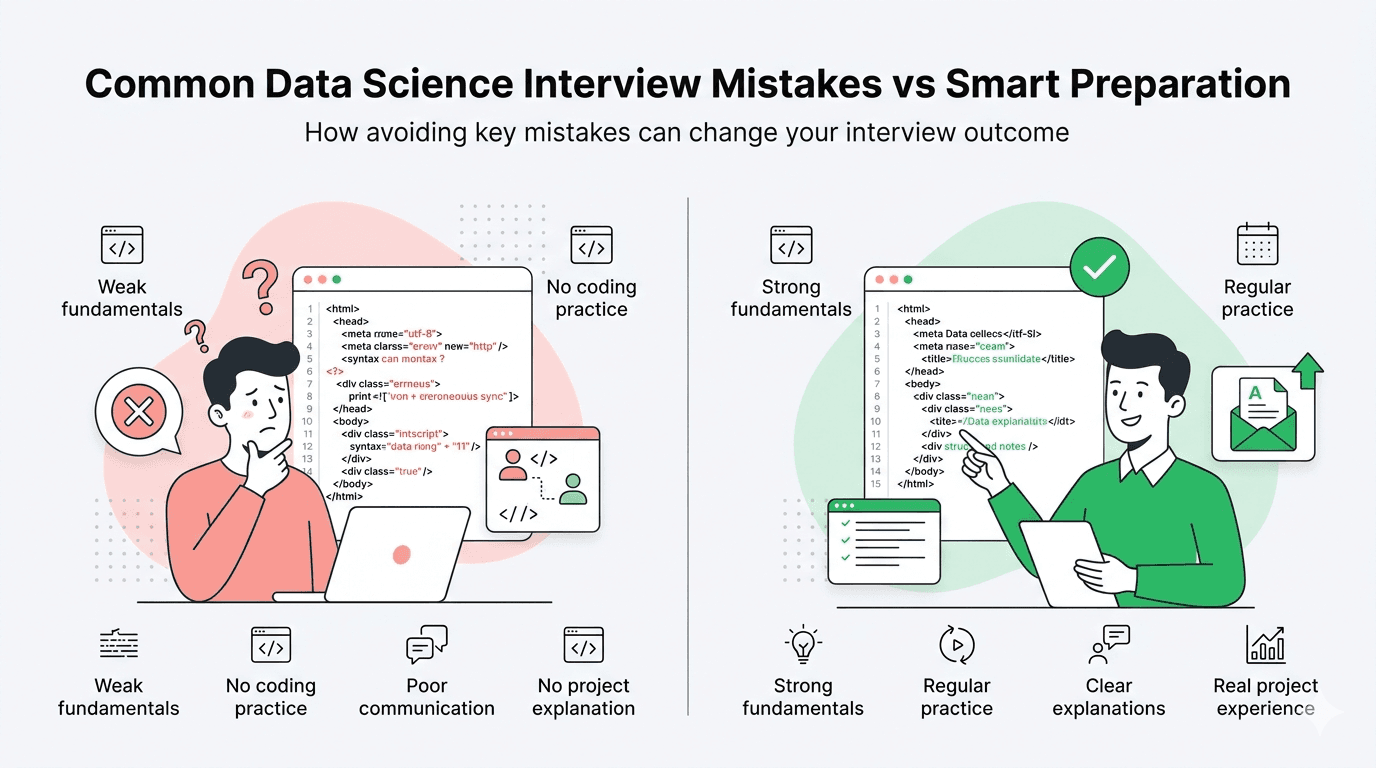
12 Common Mistakes to Avoid in Data Science Interview
(Complete Guide)
May 1, 202613 min readUpdated Oct 6, 2026
The most common data science interview mistakes include weak fundamentals, poor SQL and coding practice, unclear project explanations, memorizing instead of understanding, ignoring business context, and skipping mock interviews. Avoiding these, along with staying current on GenAI and deployment basics, significantly improves your chances of success.
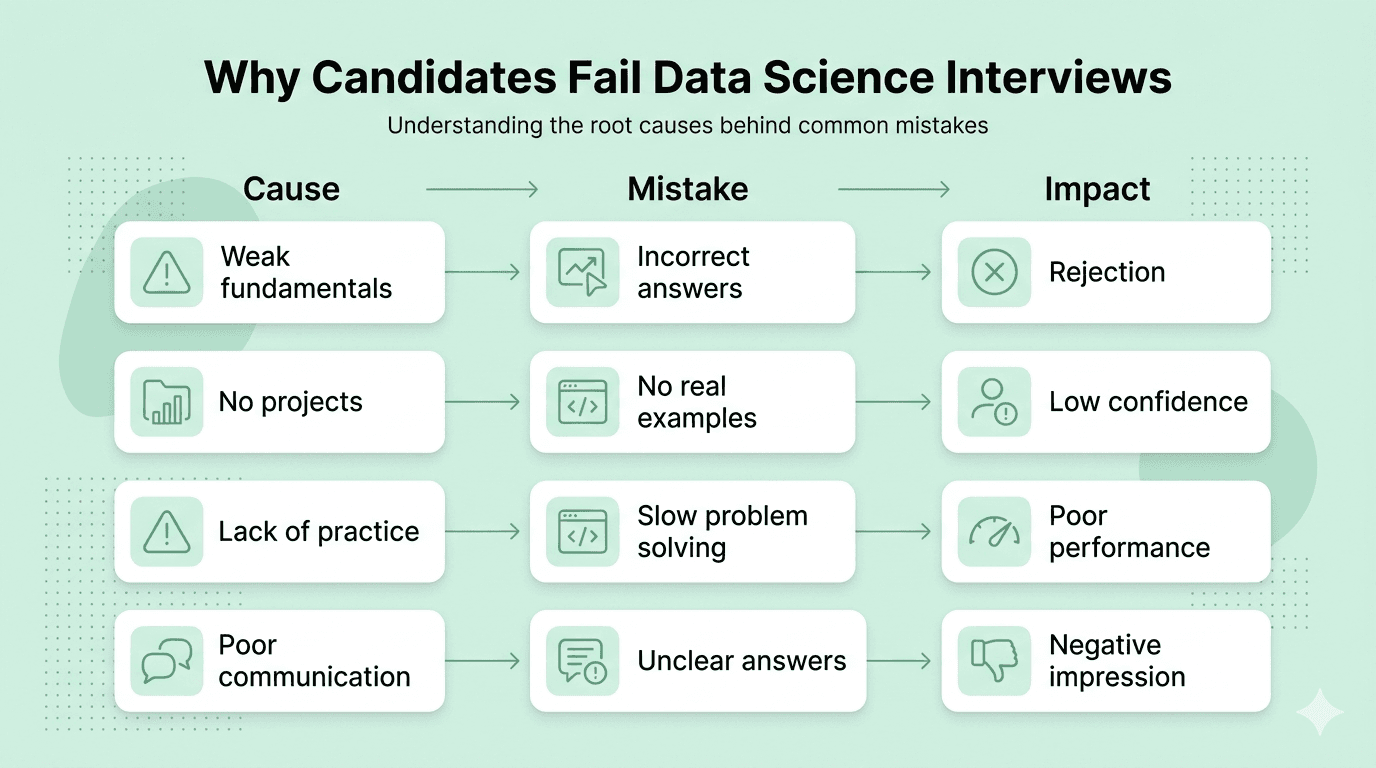
Data science is one of the most exciting and fast-growing career fields today. The demand for data scientists is huge in today's job market. However, getting a data science job is not always easy. The interview process can be challenging and competitive. Many candidates prepare for months but still fail in interviews. In most cases, it is not because they lack knowledge. Instead, they make small mistakes during the interview that reduce their chances of getting selected. In this guide, we will discuss 12 common mistakes to avoid in a data science interview and its solution.
FREE TO USE
25K+ INTERVIEWS4.8★ RATING68% IMPROVEMENT
Crack Your Dream Job
Real Interviews. Real Pressure. Practice until it feels easy.
- Seamless Interview Experience
- Resume & JD Questions
- Instant Personalized Feedback
Why Data Science Interviews Are Challenging
A data science interview usually tests multiple skills at the same time. Interviewers want to check whether you can analyze data, write code, and explain insights clearly. A typical data science interview may include: Technical questions on statistics and machine learning Coding questions in Python or SQL Case study questions Project discussions Behavioral questionsBecause the interview covers many areas, candidates sometimes make mistakes that affect their performance. Let’s look at the most common mistakes and how you can avoid them.
12 Common Mistakes to Avoid in Data Science Interview
1. Not Understanding the Basics
One of the biggest data science interview mistakes is ignoring the fundamentals.
Many candidates focus only on advanced topics like deep learning or complex algorithms. But interviewers often ask basic questions related to statistics, probability, linear regression, and data analysis concepts.
If your basics are weak, it becomes difficult to answer technical questions confidently.
Tip: Always revise fundamental concepts before your interview.
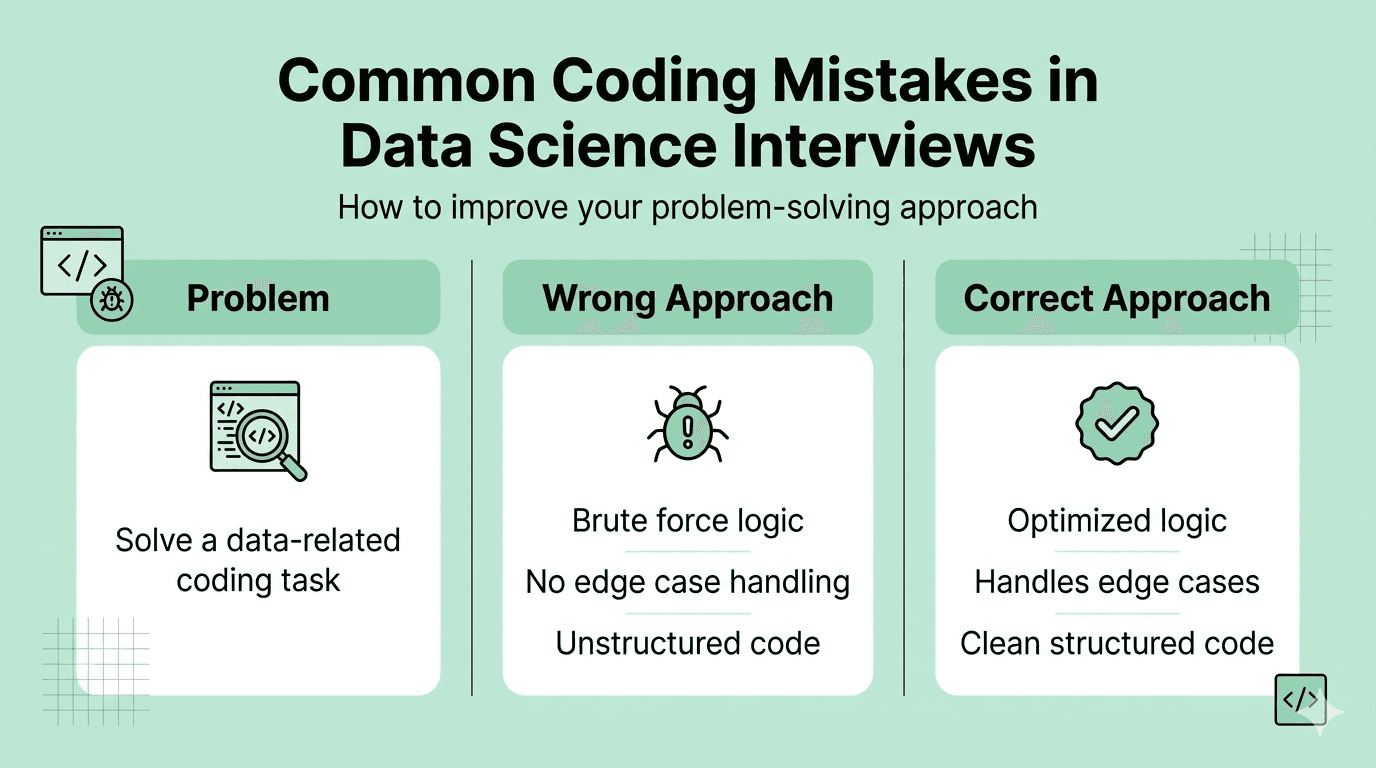
2. Weak Programming Skills
Programming is an important part of data science. Many interviews include coding questions to test your problem solving skills. Candidates often struggle because they do not practice coding regularly.
Common issues include difficulty writing Python code, not knowing common libraries, and taking too long to solve problems.
Tip: Practice coding regularly using datasets and small projects.
3. Ignoring SQL Practice
Many beginners underestimate the importance of SQL. However, SQL is one of the most frequently asked topics in data science interviews.
Interviewers may ask you to write queries to extract data, perform joins between tables, and filter and group data.
Candidates who ignore SQL practice often fail this section.
Tip: Practice writing SQL queries regularly and understand how databases work.
4. Not Explaining Projects Clearly
Projects are an important part of data science interview preparation. Interviewers often ask candidates to explain their previous projects.
Many candidates make mistakes such as not explaining the problem statement, not describing the dataset used, and not explaining the model and results.
This makes it difficult for the interviewer to understand your work.
Tip: Prepare a clear explanation of your projects. Focus on the problem, approach, and results.
5. Memorizing Instead of Understanding
Another common mistake in data science interviews is memorizing definitions without understanding concepts.
For example, candidates may memorize definitions of overfitting, bias vs variance, and cross validation. But when interviewers ask follow up questions, they struggle to explain the concept clearly.
Tip: Focus on understanding concepts instead of memorizing answers.
6. Ignoring Business Understanding
Data science is not only about algorithms. It is also about solving business problems.
Many candidates focus only on technical details and forget to explain how their work helps a business. Instead of only describing a machine learning model, you should also explain what problem it solves, how it improves decision making, and what value it provides.
Tip: Always connect your analysis to business impact.
7. Poor Data Visualization Knowledge
Data visualization is an important skill for data scientists. Interviewers sometimes ask candidates how they present data insights.
Many candidates struggle to explain which charts they would use, how dashboards work, and how they communicate insights to teams.
This shows a lack of practical data analysis experience.
Tip: Learn basic visualization tools and understand how to present data clearly.
8. Not Practicing Case Study Questions
Case study questions are common in data science interviews. These questions test your ability to solve real world problems.
For example, interviewers may ask how you would analyze customer churn, improve product recommendations, or measure marketing campaign performance.
Candidates who have never practiced case studies may feel confused during the interview.
Tip: Practice solving business problems using data analysis approaches.
Read More: Top 50 Data Science Interview Questions and Answers for 2026
9. Lack of Communication Skills
Even strong technical candidates sometimes fail interviews because they cannot explain their ideas clearly.
Interviewers want to understand your thinking process. If your explanation is confusing, they may think you do not fully understand the problem.
Good communication includes clear explanations, logical thinking, and simple language.
Tip: Practice explaining your solutions step by step.
10. Ignoring Mock Interviews
Many candidates prepare alone but never simulate real interviews.
Mock interviews help you practice answering questions, improve confidence, and manage interview pressure. Without practice, candidates often feel nervous during real interviews.
Tip: Practice with friends, mentors, or a structured tool like Mocklingo's data science mock interview, which simulates real interview pressure and gives you feedback on your answers.
11. Not Researching the Company
Another common data science interview mistake is not learning about the company before the interview.
Interviewers may ask questions such as why you want to work there, what you know about their product, and how data science could help their company.
Candidates who cannot answer these questions appear unprepared.
Tip: Always research the company's products, services, and industry before the interview.
12. No Portfolio or Real Projects
Many candidates study theory but do not build real projects. In data science interviews, employers want to see practical work. Projects help demonstrate your skills.
Examples of useful projects include customer churn prediction, sales forecasting models, recommendation systems, and data analysis dashboards.
A strong portfolio can make a big difference during interviews.
Tip: Create at least three to four data science projects and showcase them on GitHub.
Missed Points: Ignoring GenAI and Deployment Awareness
In 2026, this is becoming one of the more common gaps interviewers notice. Many candidates prepare deeply on traditional statistics and machine learning but have no answer when asked about generative AI or what happens to a model after it is trained.
You do not need to be an expert, but you should be able to explain basic ideas like embeddings, how a model moves from a notebook into a deployed API, and where GenAI tools fit into a modern data science workflow. Skipping this makes your knowledge look dated even if your fundamentals are strong.
Tip: Spend at least a little prep time on GenAI basics and how models get deployed, not just on how they get trained.
How to Prepare for a Data Science Interview
Now that you know the common mistakes in data science interviews, let's look at how you can prepare effectively.
1. Strengthen Your Fundamentals
Review statistics, probability, and machine learning basics.
2. Practice Coding
Improve your Python and SQL skills through regular coding practice.
3. Work on Real Projects
Projects help you gain practical experience and build confidence.
4. Practice Case Studies
Learn how to approach real world data problems logically.
5. Do Mock Interviews
Practice interviews help you improve communication and confidence. You can practice with friends, mentors, or online platforms.
Tools like Mocklingo are especially helpful because they simulate real interview scenarios and provide feedback on your responses. You can even practice based on your resume by choosing a resume based interview.
Following these steps will greatly improve your chances of success.
Read here in detail: "How to Prepare for a Data Science Interview in 2026"
Tips to Stand Out in a Data Science Interview
Avoiding mistakes is important, but standing out from other candidates is even more important.
Here are a few tips that can help you perform better than other candidates.
Tell a Data Story
When explaining projects, focus on the story behind the data.
Explain Your Thought Process
Interviewers care more about how you think than just the final answer.
Ask Smart Questions
At the end of the interview, ask thoughtful questions about the company's data challenges.
Show Curiosity
Demonstrate your interest in learning new tools and technologies, including how GenAI is changing the field.
These small steps can help you leave a positive impression on interviewers.
FREE TO USE
8k+ SESSIONS92% FLUENCY4.9★ RATING
Speak With Confidence
Real Conversations. Real Scenarios. Speak until it feels natural.
- Real-Time Speaking Practice
- Guided Conversation Flows
- Instant AI Feedback
Conclusion
Data science interviews can be challenging, but proper preparation can make a big difference. Many candidates fail interviews not because they lack knowledge, but because they make avoidable mistakes. By focusing on strong fundamentals, practicing coding, building real projects, and improving communication skills, you can significantly improve your data science interview preparation. With consistent practice and the right preparation strategy, you can confidently approach your next data science interview and increase your chances of success.