Loading...
Contents
Top Skills Recruiters Look for in React Developers in 2026
Sep 30, 202620 min readUpdated Oct 3, 2026
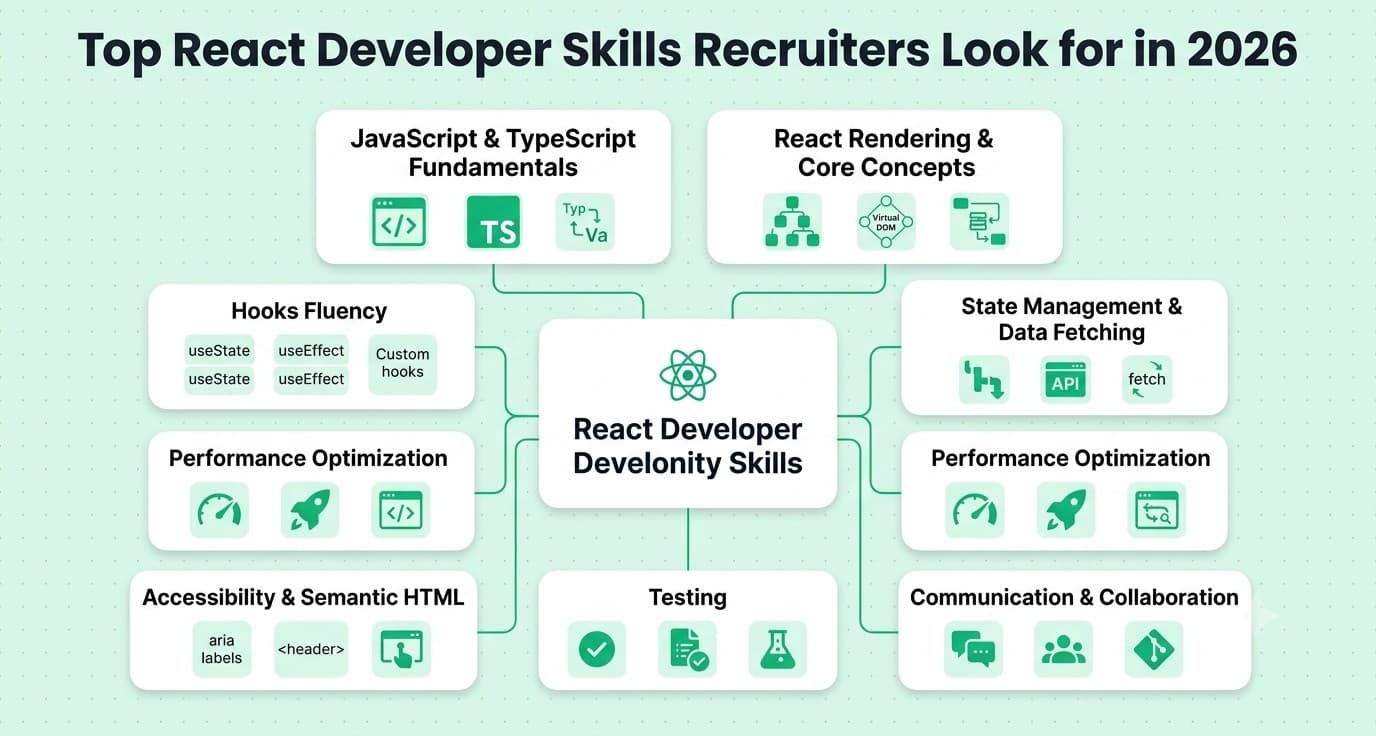
In 2026, recruiters hiring React developers look for eight core skills: strong JavaScript and TypeScript fundamentals, a real understanding of how React renders, hooks fluency, smart state management, performance awareness, accessibility, testing habits, and clear communication. The candidates who get offers are the ones who can explain why they made a decision, not just show that a component works.
If you are applying for React roles this year, the job description probably reads like a long list of tools. Recruiters read it differently. They are trying to predict one thing: will this person build interfaces that stay fast, accessible, and easy for a team to maintain? This guide breaks down the skills that answer that question, ranked by how often they decide a hiring outcome.
FREE TO USE
25K+ INTERVIEWS4.8★ RATING68% IMPROVEMENT
Crack Your Dream Job
Real Interviews. Real Pressure. Practice until it feels easy.
- Seamless Interview Experience
- Resume & JD Questions
- Instant Personalized Feedback
What Skills Do Recruiters Look for in a React Developer?
Recruiters look for skills in roughly this order of importance:
JavaScript and TypeScript fundamentals
React core concepts and rendering behavior
Hooks fluency
State management and data fetching
Performance optimization
Accessibility and semantic HTML
Testing
Communication and collaboration
The order matters. A candidate with strong fundamentals and average tooling knowledge beats a candidate who knows five libraries but cannot explain a closure. Tools change every year. Fundamentals do not.
Why Are JavaScript and TypeScript Fundamentals the First Filter?
Almost every React interview starts with plain JavaScript, often before React is mentioned at all. Recruiters know that React problems are usually JavaScript problems in disguise. A stale value inside an effect is a closure issue. A state update that does not appear immediately is an asynchronous behavior issue.
What recruiters expect you to know:
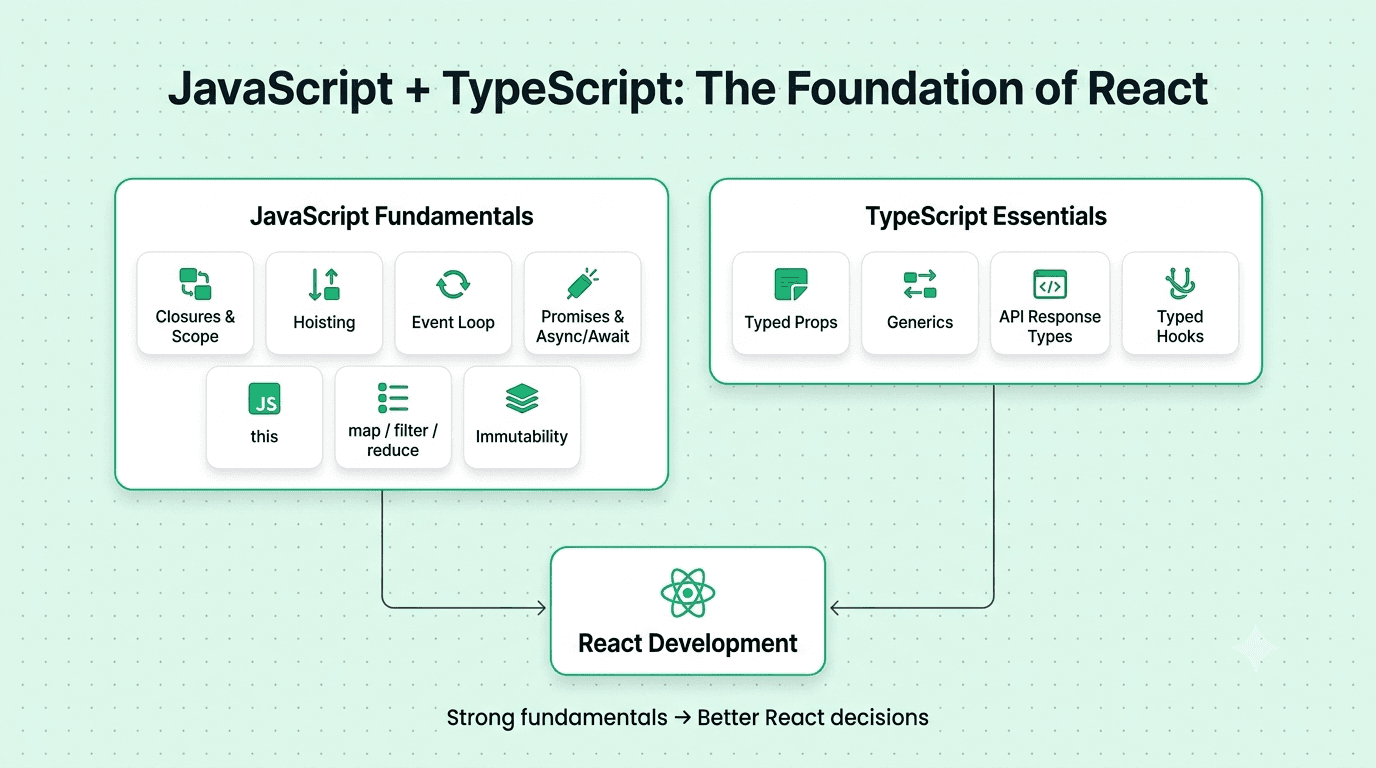
Closures, scope, and hoisting
How the event loop, promises, and async and await work
How this behaves and why arrow functions change it
Array methods like map, filter, and reduce, used fluently
Destructuring, spread, and immutability patterns
Reading and writing TypeScript: typed props, generics, and API response types
TypeScript has moved from a bonus to a baseline. Even when a job post only says JavaScript, many teams expect you to type your props and hooks without hesitation.
How to show it: Put TypeScript in your project descriptions with a concrete detail, such as "typed all API responses and component props, catching a class of bugs before runtime."
Do Recruiters Really Care How React Renders?
Yes, and this is the skill that separates mid level candidates from beginners. Anyone can build a component. Fewer people can explain why it re-rendered.
What recruiters expect you to know:
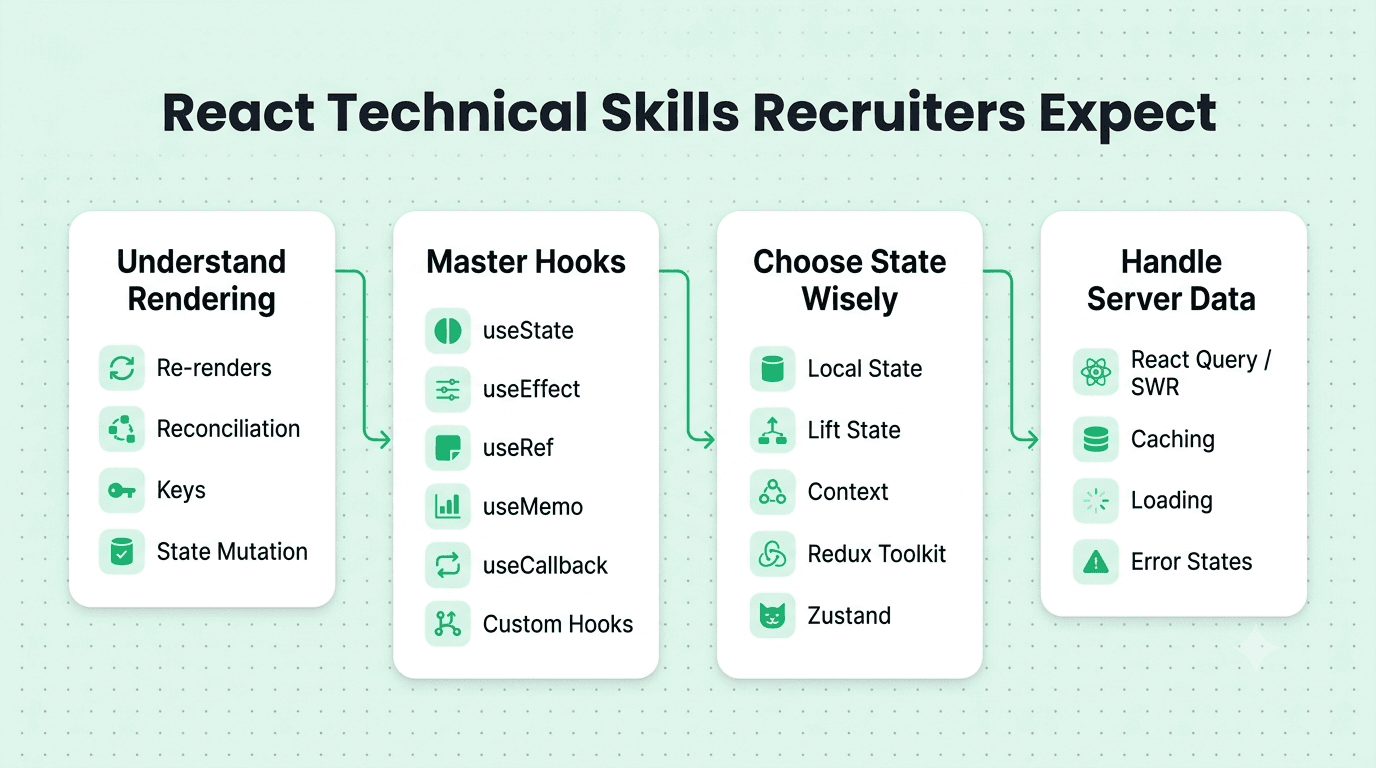
What triggers a re-render: state changes, prop changes, and parent renders
How the virtual DOM and reconciliation decide what updates
Why keys matter in lists and why array indexes are risky keys
The difference between controlled and uncontrolled inputs
Why mutating state directly causes bugs
A quick test interviewers use: "A child component re-renders every time the parent updates, even though its props did not change. Why, and what would you do?" A strong answer explains the default behavior first, then discusses memoization only if it is measurably needed.
How Fluent Should You Be With React Hooks?
Very fluent. Hooks are the center of nearly every React interview conversation.
Must know:
useState and how updates are batched
useEffect, including dependency arrays and cleanup functions
useRef for values that should not trigger a render
useMemo and useCallback, and when they actually help
Writing custom hooks to extract reusable logic
The mistake recruiters notice most: candidates who add useMemo and useCallback everywhere. It signals memorized advice rather than understanding. Explain that you measure first and optimize second.
Skills that stand out in 2026: familiarity with concurrent features like transitions and Suspense, and awareness of how React Server Components change where code runs.
FREE TO USE
8k+ SESSIONS92% FLUENCY4.9★ RATING
Speak With Confidence
Real Conversations. Real Scenarios. Speak until it feels natural.
- Real-Time Speaking Practice
- Guided Conversation Flows
- Instant AI Feedback
What State Management and Data Fetching Skills Are Expected?
Recruiters want to see that you choose the simplest tool that fits the problem.
The hierarchy of decisions:
Keep state local whenever possible.
Lift state up when a few components share it.
Use Context for low frequency, app wide values like theme or auth.
Reach for Redux Toolkit or Zustand when state is complex and shared widely.
Use a data fetching library such as React Query or SWR for server state, instead of hand written effects.
The last point is a big shift. Many teams now treat server data and client state as separate problems, and interviewers ask when you would use each. A candidate who explains this clearly signals real project experience.
Why Does Performance Awareness Matter So Much?
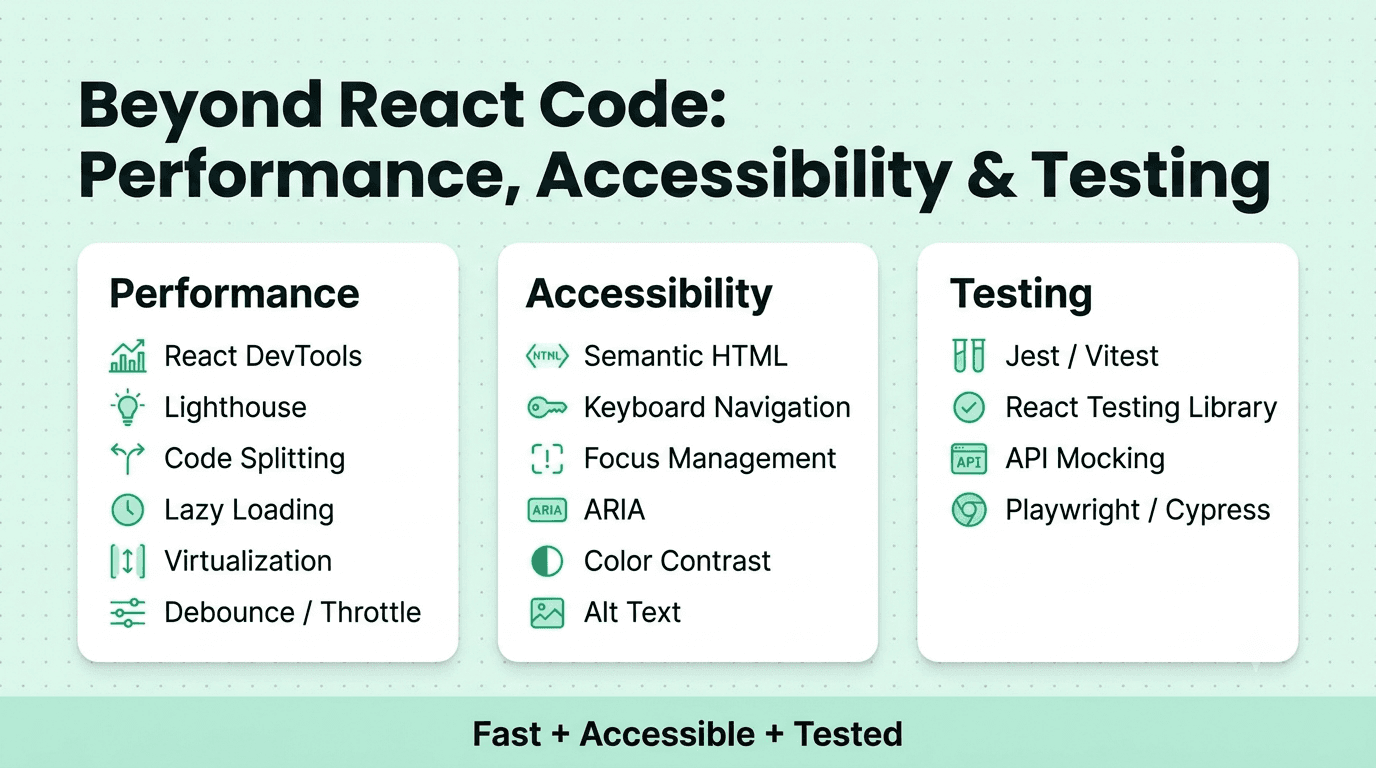
Performance directly affects revenue, so companies treat it as a core skill rather than a specialty. Google's Core Web Vitals are part of everyday vocabulary now.
What recruiters expect you to know:
How to profile with React DevTools and Lighthouse
Code splitting and lazy loading with React.lazy and Suspense
List virtualization for long lists
Debouncing and throttling for expensive handlers
Reading a bundle analysis and spotting oversized dependencies
The difference between client side rendering, server side rendering, and static generation
How to show it: Give a number. "Cut initial bundle size by 35 percent through route based code splitting" is more persuasive than any skill keyword.
Is Accessibility Really Tested in React Interviews?
More than ever. Accessibility used to be treated as optional. Now it appears in technical rounds and sometimes in live coding tasks.
What recruiters expect you to know:
Semantic HTML: using button for buttons, not clickable divs
Keyboard navigation and visible focus states
Basic ARIA roles and labels, and when not to use ARIA
Managing focus in modals and dropdowns
Sufficient color contrast and alt text
A simple way to stand out: mention keyboard support unprompted while building a component in a live round. Interviewers remember it.
What Testing Skills Do React Recruiters Expect?
You do not need to be a testing specialist, but you should not treat tests as someone else's job.
Must know:
Unit and component tests with Jest or Vitest
React Testing Library, and its philosophy of testing behavior rather than implementation details
Mocking API calls
Awareness of end to end tools like Playwright or Cypress
Recruiters often ask, "How do you decide what to test?" The best answers focus on user visible behavior and critical paths, not chasing coverage numbers.
How Important Are Communication and Collaboration Skills?
Extremely, and this is the skill candidates prepare for least. React developers work daily with designers, product managers, and backend engineers. Recruiters look for people who can explain trade offs, push back politely on impossible scope, and give clear updates.
What hiring managers listen for:
Do you think out loud during a coding round?
Do you ask clarifying questions before building?
Can you explain a technical decision to a non technical person?
Do you take feedback without getting defensive?
This matters even more for candidates interviewing in English as a second language. A strong answer that is hard to follow loses to a slightly weaker answer that is delivered clearly. Rehearsing out loud with realistic follow up questions on Mocklingo's AI mock interview tool is one of the fastest ways to fix this, and Mocklingo's English communication practice helps you sound clear and calm while explaining technical ideas.
Which Skills Matter Most at Each Experience Level?
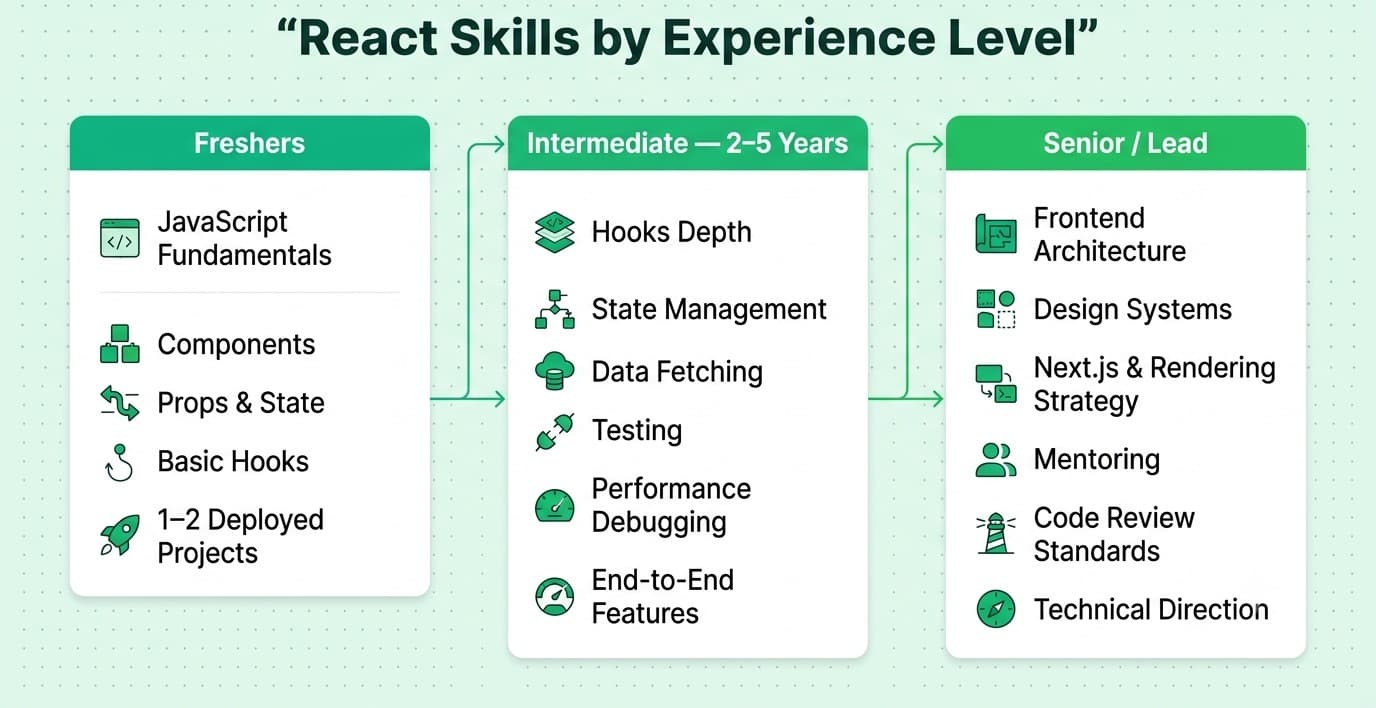
Freshers: JavaScript fundamentals, components, props, state, basic hooks, and one or two deployed projects.
Intermediate (two to five years): Hooks depth, state management choices, data fetching, testing, performance debugging, and the ability to build a feature end to end.
Senior and lead: Frontend architecture, design systems, rendering strategy with frameworks like Next.js, mentoring, code review standards, and influencing technical direction.
How Can You Prove These Skills on Your Resume and Portfolio?
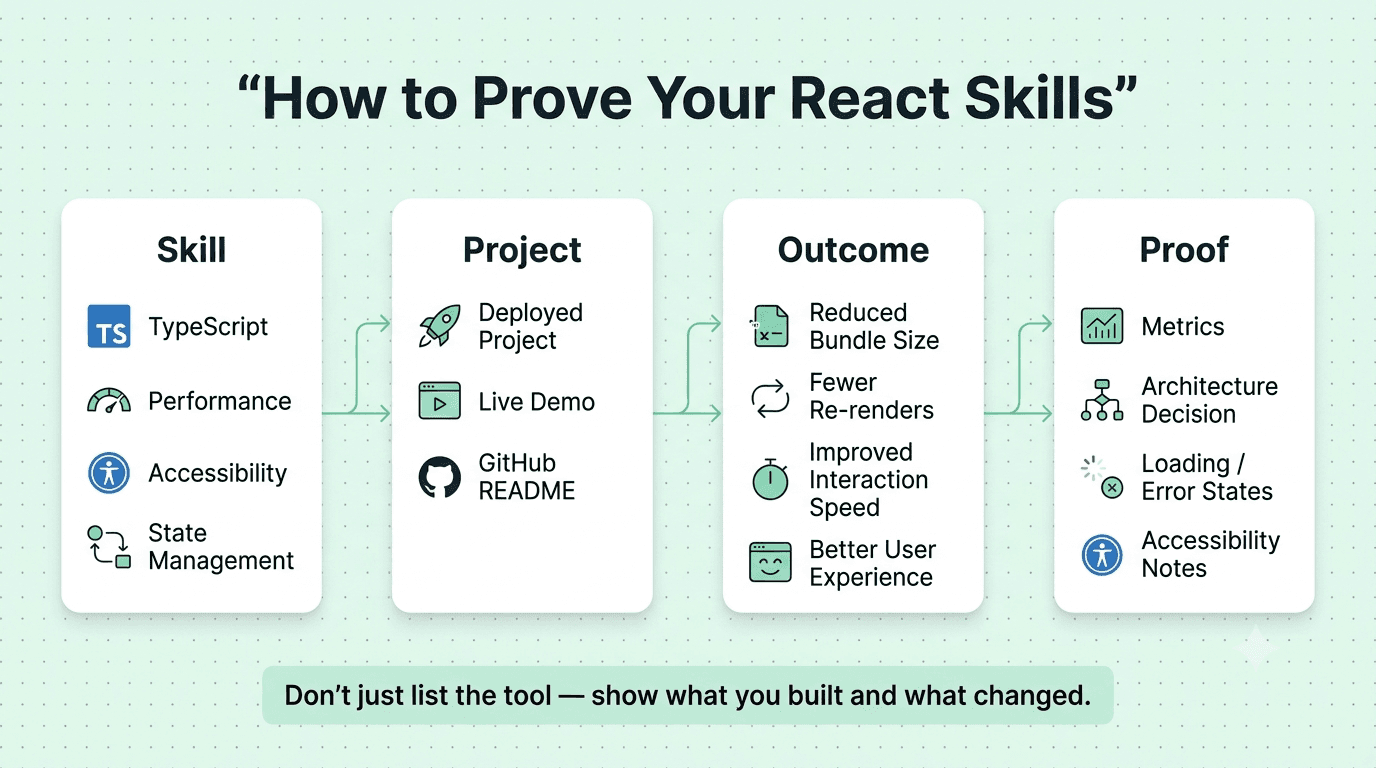
Recruiters skim. Make each skill easy to verify.
Write bullets that combine a skill with an outcome: "Reduced re-renders on the product page by memoizing list items, improving interaction speed by 30 percent."
Deploy your projects and link the live demos.
Write a clear README explaining your state management choice and why.
Show at least one project with loading, empty, and error states handled properly.
Add a short note on accessibility decisions in a project description.
Want to practice explaining these skills out loud before your next interview? Mocklingo offers AI powered mock interviews and English communication coaching built for exactly this kind of preparation.
FAQs
More Blogs
Sep 30, 2026
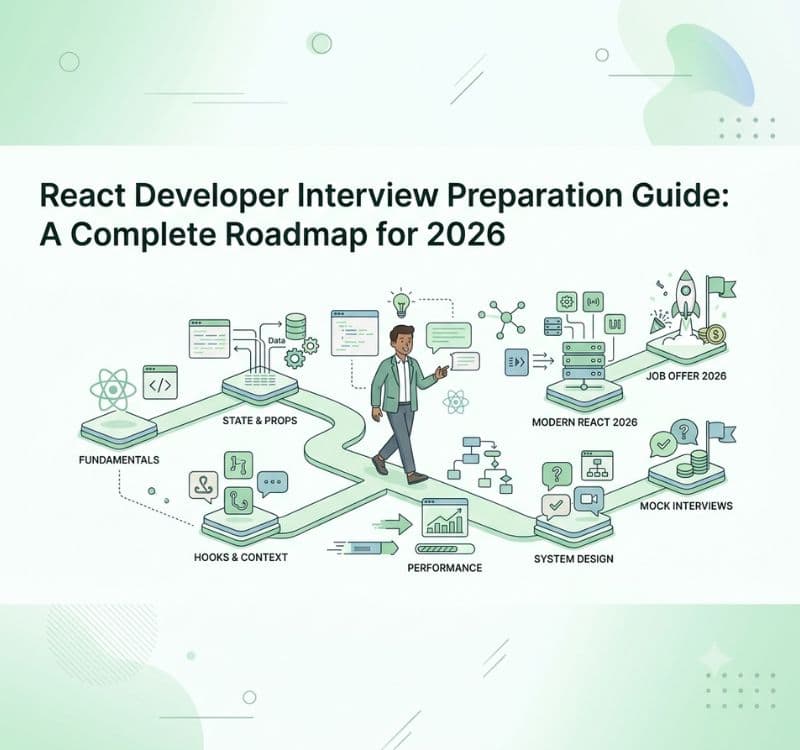
React Developer Interview Preparation Guide: A Complete Roadmap for 2026
31 min read