Loading...
Contents
UI/UX Designer Interview Preparation Guide: A Complete Roadmap for 2026
Oct 22, 202638 min readUpdated Oct 24, 2026
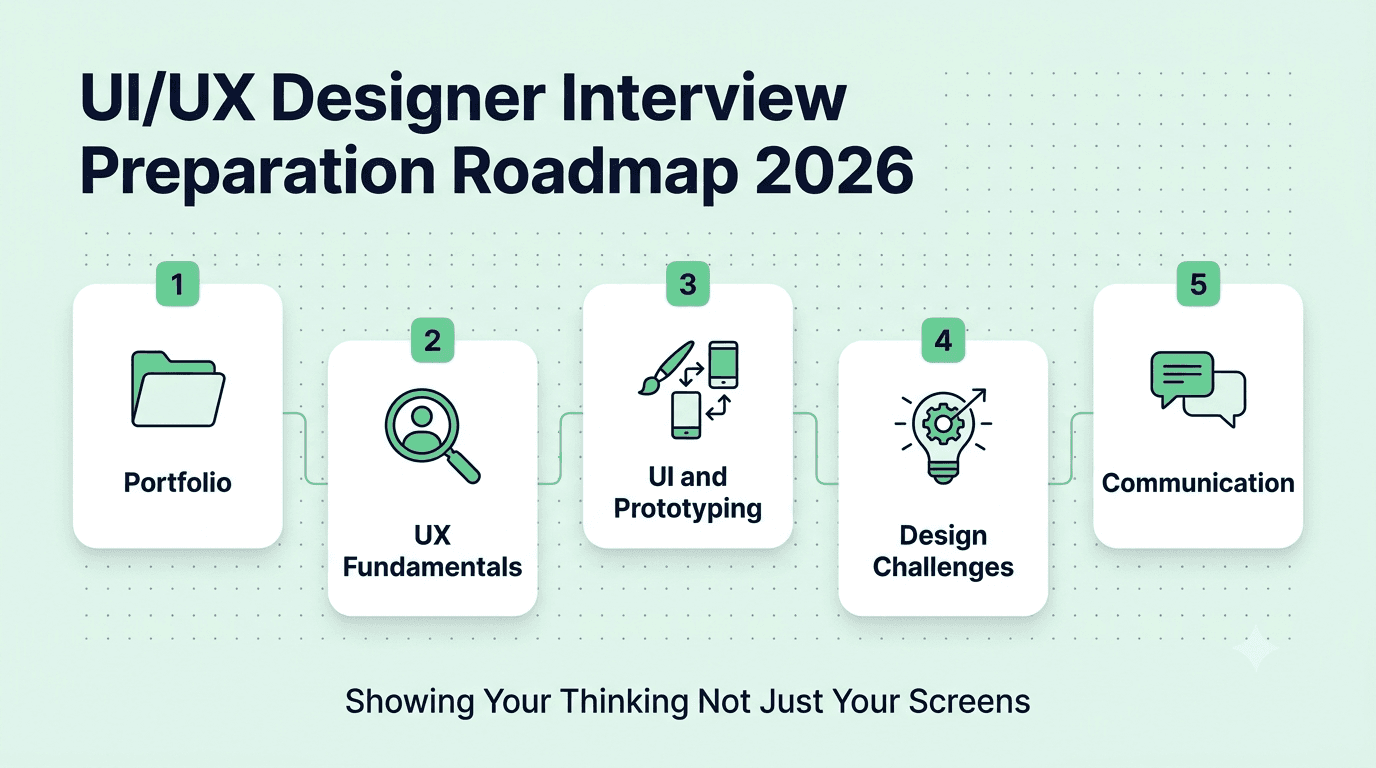
To prepare for a UI/UX designer interview, focus on five pillars: a portfolio of two to four case studies that show your thinking and results, solid UX fundamentals like research and user flows, strong visual and prototyping skills in Figma, a repeatable method for design challenges, and clear spoken communication for presenting your work. Most interview loops include a portfolio screen, a recruiter call, a portfolio presentation, a design challenge or whiteboard exercise, and a final round with the hiring manager or cross functional partners. Designers who can explain why they made a decision, and what result it created, consistently beat designers who only show beautiful screens.
If you are preparing for a UI/UX design interview, you already know it feels different from most other interviews. Your portfolio, your presentation, your live thinking, and your personality are all judged at once. Companies want designers who understand users, solve real business problems, and work well with engineers and product managers. This guide covers everything you need, whether you are a fresher applying for a first role or an experienced designer aiming for a senior or lead position.
FREE TO USE
25K+ INTERVIEWS4.8★ RATING68% IMPROVEMENT
Crack Your Dream Job
Real Interviews. Real Pressure. Practice until it feels easy.
- Seamless Interview Experience
- Resume & JD Questions
- Instant Personalized Feedback
Section 1: Introduction to the UI/UX Designer Interview Process
A design interview tests four things together: your craft, your process, your communication, and your ability to collaborate. A designer who makes stunning visuals but cannot explain the reasoning will struggle just as much as someone with great ideas but a rough portfolio.
Most processes run three to five rounds over two to five weeks. Larger companies usually include a recruiter screen, a portfolio presentation with the design team, a live or take home design challenge, and conversations with product and engineering partners. Startups often compress this into fewer, broader conversations, sometimes with a short paid or unpaid design task based on a real problem.
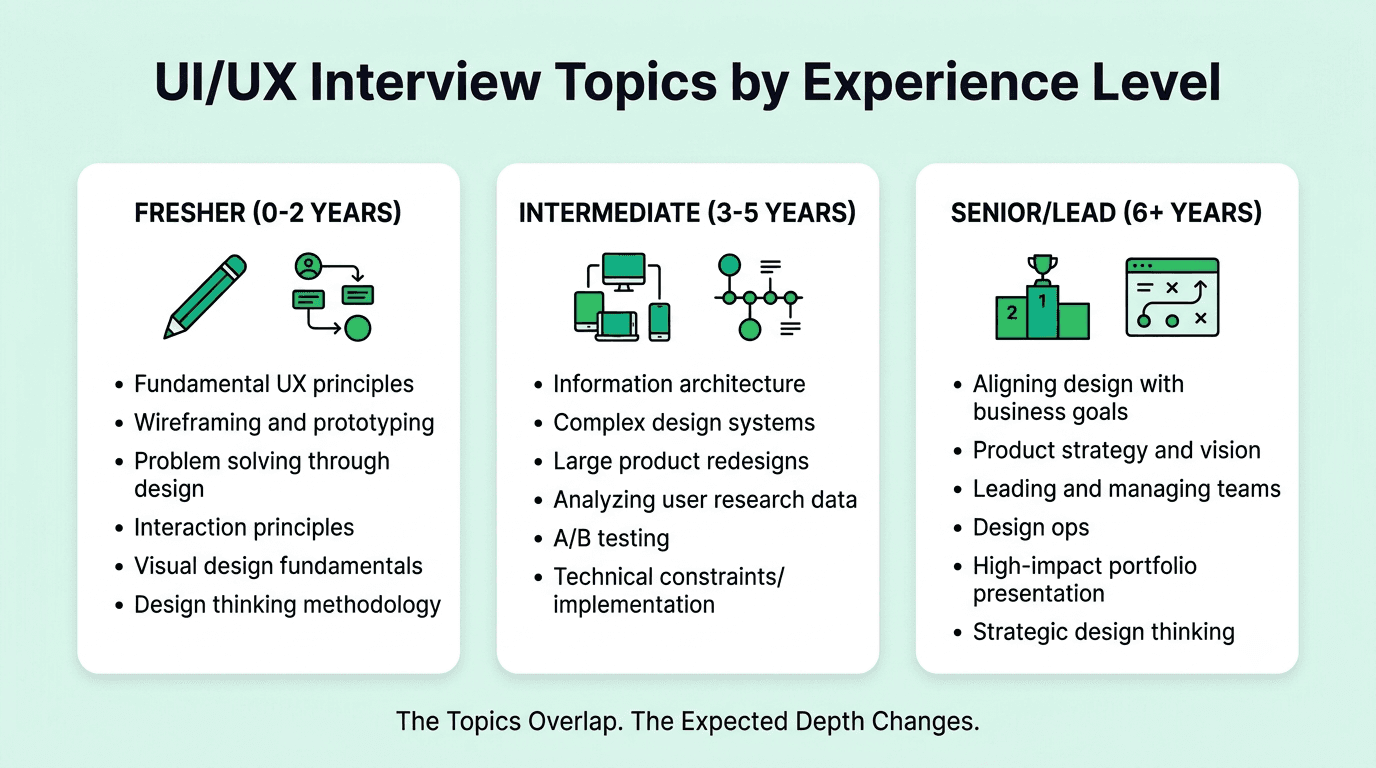
What changes with experience is depth and scope, not the topics themselves.
Freshers are tested on design fundamentals, Figma skills, and the ability to walk through a project clearly.
Intermediate designers (two to five years) are expected to own a feature from discovery to launch, use research and data, and defend their decisions.
Experienced designers are evaluated on product strategy, stakeholder management, design systems, mentoring, and the business impact of their work.
Section 2: What Recruiters and Hiring Managers Look For
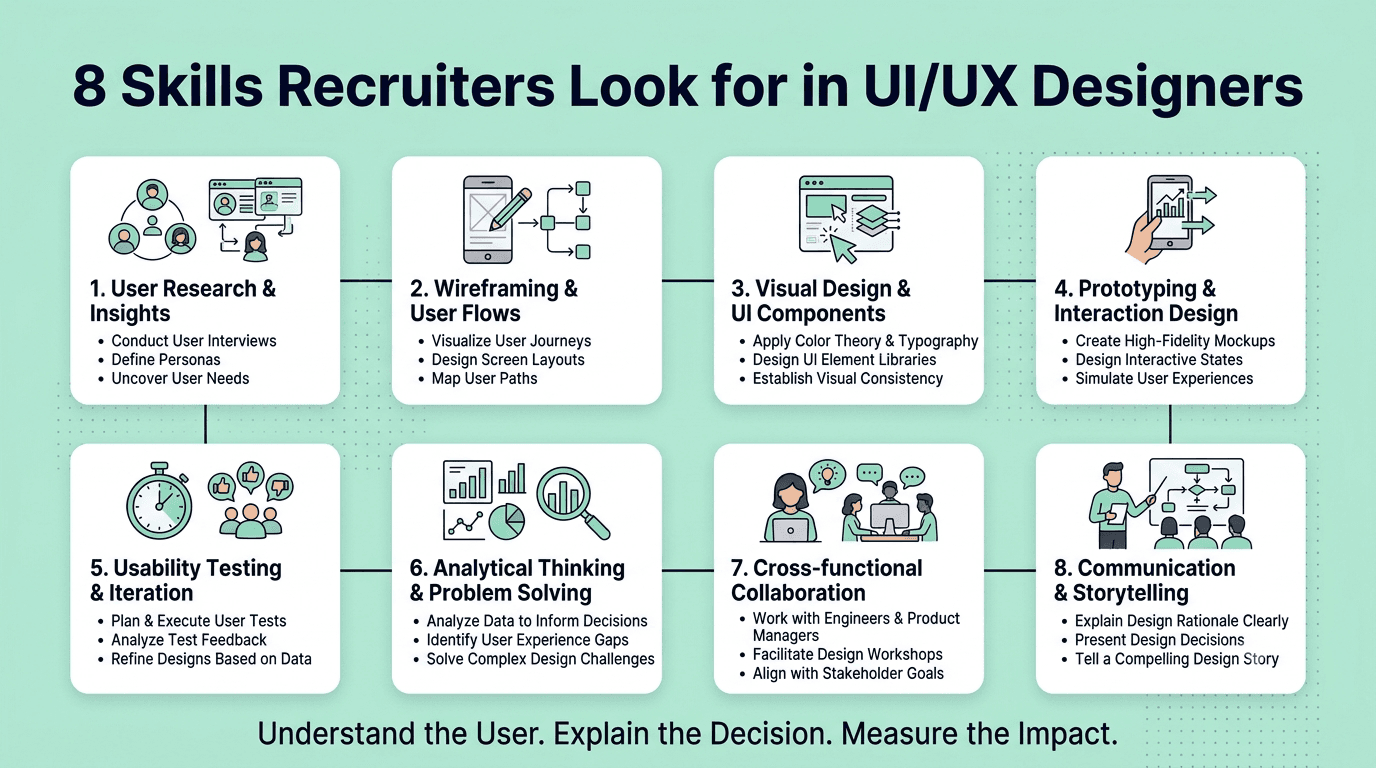
Recruiters and design leaders want to know whether you can solve the right problem, create a clear and usable solution, and work smoothly with the people who build and ship the product.
Core skills recruiters expect:
Problem framing and UX thinking. Turning a vague request into a clear problem with a measurable goal.
User research and testing. Interviews, surveys, usability testing, and reading analytics to find real issues.
Information architecture and user flows. Organizing content and mapping journeys, including errors and edge cases.
Wireframing and prototyping. Exploring ideas quickly and testing them before development begins.
Visual design fundamentals. Typography, color, spacing, hierarchy, and consistency.
Tools and systems. Strong Figma skills and a working understanding of design systems.
Accessibility. Designing for different abilities, devices, and situations.
Communication and collaboration. Presenting your thinking clearly, handling critique, and working with developers and product managers.
Hiring managers also watch for quieter signals. Do you ask good questions before designing? Do you stay calm when your decisions are challenged? Do you give credit to your team and admit what did not work?
Section 3: Resume and Portfolio Preparation
For designers, the portfolio is the first interview. Recruiters often spend only a couple of minutes on it before deciding whether to move you forward, so every project should be easy to scan and easy to understand.
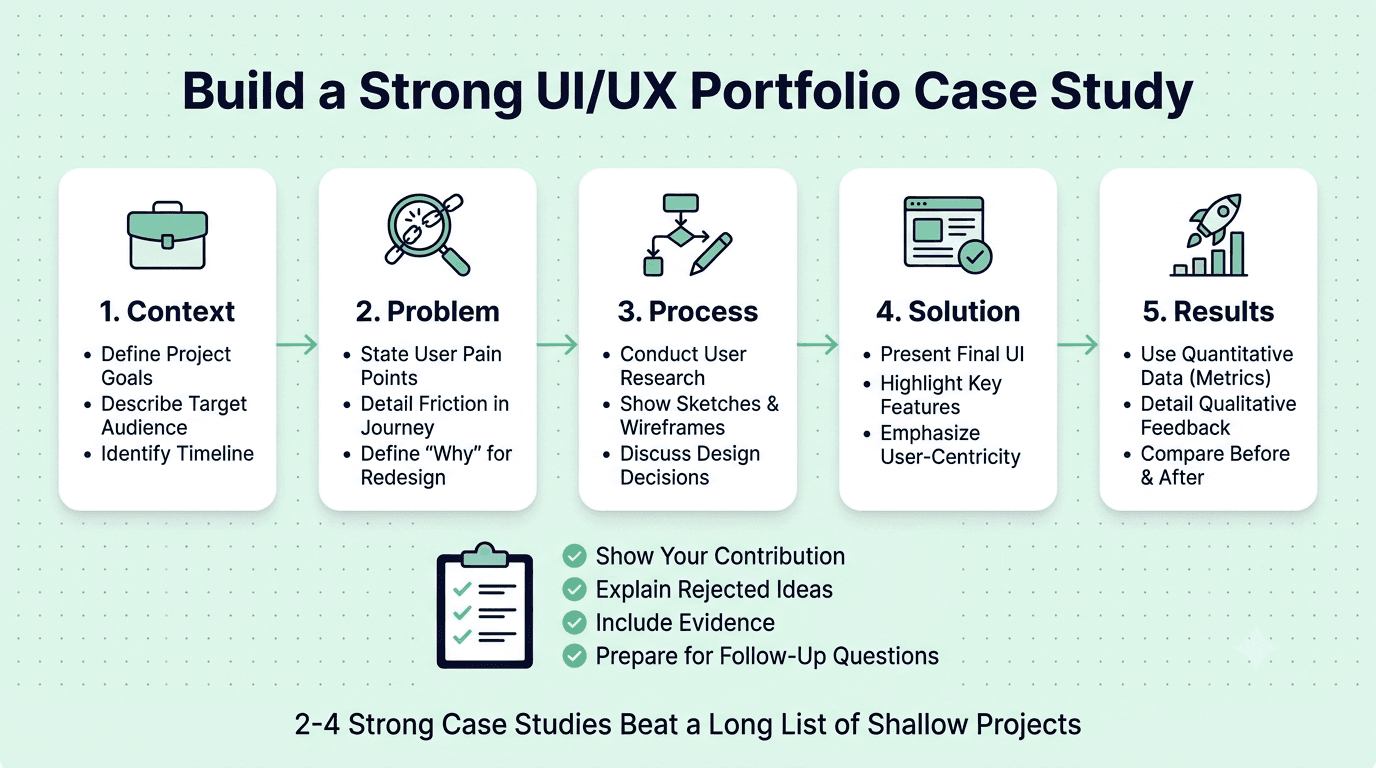
Choose two to four strong case studies. Depth beats quantity. Pick projects that show different strengths, such as research, interaction design, and systems thinking.
Start each case study with the problem. State the goal, your role, the team, and the timeline before any visuals.
Show your process honestly. Include rough sketches, early ideas, rejected options, and what you learned from testing.
Include results. Use measurable outcomes where you honestly can, like improved task completion or fewer support tickets. If you do not have numbers, share what testing revealed.
Be clear about your role. Say what you personally did, especially on team projects.
Keep it clean and mobile friendly. Your portfolio is also a sample of your design skill, so make navigation simple and loading fast.
Write a short resume. One page, with outcomes in each bullet, such as "Redesigned the onboarding flow, increasing completion by 18 percent."
Avoid portfolios that show only final screens with no explanation, or that include a long list of shallow projects.
Section 4: Core Topics to Study, Ranked by Interview Importance
Fundamental Concepts (asked in almost every interview)
The design process: understand, define, ideate, prototype, test
User centered design and how it differs from personal preference
Visual hierarchy, typography, color, contrast, and spacing
Basic usability principles, such as consistency, feedback, and error prevention
Wireframes versus mockups versus prototypes
Responsive design and designing for mobile first
Basic Figma skills: frames, components, auto layout, and prototyping
Intermediate Concepts (common at two to five years experience)
Planning and running user research, including interviews and usability tests
Creating personas, journey maps, and user flows that actually help decisions
Information architecture, navigation patterns, and content structure
Interaction design and microinteractions
Design systems: components, tokens, and documentation
Accessibility basics and WCAG guidelines
Using data and analytics to find and prioritize problems
Working with developers on feasibility and handoff
Advanced Concepts (senior and lead roles)
Product strategy and aligning design work with business goals
Measuring design impact through metrics and experiments
Building and governing a design system across teams
Leading design critiques and giving constructive feedback
Managing stakeholders and influencing product direction
Designing for complex products, such as dashboards, enterprise tools, or multi step workflows
Mentoring other designers and shaping the design culture
Ethical design and avoiding manipulative patterns
Case Study Preparation
Your case studies are your main evidence, so prepare each one as a short talk of five to seven minutes.
Context: What was the product, who were the users, and what was your role?
Problem: What was wrong, and how did you know?
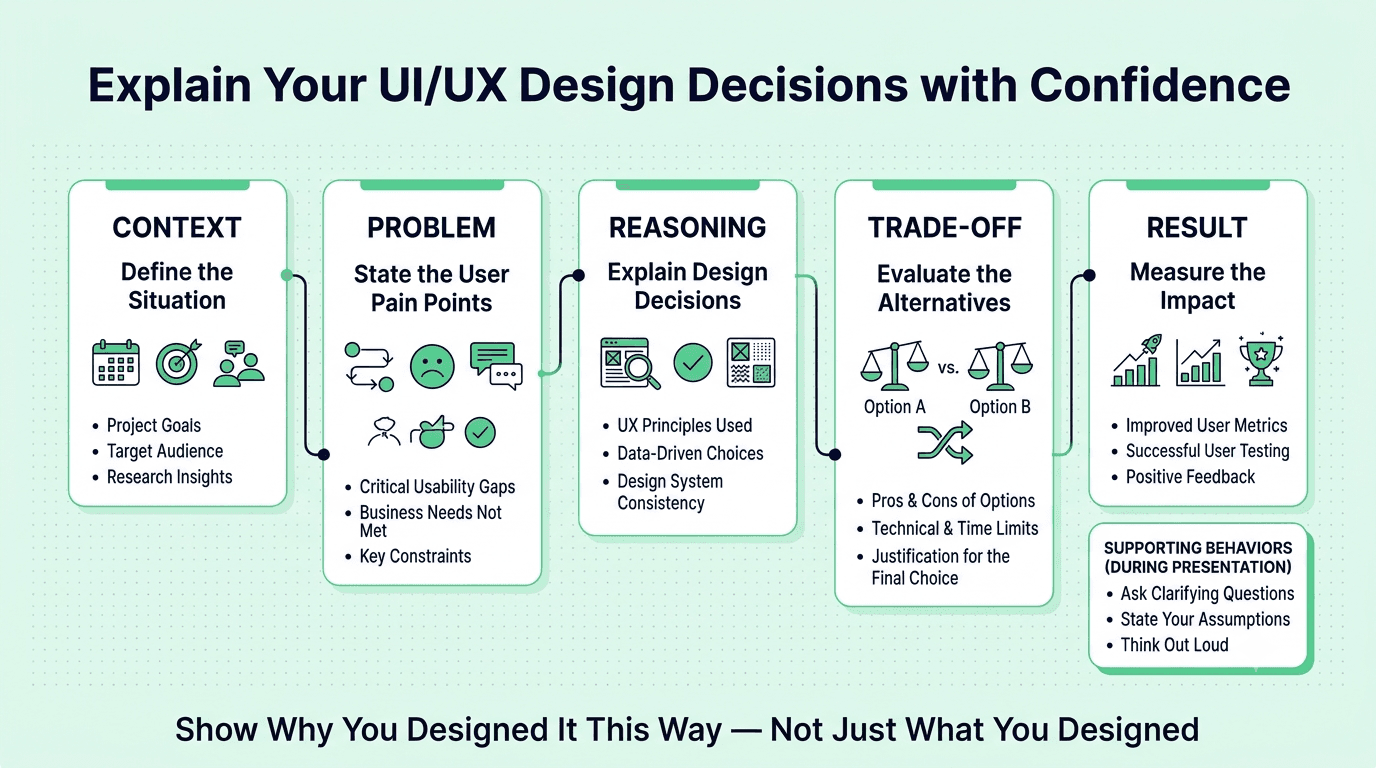
Process: What research did you do, what options did you explore, and why did you choose one?
Solution: What did you design, and how does it solve the problem?
Results: What changed afterward, and what did you learn?
Prepare for follow up questions on each decision. Interviewers often ask, "What would you do differently?" and "What was the hardest trade off?" Having honest answers ready makes you look confident and self aware.
Decision Making Frameworks
Interviewers like designers who can explain how they prioritize. A few simple frameworks help.
Impact versus effort: Rank ideas by how much value they create and how hard they are to build.
Jobs to be done: Focus on what the user is trying to accomplish, not only who they are.
Heuristic evaluation: Review a design against known usability principles to find quick problems.
Goals, signals, metrics: Define what success looks like, what behavior would show it, and how you would measure it.
You do not need to name these in the interview. Simply showing structured reasoning is enough.
Stakeholder Management Preparation
Design lives between many teams, so expect questions about working with others.
How do you handle a stakeholder who wants a specific solution that you think is wrong?
How do you work with engineers when a design is hard to build?
How do you respond when product priorities change halfway through a project?
How do you present research that contradicts what leadership believes?
A strong approach is the same every time. Listen first, understand the goal behind the request, bring evidence, offer options, and agree on next steps together.
Scenario Based Preparation Tips
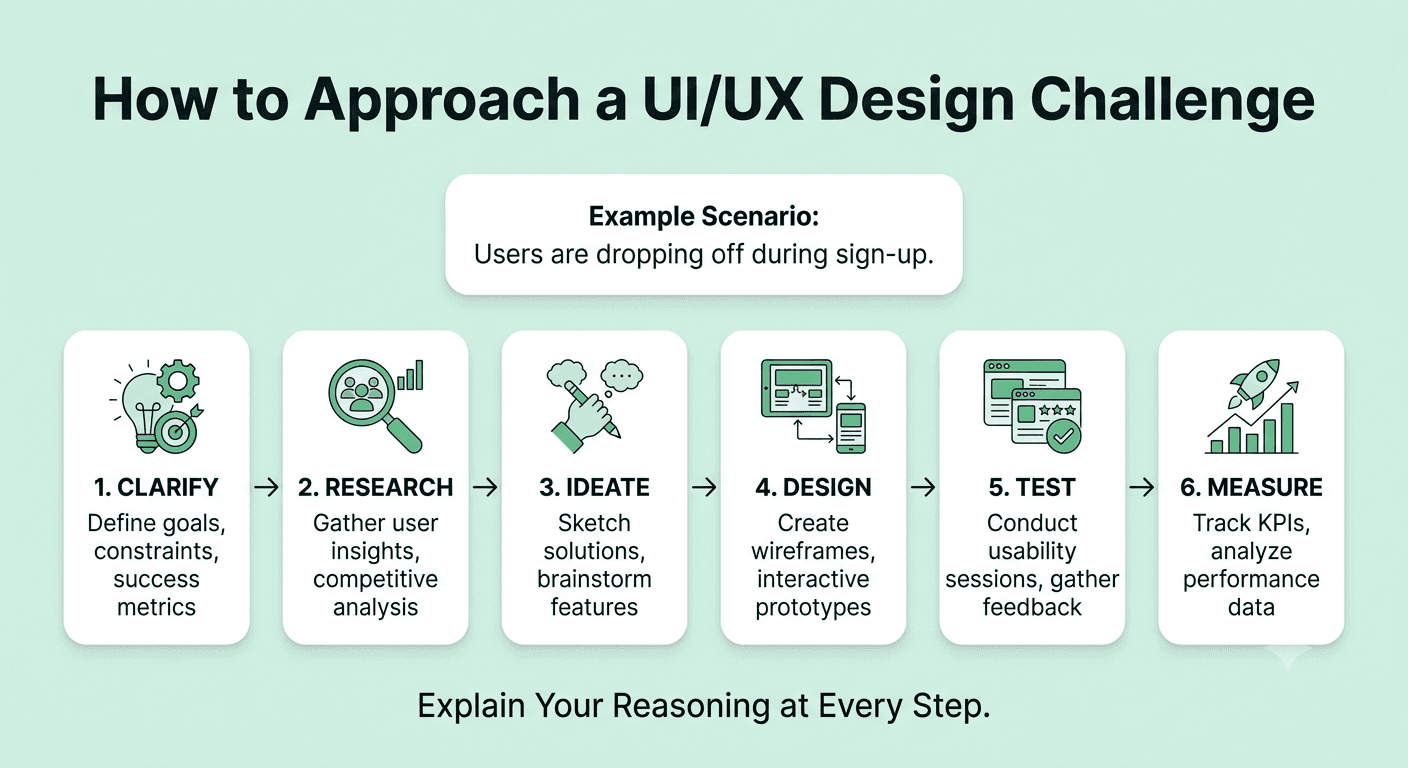
Interviewers often ask, "Users are dropping off at the sign up step of our app. How would you investigate and fix this?" Practice a repeatable approach.
Clarify the problem: how big is the drop off, and which users are affected?
Look at the data: analytics, recordings, and support feedback to find where and why people leave.
Talk to users, or review existing research, to understand their reasons.
Form two or three hypotheses, such as too many form fields or unclear value, and decide how you would test each one.
Design and test the simplest fix first, then measure the result.
Describe what you would do next if the first change does not work.
This shows structured thinking, which interviewers value more than a clever final design.
Practical Preparation Exercises
Redesign one screen of an app you use daily, and write a one page explanation of what you changed and why.
Complete a timed design challenge in one hour: spend ten minutes understanding, ten on flows, twenty on key screens, and the rest on edge cases and a summary.
Run a quick usability test with three or four friends on one of your prototypes, and note what you would change.
Present one case study out loud in six minutes, record yourself, and listen for filler words and unclear parts.
Audit one of your own designs for accessibility issues like contrast, text size, and keyboard use.
Tools and Platforms to Know
Figma for design, prototyping, and collaboration, plus FigJam for workshops and flows
Prototyping and testing tools for clickable prototypes and remote usability tests
Research tools for surveys, interviews, and analysis
Analytics tools to read user behavior data
Developer handoff basics so your files are easy to build from
AI assisted design tools, used carefully to speed up routine work while you stay responsible for the thinking
FREE TO USE
8k+ SESSIONS92% FLUENCY4.9★ RATING
Speak With Confidence
Real Conversations. Real Scenarios. Speak until it feels natural.
- Real-Time Speaking Practice
- Guided Conversation Flows
- Instant AI Feedback
Section 5: Common Interview Rounds
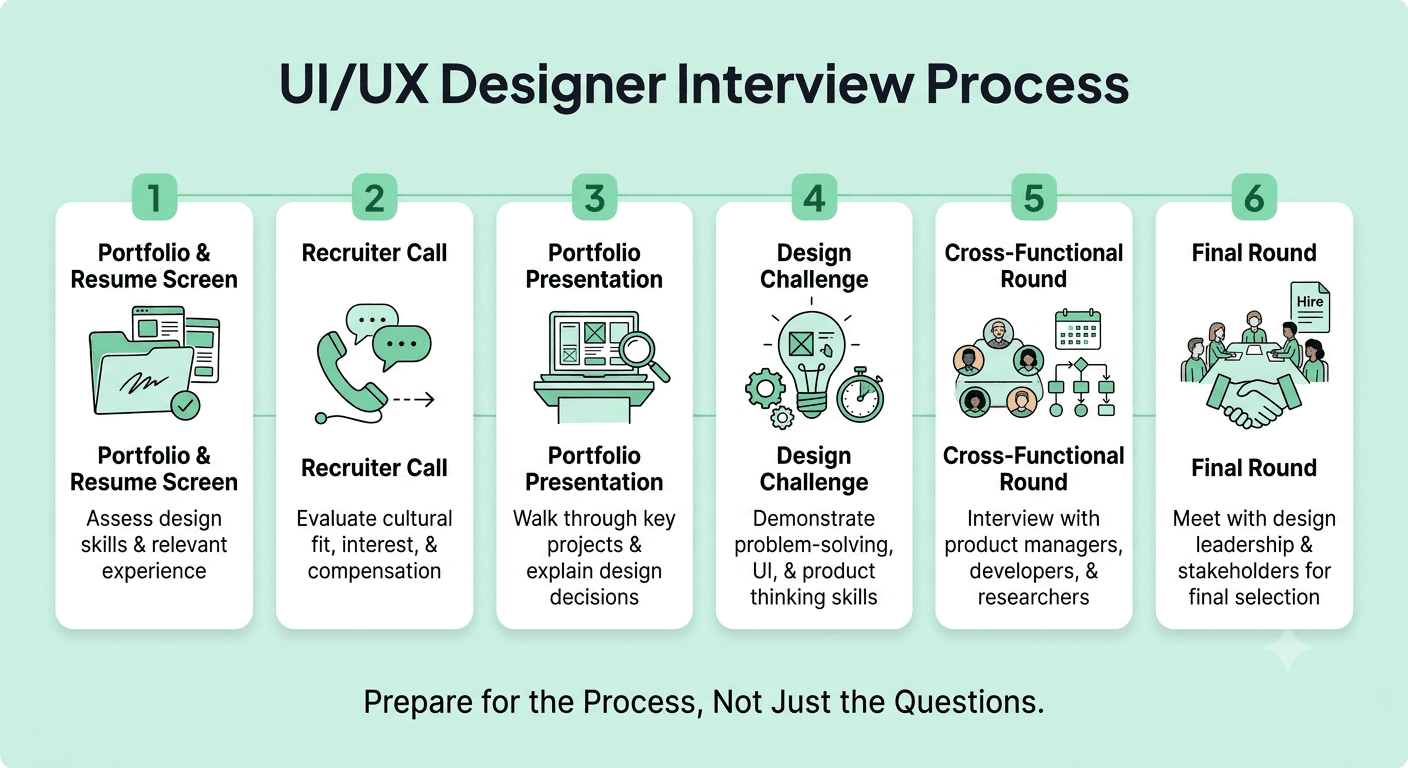
Portfolio and resume screen Recruiters scan for clear case studies, relevant experience, and evidence of impact. A portfolio with no explanation or results rarely survives this stage.
Recruiter or HR round A short conversation about your background, motivation, salary expectations, and availability. It is short, but candidates who cannot explain their own work clearly often get filtered here.
Portfolio presentation round You present one or two case studies to the design team, usually for thirty to forty five minutes, followed by questions. This is often the most important round.
Design challenge or whiteboard round You get a prompt and work through it live or as a take home task. Interviewers are watching your process, your questions, and how you handle constraints more than your final visuals.
Cross functional round Conversations with product managers and engineers to test collaboration, feasibility thinking, and communication.
Hiring manager or final round Focused on culture fit, growth, how you handle feedback, and how you have dealt with conflict or ambiguity in past work.
Section 6: Behavioral and Situational Interview Preparation
Behavioral rounds often decide close calls between designers with similar portfolios, because design depends so much on working with other people.
Use the STAR method: Situation, Task, Action, Result. Keep each story under two minutes.
Prepare five to six stories covering a disagreement with a stakeholder, a time you received tough critique, a project that failed or changed direction, a time you worked closely with engineers, a time you used research to change a decision, and a time you met a tight deadline.
Be honest about failures. Interviewers care more about what you learned than a perfect record.
Explain trade offs, not just outcomes. "We shipped a simpler version first because testing showed users only needed three of the five features" shows real judgment.
Section 7: How to Answer Confidently
Think out loud. Interviewers cannot evaluate thinking they cannot hear.
Ask clarifying questions first. This is one of the strongest signals of design maturity.
State your assumptions. "I will assume these are first time mobile users" keeps you moving and shows structure.
Pause before answering. A short pause to organize your thoughts sounds confident, not unsure.
Tell stories, not lists. Keep a clear beginning, middle, and end in each case study.
Practice out loud, not only on screen. Many strong designers lose points because their spoken explanation is rushed or scattered under pressure.
Section 8: Mistakes to Avoid
Showing only polished final screens without the thinking behind them
Including too many shallow projects instead of a few strong ones
Leaving out results, impact, or what you learned
Not making your personal role clear on team projects
Jumping straight to a solution in a design challenge
Skipping clarifying questions and hiding assumptions
Ignoring accessibility, edge cases, and technical feasibility
Getting defensive when your decisions are challenged
Not researching the company and its product
Under practicing spoken communication
Section 9: Best Practices
Keep a running document of your projects, decisions, and results, updated as you go, not only before interviews.
Rehearse each case study until you can tell it in five minutes and also in fifteen.
Use the company's product before the interview, and note a few thoughtful observations.
Practice timed design challenges at least three or four times before the real one.
Ask for feedback on your portfolio from other designers and from non designers.
Prepare thoughtful questions for the interviewer, such as how design and engineering work together and how the team measures success.
Do at least two full mock interviews before the real thing.
Section 10: Final Interview Day Checklist
Make sure your portfolio link works on both desktop and mobile.
Review your two strongest case studies and rehearse the opening of each.
Re-read the job description and note two or three skills to emphasize.
Look over the company's product and recent updates.
Prepare three to five questions to ask the interviewer.
Test your camera, microphone, screen sharing, and Figma access if the interview is remote.
Keep a notepad ready for design challenges so you can jot down questions and assumptions.
Do a five minute warm up by explaining one project out loud before the call begins.
Section 10: Final Interview Day Checklist
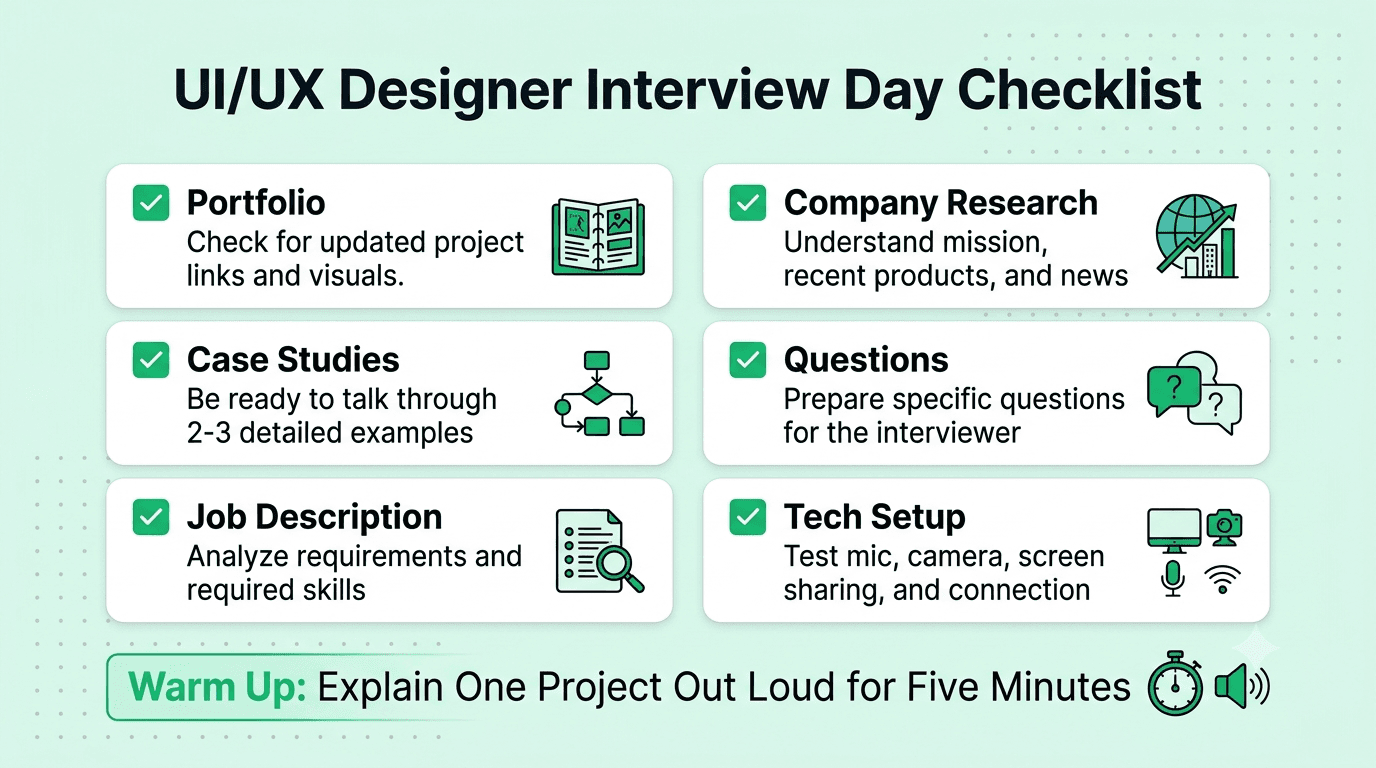
Make sure your portfolio link works on both desktop and mobile.
Review your two strongest case studies and rehearse the opening of each.
Re-read the job description and note two or three skills to emphasize.
Look over the company's product and recent updates.
Prepare three to five questions to ask the interviewer.
Test your camera, microphone, screen sharing, and Figma access if the interview is remote.
Keep a notepad ready for design challenges so you can jot down questions and assumptions.
Do a five minute warm up by explaining one project out loud before the call begins.
Section 11: Industry Trends Shaping UI/UX Designer Interviews in 2026
AI is part of the conversation. Interviewers ask how you use AI tools to speed up work, while expecting you to stay in charge of research, judgment, and quality.
Accessibility is tested directly. More teams include accessibility questions in design challenges, instead of treating it as a bonus.
Design systems experience is valued more. Companies want designers who can work within a system and improve it.
Impact and metrics matter more. Teams want designers who connect their work to business and user outcomes.
Product thinking is expected earlier. Even mid level designers are asked about strategy, prioritization, and trade offs.
Designer and developer collaboration is closer. Many companies now expect a basic understanding of how interfaces are built.
Shorter, more focused take home tasks. Companies are moving toward live, conversational challenges so they can see real time thinking.


