Loading...
Contents
Back to BlogInterview Preparation
How to Prepare for a Data Science Interview in 2026
(Complete Beginner Guide)
Apr 29, 202622 min readUpdated Oct 9, 2026
To prepare for a data science interview in 2026, focus on five areas: statistics and probability, machine learning fundamentals, SQL and Python, business case study problem solving, and clear communication of your projects. Combine daily practice with two to three strong portfolio projects, a visible GitHub profile, and regular mock interviews to build real interview confidence.
Data science is one of the most in-demand careers today. Companies use data to make better decisions, improve products, and understand customers. Because of this, the demand for data scientists continues to grow in 2026. But getting a data science job is not always easy. Interviews are becoming more technical and companies expect candidates to show strong problem-solving skills. Many candidates know theory but struggle to explain concepts, solve real problems, or talk about their projects clearly during interviews. The good news is that with the right data science interview preparation, you can improve your chances of success. In this guide, you will learn how to prepare step-by-step, what skills to focus on, and practical tips for data science interview success.
FREE TO USE
25K+ INTERVIEWS4.8★ RATING68% IMPROVEMENT
Crack Your Dream Job
Real Interviews. Real Pressure. Practice until it feels easy.
- Seamless Interview Experience
- Resume & JD Questions
- Instant Personalized Feedback
How Does a Data Science Interview Process Work?
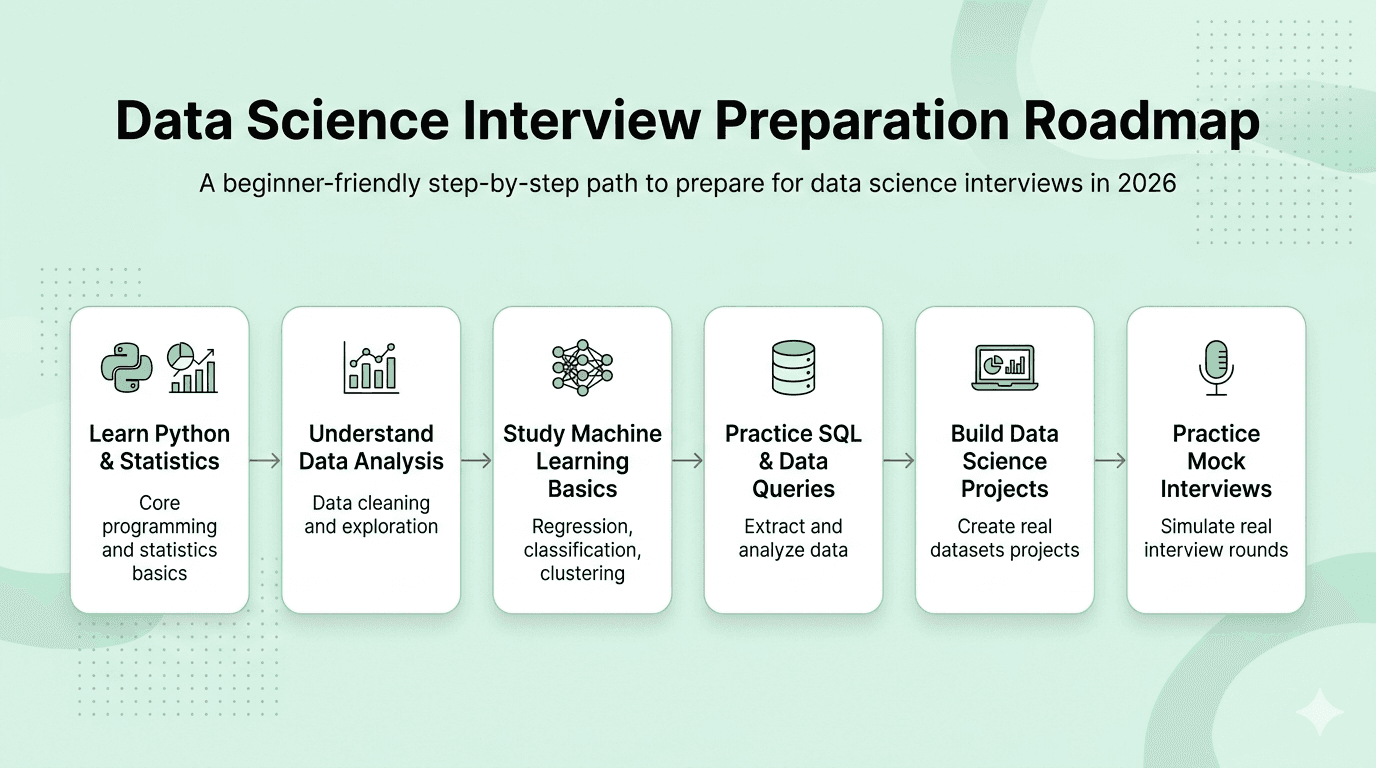
Before you start preparing, it is important to understand how most companies conduct data science interviews. The process usually includes several rounds that test different skills.
1. Resume Screening
In this stage, recruiters review your resume to check your skills, education, and projects. They look for things like:
- Python or R experience
- Machine learning projects
- Data analysis work
- SQL knowledge
Make sure your resume clearly shows your skills and achievements.
2. Technical Screening
This round tests your knowledge of statistics, machine learning, and programming.
Example questions may include:
- What is overfitting in machine learning?
- What is the difference between supervised and unsupervised learning?
3. Coding Round
Many companies test coding ability, especially in Python or SQL. You may be asked to:
- Clean data
- Write SQL queries
- Solve basic programming problems
4. Machine Learning Round
Here, interviewers check your understanding of ML concepts and algorithms.
Example questions:
- How does logistic regression work?
- What is cross validation?
5. Case Study or Business Problem
In this round, you solve a real business problem using data. For example: "How would you predict customer churn for a telecom company?"
6. HR or Culture Round
The final round checks communication skills, teamwork, and motivation. This round is often underestimated, so it gets its own section later in this guide.
Understanding these rounds helps you plan your data science interview preparation better.
What Core Skills Do You Need for a Data Science Interview?
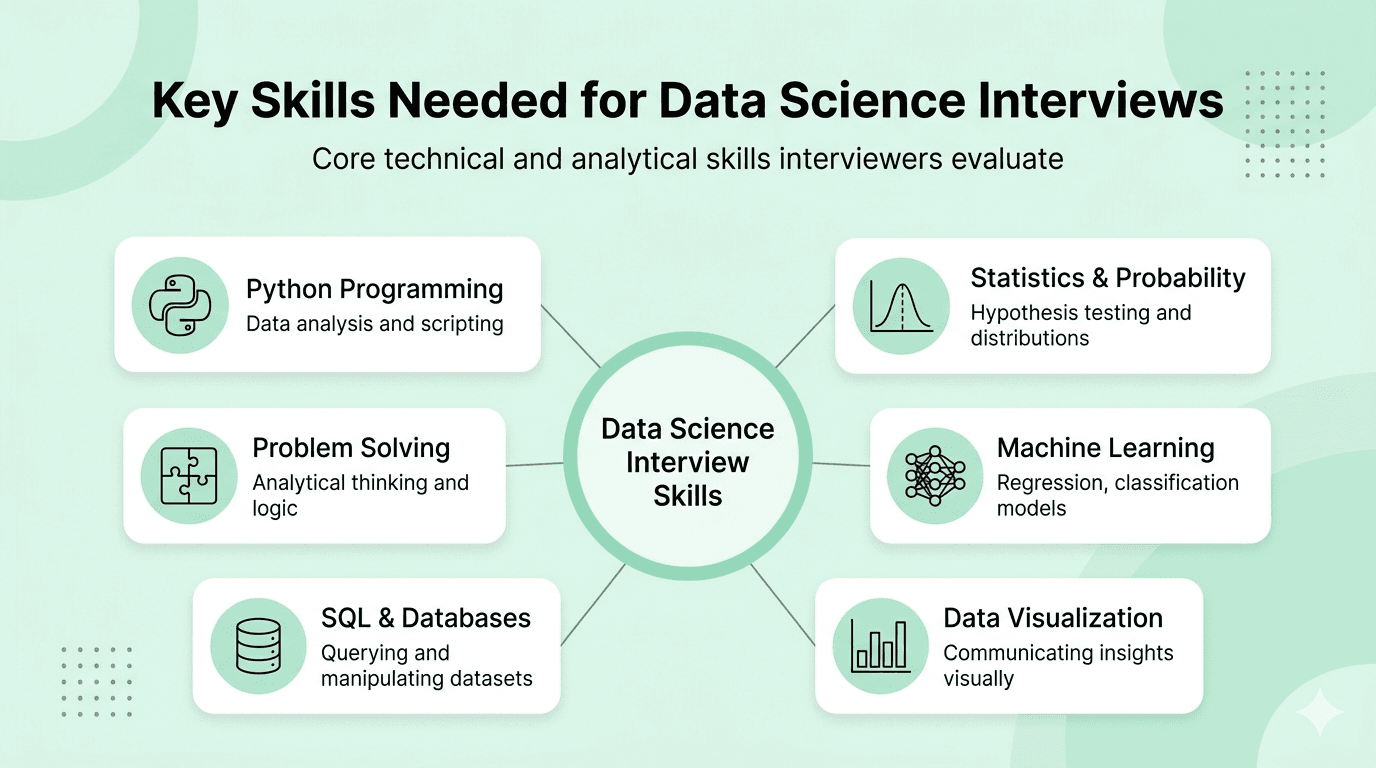
A successful data scientist needs strong fundamentals. During interviews, companies usually test these core skills.
Statistics and Probability
Statistics is the foundation of data science. Many interview questions are based on it.
Important topics include:
- Mean, median, and standard deviation
- Probability distributions
- Hypothesis testing
- A/B testing
- Bayes theorem
Example question: "What is the difference between Type 1 and Type 2 errors?"
Understanding the logic behind these concepts is more important than memorizing formulas.
Machine Learning Concepts
Interviewers expect you to understand how machine learning models work.
Key concepts include:
- Supervised vs unsupervised learning
- Overfitting and underfitting
- Bias vs variance
- Model evaluation metrics
Common algorithms to study:
- Linear regression
- Logistic regression
- Decision trees
- Random forests
- K means clustering
You should also know when to use each algorithm.
GenAI and LLM Awareness
In 2026, many data science interviews include at least one question on generative AI. You do not need to build large language models from scratch, but you should be able to explain what embeddings are, how retrieval augmented generation, or RAG, works at a high level, and where GenAI fits into a typical data science pipeline. Interviewers use this to check whether your knowledge is current, not just theoretical.
Programming Skills
Programming is a core skill in data science. Most companies test coding ability during interviews.
Popular languages include:
- Python
- SQL
- R
In Python, you should know:
- Data manipulation
- Basic coding logic
- Working with datasets
Data Manipulation and Analysis
Data scientists spend most of their time cleaning and analyzing data.
Important tools include:
- NumPy
- Pandas
- Matplotlib or Seaborn
You should know how to:
- Handle missing values
- Filter and group data
- Create simple visualizations
These skills are essential for strong data science interview preparation.
Read More: Skills Required to Become a Data Scientist in 2026
What Are the Most Common Data Science Interview Questions?
One of the best ways to prepare is through regular data science interview questions practice. Practicing questions helps you improve problem solving, learn how to explain answers, and gain confidence during interviews.
Here are some common interview questions.
Statistics Questions
- What is the difference between correlation and causation?
- What is p value in hypothesis testing?
Machine Learning Questions
- Explain the bias variance tradeoff.
- What is cross validation?
SQL Questions
- Write a query to find duplicate records.
- How do you join two tables?
Python Questions
- How do you handle missing data?
- What is the difference between a list and a tuple?
Practicing such questions regularly improves your performance during real interviews.
What Kind of Projects Impress Data Science Interviewers?
Projects are one of the most important parts of your profile. Interviewers often ask detailed questions about your projects. Good projects show that you can apply concepts to real problems. Some popular project ideas include: Customer churn prediction Sales forecasting model Movie recommendation system Sentiment analysis of product reviews The problem you solved The data used The model you built The results and insightsWhen explaining a project in an interview, focus on:This approach is especially helpful for data science interview preparation for freshers who may not have industry experience.
FREE TO USE
8k+ SESSIONS92% FLUENCY4.9★ RATING
Speak With Confidence
Real Conversations. Real Scenarios. Speak until it feels natural.
- Real-Time Speaking Practice
- Guided Conversation Flows
- Instant AI Feedback
How Do You Answer Data Science Case Study Questions?
Many companies test how well you solve business problems using data. These questions check your thinking process rather than just technical knowledge. Example question: “How would you detect fraud in online transactions?” A simple way to answer such questions is by using a structured approach. Step 1: Understand the problem Ask clarifying questions about the goal. Step 2: Define success metrics For example: accuracy, precision, recall. Step 3: Choose a suitable model Explain which algorithm you would use. Step 4: Evaluate results Discuss how you would test and improve the model. Question: "How would you detect fraud in online transactions?" Applying the framework: the goal is to flag suspicious transactions without blocking too many genuine ones, so recall and precision both matter. You would likely start with a classification model such as logistic regression or a random forest, using features like transaction amount, location, and frequency. Since fraud cases are rare compared to normal transactions, you would also explain how you would handle this class imbalance, for example through resampling or adjusting the decision threshold. Question: "How would you predict customer churn for a telecom company?" Applying the framework: the goal is to identify customers likely to cancel their service so the business can intervene early. Success metrics usually center on recall, since missing a customer who churns is costlier than a false alarm. You would build features from usage patterns, billing history, and support tickets, then test models like logistic regression or gradient boosting. Finally, you would evaluate results using a holdout set and discuss how the business could act on the predictions, such as targeted retention offers. Practicing this approach with more than one example is one of the best tips for data science interview success.Example 1: Fraud Detection
Example 2: Customer Churn Prediction
How Important Is Communication in a Data Science Interview?
Technical knowledge alone is not enough. Data scientists must explain insights clearly. Interviewers want to see if you can communicate complex ideas in simple language. Some useful tips include: Avoid too much technical jargon Explain concepts step by step Focus on business impact “The model achieved high precision.” You can say: “The model correctly identified most fraud transactions, which can help reduce financial loss.” Clear communication makes a strong impression during interviews.For example, instead of saying:
How Can AI Tools Help You Prepare for Data Science Interviews?
Technology is changing how people prepare for interviews. Many candidates now use AI tools to practice interviews. AI tools can help you: practice real interview questions simulate interview environments receive instant feedback on answers Mocklingo provides you structured mock interview simulation for practice along with detailed feedback. Here, you can practice data science questions based on either job description or your resume. Practicing mock interviews regularly can make a big difference in your performance.This type of data science interview practice helps candidates improve confidence and identify weak areas before the real interview.
How Should Freshers Prepare for a Data Science Interview?
Freshers often worry because they do not have work experience. But companies still hire fresh graduates with strong fundamentals.
Here are some simple tips for data science interview preparation for freshers.
Focus on Fundamentals
Learn statistics, machine learning basics, and programming clearly.
Build Portfolio Projects
Projects help show your practical skills. You can work on self projects to build a strong portfolio, and publish them on GitHub so recruiters can review your work directly.
Practice Coding Regularly
Daily coding improves problem solving speed.
Participate in Data Competitions
Platforms like Kaggle help you work on real datasets and improve skills.
Learn to Explain Your Work
Interviewers may ask detailed questions about your projects. If you can explain your approach clearly, it creates a strong impression.
What Should You Expect in the HR or Behavioral Round?
The HR round is often treated as a formality, but it can decide the outcome when technical scores are close. Interviewers use it to judge communication, teamwork, and how you handle setbacks.
Common behavioral questions for data science roles include:
- Tell me about a time your model did not perform as expected. What did you do?
- Describe a situation where you had to explain a technical result to a non technical stakeholder.
- How do you prioritize when you have multiple data requests at once?
Prepare short, specific answers using a simple structure: the situation, the action you took, and the result. Keep each answer under two minutes and tie it back to a real project whenever possible.
Tips for Data Science Interview Success
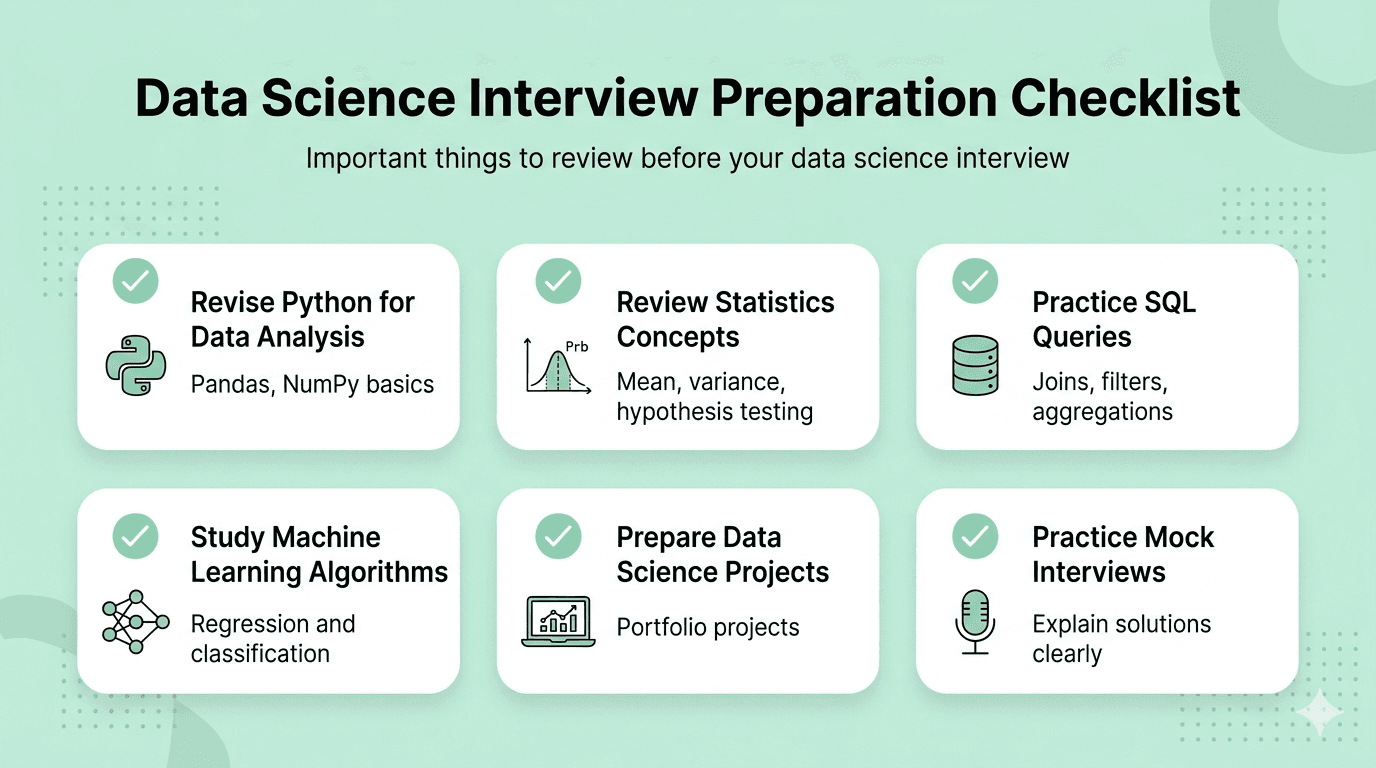
Here are some quick tips for data science interview preparation.
- Revise statistics basics regularly
- Practice SQL queries daily
- Understand machine learning algorithms clearly
- Prepare explanations for all your projects
- Keep your GitHub and portfolio updated
- Practice mock interviews with friends or AI tools
- Learn to explain technical concepts simply
- Review common interview questions before the interview
Following these steps will help you feel more confident and prepared.
Common Data Science Interview Mistakes
Many candidates lose opportunities because of simple mistakes.
Memorizing Instead of Understanding
Interviewers often ask follow up questions. If you only memorize answers, you may struggle.
Ignoring Business Context
Data science is about solving real problems, not just building models.
Poor Project Explanation
Many candidates list projects on their resume but cannot explain them clearly.
Lack of Coding Practice
Even good candidates fail interviews because of weak coding skills.
Avoiding these mistakes can greatly improve your chances of success.
Read More: 12 Common Mistakes to Avoid in Data Science Interview
Conclusion
Preparing for a data science interview takes time and consistent effort. The key is to focus on strong fundamentals and practical practice. Start by understanding the interview process. Then strengthen your knowledge of statistics, machine learning, programming, and data analysis. Building real projects and practicing interview questions regularly will improve your confidence. With the right data science interview preparation and practice, you can successfully crack your data science interview in 2026.