Loading...
Contents
Top Skills Recruiters Look for in Java Developers in 2026
Oct 10, 202623 min read
In 2026, recruiters hiring Java developers look for eight core skills: strong core Java and object oriented design, collections and concurrency knowledge, Spring and Spring Boot experience, database and SQL fluency, REST API design, testing habits, cloud and DevOps awareness, and clear communication. The candidates who get offers are the ones who can explain why they made a design decision, not just show that their code runs.
If you are applying for Java roles this year, the job description probably reads like a long shopping list of tools. Recruiters read it differently. They are trying to answer one simple question: can this person build backend systems that are reliable, fast, and easy for a team to maintain? This guide walks through the skills that answer that question, ranked by how often they decide a hiring outcome.
FREE TO USE
25K+ INTERVIEWS4.8★ RATING68% IMPROVEMENT
Crack Your Dream Job
Real Interviews. Real Pressure. Practice until it feels easy.
- Seamless Interview Experience
- Resume & JD Questions
- Instant Personalized Feedback
What Skills Do Recruiters Look for in a Java Developer?
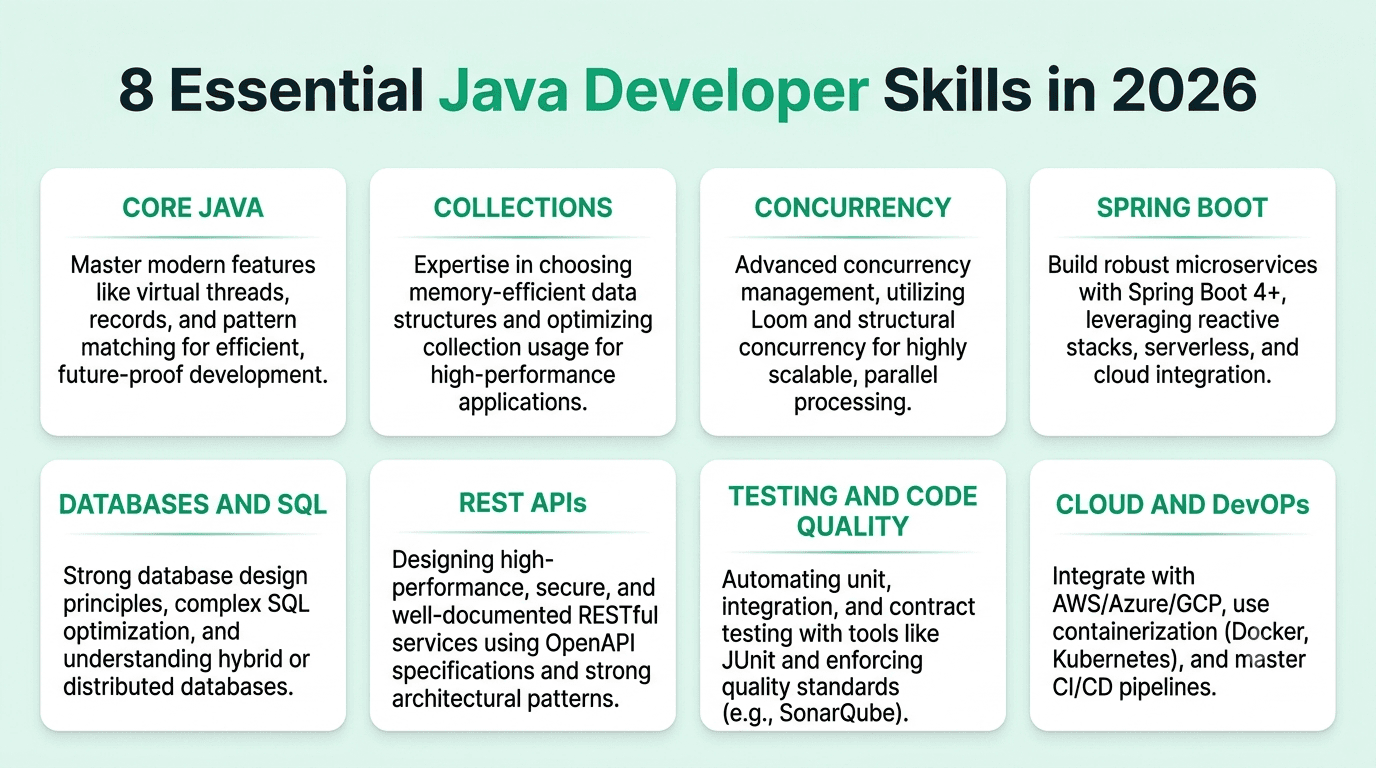
Here is the order in which skills usually matter most:
Core Java and object oriented design
Collections, generics, and the Java memory model
Multithreading and concurrency
Spring and Spring Boot
Databases, SQL, and JPA or Hibernate
REST API and microservices design
Testing and code quality
Cloud, DevOps, and communication
The order matters. A candidate with excellent fundamentals and average framework knowledge usually beats someone who has used ten libraries but cannot explain how a HashMap works. Frameworks change every few years. Fundamentals stay useful for a whole career.
How Strong Does Your Core Java Need to Be?
Very strong. Almost every Java interview starts here, even for senior roles, because it is the fastest way for an interviewer to see whether you really understand the language or just copy patterns from tutorials.
Recruiters expect you to know:
The four pillars of object oriented programming and how to apply them, not just define them
The difference between an abstract class and an interface, and when to choose each
How equals and hashCode work together, and why breaking that contract causes bugs
Immutability, and why String is immutable
Exception handling, including checked versus unchecked exceptions
Modern Java features such as lambdas, streams, Optional, records, and the newer language improvements from recent long term support releases
A common interview question is, "Why would you override hashCode when you override equals?" A strong answer explains what goes wrong inside a HashMap when you do not. That kind of answer shows understanding instead of memorization.
How to show it: describe a real design choice in your project, such as using an interface to swap payment providers without touching the rest of the code.
Why Do Collections and Memory Knowledge Matter So Much?
Because they sit behind almost every performance and correctness problem in a Java application. Interviewers love collections questions since they quickly reveal how deeply you understand what happens under the hood.
You should be comfortable with:
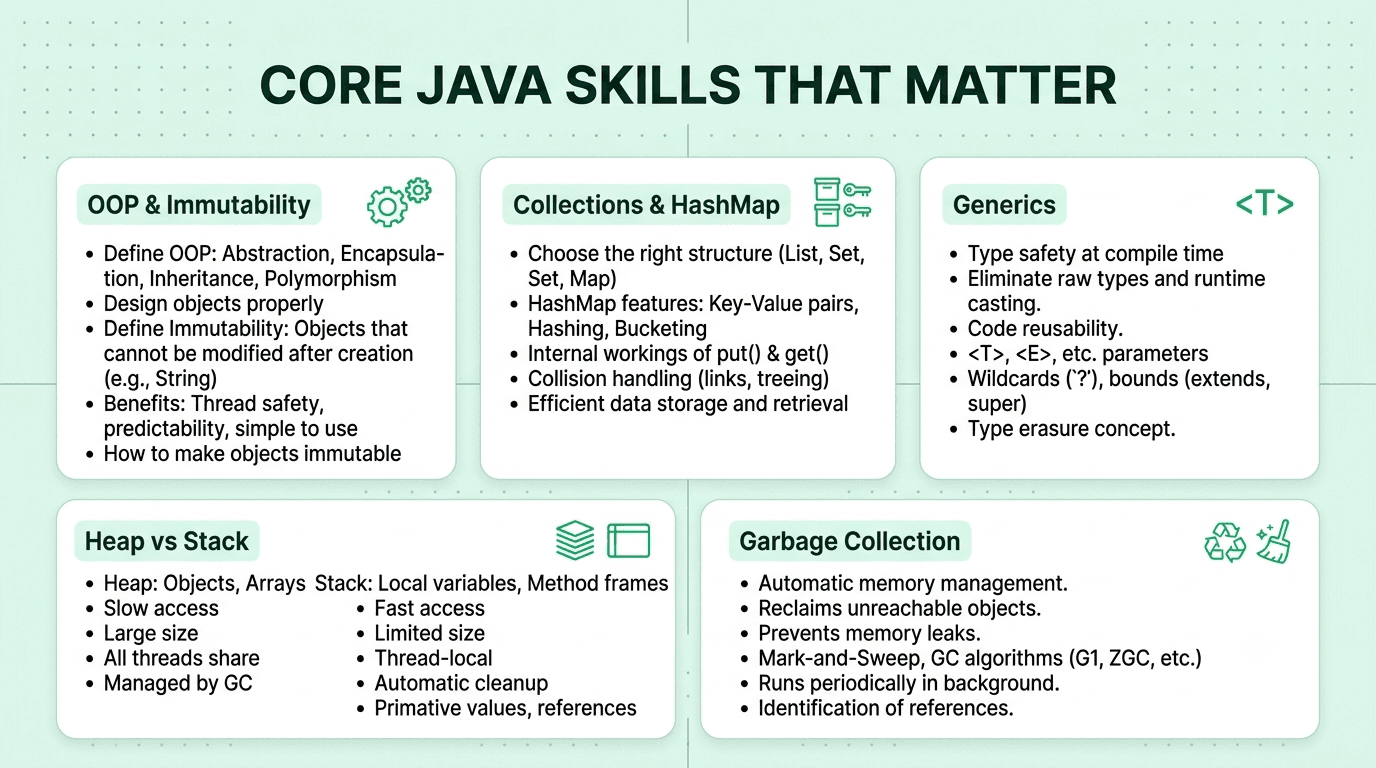
How HashMap works internally, including hashing, buckets, and collisions
The difference between ArrayList and LinkedList, and when each makes sense
HashSet, TreeSet, and LinkedHashSet, and what ordering guarantees they give
ConcurrentHashMap and why a regular HashMap is unsafe across threads
Generics, including wildcards and type erasure
Heap versus stack memory, garbage collection basics, and what causes memory leaks
You do not need to tune a garbage collector for a junior role. You do need to explain, in plain words, how objects are created, referenced, and cleaned up. At senior levels, expect questions about common collectors and how to read a heap dump.
How Important Is Multithreading and Concurrency?
It is one of the topics that separates intermediate candidates from beginners. Backend systems handle many requests at once, so recruiters want to know you can write code that is safe when threads collide.
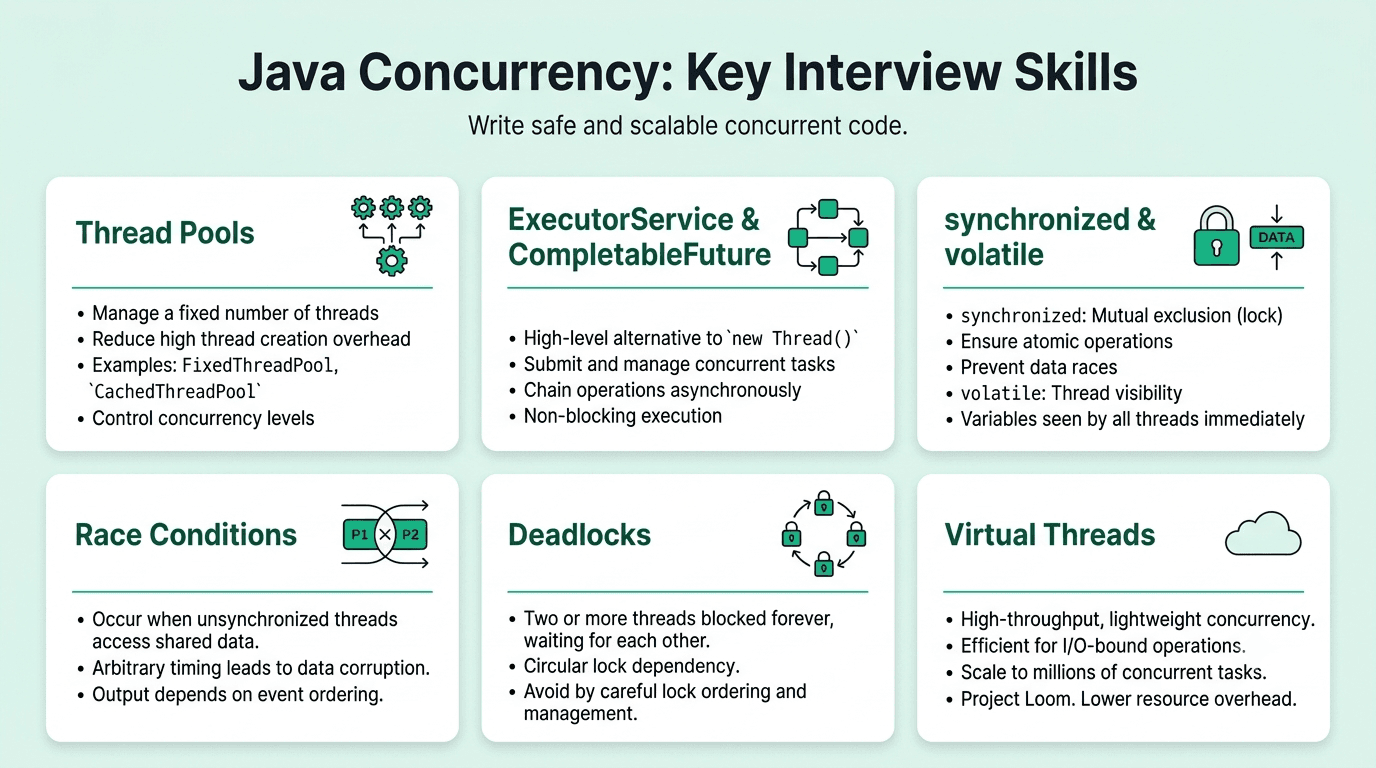
Key areas to know:
Creating and managing threads, and why thread pools are preferred
The Executor framework and CompletableFuture
synchronized, volatile, and the basics of locks
Race conditions and deadlocks, with a clear example of each
The difference between concurrency and parallelism
Virtual threads, which are now a regular topic in modern Java discussions
A good way to stand out is to share a real example. Maybe you fixed a race condition in a shared counter, or moved blocking work onto a separate thread pool. Even a small story shows interviewers that you have met these problems in practice.
1 / 2
FREE TO USE
8k+ SESSIONS92% FLUENCY4.9★ RATING
Speak With Confidence
Real Conversations. Real Scenarios. Speak until it feels natural.
- Real-Time Speaking Practice
- Guided Conversation Flows
- Instant AI Feedback
Is Spring Boot Really Mandatory for Java Jobs?
For most backend roles, yes. Spring Boot is the default choice at a huge number of companies, so recruiters often treat it as a basic expectation rather than a bonus.
What recruiters expect you to know:
Dependency injection and inversion of control, explained simply
How Spring Boot auto configuration works
Bean scopes and the bean lifecycle
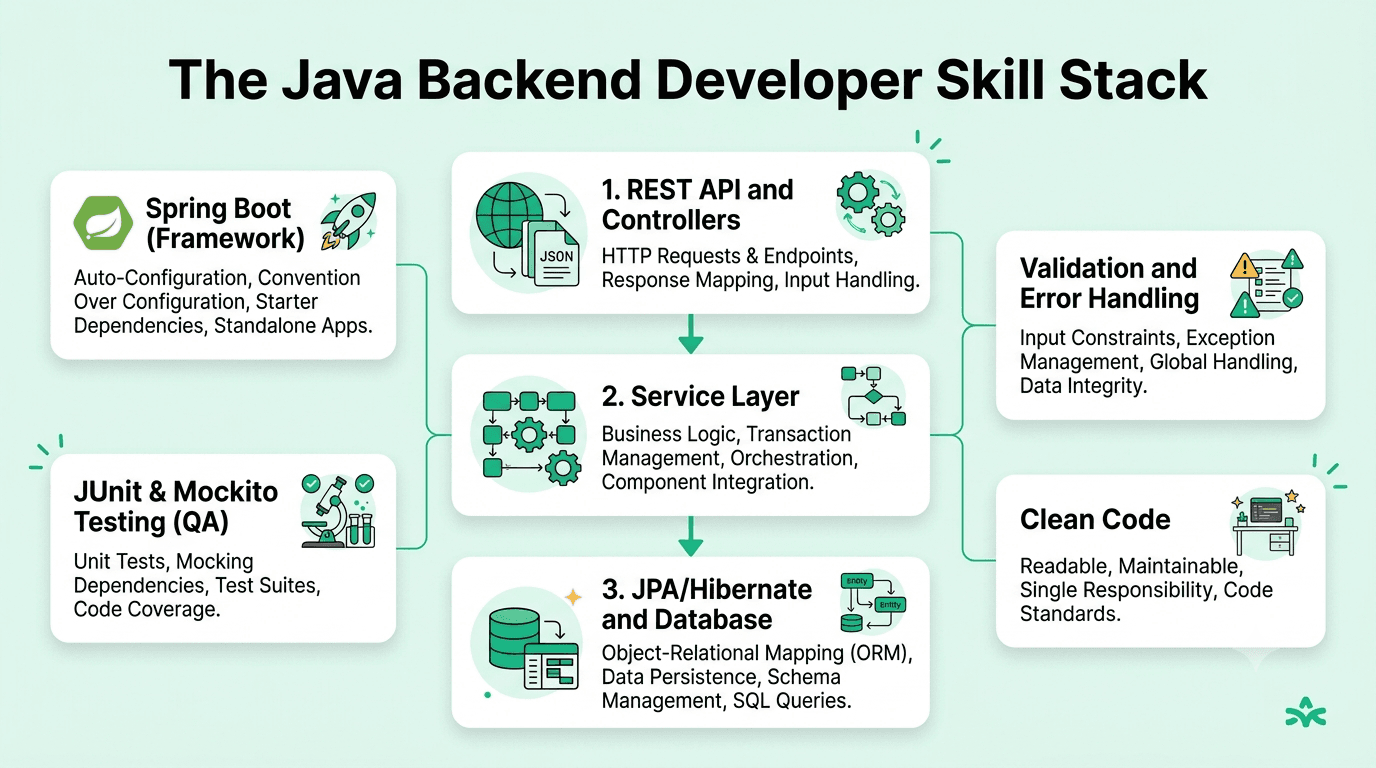
Building controllers, services, and repositories in a clean layered structure
Handling configuration with profiles and properties files
Exception handling with controller advice
Basic Spring Security, including authentication and authorization flows
Spring Data JPA and how it maps to a database
For experienced candidates, add transaction management, caching, and an understanding of how Spring proxies work, since that explains many surprising behaviors, like why a transactional method sometimes does nothing when called from inside the same class.
What Database Skills Do Java Recruiters Expect?
Nearly every Java application talks to a database, and slow queries are among the most common real world performance problems. Recruiters want developers who treat data access as a core skill, not an afterthought.
You should know:
Writing joins, aggregations, and subqueries confidently in SQL
How indexes work and when they help or hurt
Transactions and isolation levels in simple terms
JPA and Hibernate basics, including entities, relationships, and lazy versus eager loading
The N plus one query problem, and how to spot and fix it
When a NoSQL store such as Redis or MongoDB is a better fit
If you mention the N plus one problem unprompted while discussing a project, interviewers notice. It tells them you have looked at the actual queries your code produces.
How Should You Approach REST APIs and Microservices?
Recruiters look for developers who can design APIs that other teams can rely on. Writing an endpoint is easy. Designing a consistent, versioned, well documented one is the real skill.
Know these ideas well:
REST principles, correct use of HTTP methods and status codes
Request validation, error responses, and pagination
API versioning and backward compatibility
Idempotency, especially for payment or order style operations
Authentication with tokens such as JWT or OAuth 2.0
Documentation with OpenAPI or Swagger
For intermediate and senior roles, microservices questions are common. Be ready to discuss service communication, message queues such as Kafka or RabbitMQ, circuit breakers, and the honest trade offs between a monolith and microservices. Interviewers respect candidates who say that microservices are not always the answer.
Do Testing Skills Really Affect Hiring Decisions?
Yes, more than many candidates expect. Teams do not want to merge code that nobody can safely change, so testing habits are a strong signal of professionalism.
Recruiters like to see:
Unit testing with JUnit and Mockito
Integration testing with Spring Boot test support and tools like Testcontainers
Writing tests that check behavior instead of internal details
Awareness of test coverage as a guide, not a goal
Comfort with code reviews, clean code, and refactoring
A strong answer to "How do you decide what to test?" focuses on business critical paths and edge cases, not on chasing a coverage percentage.
What Cloud and DevOps Awareness Is Expected?
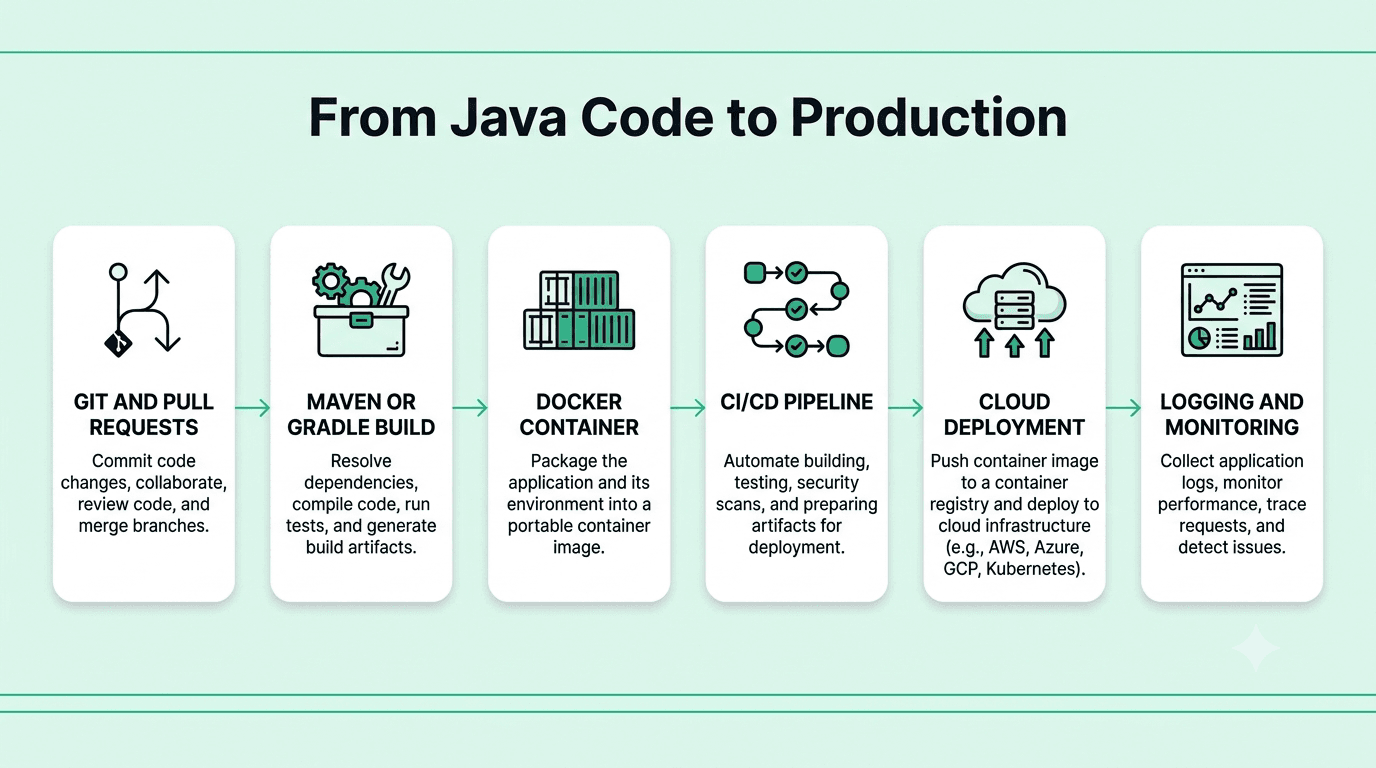
You are not expected to be a DevOps engineer, but you should understand how your code gets built, shipped, and monitored. Recruiters increasingly treat this as part of the job.
Helpful areas include:
Git workflows and pull request habits
Build tools such as Maven or Gradle
Docker basics, and what a container image actually contains
CI and CD pipelines
A working idea of AWS, Azure, or Google Cloud services
Logging, metrics, and monitoring, and how to debug a problem in production
Senior candidates should be able to talk about observability, incident response, and how they would investigate a sudden jump in response times.
Why Do Communication Skills Decide So Many Offers?
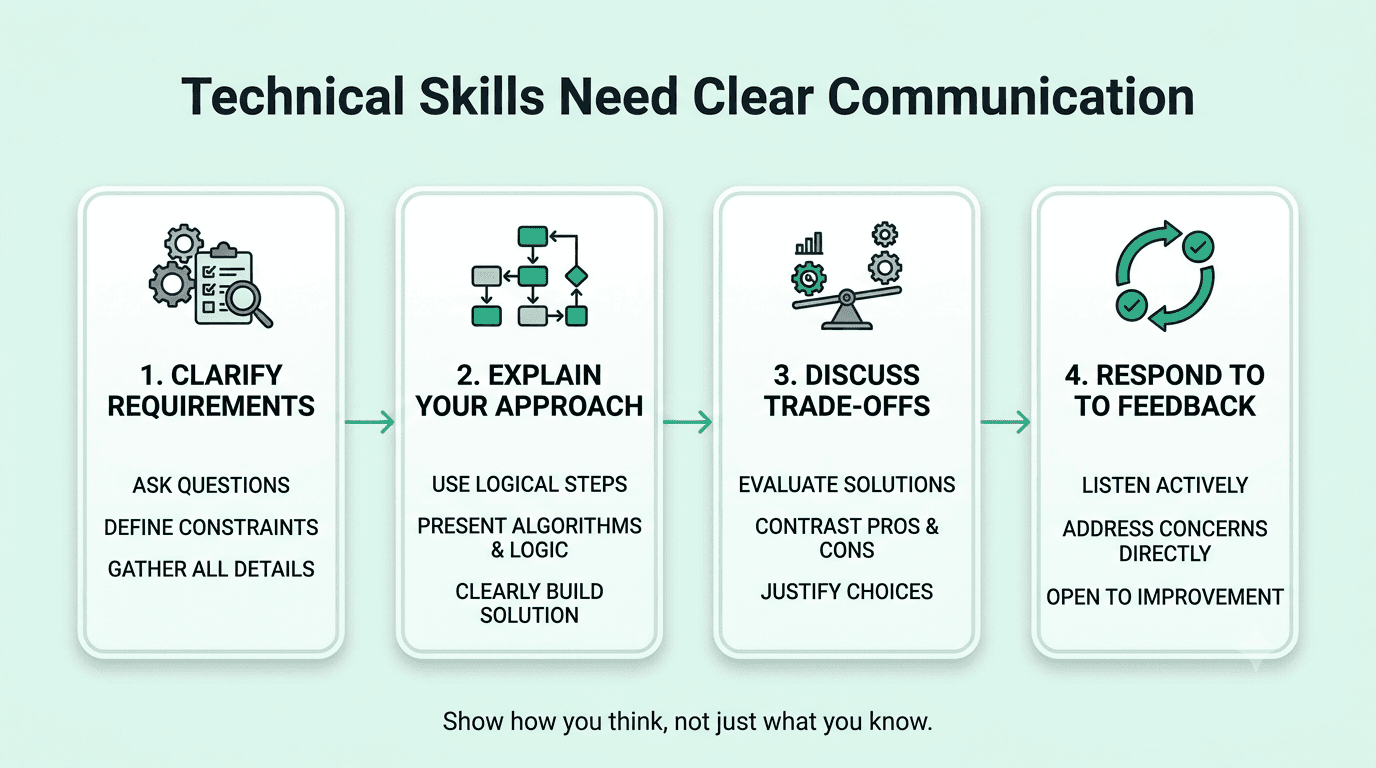
Because this is the skill candidates practice least. Java developers work with product managers, testers, and other engineers every day. Hiring managers listen closely for people who can explain a trade off simply, ask good questions, and accept feedback gracefully.
What interviewers pay attention to:
Do you think out loud during a coding round?
Do you ask clarifying questions before writing code?
Can you explain a technical idea to someone non technical?
Do you stay calm when a hint or a challenge comes your way?
This matters even more for candidates interviewing in English as a second language. A strong answer that is hard to follow often loses to a slightly weaker answer that is delivered clearly. Rehearsing out loud with realistic follow up questions on Mocklingo's AI mock interview tool is one of the quickest ways to fix this, and Mocklingo's English communication practice helps you sound clear and calm while explaining technical ideas.
Which Skills Matter Most at Each Experience Level?
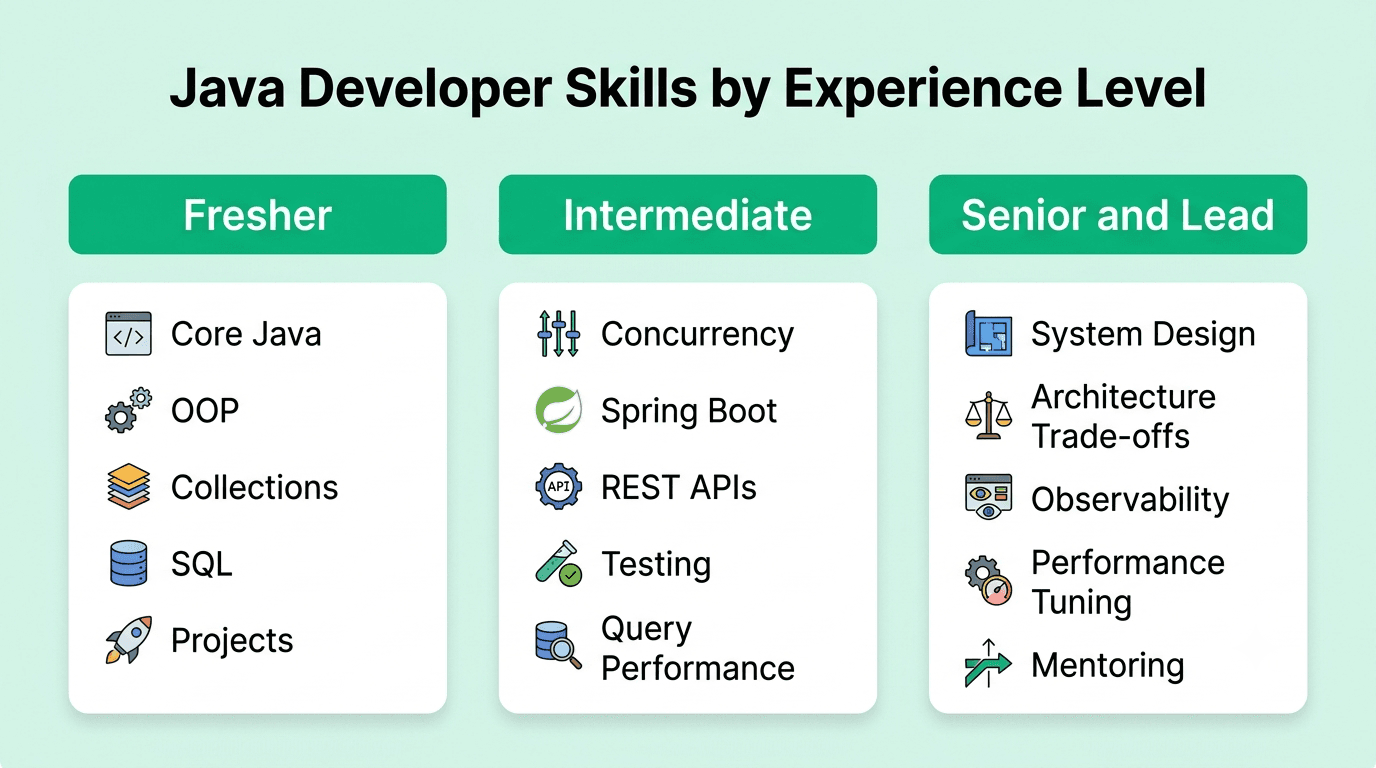
Freshers: Core Java, OOP, collections, basic SQL, and one or two working projects, ideally built with Spring Boot.
Intermediate candidates (two to five years): Concurrency, Spring depth, JPA and query performance, REST design, testing, and the ability to build a feature end to end.
Senior and lead engineers: System design, microservices trade offs, performance tuning, observability, mentoring, and influencing architecture decisions across a team.
How Can You Prove These Skills on Your Resume and Portfolio?
Recruiters skim quickly, so make every skill easy to verify.
Pair each skill with an outcome, such as "Reduced API response time by 40 percent by fixing an N plus one query and adding a Redis cache."
Keep two or three solid projects on GitHub with a clear README that explains the architecture and your database design.
Show at least one project with authentication, validation, proper error handling, and tests.
Mention scale where you honestly can, like requests per day or records processed.
Avoid copying tutorial projects without adding something of your own.