Loading...
Contents
How to Choose an AI Mock Interview Platform in 2026
Oct 6, 202619 min read
To choose an AI mock interview platform, start with your interview type, then check five things: realistic follow up questions, useful feedback, role coverage, spoken practice support and data privacy. Test any platform with one hard question and one deliberately vague answer. If the AI pushes back with a sharper follow up, it is a real simulator. If it only praises you and moves on, it is just a question reader.
There are now dozens of tools that promise to get you interview ready. Some are excellent. Others are a list of questions with an AI label on top. If you are trying to choose an AI mock interview tool, the hard part is not finding options. It is telling the good ones from the weak ones before you waste time or money.
This guide gives you a simple way to decide. You will learn what to look for, how to test a platform in about ten minutes, which red flags to watch for and how to build an AI mock interview preparation routine that actually improves your answers.
FREE TO USE
25K+ INTERVIEWS4.8★ RATING68% IMPROVEMENT
Crack Your Dream Job
Real Interviews. Real Pressure. Practice until it feels easy.
- Seamless Interview Experience
- Resume & JD Questions
- Instant Personalized Feedback
What should you decide before you compare any platform?
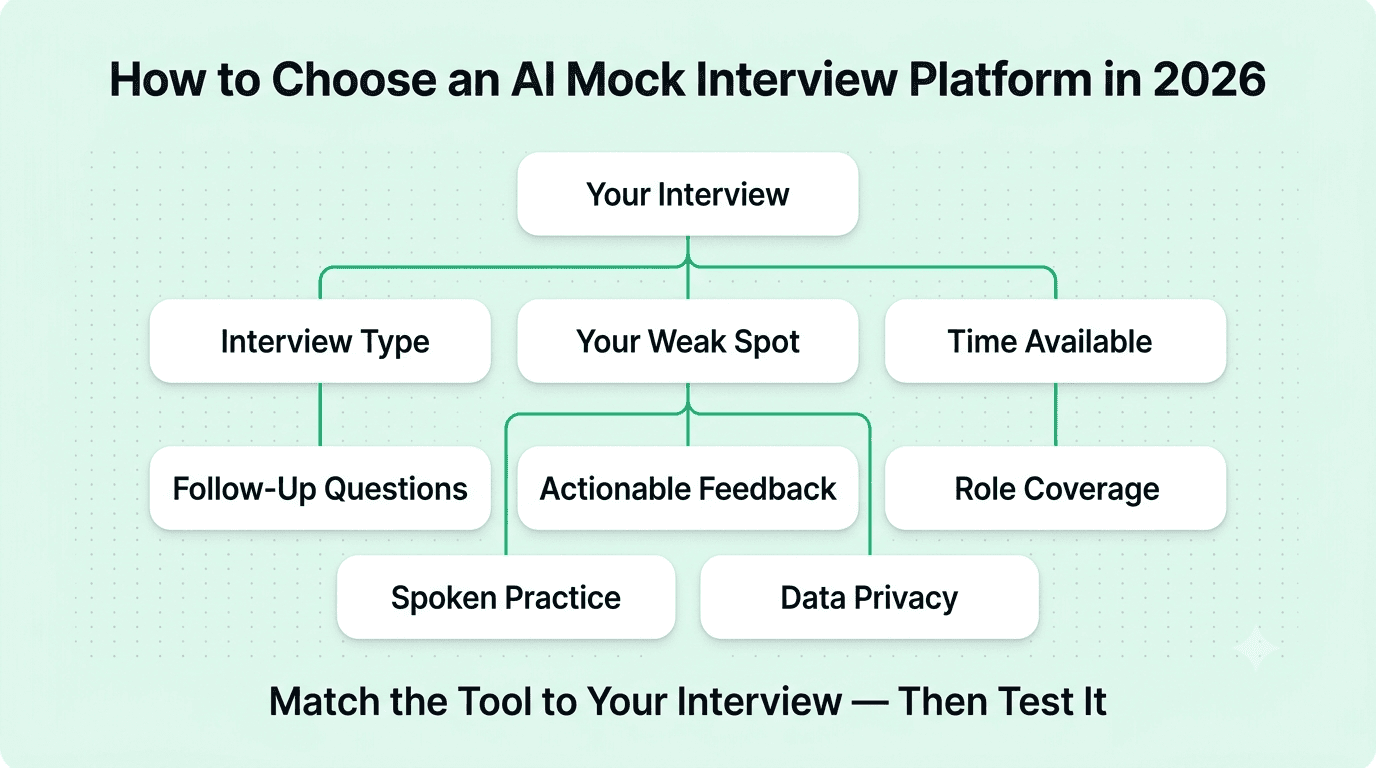
Start with your interview, not with the tool. Three quick questions save you a lot of confusion.
What kind of interview is coming? A behavioral screen, a coding round, a case interview and an HR conversation all reward different practice. A tool that is great at one can be weak at another.
What is your real weak spot? Some candidates do not know the answer. Others know it but ramble, freeze or struggle to say it clearly in English. The fix for each problem is different, so name yours first.
How much time do you have? If your interview is in three days, you need a fast, focused tool. If you have a month, a structured course may be worth the extra setup.
Once you answer these, the right category usually becomes obvious.
What are the main types of AI interview tools?
Many people compare tools that are not even in the same category. Knowing the difference makes your shortlist much shorter.
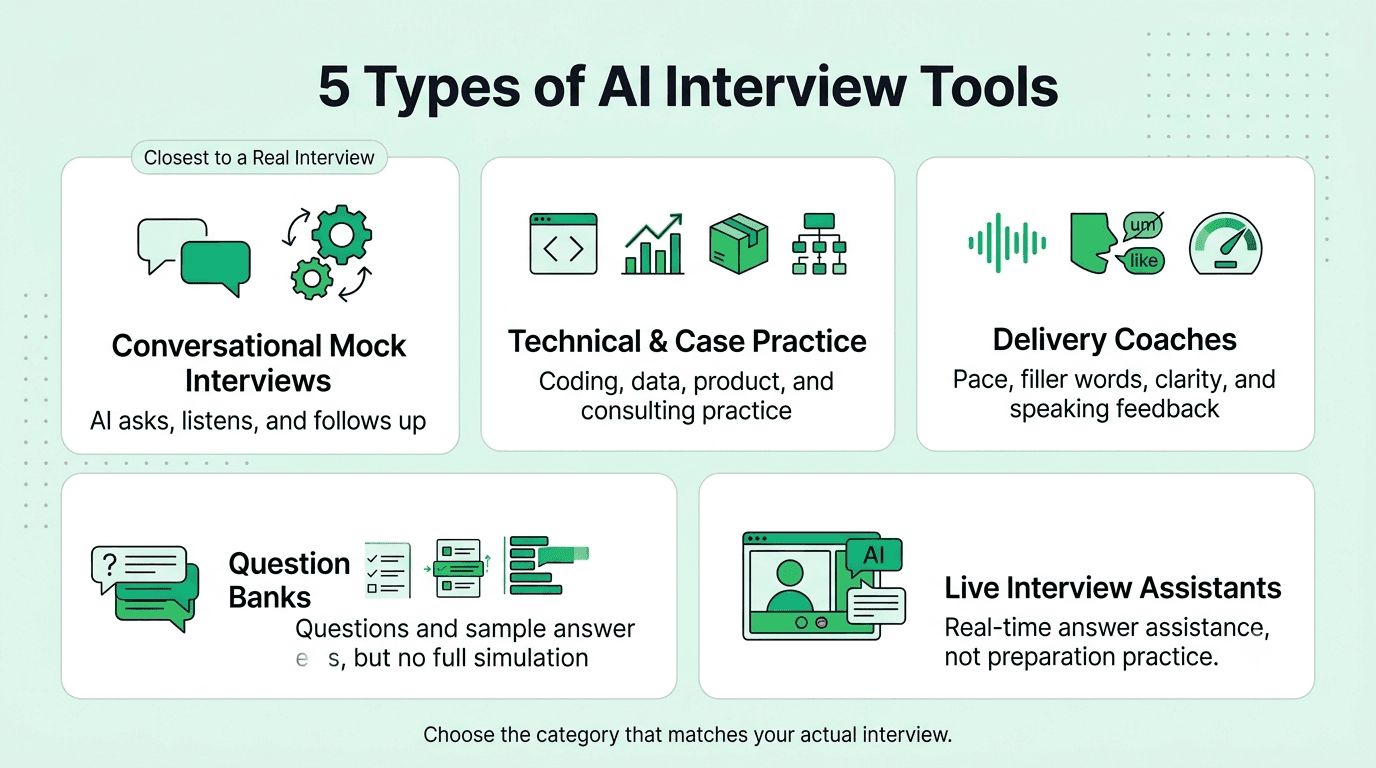
Conversational mock interview platforms. An AI interviewer asks questions, listens to your answers and follows up. This is the closest thing to a real interview.
Technical and case practice platforms. These focus on coding, data, product or consulting interviews, with problems that match those formats.
Delivery coaches. These analyse how you sound, including pace, filler words and clarity, rather than testing role knowledge.
Question banks. These give you lists of likely questions and sample answers. Useful for study, but not a simulation.
Live interview assistants. These feed you answers during a real interview. They are not practice tools, and many employers ban them.
If you want a real mock interview, you want the first category, possibly paired with one of the second or third.
How do you choose an AI mock interview platform? Five things to check
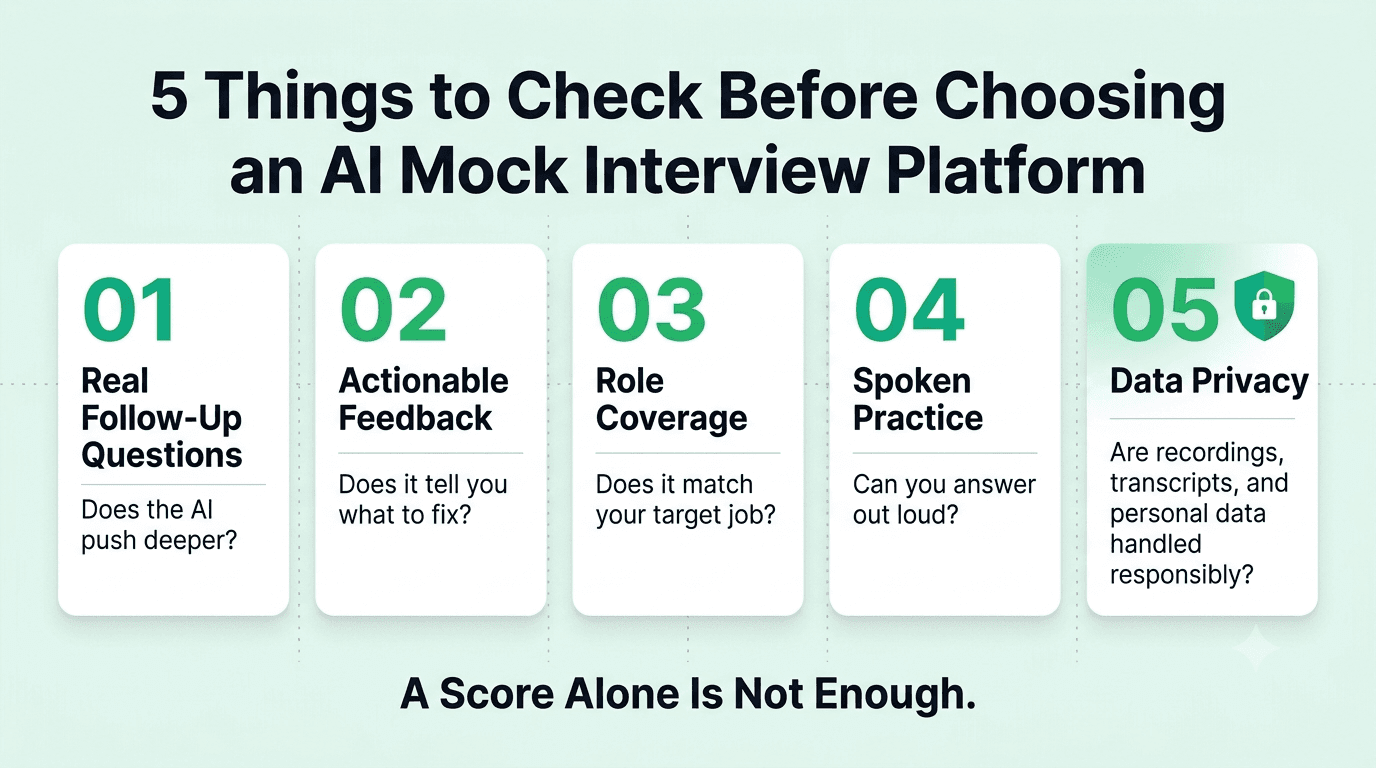
1. Does it ask real follow up questions?
This is the single most important feature. Real interviewers dig. They ask "why did you choose that approach?" or "what would you do differently?" A platform that only moves to the next question gives you comfort, not preparation.
2. Is the feedback specific enough to act on?
A score out of ten does not help. Good feedback tells you that your answer lacked a result, ran too long, skipped the question or sounded generic, and it suggests a better version. Look for feedback on structure, clarity and confidence, not just a grade.
3. Does it cover your actual role?
A generic list of "tell me about yourself" questions will not prepare a backend developer or a data analyst. Check whether the platform has role specific practice for your job and whether it can use your resume or the job description to shape questions.
4. Can you practise out loud?
Typing answers hides your nerves, your pauses and your filler words. Real interviews are spoken, so spoken practice matters. This is even more important if English is not your first language, because fluency under pressure is a skill of its own. Platforms that combine interview practice with English communication support, such as Mocklingo, are built for exactly this gap.
5. Is your data handled responsibly?
You will upload a resume and speak about your work history. Before you start, check whether recordings and transcripts are stored, whether they are used to train models, whether they are shared with third parties and whether you can delete your data. If the policy is unclear, remove personal details before uploading.
How can you test a platform in 10 minutes?
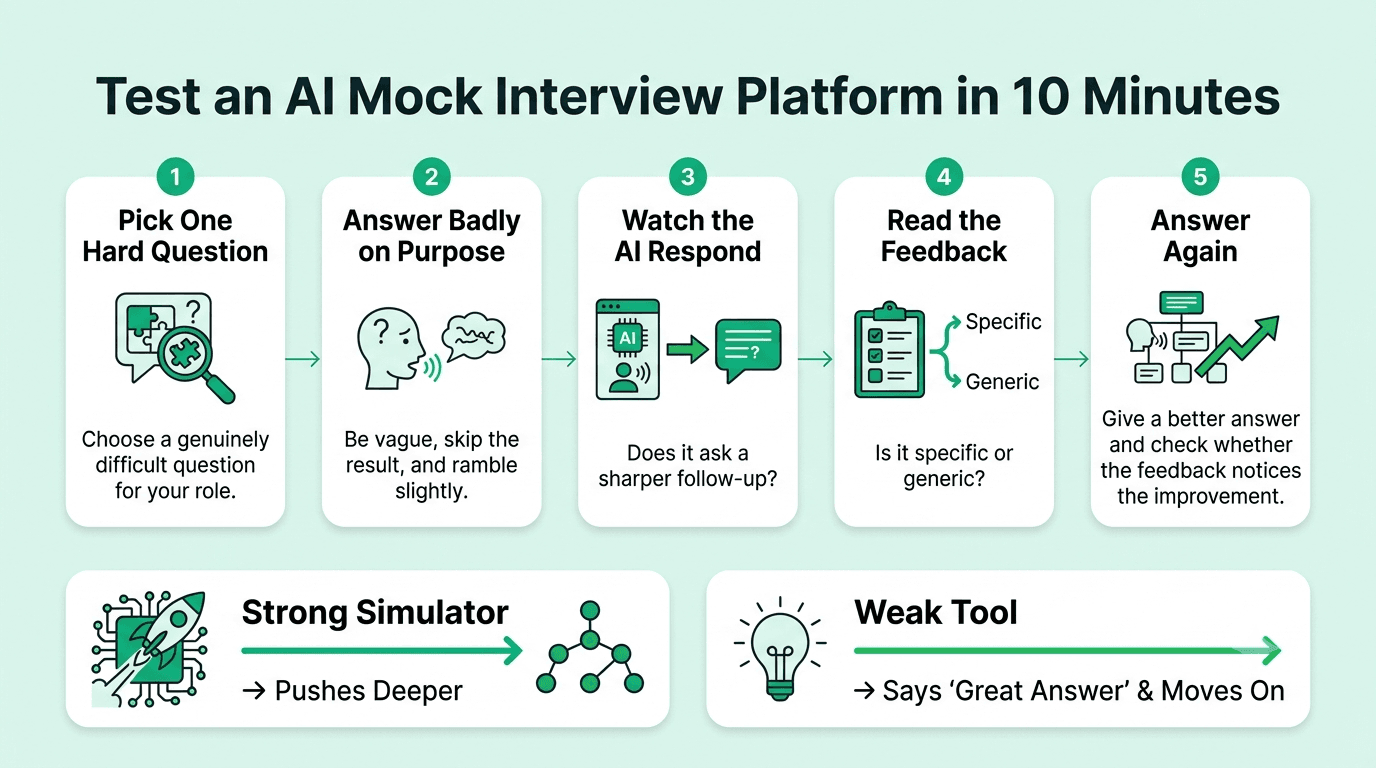
You do not need a long trial to judge quality. Run this short test on any tool you are considering.
Pick one hard question for your role. Choose something you would genuinely find difficult.
Answer it badly on purpose. Be vague. Skip the result. Ramble a little.
Watch what the AI does. A strong platform asks a sharper follow up or points out what is missing. A weak one says "great answer" and moves on.
Read the feedback. Is it specific, or could it apply to anyone?
Repeat the question. Give a better answer and see whether the feedback notices the improvement.
If a tool passes this test, it is worth your time. If it fails, move on, no matter how polished the interface looks.
FREE TO USE
8k+ SESSIONS92% FLUENCY4.9★ RATING
Speak With Confidence
Real Conversations. Real Scenarios. Speak until it feels natural.
- Real-Time Speaking Practice
- Guided Conversation Flows
- Instant AI Feedback
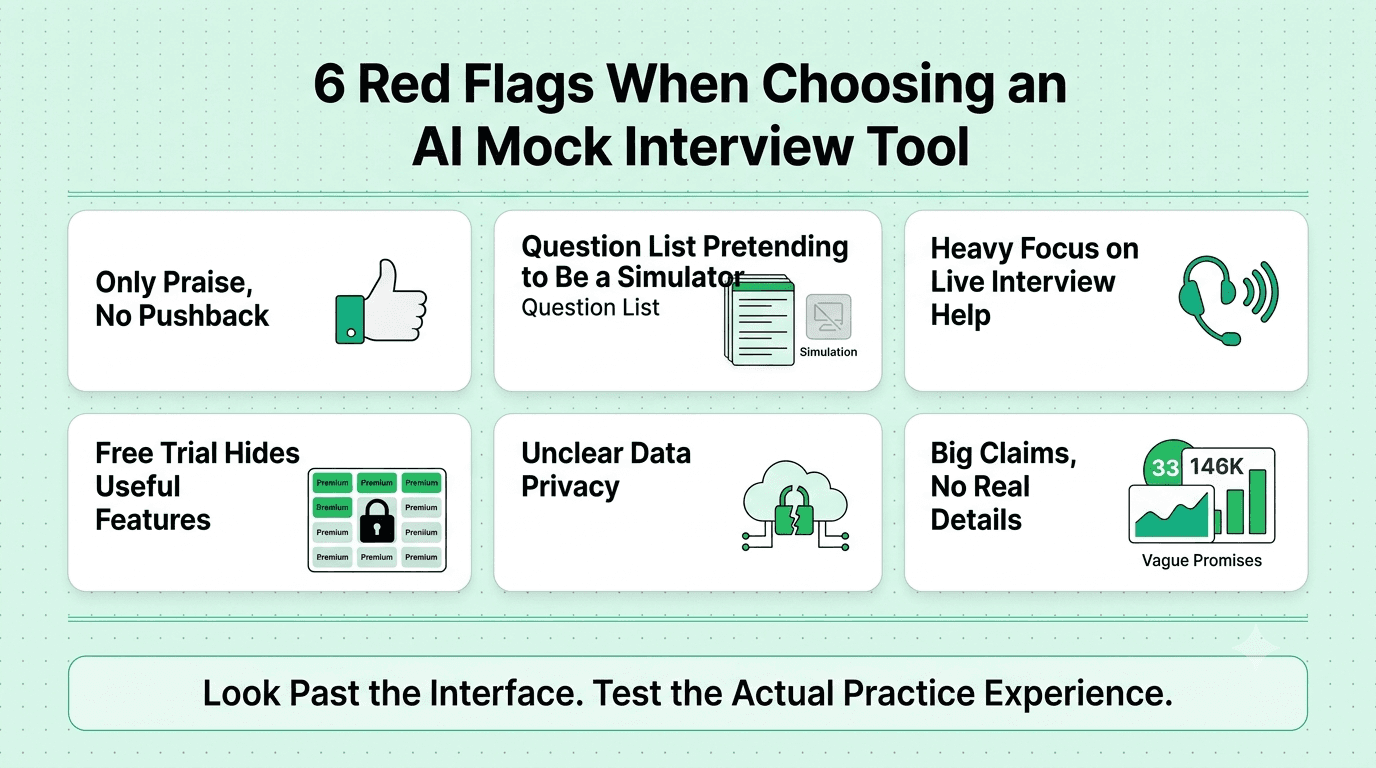
What are the red flags when choosing an AI mock interview tool?
Only praise, no pushback. Feedback that is always positive teaches you nothing.
A question list pretending to be a simulator. If you cannot complete an interactive session, it is a question bank.
Heavy focus on live interview help. If the main promise is feeding you answers during a real interview, it is not preparation, and it can put your offer at risk.
A free trial that hides the useful parts. Some free plans allow one short session with no feedback. Check how many full practice rounds you actually get.
No clarity on privacy. If you cannot find out how your recordings are used, be careful.
Big claims with no detail. Promises like "land your dream job in 30 days" are marketing, not a feature.
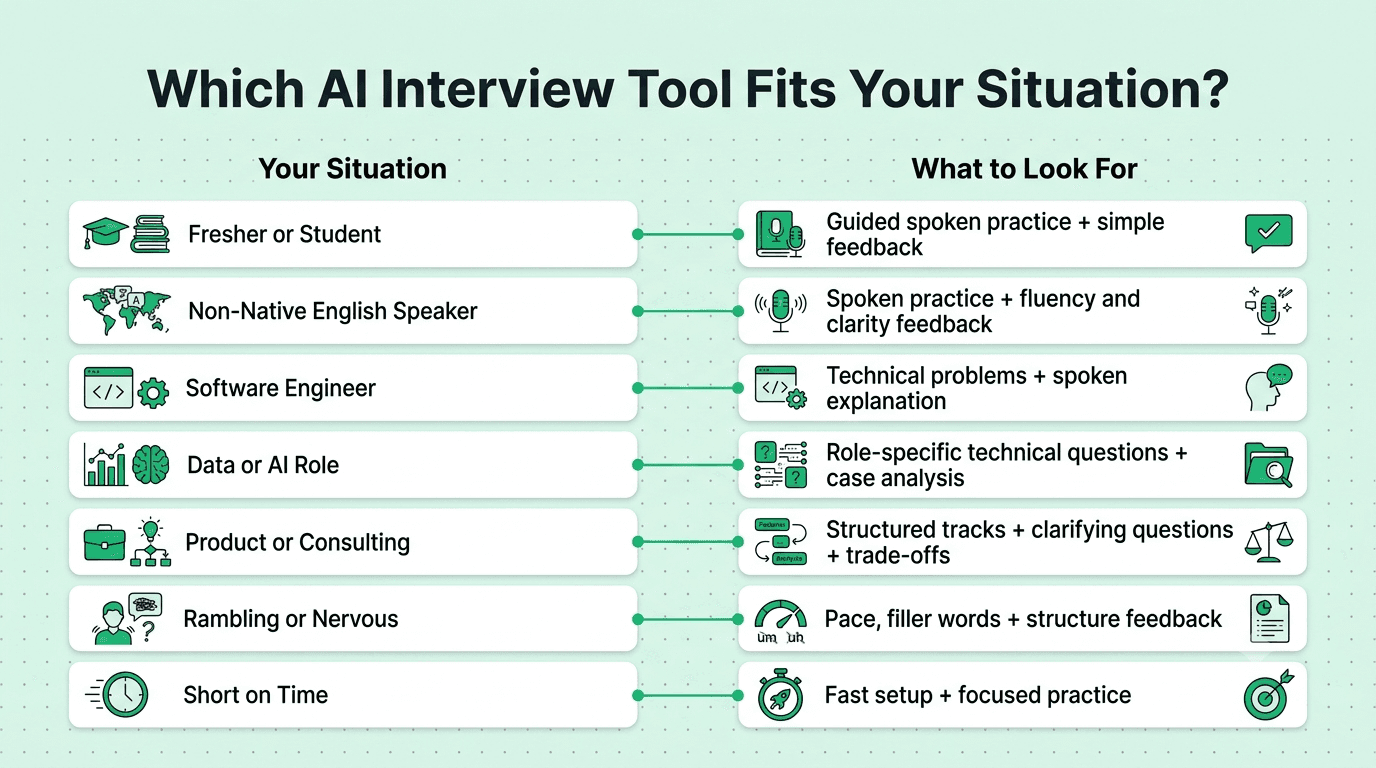
Which type of platform fits which candidate?
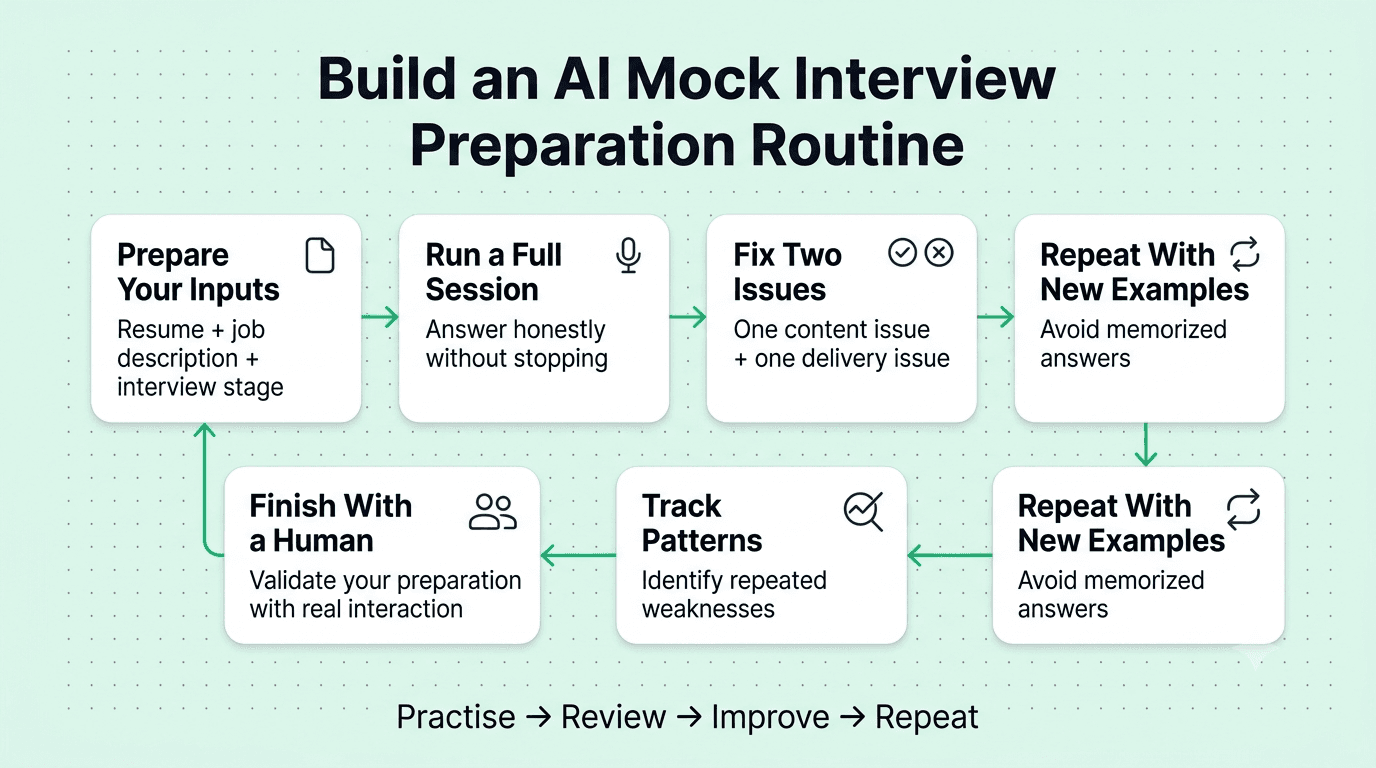
How do you build an AI mock interview preparation routine?
The tool matters, but your routine matters more. A candidate who runs five sessions and reviews each one carefully will usually beat someone who runs ten without reflection.
Prepare your inputs. Gather the job description and your resume, and decide your interview stage.
Run a first session without stopping. Answer honestly, even when it feels uncomfortable. This shows how you really perform under pressure.
Review one content issue and one delivery issue. For example, missing results and long openings. Do not try to fix everything at once.
Repeat the same questions with new examples. This prevents your answers from sounding memorised.
Track patterns across sessions. Notice if you repeatedly forget metrics, ramble or avoid the question.
End with a human. Do one session with a friend, mentor or former manager. AI is great for repetition, while people read tone and chemistry better.
If you want to start with spoken practice and follow up questions, try Mocklingo's AI mock interview. If your main challenge is speaking clearly in English, pair it with English communication practice.
What mistakes should you avoid when choosing?
Choosing by brand instead of fit. The most famous tool is not always right for your role.
Paying before testing. Always run the 10 minute test first.
Practising only in text. If your interview is spoken, practise speaking.
Chasing perfect scores. A high score on an easy session proves little.
Skipping the human check. AI can miss factual errors and reward answers that sound polished but are shallow.
Using AI live in the real interview. Unless the employer clearly allows it, do not.
Conclusion
To choose an AI mock interview platform well, match the tool to your interview, test it with a hard question and judge it by the quality of its follow ups and feedback. Then build a routine you can stick to. Good AI mock interview preparation is less about the tool you pick and more about practising out loud, reviewing honestly and repeating until your answers feel natural.
FAQs
More Blogs
Sep 30, 2026
React Developer Interview Preparation Guide: A Complete Roadmap for 2026
31 min read