Loading...
Contents
Skills Required to Become a Data Scientist in 2026
(Beginner Guide)
Apr 29, 202618 min readUpdated Oct 6, 2026
To become a data scientist in 2026, you need a mix of technical skills such as Python, statistics, SQL, machine learning, and data visualization, along with growing skills in cloud platforms, MLOps, and generative AI tools. Pair these with soft skills like communication and business understanding, and build two to three real projects on GitHub to show employers what you can do.
Data science is one of the fastest growing careers in the world. Companies today collect huge amounts of data from websites, apps, and customers. But data alone is not useful unless someone can analyze it and find insights. This is where data scientists play an important role. If you are planning a career in data science, you may be wondering about the skills required to become a data scientist in 2026. The field is evolving quickly because of artificial intelligence, machine learning, and automation. So the skills required today are slightly different from a few years ago. In this beginner guide, you will learn: The most important data scientist technical skills The key skills for data scientist roles Skills required for data scientist freshers What to study to become a data scientist A simple learning roadmapLet’s start with the basics.
FREE TO USE
25K+ INTERVIEWS4.8★ RATING68% IMPROVEMENT
Crack Your Dream Job
Real Interviews. Real Pressure. Practice until it feels easy.
- Seamless Interview Experience
- Resume & JD Questions
- Instant Personalized Feedback
What Does Data Science Require in 2026?
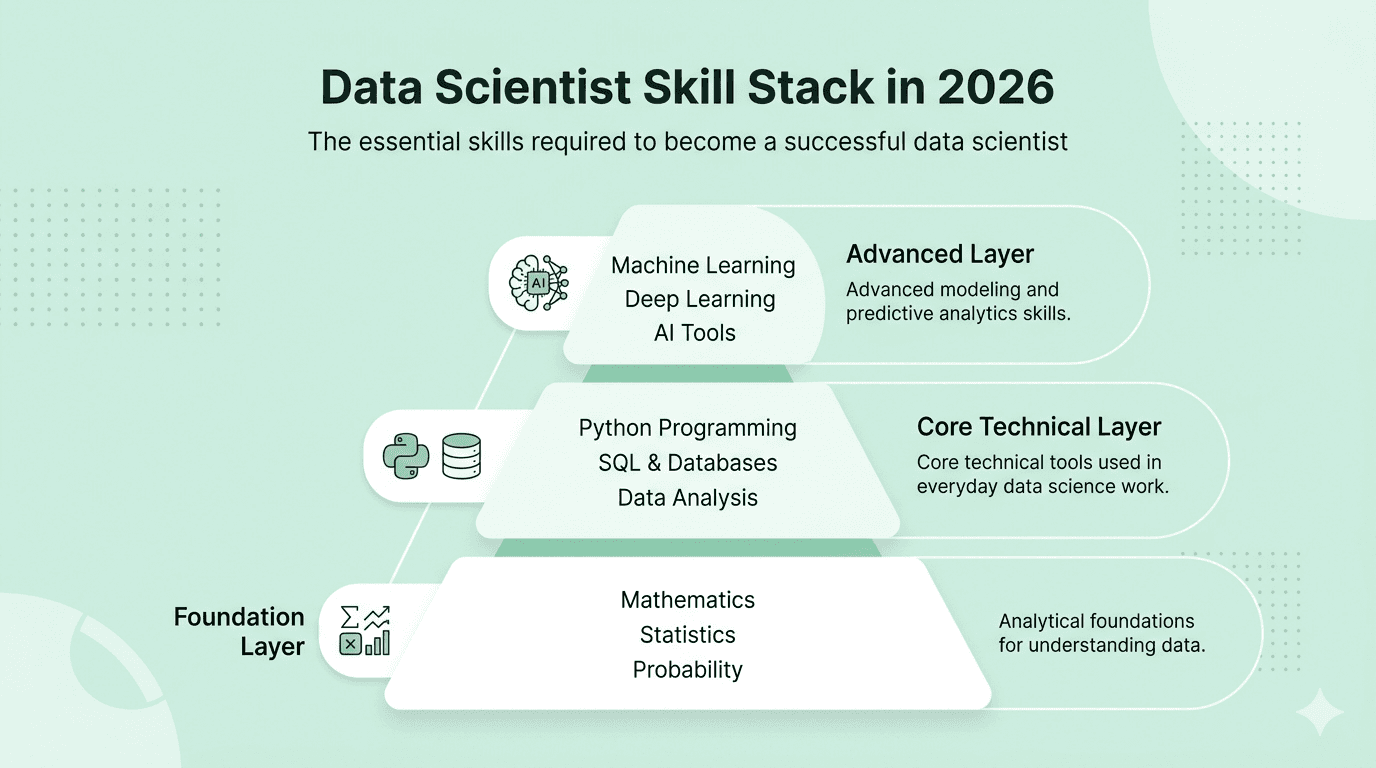
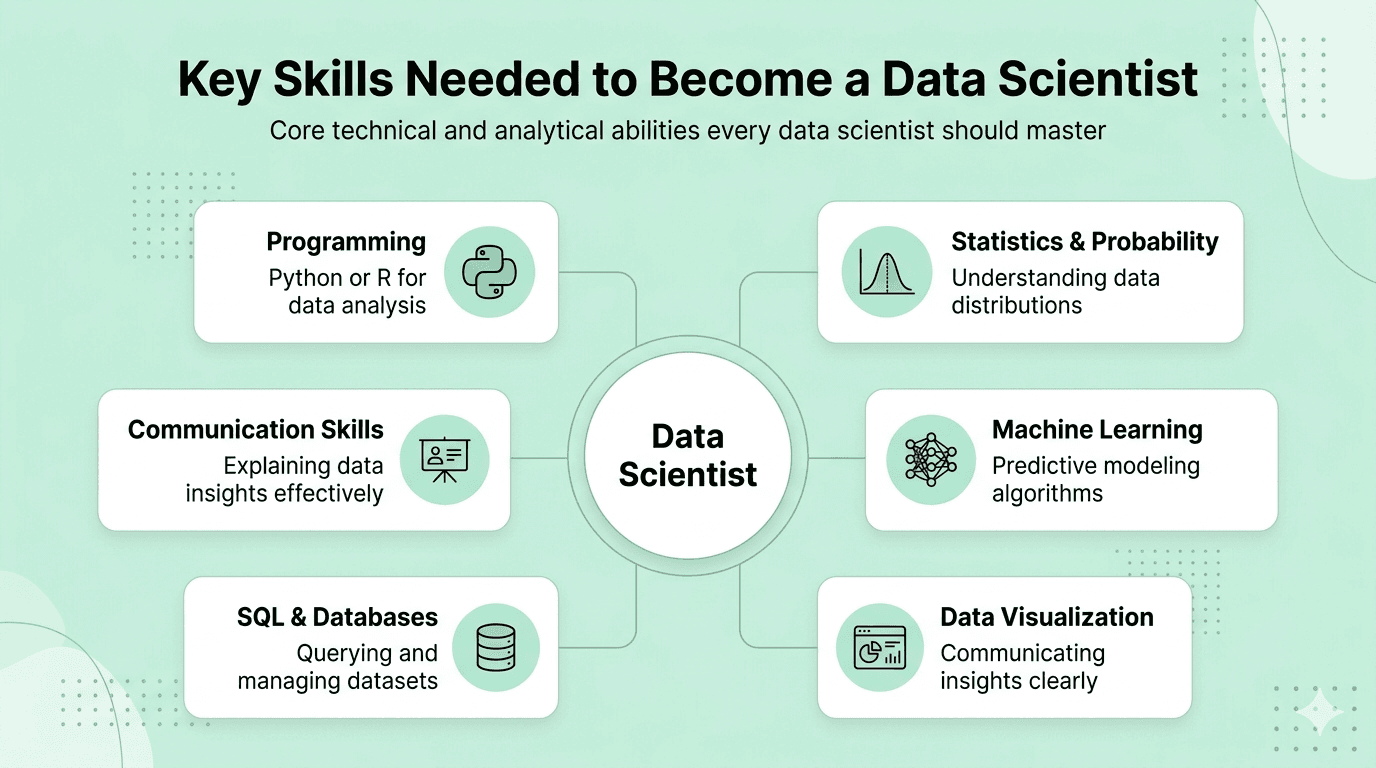
Data science combines different fields together. A data scientist does not only write code. They also work with data, statistics, business problems, and machine learning models. In simple words, data science mainly requires these areas: Programming skills Statistics and mathematics Data analysis skills Machine learning knowledge Data visualization Communication and problem-solving skills Now let’s look at the most important skills one by one.A good data scientist uses these skills to collect data, clean it, analyze it, and build models that help businesses make better decisions.
What Technical Skills Do You Need to Become a Data Scientist?
1. Programming Skills (Python or R)
Programming is one of the most important data scientist technical skills.
Most data scientists use Python because it is simple and powerful. It has many libraries that help in data analysis and machine learning.
Important Python libraries include:
- Pandas
- NumPy
- Scikit-learn
- Matplotlib
With programming skills, you can analyze datasets, build machine learning models, and automate data tasks.
If you are starting your journey, learning Python should be your first step.
2. Statistics and Probability
Statistics is the foundation of data science. It helps you understand patterns and relationships in data. Some important statistical concepts include:
- Mean, median, and standard deviation
- Probability
- Hypothesis testing
- Regression analysis
Statistics helps data scientists make decisions based on data instead of guesses. Without understanding statistics, it becomes difficult to build reliable models.
3. Machine Learning
Machine learning is a key part of modern data science. Machine learning allows computers to learn patterns from data and make predictions.
Common machine learning techniques include regression models, classification models, and clustering methods.
For example:
- Predicting house prices
- Detecting spam emails
- Recommending products on e-commerce websites
Machine learning algorithms are one of the most important skills required to become a data scientist.
4. Data Cleaning and Data Preparation
Real world data is rarely perfect. It often contains missing values, incorrect entries, and duplicates. Before analyzing data, a data scientist must clean it.
This process is called data cleaning or data wrangling.
Tasks include:
- Removing duplicates
- Handling missing data
- Correcting errors
- Transforming data formats
Many experts say that data scientists spend more than 60 percent of their time cleaning data. So this is an essential skill.
5. SQL and Database Knowledge
Most companies store their data in databases. To work with this data, you need to know SQL, or Structured Query Language.
SQL helps you:
- Retrieve data from databases
- Filter data
- Combine data from multiple tables
- Perform calculations on datasets
Common SQL operations include SELECT statements, JOIN queries, and GROUP BY functions.
Knowing SQL is one of the key skills for data scientist roles because it helps you work with large datasets efficiently.
6. Data Visualization
Data scientists must explain their findings clearly. Numbers alone are not always easy to understand. This is why data visualization is important.
Visualization tools help present data using charts, graphs, and dashboards.
Popular tools include:
- Tableau
- Power BI
- Matplotlib
- Seaborn
For example, instead of showing thousands of rows of numbers, a data scientist can create a simple graph that shows trends and patterns. This helps businesses quickly understand the insights.
7. Big Data Tools
In many companies, datasets are extremely large. Traditional tools cannot always handle this data. This is where big data technologies come in.
Some common big data tools include Hadoop and Apache Spark.
These tools allow data scientists to process huge datasets efficiently. While beginners may not need to master these tools immediately, learning them later can improve career opportunities.
8. Cloud Platforms and Deployment Basics
A skill that is often missing from beginner roadmaps is cloud and deployment knowledge. Most companies no longer train and forget a model. They deploy it, monitor it, and retrain it over time.
At a beginner level, you should understand:
- The basics of at least one cloud platform, such as AWS, Google Cloud, or Azure
- How a trained model gets deployed as an API or service
- The idea of MLOps, which covers versioning, monitoring, and retraining models in production
You do not need deep infrastructure expertise early on, but knowing how your model reaches real users makes you far more employable in 2026 than someone who only knows how to train models in a notebook.
9. Git and Version Control
Data scientists increasingly work in teams and collaborate on shared codebases, not just standalone notebooks. Learning Git for version control, along with basic workflows like commits, branches, and pull requests, helps you work professionally from day one and is something most interviewers now expect even from freshers.
10. Deep Learning and AI
Artificial intelligence is becoming more important in data science. Deep learning is a part of AI that uses neural networks to analyze complex data.
Deep learning is used in many modern applications such as image recognition, voice assistants, chatbots, and natural language processing.
In 2026, understanding basic AI and deep learning concepts will be a valuable skill for data scientists.
11. Generative AI and Prompt Engineering
The role of generative AI in data science is growing rapidly, and this has become one of the more visible changes in the field since last year.
At a practical level, you should be able to:
- Use AI coding assistants to speed up everyday data tasks
- Understand what embeddings are and how they are used to represent data
- Write clear prompts to get useful output from AI tools, sometimes called prompt engineering
- Understand at a high level how retrieval augmented generation, or RAG, connects a language model to external data
You do not need to build these systems from scratch, but understanding how they work helps you use them effectively and answer questions about them in interviews.
Read More: Top 10 Data Science Tools for Beginners in 2026
What Soft Skills Do Data Scientists Need?
Technical knowledge is important, but soft skills are also essential for success.
Analytical Thinking
Data scientists must analyze problems carefully and find patterns in complex data. Analytical thinking helps them break down large problems into smaller parts.
Problem Solving Skills
Data science is mainly about solving real world problems.
For example:
- Why are sales decreasing?
- Which customers are likely to leave?
- What product should be recommended next?
A good data scientist uses data to answer these questions.
Communication Skills
Data scientists often work with business teams who may not have technical knowledge. So they must explain their findings in a simple way.
This may include presenting reports, creating dashboards, and explaining insights to managers.
Clear communication helps companies understand and use data effectively.
Business Understanding
Understanding the business problem is also important.
For example, if you are working for an e-commerce company, you should understand customer behavior, sales patterns, and marketing strategies.
This helps data scientists create solutions that are useful for the business.
What Skills Do Data Scientist Freshers Need?
If you are a beginner or student, you do not need to master everything at once. Freshers should focus on building strong fundamentals first. Important skills required for data scientist fresher roles include: In addition to these skills, freshers should also build projects to demonstrate their abilities. Example projects include:
Projects help you build a strong portfolio for job interviews. Once you have built a project, practicing how you explain it out loud matters just as much as the project itself. Tools like Mocklingo's data science mock interview let you rehearse walking an interviewer through your project and get feedback before the real thing.
FREE TO USE
8k+ SESSIONS92% FLUENCY4.9★ RATING
Speak With Confidence
Real Conversations. Real Scenarios. Speak until it feels natural.
- Real-Time Speaking Practice
- Guided Conversation Flows
- Instant AI Feedback
What Should You Study to Become a Data Scientist?
Many beginners ask what to study to become a data scientist. The main subjects you should learn include: Programming. Start with Python and learn libraries used for data analysis. Statistics and Mathematics. Important topics include probability, linear algebra, and regression analysis. Machine Learning. Learn how models are trained and how predictions are made. Data Analysis. Practice analyzing datasets and finding insights. Data Visualization. Learn to create charts, dashboards, and reports. Cloud and Deployment Basics. Get familiar with how models move from a notebook into production. These subjects form the core knowledge required for data science.
What Is the Learning Roadmap to Become a Data Scientist?
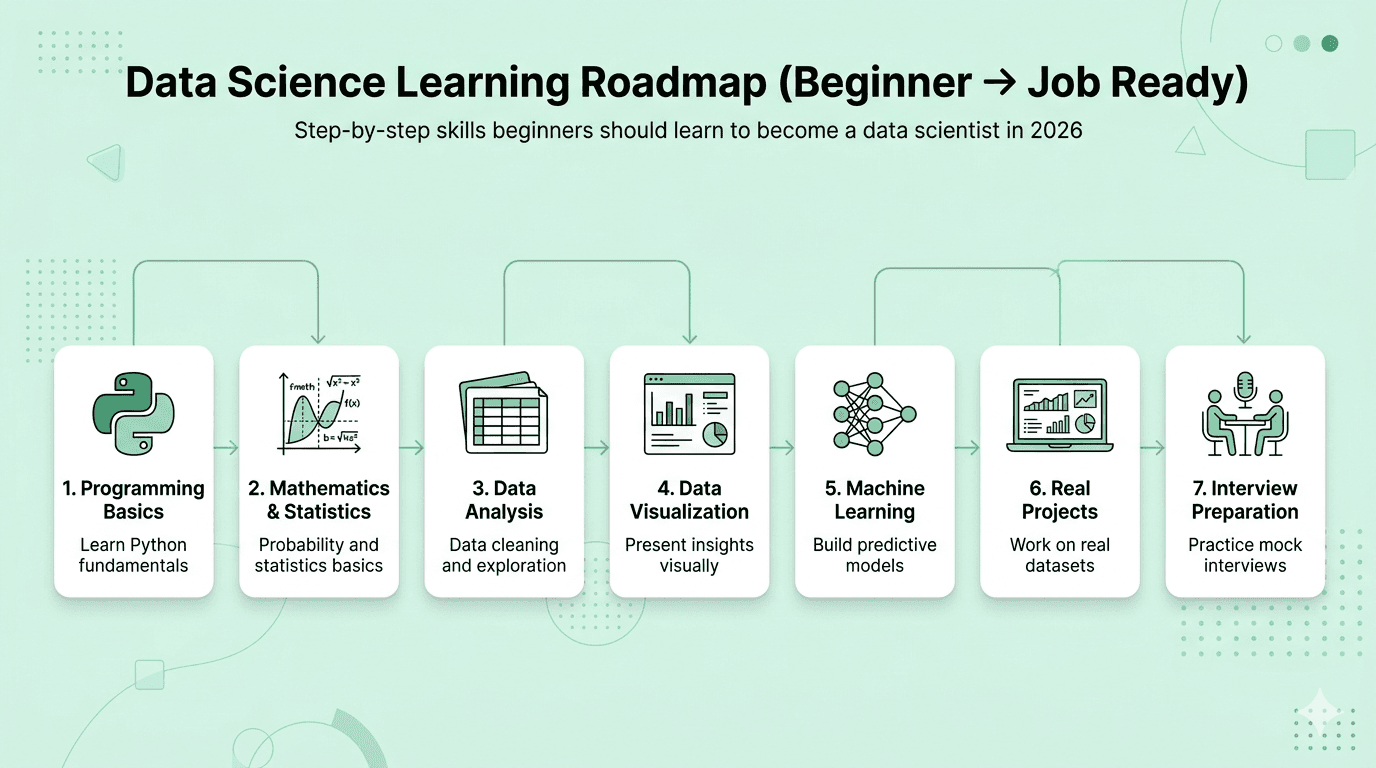
Here is a simple roadmap that beginners can follow. Step 1: Learn Programming. Start with Python and practice writing simple programs. Step 2: Learn Statistics and Mathematics. Understand probability, distributions, and basic statistical concepts. Step 3: Practice Data Analysis. Use datasets and analyze them using Python libraries like Pandas. Step 4: Learn Machine Learning. Study basic algorithms such as linear regression, decision trees, and logistic regression. Step 5: Learn the Basics of Deployment. Understand how a model gets served through an API and what MLOps means at a high level. Step 6: Build Projects. Create projects and upload them to GitHub. Projects show employers your practical skills.
How Can You Build Data Science Skills Faster?
Learning data science can feel overwhelming, but these tips can help you progress faster.
Work on Real Projects
Projects help you apply what you learn and build practical experience.
Read More: 10 Best Data Science Projects for Beginners
Participate in Competitions
Platforms like Kaggle provide datasets and competitions where you can practice data science.
Build a Portfolio
Create a GitHub portfolio that shows your projects and code.
Keep Learning New Tools
The field of data science evolves quickly. Staying updated with new tools and technologies, including generative AI tools, is important.
Read and Practice Regularly
Consistent learning and practice are the key to mastering data science.
Conclusion
Data science is an exciting and rewarding career. As companies continue to rely on data for decision-making, the demand for skilled data scientists will keep growing. The skills required to become a data scientist in 2026 include a mix of programming, statistics, machine learning, data analysis, and communication skills. Beginners should start with Python, statistics, and SQL, then gradually move toward machine learning and advanced AI tools. The most important thing is to keep learning and practicing. By building projects and improving your skills step by step, you can build a strong career in data science.