Loading...
Contents
Common Java Developer Interview Mistakes to Avoid in 2026
Oct 10, 202629 min read
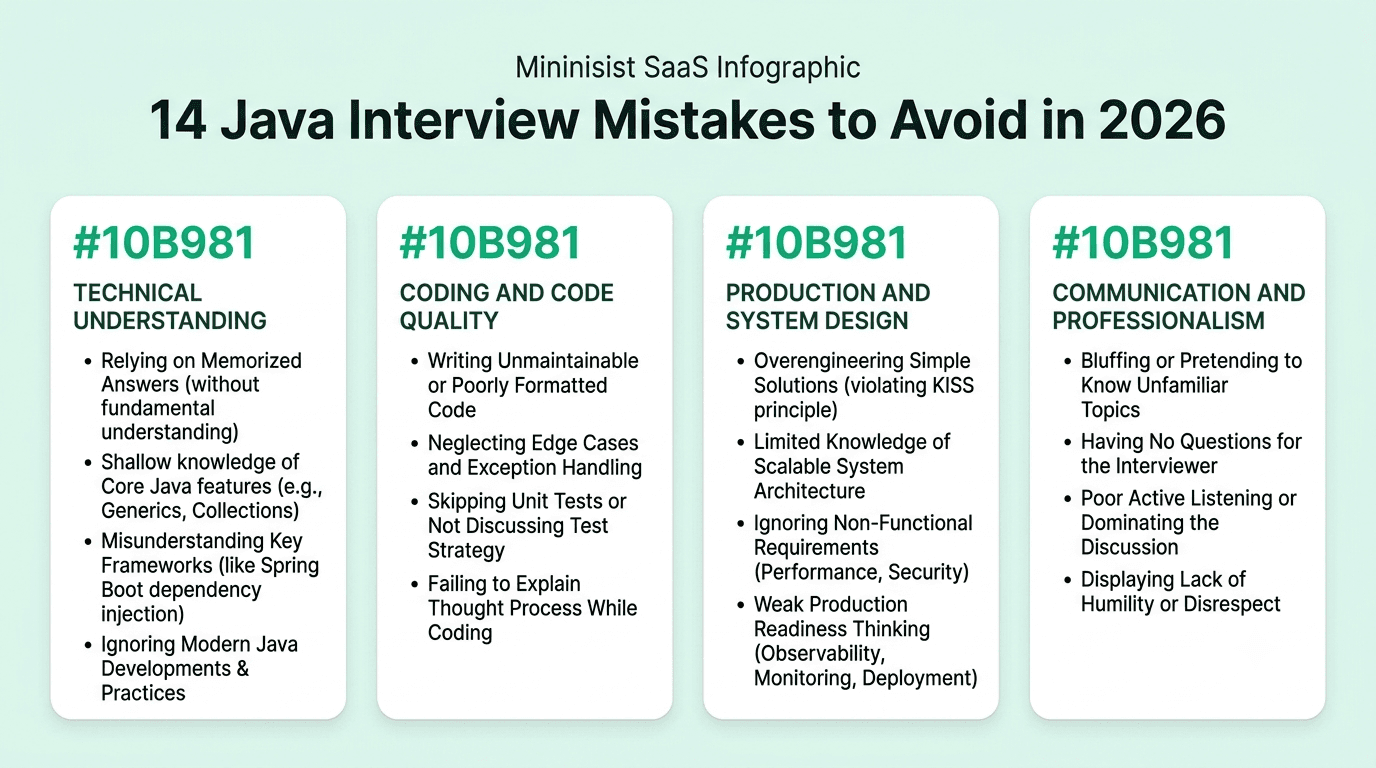
If you keep getting interviews for Java developer roles but the offers go to someone else, the problem is rarely that you do not know Java. Most of the time it is a small set of habits that make an interviewer doubt how you would behave on a real team. This guide walks through the mistakes that actually cost people offers, explains why each one matters from the interviewer's side of the table, and gives you a clear way to fix it. Not vague advice like "practice more." Real steps you can start this week.
Java interviews have a particular pattern. Because the language and the main framework are so widely used, many candidates arrive with the same preparation. They have memorized the same list of questions and built the same tutorial project. Interviewers know this, so they have learned to probe past the memorized layer. The candidates who stand out are the ones who can go one level deeper than the textbook, and who can explain what they actually did on real work.
Let's go through the mistakes one at a time.
FREE TO USE
25K+ INTERVIEWS4.8★ RATING68% IMPROVEMENT
Crack Your Dream Job
Real Interviews. Real Pressure. Practice until it feels easy.
- Seamless Interview Experience
- Resume & JD Questions
- Instant Personalized Feedback
Mistake 1: Memorizing answers instead of understanding the reason
What this looks like
Asked about the difference between an abstract class and an interface, or between HashMap and ConcurrentHashMap, the candidate recites a polished answer word for word. Then the interviewer asks a small follow up, such as "when would that difference actually cause a bug," and the candidate has nothing to say.
Why this hurts you
A memorized answer proves you read something. It does not prove you understand it. The follow up question is the real test, and most experienced interviewers are skilled at asking it. When the second question collapses, the interviewer assumes the first answer was also borrowed.
The real fix
For every concept you plan to discuss, prepare three layers. The definition in one sentence. A realistic situation where the difference matters. And a failure you could cause by getting it wrong. For example, with equals and hashCode, the definition is that equal objects must produce equal hash codes. The situation is using a custom object as a key in a map. The failure is that the object seems to disappear from the map because it lands in the wrong bucket.
Practice by picking ten core topics and explaining each out loud to someone, or to an empty room, until you can give all three layers without notes. If you cannot think of a real failure for a concept, write a tiny program that demonstrates one. Seeing it break once makes it far easier to remember and to explain.
Mistake 2: Listing Spring Boot on the resume without understanding what it does
What this looks like
The candidate has built several projects using Spring Boot, but when asked how dependency injection works, how auto configuration decides what to create, or what a transactional annotation actually does, the answers are vague. "It handles it for us" is a common one.
Why this hurts you
Spring Boot appears on almost every Java resume, so it tells the interviewer very little by itself. The questions about internals are how they find out whether you used the framework or just followed along with it. Developers who treat annotations as magic tend to struggle badly the first time something goes wrong.
The real fix
Learn the three or four mechanisms that explain most surprising Spring behavior. First, the container creates and wires objects, and you can ask it what it created. Second, auto configuration uses conditions, and you can see which conditions passed or failed by turning on the startup report. Third, many features such as transactions work through proxies, which is why calling a transactional method from another method in the same class often does not behave as expected. Fourth, lazy loading of database relationships only works while a session is open.
A strong practice exercise is to break things on purpose. Remove a bean and read the error. Call a transactional method from inside its own class and watch it fail to roll back. Seeing these failures yourself is worth more than reading about them.
In the interview, when you describe a feature, mention the mechanism. "The transaction annotation works through a proxy, which means it will not apply to a self call" is the kind of sentence that changes how an interviewer sees you.
Mistake 3: Never having looked at the SQL your code runs
What this looks like
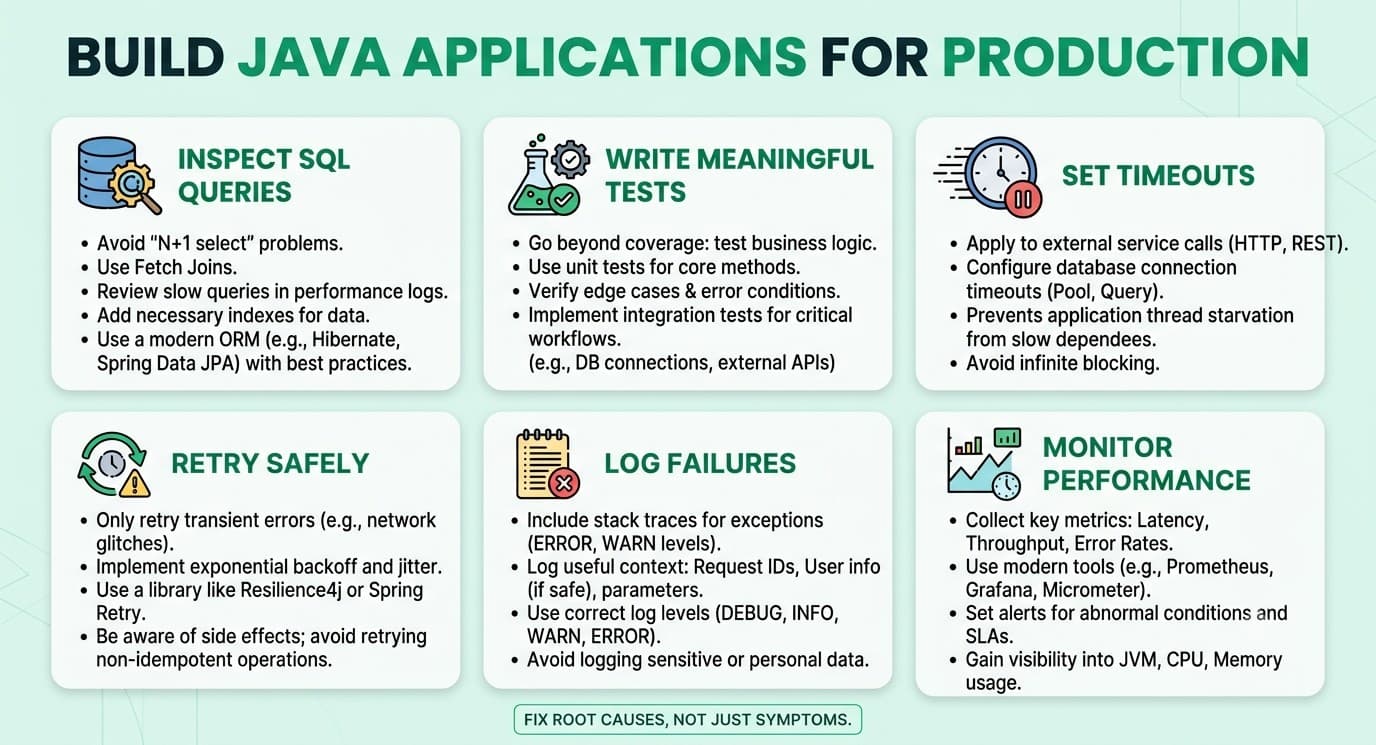
The candidate uses JPA and Hibernate daily but has never turned on query logging. Asked how they would fix a slow page, they suggest adding caching or more servers before ever mentioning the database queries.
Why this hurts you
A very large share of real performance problems in Java services come from the data layer, especially the case where one request quietly triggers hundreds of small queries. Interviewers who have fixed this problem several times listen for whether you think of it. Reaching for caching first suggests you treat the symptom, not the cause.
The real fix
Turn on SQL logging in one of your projects today and read every query it produces for a single page load. You will probably find something surprising. Then practice the diagnosis out loud. "First I would look at what queries are actually running for this request. If I see one query for the list followed by one more query per item, that is the extra query problem, and I would fix it by fetching the related data together or using a batch approach."
Also practice writing SQL directly. Many candidates rely so heavily on the mapping layer that they stumble on a basic join or grouped query. Spend a few hours writing queries without an assistant until joins, grouping, and filtering feel automatic. Learn to read a basic query plan and recognize when an index is being used.
Mistake 4: Skipping tests in take home assignments
What this looks like
The candidate delivers a working solution to the take home task with no tests, or with a single trivial test added at the end. The code runs, but nothing proves it keeps running after a change.
Why this hurts you
For many companies, the take home is the strongest signal they get. A missing test suite tells them that this person ships code without a safety net, and they will have to teach the habit. Many reviewers reject an otherwise good submission on this point alone, because they have many other submissions to compare it against.
The real fix
Treat tests as part of the deliverable, not an extra. Write unit tests for the core logic and at least a few integration tests that exercise the real stack, ideally with a real database running in a container rather than a mock that hides differences. Name tests so they describe behavior, such as "rejects an order with no items," not "test1."
Add a short README that explains how to run the tests, what you chose to test, and what you deliberately left out and why. That last part is powerful. "I did not test the email sending because it is a thin wrapper, but I would add a contract test if this were going to production" shows judgment, not laziness.
Do not chase a coverage percentage. Reviewers can tell the difference between tests that protect behavior and tests written to raise a number.
FREE TO USE
8k+ SESSIONS92% FLUENCY4.9★ RATING
Speak With Confidence
Real Conversations. Real Scenarios. Speak until it feels natural.
- Real-Time Speaking Practice
- Guided Conversation Flows
- Instant AI Feedback
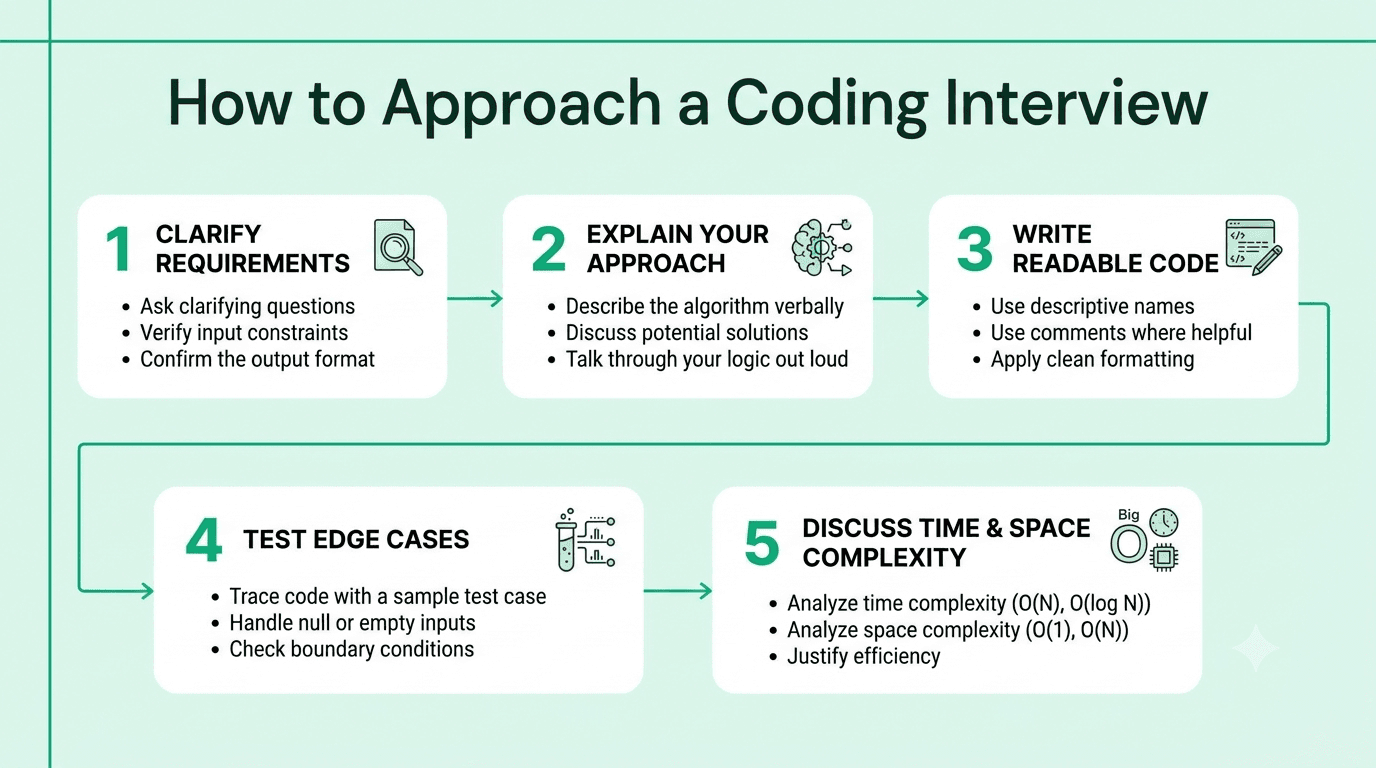
Mistake 5: Going silent while solving a coding problem
What this looks like
Given a problem, the candidate stares at the screen for a long time, then writes code in silence. If they get stuck, they stop speaking entirely and the interviewer watches awkwardly.
Why this hurts you
The interviewer is trying to understand how you think, and silence hides that completely. A candidate who says a wrong idea out loud, notices the flaw, and corrects it often scores higher than one who silently produces a correct answer, because the first person demonstrated the reasoning process the job requires.
The real fix
Use a simple routine every time. Restate the problem in your own words and ask a clarifying question or two. Describe a simple approach first, even if it is slow. Say what is wrong with it. Then improve it. While coding, narrate in short sentences about what you are doing and why. When you get stuck, say exactly where you are stuck. "I am not sure how to handle duplicates here, so let me try a small example by hand" is a perfectly good thing to say.
Practice this with a friend watching, or record yourself. Most people have never rehearsed thinking aloud under time pressure, and it is a skill separate from solving problems. After three or four sessions, it starts to feel natural.
Mistake 6: Treating Java 8 as the whole language
What this looks like
All of the candidate's examples use patterns from a decade ago. When asked about records, sealed classes, pattern matching, or virtual threads, the candidate has heard the names but has never used them.
Why this hurts you
Many companies have now moved to Java 17 or Java 21, and some are on newer versions. A candidate who has stopped learning at Java 8 suggests someone who has not kept up, and that is a concern for a field that changes steadily. You do not need to be an expert in everything, but being completely unaware is a visible gap.
The real fix
Spend a weekend rewriting a small old project with modern features. Replace data holder classes with records. Use switch expressions and pattern matching where they simplify the code. Try virtual threads on a simple program that makes many blocking calls. Then write down what got simpler and what did not.
In the interview, you do not need to claim expertise. A good answer sounds like this. "My main experience is on an older version, but I have been learning the newer features. I rewrote a project using records and pattern matching, and the data classes shrank a lot. I would want to look at how virtual threads would change how we handle blocking calls." This shows honesty and momentum, which interviewers value.
Mistake 7: Using streams and clever code to show off
What this looks like
In a live coding round, the candidate writes a single long chain of stream operations with nested collectors, proud of how compact it is. The interviewer struggles to read it, and the candidate struggles to explain it.
Why this hurts you
Readable code is a core skill. Teams spend far more time reading code than writing it, and a developer who prefers cleverness over clarity creates maintenance cost for everyone. Interviewers often prefer a plain loop that is obviously correct over a clever expression that takes a minute to decode.
The real fix
Adopt a simple rule for interviews. Write the clearest version first, even if it is longer. Use a stream when it genuinely makes the code easier to read, usually for straightforward filtering and mapping. Switch to a loop when the logic involves several steps or early exits. Use meaningful variable names, and break complicated expressions into named steps.
Practice by taking solutions you have written and rewriting them for readability, then asking someone else to read them without explanation. If they understand it quickly, you are on the right track.
Mistake 8: Ignoring what happens when a call fails or is slow
What this looks like
Asked to design a service that calls another service, the candidate describes the happy path in detail and never mentions timeouts, retries, or what happens if the other service is down.
Why this hurts you
In production, remote calls fail and slow down constantly. A design with no handling for this signals someone who has not yet lived through an outage caused by a missing timeout, which is one of the most common causes of cascading failures. Interviewers listen specifically for this.
The real fix
Make failure handling a fixed closing step for any design answer. Run through these questions out loud. What is the timeout on this call. Is it safe to retry, and if so how many times, with what delay. What happens to the user if the downstream system stays down. How will we find out it is failing.
For example, after describing an order service, add this. "I would set a short timeout on the payment call and only retry operations that are safe to repeat, using an idempotency key so a retry cannot charge the customer twice. If the payment service is down, I would return a clear error and queue the order for follow up rather than leave the user guessing."
To build the instinct, take a project and deliberately make a dependency slow or broken, then watch what your service does. Fixing what you find gives you a real story to tell.
Mistake 9: Over designing for scale nobody asked for
What this looks like
Asked to design a small internal tool, the candidate immediately proposes microservices, message queues, multiple databases, and a caching layer for a system used by fifty people.
Why this hurts you
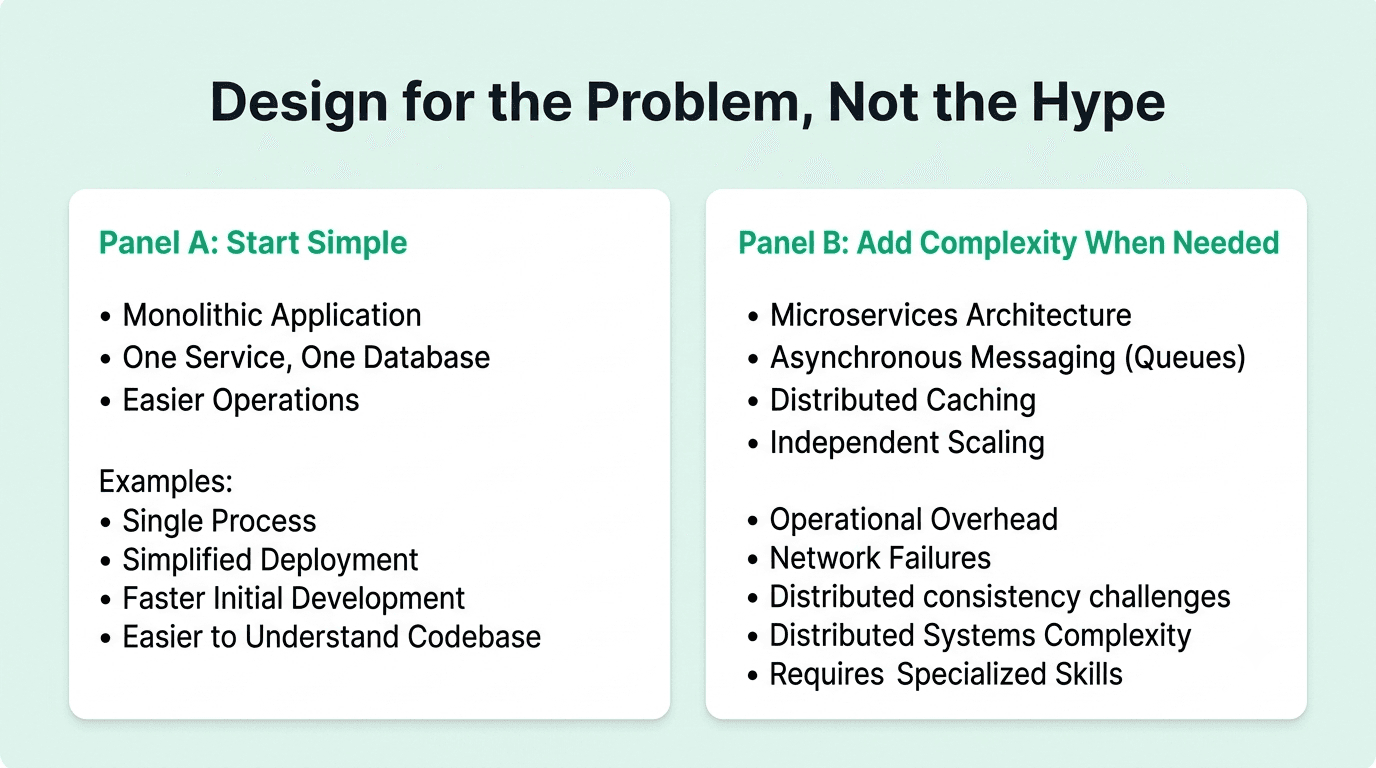
Right sizing a solution is one of the clearest signs of experience. Over engineering suggests someone who has absorbed many best practices without ever having to justify the cost and complexity to a team that must maintain it.
The real fix
Before proposing anything, ask about the expected load, team size, and growth. If you cannot ask, state your assumptions. Then present a simple version first. "I would start with a single service and one database, since that is easy to build and run. I would only split it when a specific need appears, like different scaling requirements or separate teams needing independent releases."
Whenever you propose something advanced, name its cost as well as its benefit. Microservices help teams work independently but add network failures and operational work. Caching improves speed but introduces stale data. Stating the tradeoff without being asked is one of the strongest senior signals you can give.
Mistake 10: Having no production story
What this looks like
Asked about a difficult bug or incident, the candidate describes something vague like "there was an issue and we fixed it," with no detail about how they found the cause.
Why this hurts you
Real experience shows up in detail. A story with logs, a wrong guess, and a verified cause is almost impossible to fake, and a vague story is easy to see through. When the interviewer probes and finds nothing underneath, trust drops quickly.
The real fix
Prepare two real stories in advance using a simple order. What was the symptom. What did you suspect first, and why was it wrong. How did you narrow it down, such as logs, a thread dump, or query logging. What was the actual cause. What did you change so it would not happen again.
Include the wrong turn. A story where your first idea was wrong sounds much more real than a perfect one. Keep it under two minutes when spoken, and practice it aloud until it flows without reading.
If you genuinely lack production experience, create one. Run a project under load, cause a problem such as a slow query or a thread leak, and diagnose it with proper tools. Then you can honestly describe what you found and how.
Mistake 11: Using AI tools badly, or lying about not using them
What this looks like
Asked whether they use AI coding assistants, the candidate either claims they never do, which sounds unrealistic and out of date, or describes accepting generated code without checking it.
Why this hurts you
Interviewers are not testing whether you use these tools. They know almost everyone does. They are testing whether you verify the output, because unreviewed generated code has caused real problems, such as invented library methods and subtle concurrency mistakes.
The real fix
Prepare a specific answer with a real example. Say what tool you use, give one concrete task, and describe exactly how you checked the result. "I used an assistant to draft a data export function. It worked on small data but loaded the whole table into memory, which I caught in review and replaced with streaming" is a strong answer, because it shows both productive use and careful checking.
Keep a short personal list of times an assistant gave you wrong code. It calibrates your trust, and it gives you honest examples for interviews.
Mistake 12: Bluffing instead of saying you do not know
What this looks like
Asked about something unfamiliar, such as a specific framework feature or a concurrency detail, the candidate produces a confident but wrong answer rather than admitting the gap.
Why this hurts you
Experienced interviewers usually notice when someone is bluffing, and it costs far more trust than an honest gap would have. In a job where wrong confidence causes outages, honesty about uncertainty is valued highly.
The real fix
Prepare a confident way to say you do not know. A good template is this. "I have not used that directly. Here is what I do know that is related, and here is how I would find the answer. I would check the documentation, try it in a small test project, and ask someone on the team who has used it."
This often scores better than a lucky guess, because it shows method and honesty together. Practice saying it out loud so it does not feel awkward under pressure.
Mistake 13: Talking only about code, never about people
What this looks like
In a behavioral round, every story is about solving a technical problem alone. No mention of teammates, disagreements, code reviews, or helping someone else.
Why this hurts you
Software is built by teams. If every story is solo, the interviewer cannot tell how you work with others, and many hiring decisions come down to whether people want to work with you.
The real fix
Prepare stories that include other people. A disagreement in a code review and how it was resolved. A time you helped a newer developer. A time you pushed back on a deadline with reasons. When telling any story, mention who else was involved and what you learned from them.
When describing disagreement, focus on the problem and not the person. "We disagreed about whether to add a cache, so we measured the actual query time and found the cache was not needed yet" shows a healthy way of resolving conflict.
Mistake 14: Having no questions at the end
What this looks like
When asked "do you have any questions for us," the candidate says no, or asks only about salary and vacation.
Why this hurts you
This is often the last impression you leave. No curiosity about the actual work suggests you have not thought carefully about whether the role fits, or that you are applying everywhere.
The real fix
Prepare three or four specific questions. How are releases done and how often. What is the testing approach and how fast does the build run. What does an on call week look like. What is the team's plan for moving to newer Java versions. What was the most recent production problem and what changed because of it.
These questions help you decide whether the team is a good place to work, and they show that you think like someone who will actually run and maintain the system.
A quick way to check yourself before your next interview
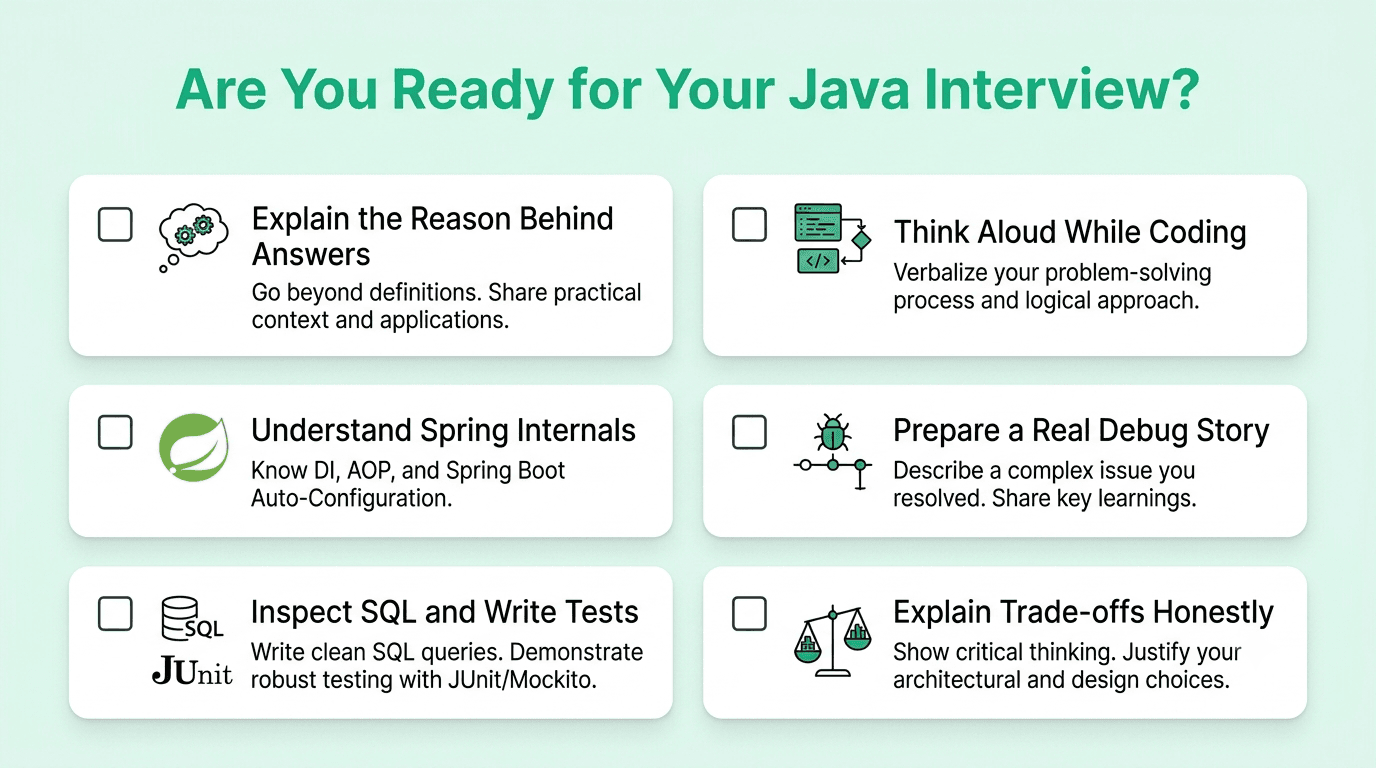
Be honest with yourself on each of these.
Can you explain the reason behind your answers, not just the definition. Can you describe the mechanism behind Spring features like transactions and auto configuration. Have you read the SQL your own code generates. Do your assignments include meaningful tests and a short README. Do you talk through your thinking while solving problems. Have you used at least a few modern Java features in real code. Do you write clear code rather than clever code. Do you mention timeouts, retries, and failure handling in designs. Do you right size your designs and state tradeoffs. Do you have two real debugging stories with a wrong turn in them. Do you have an honest answer about how you verify AI generated code. Do you have a calm way to say you do not know something. Do your stories include other people. Do you have specific questions prepared for the interviewer.
If many of these are unchecked, do not worry. Pick the three that matter most for the roles you are applying to and work on those first. Turning on SQL logging, writing real tests, and preparing one honest debugging story will fix several of these at once.