Loading...
Contents
Top 50 Data Science Interview Questions and Answers for freshers in 2026
May 1, 202641 min readUpdated Sep 24, 2026
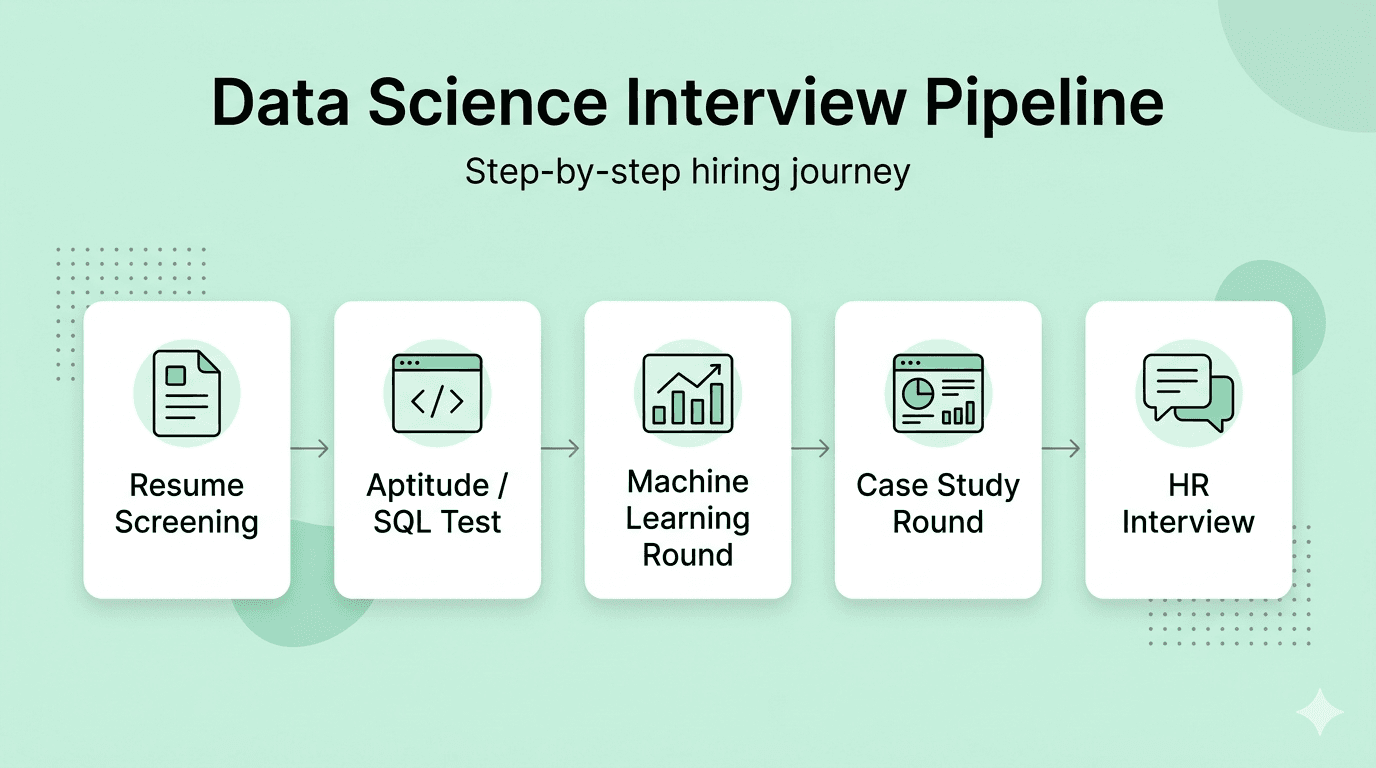
Data science is one of the fastest-growing career fields today. Many companies are looking for skilled data scientists who can analyze data, build machine learning models, and help businesses make better decisions. Because of this high demand, data science interviews can be competitive. If you are preparing for a job in this field, it is important to understand the most common data scientist interview questions. Recruiters often test your knowledge of statistics, machine learning, Python, and data analysis concepts. In this data science interview questions guide, we will cover the Top 50 Data Science Interview Questions and Answers for freshers in 2026. These questions are useful for beginners, freshers, and even experienced professionals who want to revise key concepts before an interview.
FREE TO USE
25K+ INTERVIEWS4.8★ RATING68% IMPROVEMENT
Crack Your Dream Job
Real Interviews. Real Pressure. Practice until it feels easy.
- Seamless Interview Experience
- Resume & JD Questions
- Instant Personalized Feedback
Basic Data Science Interview Questions (for freshers)
These are some common data science interview questions for freshers. They test your understanding of basic concepts.
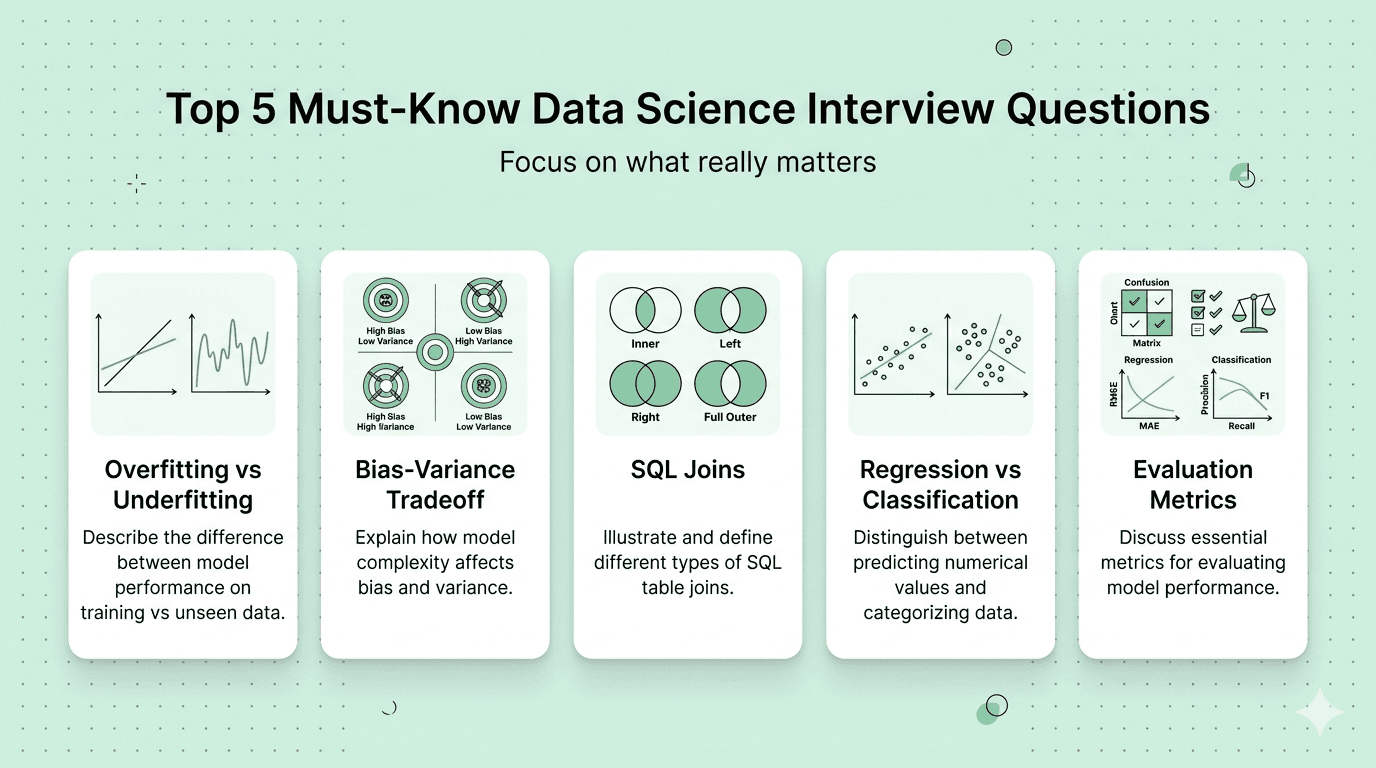
1. What is Data Science? Data science is the process of collecting, analyzing, and interpreting data to extract useful insights and support decision-making. It combines multiple fields like statistics, programming, and machine learning. Data scientists work with structured and unstructured data to solve real-world problems. For example, they help companies predict customer behavior, detect fraud, or improve product recommendations. In simple terms, data science turns raw data into meaningful information that businesses can use to make better decisions. 2. What is the difference between Data Science and Data Analytics? Data science and data analytics are closely related but have different goals. Data analytics focuses on analyzing past data to understand what happened and why it happened. On the other hand, data science goes a step further. It uses advanced techniques like machine learning to predict future outcomes and automate decision-making. While data analysts mainly work with reports and dashboards, data scientists build predictive models and work on more complex problems. 3. What is Machine Learning? Answer: Machine learning is a branch of artificial intelligence that allows computers to learn patterns from data without being explicitly programmed. Instead of writing rules manually, we provide data to the model, and it learns from that data to make predictions or decisions. For example, a spam filter learns to identify spam emails based on past examples. Machine learning is widely used in applications like recommendation systems, fraud detection, and image recognition. 4. What are the types of Machine Learning? There are three main types of machine learning: supervised learning, unsupervised learning, and reinforcement learning. In supervised learning, the model is trained using labeled data, meaning the correct output is already known. In unsupervised learning, the model finds patterns in unlabeled data. Reinforcement learning is based on rewards and penalties, where the model learns by interacting with an environment. Each type is used for different kinds of problems. 5. What is a dataset? A dataset is a collection of data that is used for analysis or training machine learning models. It can be structured (like tables) or unstructured (like text or images). A typical dataset contains rows (records) and columns (features). For example, a dataset of customers may include columns like age, income, and purchase history. The quality of the dataset is very important because better data leads to better insights and more accurate models.
Statistics-Based Questions
6. What is mean, median, and mode? Mean, median, and mode are basic statistical measures used to understand data distribution. The mean is the average of all values. The median is the middle value when the data is sorted. The mode is the value that appears most frequently. Each measure is useful in different situations. For example, median is better when there are outliers, while mean gives an overall average. 7. What is standard deviation? Standard deviation measures how much the data values are spread out from the mean. It helps us understand the variability in the dataset. If the standard deviation is low, it means the data points are close to the mean. If it is high, the data is more spread out. This concept is important in data science because it helps identify consistency and detect unusual patterns in data. 8. What is probability? Probability is a measure of how likely an event is to occur. It ranges from 0 to 1, where 0 means the event will not happen and 1 means it will definitely happen. For example, the probability of getting heads in a coin toss is 0.5. In data science, probability is used in predictive modeling and decision-making. It helps models estimate outcomes based on uncertainty and patterns in data. 9. What is hypothesis testing? Hypothesis testing is a statistical method used to test assumptions about a dataset. It helps determine whether a certain claim is true or false. We start with a null hypothesis (assumption) and an alternative hypothesis. Then we use data to decide whether to reject the null hypothesis. This method is widely used in experiments and A/B testing to make data-driven decisions. 10. What is the normal distribution? Normal distribution is a type of data distribution where values are symmetrically distributed around the mean, forming a bell-shaped curve. Most real-world data, such as height or exam scores, follows this distribution. In a normal distribution, mean, median, and mode are equal. It is important in data science because many algorithms assume that data follows a normal distribution.
Data Cleaning & Preprocessing
11. What is data cleaning? Data cleaning is the process of preparing data by fixing errors, removing duplicates, and handling missing values. Raw data is often messy and contains incorrect or incomplete information. Cleaning the data ensures that it is accurate and reliable for analysis. This step is very important because poor-quality data can lead to incorrect insights and bad model performance. 12. How do you handle missing values? Missing values can be handled in different ways depending on the situation. One common method is removing rows or columns with too many missing values. Another approach is filling missing values using mean, median, or mode. In some cases, advanced techniques like interpolation or predictive models are used. The choice depends on the dataset and how important the missing data is. 13. What are outliers? Outliers are data points that are very different from the rest of the data. They can occur due to errors or rare events. For example, if most salaries are between 20k–50k and one value is 5 lakh, it may be an outlier. Outliers can affect model performance, so they should be carefully analyzed and handled using techniques like removal or transformation. 14. What is feature scaling? Feature scaling is the process of normalizing data so that all features are on a similar scale. Some machine learning algorithms, like KNN and SVM, are sensitive to the scale of data. Without scaling, features with larger values can dominate the model. Common techniques include Min-Max scaling and standardization. 15. What is encoding? Encoding is the process of converting categorical data into numerical form so that machine learning models can understand it. For example, categories like “Male” and “Female” can be converted into numbers. Common methods include label encoding and one-hot encoding. Encoding is necessary because most algorithms work only with numerical data.
Machine Learning Questions
16. What is overfitting? Overfitting occurs when a model learns the training data too well, including noise and irrelevant details. As a result, the model performs very well on training data but poorly on new or unseen data. This means it does not generalize well. Techniques like cross-validation, regularization, and using more data can help reduce overfitting. 17. What is underfitting? Underfitting happens when a model is too simple to capture the underlying patterns in the data. It performs poorly on both training and test data because it fails to learn important relationships. To fix underfitting, we can use more complex models, add more features, or improve feature engineering. 18. What is a regression model? A regression model is used to predict continuous numerical values, such as price, temperature, or sales. For example, predicting house prices based on features like size, location, and number of rooms. Regression models help understand relationships between variables and are widely used in forecasting. 19. What is classification? Classification is a type of machine learning problem where the output is a category or class. For example, predicting whether an email is spam or not spam. Common algorithms include logistic regression, decision trees, and random forests. It is widely used in fraud detection, medical diagnosis, and customer segmentation. 20. What is a confusion matrix? A confusion matrix is a table used to evaluate the performance of a classification model. It shows the number of correct and incorrect predictions, including true positives, true negatives, false positives, and false negatives. This helps us understand how well the model is performing and where it is making mistakes.
FREE TO USE
8k+ SESSIONS92% FLUENCY4.9★ RATING
Speak With Confidence
Real Conversations. Real Scenarios. Speak until it feels natural.
- Real-Time Speaking Practice
- Guided Conversation Flows
- Instant AI Feedback
Advanced Machine Learning Questions
21. What is cross-validation? Cross-validation is a technique used to evaluate how well a machine learning model performs on unseen data. Instead of splitting the dataset once, it divides the data into multiple parts (folds). The model is trained on some folds and tested on the remaining fold. This process is repeated multiple times. It helps reduce overfitting and gives a more reliable estimate of model performance. One common method is k-fold cross-validation. 22. What is bias vs variance? Bias and variance are two types of errors in machine learning models. Bias occurs when a model is too simple and fails to capture patterns in the data. Variance occurs when a model is too complex and learns noise instead of actual patterns. A good model should balance both bias and variance. High bias leads to underfitting, while high variance leads to overfitting. 23. What is feature engineering? Feature engineering is the process of creating new features or improving existing ones to make machine learning models perform better. It includes techniques like combining variables, extracting useful information, or transforming data. Good feature engineering can significantly improve model accuracy without changing the algorithm. It is considered one of the most important steps in a data science project. 24. What is hyperparameter tuning? Hyperparameter tuning is the process of finding the best settings for a machine learning model to improve its performance. These parameters are not learned from data but are set before training the model. Techniques like Grid Search and Random Search are commonly used to find the best combination. Proper tuning can greatly improve accuracy and reduce errors. 25. What is gradient descent? Gradient descent is an optimization algorithm used to minimize errors in machine learning models. It works by adjusting model parameters step by step in the direction that reduces the error. The algorithm keeps updating values until it reaches the lowest possible error. It is widely used in training models like linear regression and neural networks.
Programming & Tools Questions
26. Why is Python used in data science? Python is widely used in data science because it is simple, easy to learn, and has a large number of powerful libraries. Libraries like Pandas, NumPy, Matplotlib, and Scikit-learn make data analysis and machine learning easier. It also has strong community support and is widely used in industry. Python allows faster development and is suitable for beginners and experts. 27. What is Pandas? Pandas is a Python library used for data manipulation and analysis. It provides data structures like DataFrames, which allow you to work with data in a table format. You can use Pandas to clean data, filter rows, handle missing values, and perform analysis. It is one of the most important tools for any data scientist. 28. What is NumPy? NumPy is a Python library used for numerical computations and working with arrays. It provides fast operations on large datasets and supports mathematical functions. NumPy arrays are more efficient than regular Python lists. It is widely used for calculations in data science and machine learning. 29. What is SQL? SQL (Structured Query Language) is used to manage and query data stored in databases. It allows you to retrieve, filter, update, and organize data. Data scientists use SQL to extract data from databases for analysis. It is an essential skill for working with real-world data. 30. What is data visualization? Data visualization is the process of representing data using charts, graphs, and plots. It helps in understanding patterns, trends, and relationships in data. Common tools include Matplotlib, Seaborn, Tableau, and Power BI. Visualization makes it easier to communicate insights to others.
Scenario-Based Questions
31. How do you start a data science project? A data science project usually starts with understanding the problem clearly. You need to define the objective and what you want to achieve. Next, you collect relevant data and perform data cleaning to ensure quality. After that, you explore the data, build models, and evaluate their performance. Finally, you present insights and deploy the model if needed. 32. How do you choose a machine learning model? Choosing a model depends on the type of problem, such as classification or regression. You also consider the size of the dataset, number of features, and required accuracy. Usually, multiple models are tested, and their performance is compared. The best model is selected based on evaluation metrics and performance. 33. How do you improve model accuracy? Model accuracy can be improved by cleaning data, handling missing values, and removing outliers. Feature engineering also plays a key role in improving performance. Hyperparameter tuning helps optimize model settings. Using more data and trying different algorithms can also improve results. 34. What if your model performs poorly? If a model performs poorly, the first step is to check data quality. You should verify if there are missing values, incorrect data, or outliers. Then, try different models and improve feature selection. Also check for overfitting or underfitting and adjust the model accordingly. 35. How do you explain results to non-technical people? To explain results to non-technical people, use simple language and avoid technical terms. Focus on insights and what they mean for the business. Use charts and visualizations to make explanations easier. Always connect your findings to real-world impact and decisions. Read more: 10 Best Data Science Projects for Beginners
Real-World & Behavioral Questions
36. What is your favorite data science project? This question allows you to showcase your practical experience. You should describe a project where you solved a real-world problem using data. Explain the problem, your approach, tools used, and the results achieved. Also mention challenges you faced and how you solved them. 37. How do you handle large datasets? Large datasets can be handled using tools like Hadoop or Spark. You can also optimize code and use efficient data structures. Breaking data into smaller chunks can make processing easier. Cloud platforms are also used to store and process large data. 38. What challenges have you faced in data science? Common challenges include missing data, poor data quality, and model performance issues. Sometimes, data is not available in the required format. Another challenge is choosing the right model and features. You should explain how you solved these problems in your projects. 39. How do you stay updated in data science? You can stay updated by reading blogs, research papers, and industry news. Practicing on platforms like Kaggle helps improve skills. Following experts and communities also helps in learning new trends. Continuous learning is very important in data science. 40. Why do you want this data science role? You should connect your skills and interests with the job role. Explain your passion for working with data and solving problems. Mention how your knowledge can help the company. Also show your willingness to learn and grow.
Advanced & Conceptual Questions
41. What is deep learning? Deep learning is a subset of machine learning that uses neural networks with multiple layers. It is used to process complex data like images, audio, and text. Deep learning models automatically learn features from data. It is widely used in applications like facial recognition and speech processing. 42. What is NLP? Natural Language Processing (NLP) is a field of data science that deals with text and language data. It helps machines understand, interpret, and generate human language. Examples include chatbots, sentiment analysis, and language translation. NLP is widely used in modern applications like virtual assistants. 43. What is time series analysis? Time series analysis involves analyzing data collected over time. It is used to identify trends, patterns, and seasonal variations. This type of analysis is useful in forecasting future values. Examples include stock price prediction and sales forecasting. 44. What is clustering? Clustering is an unsupervised learning technique used to group similar data points. It helps identify patterns without using labeled data. Common algorithms include K-means and hierarchical clustering. It is used in customer segmentation and pattern recognition. 45. What is dimensionality reduction? Dimensionality reduction is the process of reducing the number of features in a dataset. It helps simplify models and reduce computation time. It also removes redundant or less important features. This improves model performance and visualization. 46. What is PCA? Principal Component Analysis (PCA) is a technique used for dimensionality reduction. It transforms data into a smaller set of variables called principal components. These components capture most of the important information. PCA helps reduce complexity while retaining useful data. 47. What is ensemble learning? Ensemble learning combines multiple models to improve performance. Instead of relying on one model, it uses several models together. Techniques like Random Forest and Boosting are examples. It usually gives better accuracy than individual models. 48. What is A/B testing? A/B testing is a method of comparing two versions to see which performs better. It is commonly used in marketing and product testing. Users are divided into two groups, and each group sees a different version. The results help in making data-driven decisions. 49. What is ROC-AUC? ROC-AUC is a performance metric used for classification models. ROC stands for Receiver Operating Characteristic curve. It shows the trade-off between true positive rate and false positive rate. A higher AUC value indicates a better model. 50. What is model deployment? Model deployment is the process of making a machine learning model available for real-world use. After training and testing, the model is integrated into applications or systems. It can be deployed using APIs, cloud platforms, or web apps. Deployment allows businesses to use predictions in real-time.
Tips to Prepare for Data Science Interviews
Preparing for interviews requires more than just reading questions. Here are some useful tips: Many companies test programming skills through coding problems. Building projects helps you understand real-world problems. Strong theoretical knowledge is important for interviews. Most data science jobs require Python and SQL knowledge. Mock interviews help you improve communication and confidence. Platforms like Mocklingo allow candidates to practice interviews and receive feedback before facing real job interviews.Practice coding regularly
Work on real projects
Learn statistics and machine learning fundamentals
Study Python and data analysis tools
Practice mock interviews
Conclusion
Preparing for a data science job interview can feel challenging, especially for beginners. However, understanding the most common concepts can make the process much easier. The best way to prepare is to practice regularly, build projects, and focus on understanding the concepts instead of memorizing answers. With consistent practice and preparation, you can improve your confidence and increase your chances of getting a data science job. Read More: 50 Best AI Prompts for Data Science in 2026