Loading...
Contents
Why Do I Keep Failing Business Analyst Interviews Even After Months of Prep?
Here's What It Was
May 15, 202611 min readUpdated Oct 6, 2026
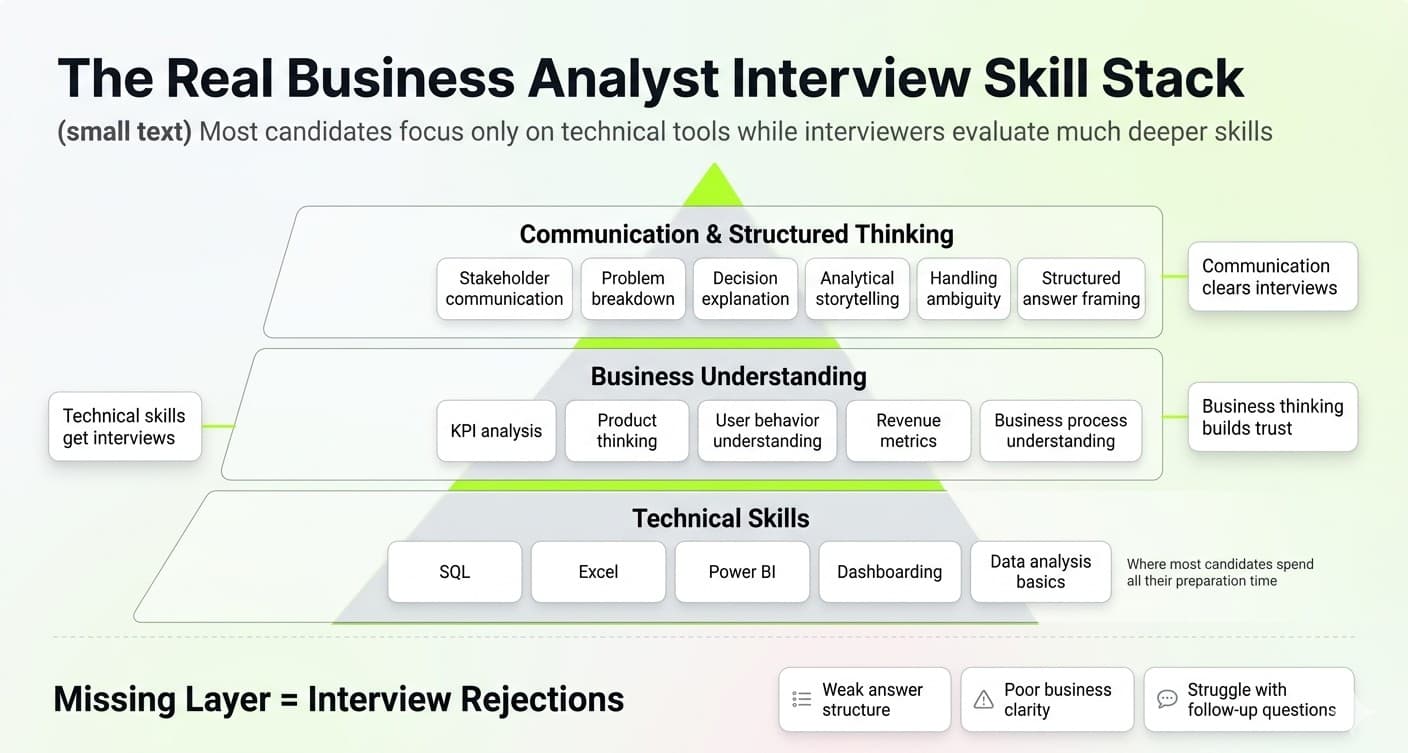
You keep failing business analyst interviews not because you lack knowledge, but because you are answering questions like a student instead of thinking like a business analyst. Most candidates prepare the wrong way, and interviewers can tell within the first five minutes.
FREE TO USE
25K+ INTERVIEWS4.8★ RATING68% IMPROVEMENT
Crack Your Dream Job
Real Interviews. Real Pressure. Practice until it feels easy.
- Seamless Interview Experience
- Resume & JD Questions
- Instant Personalized Feedback
The Moment I Realized Preparation Was Not the Problem
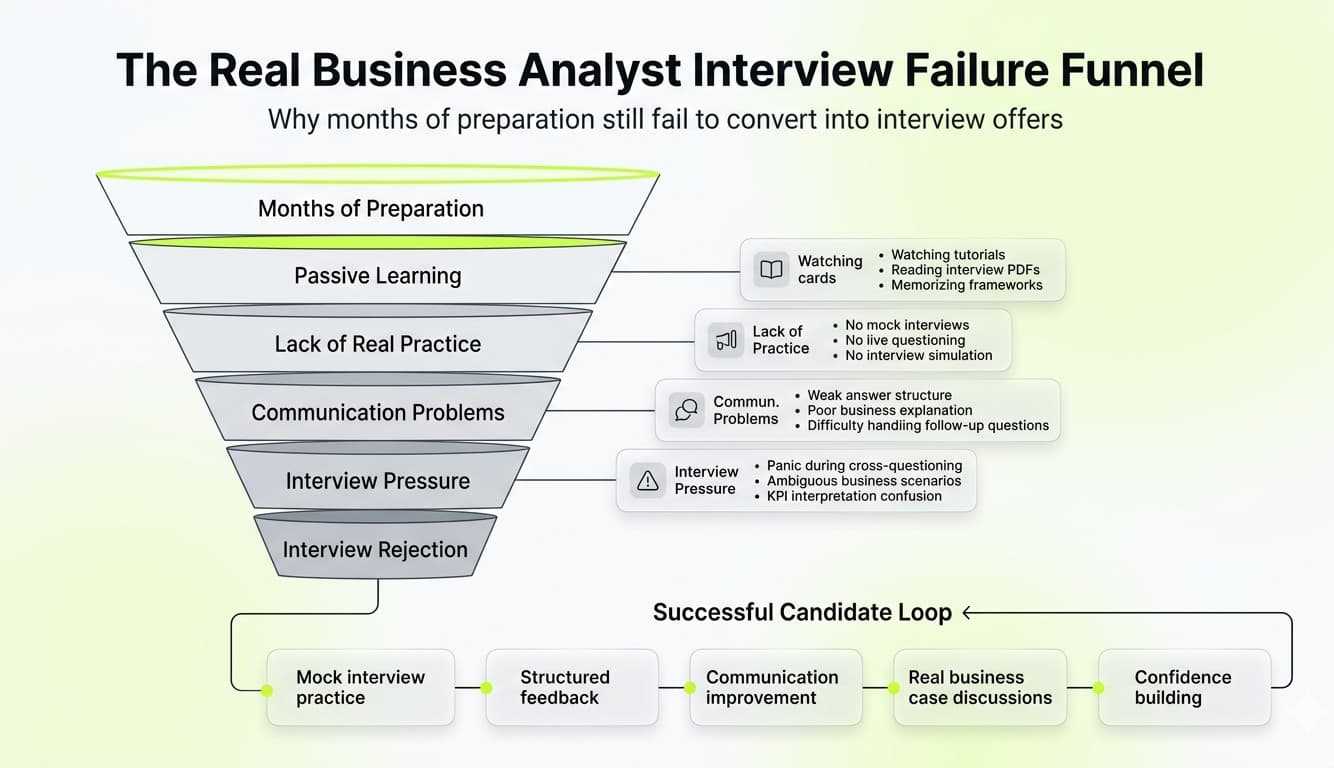
Six months of prep. Dozens of mock interviews. Every popular book on business analysis dog-eared and highlighted. And still, the rejection emails kept coming. If this sounds familiar, you are not alone. Every week, hundreds of BA candidates walk into interviews feeling confident, only to walk out confused. Not because they did not prepare. But because they prepared for the wrong thing entirely. Here is the uncomfortable truth: failing business analyst interviews after months of preparation usually means one specific thing. You have been memorizing answers instead of building the mindset.
Why Most BA Interview Prep Fails You (The Real Problem)
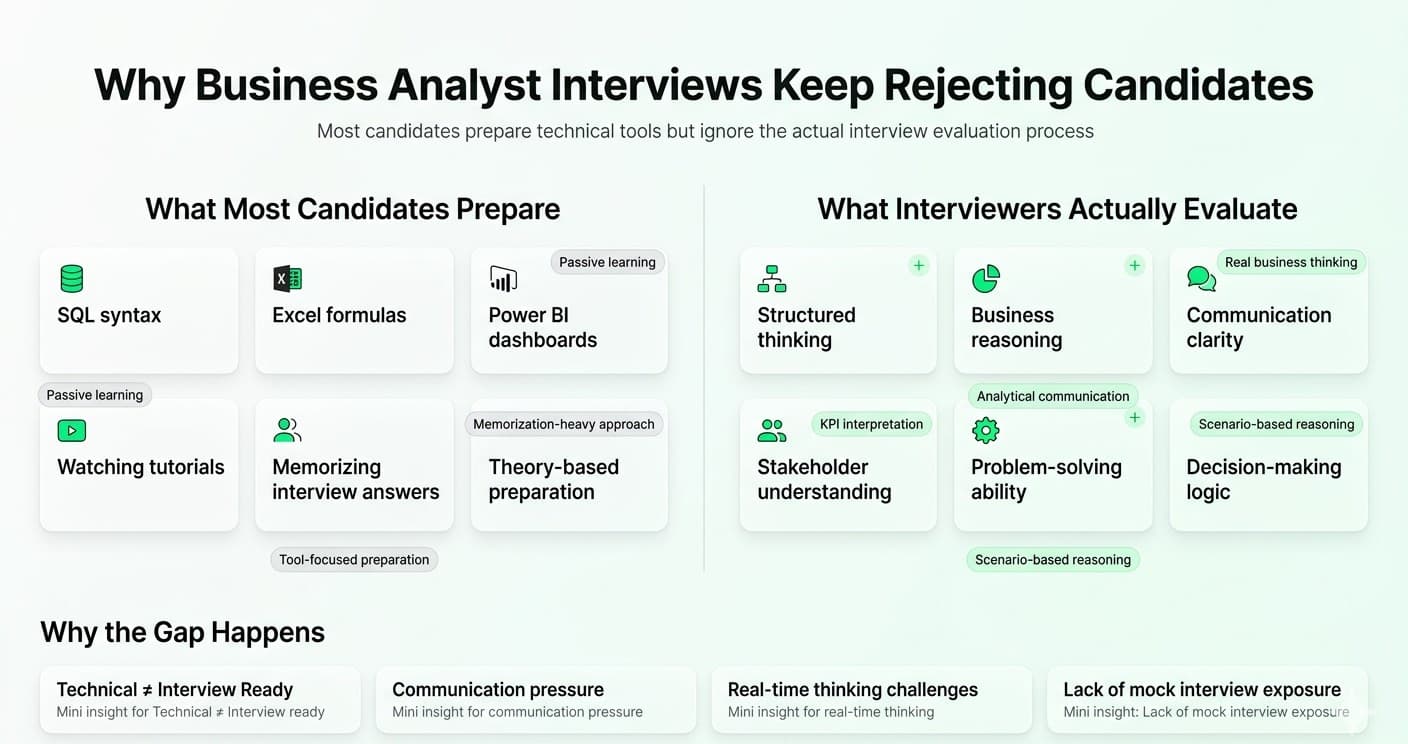
When candidates research business analyst interview questions, they find lists. "Tell me about a time you gathered requirements." "How do you handle conflicting stakeholder priorities?" "What is the difference between functional and non-functional requirements?" So they prepare answers. Clean, polished, rehearsed answers. And they walk into the interview sounding like a Wikipedia article on business analysis. Interviewers are not looking for definitions. They are evaluating whether you think like someone who can sit in a room full of confused stakeholders, untangle a messy problem, and translate it into something a development team can actually build. That is a thinking skill. Not a recall skill.
The Three Most Common Business Analyst Interview Mistakes
Mistake 1: You answer what was asked, not what they meant When an interviewer asks "How do you gather requirements?", they are not expecting a textbook walkthrough of interviews, workshops, and document analysis. They want to know if you understand that requirements gathering is fundamentally about managing people, not collecting information. The best candidates talk about resistance, ambiguity, and political dynamics. The average ones list techniques. Mistake 2: You talk about process instead of outcomes Business analyst interview preparation guides love to teach you frameworks. SWOT analysis, use case diagrams, BRD structures. And those matter. But interviewers remember candidates who connect every process to a business outcome. "I built the use case diagram" means nothing. "I built the use case diagram, which helped us catch a $200,000 integration gap before development started" means everything. Mistake 3: You forget that BA interviews are themselves a test of your BA skills Here is the part nobody tells you. A business analyst interview is a simulation. Every question is a poorly defined problem. Every answer is a requirements gathering session. The interviewer is watching how you handle ambiguity, how you ask clarifying questions, and whether you can structure your thinking in real time. Most candidates treat the interview like a test. The best candidates treat it like a stakeholder meeting.
What Actually Works: How to Fix Your Business Analyst Interview Preparation
Before every interview, research the company. Not their values page. Their actual business challenges. What market are they in? What problems are they likely solving? What does a BA in their industry actually spend their days doing? When you walk in understanding their world, your answers become specific and credible instead of generic and forgettable. Take any answer you have prepared and ask yourself: "So what?" Keep asking until you reach a number, a decision, or a risk avoided. Interviewers remember outcomes. Everything else fades. Instead of: "I facilitated a requirements workshop with the product team." Say: "I facilitated a requirements workshop that revealed we had three different interpretations of the same feature, which would have caused a two-sprint delay if we had missed it." One of the most powerful business analyst interview tips is deceptively simple. Stop rehearsing answers. Start rehearsing thinking. When you get a case-style question or a scenario, narrate your reasoning process. Say things like "My first question would be..." or "Before I could answer that, I would need to understand..." This shows analytical thinking in action, which is exactly what the interviewer wants to see. When an interviewer asks something broad or ambiguous, most candidates panic and rush to answer. Experienced BAs pause and ask a clarifying question. "Before I answer that, could you tell me a bit more about the context?" or "Are you thinking about this from a technical or business process angle?" This one habit, asking smart clarifying questions, does more for your interview performance than any amount of memorizing business analyst interview questions.Start With the Business Problem, Not the Job Description
Reframe Every Answer Around Impact
Practice Thinking Out Loud, Not Reciting
Treat Vague Questions as Gifts
Also read : How to Prepare for HR Interview
FREE TO USE
8k+ SESSIONS92% FLUENCY4.9★ RATING
Speak With Confidence
Real Conversations. Real Scenarios. Speak until it feels natural.
- Real-Time Speaking Practice
- Guided Conversation Flows
- Instant AI Feedback
The Unforgettable Insight Nobody Talks About
Here is something most business analyst interview tips guides will never say: The interviewers who reject you are not doing it because you gave wrong answers. They are doing it because you gave safe answers. Safe answers are answers that could have come from anyone who read the same book you did. They are technically correct. They are completely forgettable. The candidates who get hired are the ones who make the interviewer lean forward. Who say something unexpected but true. Who show a scar from a real project, a lesson they learned the hard way, a moment where everything went sideways and here is exactly how they pulled it back together. Your failures are not liabilities to hide. They are the most compelling part of your story, if you know how to tell them
Summary: What to Do Differently Starting Today
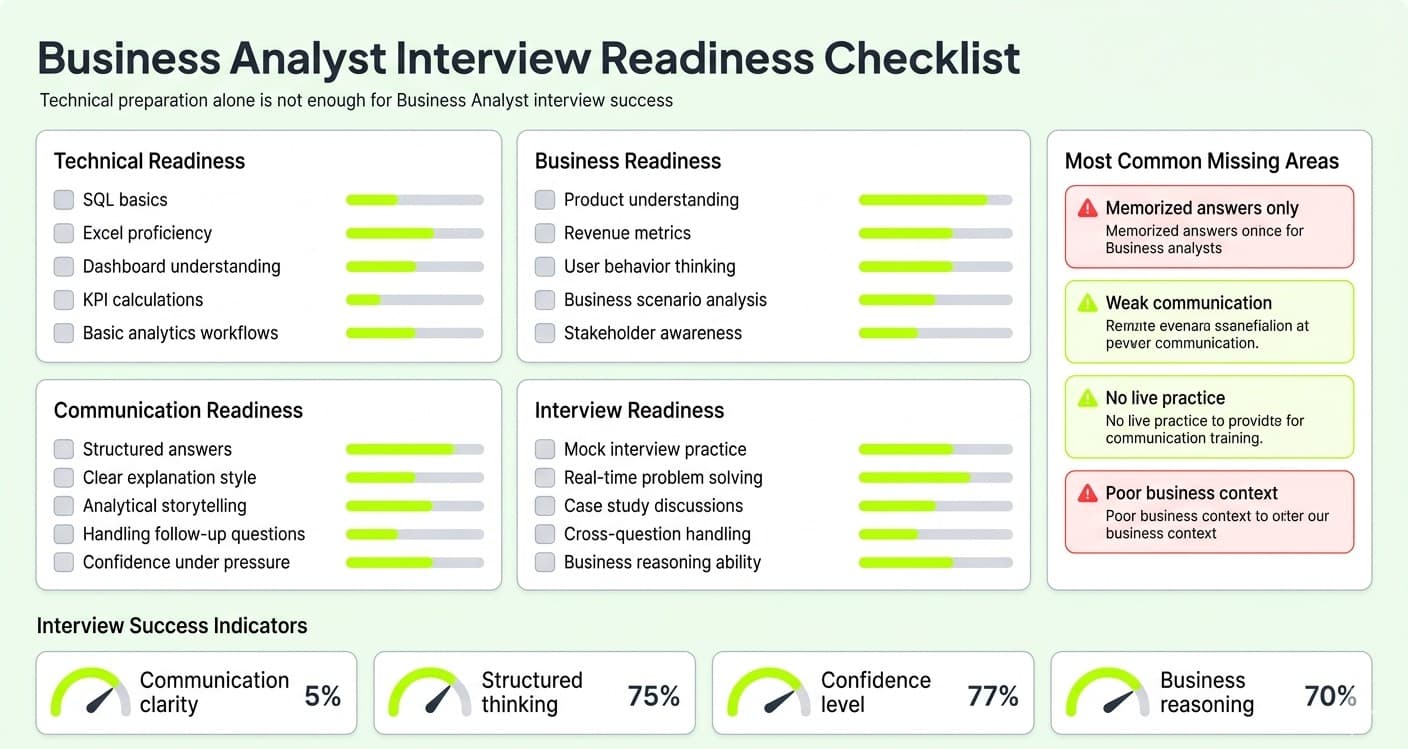
You are not failing business analyst interviews because you do not know enough. You are failing because the preparation most people do trains them to sound knowledgeable without demonstrating the one thing that actually gets you hired: the ability to think like a BA in the room. Here is the one action step to take this week: Take your three most-prepared interview answers and strip out every mention of a tool, technique, or process. What is left? If the answer is "not much," you have found exactly where to focus your next round of preparation. Rebuild those answers around real moments, business outcomes, and honest lessons. Then practice saying them out loud until they sound less like answers and more like experiences. That is the difference.
Ready to Put This Into Practice?
Reading about business analyst interview preparation is one thing. Actually drilling it under realistic conditions is another. Mocklingo lets you practice real BA interview scenarios with AI-powered feedback that tells you not just what you said, but how you came across. If you are serious about landing your next BA role, try a mock interview session and see exactly where your thinking breaks down before it costs you another opportunity.