Loading...
Contents
Back to BlogInterview Preparation
How to Answer “Tell Me About Yourself” in an Interview
(With Examples)
Apr 24, 202612 min readUpdated Oct 8, 2026
Among all interview questions, “Tell me about yourself” is usually the first and sometimes the most confusing question. Many candidates prepare for technical or role-specific questions, but struggle when asked this simple introduction.
Understanding how to answer “tell me about yourself” in an interview can make a strong first impression and set a positive tone for the conversation.
This question is not meant to test your personal life or memorization skills. It is asked to assess how clearly you can present yourself in a professional setting.
This article shows you how to organize your answers. It explains common mistakes to avoid. And give simple examples you can use based on your background.
FREE TO USE
25K+ INTERVIEWS4.8★ RATING68% IMPROVEMENT
Crack Your Dream Job
Real Interviews. Real Pressure. Practice until it feels easy.
- Seamless Interview Experience
- Resume & JD Questions
- Instant Personalized Feedback
Why Interviewers Ask “Tell Me About Yourself”
Although it sounds informal, this question has a clear purpose. Interviewers ask this to see how clearly you can explain your background.
Through this question, interviewers usually want to check:
• Your communication skills
• Your professional or academic background
• How relevant your experience is to the role
• Your confidence and clarity
It is often the first question asked, which means it sets the direction for the interview. A clear answer helps the interviewer understand you easily and keeps the conversation smooth.
The Purpose of This Question?
Before learning how to answer, it is important to clarify what this question is not asking.
It is not asking for:
• Your full life story
• Personal details such as family background or hobbies (unless relevant)
• A word-by-word repetition of your resume
Instead, it is asking for a professional introduction, a brief overview of who you are, what you have done, and where you are heading.
Understanding this distinction makes it easier to frame the right response.
Common Mistakes Candidates Make
Many candidates struggle with this question because they approach it incorrectly.
Some common mistakes include:
• Speaking for too long and losing focus
• Sharing personal details that are not relevant
• Giving very short, incomplete answers
• Sounding overly rehearsed or robotic
• Listing resume points without explanation
These mistakes are common, especially among freshers. This usually happens due to nervousness or lack of practice rather than lack of ability.
Read More: How to Prepare for HR Interview
How to Answer “Tell Me About Yourself” in an Interview (Simple Structure)
The easiest way to answer this question is to follow a clear structure. A commonly recommended and effective approach is the Present - Past - Future format.
This structure helps you stay organized and ensures your answer remains relevant.
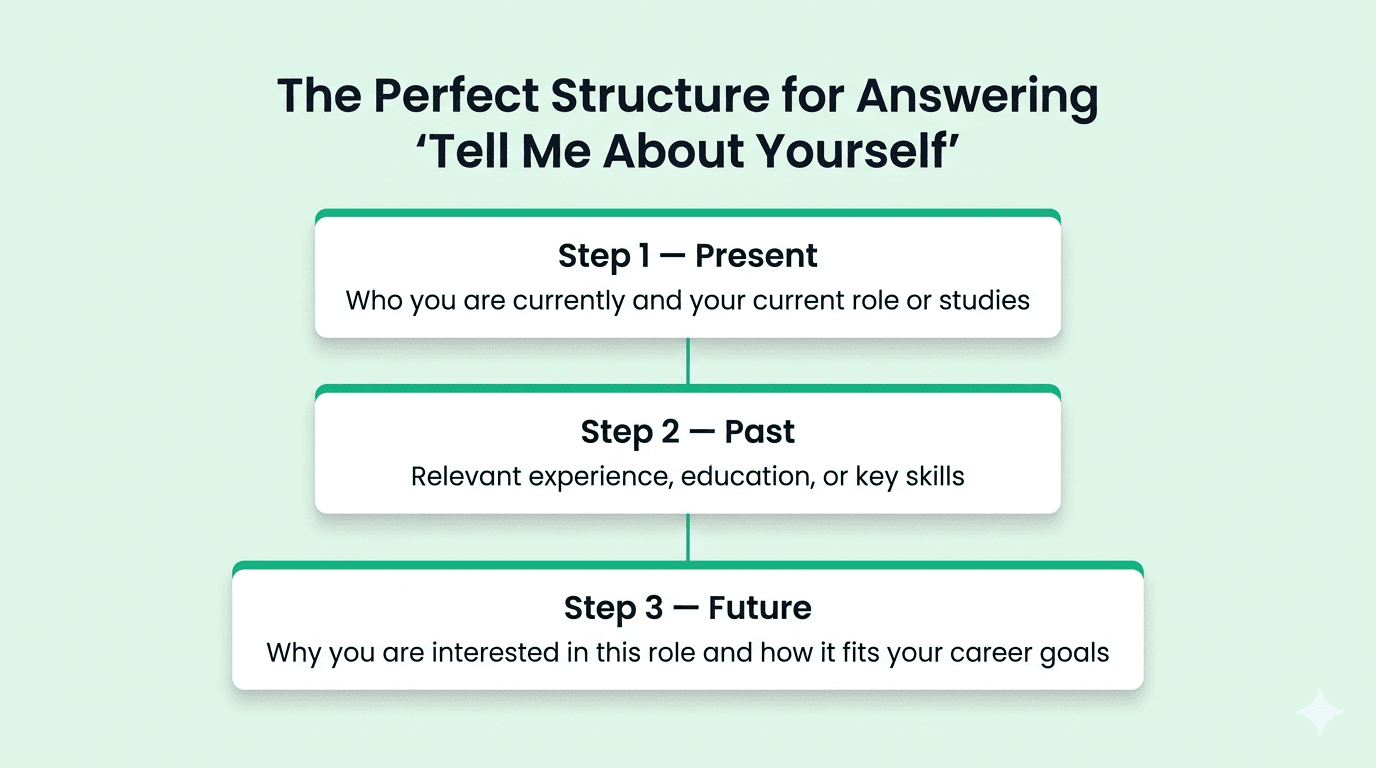
Present: Start With Your Current Status
Begin by briefly explaining who you are right now. This could include:
• Your current role or education
• Your field of study or professional focus
Example:
“I am a final-year engineering student specializing in computer science”.
or
“I am currently working as a junior marketing executive with one year of experience”.
This gives the interviewer immediate context.
2. Past: Share Relevant Background or Experience
Next, mention your previous experience that is relevant to the role. This could include:
• Internships
• Academic projects
• Work experience
• Key skills you have developed
Focus on relevance rather than quantity. You do not need to cover everything, only mention what supports your application.
Example:
“During my final year, I completed an internship where I worked on content research and basic SEO tasks. I also handled academic projects that required data analysis and presentation skills. This helped me improve my communication and analytical abilities, and I believe it's relevant to this role.”
3. Future: Explain Your Career Direction
End by explaining what you are looking for and how the role fits into your career goals. This shows clarity and intention, which interviewers appreciate.
Example:
“I am now looking for an opportunity where I can apply these skills and continue learning in a practical environment.”
FREE TO USE
8k+ SESSIONS92% FLUENCY4.9★ RATING
Speak With Confidence
Real Conversations. Real Scenarios. Speak until it feels natural.
- Real-Time Speaking Practice
- Guided Conversation Flows
- Instant AI Feedback
How to Introduce Yourself in an Interview as a Fresher
For freshers, this question can feel challenging because of limited work experience. However, interviewers do not expect extensive professional backgrounds from entry-level candidates.
A fresher’s introduction in an interview should focus on:
• Education
• Relevant projects or internships
• Skills and interests related to the role
Example (Fresher - No Experience):
“I recently completed my bachelor’s degree in commerce. During my studies, I developed a strong interest in finance and data analysis. I worked on academic projects related to financial reporting, which helped me build analytical and problem-solving skills.
I am now looking for an entry-level opportunity where I can apply my learning and gain practical exposure.”
This answer is simple, honest, and professional.
How to Introduce Yourself in an Interview as an Experienced Candidate
Experienced professionals should focus on their role, responsibilities, and achievements rather than educational details.
Key points to include:
• Current role and years of experience
• Area of expertise
• What you are seeking next
Example (Experienced Candidate):
“I have over three years of experience working as a customer support executive in the e-commerce industry. My role involved handling customer queries, resolving issues, and coordinating with internal teams.
Over time, I developed strong communication and problem-solving skills. I am now looking to move into a role that offers more responsibility and growth opportunities.”
How to Introduce Yourself in an Interview as a Career Switcher
For career switchers, this question is a good chance to explain their shift clearly. You can connect your past work to the new job. Interviewers are not only interested in what you did before, they want to know why you changed your career. And how your old skills are still useful for this new role.
A strong introduction for a career switcher should focus on:
• Your previous professional background
• The reason for your career change
• Skills that transfer to the new role
• Your current direction and goals
It is important to keep the explanation positive and forward-looking. Avoid criticizing your previous role or industry. Instead, emphasize what you learned and how it supports your transition.
Example (Career Switchers):
“I started my career in sales, where I worked for two years and gained experience in client communication and relationship management. Over time, I developed a strong interest in digital marketing and completed certification courses alongside my job.
I am now looking to transition into a digital marketing role where I can combine my communication skills with my new technical knowledge.”
How Long Should Your Answer Be?
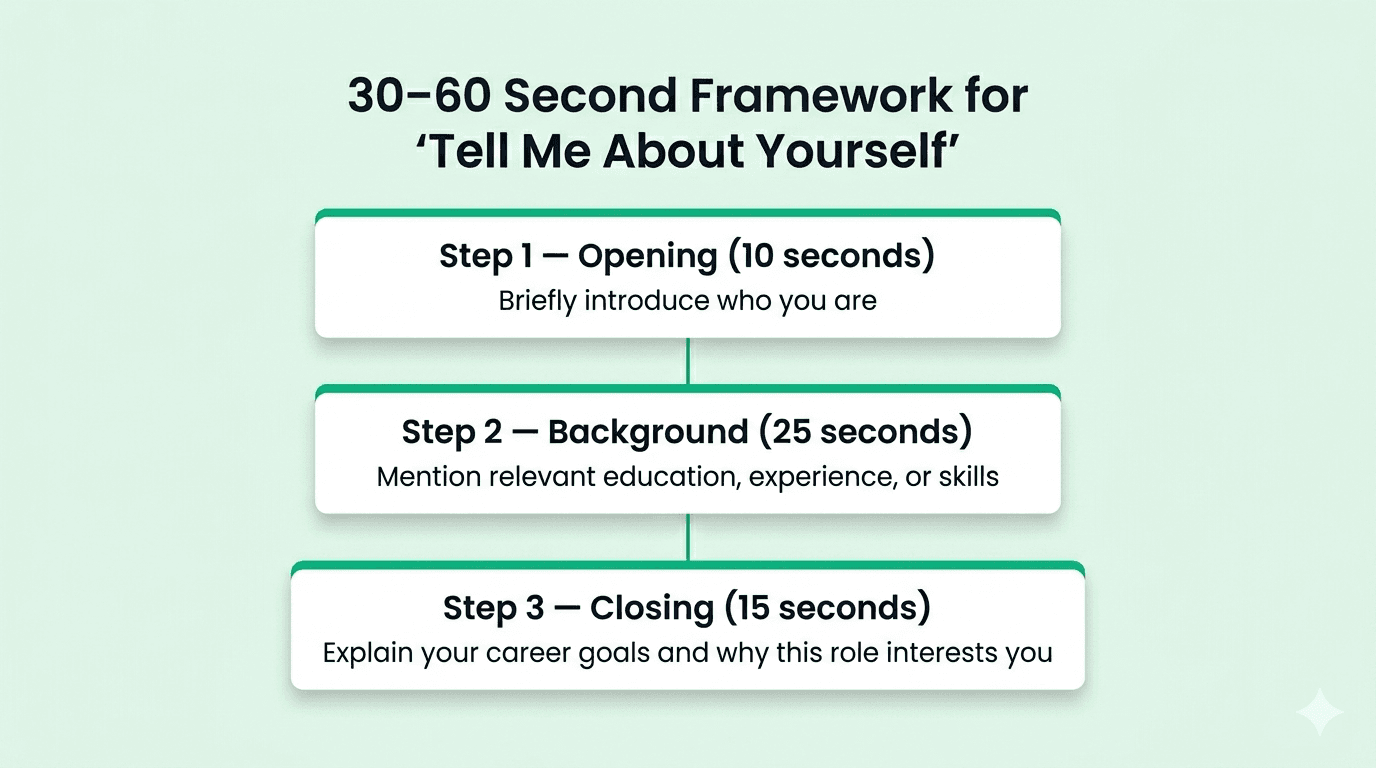
One of the most common concerns candidates have is the length of the answer. Ideally, your response should be:
• 60 to 90 seconds long
• Long enough to give context
• Short enough to maintain interest
If your answer is too short, it may sound unprepared. If it is too long, it may seem unfocused. Practicing helps you find the right balance.
How to Practice Your Answer Effectively
Knowing what to say is only half preparation. Practicing how you say it is equally important. Helpful practice methods include: Speaking your answer out loud. Recording yourself and reviewing clarity and pace. Practicing with mock interviews with structured feedback. Getting feedback from mentors or peers Avoid memorizing your answer word by word. Instead, remember the structure and key points so your response sounds natural.
Variations of This Question in Interviews
Interviewers may not always use the exact phrase “Tell me about yourself.” You might hear variations such as: “Walk me through your resume” “Please introduce yourself” “Tell me something about yourself” Despite different wording, the expectation remains the same. These are all common interview questions designed to assess your professional introduction.
Final Tips for a Strong First Impression
To make your answer more effective: Maintain comfortable eye contact Speak clearly and at a steady pace Keep a professional but friendly tone Focus on confidence, not perfection .English communication is one of most common problem with candidates, they often get blank when interview starts in English. Here read our blog "How to Face an Interview in English”. Remember, interviewers are not looking for flawless answers. They are looking for clarity, honesty, and relevance.
Conclusion
With the right structure and practice, you can answer this first question confidently and start the interview in a positive way.Learning how to answer this question is an important step in interview preparation. This question is not a trap or a test of memorization. It is an opportunity to present your background in a clear and professional way.