Loading...
Contents
Back to BlogInterview Preparation
How to Face an Interview in English
Step-by-Step Guide for Job Seekers
Apr 24, 202630 min readUpdated Oct 6, 2026
Are you struggling to convey your answers, but you know the answers? It's because you cannot express your skills clearly in English during interviews. You might know the answer in your mind. You might have completed projects, internships, or have work experience. But when the interview starts and the conversation shifts to English, you can't speak out loud. If you are wondering how to face an interview in English, this guide will help you. In this article you will get to know practical strategies and clear actionable steps to improve your English communication for interviews. Let’s break it down step by step in this article.
FREE TO USE
25K+ INTERVIEWS4.8★ RATING68% IMPROVEMENT
Crack Your Dream Job
Real Interviews. Real Pressure. Practice until it feels easy.
- Seamless Interview Experience
- Resume & JD Questions
- Instant Personalized Feedback
Why Interviews in English Feel Difficult Even for Skilled Candidates
Before improving anything, it’s important to understand the real problem. Here are most likely reasons:
FREE TO USE
25K+ INTERVIEWS4.8★ RATING68% IMPROVEMENT
Crack Your Dream Job
Real Interviews. Real Pressure. Practice until it feels easy.
- Seamless Interview Experience
- Resume & JD Questions
- Instant Personalized Feedback
Thinking in Your Native Language and Translating
Many candidates first think in Hindi, Tamil, Telugu, or another native language, and then try to translate the sentence into English. This creates pauses, broken sentences, and confusion. Example: Actually I am doing from computer science background and I have interest in coding. Instead you can say: I come from a computer science background, and I am interested in coding. You knew what you wanted to say. But translation caused grammar mistakes. The solution is not about better grammar rules. It’s about thinking directly in simple English. General English speaking is different from English for interviews. In daily conversation, you might say informal phrases like “it was good”, “Yes, I did that” or “I worked there”. But in an interview, you need structured, professional communication like “I was responsible for” “I contributed by” “One challenge I handled was” If you never practice this type of English speaking, interviews will feel uncomfortable.
FREE TO USE
25K+ INTERVIEWS4.8★ RATING68% IMPROVEMENT
Crack Your Dream Job
Real Interviews. Real Pressure. Practice until it feels easy.
- Seamless Interview Experience
- Resume & JD Questions
- Instant Personalized Feedback
Fear of Making Grammar Mistakes
Many candidates stop mid-sentence because they worry about grammar. This actually makes communication weaker. Interviewers are not grammar examiners. They assess: Clarity Structure Relevance Confidence in communication in English Simple and clear English is always better than complex and confusing sentences.Read here about the interview anxiety and tips to manage it.
How to Prepare English Speaking for an Interview
Now let’s move to practical preparation.
Focus on Clarity, Not Accent
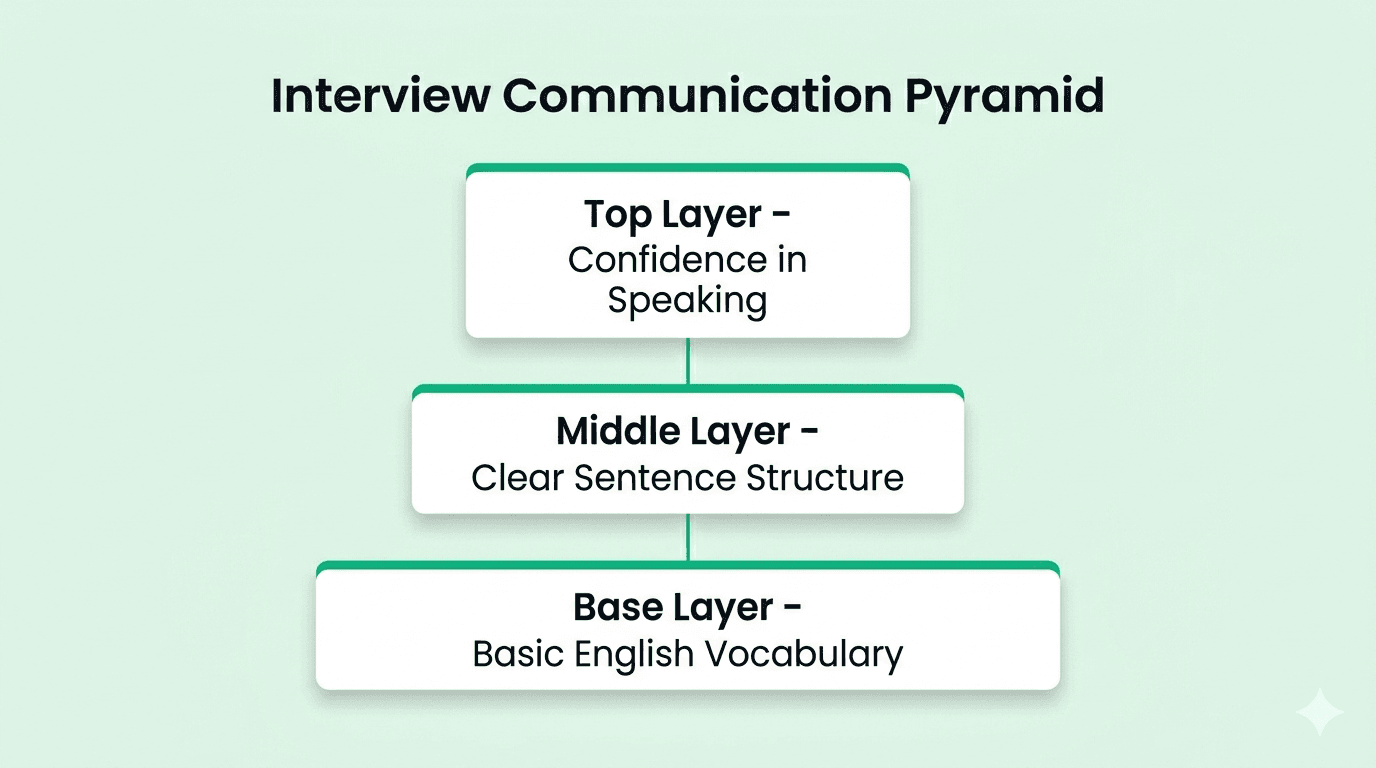
Keep it simple. Clarity builds confidence automatically. You do not need a foreign accent. You do not need advanced vocabulary. Professional English for interview means: Clear sentences Proper structure Logical answers For example: Wrong approach: “Myself Smith and basically I am belonging from Delhi.” Right approach: “My name is Smith. I am from Delhi.”
Learn Interview-Specific English Phrases
Instead of memorizing full answers, learn useful sentence structures. Here are examples you can practice for responsibilities, challenges, achievements: “My role involved” “One challenge I faced was” “Initially, I found it difficult to” “I contributed to” These small structures improve your English speaking in interviews significantly. And you sound more prepared and confident.
Practice Speaking Out Loud (Not Silent Reading)
Reading answers silently does not improve communication in English. You must: Speak aloud Record yourself Listen and improve When you hear your own voice, you will notice repeated words, long pauses, and incomplete sentences. Improvement begins with awareness.
How to Answer Interview Questions in English
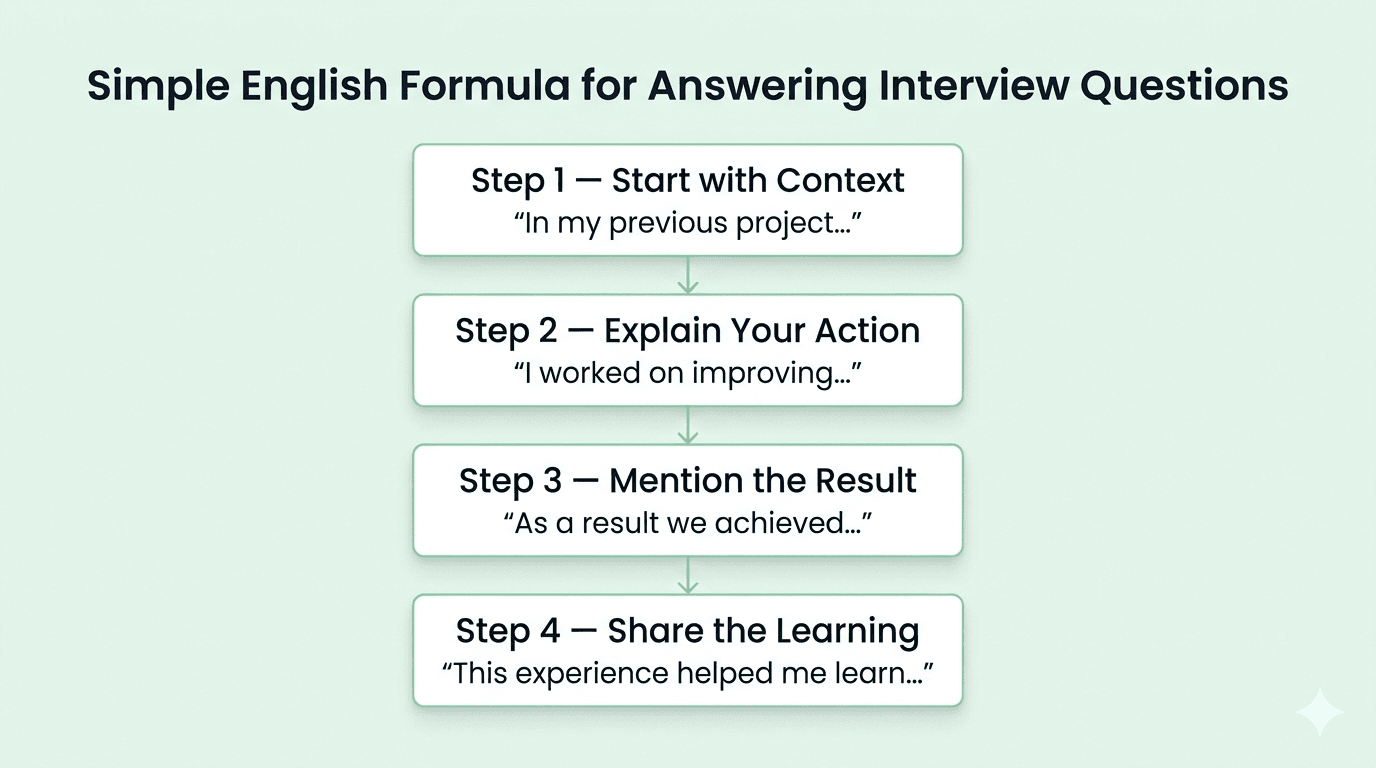
Now let’s look at common interview situations and how to handle them in English. Self-Introduction in English This is usually the first question: “Tell me about yourself” in most of the Interviews. Your self-introduction sets the tone for the entire interview. Instead of speaking randomly, follow a clear structure. Use this simple structure to frame user answer: Present status Past education/experience Key skills Career goal Example: “I recently completed my Bachelor’s degree in Computer Science. During my studies, I worked on two academic projects related to web development. I am comfortable with HTML, CSS, and basic JavaScript. I am now looking for an opportunity where I can apply my technical skills and continue learning in a professional environment.” If you want a detailed breakdown with examples and common mistakes to avoid,. you can read our complete guide on How to Answer “Tell Me About Yourself” in an Interview.
Answering Skill-Based Questions One common question in an interview in English is: “What are your strengths?” Many candidates give very short answers. But this does not create a strong impression. The interviewer wants to understand how your strength actually helped you in a real situation. Instead of saying only one word, explain your strength with a small example. For example: “One of my strengths is problem-solving. During my final year project, we had a deadline issue. I suggested dividing the tasks more clearly among team members so we could finish on time. Because of that, we completed the project successfully.” This type of answer is better because: You clearly mention your strength. You give a real example. You show what you did. You explain the result. You don’t need difficult vocabulary. Simple and structured English is always more effective in interviews.Read More: How to Prepare for HR Interview
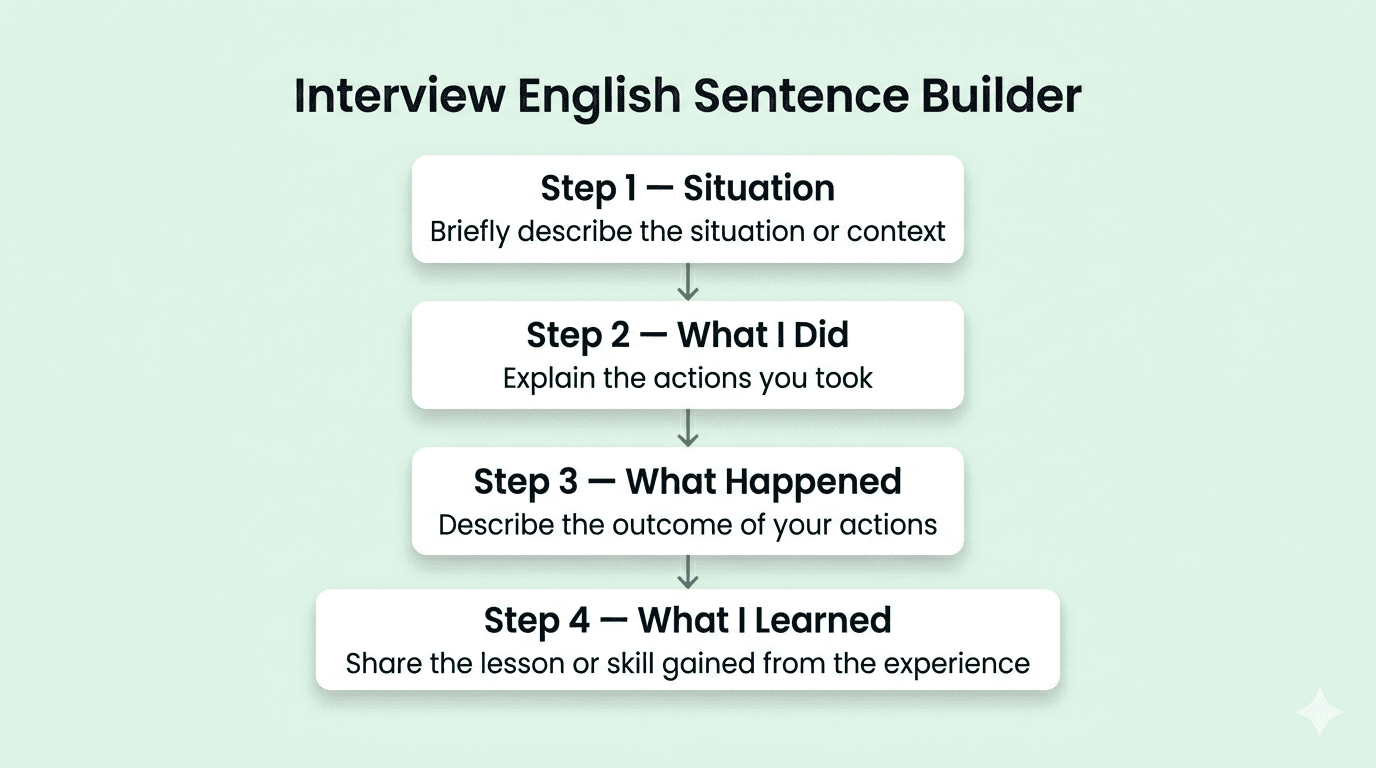
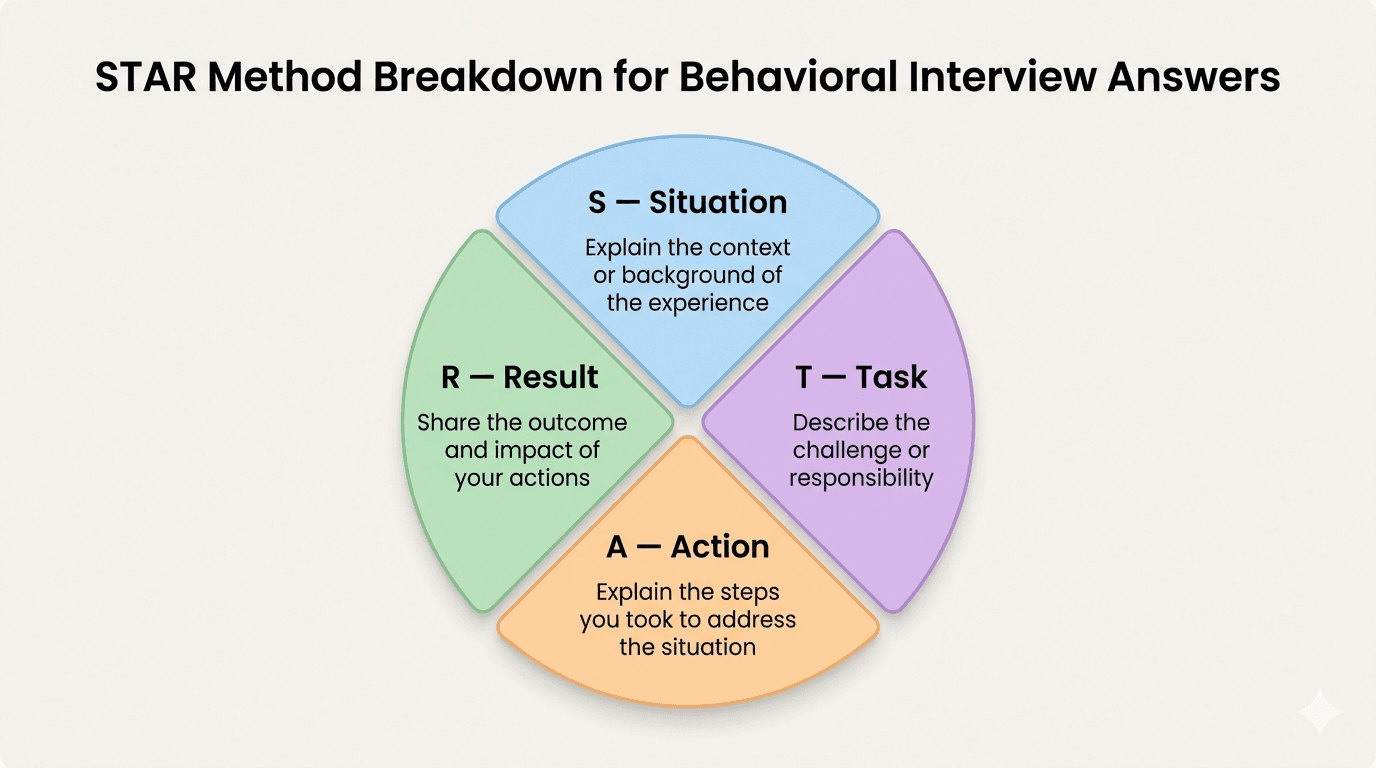
Behavioral Questions in English (Using STAR Method) Behavioral questions test how you handle situations. Use the STAR structure: Situation, Task, Action, and Result. Example: Question: “Describe a time you worked in a team.” Right Response: “During my final year project, we worked in a team of four members. Our task was to develop a web application within two months. Midway, we faced technical issues with database integration. I took responsibility for researching solutions and coordinating with teammates. As a result, we completed the project on time and received positive feedback from our faculty.” You can simply focus on : Clear beginning Logical flow No complicated words This is an effective English communication tip for interview answers.
Common English Speaking Mistakes in Interviews
Even candidates with good knowledge struggle during an interview in English because of small speaking mistakes. These mistakes are usually not about intelligence or skills, but about communication habits. By identifying and correcting them, you can improve your English speaking skills for interviews.
Memorizing Full Answers
When you memorize answers word-for-word, you may panic if you forget a line. Instead of memorizing, understand the structure and speak .naturally
Using Overly Complex Vocabulary
Trying to impress the interviewer with difficult words can make your answers confusing. Simple and clear English is always more professional.
Speaking Too Fast
Many candidates speak very fast when they are nervous. Slow down, pause when needed, and focus on clarity.
Giving Very Short Answers
An interview is a conversation. Avoid one-word responses and explain your points briefly.
Panicking Over Small Grammar Mistakes
If you make a small grammar mistake, continue speaking. Fluency and clarity matter more than perfection.
FREE TO USE
8k+ SESSIONS92% FLUENCY4.9★ RATING
Speak With Confidence
Real Conversations. Real Scenarios. Speak until it feels natural.
- Real-Time Speaking Practice
- Guided Conversation Flows
- Instant AI Feedback
How to Improve Communication in English for Interviews
Improvement requires structured practice along with feedback. English communication highly relies on practice. Here are practical methods you can follow: Choose one interview question daily. Speak for 2–3 minutes. Record it. Improve it the next day. Consistency matters more than long study hours. By following this tip continuously you will see drastic improvement in your communication skills. Real improvement happens when you simulate real interview situations. And mock interviews help you: Think quickly Structure answers Speak under mild pressure Improve English speaking naturally Platforms like Mocklingo help candidates to practice interview questions in English through structured mock interviews. This helps improve clarity, fluency, and confidence before facing a real interviewer. Practice reduces hesitation because your brain becomes familiar with interview-style communication. Listening improves speaking automatically. Watch interview videos, professional talks, and career-related discussions. And try to figure out and observe sentence structure, tone, and flow. Do not memorize. Understand your own story in English. Write bullet points for: Self-introduction Strengths Weaknesses Internship/project experience Career goals Try describing your day in English, explain what you are doing and mentally answer random questions. This reduces translation habits.Daily 15-Minute Speaking Practice
Practice Mock Interviews
Improve Listening Skills
Build a Personal Answer Bank
Think in English During Daily Activities
How Mock Interviews Help You Face Interviews in English Better
Many candidates read interview blogs but still struggle when speaking. Because reading is passive, while speaking is an active process. Mock interviews help you : Train your brain to respond quickly Improve real-time English speaking Reduce awkward pauses Improve structured communication in English When you practice regularly, the actual interview feels familiar rather than stressful. That is why structured mock practice is one of the most effective ways to prepare for an interview in English. Mocklingo provides you feature to practice English communication powered by Ai, you get real time detailed feedback on Grammar, fluency and many more after each sessions.
Final Tips to Face an Interview in English Successfully
Before you step into your next interview, keep these practical points in mind: Use simple, correct English. Structure your answers clearly. Practice speaking more than reading. Don’t aim for perfection instead aim for clarity. Improve daily with small, consistent practice. Focus on communication, instead worrying about grammar mistakes. Most importantly, interviewers are trying to understand your skills, experience, and potential. They are not evaluating your accent or expecting flawless language. Your ability to express your thoughts clearly and professionally in English matters most.
Conclusion
Facing an interview in English is not about speaking advanced vocabulary or perfect grammar. It is about structured thinking, clear expression, and regular practice. Communication in English is a skill, it improves with consistent practice. If you focus on clarity, structure, and steady improvement, interviews in English will not feel hectic. It will become manageable conversations where you confidently present your skills and experience.