Loading...
Contents
How to Become a Data Analyst with no Experience in 2026
May 10, 202623 min readUpdated Oct 6, 2026
Arjun had a BCA degree, a YouTube certification in Excel, and a Kaggle account with two incomplete projects. He applied to 47 data analyst jobs in three months. Got two automated rejection emails. Heard nothing from the rest. Then he changed three things: not his skills, not his degree, not his tools. He changed how he presented what he already had. Four weeks later, he had an offer from a Pune-based SaaS startup at ₹5.2 LPA. This blog is what Arjun did. Not theory. Not a roadmap you've already seen. The specific, uncomfortable, unglamorous things that actually got him in, and can get you in too.
FREE TO USE
25K+ INTERVIEWS4.8★ RATING68% IMPROVEMENT
Crack Your Dream Job
Real Interviews. Real Pressure. Practice until it feels easy.
- Seamless Interview Experience
- Resume & JD Questions
- Instant Personalized Feedback
First, Let's Be Honest About What You're Up Against
If you've been searching for how to become a data analyst with no experience, you've probably read the same 12 articles. All of them say some version of: "Learn SQL, do some projects, get a certification, apply, you'll be fine." That advice isn't wrong. It's just incomplete in exactly the ways that hurt you. Here's the real situation in 2026: There are over 430 active entry-level data analyst positions on LinkedIn India alone and that number refreshes daily. On Glassdoor India, roughly 365 openings are specifically for freshers in cities like Bengaluru, Delhi, and Hyderabad. But the effective competition for each of those roles is enormous because everyone applying has the same Google certificate, the same Kaggle projects, and the same resume template. The opportunity is real. The queue is just very long, and most people in it look identical to each other.
So the question,
"can I get a data analyst job with zero experience?" has a real answer: Yes, but not by doing what everyone else is doing.
Also read: Will AI Replace Data Analysts in 2026?
Does Being a Data Analyst for Freshers Require a Degree?
This is the question that stops most people before they even start, so let's settle it with real data. About 80% of employers want to see at least a bachelor's degree but the requirement for a bachelor's specifically has dropped from 45% of job postings in 2024 to 39% in 2025. According to Zippia, most working data analysts hold a bachelor's degree (65%), while others have a master's degree (15%) or an associate degree (12%). The rest hold some other qualification. What does this mean practically for you? If you have any bachelor's degree in anything you already clear the formal education bar for most entry-level data analyst positions. Your degree does not have to be in data science, computer science, or statistics. If you don't have a degree: A degree is not an absolute requirement for breaking into the field. The focus has shifted towards a candidate's ability to extract actionable insights from data and contribute to data-driven decision-making. Companies are increasingly open to candidates who can show a strong portfolio and demonstrable skills, even without traditional data analyst education requirements being met on paper. What actually matters more than your degree: 1 strong, end-to-end portfolio project Demonstrated SQL ability (a short test they can verify) A coherent story for why data analytics, told specifically
The Real Barrier: You Look Like Everyone Else
Here is the visualization that explains why most fresher applications fail:
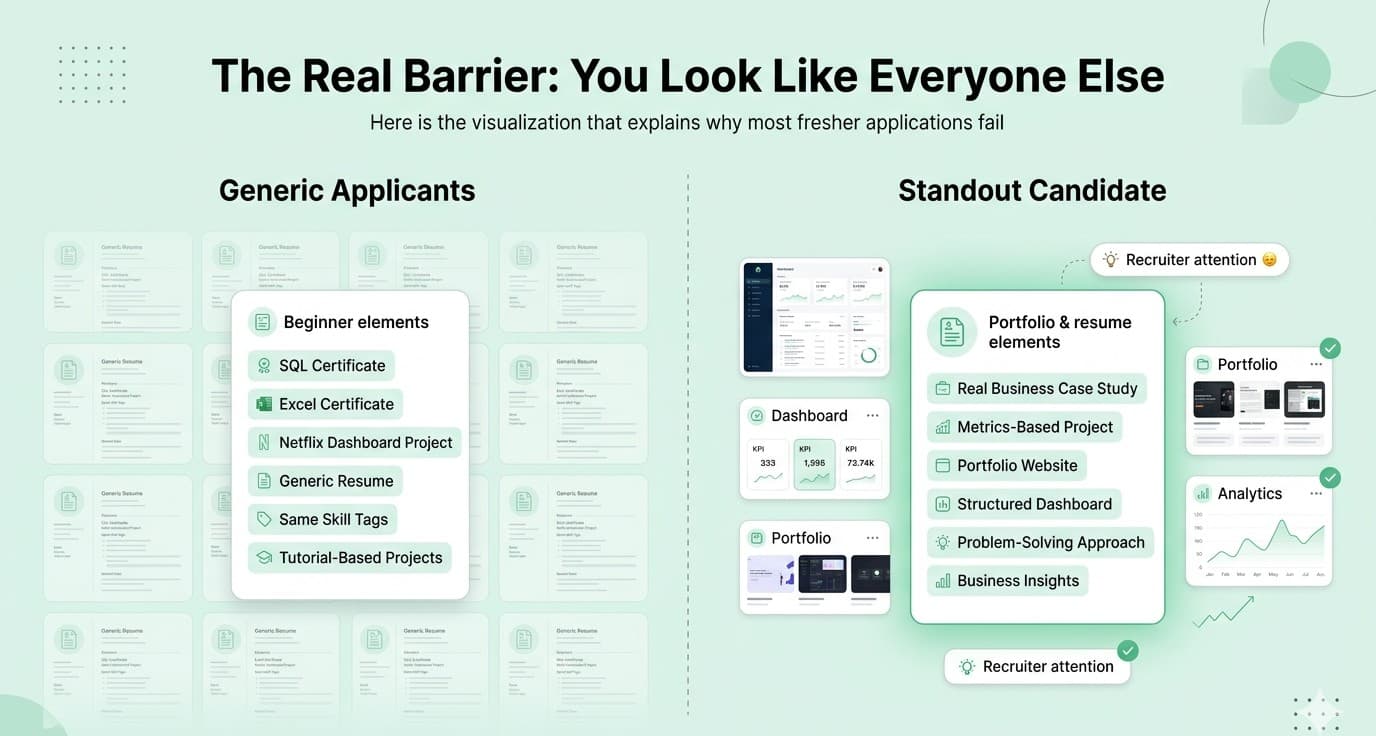
This is not to demoralize you. It's to show you exactly where the opening is: almost nobody is fixing these problems. Fix them, and you move from invisible to shortlisted.
How to Become a Data Analyst With No Experience - What Actually Works in 2026
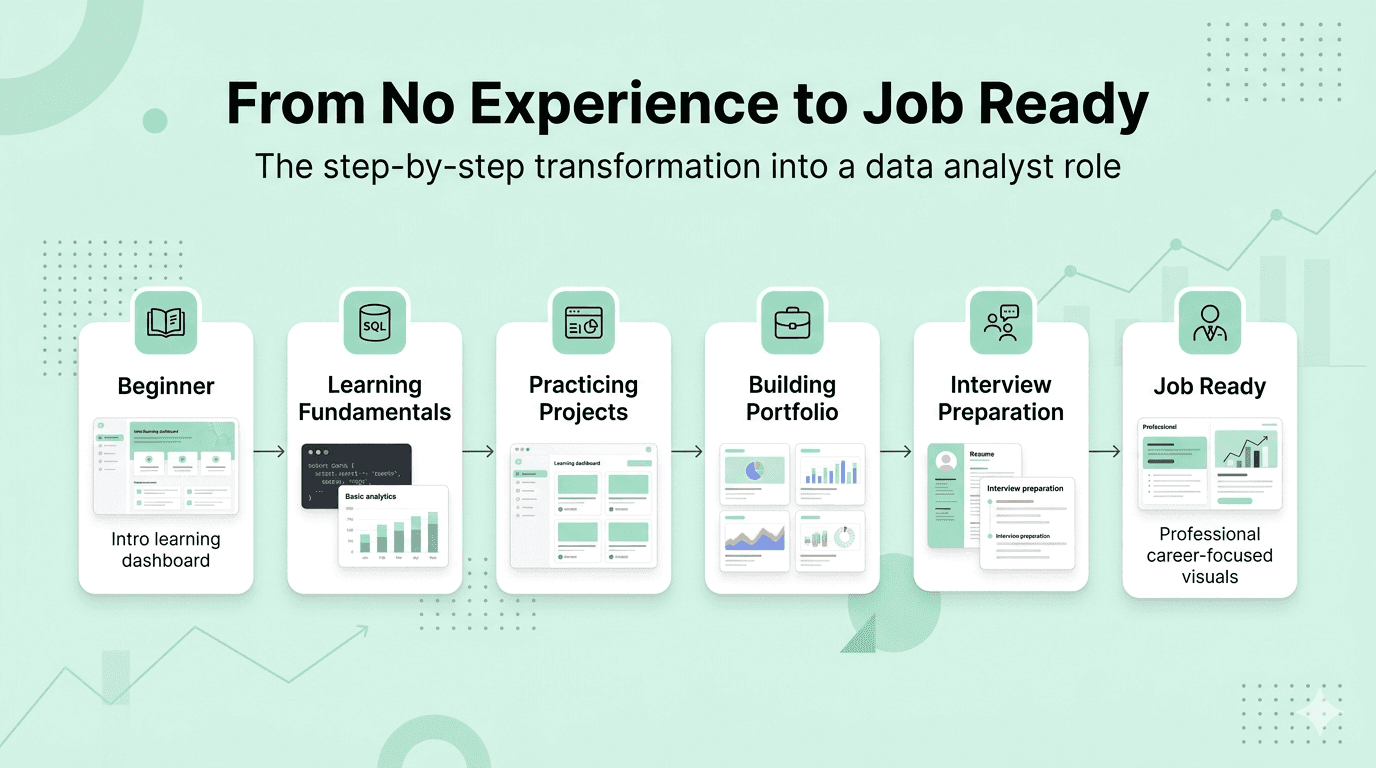
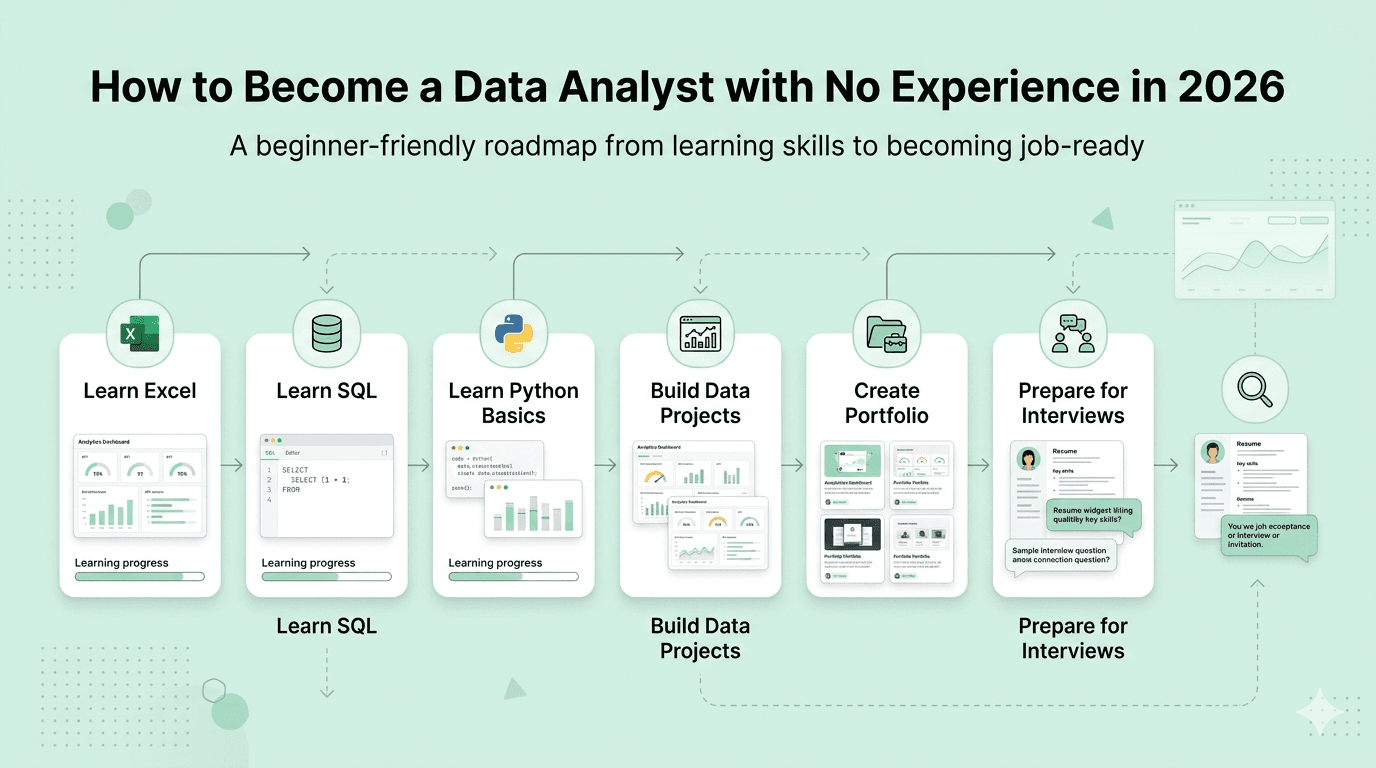
One project beats five incomplete Kaggle notebooks every single time. But the project has to answer a real business question, not just show that you can run a Pandas command. What makes a project "real": It starts with a business question, not a dataset ("Why are customers churning in month 3?" not "I analysed customer data") It contains a cleaning section where you explain what was wrong with the data It ends with a recommendation, something a business could actually act on It lives on GitHub with a clear README a non-technical person can understand Good project ideas for freshers: Scrape Swiggy or Zomato reviews and analyse what drives 1-star ratings in a specific city Build a dashboard on public NREGA or PM housing data and find one state-level anomaly Analyse IPL match data (freely available) and answer: "Which metric best predicts a team's playoff chances?" The point isn't the topic. The point is the framing: question → data → cleaning → insight → recommendation. Before you learn anything else, go look at 20 real job descriptions for data analyst for freshers on Naukri, LinkedIn, and Internshala right now. Read them. Take notes on which skills appear in more than half. Here is what you'll consistently find in 2026: Technical skills that appear in most JDs: SQL (this is non-negotiable it appears in 85%+ of listings) Excel / Google Sheets Power BI or Tableau (at least one) Basic Python or R (increasingly common, but often listed as "good to have") Soft skills that appear but nobody prepares for: "Ability to communicate findings to non-technical stakeholders" "Translate data into business recommendations" "Work cross-functionally with product and marketing teams" That last category, the communication layer, is where most freshers have zero preparation. Learn the tools. But also practice explaining what your analysis means in one sentence to someone who has never opened Excel. Many entry-level listings explicitly state that 0–1 years of experience in data analysis is acceptable and that internships and projects count. The problem is almost never eligibility. It resumes execution. The four resume mistakes that get freshers filtered out immediately: Listing tools without context - "Skills: SQL, Python, Tableau" tells a recruiter nothing. "Built a SQL query that identified ₹2.3L in duplicate vendor payments in a 10,000-row dataset" tells a story. No quantification anywhere - If there isn't a single number in your experience or projects section, your resume reads as abstract. Add numbers wherever you can rows of data, % accuracy, hours saved, users affected. Generic objective statement- "Seeking a challenging position in data analytics to apply my skills" is invisible. Replace it with one line that says exactly what you offer: "BBA graduate with SQL certification, one published data project, and 3 months of freelance reporting work for a Pune e-commerce brand." No link to your work - Your GitHub profile link or portfolio URL should be in the header, not buried at the bottom. Recruiters spend under 10 seconds on a first scan. Make your work immediately clickable. You will pass the resume screen. You'll do fine in the SQL test. And then you'll get to the case study round and business problem round and here you freeze. This is the round that kills the most data analyst fresher applications. The reason? No course on earth teaches you to answer questions like: "Our app's Day 7 retention dropped 12% last month. Walk me through how you'd investigate this." "We're launching in a new city. What data would you look at first to decide whether it was a success?" These questions have no SQL in them. They're testing whether you think like a business person and not just a technician. How to prepare for these rounds: Read one case study breakdown from a working analyst every day for two weeks Practice answering "how would you measure success for X?" questions out loud. Learn one framework for structuring your answer (even a simple one: Define the metric → Segment it → Find the anomaly → Propose a test) Most freshers apply to 50 companies using the same resume with no cover letter. Here's a more effective approach: Instead of 50 spray-and-pray applications, try 10 targeted ones: Find 10 companies in your city that are in growth mode (check LinkedIn "Jobs Posted" in the last week) For each one, spend 20 minutes finding one public data point about their business (a news article, a product launch, a public customer review trend) In your application email, reference it: "I noticed from your recent Series B announcement that you're expanding to Tier 2 cities, I ran a quick analysis on [X] that might be relevant." This approach gets responses. Step 1: Build One Real Project (Not Five Generic Ones)
Step 2: Understand What a Data Analyst Position Entry Level Actually Requires
Step 3: Fix the Most Common Resume Kills
Step 4: The Interview Round Nobody Prepares For
Step 5: Apply Differently Than Everyone Else
FREE TO USE
8k+ SESSIONS92% FLUENCY4.9★ RATING
Speak With Confidence
Real Conversations. Real Scenarios. Speak until it feels natural.
- Real-Time Speaking Practice
- Guided Conversation Flows
- Instant AI Feedback
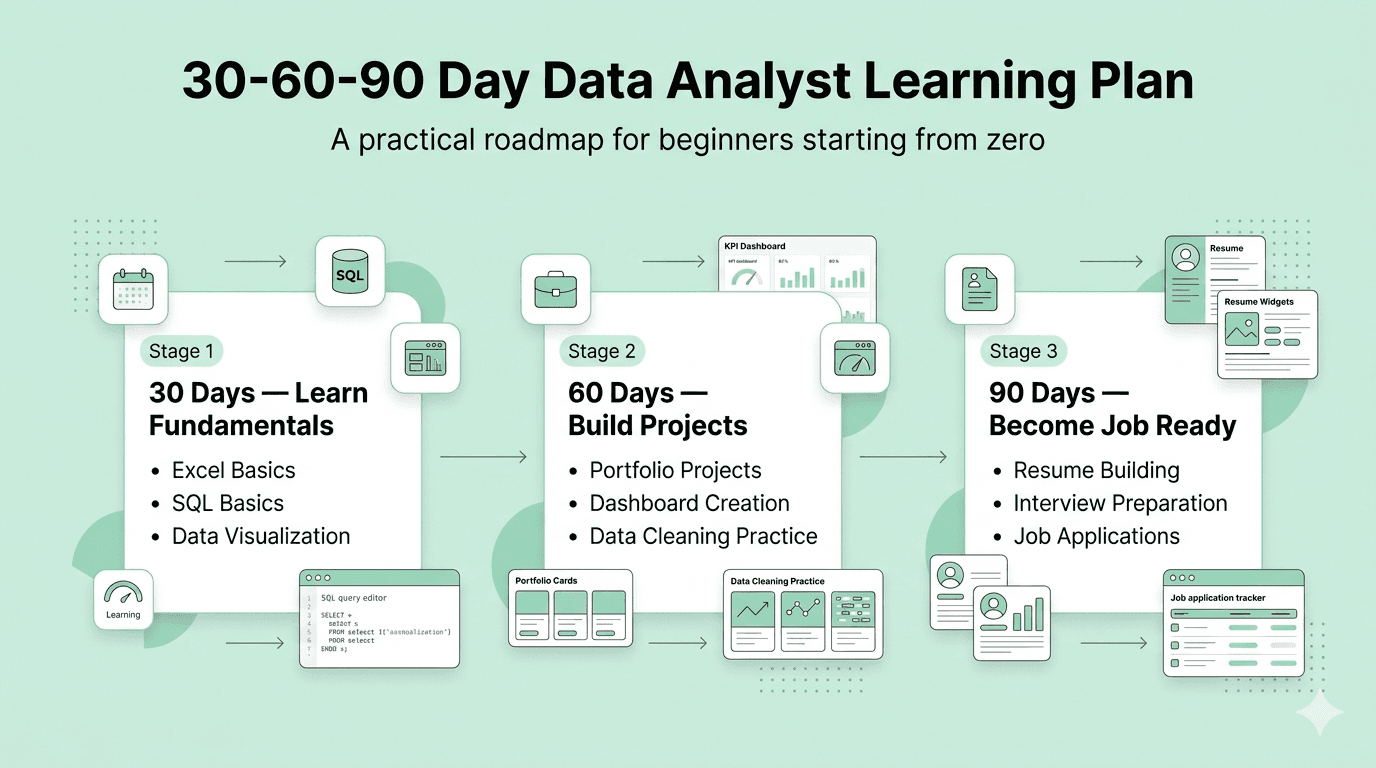
A Realistic Timeline: How Can I Become a Data Analyst Starting From Zero?
This is not the 30-day bootcamp fantasy. This is what a realistic path looks like:
What Salary Should You Actually Expect?
Let's be specific, because vague ranges don't help you. For a data analyst for freshers with one solid portfolio project and SQL skills, here's a realistic 2026 picture by company type: Read More: Data Analytics Salary in India 2026
| Company Type | Freshers Salary Range | Notes |
|---|---|---|
| Indian Startup (Seed–Series A) | ₹3.5–5 LPA | Lower pay, broader scope, faster learning |
| Indian Product Company (Swiggy, Meesho, PhonePe) | ₹6–9 LPA | Competitive process, worth targeting |
| Indian IT/Service Company (TCS, Infosys, Wipro) | ₹3–4.5 LPA | More structured, slower growth |
| MNC India Offices (Amazon, Deloitte, EY) | ₹5–8 LPA | Structured hiring, clearest JDs |
| Early-stage fintech/edtech | ₹4–6.5 LPA | High variance depends on funding |
The One Thing That Actually Separates People Who Get In
After everything above, the honest answer to "how can I become a data analyst with no experience" is this: The people who get in are not the most skilled. They are the most specific. They have a specific project. A specific company they're targeting. A specific answer to "why data analytics?" A specific skill they've gone deeper on than everyone else. Not to practice SQL. Not to review flashcards. The case study round is where most fresher candidates fail and it's the one round you can only get better at by doing it out loud, getting real feedback, and doing it again. Mocklingo simulates the exact case study questions used by Swiggy, Razorpay, Meesho, and other Indian product companies with AI feedback on your structure, communication, and business thinking. Try Your First Free Mock Interview on MocklingoYour One Next Step