Loading...
Contents
Will AI Replace Data Analysts in 2026?
Here's the Truth
May 10, 202618 min readUpdated Oct 6, 2026
Will AI replace data analyst in 2026? If you've had that same thought, you're not alone. It's one of the most searched questions in the analytics world right now. So let's answer it properly. Not with vague reassurances. With real data, honest context, and a clear picture of what's actually changing. The Short Answer is No: AI will not replace data analysts in 2026. But here's the part most articles skip: AI is absolutely changing what a data analyst does every day. And that difference matters a lot for your career. The analysts who understand this change will grow. The ones who ignore it will struggle, not because AI took their job, but because a colleague who uses AI became more valuable than them. Let's break this down step by step.
FREE TO USE
25K+ INTERVIEWS4.8★ RATING68% IMPROVEMENT
Crack Your Dream Job
Real Interviews. Real Pressure. Practice until it feels easy.
- Seamless Interview Experience
- Resume & JD Questions
- Instant Personalized Feedback
What Does the Data Actually Say?
Let's start with numbers, not opinions. The US Bureau of Labor Statistics estimates that data analyst positions may surge 36 percent between 2023 and 2033- a significant increase over the general job outlook average. Read that again. A field people think AI is destroying is expected to grow by more than a third in one decade. The US Bureau of Labor Statistics also projects 21% employment growth for operations research analysts which includes many data analyst roles through 2034, which is much faster than average. India is expected to see 11 million new data analyst positions by 2026. LinkedIn So the job market is not shrinking. It's growing. But the type of work being done inside that job; that is changing.
What Tasks Is AI Already Doing?
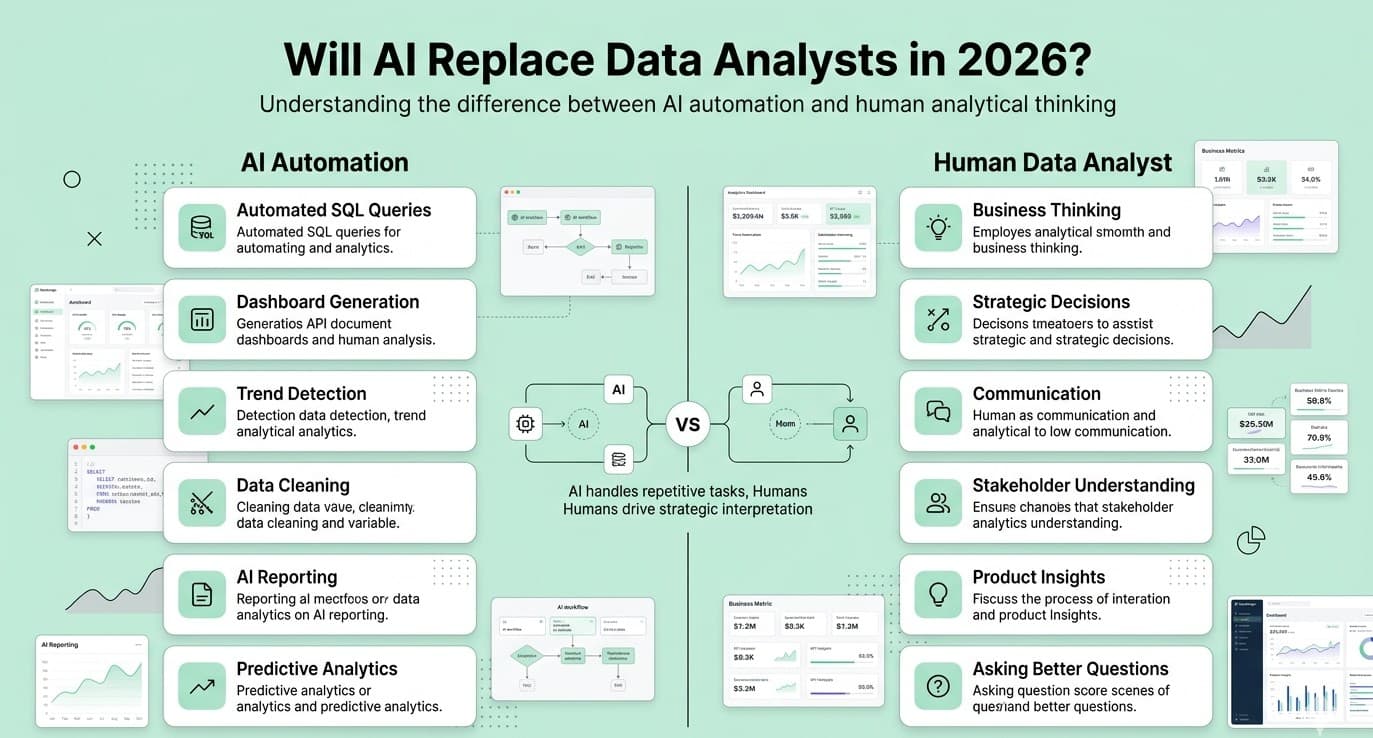
This is the honest part. There are specific things AI is genuinely good at right now. And some of those things used to take analyst hours every week. Here's a simple breakdown:
Automation is predominantly being used for speed, automating repetitive tasks, and identifying subtle patterns which frees human analysts to concentrate on activities that require intuition, discernment, strategic foresight, and ethical reasoning. Think of it this way. AI is very good at the mechanical parts of data work. The parts that are repetitive, rules-based, and follow a pattern. But data analytics isn't just mechanical. The hard part is the part that makes an analyst actually valuable is figuring out what to look for, what the numbers mean, and what the business should do about it. AI cannot do that.
Why AI Can't Replace a Data Analyst Completely
Let's make this concrete with a real scenario. Imagine this: The sales team at a food delivery company notices that their order numbers dropped 18% last Tuesday. They go to the data team and ask: "What happened?" An AI tool can pull the data instantly. It can show you charts. It can flag anomalies. But here's what it cannot do: It doesn't know that Tuesday was a local festival in one city It doesn't know the sales team ran a broken promo code that day It doesn't know the CEO just greenlit a competitor partnership that caused internal confusion It can't sit in the room and say "Here's what I think you should do, and here's why" Subject matter expertise, critical thinking, and the ability to formulate insightful business questions that guide AI exploration cannot be automated. Analysts provide the contextual understanding and strategic thinking that transforms AI outputs into actionable business intelligence. That context is knowing the business, knowing the people, knowing what questions to ask is entirely human. And it's exactly what companies are now paying more for, not less.
What Is Actually Changing for Data Analysts?
AI will not replace data analysts, instead it will shift their focus from extraction to strategy. McKinsey finds 78% of companies use AI to augment teams, not replace them. The job is moving from: What it used to be: Spend 60% of your time pulling data and cleaning it Build the same weekly report every Monday Answer questions like "How many users did we get this month?" What it's becoming: AI handles the pulling and cleaning AI builds the standard report You spend your time answering questions like "Why did we lose users this month, and what should we do?" If your entire job is pulling data and making charts, AI is your competition. If your job is understanding business problems and using data to solve them, AI is your tool. This is the single most important sentence in this entire blog. Read it again.
FREE TO USE
8k+ SESSIONS92% FLUENCY4.9★ RATING
Speak With Confidence
Real Conversations. Real Scenarios. Speak until it feels natural.
- Real-Time Speaking Practice
- Guided Conversation Flows
- Instant AI Feedback
Two Types of Analysts: Which One Are You?
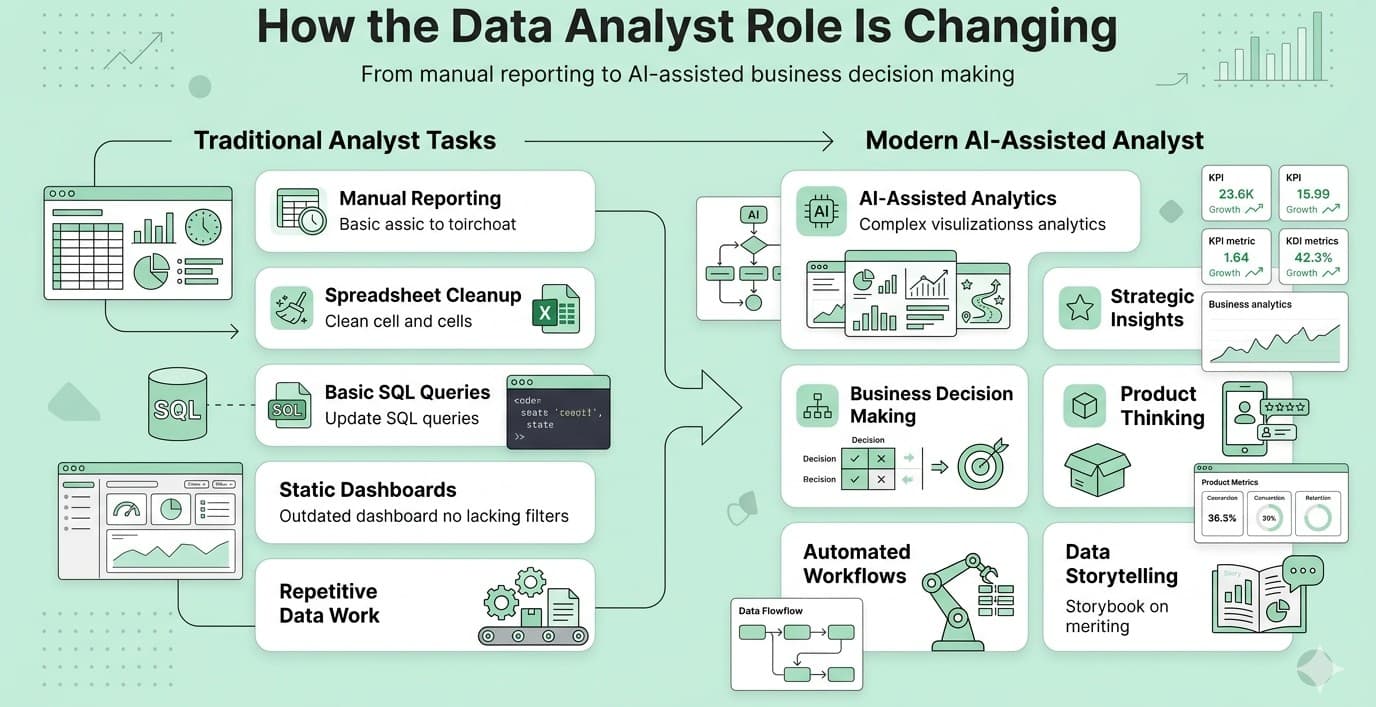
Right now, in 2026, the data analyst world is splitting into two groups. Jobs focused solely on repetitive reporting or routine dashboard updates are increasingly at risk. But roles that involve experimentation, governance, or strategic decision support are holding strong. If you spend most of your time doing Task Analyst work, this is your signal to move. Not because AI will take your job tomorrow, but because the market is already rewarding Strategy Analysts more, and that gap is growing every year.
What Skills Actually Matter in 2026?
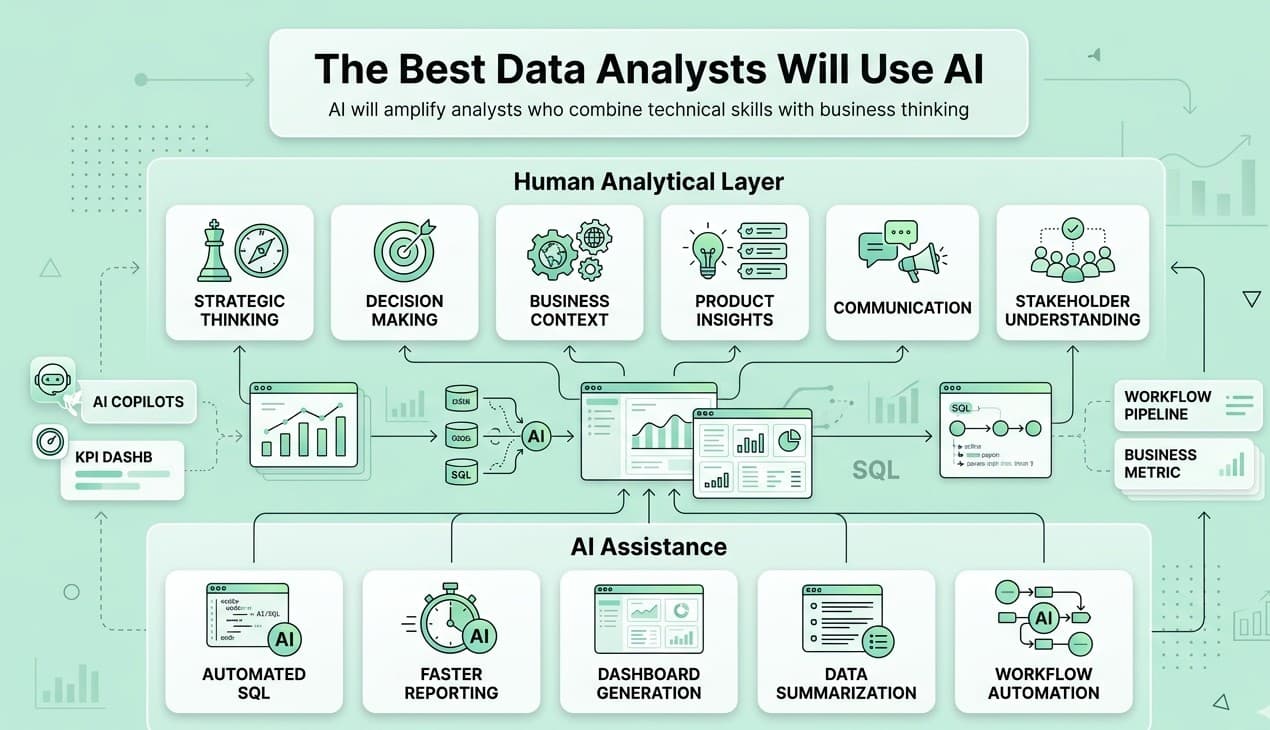
Employers expect AI fluency, the ability to use text-to-SQL, prompt-driven exploration, and notebook automation. At the same time, the core stack remains steady: Python, SQL, statistics, and experimentation literacy are still non-negotiable. But here's what's becoming the real differentiator: Companies are placing increasing value on domain knowledge and the ability to link metrics to outcomes. Analysts who can write clearly and present insights persuasively win offers. In simple terms, here's what companies want from a data analyst in 2026: Still essential: SQL - this never goes away Python basics At least one BI tool (Power BI, Tableau, Looker) Now becoming more important Knowing how to use AI tools in your daily workflow Asking good business questions, not just running queries Explaining your findings clearly to non-technical people Understanding the business context behind the data The new edge: Knowing when to trust an AI output and when to question it Being the person in the room who connects data to actual decisions
What This Means If You're a Fresher
If you're just starting out in data analytics, this might all feel overwhelming. Here's the honest, simple version: Don't panic. The opportunity is bigger than the threat. Starting from 2025, companies are not hiring data analysts who ignore AI, they are hiring analysts who can make use of AI. That's actually good news for freshers. You're entering the field at exactly the right time to build AI-fluent habits from day one and something experienced analysts are now scrambling to learn. Here's what to focus on: Learn SQL properly - this is still the foundation of every data analyst role Get comfortable with at least one AI tool - ChatGPT for analysis, Power BI Copilot, or Julius AI Practice explaining your analysis in plain English - communication is now a technical skill Build a project that shows business thinking, not just technical execution You don't need to be an AI engineer. You just need to be an analyst who works well with AI and that's a skill you can build right now.
A Simple Way to Think About All of This
Here is one analogy that makes everything clear: Think about calculators. When calculators became common, people worried that mathematicians and accountants would lose their jobs. The opposite happened. Calculators removed the boring, error-prone arithmetic and the humans who used calculators became much more valuable because they could focus on harder problems. Think of emerging AI tools as sophisticated versions of Excel formulas or Tableau dashboards. Automation primarily accelerates routine tasks, identifies subtle patterns, and handles repetitive workflows. That's exactly what's happening with AI and data analytics. The calculator got smarter. The analyst's job got more interesting.
Conclusion
AI will not replace data analysts in 2026. But data analysts who use AI will replace data analysts who don't.
If this blog made one thing clear, it's this: the analysts who grow in 2026 are the ones who practice the judgment and communication side of analytics, not just the technical side.
That's exactly what a mock interview helps you build. Not just SQL questions but real case study rounds where you have to think like a business person, explain your reasoning, and make a recommendation under pressure.