Loading...
Contents
What Do Flipkart, Swiggy, and Razorpay Actually Pay Business Analysts in 2025?
May 14, 202617 min readUpdated Oct 6, 2026
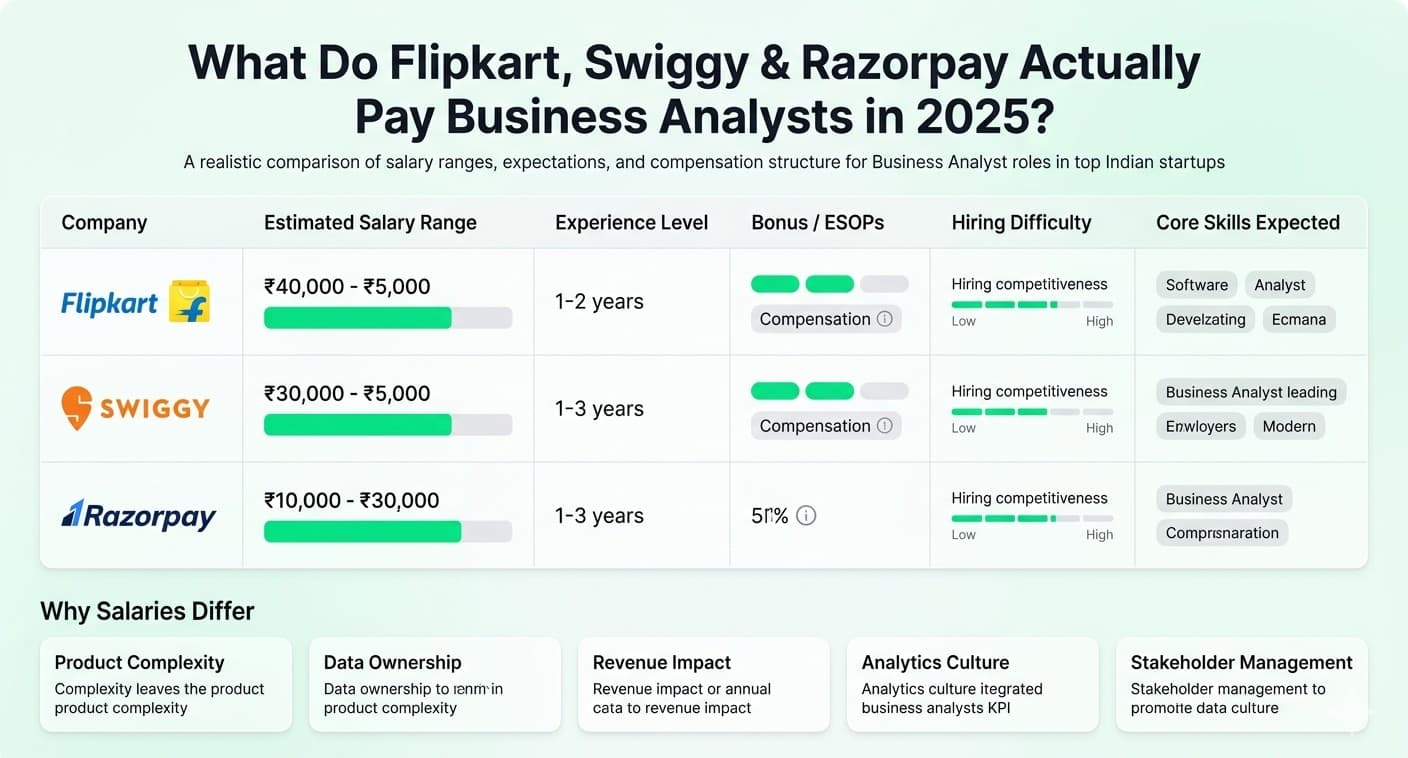
In 2025, a Business Analyst at Flipkart earns anywhere between ₹12 LPA to ₹33 LPA depending on experience and level, while Swiggy pays between ₹9 LPA and ₹30 LPA, and Razorpay packages can reach up to ₹19.9 LPA for senior roles. These numbers are significantly higher than the market average for the same role at service-based companies, and there is a very clear reason for that gap. But before you get excited and screenshot this for your next salary negotiation, let us go deeper. Because the number on the offer letter is rarely the full picture.
FREE TO USE
25K+ INTERVIEWS4.8★ RATING68% IMPROVEMENT
Crack Your Dream Job
Real Interviews. Real Pressure. Practice until it feels easy.
- Seamless Interview Experience
- Resume & JD Questions
- Instant Personalized Feedback
The Real Problem Nobody Talks About
You have probably Googled "business analyst salary India" at least once and landed on something like "average is ₹6 to ₹8 LPA." And you closed the tab immediately because that number felt completely disconnected from what your friend who just joined Swiggy is making. That frustration is valid. The problem is most salary articles lump together service companies, small startups, BPOs, and top product companies into one big average, and the result is a number that is accurate for almost nobody. If you are targeting a product based company for your business analyst career, you need product company data. Not the blended average. That is exactly what this breakdown gives you.
Business Analyst Salary at Flipkart
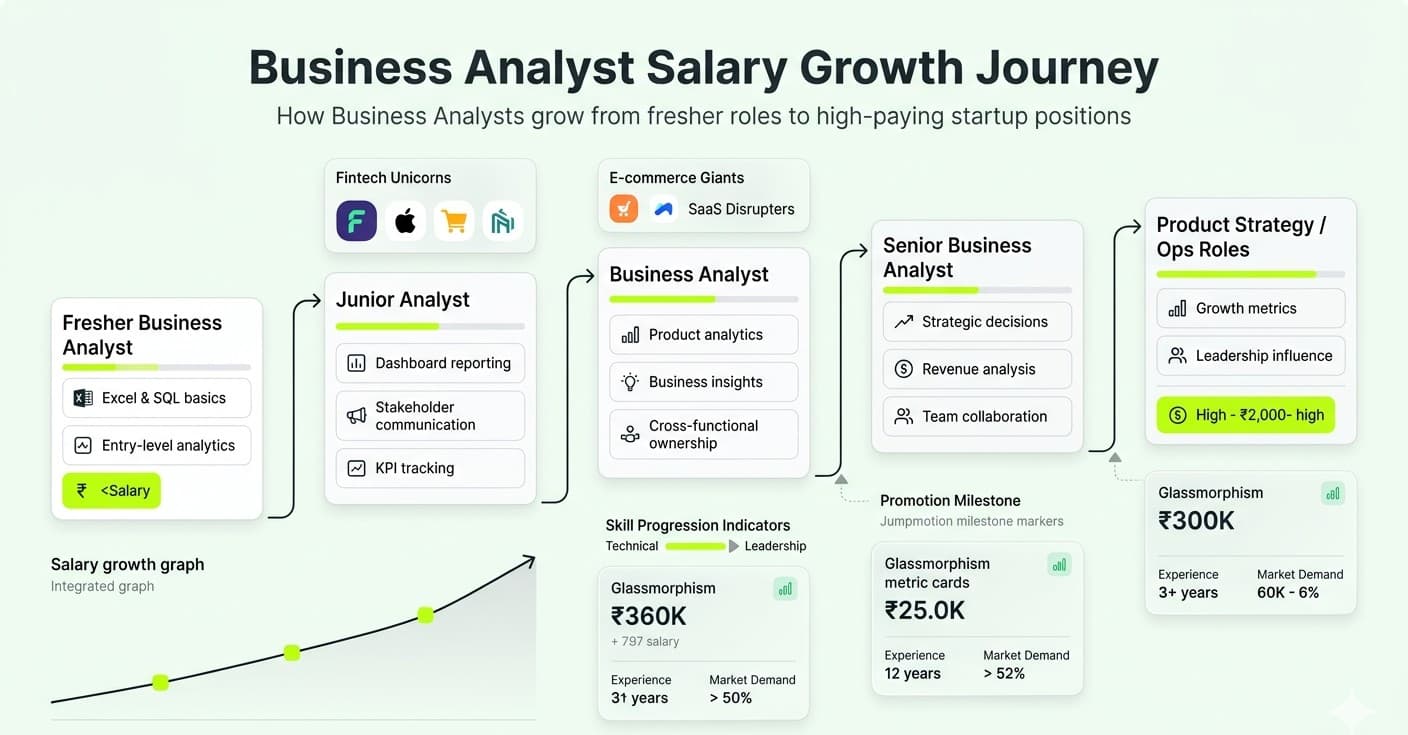
Flipkart, Walmart's Indian ecommerce giant headquartered in Bengaluru, is one of the most sought-after product companies for business analysts in India. The work here is not about creating PowerPoint decks for clients. It is about moving needles on a platform that handles millions of transactions every single day. Here is what the data actually shows: Entry level (0 to 2 years experience): ₹8 LPA to ₹13 LPA Mid level (2 to 5 years experience): ₹13 LPA to ₹20 LPA Senior Business Analyst: ₹18 LPA to ₹27 LPA Total compensation including stock and bonus at senior level: Can reach ₹33 LPA The median total compensation for a Business Analyst at Flipkart sits around ₹15.7 LPA, and top performers at higher levels have reported total packages reaching ₹33.7 LPA when you include stock grants and performance bonuses. What makes Flipkart salaries interesting is the stock component. Because Flipkart is a pre-IPO company (still), it offers ESOPs that can become significantly valuable. Some analysts who joined in earlier growth phases have seen those stock grants become a meaningful portion of their wealth. That is a conversation worth having during your offer negotiation. The role itself at Flipkart typically involves working closely with category teams, supply chain, or the growth and monetization verticals. If you land in a category that drives revenue directly, your visibility inside the company goes up considerably, and so does your bargaining power at the next appraisal cycle. One honest note: Flipkart's compensation satisfaction ratings on Glassdoor sit around 3.1 out of 5. That tells you the base pay is competitive, but some employees feel the total package could be better relative to the intensity of work. Know this going in.
Business Analyst Salary at Swiggy
Swiggy is a different beast compared to Flipkart. It is a quick commerce and food delivery company that operates in high-speed, real-time decision environments. Every minute of app downtime, every pricing algorithm tweak, every restaurant onboarding decision has immediate measurable impact. Business analysts here do not wait weeks to see if their recommendation worked. They see it within hours. Here is what analysts at Swiggy are actually earning: Entry level: ₹9 LPA to ₹13 LPA Mid level: ₹13 LPA to ₹20 LPA Senior Business Analyst: ₹20 LPA to ₹28 LPA (with top earners reporting up to ₹30.9 LPA) Lead Business Analyst: ₹25 LPA to ₹32 LPA The median total compensation across all BA levels at Swiggy sits around ₹16.6 LPA. But levels matter a lot here. Swiggy uses an internal levelling system (L6 through L9 for BA roles), and the compensation jump between levels is steep. An L6 analyst earns around ₹15.7 LPA in total compensation, while an L9 can command north of ₹64 LPA. Yes, that gap is real. And it is entirely a function of how much business ownership the role carries at each level. Swiggy employees actually rate their compensation satisfaction at 3.9 out of 5, which is noticeably higher than Flipkart. Many attribute this to Swiggy's reputation for fair appraisals and the fact that analysts close to GTM or revenue functions tend to get rewarded when the business does well. One thing worth knowing: Swiggy went public in late 2024. What that means for future ESOPs and salary benchmarking is something to track. In general, post-IPO product companies tend to recalibrate compensation bands upward to retain talent.
Business Analyst Salary at Razorpay
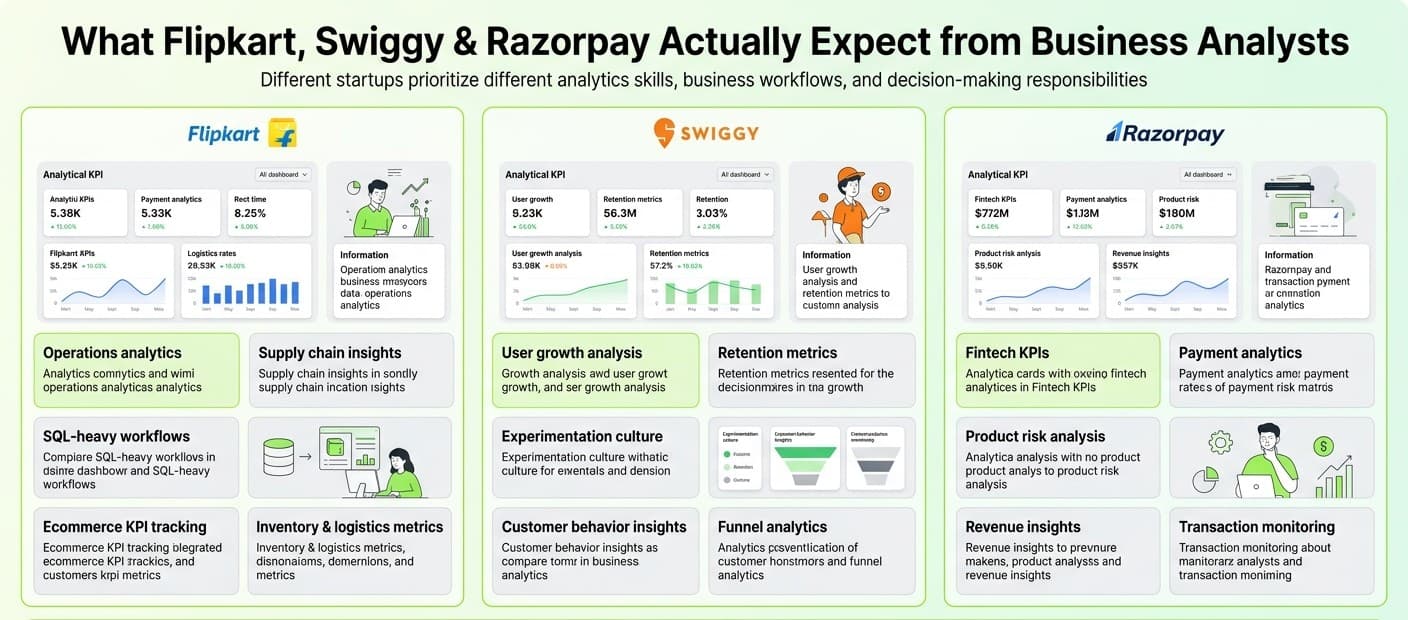
Razorpay is India's dominant B2B fintech company, powering payments infrastructure for hundreds of thousands of businesses. A business analyst at Razorpay operates in a fundamentally different environment than ecommerce. Here, the problems are often about fraud detection, payment success rates, merchant onboarding funnels, and financial product adoption. The domain is more specialized, the data is more sensitive, and the stakes of a wrong recommendation are different. Here is the salary picture at Razorpay: Entry level Business Analyst: ₹7.6 LPA to ₹11 LPA Mid level: ₹11 LPA to ₹17 LPA Senior Business Analyst: ₹19.9 LPA to ₹28.3 LPA (total compensation) Top reported package: ₹45.5 LPA for the most senior BA roles The median total compensation for business analysts at Razorpay sits around ₹19.9 LPA, which actually edges out both Flipkart and Swiggy at the senior level. This is likely because fintech domain expertise carries a premium in the market, and Razorpay competes hard for people who understand both payments and data fluently. However, there is one number that stands out in a different way. Indeed and Glassdoor data on Razorpay's BA compensation at the entry level shows a wider variance than the other two companies. Some entry-level BAs have reported packages starting as low as ₹5 to ₹6 LPA, while others report ₹12 to ₹14 LPA for the same title. That spread tells you one thing clearly: at Razorpay, the negotiation matters enormously. Go in with data, go in with clarity about your impact, and do not accept the first number. The compensation satisfaction scores at Razorpay for BA roles are lower than Swiggy on Glassdoor (around 2 out of 5 in some ratings), which multiple employees link to how frequently salary reviews happen and whether performance bonuses land on time. This is worth factoring into your decision.
FREE TO USE
8k+ SESSIONS92% FLUENCY4.9★ RATING
Speak With Confidence
Real Conversations. Real Scenarios. Speak until it feels natural.
- Real-Time Speaking Practice
- Guided Conversation Flows
- Instant AI Feedback
Why Product Companies Pay Analysts More
This is the question underneath the question: Why does a business analyst at Flipkart make nearly double what someone in the same role might make at an IT services company? The answer is not just money. It is incentive alignment. In a service-based company, a business analyst is a cost that gets billed to a client. The company makes money by having you utilised on a project. The incentive is utilisation, not impact. Your salary ceiling is usually tied to your billability, and that ceiling tends to be lower. In a product company like Flipkart, Swiggy, or Razorpay, the business analyst is directly connected to outcomes. If you find a way to improve the checkout conversion rate by 2%, that 2% turns into real revenue for the company. If your analysis helps reduce delivery costs by identifying route inefficiencies, that flows directly to the company's margin. The company is not billing you out. It is betting on you. And companies pay more for bets they believe in. There is also a talent competition angle. Product companies compete with each other for the same pool of sharp analytical thinkers. Flipkart is not just competing with Meesho or Zomato for business analysts. It is also competing with consulting firms, global tech companies, and well-funded startups. To attract and retain people with strong SQL skills, structured thinking, and product intuition, they have to pay up. That is the fundamental economics of why the product company business analyst salary in India keeps climbing while service company salaries grow more slowly.
Skills That Increase Business Analyst Salary
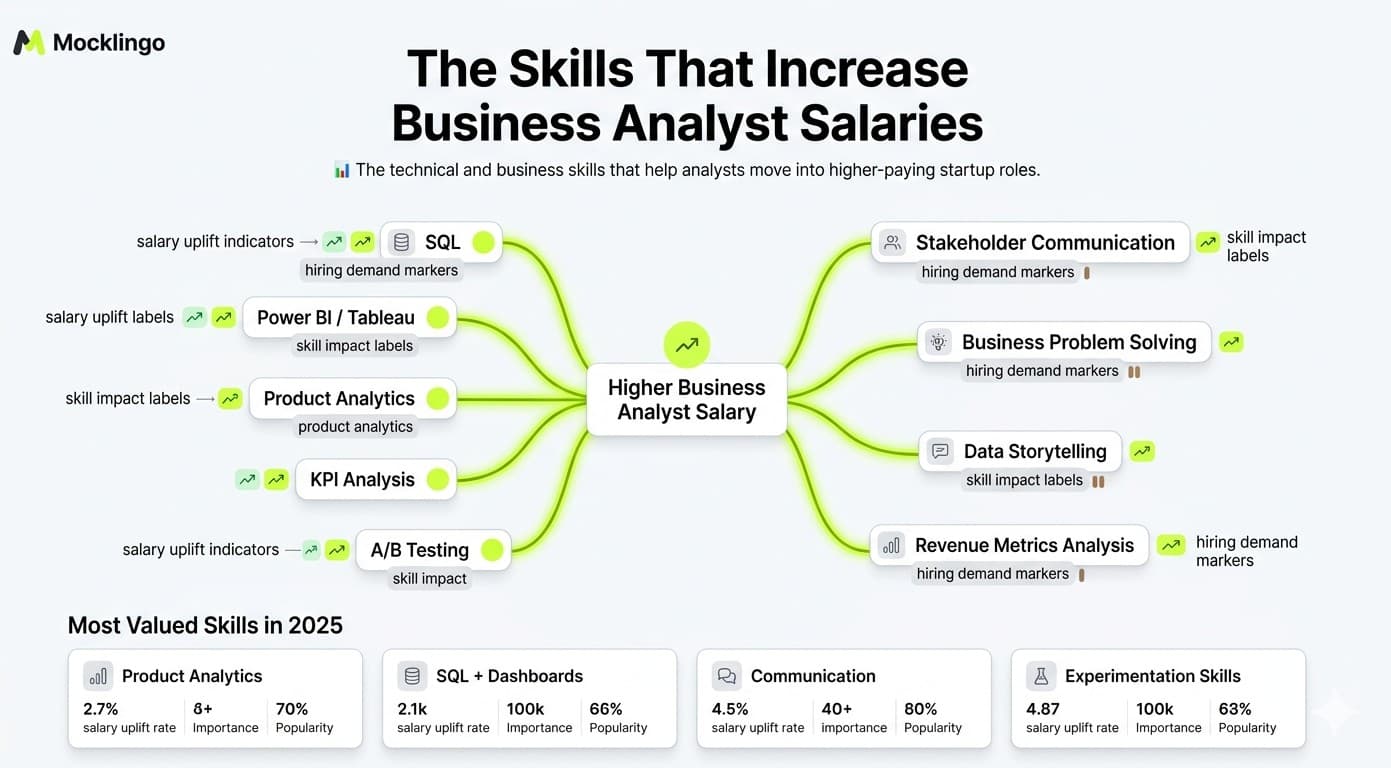
Here is what separates the analysts who negotiate ₹20 LPA from the ones who walk away with ₹12 LPA for essentially the same years of experience. SQL and data fluency are table stakes. Every single product company expects you to be able to write queries, pull your own data, and validate your findings. If you are waiting for a data engineer to run every query for you, you are not competitive at these companies. Product sense matters as much as analytics. The analysts who move from ₹14 to ₹22 LPA are usually the ones who can look at a metric and immediately connect it to a user behavior or a business decision. It is not just about knowing the number. It is about knowing why the number moved and what to do about it. Experience with A/B testing and experimentation. Companies like Swiggy run hundreds of product experiments simultaneously. Analysts who understand how to design and interpret experiments correctly, including knowing when a result is actually significant and when you are just looking at noise, are genuinely rare and genuinely valuable. Fintech or ecommerce domain knowledge. This is specific to the companies in this piece. If you are interviewing at Razorpay and you can speak intelligently about payment success rates, MDR, or merchant economics, you are immediately more credible than someone with the same resume who does not have that vocabulary. Communication that influences decisions. The highest-paid analysts are not the ones with the most complex dashboards. They are the ones who can walk into a room with a product manager and a business head and present a recommendation so clearly that a decision gets made in that meeting. That skill is rare, and companies pay for it.
What This Actually Means for You
Here is the honest summary. Flipkart, Swiggy, and Razorpay all pay business analysts well above the market average in India. The realistic range across all three, depending on your level and experience, is ₹12 LPA to ₹33 LPA, with senior and lead roles pushing higher. But salary is not just a function of which company you join. It is a function of which level you join at, how well you negotiate, what domain expertise you bring in, and how quickly you demonstrate impact once you are inside. The gap between an analyst earning ₹14 LPA and one earning ₹24 LPA at the same company is rarely about years of experience. It is almost always about clarity of thinking, ownership of outcomes, and the ability to connect data to decisions that the business cares about. If you are targeting a product company business analyst role and want to be in that upper range, start with the skills. Then focus on how you tell the story of your work in interviews. That combination, domain knowledge plus the ability to demonstrate impact clearly, is what the salary data above is actually rewarding.
Also read: How to Negotiate a Business Analyst Offer
Want to break into a product company as a Business Analyst? Mocklingo offers structured mock interviews with former interviewers from Flipkart, Swiggy, Razorpay, and other top product companies. Real feedback, real questions, and the exact preparation that gets you past the bar. Start your first mock interview today.