Loading...
Contents
Which Web Developer Jobs Is AI Actually Replacing in 2026?
May 12, 202632 min readUpdated Oct 8, 2026
Every few months, a new headline drops. "AI will replace developers by 2026." "ChatGPT can already build websites." "You don't need to learn to code anymore." And every time, thousands of web developers panic. They start questioning whether they chose the right career. Whether they should pivot. Whether it's already too late. Here's what you should know before anything else: Most of what you've heard about AI replacing web developers is either exaggerated, misunderstood, or just flat-out wrong. But some of it is true. There are specific types of web development work that AI is genuinely taking over in 2026. And if you're doing that kind of work exclusively, it's time to pay attention. In this blog, we're going to know about which web developer jobs AI is actually replacing, which ones it's making stronger, and what you should do about all of it.
FREE TO USE
25K+ INTERVIEWS4.8★ RATING68% IMPROVEMENT
Crack Your Dream Job
Real Interviews. Real Pressure. Practice until it feels easy.
- Seamless Interview Experience
- Resume & JD Questions
- Instant Personalized Feedback
What AI Can Actually Do in 2026
Before we talk about jobs, let's be honest about what AI tools can and cannot do right now. What AI can do well today: Generate boilerplate code (HTML structure, CSS layouts, basic components) Write simple JavaScript functions when given a clear description Convert a Figma design into rough HTML/CSS code Debug small, isolated code errors Write unit tests for existing functions Generate content for basic static websites Answer coding questions faster than Stack Overflow What AI still struggles with: Understanding the full context of a large, complex codebase Making product decisions, what to build and why Handling ambiguous requirements from a real client Debugging deeply nested logic across multiple files Building accessible, performant, production-ready UIs from scratch Working with legacy code that has no documentation Communicating with stakeholders and translating business needs into features AI is a very fast junior developer that never sleeps, never asks questions, and sometimes confidently gives you the wrong answer.
Is AI Replacing Web Developer Jobs in 2026? The Real Answer
AI is not replacing "web developers" as a category. It is replacing specific types of web development tasks. And the developers who were doing only those tasks without growing beyond them are feeling it the most. Think of it this way. When ATMs were introduced, bank tellers didn't disappear. But the tellers who only counted cash had a harder time. The ones who could open accounts, give financial advice, and build customer relationships? They were fine. Better, actually. The same thing is happening in web development right now.
The Web Developer Jobs AI Is Actually Replacing in 2026
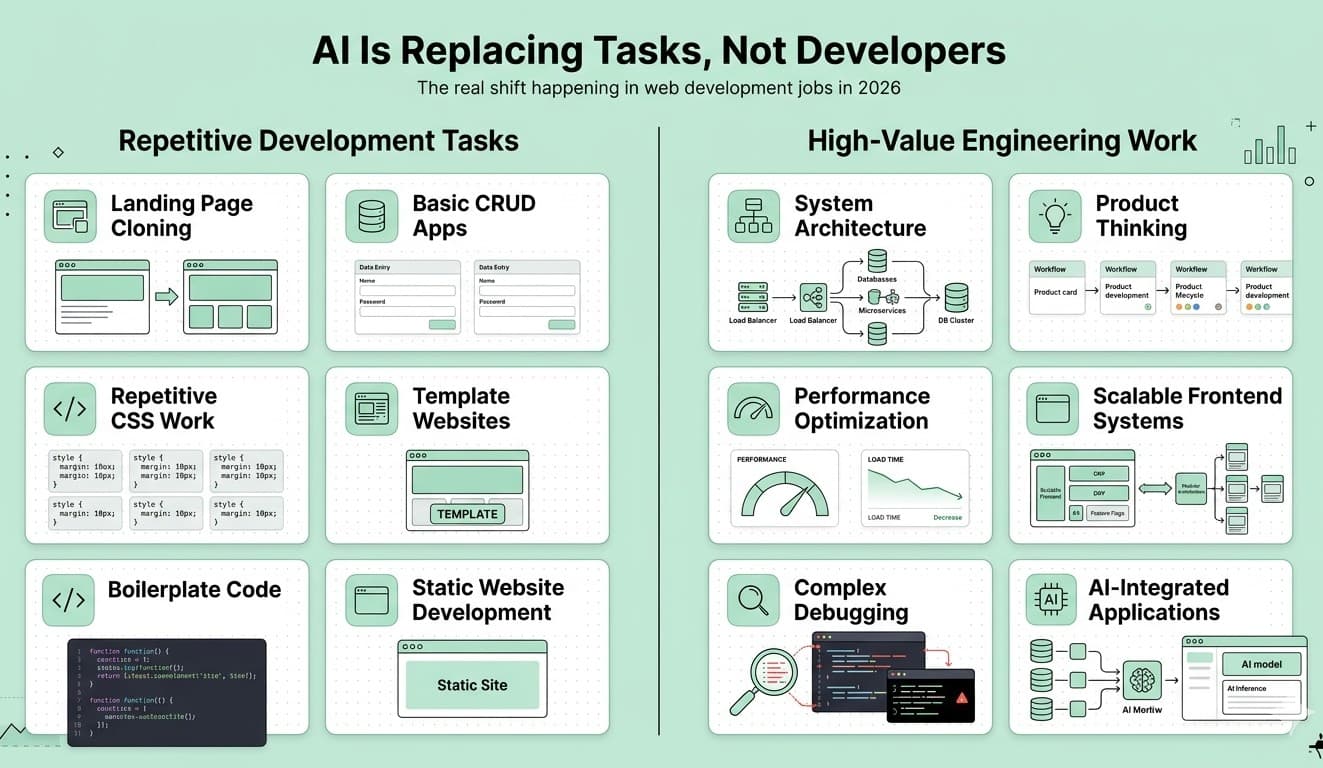
Let's be specific. Here are the roles and tasks where AI is genuinely making a dent: This is the clearest one. If your job is to take a WordPress or Wix template, swap out the logo and text, and hand it to a client for ₹5,000–15,000, that work is almost gone. Tools like Wix ADI, Squarespace AI, and Framer AI can build a basic 5-page business website in under 10 minutes. A restaurant website. A salon booking page. A small freelancer portfolio. The client doesn't need you for that anymore. They can do it themselves. Who this affects: Freelancers who only do basic brochure websites for small local businesses. What to do: Move up the value chain. Build custom features. Focus on performance, SEO, integrations, and things the no-code tools can't handle. There's a category of frontend work that is essentially: "Here's the Figma. Convert it to HTML and CSS. Pixel perfect, please." AI tools, especially GitHub Copilot, Cursor, and tools like Locofy are getting very good at this kind of mechanical translation work. Especially for simple, clean, component-based designs. If this is the majority of your day-to-day work and you add no logic, no interactivity, no performance thinking, AI can replicate a lot of it. Who this affects: Junior developers at agencies who spend most of their time doing HTML/CSS slicing from design files. What to do: Learn to own the full component not just write it, but make it accessible, reusable, responsive, and performant. That's a different skill level, and AI still needs a human to get there. CRUD forms. API fetch wrappers. Config files. Basic React components with props and state. Authentication flows that look the same across every project. AI writes all of this faster than any human can type. If you spend 4 hours a day writing code that looks almost identical to code you've written before, AI is already doing a lot of that work on teams that use Copilot or Cursor. Who this affects: Developers at every level who haven't moved beyond writing predictable, templated code. What to do: This isn't a crisis, it's actually a gift. Use AI to write the boring stuff and spend your time on the hard, interesting, high-value problems. The developers who adopt AI as a tool are becoming significantly faster. They're not being replaced, they're being amplified. Performance marketing teams used to hire a developer to build quick landing pages for Google or Meta ad campaigns. Simple pages. Big headline, some copy, a CTA button, a form. AI-powered tools like Unbounce and Instapage now generate these automatically including copy variations for A/B testing. Marketers can do this without a developer. Who this affects: Freelancers and junior developers who only build marketing landing pages. What to do: If you work in marketing-adjacent development, go deeper into conversion optimization, analytics integration, experimentation frameworks, and performance. That's where the value is now. If part of your job was writing component documentation, README files, or API docs for internal tools, AI does this very well now. GitHub Copilot can generate a README. Claude and ChatGPT can document a codebase when given the code. Who this affects: Developers whose job description included significant documentation writing.1. Template-Based Website Builders
2. Copy-Paste Frontend from Design Files
3. Writing Repetitive Boilerplate Code
4. Basic Landing Page Development for Ads
5. Writing Basic Technical Documentation
AI vs Web Developers - Who's Actually Winning in 2026?
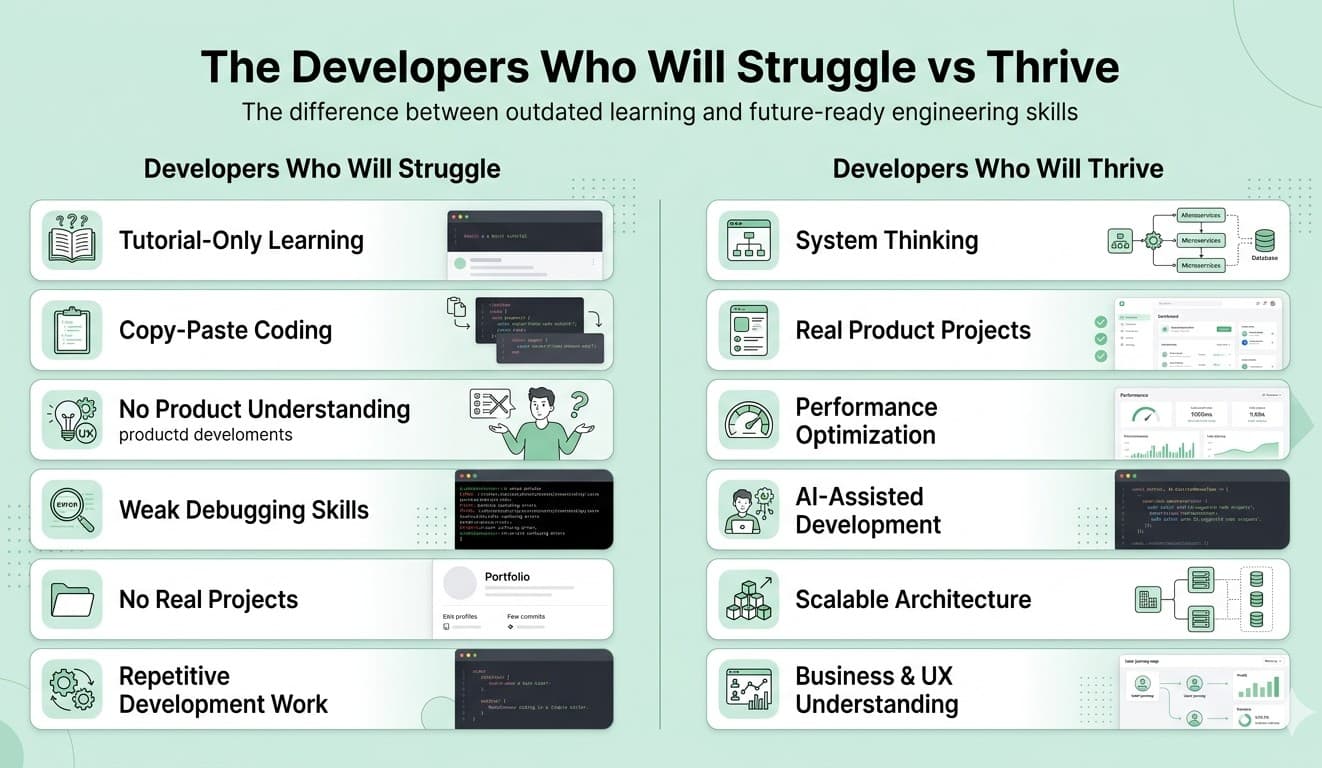
Here's what the data actually says. According to the U.S. Bureau of Labor Statistics, web development employment is projected to grow 16% between 2022 and 2032, much faster than average for all occupations. In India, the demand for developers is not shrinking. According to NASSCOM, India will need 1.5 million additional tech professionals in data, cloud, AI, and full-stack development by 2026. Stack Overflow's 2024 Developer Survey found that 62% of developers are already using AI tools in their workflow and most of them said it made them more productive, not worried about their jobs. This is the key insight: AI is not fighting web developers. It is being used by web developers. The developers losing ground are the ones who refuse to learn and adapt. The ones growing faster than ever are the ones who've made AI a part of their toolkit.
FREE TO USE
8k+ SESSIONS92% FLUENCY4.9★ RATING
Speak With Confidence
Real Conversations. Real Scenarios. Speak until it feels natural.
- Real-Time Speaking Practice
- Guided Conversation Flows
- Instant AI Feedback
AI Impact on Web Development Jobs - What's Changing, What's Not
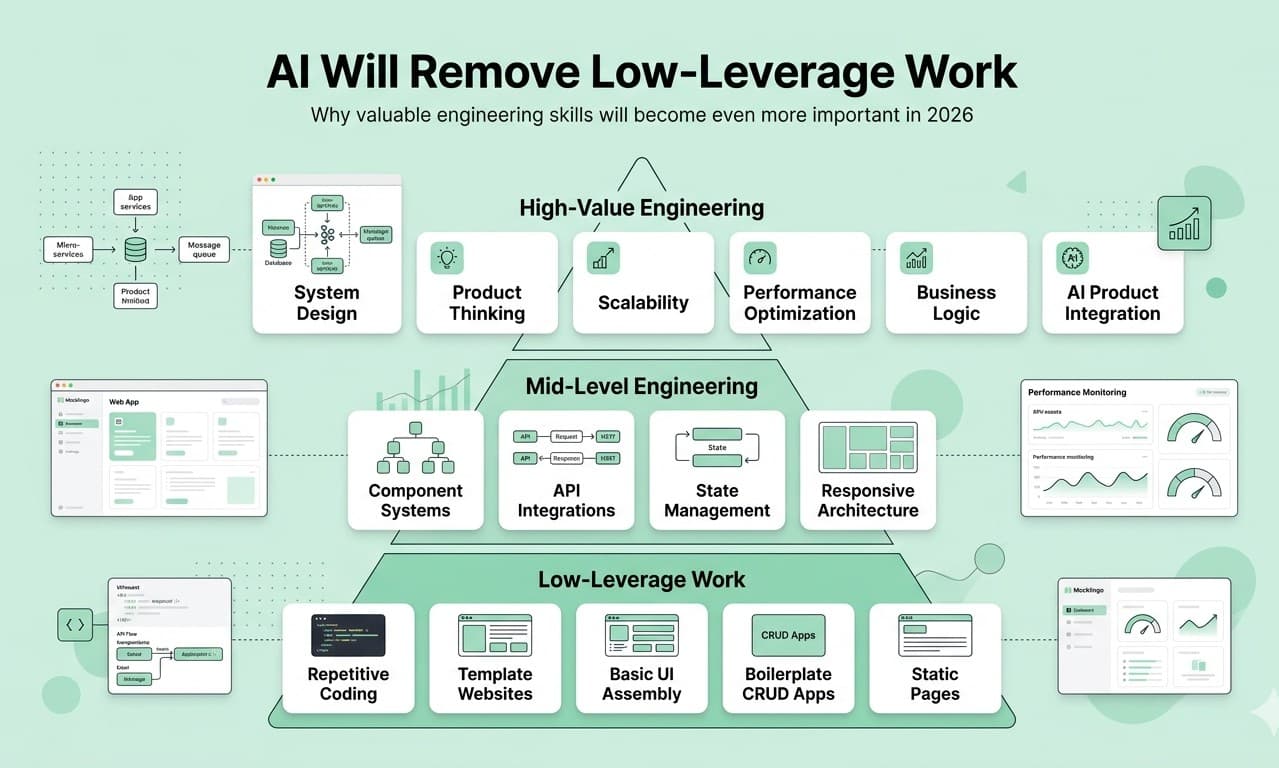
Let me break this down clearly: What's changing: The time it takes to write a component has dropped dramatically Junior developers are expected to use AI tools, it's not optional anymore Purely mechanical "implement this design" work has lower market value Entry-level freelance rates for basic websites have dropped Companies need fewer people for routine tasks but more people for complex ones What's NOT changing: The need for developers who understand systems at a deep level The need for people who can talk to clients and understand what they actually need The need for senior engineers who can review AI-generated code and spot what's wrong The need for developers who can own a product end-to-end and not just write features The need for performance, accessibility, and security expertise The need for people who can build what doesn't exist yet That's the skill that's becoming more valuable, not less.
Will AI Replace Web Developers
Let's put it in a simple table:
Are Web Developers Still in Demand? Yes
Let me give you the honest answer: Web developers are absolutely still in demand in 2026. But the demand has shifted upward in skill level. Companies are not looking for fewer developers. They are looking for better developers. Developers who: Can think about the product, not just the code Can work with AI tools and review their output critically Understand performance, security, and scalability Can communicate clearly with non-technical teammates Can solve problems that don't have a Stack Overflow answer The "easy" entry into development; copy a template, write some HTML, and earn money is harder than it was in 2019. That's real. But the ceiling for a skilled web developer has never been higher. A full-stack developer who understands cloud infrastructure, can build accessible interfaces, knows how to optimize Core Web Vitals, and can use AI to move 3x faster than their peers. That person is more valuable in 2026 than in any previous year.
The Future of Web Developers With AI - What Smart Developers Are Doing
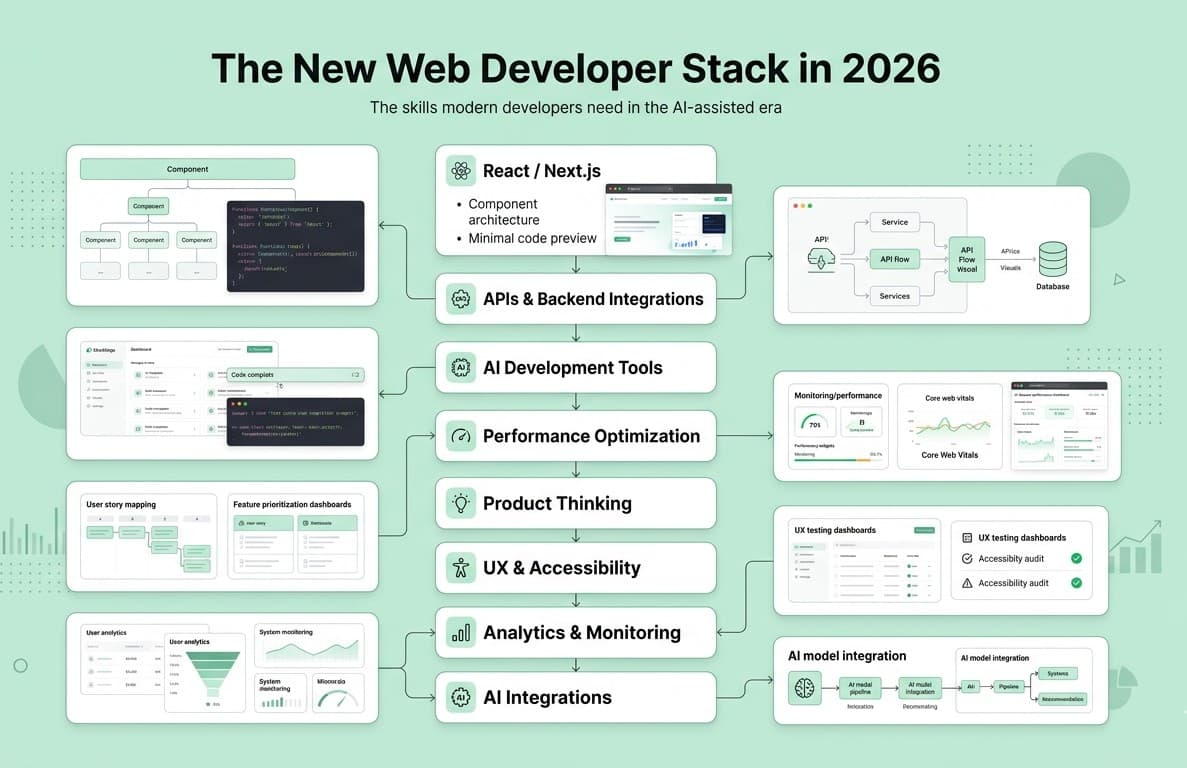
Here's what I see the best developers doing right now: 1. They're using AI as a pair programmer, not fearing it They use GitHub Copilot, Cursor, or Claude to write the repetitive parts. Then they spend their time reviewing, refining, and building on top of it. They're writing twice as much in the same amount of time. 2. They're specializing, not generalizing The generalist "I know a bit of everything" developer has a harder path now. The specialist- "I build high-performance React apps with a focus on accessibility and Core Web Vitals" has a clearer, higher-value market position. 3. They're developing product thinking The most future-proof developers are the ones who understand why something is being built, not just how. They can sit in a product meeting, understand the business problem, and come back with the right technical approach. 4. They're learning to review AI-generated code critically This is a new skill that barely existed 3 years ago. AI writes code that looks right but isn't always right. Knowing how to read AI output, catch the subtle bugs, and refactor it into production-quality code is genuinely valuable. 5. They're building their presence - portfolio, writing, open source In a world where AI can write code, the humans who stand out are the ones with proof of work. A portfolio with real projects. Articles that show how they think. Open source contributions. GitHub activity.
What Should You Do If You're a Web Developer?
Let me give you real, actionable advice not vague "upskill yourself" advice. If you're a fresher or student: Don't skip fundamentals. Learn how the web actually works. HTTP, the DOM, JavaScript engines, how browsers render. AI can't replace someone who truly understands the foundations. Learn to use AI tools from day one treat them like a calculator, not a cheat code. Build real projects that solve real problems. Not just tutorials. If you're 1–3 years in: Go deeper, not wider. Pick one area: performance, accessibility, testing, architecture and become genuinely strong at it. Start reviewing AI-generated code in your work. It'll teach you more about good code than most tutorials. Think about the product you're building, not just your tickets. If you're senior or above: Your biggest advantage is judgment and context, protecting it by staying close to real problems. Use AI to make your team faster, but own the quality bar. Start mentoring and writing. The developers who share knowledge become the ones everyone wants to hire.Also read: How to Build a Web Dev Portfolio
Conclusion
Here's my honest answer after looking at everything clearly: AI is replacing specific tasks in web development that are the mechanical, repetitive, low-judgment ones. That is real and it's already happening. But AI is not replacing web developers, the curious, problem-solving, product-thinking humans who build things that matter. The developers who are struggling are the ones who never moved beyond mechanical work. The developers who are thriving are the ones who use AI as a tool and spend their energy on the things AI genuinely cannot do. You are not competing with AI. You are learning to work with it. That's the real story of 2026.