Loading...
Contents
How AI Killed the Generalist Data Scientist
and What Profile Actually Survives
May 3, 202621 min readUpdated Oct 7, 2026
There is an uncomfortable conversation happening in data science circles right now. Job postings for "data scientist" are still going up. LinkedIn shows thousands of openings. Bootcamps are still enrolling students. And yet the developers who finished a DS course a year or two ago and called themselves generalist data scientists are finding it unusually hard to get interviews. The two things are not contradictory. Data science as a field is not dying. But a specific type of data scientist, the person who could do a bit of everything reasonably well, is having a much harder time. And the reason is not the job market. It is AI. This blog explains honestly what is happening, which profiles are struggling, which ones are not, and what skills actually matter if you want to build a data science career that holds up through 2026 and beyond.
FREE TO USE
25K+ INTERVIEWS4.8★ RATING68% IMPROVEMENT
Crack Your Dream Job
Real Interviews. Real Pressure. Practice until it feels easy.
- Seamless Interview Experience
- Resume & JD Questions
- Instant Personalized Feedback
Why Generalist Data Scientists Are Disappearing
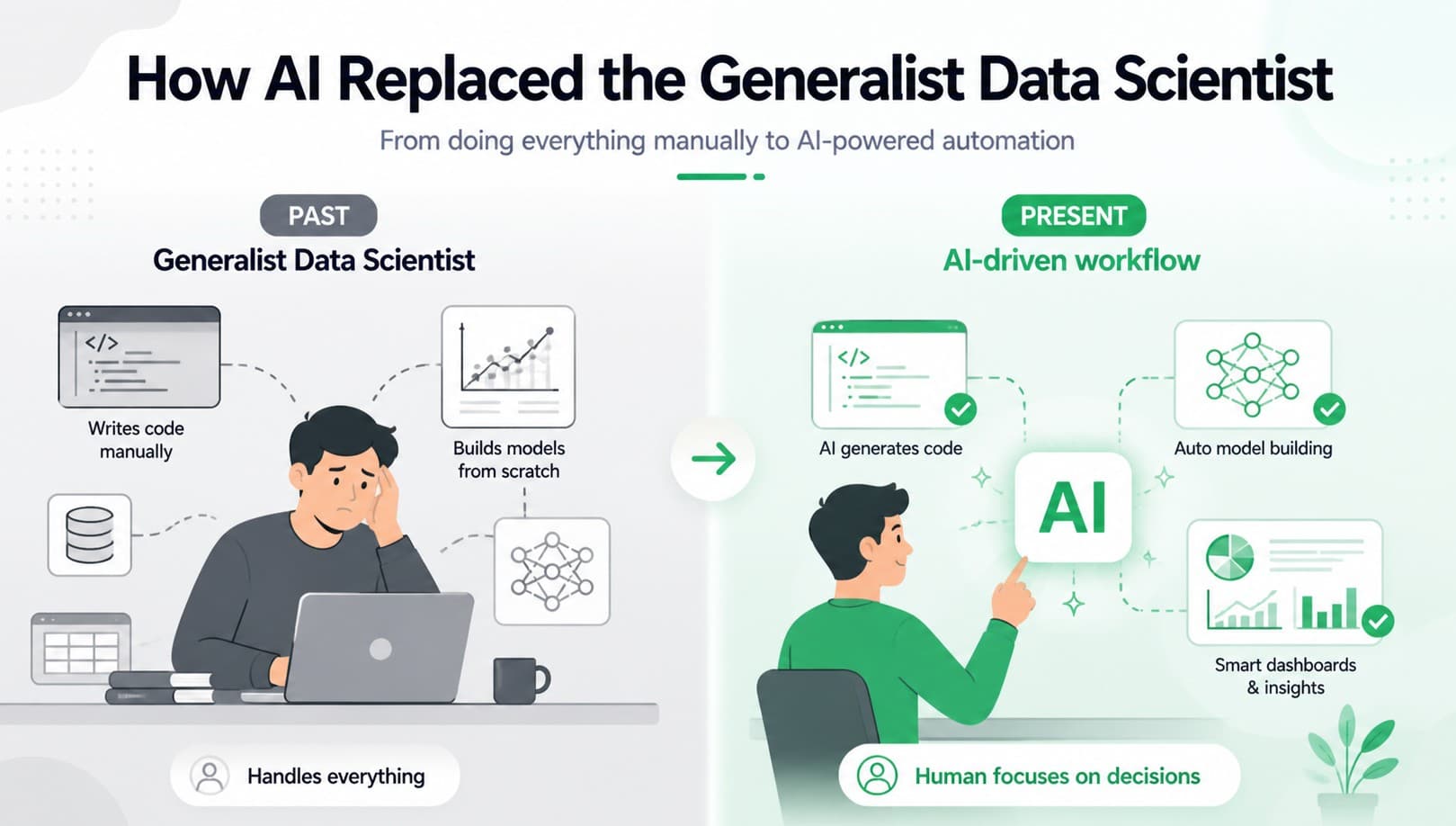
A generalist data scientist in 2021 could clean data, build models, write SQL queries, create dashboards, and put together a presentation for stakeholders. That combination of skills was valuable because doing all of it required dedicated human time and effort. By 2025, AI tools had automated or significantly accelerated almost every piece of that list. What AI tools have taken over from generalist data scientists: Exploratory data analysis that used to take hours can now be initiated with a natural language prompt in tools like ChatGPT with code interpreter, Julius AI, or GitHub Copilot with pandas SQL query generation from a plain English description of what you want to find Basic feature engineering suggestions based on dataset characteristics Dashboard creation through tools like Tableau AI and Power BI Copilot, which generate charts from natural language descriptions Data cleaning pipelines that previously required significant manual scripting Boilerplate model training code for standard classification and regression tasks None of this means the output is perfect. It still needs human review. But the human time required has dropped dramatically. Here is the core problem for the generalist: if a company can get 80 percent of what a generalist data scientist does through an analyst with good prompting skills and AI tools, the business case for hiring a full-time generalist weakens. Not disappears. Weakens. The roles that remain, and the roles that are growing, are the ones where the work cannot be delegated to a well-prompted AI. Those roles require deep specialization, domain knowledge, or the kind of judgment that comes from genuinely understanding a complex system end to end.
Will AI Replace Data Scientists? The Honest Answer
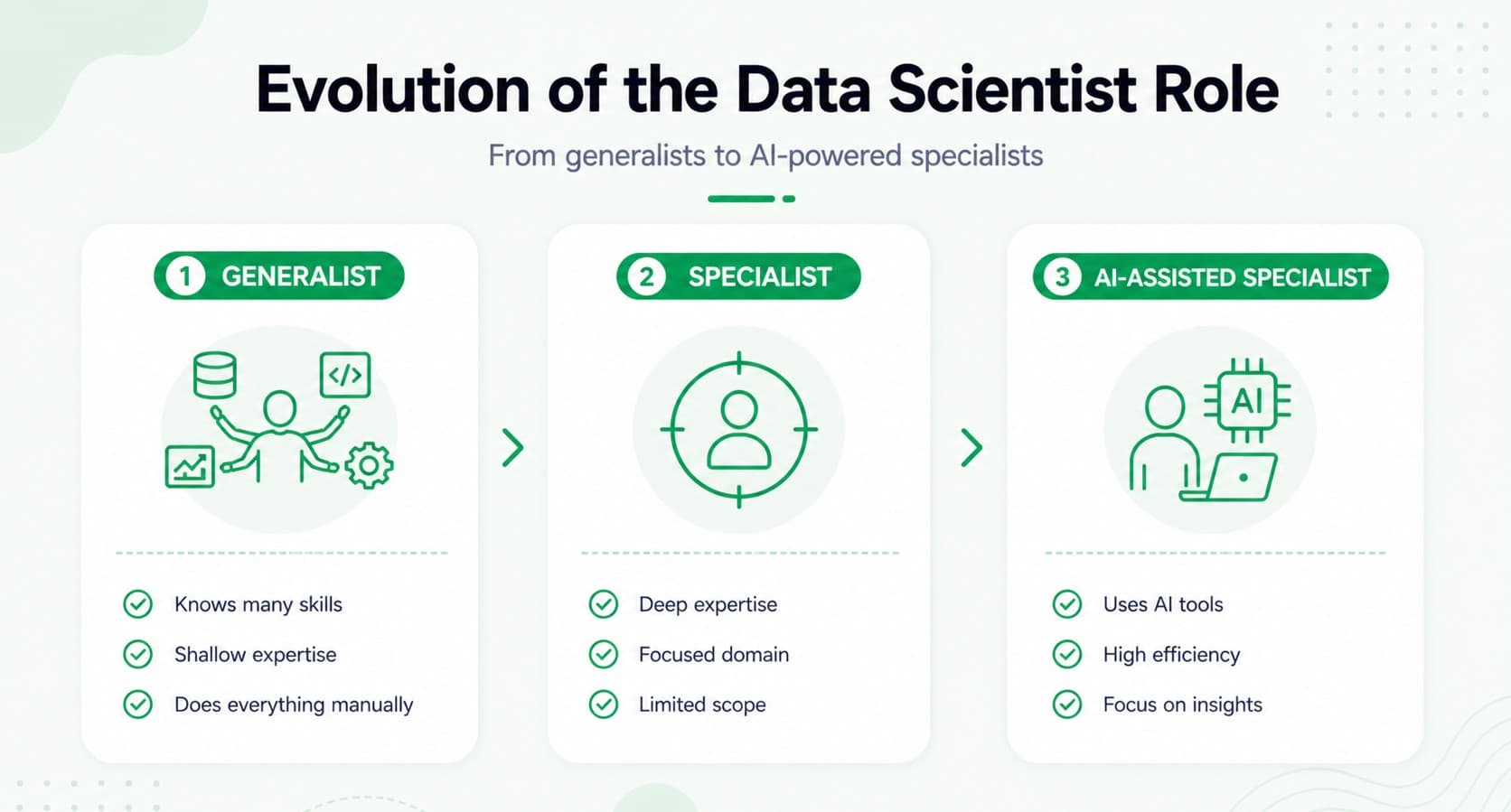
This is the question everyone is actually asking, and the honest answer has two parts. AI is replacing the tasks that generalist data scientists do. It is not replacing the judgment and expertise that specialist data scientists provide. LinkedIn's 2024 AI at Work report found that the fastest-growing skills on the platform included AI and machine learning proficiency, not as a replacement for domain expertise but alongside it. Companies are not hiring fewer people who understand data. They are hiring fewer people who only understand data at a surface level. The U.S. Bureau of Labor Statistics projects that employment in data science and related roles will grow by 35 percent between 2022 and 2032, significantly faster than the average for all occupations. But that growth is not evenly distributed. It is concentrated in roles that require deep technical capability, domain knowledge, or the ability to work directly with AI systems. Is data science still a good career in 2026? Yes. But the version of it that survives looks different from what many people signed up for.
The 3 Data Scientist Profiles That Still Survive
These are not the only profiles with a future, but they represent the clearest paths forward based on where companies are actually hiring.
Profile 1: The ML Engineer DS
This is a data scientist who has moved meaningfully toward engineering. They can build and deploy models in production, not just in a Jupyter notebook. They understand MLOps, model monitoring, retraining pipelines, and how to make a model work reliably at scale. What makes this profile survive AI tools is that the hard part of ML engineering is not building a model. It is making a model work correctly in a system that runs continuously, handles edge cases, drifts gracefully, and can be updated without breaking everything downstream. AI tools can generate training code. They cannot architect a production ML system. Skills that define this profile: Python with production habits (testing, logging, version control, packaging) MLflow, Weights and Biases, or similar experiment tracking tools Docker, basic Kubernetes, or cloud ML services like AWS SageMaker or GCP Vertex AI Feature stores and serving infrastructure Model monitoring and drift detection Companies hiring for this profile include product companies with real-time prediction needs: recommendation systems, fraud detection, dynamic pricing, personalization
Profile 2: The Domain Expert DS
This is a data scientist with deep knowledge of a specific industry or function, combined with strong enough technical skills to apply ML meaningfully within it. A data scientist who spent three years as a credit risk analyst before learning ML is not just a data scientist. They are someone who understands exactly which features predict default, what the regulatory constraints are, what the false positive cost means for a lending business, and how a model's behaviour changes across economic cycles. An AI tool has no access to that understanding. The same logic applies to healthcare data scientists who understand clinical workflows, supply chain data scientists who understand inventory dynamics, or fintech data scientists who understand payment fraud patterns at a transaction level. This profile survives because the value is not in the ML alone. It is in the combination of ML and irreplaceable domain context. What makes this profile strong: 3 or more years of work experience in a specific domain before or alongside data science Ability to translate business constraints into modelling constraints Understanding of what the model's errors cost in real terms, not just in metric terms Relationships and credibility with domain stakeholders who trust their analysis
Profile 3: The Research or Applied Scientist DS
This profile is at the most technically advanced end of the spectrum. These are data scientists working on new methods, pushing the state of the art in a specific problem area, or applying cutting-edge techniques to genuinely novel problems. This is not a profile most people start with. It typically requires a strong quantitative background, graduate-level research experience, and the ability to read and implement ideas from academic papers. But it is the profile most insulated from AI disruption for an obvious reason. AI tools are trained on existing knowledge. They cannot generate the next methodological advance. The scientists who do that work are more valuable, not less, in an AI-saturated environment where better methods have larger downstream impact. Large tech companies, AI labs, research arms of fintech and healthcare organisations, and PhD-focused startups are all still hiring for this profile competitively.
AI Tools Replacing DS Tasks: What Has Already Shifted
Let us be specific about what AI tools are doing right now, because the picture is clearer than most people think.
| TASK | AI TOOL IMPACT | HUMAN STILL NEEDED FOR |
|---|---|---|
| EDA and data exploration | High. Tools generate summaries, plots, and anomaly detection automatically | Interpreting what the findings mean for the business |
| SQL query writing | High. Natural language to SQL is reliable for standard queries | Complex multi-table business logic and performance tuning |
| Dashboard creation | Medium-High. AI can generate charts from descriptions | Designing what questions to ask, not just what to show |
| Feature engineering | Medium. AI suggests features but misses domain-specific ones | Medium. AI suggests features but misses domain-specific ones |
| Model selection and training | Medium. AutoML tools handle standard cases well | Custom architectures, constrained problems, production readiness |
| Model interpretation and communication | Low. AI can explain models but not advocate for them to sceptical stakeholders | Business stakeholder management and decision influence |
| Research and novel methods | Very Low | The entire task |
The pattern is consistent. AI tools handle the mechanical parts of data science work well. They handle the judgment, communication, and domain-specific parts poorly. Read More: 50 Best AI Prompts for Data Science in 2026
FREE TO USE
8k+ SESSIONS92% FLUENCY4.9★ RATING
Speak With Confidence
Real Conversations. Real Scenarios. Speak until it feels natural.
- Real-Time Speaking Practice
- Guided Conversation Flows
- Instant AI Feedback
Is Data Science Still a Good Career in 2026?
If the version you are building is generalist, the answer is: it is harder than it was three years ago and getting harder. Not impossible. But the competition from candidates with AI productivity tools means that a generalist who does not specialize will find the market increasingly competitive. If the version you are building is specialist, domain-specific, or ML engineering-focused, the answer is clearly yes. These profiles are in demand, they are not easily replaced by AI tools, and the salary premium for genuinely deep expertise continues to grow. The most useful framing is this: AI has raised the floor and lowered the ceiling for generalist data work. The floor is higher because AI tools mean anyone can do basic data analysis. The ceiling is lower because the value of surface-level DS skills has compressed. The people with real depth are worth more than ever.The version of this question that matters is not "is data science still a good career" in the abstract. It is "is the version of data science I am building toward still a good career."
Skills Data Scientists Need in 2026
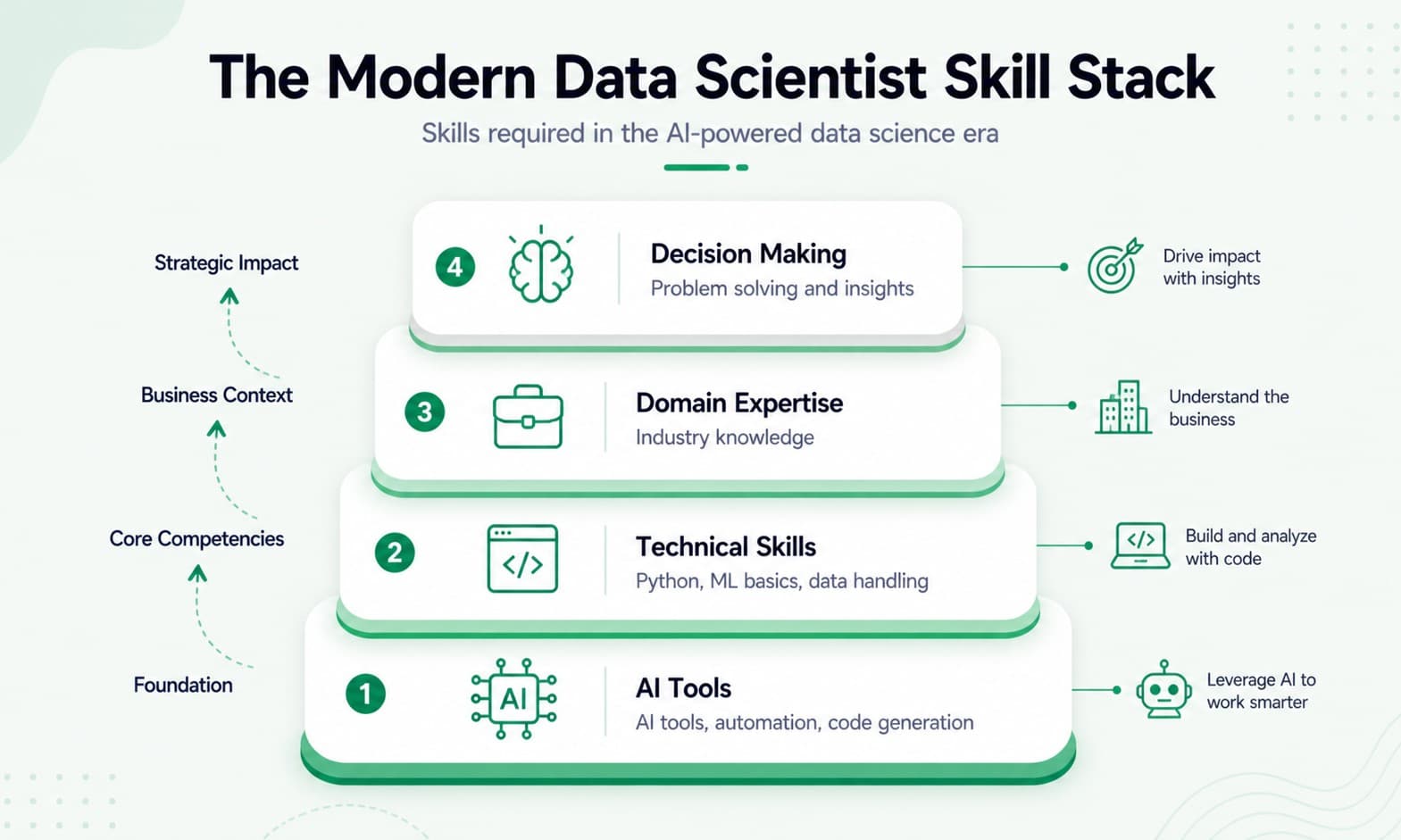
Technical skills that are becoming more valuable: Production ML skills. Not just training models but deploying, monitoring, and maintaining them. MLOps is no longer optional for mid-to-senior DS roles. LLM integration and prompt engineering. Many DS roles now involve working with or on top of large language models. Understanding how to use them productively and where they fail is a distinct skill. Statistical rigour for experimentation. A/B testing, causal inference, and experimental design are areas where AI tools are weakest. Companies running hundreds of experiments need people who understand this deeply. Data engineering fundamentals. A data scientist who can build and maintain data pipelines is significantly more valuable than one who only consumes clean data. Deep learning for specific modalities. If your domain involves images, text, time series, or tabular data with complex patterns, knowing the relevant deep learning approaches is increasingly important. Non-technical skills that are becoming more valuable: Communication with non-technical stakeholders. The ability to explain what a model does, why it should be trusted, and what its limitations are in plain language is a skill AI tools cannot replicate. Problem framing. Knowing which business question to answer with data before touching any tools. This is where most DS work actually fails or succeeds. Domain depth. The more you understand the business or domain you work in, the harder you are to replace by anything, AI or otherwise.This is the practical section. If you are a working data scientist or someone building toward the role, here is what actually matters right now.
The Future of Data Scientist Jobs: What the Next Three Years Look Like
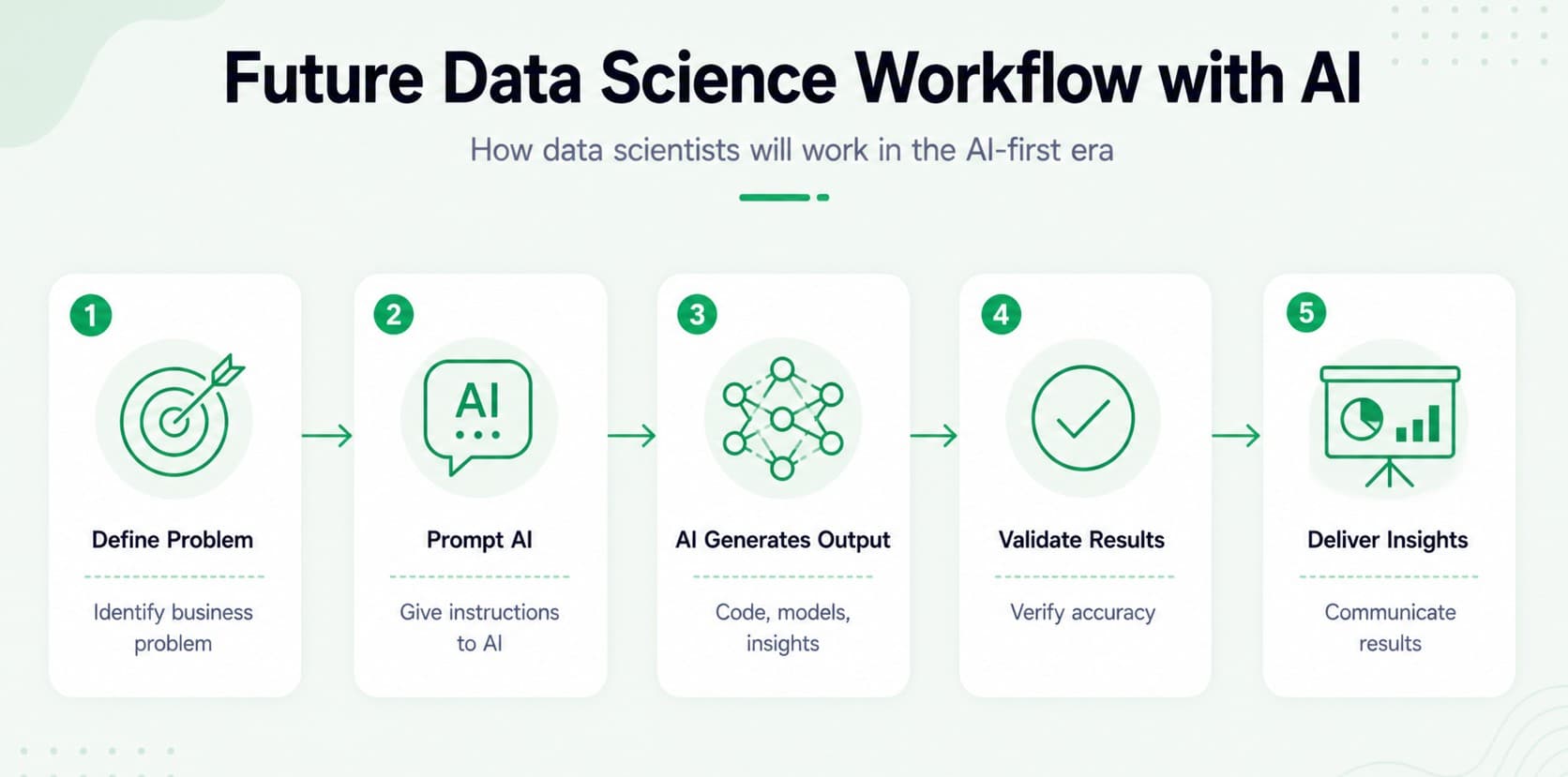
The generalist who can do a bit of everything but nothing deeply will have the hardest time. Not because data science is dying. Because depth has become the thing that differentiates a person from a well-prompted AI tool. The path forward is not complicated. Pick a domain or a technical depth area. Go genuinely deep in it. Use AI tools to move faster on the parts of your work that do not require your specific expertise. Spend the time you save on the parts that do. That is the profile that survives.By 2027, the distinction between a "data scientist" and an "ML engineer" will be less meaningful than it is today. The roles are converging. The data scientists who will be most in demand are those who can build things that work, understand the domain they are working in, and communicate clearly about both.