Loading...
Contents
I Interviewed at Swiggy for a Data Analyst Role -
Every Question They Asked (2026)
May 10, 202618 min readUpdated Oct 5, 2026
Preparing for a data analyst interview at a product company can feel uncertain. You may know SQL, understand data analysis concepts, and still wonder what actually happens inside the interview room. Recently, I had the opportunity to interview for a Data Analyst role at Swiggy. The experience was insightful because the interview was not only about technical knowledge but also about how data can be used to solve real business problems. If you are preparing for a similar role, understanding the Swiggy data analyst interview questions in 2026 can give you a clearer idea of what interviewers expect from candidates. In this article, I will share my complete interview experience, including the interview process, the types of questions asked, and the analytical approach that helped me navigate the discussion.
FREE TO USE
25K+ INTERVIEWS4.8★ RATING68% IMPROVEMENT
Crack Your Dream Job
Real Interviews. Real Pressure. Practice until it feels easy.
- Seamless Interview Experience
- Resume & JD Questions
- Instant Personalized Feedback
Swiggy Data Analyst Interview Questions in 2026
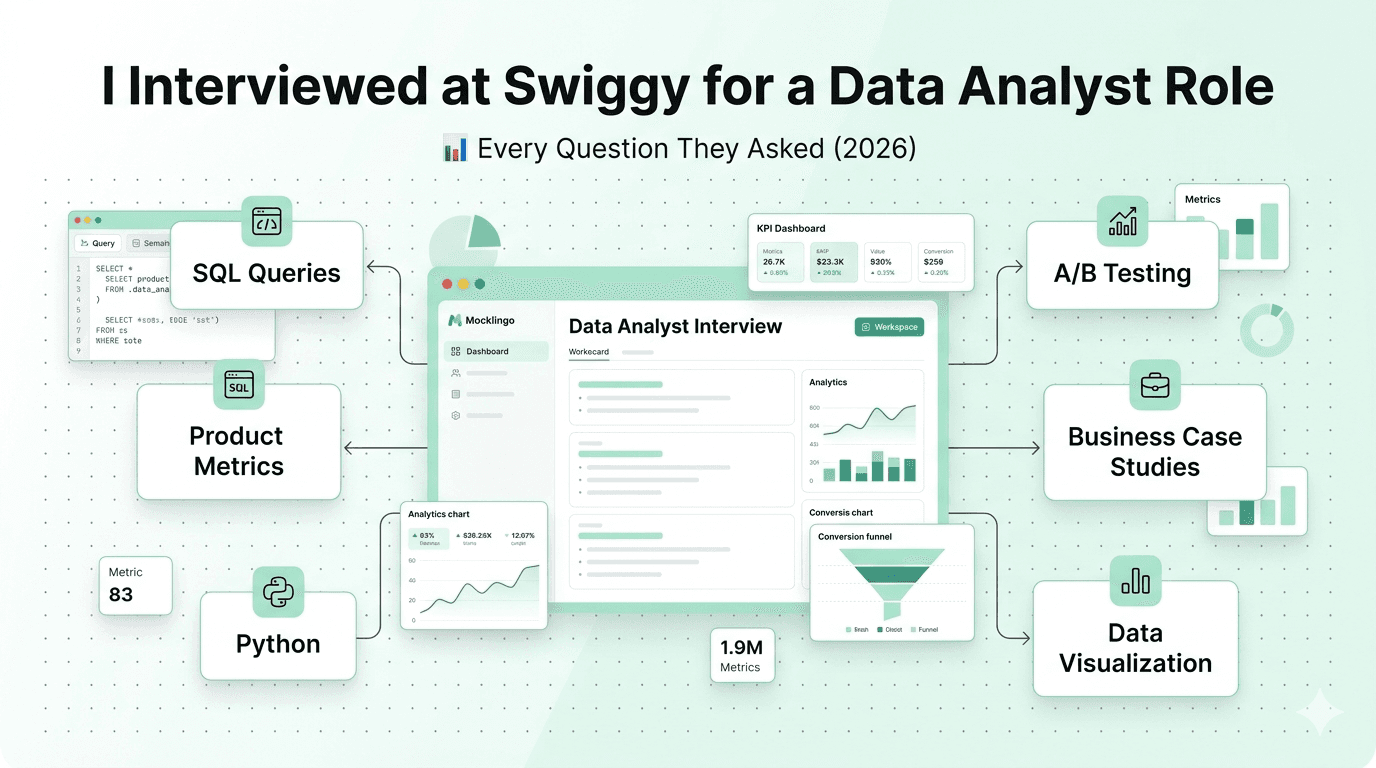
During the interview process, the questions covered several important areas such as SQL, business analysis, and product metrics. The interviewers were interested in understanding how I approach data problems and how I connect insights with business decisions. In the sections below, I will walk through the Swiggy data analyst interview questions in 2026, explain the structure of the interview rounds, and highlight the key analytical skills expected from candidates applying for data roles at Swiggy.
How I Got the Swiggy Interview
The process started when I applied for the Data Analyst role through the company’s hiring portal. After about a week, I received an email from the recruitment team at Swiggy inviting me for an initial discussion. The recruiter call lasted around 15 minutes. It focused mainly on understanding my background and verifying whether my experience aligned with the role. Some of the questions included: What tools do you usually use for data analysis? How comfortable are you with SQL? Have you worked on any business analytics projects? The recruiter also explained the interview structure. The process would include technical and analytical rounds designed to evaluate both technical ability and business thinking. A few days later, I received the interview schedule.
Swiggy Data Analyst Interview Process
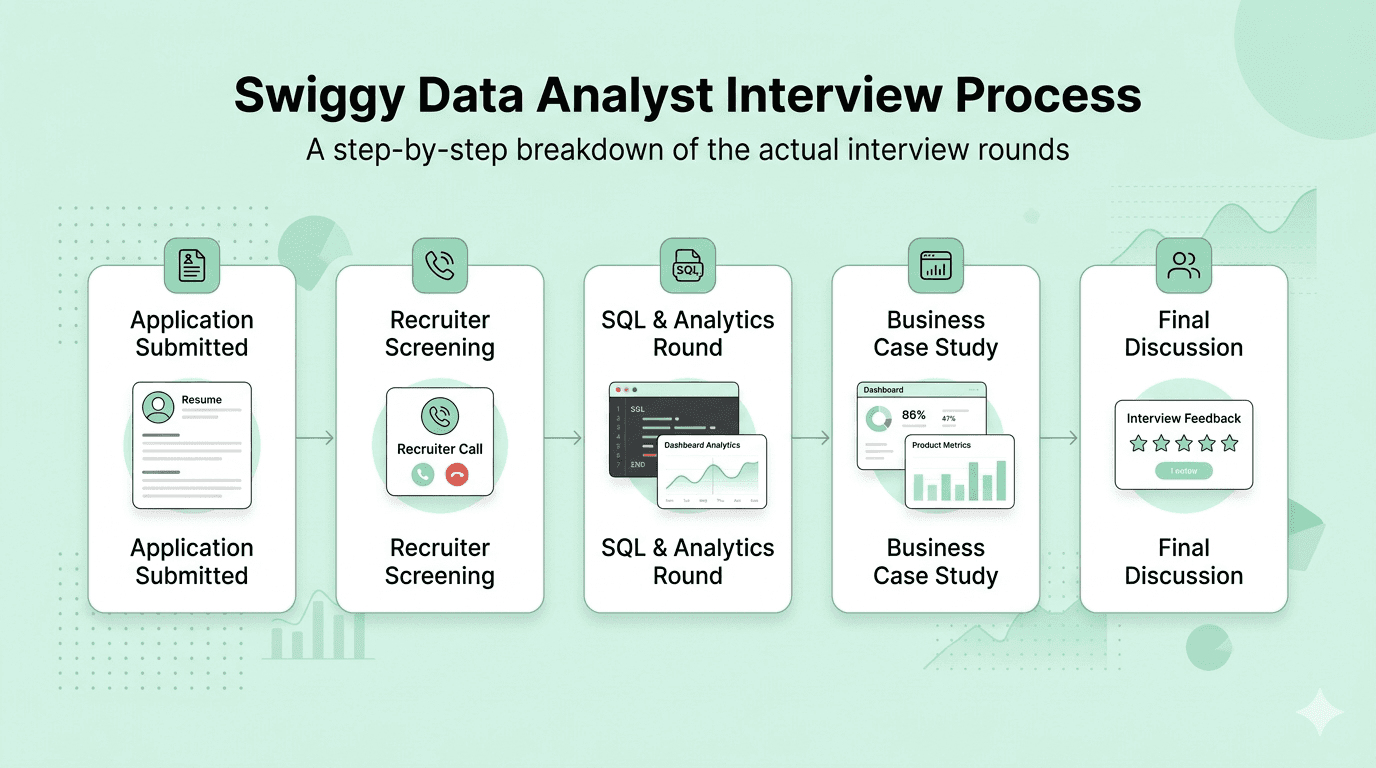
Knowing the structure of an interview before you walk in makes a huge difference. From my experience, the Swiggy data analyst interview has 4 rounds. Each round tests something different, so you really can't just prepare for one thing and hope for the best. Here is how the process looks: Stage 1: HackerRank SQL Test The first thing they give you is an online SQL test on HackerRank. The questions test your query writing, optimization, and problem solving skills. This is basically the filter round. If SQL is your strong suit, you can clear this comfortably. If not, this is where most people get stuck. Stage 2: Technical Round Once you clear the HackerRank test, the real conversation starts. This round covers SQL, a resume discussion, and statistics. The SQL questions go deeper into query writing and data manipulation. You also discuss your past projects and experiences in detail, so be ready to talk about your work confidently. The statistics side focuses on probability, hypothesis testing, and A/B testing, which are becoming essential skills for any data analyst role today. Stage 3: Case Study Round This is where things get really interesting. You are given a business problem related to Swiggy's actual operations. You have to break down the problem, define the right metrics, and suggest data driven solutions. The interviewer is not just looking for the right answer here. They want to see how structured and clear your thinking is. Stage 4: Behavioral Round The final round is more of a conversation. It focuses on culture fit, your past experiences, and how you approach problem solving when working in a team. Using the STAR framework, Situation, Task, Action, Result, helps a lot here to keep your answers focused and to the point.
My Interview Experience at Swiggy
Now that you know the structure, let me walk you through what actually happened during my interview. Honestly it was more intense than I expected, but every round gave me something to learn from. Round 1: HackerRank SQL Test The process started with an online SQL test. The questions were not just about writing correct syntax. They were testing whether I could actually think through data problems and optimize my queries. I had to stay calm and approach each question systematically because some of them were trickier than they looked on the surface. My advice here is simple. Practice writing queries regularly, not just once in a while before an interview. The more you practice, the faster and cleaner your thinking gets. Round 2: Technical Round After clearing the test, I had a live technical interview. We covered SQL again but at a deeper level, including data manipulation and query writing on real scenarios. Then the interviewer moved to my resume and asked me to walk through my past projects in detail. Be prepared for this because they will dig into your work and ask follow up questions. The statistics questions surprised me a little. They asked about probability, hypothesis testing, and A/B testing. These are not just theory questions. They want to know if you actually understand how to apply these concepts in a data driven environment. Round 3: Case Study Round This was the most challenging round for me personally. The interviewer gave me a business problem connected to Swiggy's operations and asked me to break it down, identify the right metrics, and suggest what I would do with the data. The biggest learning from this round was that structure matters more than the answer. I focused on thinking out loud, laying out my approach step by step, and explaining why I was choosing certain metrics over others. That clarity in thinking is exactly what they are looking for. Round 4: Behavioral Round The last round felt like a proper conversation more than an interview. The questions were around culture fit, how I work in a team, and how I handle real situations at work. I used the STAR framework throughout, Situation, Task, Action, Result, and it genuinely helped me give answers that were specific and easy to follow rather than vague and long. This round is easy to underestimate during preparation but it matters a lot. They want to know if you will actually be good to work with, not just technically capable.
FREE TO USE
8k+ SESSIONS92% FLUENCY4.9★ RATING
Speak With Confidence
Real Conversations. Real Scenarios. Speak until it feels natural.
- Real-Time Speaking Practice
- Guided Conversation Flows
- Instant AI Feedback
How Difficult Is the Swiggy Data Analyst Interview?
Honestly, I would call it moderate to challenging, but it really depends on how well you have prepared. The HackerRank SQL round is manageable if you practice regularly. The questions test query writing and optimization, nothing comes out of nowhere. But once you get past that, the difficulty goes up a notch. The technical round pushes you on statistics, probability, A/B testing, and hypothesis testing along with SQL. If you have not touched stats in a while, that round can catch you off guard. And the case study round is a completely different challenge because there is no fixed right answer. They are watching how you think, how you break down a problem, and how clearly you can communicate your approach. What surprised me the most was that even in the behavioral round, they were not just making small talk. They were genuinely evaluating whether you can work well in a team and handle real situations at work. So the difficulty is not just about technical knowledge. It is about how well you can put everything together under pressure.
How to Prepare for the Swiggy Data Analyst Interview
After going through all four rounds, here is what I genuinely wish I had focused on more before going in. Get your SQL sharp before anything else The HackerRank round is your entry ticket. If you are not comfortable writing and optimizing queries under time pressure, this round will be tough. Practice joins, aggregations, window functions, and subqueries regularly. Do not just read about them, actually write them out on real datasets until it feels natural. Do not ignore statistics This is the part most people underestimate. The technical round at Swiggy specifically covers probability, hypothesis testing, and A/B testing. Know what these concepts mean and more importantly know how to apply them in a data context. If your stats are rusty, start revisiting them early. Understand how Swiggy's business actually works The case study round becomes so much easier when you understand the platform. Swiggy connects customers, restaurants, and delivery partners. When you know how these three sides interact and where problems typically arise, you can break down any business scenario they throw at you with a lot more confidence. Practice case studies out loud Most people practice case studies in their head and that is a mistake. Solving a problem silently is very different from explaining your reasoning to someone in real time. Practice structuring your approach, talking through your thinking step by step, and defining metrics clearly. The interviewers are not just checking your answer, they are checking whether you can be followed. Prepare your STAR stories before the behavioral round The behavioral round is not just a formality at Swiggy. They are genuinely assessing culture fit and how you handle real team situations. Having three or four strong STAR stories ready, covering situations around problem solving, conflict, and ownership, will help you stay calm and give focused answers instead of rambling.
What I Actually Took Away From This Experience
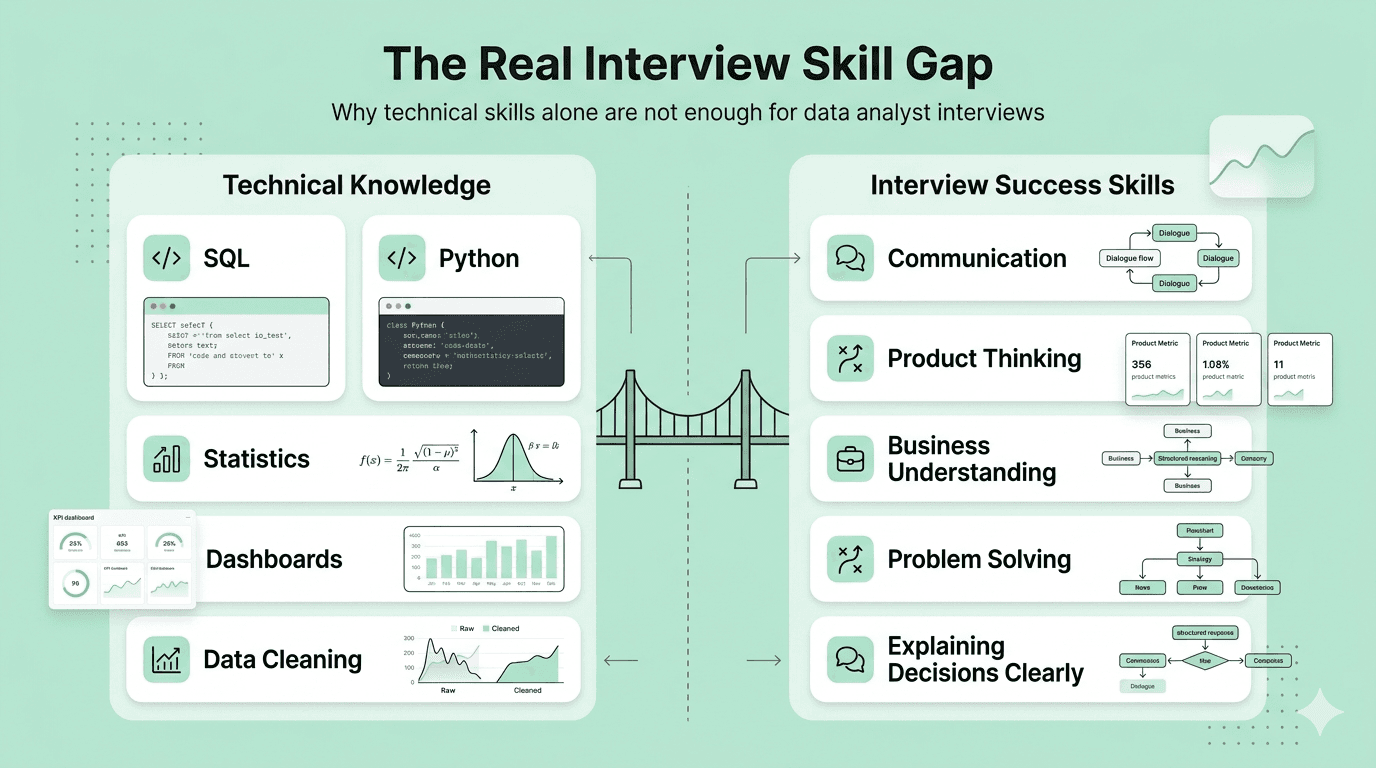
The biggest lesson across all four rounds was that technical skills alone will not get you through this interview. The HackerRank round tests your SQL. The technical round tests your SQL and stats. But from the case study round onwards, what they are really evaluating is how you think. Can you take a messy business problem and structure it clearly? Can you define the right metrics? Can you explain your reasoning in a way that actually makes sense to the person sitting across from you? A strong data analyst does three things well. They interpret data correctly, connect those insights to real business decisions, and communicate their findings clearly. All four rounds at Swiggy are designed to check exactly those three things in different ways.
A Quick Practice Exercise Before You Go
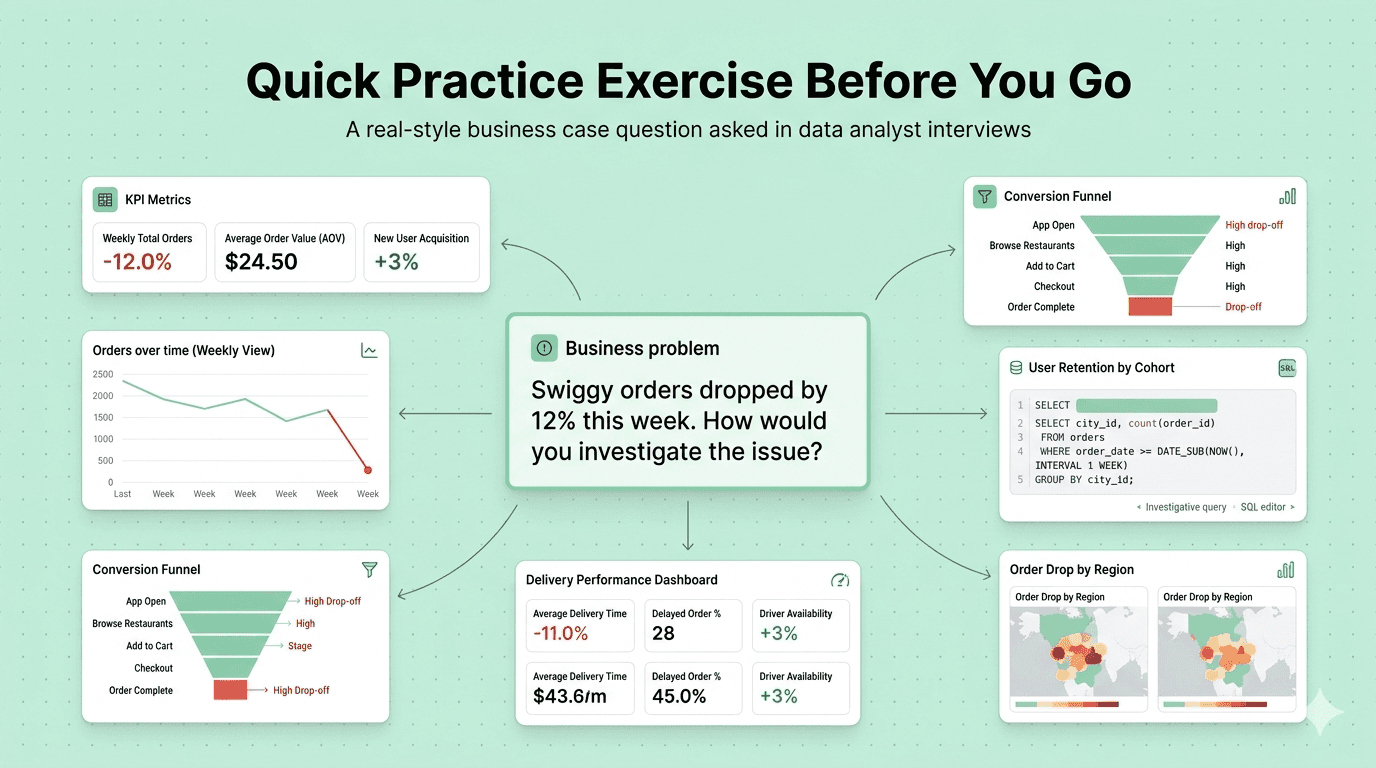
Before you close this article, try this small exercise. It will take around 15 to 20 minutes and it is genuinely worth doing. Open your SQL editor and imagine you are working with a Swiggy dataset. Assume you have four tables available: orders, customers, restaurants, and delivery partners. Try solving these three questions: Write a SQL query to find the top 5 restaurants with the highest number of completed orders. Identify customers who placed more than three orders in the last 30 days. Calculate the average delivery time for each city. You do not need a perfect solution on the first try. The goal is to practice thinking like a data analyst. If you can clearly explain your approach before even writing the first line of SQL, you are already building the exact kind of thinking that gets you through Swiggy's interview rounds.
Conclusion
Going through the Swiggy data analyst interview was honestly one of the more challenging experiences I have had. Four rounds, each testing something different, and each one requiring you to show up prepared in a completely different way. But it was also one of the most useful experiences because it showed me exactly where my gaps were. If you are preparing for this role, focus on SQL and statistics early, understand the business deeply, practice your case study approach out loud, and have your behavioral stories ready. Do those four things consistently and you will walk into that interview in a much stronger position than most people do. Also read: Will AI Replace Data Analysts in 2026?