Loading...
Contents
Common Full Stack Developer Interview Mistakes to Avoid in 2026
Aug 12, 202638 min readUpdated Sep 16, 2026
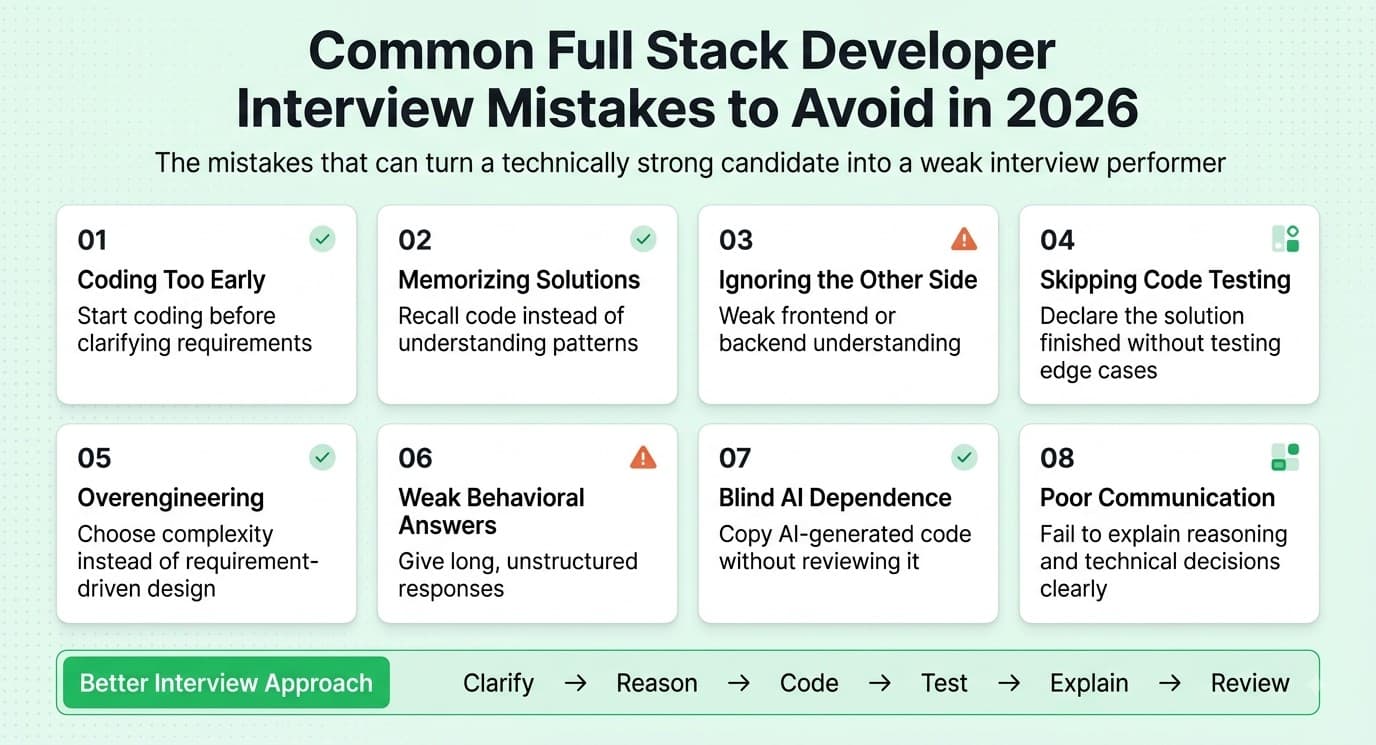
The most common full stack developer interview mistakes in 2026 are writing working code without being able to explain the underlying mechanism, jumping to a complex architecture before clarifying requirements, treating the frontend and backend as disconnected concerns in a system design round, shipping AI-generated code that passes the eye test but contains a security flaw, and describing past projects as all successes with no failures or real tradeoffs. Every mistake below has a specific, rehearsable fix — not a vague suggestion to "be more confident."
Most interview prep advice for full stack developers focuses on what to study, not what actually causes technically capable candidates to fail. The reality is that most rejections after a technical round are not caused by a knowledge gap. They are caused by a fixable behavior: narrating what code does instead of why you made the architectural choice, or designing an impressive system that solves a problem the interviewer never asked about.
I have evaluated hundreds of full stack developer candidates across small startups and large engineering organizations. The mistakes below appear repeatedly, across experience levels, across technology stacks, and increasingly in AI-era rounds that most prep guides have not caught up to. Every mistake is named precisely, its real cost explained, and the fix is specific enough to actually practice before your next interview.
FREE TO USE
25K+ INTERVIEWS4.8★ RATING68% IMPROVEMENT
Crack Your Dream Job
Real Interviews. Real Pressure. Practice until it feels easy.
- Seamless Interview Experience
- Resume & JD Questions
- Instant Personalized Feedback
Why Technically Strong Candidates Still Fail Full Stack Interviews
Full stack interviews test three things simultaneously: whether you can build it, whether you thought through it before building, and whether you can articulate the tradeoffs of your choices. Most candidates prepare heavily for the first, moderately for the second, and almost not at all for the third, which is the one that most often decides the offer.
Full stack roles carry a specific burden that frontend-only or backend-only roles do not: you are expected to hold the entire feature in your head, from the database schema to the API contract to the UI state model, and to reason about how a decision at one layer affects the others. Interviewers probe for this holistic thinking specifically because it is rare and because its absence causes real problems on the job. Most of the mistakes below are variations of this same root cause: thinking in layers instead of thinking end to end.
Read More : How to prepare for full stack developer interview in 2026
Category 1: Technical Interview Mistakes
Mistake 1: Writing Working Code Without Being Able to Explain the Mechanism Beneath It
What This Looks Like
A candidate builds a working async function using async/await, or correctly wires up a React context, but when the interviewer asks "what is actually happening here, step by step," the answer becomes vague or collapses into restating what the code does rather than explaining why it behaves the way it does.
Why Recruiters Flag This
With AI tools generating correct-looking code in seconds, the code itself proves almost nothing anymore. What tells a recruiter whether a candidate truly understands their own work is the explanation. A developer who cannot explain the mechanism beneath their code cannot debug it when it breaks in an unexpected way in production, which it will.
The Real Cost
This mistake is especially damaging in full stack interviews because it signals pattern matching rather than understanding, and pattern matching breaks down the moment a system behaves in an unexpected way across layer boundaries, exactly the situation full stack developers face most often.
The Complete Fix
Adopt a two-layer explanation habit for every piece of code you write: first, what the code does, and second, what the language or runtime is actually doing underneath. For async/await, the first layer is "this waits for the API response before continuing." The second layer is "the runtime suspends this function, frees the event loop thread for other work, and resumes it when the microtask queue processes the resolved promise." The second layer is what interviewers are actually asking for.
Practice this specifically with the five or six mechanisms you use most often: the JavaScript event loop and microtask queue, how your chosen framework reconciles a virtual DOM or reactive state tree, how database connection pooling works behind an ORM, and how HTTP sessions and cookies interact with a stateless backend. You do not need to go infinitely deep, but you need a solid second layer for each.
Practice Method
Take any working piece of code you have written recently and write a one-paragraph plain-language explanation of what the runtime is doing underneath it, without referencing the framework or library by name. If you cannot write that paragraph, you have found a gap worth filling before your interview.
Mistake 2: Building the Feature But Ignoring What Breaks at the Seams
What This Looks Like
A take-home or live coding round involves building a feature end to end. The candidate's implementation works cleanly in the happy path but has no error handling between layers: the frontend assumes the API always returns the expected shape, the backend assumes the database always succeeds, and neither handles the cases where they do not.
Why Recruiters Flag This
Full stack work lives at the seams between systems, and the seams are where production breaks happen. A candidate who only codes the happy path reveals they have been working mostly on features, not on maintaining them through real failures. Interviewers test this explicitly because it predicts production reliability.
The Real Cost
The mistake is not missing a catch block. The mistake is revealing that you did not think about failure modes at all, which means you would make the same omissions in production code.
The Complete Fix
Build a mental checklist of four failure points you walk through every time you implement a feature spanning more than one layer. What happens if the API call fails? What happens if the data returned has an unexpected shape? What happens if the database write times out? What happens if the user takes an unexpected action while an async operation is in flight? You do not need to handle all of these perfectly in a time-pressured interview, but naming them explicitly, then handling the one or two most likely ones, demonstrates the maturity that distinguishes a careful engineer from one who only writes greenfield happy-path code.
In a live round, say the checklist out loud: "Before I consider this done, I want to at least handle the network failure case and document the others." Verbalizing the omissions intentionally reads far better than leaving them unnoticed.
Practice Method
Take any personal project endpoint or component and spend thirty minutes specifically introducing failure scenarios: drop the network, return malformed data, inject a database timeout, and observe exactly what the user would see. Fix the worst two cases and document the rest. This exercise builds instincts that last well beyond any single interview.
Mistake 3: Ignoring Security Basics During a Live Coding Round
What This Looks Like
A candidate builds a working user authentication endpoint or a search feature with dynamic queries but does not mention input validation, parameterized queries, or token expiration, because they were focused on making it work and security felt like a separate concern to add later.
Why Recruiters Flag This
Security awareness has moved from a senior-only concern to a baseline expectation at the mid-level, specifically because AI tools now generate security vulnerabilities embedded in otherwise functional code, and teams need developers who catch these in review, not after a breach.
The Real Cost
Missing a single security consideration in a live round is recoverable if you catch it yourself or acknowledge it explicitly. Never mentioning security at all, even briefly, is a meaningful red flag for any role that involves user data, authentication, or database queries.
The Complete Fix
Memorize four specific security checks as a verbal habit you trigger on any feature involving user input, authentication, or data access: is every user-supplied value going through a parameterized query or an ORM that parameterizes it, never string concatenation? Is every API endpoint verifying the caller's identity and checking they are authorized for this specific resource, not just authenticated? Are tokens and session credentials being transmitted only over HTTPS and stored with appropriate scope restrictions? Are error messages returning safe information to the client rather than internal stack traces or database error details?
You do not need to implement all of these perfectly in an interview. You need to name them proactively and implement the most critical one for the feature at hand. An interviewer who sees a candidate pause and say "before I finalize this endpoint, I want to make sure I'm using parameterized queries here, not interpolating the user input directly" evaluates that candidate significantly higher than one who submits a working but injectable query without comment.
Practice Method
Find a tutorial project that involves a login form and a database query. Spend one session specifically looking for every security assumption the tutorial made silently, inputs it did not validate, tokens it did not expire, errors it returned raw, and document each one with its real-world consequence. This exercise builds the security lens faster than reading about it in the abstract.
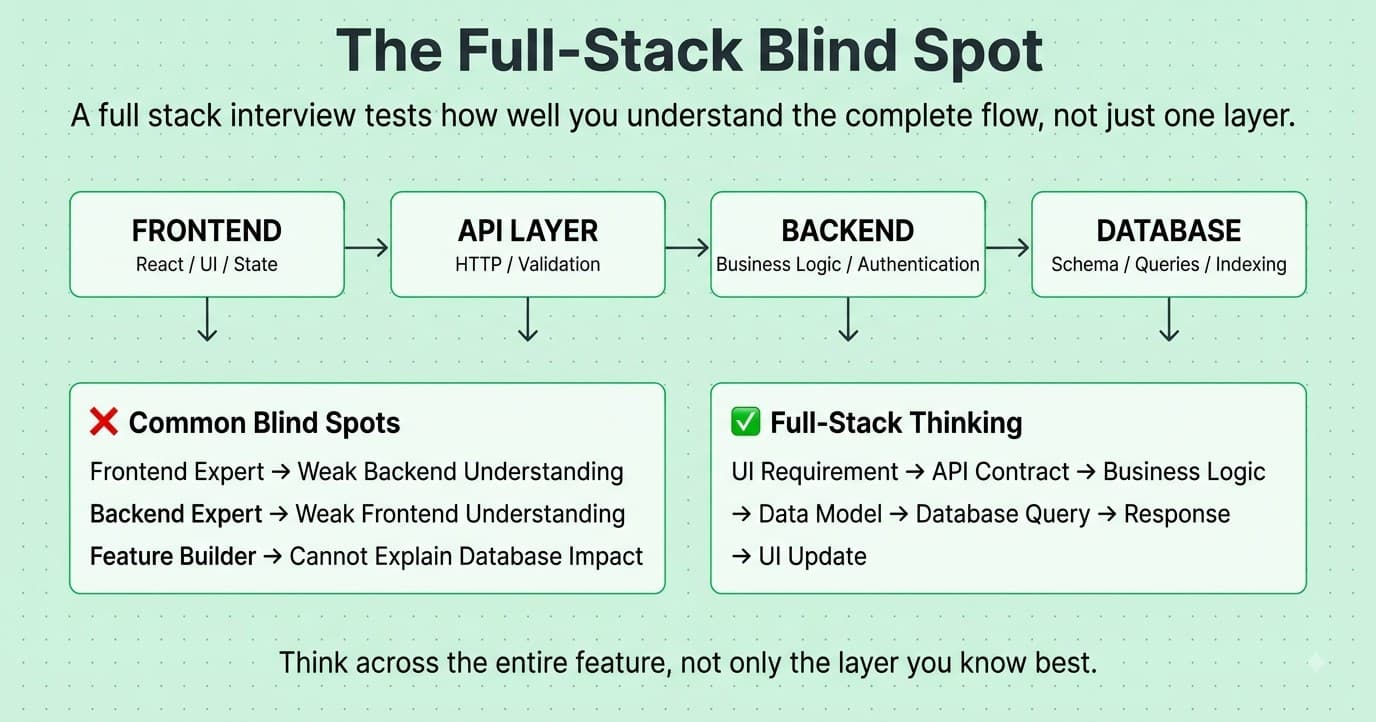
Mistake 4: Treating the Frontend and Backend as Separate Problems Instead of One Connected System
What This Looks Like
In a system design or take-home round, a candidate designs a well-structured frontend component and a well-structured backend API, but the two do not fit together: the API returns a data shape the frontend cannot cleanly consume without significant transformation, or the state model on the frontend assumes data fetching behavior the backend's pagination strategy does not support.
Why Recruiters Flag This
This is the most distinctly full stack mistake on this list, because it can only surface in full stack interviews. A frontend specialist or a backend specialist would never be evaluated on the contract between the two layers. Full stack developers are hired specifically to own that contract, and a candidate who designs each side in isolation has revealed the most common failure mode of poorly integrated full stack work.
The Real Cost
In production, mismatched layer contracts cause cascading rework: a backend is rebuilt to match a frontend assumption, or a frontend adds complex transformation logic that should have been handled server-side, and the seam becomes a perpetual maintenance burden.
The Complete Fix
Design the API contract first, before building either layer, and write it out explicitly as if it were a document another developer on the other side would consume. Define the exact response shape, status codes, pagination strategy, and error format. Then build both sides to that contract, not to an implicit assumption that "they'll match up." In an interview, stating this approach out loud, "I am going to define the API contract first so both sides have a clear target," signals exactly the holistic thinking full stack interviewers are looking for.
Practice Method
Take a feature you have already built both sides of, and write out the actual API contract as a formal specification after the fact. Look for every place where the frontend was making an assumption the backend was not explicitly guaranteeing, and note what would happen if the backend changed its behavior. These are the contract gaps you will learn to prevent upfront.
Category 2: System Design Mistakes
Mistake 5: Over-Engineering Before Clarifying What the Problem Actually Needs
What This Looks Like
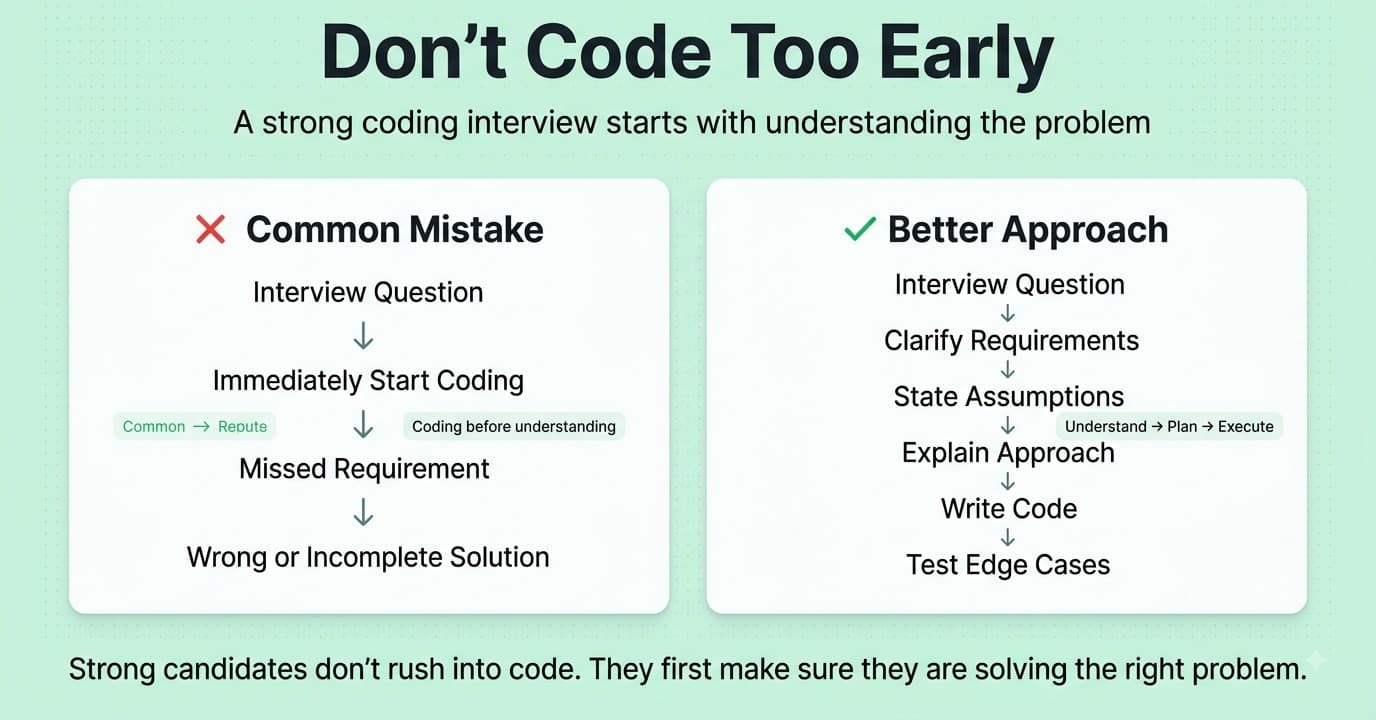
Given a system design prompt like "design a notification system for our app," the candidate immediately proposes Kafka, multiple microservices, and a distributed message queue before asking how many users the system needs to serve, what latency is acceptable, or whether notifications need to be real-time or can be batched.
Why Recruiters Flag This
Over-engineering without requirements is as problematic as under-engineering. It signals an engineer who will choose architecturally impressive over operationally appropriate, which creates real cost and complexity for teams who have to maintain the system. Interviewers deliberately give underspecified prompts to see whether candidates clarify requirements or immediately start designing toward their preferred technology.
The Real Cost
An interviewer who asked for a notification system and gets Kafka and six microservices as the first response has learned something about how this candidate approaches open-ended problems on the job, and it is not flattering.
The Complete Fix
Make clarifying questions a mandatory first step in any system design round, not an optional one. Specifically ask about three things before proposing anything: scale, meaning the order of magnitude of users and requests per second; latency and consistency requirements, meaning how real-time does this need to be and can we tolerate eventual consistency; and operational context, meaning is this a new system or an extension of an existing one. Only after hearing or reasonably assuming answers to these should you propose an architecture.
Then design to the minimum complexity that meets the stated requirements, and explicitly say so: "Given that we're starting at this scale and can tolerate a few seconds of delay on notifications, I'd start with a simple database-backed queue rather than a full message broker, because adding Kafka later is a smaller migration cost than operating it from day one when we do not yet need it." This kind of reasoning wins system design interviews far more reliably than architectural ambition.
Practice Method
Take any system design question you find online and force yourself to write out five clarifying questions before writing a single component. Practice this until the clarifying-questions step is automatic, not something you remember to do after the design is already half-drawn.
Mistake 6: Designing for the Wrong Scale in Both Directions
What This Looks Like
Some candidates design a simple feature with a heavyweight distributed architecture it does not need. Others design a clearly high-scale system with no thought given to obvious bottlenecks, like a social feed that scans the full posts table on every load, or a search feature using a full database table scan on an unsorted column.
Why Recruiters Flag This
Designing for the wrong scale in either direction reveals the same root problem: a candidate who is designing to a technology preference or a tutorial template rather than the actual requirements. Recruiters want to see candidates who reason about scale from first principles, not from what they last read about how large companies solved a different problem.
The Real Cost
Both failure modes are costly on the job. Over-engineering for a scale you will never reach wastes engineering time and creates operational overhead. Under-engineering for a scale you will definitely reach causes production incidents, often at the worst possible moment.
The Complete Fix
Develop a quick back-of-envelope estimation habit for every system design problem. Before proposing any architecture, say out loud: "Let me estimate the order of magnitude here. If we have one million users and five percent log in daily, that is fifty thousand daily active users. If each makes ten requests, that is around five hundred thousand requests per day, or about six requests per second at peak on average, with maybe ten times that at true peak, so roughly sixty requests per second." This number then drives your architecture: sixty requests per second is comfortably handled by a single well-provisioned server with a good database index, not a distributed cache and a queue.
This estimation habit not only prevents the wrong scale mistake, it actively impresses interviewers because so few candidates do it unprompted.
Practice Method
Before every system design practice session, spend five minutes estimating the scale of the problem using only the stated requirements. Then let that estimate explicitly determine your first architectural choice, and state the connection out loud when you make it.
Category 3: Communication Mistakes
Mistake 7: Narrating What the Code Does Instead of Why You Made the Choice
What This Looks Like
Walking through a solution, the candidate says things like "here I fetch the user data, then I map over the results, then I set the state." The interviewer follows along but learns nothing about the candidate's reasoning, because narrating the code is something any reader can do.
Why Recruiters Flag This
Technical communication in a real job is almost entirely about reasoning and tradeoffs, not transcription. A code walkthrough that only restates what is already visible in the code tells an interviewer nothing about whether this developer made deliberate choices or stumbled onto a working solution.
The Real Cost
This mistake is especially costly in system design and take-home review rounds, where the walk-through is the primary evaluation mechanism. An interviewer who cannot tell whether your choices were deliberate or accidental will default to skepticism.
The Complete Fix
Replace every "here I..." narration with a "I chose this because..." explanation. Instead of "here I used a useEffect to fetch the data when the component mounts," say "I used useEffect with an empty dependency array here because this data only needs to be fetched once on mount, and I wanted to avoid re-fetching on every render. I considered whether it should live higher in the component tree, but it was specific enough to this component to keep it local." That version gives the interviewer insight into your reasoning, your awareness of alternatives, and your judgment about when local state is appropriate.
Prepare one "I chose this because, and I considered X instead but rejected it for Y reason" explanation for every major decision in your solution before any interview that includes a walkthrough.
Practice Method
Record yourself walking through a project you have already built. Listen back and mark every sentence that begins with "here I" or "then I" as a sentence to rewrite as a choice explanation. Replace each one and re-record until the narration-to-reasoning ratio has flipped.
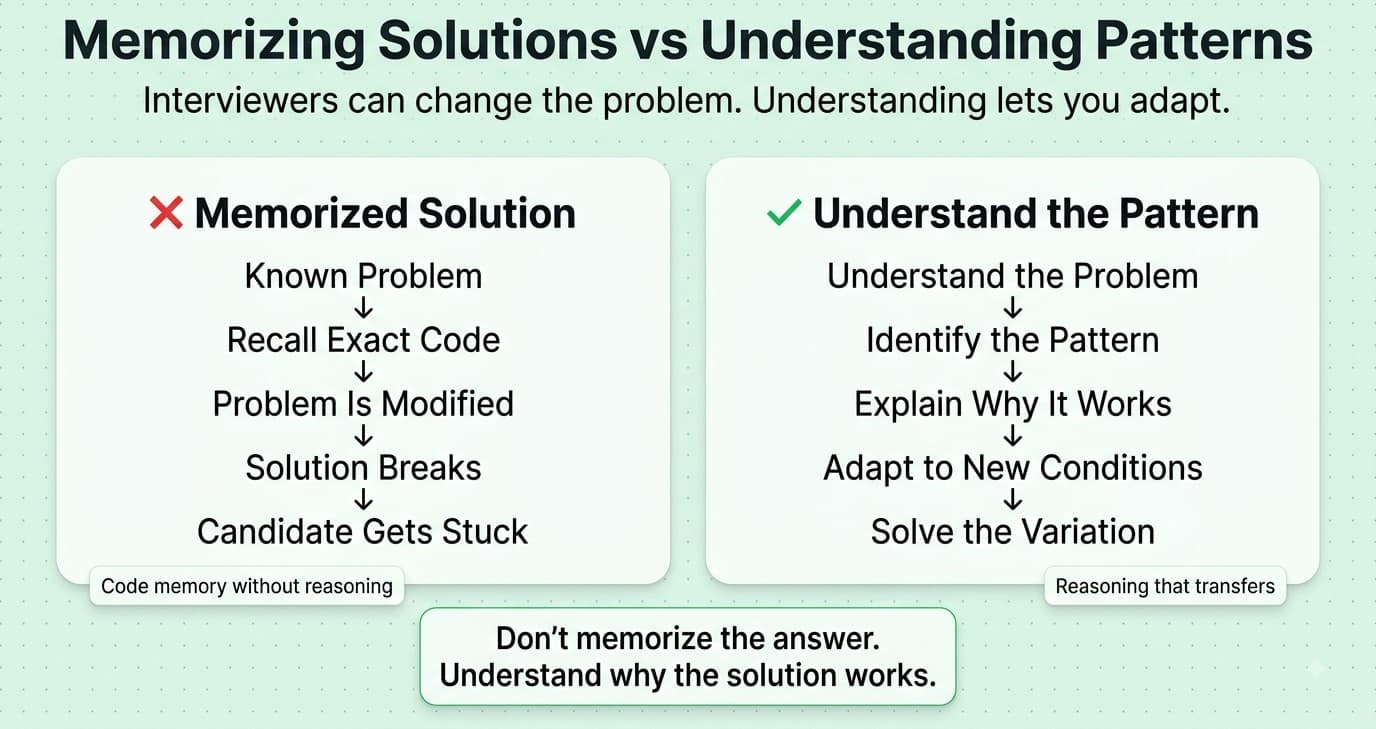
Mistake 8: Freezing When the Interviewer Pushes on an Unfamiliar Variation
What This Looks Like
A candidate gives a strong initial answer to a system design or technical question, and then the interviewer asks a deliberate variation: "What if the read-to-write ratio were reversed?" or "What if the user count were ten times higher?" The candidate either retreats to restating the original answer or freezes visibly.
Why Recruiters Flag This
Variation questions are how interviewers distinguish a candidate who genuinely understands the design from one who memorized a pattern. They are also a realistic simulation of what happens when requirements change partway through a project, which is constant.
The Real Cost
A strong initial answer followed by a freeze on the follow-up actually sets a higher bar for the candidate than a weaker initial answer would have, because the follow-up reveals that the initial answer may have been closer to a script than genuine understanding.
The Complete Fix
Build a structured response to variation questions that buys you a moment to think without appearing stuck. When a variation comes, repeat the new constraint out loud, specifically: "So if the write volume increases by ten times, the main pressure point shifts from the read path to the write throughput." That restatement is not stalling, it is genuinely useful because it forces you to identify what changes before you propose what you would change. Then reason from that constraint to one or two specific architectural adjustments.
You will never be able to memorize answers to every variation. The fix is a reliable process for reasoning through unfamiliar variations under pressure, not more memorized answers. Building this reasoning process, specifically in practice sessions that involve someone else asking you unexpected follow-ups, is something that transfers directly to real interviews.
Practice Method
For every system design problem you practice, end by asking yourself four variations: what changes if traffic is ten times higher, what changes if the latency requirement is ten times stricter, what changes if you had to make this work offline, and what would you change if you were rebuilding it with a different technology constraint. Practicing these variations yourself trains the same reasoning muscle an interviewer's follow-up tests.
Mistake 9: Explaining Technical Decisions Using Terminology the Interviewer Cannot Follow
What This Looks Like
During a final round or hiring manager interview, the candidate explains a past technical decision using terms like "idempotent endpoints," "eventual consistency," or "connection pool exhaustion" without pausing to check whether the interviewer is following, or to offer a plain-language equivalent.
Why Recruiters Flag This
Many final round interviewers for full stack roles are engineering managers, product managers, or senior business stakeholders who are evaluating communication skill and cultural fit alongside technical judgment. An answer that relies on unexplained jargon fails the communication half of the interview even if the underlying thinking was excellent.
The Real Cost
The interviewer may not ask for clarification, they may simply note the communication gap, and the candidate never knows the real reason the round did not go well.
The Complete Fix
Develop a parallel vocabulary for every technical concept you regularly discuss: one version for a technical audience, and one version that uses an analogy or plain language for a non-technical one. For connection pool exhaustion: "the database has a maximum number of simultaneous conversations it can hold. If every server thread tries to open a new conversation at the same moment, the database has to start refusing some of them." For eventual consistency: "different servers might give you slightly different answers for a few seconds after a write, but they all catch up to the same answer within a short window."
In any interview, read the interviewer's title before the conversation starts, and calibrate your vocabulary accordingly in the first two minutes. If you are uncertain which version to use, start with the plain version and add technical specificity only if the interviewer responds with technical language themselves.
Practice Method
Pick five technical concepts you regularly discuss and write out a plain-language analogy version of each. Practice delivering both versions of each explanation aloud until switching between them is automatic and does not feel like you are dumbing something down.
FREE TO USE
8k+ SESSIONS92% FLUENCY4.9★ RATING
Speak With Confidence
Real Conversations. Real Scenarios. Speak until it feels natural.
- Real-Time Speaking Practice
- Guided Conversation Flows
- Instant AI Feedback
Category 4: Behavioral and Mindset Mistakes
Mistake 10: Describing Every Past Project as a Success With No Failures, Tradeoffs, or Lessons
What This Looks Like
Asked to walk through a past project, the candidate describes a clean, linear story where every decision was correct, the feature shipped on time, and the team was happy. There are no tradeoffs discussed, no things they would change, and no mention of what did not go as planned.
Why Recruiters Flag This
Real engineering work involves constant tradeoffs, frequent course corrections, and occasional genuine failures. A project story with none of these is either an unusually simple project, an incomplete account, or a candidate who does not reflect critically on their own work. All three are concerns.
The Real Cost
This mistake is particularly damaging because interviewers ask about past projects partly to assess self-awareness and learning orientation, not just to hear about accomplishments. A story with no tension or growth moments tells them almost nothing useful.
The Complete Fix
For every major project on your resume, prepare a version of the story that includes three elements beyond the accomplishment: a tradeoff you made and why, something you would do differently if you started today, and something that was harder than expected and what you learned from it. These additions do not make you look weaker, they make you look like someone with the experience and maturity to reflect on their own work, which is exactly what experienced interviewers are evaluating.
A strong version might sound like: "The feature shipped successfully, but in retrospect I over-normalized the database schema for our actual access patterns, which we only discovered when the feature started getting real traffic. I would design for the read queries first next time. I also learned from that project that I should validate schema design with a load estimate before building, which I now do on every data model decision."
Practice Method
Go through every project on your resume and write one honest "what I would do differently" statement for each. Make it specific enough that it could only apply to that project, not a generic "I would communicate more." If you cannot write a specific one, you have not reflected on that project deeply enough to discuss it well in an interview.
Mistake 11: Claiming Familiarity With a Technology Listed on the Resume, Then Being Unable to Go One Layer Deep
What This Looks Like
A resume lists Redis, Docker, or a specific testing library. An interviewer asks a single follow-up question, like "how does Redis decide what to evict when it runs out of memory" or "what is the difference between a Docker image and a container," and the candidate cannot answer at even a conceptual level.
Why Recruiters Flag This
Recruiters use resume keywords to screen in, then use technical questions to screen out inflated claims. Being caught unable to go one layer deep on something you listed signals, at minimum, that the resume is padded and, more concerning, that the candidate's depth on other listed skills may be similarly shallow.
The Real Cost
This mistake can invalidate an otherwise strong interview, because it introduces a trust question about everything else the candidate claimed.
The Complete Fix
The rule is simple: never list a technology on your resume unless you can answer at least three progressively deeper questions about it. For Redis: what is it and why would you use it? How does it handle persistence? What eviction policies exist and when would you choose each? If you cannot reach that third question confidently, change the resume listing from a bullet point claim to a project description that mentions the technology in context, which is harder to probe directly and more honest about the actual depth of experience.
Before every interview, review your own resume as if you were an interviewer trying to find a bluff, and ask yourself the three-question test for each technology listed. Replace any listing that fails the test.
Practice Method
Pick five technologies currently on your resume and spend fifteen minutes researching them one layer deeper than you currently understand them. Then write three questions an interviewer could ask, with your best answers. Do this before every interview for any technology you listed recently but have not used in the last three months.
Category 5: AI-Era Mistakes Most Guides Still Miss
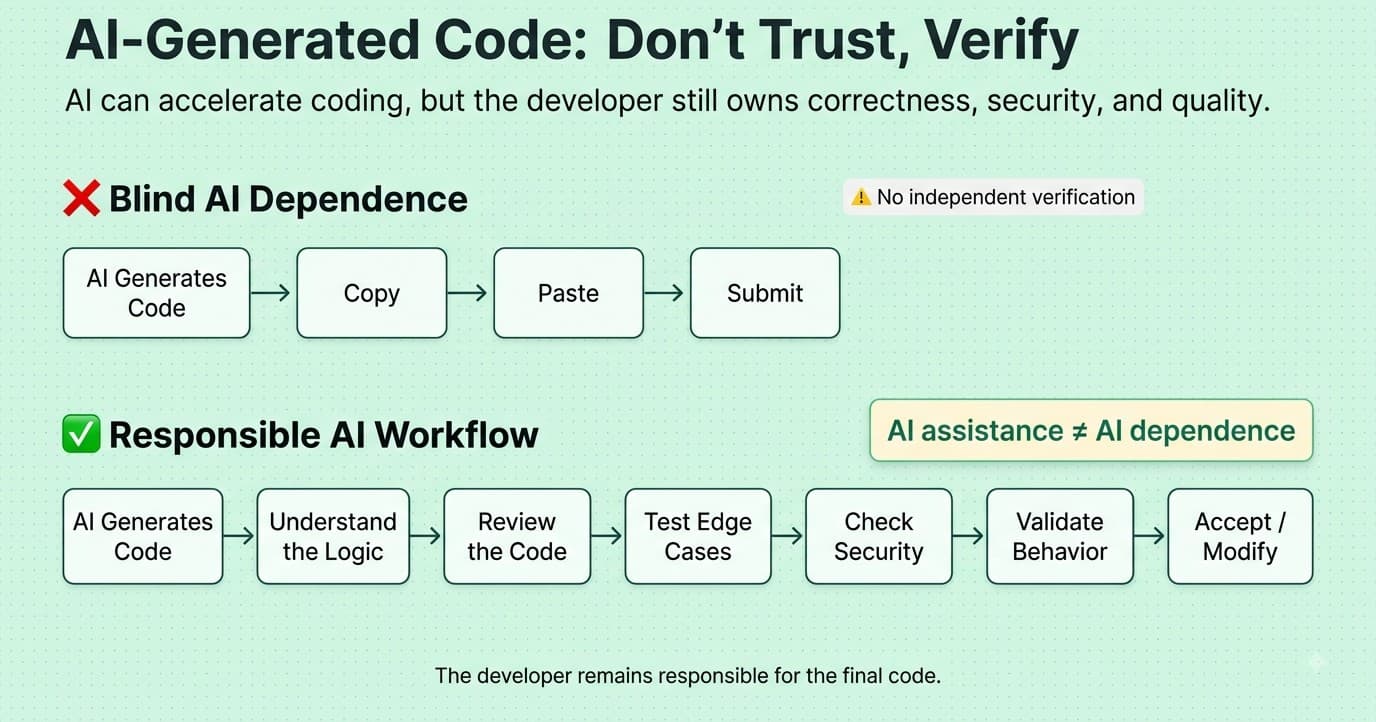
Mistake 12: Submitting AI-Generated Take-Home Work You Cannot Defend in a Follow-Up
What This Looks Like
A candidate uses an AI tool to build a take-home full stack project. The code is clean, the feature works, and the README looks professional. Then the follow-up interview asks why a specific architectural choice was made, why a particular database schema was structured that way, or what would happen to the error handling if a certain edge case occurred, and the candidate cannot answer confidently because they did not write or fully review the code they submitted.
Why Recruiters Flag This
Companies expect AI tool use now. The follow-up interview is the mechanism they use to distinguish between candidates who used AI to accelerate their own judgment and candidates who used AI to substitute for judgment they do not have. Being caught unable to defend your own submission is not treated as an AI-use problem, it is treated as an integrity problem.
The Real Cost
This outcome is worse than submitting a simpler project you fully understand, because it raises a question about trustworthiness that persists into every other part of the evaluation.
The Complete Fix
Every line of a take-home submission must meet a single test: can you explain why it is there and what would happen if it were different. This applies equally to code you wrote yourself and to code an AI tool generated. Before submitting any take-home, close the AI tool and walk through your own submission out loud, narrating each major decision as if the interviewer were watching. Every part you hesitate on is a part you need to either understand better or rewrite in a way you do understand.
A useful specific practice: for every function or component in your submission, write one sentence in a comment or in the README explaining the decision behind it. This both prepares you for follow-up questions and demonstrates to the reviewer that the decisions were deliberate.
Practice Method
After using an AI tool to build any practice project, spend equal time in a review session where you explain every architectural and structural decision out loud, as if to someone who has never seen the code. Record yourself if possible. Any part where the explanation stalls or becomes vague is a gap that would surface in a real follow-up interview.
Mistake 13: Failing to Catch an Obvious Security Flaw in a Live AI Code Review Round
What This Looks Like
An interviewer shows a candidate a snippet of AI-generated code for an authentication endpoint, a search feature, or a user data retrieval function, and asks them to review it. The candidate comments on variable naming, code organization, or minor style issues, but misses the SQL injection vulnerability, the missing authorization check, or the plaintext token being logged to the console.
Why Recruiters Flag This
This round now appears in interviews at companies of all sizes because it directly replicates a real daily task: reviewing code, some of which was AI-generated, for correctness and safety before it merges. Candidates who only review for style and clarity while missing functional security issues demonstrate exactly the gap companies are most worried about as AI code generation scales.
The Real Cost
Missing a security issue in a code review round carries more weight than missing a performance optimization or a stylistic choice, because security vulnerabilities have a fundamentally different cost profile on the job. A slow query gets fixed in the next sprint. A SQL injection in a user-facing feature causes a breach.
The Complete Fix
Build a security-first review sequence you run through before anything else when looking at any code involving user data, authentication, or database access. Every time, in this order: is any user-supplied value being inserted into a query, command, or template without sanitization or parameterization? Is the caller's identity verified, and separately, is their authorization for this specific resource verified? Are secrets, tokens, or sensitive values potentially being logged, returned in error messages, or stored in a way that could leak them? Is there any way a user could access another user's data by changing a simple parameter like an ID?
Running this sequence aloud during a live review round transforms it from a passive reading into an active, structured evaluation. Interviewers watching a candidate run a named security checklist see exactly the kind of disciplined review habit they are looking for.
Practice Method
Find three open-source pull requests or tutorial projects involving authentication or user data. Review each one specifically looking for the four security issues above, ignoring everything else. Then look up whether any of those issues were actually present and compare. This exercise calibrates the security lens faster than reading a list of vulnerability types in the abstract.
Self-Check: Are You Making These Mistakes Without Knowing It
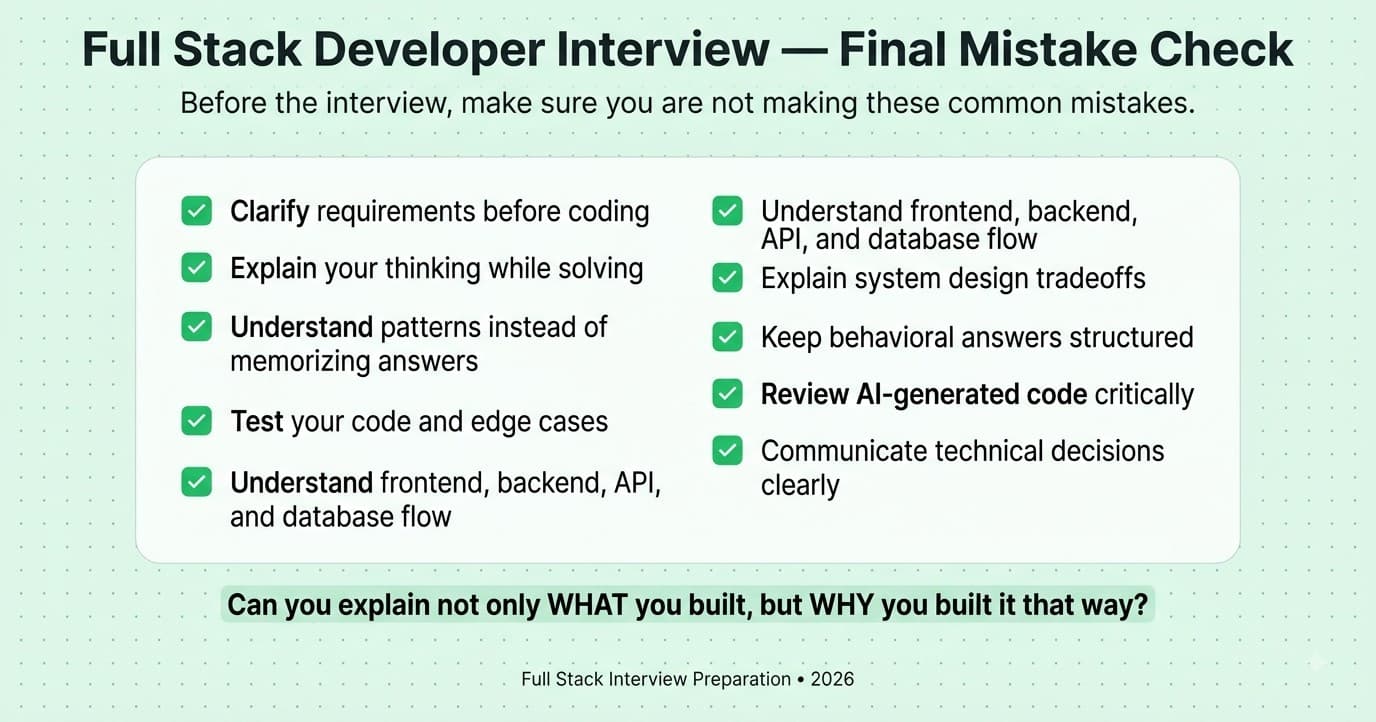
- Can you explain the mechanism underneath the five technical patterns you use most often, beyond what the code does to why the runtime behaves that way?
- Do you name at least two failure modes at layer boundaries every time you implement a cross-layer feature?
- Do you check for input validation and parameterized queries by habit, before being asked?
- Do you design the API contract before building either the frontend or backend side of a feature?
- Do you ask three clarifying questions before proposing any architecture in a system design prompt?
- Do you estimate the order of magnitude of scale before making your first architectural choice?
- Do you explain why you made a technical choice, not just what the code does?
- Do you have a structured process for reasoning through follow-up variations on a design question?
- Do you adjust your technical vocabulary based on who is interviewing you?
- Does every project story you tell include a tradeoff made, something learned, and something you would do differently?
- Can you answer three progressively deeper questions about every technology listed on your resume?
- Can you defend every line of a take-home submission, including any AI-generated parts?
- Do you run a security-first check before any other review on code involving user data or authentication?
If more than three of these are unchecked, this list is your actual interview prep plan for the next two weeks, not a bonus read.
Conclusion
Thirteen specific, fixable mistakes. The connecting thread through all of them is the same thing: the difference between working and thought through. Working code without explained reasoning, a working design without clarified requirements, a working project story without an honest tradeoff. Every one of these gaps is closable, and none of them requires rare talent to close.
The hardest part is that most of these mistakes only surface under the pressure of a real interview follow-up question, not during solo prep. You can read this list and completely believe you are not making mistake seven, and still narrate your code instinctively instead of explaining your reasoning the moment an interviewer is watching and a follow-up question catches you off guard. That is the gap that structured, pressure-tested mock interview practice is specifically designed to close, giving you the repetitions you need under realistic interview pressure before those habits have to hold in an interview that actually decides your offer. Platforms like Mocklingo's AI mock interview practice are built for exactly this: surfacing the habits that only break under pressure, so you can fix them in a safe setting first.
Practice Full stack developer interview with Mocklingo