Loading...
Contents
The Complete Interview Preparation Guide for Prompt Engineers
Sep 24, 202610 min read
Whether you're a fresher trying to break into AI, a mid-level engineer moving from software or data into prompt engineering, or an experienced professional targeting a senior/lead AI role, this guide walks you through everything you need to prepare from fundamentals to advanced scenario-based questions.
FREE TO USE
25K+ INTERVIEWS4.8★ RATING68% IMPROVEMENT
Crack Your Dream Job
Real Interviews. Real Pressure. Practice until it feels easy.
- Seamless Interview Experience
- Resume & JD Questions
- Instant Personalized Feedback
Section 1: Introduction
Prompt engineering interviews are unusual because the role itself is still being defined differently at every company. At one company it's closer to applied AI engineering (building LLM pipelines, RAG systems, evals). At another it's closer to product and content design (crafting system prompts, tone, guardrails). At a third it's research-adjacent (red-teaming, model behavior analysis).
So the first thing interviewers assess is whether you understand how LLMs actually behave — not just whether you know a list of prompting tricks.
Expect a mix of:
• Conceptual questions (how LLMs work, tokens, context windows, temperature, hallucination)
• Hands-on tasks (rewrite a failing prompt, design a system prompt, build an eval set)
• Scenario-based questions ("The model keeps ignoring one instruction — how do you debug it?")
• Behavioral questions (working with PMs, handling ambiguous requirements, shipping under uncertainty)
The bar has risen sharply. Companies now expect prompt engineers to understand evaluation, cost/latency trade-offs, safety, and system design — not just clever wording.
Section 2: What Recruiters Look For
Core Technical Skills
1. LLM fundamentals — tokenization, context windows, temperature/top-p, sampling, why models hallucinate
2. Prompting techniques — zero-shot, few-shot, chain-of-thought, role prompting, decomposition, self-critique
3. Structured output — JSON/XML schemas, reliable parsing, handling malformed responses
4. Evaluation — building eval sets, golden datasets, LLM-as-judge, regression testing prompts
5. RAG (Retrieval-Augmented Generation) — chunking, embeddings, vector search, reranking, grounding
6. Python — the default language for LLM tooling and scripting
7. APIs & SDKs — Anthropic, OpenAI, or open-source model APIs; streaming, tool use/function calling
8. Agentic workflows — multi-step tool use, planning loops, error recovery
9. Guardrails & safety — prompt injection, jailbreak resistance, refusal behavior, PII handling
10. Cost & latency optimization — model selection, prompt compression, caching, batching
Soft Skills & Traits
• Systematic experimentation — treating prompts like code: version, test, measure
• Clear writing — the core craft; ambiguous writing produces ambiguous model behavior
• Product sense — understanding what the user actually needs from the output
• Comfort with ambiguity — model behavior is probabilistic, and answers are rarely clean
• Cross-functional collaboration — works with PMs, designers, ML engineers, legal/safety teams
Ranking by Importance (Most → Least Frequently Tested)
1. Core prompting techniques + why they work
2. Debugging a failing prompt (live exercise)
3. Evaluation and measurement methodology
4. LLM fundamentals (context, tokens, hallucination causes)
5. Structured output and reliability
6. RAG design
7. Python + API integration
8. Agents and tool use
9. Safety, guardrails, prompt injection
10. Cost/latency optimization
Section 3: How to Prepare — Step-by-Step Roadmap
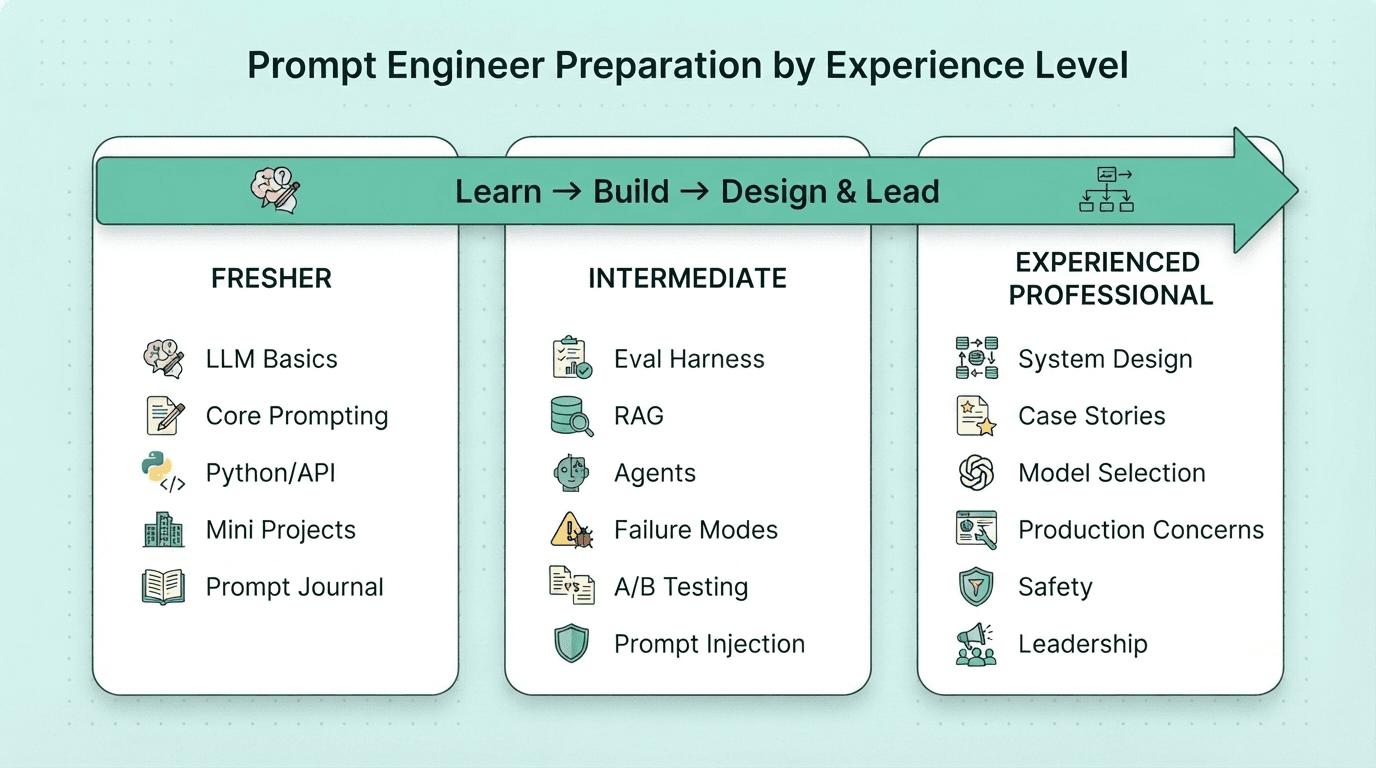
For Freshers
1. Learn how LLMs work at a conceptual level — tokens, context windows, next-token prediction, why hallucination happens
2. Practice core prompting patterns daily on real tasks (summarization, extraction, classification, rewriting)
3. Learn basic Python and call an LLM API directly — not just through a chat UI
4. Build a small portfolio: 3–4 prompts or mini-apps with before/after examples showing measurable improvement
5. Learn to write structured-output prompts that reliably return valid JSON
6. Start a "prompt journal" — log what failed, why, and what fixed it. This becomes your interview material.
For Intermediate Candidates
1. Build a real eval harness — a test set of inputs with expected behaviors, run automatically
2. Build a RAG system end-to-end: ingest documents, chunk, embed, retrieve, generate, evaluate
3. Learn tool use / function calling and build a simple agent that completes a multi-step task
4. Study failure modes deeply: instruction drift, over-refusal, format breakage, context overflow
5. Practice A/B testing prompts and reporting results with actual numbers
6. Learn prompt injection and basic defenses
For Experienced Professionals
1. Prepare to discuss system design — how you'd architect an LLM feature end-to-end, including fallback, monitoring, and eval pipelines
2. Have 3–4 detailed case stories (STAR format) where you improved a metric through prompt/system changes
3. Understand model selection trade-offs — when a smaller/faster model suffices vs. when you need the frontier model
4. Study production concerns: latency budgets, caching, token cost at scale, rate limits, graceful degradation
5. Be ready to discuss safety, red-teaming, and responsible deployment
6. Be ready to lead — senior interviews assess judgment and the ability to set evaluation standards for a team
Section 4: Core Topics to Study
Fundamental Concepts
• How LLMs generate text: next-token prediction, probability distributions
• Tokens, context windows, and why long inputs degrade performance
• Temperature, top-p, and when to change them
• Zero-shot vs. few-shot prompting
• Role/persona prompting and system prompts vs. user prompts
• Chain-of-thought and step-by-step reasoning
• Why models hallucinate, and how grounding reduces it
• Clear instruction writing: specificity, positive framing, examples
Intermediate Concepts
• Prompt decomposition — breaking one big prompt into a chain of smaller ones
• Structured output: JSON schemas, XML tags, delimiters, parsing safely
• Few-shot example selection: how many, how diverse, how ordered
• Self-consistency and self-critique patterns
• RAG basics: chunking strategies, embeddings, similarity search, reranking
• Evaluation: golden datasets, rubrics, LLM-as-judge, human review loops
• Handling edge cases and adversarial inputs
• Versioning and managing prompts like source code
Advanced Concepts
1. Agentic systems: planning, tool use, memory, error recovery, loop termination
2. Advanced RAG: hybrid search, query rewriting, multi-hop retrieval, citation grounding
3. Prompt injection and indirect injection defenses
4. Context engineering: what to include, what to compress, what to retrieve on demand
5. Fine-tuning vs. prompting vs. RAG — when each is the right tool
6. Cost/latency engineering: prompt caching, batching, model routing, distillation
7. Regression testing and CI for prompts
8. Multi-modal prompting (images, documents, audio)
9. Measuring and reducing variance in non-deterministic outputs
Scenario-Based Preparation Tips
Practice answering questions like:
• "This prompt works 80% of the time and fails 20%. How do you find out why?"
• "The model follows instruction A but ignores instruction B. What do you try?"
• "How would you design an LLM-powered customer support assistant for a bank?"
• "How would you evaluate whether a new prompt version is actually better?"
• "A user found a jailbreak in your product. Walk me through your response."
• "Your feature costs too much per request. How do you cut costs by half?"
Tip: Structure your answers as: Reproduce → Isolate the failing component → Hypothesize → Test with an eval set → Measure → Ship with monitoring. Interviewers want a scientific method, not vibes.
Practical Preparation Exercises
• Take a badly written prompt and rewrite it, documenting exactly what improved and why
• Build a 30-example eval set for a task and score two prompt versions against it
• Write a prompt that returns valid JSON 100% of the time, including on adversarial inputs
Build a small RAG app over your own documents and measure retrieval quality
• Build a simple agent that uses 2–3 tools to complete a task, with failure handling
• Red-team one of your own prompts — try to break it, then patch it
• Reduce a working prompt's token count by 40% without losing output quality
FREE TO USE
8k+ SESSIONS92% FLUENCY4.9★ RATING
Speak With Confidence
Real Conversations. Real Scenarios. Speak until it feels natural.
- Real-Time Speaking Practice
- Guided Conversation Flows
- Instant AI Feedback
Section 5: Common Interview Rounds
1. HR/Recruiter Screening — background, motivation, why AI, salary expectations, culture fit
2. Portfolio/Work Sample Review — walking through prompts you've written and results you've achieved
3. Technical Screening — LLM fundamentals, prompting techniques, Python basics
4. Live Prompting Exercise — you're given a failing prompt or a fresh task and asked to iterate in real time while thinking aloud
5. Take-Home Assignment — build a working prompt/pipeline with documentation and an eval set
6. System Design Round (mid-to-senior) — design an LLM feature end-to-end with evals, guardrails, and cost constraints
7. Evaluation & Measurement Round — how you'd prove a change is an improvement
8. Behavioral/Managerial Round — collaboration, ambiguity, shipping decisions, handling failures
9. Final Round with Leadership — product judgment, long-term thinking, safety mindset
Section 6: Best Practices
1. Show measurable results, not clever prompts. "Improved extraction accuracy from 72% to 94% across a 200-example eval set" beats any wording trick.
2. Think aloud during live exercises. The reasoning process is what's being graded, not the final prompt.
3. Always mention evaluation. If you propose a prompt change without saying how you'd verify it, you'll look junior.
4. Bring before/after artifacts. A short doc with failing outputs, your fix, and the resulting metric is extremely persuasive.
5. Know the limits of prompting. Recognizing when the answer is RAG, fine-tuning, or a product change shows maturity.
6. Use the STAR method for behavioral questions.
7. Stay current — model capabilities change fast; follow release notes and documentation from major labs.
8. Ask clarifying questions before designing anything: who's the user, what's the failure cost, what's the latency/cost budget?
9. Practice writing well. Prompt engineering is technical writing with a probabilistic compiler.
Section 7: Mistakes to Avoid
• Treating prompt engineering as a bag of magic phrases instead of a systematic discipline
• Having no evaluation story — "it looked better to me" is not an answer
• Ignoring the underlying model behavior and only memorizing techniques
• Writing enormous prompts that stuff in everything instead of decomposing the task
• Never testing edge cases or adversarial inputs
• Ignoring cost and latency entirely when designing a solution
• Claiming portfolio work you can't explain in depth
• Dismissing safety/guardrail questions as someone else's job
• Assuming one prompt run proves anything — not accounting for output variance
• Weak communication — this role is fundamentally about precise expression
Section 8: Final Interview-Day Checklist
[ ] Review the job description and map your examples to the listed responsibilities
[ ] Re-read your portfolio and be ready to explain every prompt and result
[ ] Prepare 3–4 STAR-format stories with concrete metrics
[ ] Refresh core concepts: tokens, context windows, temperature, CoT, RAG, evals
[ ] Have before/after prompt examples ready to share on screen
[ ] Test your setup if the interview involves live prompting or screen-sharing
[ ] Prepare 2–3 thoughtful questions about their eval process and how the role is scoped
[ ] Get a good night's sleep — live prompting exercises demand clear, calm thinking
[ ] Have a scratchpad ready for structuring system design answers
Section 9: Industry Trends in Prompt Engineering
1. Context engineering — the field is shifting from "writing prompts" to designing what information enters the context window and when
2. Evaluation-first workflows — evals are becoming the primary deliverable; prompts are just the variable being tested
3. Agentic systems — multi-step tool-using agents are now a core part of the job, not a niche
4. Prompt caching and cost engineering — token economics increasingly shape design decisions
5. Structured output as default — schema-enforced generation replacing fragile text parsing
6. Model routing — using cheap/fast models for easy cases and frontier models only where needed
7. Prompt injection defense — a growing security discipline as agents gain real-world permissions
8. Convergence with AI engineering — the pure "prompt engineer" title is increasingly folding into broader AI/LLM engineering roles
9. Multi-modal prompting — images, documents, and audio as routine inputs
10. Automated prompt optimization — tooling that searches prompt space against an eval set, shifting the human role toward defining good evaluation
Conclusion
Prompt engineering interviews reward candidates who think like scientists and write like editors. Anyone can paste a clever template; what separates strong candidates is the ability to diagnose a failure, design an experiment, measure the result, and ship something reliable. Build real systems, measure everything, and bring your numbers to the interview.