Loading...
Contents
Top Business Analyst Skills Recruiters Look for in 2026
Sep 18, 202657 min readUpdated Sep 20, 2026
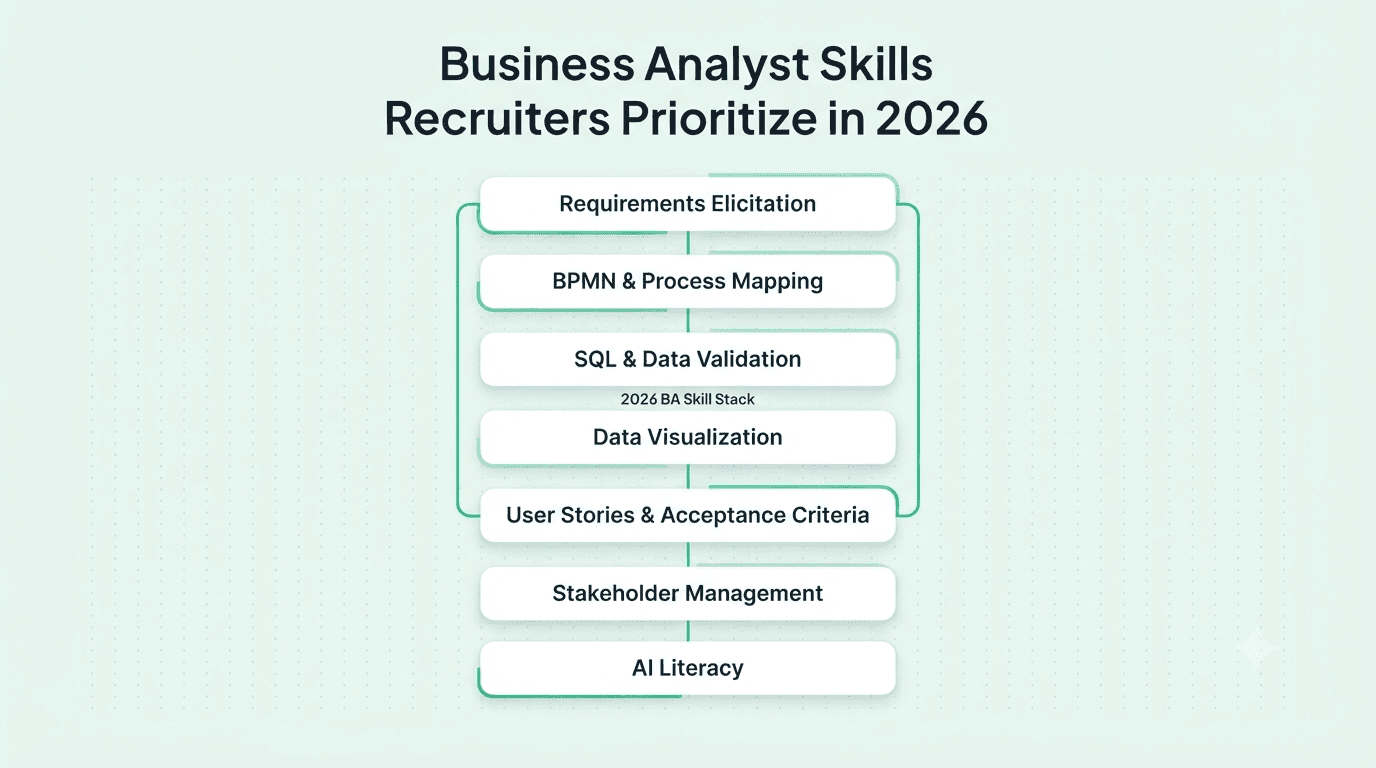
In 2026, recruiters hiring business analysts prioritize requirements elicitation precision that goes beyond gathering requests to distinguishing real business needs from assumed solutions, process modeling fluency in BPMN and AS-IS versus TO-BE analysis, SQL literacy for data validation and business querying, data visualization designed to drive decisions rather than display information, well-formed user stories and acceptance criteria that development teams can act on without follow-up meetings, stakeholder management techniques for resolving conflicting requirements, and AI literacy that includes understanding which BA tasks AI automates and where human business judgment remains irreplaceable. The CBAP certification matters less than a portfolio of documented deliverables that a hiring panel can read and evaluate. Fresher expectations center on structured thinking and clear written communication. Senior expectations center on connecting analysis to measurable business outcomes and leading requirement workshops across hostile stakeholder groups.
Business analyst interviews share a failure mode with product manager interviews: almost every candidate sounds capable in their first answer. Every candidate talks about stakeholders, requirements, and process improvement. Every candidate describes projects as successful with quantified benefits. The interviews blur together until the follow-up question arrives.
The follow-up question is always specific. Not "how do you gather requirements" but "describe a situation where a stakeholder gave you requirements that were actually a solution to a problem they had not yet told you about, and explain how you identified and surfaced the real requirement." Not "how do you handle conflict between stakeholders" but "walk me through a specific situation where two senior stakeholders had contradictory requirements for the same system, and tell me exactly what you did and what the outcome was."
This guide is built around the skills that survive those specific follow-up questions in 2026. Every skill is covered at the mechanism level: why recruiters prioritize it, how they test it, what separates average from exceptional candidates, and how to build it before your next interview.
FREE TO USE
25K+ INTERVIEWS4.8★ RATING68% IMPROVEMENT
Crack Your Dream Job
Real Interviews. Real Pressure. Practice until it feels easy.
- Seamless Interview Experience
- Resume & JD Questions
- Instant Personalized Feedback
How Hiring for Business Analysts Has Changed Going Into 2026
The two biggest shifts in BA hiring are that SQL and data querying have moved from a differentiator to a near-universal baseline expectation, and that AI literacy has become a genuine screening criterion as companies expect BAs to understand which parts of their workflow AI is automating and how to deliver the judgment work that remains.
Several forces are reshaping what BA hiring looks like this year:
Data fluency is now table stakes. A business analyst who cannot write a basic SQL query to validate whether a system is behaving correctly, verify data quality, or answer a business question independently is increasingly screened out at the mid-level, because the alternative, depending on a data analyst for every data investigation, creates a bottleneck that slows every project the BA touches.
Agile and hybrid delivery has made user story writing a core competency rather than a developer responsibility. BAs who can only write traditional business requirements documents and cannot translate them into well-formed user stories with testable acceptance criteria are evaluated as needing reskilling for modern delivery environments.
Process mining and automation awareness has entered the BA skill set. Companies implementing robotic process automation and workflow automation need BAs who can identify automation candidates, quantify the process metrics that justify automation investment, and document processes at a level of detail that automation engineers can use. BAs who have no exposure to this area are increasingly disadvantaged in roles at companies pursuing operational efficiency.
AI has begun automating the mechanical parts of BA work, including initial meeting documentation, first-draft process maps from process logs, and competitive feature matrices. Recruiters are now specifically looking for candidates who understand which parts of their work AI accelerates, which require human business judgment that AI cannot replicate, and how to use AI tools to produce better deliverables in less time.
Core Fundamentals
Requirements Elicitation and Precision Requirements Writing
Why Recruiters Prioritize This Skill
Requirements elicitation is the business analyst's most foundational skill and the one most commonly done superficially. A BA who gathers what stakeholders say they want and documents it faithfully is not doing requirements analysis; they are doing transcription. Requirements analysis means distinguishing a real business need from an assumed solution, surfacing requirements that stakeholders have not articulated because they consider them obvious, and resolving contradictions between requirements from different stakeholders before development begins rather than during it. Recruiters test this skill specifically because its absence is the most common cause of projects that deliver exactly what was specified and still fail to meet the business need.
What Recruiters Actually Expect in 2026
Not a list of elicitation techniques. Recruiters expect a candidate to describe the specific technique they would use for a specific type of requirement, explain why they chose that technique over alternatives, and describe what they would do when a stakeholder cannot articulate a requirement because they have never had to think about it explicitly. The ability to write a requirement that is specific, measurable, achievable, relevant, and time-bound rather than a vague statement of intent is evaluated through writing exercises, not self-report. The distinction between business requirements, functional requirements, non-functional requirements, and technical constraints is expected at mid-level and above.
Interview Evaluation
Writing exercises where candidates are given a vague requirement statement and asked to rewrite it as a precise, testable requirement. Behavioral questions asking candidates to describe a situation where a stakeholder's stated requirement turned out to be a solution to an unstated problem, and how they identified and surfaced the actual requirement. Case study rounds where candidates analyze a set of requirements for completeness and consistency, identifying gaps, contradictions, and ambiguities.
Real Workplace Example
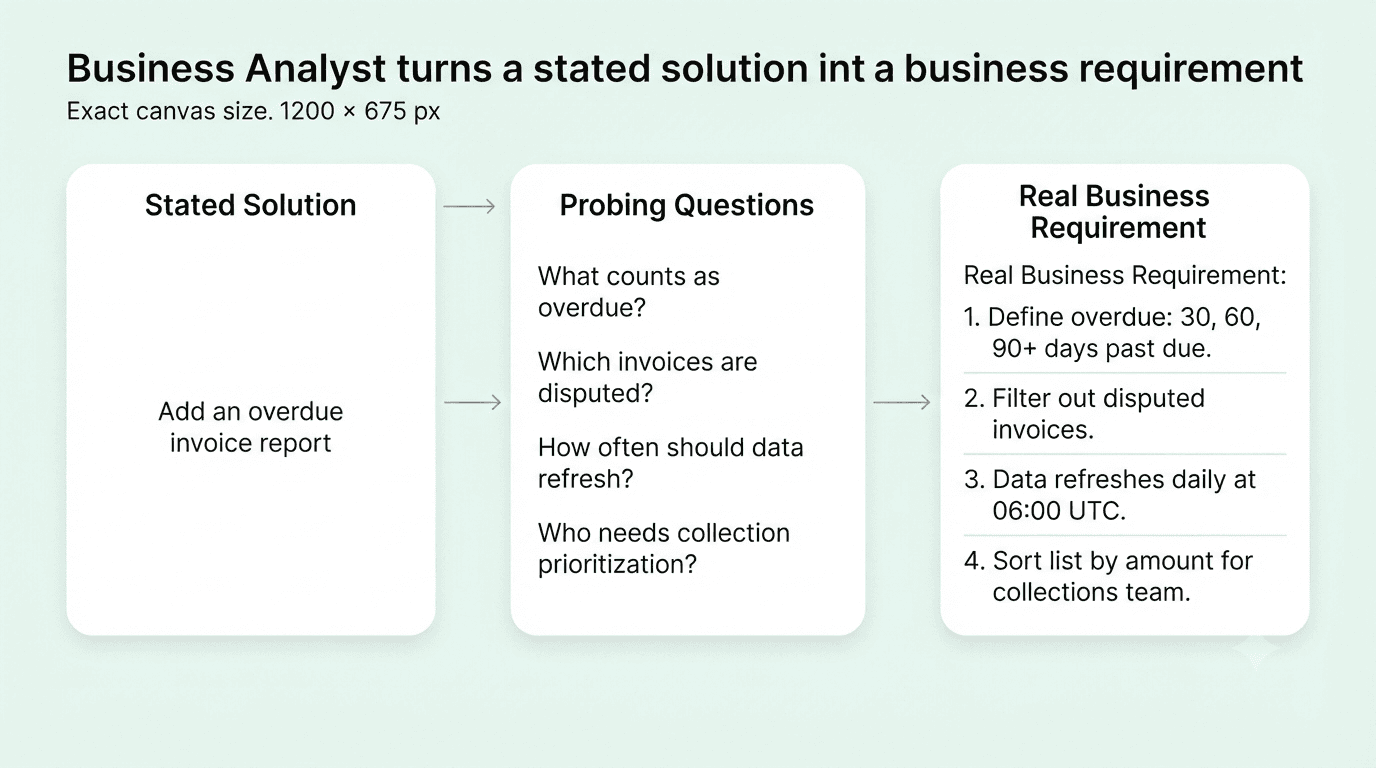
A stakeholder tells a BA: "We need a report that shows all overdue invoices." A BA who transcribes this documents it as a functional requirement for an overdue invoice report. A BA who analyzes it asks: what defines overdue, is it payment terms plus one day, plus five days, or something else? Which users need this report and for what decision? Does "all" include invoices in dispute? Is this a real-time view or a daily export? After elicitation, the real requirement is: "Finance managers need a view of invoices where payment is more than five days past the agreed payment terms, excluding invoices with an active dispute flag, refreshed at the start of each business day, that enables them to prioritize collection calls." These are two very different specifications, and only one of them produces a system that serves the actual business need.
Fresher Expectations
Can conduct a structured requirements interview using a prepared discussion guide, can identify when a stakeholder's stated requirement contains an embedded solution assumption and ask the question that surfaces the underlying need, and can write a requirement in specific enough language that a developer could implement it without a follow-up conversation.
Mid-Level Expectations
Selects elicitation techniques appropriate to the situation: interviews for individual stakeholder perspectives, workshops for reaching consensus across groups, observation for processes stakeholders cannot articulate explicitly, and prototyping for requirements that only become clear when stakeholders see a working model. Manages requirements traceability so that every requirement can be traced to a business objective and every feature in development can be traced to a requirement.
Senior-Level Expectations
Designs and facilitates a requirements elicitation program for a large project involving multiple stakeholder groups with potentially conflicting needs. Establishes requirements quality standards for a BA team, including specific criteria for what constitutes a complete and testable requirement. Makes judgment calls about when requirements are complete enough to proceed versus when more elicitation is necessary despite schedule pressure.
Common Mistakes
Documenting requirements in the stakeholder's language without validating that the language means the same thing to all parties. "Intuitive interface" means something different to every stakeholder who says it. Accepting a requirement without asking what happens in the exception case, which is where systems most commonly fail and where requirements are most commonly incomplete.
How to Build This Skill
Take any existing system you use daily and write a complete set of requirements for its most complex feature from scratch, as if you were preparing to build it from a blank page. Write each requirement in specific, testable language and then read each one asking: could two different developers implement this differently and both be correct? Every requirement where the answer is yes needs to be rewritten until the answer is no.
Example Interview Questions
"A stakeholder tells you 'the system should be easy to use.' How do you turn that into a testable requirement?" "Describe a situation where a stakeholder's stated requirement was actually a solution to a problem they hadn't told you about. How did you identify the real requirement?" "How do you handle a situation where two senior stakeholders give you contradictory requirements for the same feature?"
Strong Sample Answer Direction
A strong answer names a specific elicitation technique, explains why it was the right choice for the situation described, and describes a specific outcome that the elicitation produced that would not have been discovered without it. An answer that describes "I talked to stakeholders and gathered requirements" does not demonstrate elicitation skill; it demonstrates that elicitation happened without revealing whether it was done well.
Process Modeling, Analysis, and AS-IS Versus TO-BE Design
Why Recruiters Prioritize This Skill
Process modeling is how a business analyst makes complex workflows visible, communicable, and improvable. A BA who cannot model a process cannot identify where it breaks down, cannot communicate the current state to people who did not build it, and cannot design an improved future state that all stakeholders understand before implementation begins. Recruiters test process modeling specifically because it is the skill that determines whether a BA can contribute to process improvement projects independently or only document what others describe to them.
What Recruiters Actually Expect in 2026
Fluency with BPMN notation sufficient to create a process diagram that another analyst could read without explanation, including the correct use of events, tasks, gateways, swimlanes, and boundary events for exceptions. The ability to conduct an AS-IS process analysis that identifies not just the steps but the decision points, the exception paths, the handoffs between roles, and the metrics that characterize the current process including cycle time, error rate, and cost. The ability to design a TO-BE process that addresses the root causes of the identified problems rather than the visible symptoms.
Interview Evaluation
Practical exercises where candidates are given a verbal description of a business process and asked to model it in BPMN, evaluated on notational correctness, completeness of exception paths, and swimlane structure. Case study rounds where candidates are shown an AS-IS process diagram and asked to identify the three most significant process problems and design a TO-BE that addresses them, evaluated on whether the improvements target root causes rather than symptoms.
Real Workplace Example
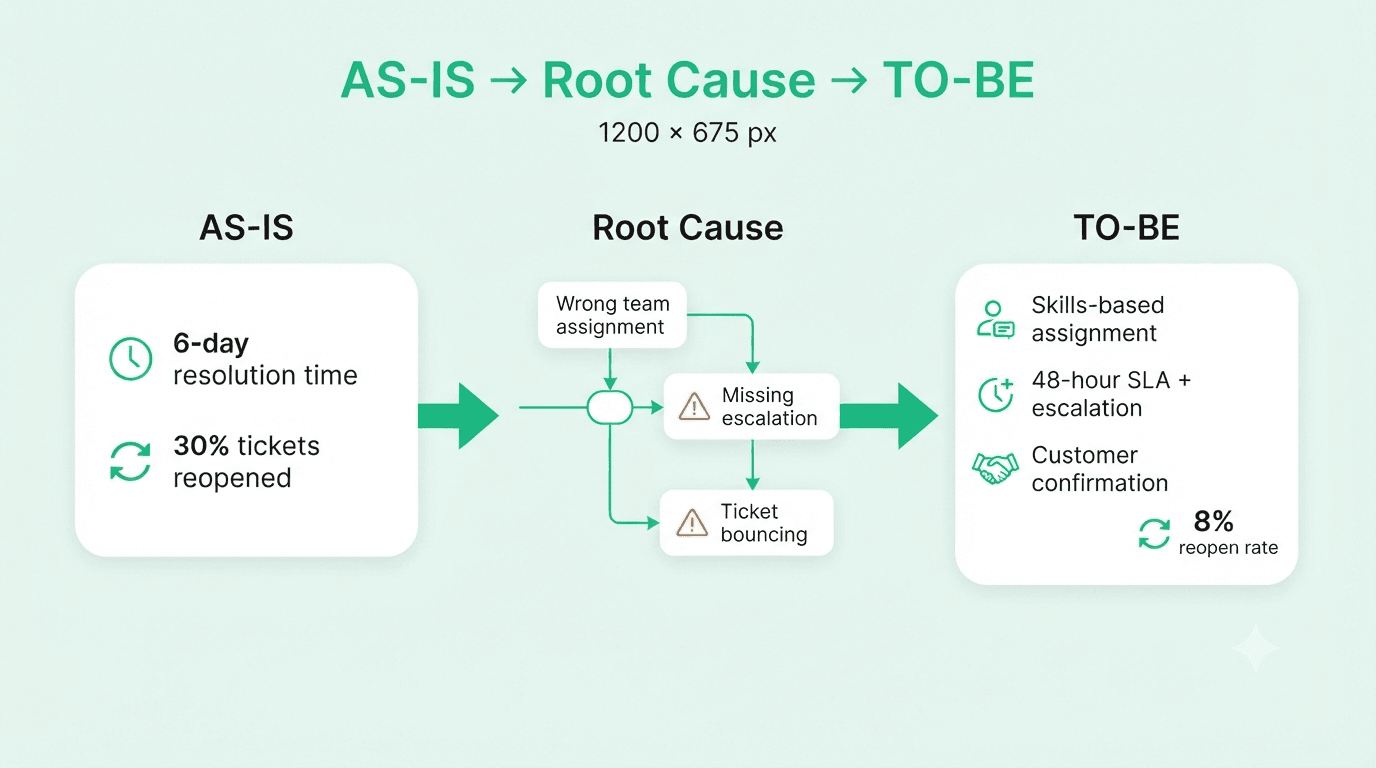
A customer complaints handling process has a six-day average resolution time and a thirty percent reopen rate. A BA who documents the AS-IS process shows that complaints are entered, assigned to a case worker, investigated, and resolved. A BA who analyzes the AS-IS process identifies three specific problems: complaints are assigned based on workload rather than expertise, the investigation step has no time limit so cases sit unattended when case workers are busy, and resolution is marked complete when the case worker considers it done rather than when the customer confirms satisfaction. The TO-BE process addresses all three: skills-based assignment, a forty-eight hour investigation SLA with escalation triggers, and a customer confirmation step before closure. The reopen rate falls from thirty percent to eight percent because the TO-BE addresses the root causes identified in the AS-IS analysis.
Fresher Expectations
Can create a BPMN diagram from a verbal process description using correct notation for the main flow and at least the most common exception path. Understands the difference between AS-IS analysis, which documents current state, and TO-BE design, which specifies an improved future state, and knows that jumping directly to TO-BE design without a thorough AS-IS analysis is a common and consequential error.
Mid-Level Expectations
Conducts an AS-IS process analysis that quantifies process performance using metrics like cycle time, first-pass yield, and cost per transaction. Identifies root causes rather than symptoms using structured problem analysis techniques. Designs TO-BE processes that include measurable improvement targets and a gap analysis identifying the changes required to move from AS-IS to TO-BE.
Senior-Level Expectations
Leads process improvement initiatives involving multiple departments, including the stakeholder alignment required to get agreement on the TO-BE design when different departments have different improvement priorities. Evaluates process improvement ROI to justify implementation investment, and establishes measurement mechanisms that confirm the TO-BE improvements were actually realized after implementation.
Common Mistakes
Creating AS-IS diagrams that show only the happy path without modeling exception handling, which produces a process model that looks complete but omits the cases where the process most commonly fails. Designing a TO-BE process without first quantifying what is wrong with the AS-IS process, which makes it impossible to evaluate whether the TO-BE actually delivers improvement.
How to Build This Skill
Choose any process you participate in daily, whether it is an onboarding process, an expense approval process, or an order fulfillment process, and model it in AS-IS format using BPMN. Count every decision point, every handoff between roles, every exception path. Then measure one process metric, whether it is how many days the process takes on average, how many times it requires rework, or how many steps involve waiting for another person. Design a TO-BE that reduces that metric by a specific percentage and identify exactly which process changes produce the improvement.
Example Interview Questions
"Walk me through how you would conduct an AS-IS process analysis for an order management process you have never seen before." "What BPMN element would you use to model a process that waits for one of three possible events before proceeding?" "How do you ensure that a TO-BE process design is actually an improvement rather than just a different way of doing things?"
Strong Sample Answer Direction
A strong process modeling answer names a specific metric that the AS-IS analysis revealed as the primary performance problem, explains the root cause analysis that connected the metric to a specific process design flaw, and describes a TO-BE element that directly addresses that root cause. An answer that describes "mapping the current process and designing an improved version" without specifics does not demonstrate analytical depth.
Technical Skills
SQL and Data Querying for Business Validation
Why Recruiters Prioritize This Skill
A business analyst who cannot query data independently is dependent on a developer or data analyst for every data-related question. This dependency creates a bottleneck during requirements analysis, where data questions need fast answers; during system testing, where data validation needs to happen in parallel with functional testing; and during implementation, where post-launch validation needs to confirm that the system is processing data correctly. Recruiters test SQL because it is the skill that determines whether a BA can self-serve on data questions or whether every data question becomes a two-day delay waiting for another person.
What Recruiters Actually Expect in 2026
Not database administration. What is expected for a BA role is working proficiency with SELECT statements including JOIN across multiple tables, WHERE clause filtering, GROUP BY aggregation, and basic subqueries. The specific BA use cases are data validation, which means confirming that a database contains what it should after a system change; data profiling, which means understanding the range, completeness, and quality of data in a source system before building requirements around it; and ad hoc business questions, which means answering a stakeholder's question about current data without waiting for a formal report.
Interview Evaluation
Technical interviews that include a schema diagram and several business questions, asking candidates to write the SQL query that answers each one. Take-home assignments that include a sample dataset and ask candidates to validate a set of business rules against it using SQL queries. Behavioral questions asking candidates to describe a time they used SQL to validate a system behavior or identify a data quality problem.
Real Workplace Example
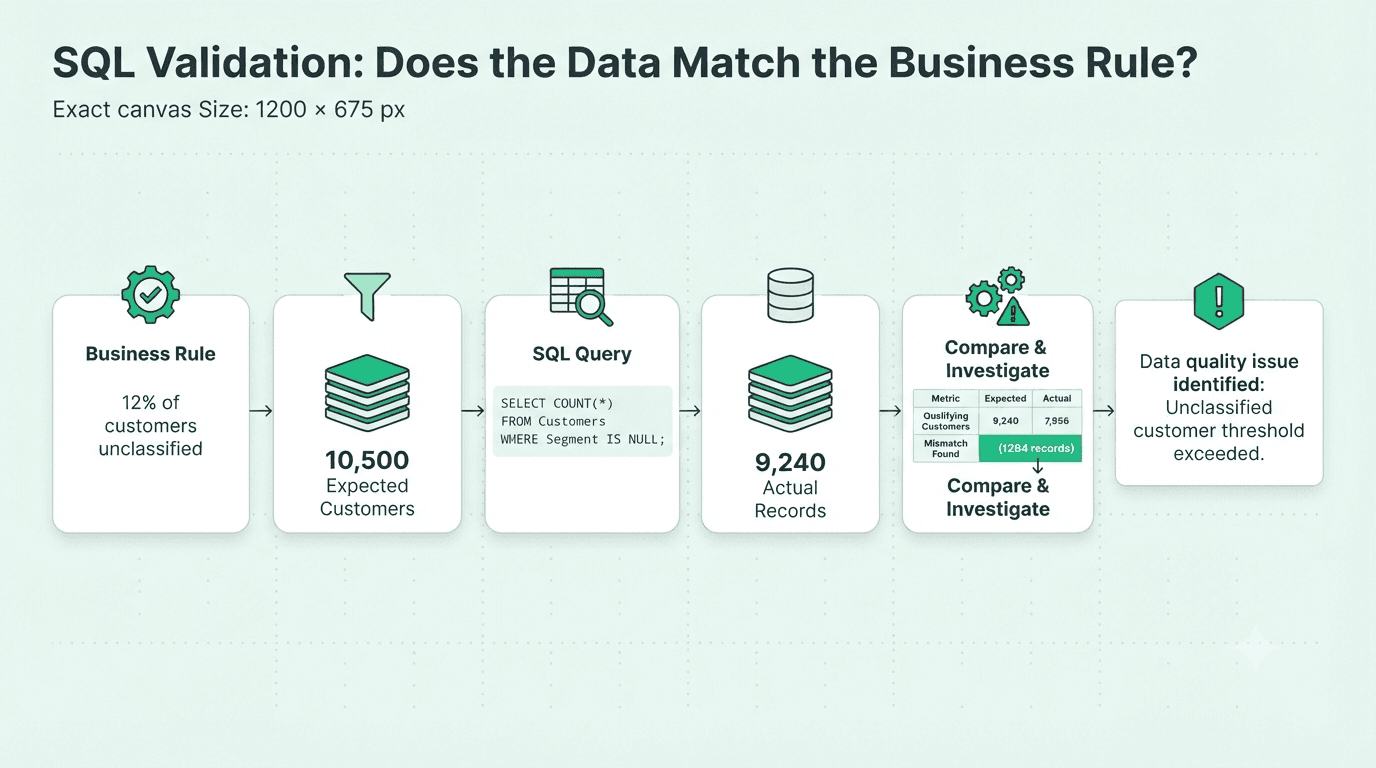
A new customer classification system is implemented that should automatically categorize customers into three tiers based on their purchase history. The implementation team confirms the system is running and the classification logic is deployed. A BA who cannot query data marks the task complete based on the technical team's confirmation. A BA with SQL proficiency runs three validation queries: one that counts customers in each tier and compares it to the expected distribution based on historical data, one that checks a sample of customers against the classification rules manually to confirm the logic is being applied correctly, and one that checks for customers who were not classified at all due to missing data. The third query reveals that twelve percent of customers have null values in the purchase history field required for classification and were silently left unclassified. This is a data quality problem that would have become a customer-facing billing problem had it not been caught.
Fresher Expectations
Can write a SELECT statement with a WHERE clause, can join two tables on a common key, and can use GROUP BY with an aggregate function to answer a basic business question like "how many orders were placed by customers in each region last month."
Mid-Level Expectations
Writes multi-table join queries to validate data relationships, uses subqueries to compare data sets before and after a system change, and uses SQL for data profiling to assess data quality in a source system before requirements are written around it.
Senior-Level Expectations
Designs the data validation strategy for a system implementation including the specific queries that will confirm each business rule is being applied correctly. Reviews data architecture decisions from a business requirements perspective, identifying where the proposed data model will make required business queries difficult or impossible.
Common Mistakes
Treating data validation as a developer responsibility rather than a BA responsibility. The developer tests whether the code runs correctly; the BA validates whether the system produces the correct business outcome, which requires a separate and independent validation using the same business logic documented in the requirements.
How to Build This Skill
Download any public dataset available in SQL format, such as a sample e-commerce database or a public government dataset, and write ten business questions in plain language. Then write the SQL query that answers each one, verify the answer is correct by checking it against a different method, and note any query that required more than one attempt to get right. Repeat until writing the correct query for a standard business question is automatic rather than effortful.
Example Interview Questions
"You need to validate that a new pricing rule is being applied correctly in the system. The rule states that orders over five hundred dollars from customers in the premium tier receive a ten percent discount. How would you write a SQL query to validate this?" "What would you look for when profiling a data set from a source system before writing requirements for a migration?" "How do you use SQL differently in requirements analysis versus system testing?"
Strong Sample Answer Direction
A strong SQL answer for a BA role focuses on the business validation purpose rather than the technical query mechanics: "I would first write the query that identifies the records that should qualify for the rule, then a separate query that identifies the records where the rule was actually applied, then compare the two to find any records that should have had the rule applied but did not." This purpose-first framing demonstrates BA thinking applied to technical tooling.
Data Visualization and Decision-Driven Reporting
Why Recruiters Prioritize This Skill
A business analyst who can analyze data but cannot present it in a way that drives a decision has completed only half the job. Data visualization is the bridge between analysis and action, and the quality of that bridge determines whether a finding produces a business change or a politely received presentation that generates no follow-through. Recruiters test this skill because it reveals whether a BA understands their audience well enough to design communication for the decision the audience needs to make, rather than designing a display of the data they gathered.
What Recruiters Actually Expect in 2026
Proficiency in at least one BI tool, primarily Power BI or Tableau, beyond basic chart creation, including calculated fields, filters, drill-down functionality, and designing a layout that guides the viewer to the most important information before showing supporting detail. The judgment to select the right chart type for the data being communicated, specifically knowing when a bar chart is appropriate versus a line chart, when a scatter plot reveals a relationship that no other chart would show, and when a table is actually clearer than any chart. The ability to design a dashboard or report specifically for the decision a particular audience needs to make, rather than designing a comprehensive data display that shows everything available.
Interview Evaluation
Take-home assignments that include a dataset and ask candidates to build a dashboard that answers specific business questions, evaluated on chart choice, layout, labeling, and whether the design guides the viewer to the insight rather than requiring them to find it. Portfolio reviews where candidates walk through dashboards they have built, asked specifically "what decision was this designed to support" and "what would you change if you rebuilt it today."
Real Workplace Example
A retail operations team needs to decide which stores to prioritize for a supply chain intervention. A BA produces a report showing store performance across twelve metrics in a table with color coding for above and below average. The operations director reads it for ten minutes and asks "so which stores should we focus on?" A BA with decision-driven visualization skills goes back and produces a single scatter plot showing each store's revenue impact on one axis and operational cost on the other, with a reference line at average performance on both axes. The stores in the upper-left quadrant, high revenue impact and high operational cost, are immediately visible as the intervention priorities without any explanation required. The operations director makes the decision in three minutes.
Fresher Expectations
Knows when to use a line chart versus a bar chart versus a scatter plot and can explain the reasoning for each choice. Builds charts with clear labels, appropriate scales, and titles that state the insight rather than describing the data. Avoids common visualization errors such as truncated y-axes, 3D charts that distort comparisons, and pie charts with more than five segments.
Mid-Level Expectations
Designs dashboards with a clear visual hierarchy that guides the viewer from the most important information to supporting detail. Uses BI tool calculated fields and parameters to create interactive reports that let viewers answer their own follow-up questions without needing a new report. Tailors visualization design to the specific audience, with executive summaries that answer the question directly and operational dashboards that provide the detail needed for daily decisions.
Senior-Level Expectations
Establishes data visualization standards for a BA team or a business unit, including templates, approved chart types, and style guidelines that ensure consistency across all reporting. Evaluates whether data infrastructure supports the reporting requirements and recommends changes to data collection or storage when current data cannot support required visualizations.
Common Mistakes
Building dashboards that display all available data rather than answering a specific question. Adding every metric a stakeholder mentioned rather than designing for the specific decision the dashboard should support, which produces a visually complex report that does not help anyone make a decision faster.
How to Build This Skill
Find any publicly available dataset and build three different visualizations of the same data, each designed for a different audience: an executive who has thirty seconds, an operations manager who makes daily decisions from the data, and an analyst who needs to investigate anomalies. Notice how the layout, the level of detail, and the chart choices change for each audience. The exercise builds the skill of designing for the viewer's decision rather than for data completeness.
Example Interview Questions
"You need to show a senior leadership team how customer satisfaction scores have changed across five product lines over the past two years. What visualization would you use and why?" "Walk me through a dashboard you have built. What decision was it designed to support, and what would you change if you rebuilt it?" "A stakeholder asks for a report showing all sales data. How do you respond?"
Strong Sample Answer Direction
A strong visualization answer starts with the audience and the decision before describing any chart: "I would first ask what decision this visualization needs to support and who will be making it, because the chart type and the level of detail should follow from the answer to that question rather than from what data is available." This framing demonstrates analytical thinking applied to communication rather than technical proficiency applied to data display.
Agile and Delivery Skills
User Story Writing and Acceptance Criteria Precision
Why Recruiters Prioritize This Skill
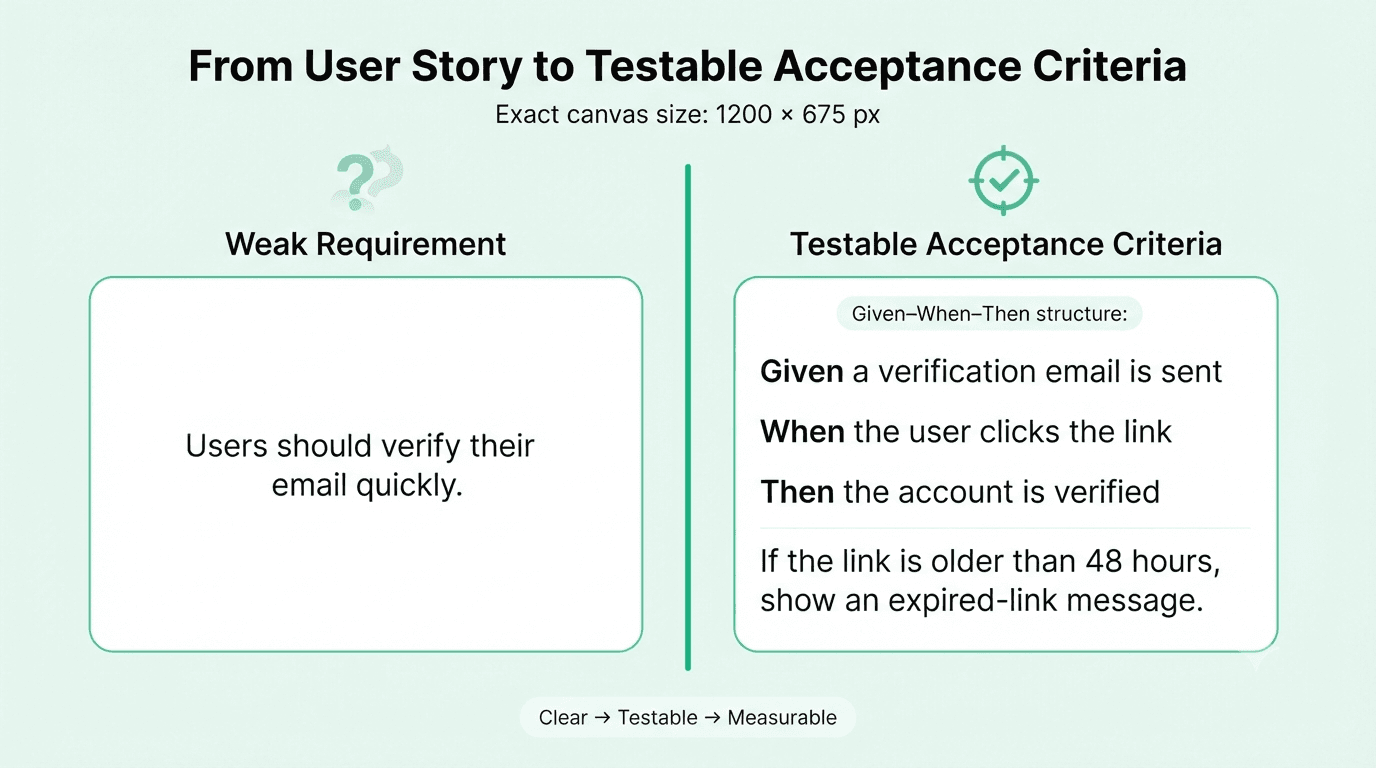
A user story is a contract between the business and the development team about what will be built and how to verify it is built correctly. A poorly written user story, one with vague acceptance criteria, no definition of edge cases, and no testable success condition, produces a feature that the developer built to their best interpretation and the business expected to their own different interpretation. The gap between those two interpretations is discovered in user acceptance testing, when it is expensive to fix. Recruiters test user story quality because it is the most direct measure of a BA's ability to function effectively in an agile delivery environment.
What Recruiters Actually Expect in 2026
User stories written in the standard format with a clear user role, a specific action, and a concrete benefit, not as a template exercise but as a specification that is genuinely useful to a developer who has never spoken with the BA. Acceptance criteria written in Given-When-Then format that specifies the precondition, the user action, and the expected system response in enough detail that a QA engineer can write a test case from it without a follow-up conversation. A clear distinction between the acceptance criteria, which define when the story is done, and the definition of done, which defines the team's quality standard that applies to every story regardless of content.
Interview Evaluation
Writing exercises where candidates are given a business requirement and asked to write the user stories and acceptance criteria that implement it, evaluated on whether the acceptance criteria are specific enough to be tested without interpretation. Review exercises where candidates are shown user stories with vague or incomplete acceptance criteria and asked to identify the gaps and rewrite them. Behavioral questions asking candidates to describe a situation where a poorly written acceptance criterion led to a testing or delivery problem, and what they changed in their writing process as a result.
Real Workplace Example
A user story reads: "As a customer, I want to be able to update my email address so that I receive communications at my current address." The acceptance criteria are: "The customer can change their email address in the profile settings." A BA who writes precise acceptance criteria would expand this to: "Given a customer is logged in and navigates to Profile Settings, when they enter a new email address and click Save, then the system sends a verification link to the new address, displays a message confirming a verification email was sent to the new address, and does not update the email address in the system until the customer clicks the verification link. Given the customer clicks the verification link, then the email address is updated and a confirmation notification is sent to the old address. Given the customer does not click the verification link within 48 hours, then the email change request is cancelled and the existing email address is retained." The first version has one sentence of acceptance criteria. The second has a complete specification of the behavior, the security mechanism, and the edge case handling.
Fresher Expectations
Writes user stories in the standard format with a user role, an action, and a benefit. Writes at least one acceptance criterion per story in Given-When-Then format. Understands that acceptance criteria should specify what the system does, not how it does it, and should be testable without interpretation.
Mid-Level Expectations
Writes acceptance criteria that cover the happy path, the most likely exception paths, and the edge cases that would only be discovered in testing if not specified upfront. Can review a set of user stories and identify which ones are likely to cause a delivery problem due to ambiguous acceptance criteria. Facilitates story refinement sessions with development and QA teams to identify gaps before a story enters development.
Senior-Level Expectations
Establishes user story and acceptance criteria quality standards for a BA team or a product team, including examples of well-written and poorly-written acceptance criteria and a checklist that writers use to self-assess before stories enter refinement. Coaches other BAs on precision writing as a specific discipline, not as a general communication skill.
Common Mistakes
Writing acceptance criteria as a list of features rather than as a specification of behavior: "The customer can view, edit, and delete their profile information" is a feature list, not an acceptance criterion. An acceptance criterion specifies what happens when the customer does each of those things, under what conditions, and with what system response.
How to Build This Skill
Take any feature in a system you use daily and write the user stories and acceptance criteria for it as if you were preparing it for a development team. Write until every Given-When-Then statement could be handed to a QA engineer who has never used the system and used to write a test case. Share it with a developer or QA engineer and ask them to identify every question they would have before starting work. Every question they ask identifies a gap in the acceptance criteria.
Example Interview Questions
"Write user stories and acceptance criteria for a password reset feature. Include edge cases." "I am going to show you a user story. Tell me what is missing from the acceptance criteria and how you would fix it." "How do you decide when a user story is specific enough to move into development?"
Strong Sample Answer Direction
A strong acceptance criteria answer immediately identifies a specific edge case the interviewer did not mention, explains why it matters for the system's correct behavior, and writes a Given-When-Then that covers it. A weak answer writes only the happy path acceptance criterion without considering what happens when something goes wrong or the user takes an unexpected action.
Business and Communication Skills
Stakeholder Management: Facilitation, Conflict Resolution, and Influence
Why Recruiters Prioritize This Skill
A business analyst operates at the intersection of the business and the technology delivery team, which means they routinely work with people who have different goals, different vocabularies, and different ideas about what the project should deliver. Stakeholder management for a BA is not about relationship maintenance; it is about extracting accurate requirements from people who may not know what they want, resolving conflicts between stakeholders who have legitimate but contradictory needs, and influencing decisions without formal authority over the people making them. Recruiters test this because its absence produces projects where requirements are incomplete, where scope creep is constant, and where the delivery team and the business reach user acceptance testing with different expectations.
What Recruiters Actually Expect in 2026
Specific facilitation techniques for requirements workshops, including how to structure an agenda that moves a group from divergent individual opinions to a convergent shared requirement, how to handle a dominant stakeholder who redirects discussion to their own priorities, and how to surface the quiet stakeholder whose domain knowledge is critical but whose input is being drowned out by louder voices. The ability to document conflicting requirements in a way that surfaces the conflict explicitly rather than papering over it, which forces a business decision rather than allowing the conflict to become a technical decision by default. Influence techniques that work without formal authority: building credibility through demonstrated knowledge, using data to shift opinion, and framing trade-offs in business terms that make the cost of a preferred option visible.
Interview Evaluation
Behavioral questions asking candidates to describe specific situations where they resolved a conflict between stakeholders or influenced a decision they disagreed with. Role-play exercises where candidates facilitate a simulated requirements workshop or stakeholder conversation. Questions about specific facilitation techniques, such as how to run a prioritization exercise with a group of stakeholders who all consider their requirements highest priority.
Real Workplace Example
Two departments have contradictory requirements for a customer data field. The sales department requires the customer type field to have five values that map to their sales segmentation model. The finance department requires the same field to have three values that map to their billing tier model. Both requirements are correct for their respective use cases. A BA who documents both sends an irresolvable conflict to development. A BA who manages stakeholders surfaces the conflict explicitly, schedules a meeting with decision makers from both departments, presents the two requirements with their business implications in neutral terms, and facilitates a decision: either the field uses a master taxonomy that both departments map from, or two separate fields are created. The BA documents the decision with the attendees' names and the rationale, creating a record that prevents the conflict from reappearing when the project moves to testing.
Fresher Expectations
Can prepare for and conduct a one-on-one requirements interview with a structured agenda, can document conflicting requirements accurately without accidentally taking a side, and can escalate a conflict to a decision-maker with a clear statement of the issue and the options rather than simply reporting that two stakeholders disagree.
Mid-Level Expectations
Facilitates a requirements workshop with multiple stakeholders, managing group dynamics to ensure all perspectives are heard and decisions are made rather than deferred. Resolves conflicts between stakeholders by identifying the underlying business goals that each requirement is meant to serve, which often reveals that the conflict is at the requirement level but not at the goal level.
Senior-Level Expectations
Designs the stakeholder engagement strategy for a large project, identifying which stakeholders need to be consulted, which need to be informed, and which need to be consulted about specific decisions rather than all decisions. Coaches other BAs on facilitation techniques. Manages executive stakeholders who want a specific outcome rather than a requirements-driven outcome.
Common Mistakes
Presenting conflicting requirements to the project team without forcing a business decision, which passes the conflict to development and creates a technical decision where a business decision was needed. Allowing a stakeholder to sign off on requirements they did not fully read or understand, which results in user acceptance testing failures that both parties attribute to the other's misunderstanding.
How to Build This Skill
Practice running structured facilitation exercises with any group, whether professional or personal. Specifically practice the MoSCoW prioritization exercise with a group that has not pre-agreed on priorities and observe what happens when two participants disagree about whether a requirement is Must Have or Should Have. The skill of moving a group from disagreement to decision without one person simply overruling another is built through practice, not through understanding the technique theoretically.
Example Interview Questions
"Two senior stakeholders have contradictory requirements for the same system feature. How do you handle it?" "You are facilitating a requirements workshop and one participant is dominating the conversation and preventing others from contributing. What do you do?" "A stakeholder signs off on requirements and then in UAT says 'that's not what I asked for.' How do you handle it and how do you prevent it happening again?"
Strong Sample Answer Direction
A strong stakeholder management answer describes the specific facilitation or resolution technique used, the specific moment where the situation could have gone wrong without the intervention, and the specific outcome including the stakeholder's response. A weak answer describes the general approach to stakeholder communication without a concrete example of a difficult situation resolved through specific technique.
Gap Analysis and Business Case Development
Why Recruiters Prioritize This Skill
A business analyst who can only document the current state and describe a desired future state without quantifying the gap or building the business case for closing it is producing analysis that cannot drive an investment decision. Every significant business change requires a justification: why this change, why now, why the proposed solution, and what is the expected return. A BA who can build that case connects their analysis to organizational decisions rather than producing documentation that informs decisions others make without their input. Recruiters test this because it is the skill that determines whether a BA's output influences strategy or only informs implementation.
What Recruiters Actually Expect in 2026
The ability to quantify the AS-IS state using specific process metrics: the cost per transaction, the error rate, the cycle time, and the customer or employee impact of the current state problems. The ability to estimate the TO-BE state improvement using one of three approaches: benchmarking against industry standards, piloting the improvement in a limited scope and extrapolating, or calculating the improvement from first principles using the process change's expected effect on the identified metric. The ability to structure a business case that a non-technical executive can read in five minutes and make a funding decision from, including the problem statement, the proposed solution options, the costs and benefits of each option, and a recommendation with supporting rationale.
Interview Evaluation
Case study rounds where candidates are given an AS-IS process with performance data and asked to build a business case for a specific improvement, evaluated on whether they quantify the current state problem, estimate the improvement using a defensible method, and structure the recommendation clearly. Behavioral questions asking candidates to describe a business case they built that resulted in a funded project, and what they would do differently in how they structured or presented it.
Real Workplace Example
A BA is asked to investigate why customer onboarding takes an average of twelve business days. The AS-IS analysis reveals that three of those days are spent waiting for a manual credit check that involves emailing a third party, receiving a response, and manually entering the result into the system. The BA quantifies the cost: twelve days average time-to-revenue per customer, with the three manual days contributing to an estimated 1.4 million dollars in deferred annual revenue for the current customer volume. The BA identifies two solution options: automating the credit check via API integration, which costs an estimated 80,000 dollars to implement and reduces onboarding to nine days, and manual process optimization that reduces the waiting time through a dedicated resource, which costs 60,000 dollars annually in personnel and reduces onboarding to ten days. The business case presents both options with their net present value over three years and recommends the API integration, which has a higher implementation cost but a better three-year return. The business case produces a funding decision in the next planning cycle.
Fresher Expectations
Can identify the performance gap between the current state and a target state using specific metrics. Understands the components of a basic business case including problem statement, solution options, costs, benefits, and recommendation. Can calculate a simple payback period for an investment with a known cost and a known annual benefit.
Mid-Level Expectations
Builds a complete business case with quantified current state costs, estimated future state benefits using a defensible methodology, total cost of ownership for solution options, and a structured recommendation. Validates benefit estimates with subject matter experts before presenting them as projections.
Senior-Level Expectations
Leads business case development for strategic investments, including sensitivity analysis that tests the recommendation under different assumptions, and structures the presentation specifically for the decision-making body's information needs and decision criteria. Coaches other BAs on business case methodology.
Common Mistakes
Building a business case that describes the solution features rather than the business problem and the cost of not solving it. Estimating benefits without quantifying the assumptions they rest on, which produces projections that are challenged at the decision stage and cannot be defended.
How to Build This Skill
Take any inefficiency you observe in your current organization, even a small one, and build a complete business case for fixing it. Quantify the current cost using real data, estimate the improvement using a specific method you can explain and defend, calculate the cost of the proposed fix, and write a one-page business case with a recommendation. Share it with a manager or senior colleague and ask what questions they would need answered before making a funding decision. Every question they ask identifies a gap in your business case methodology.
Example Interview Questions
"How would you build a business case for replacing a manual process with an automated system?" "What is the difference between ROI and payback period, and when would you use each in a business case?" "Describe a business case you built that resulted in a decision to proceed. What did you include and what would you change?"
Strong Sample Answer Direction
A strong business case answer quantifies the current state problem with a specific number before describing any solution: "The first thing I would establish is the cost of the current state, because without that the business case is a solution looking for a problem. In this case, the manual process costs approximately X per year in staff time and Y per year in errors that require rework." This quantification-first approach demonstrates analytical discipline that produces a credible rather than aspirational business case.
FREE TO USE
8k+ SESSIONS92% FLUENCY4.9★ RATING
Speak With Confidence
Real Conversations. Real Scenarios. Speak until it feels natural.
- Real-Time Speaking Practice
- Guided Conversation Flows
- Instant AI Feedback
AI and Emerging Skills
AI Literacy: Understanding Automation, Process Mining, and AI-Augmented Analysis
Why Recruiters Prioritize This Skill
Business analysts are among the roles most directly affected by AI-driven process automation, because the processes BAs document and improve are often the same processes that organizations are automating using robotic process automation, process mining, and workflow intelligence tools. A BA who does not understand these technologies cannot identify which processes are good automation candidates, cannot write requirements for an automation solution, and cannot evaluate whether an implemented automation is delivering the expected outcome. Recruiters are increasingly testing AI literacy because BAs who lack it are becoming unable to contribute to a significant portion of the operational improvement projects their companies are running.
What Recruiters Actually Expect in 2026
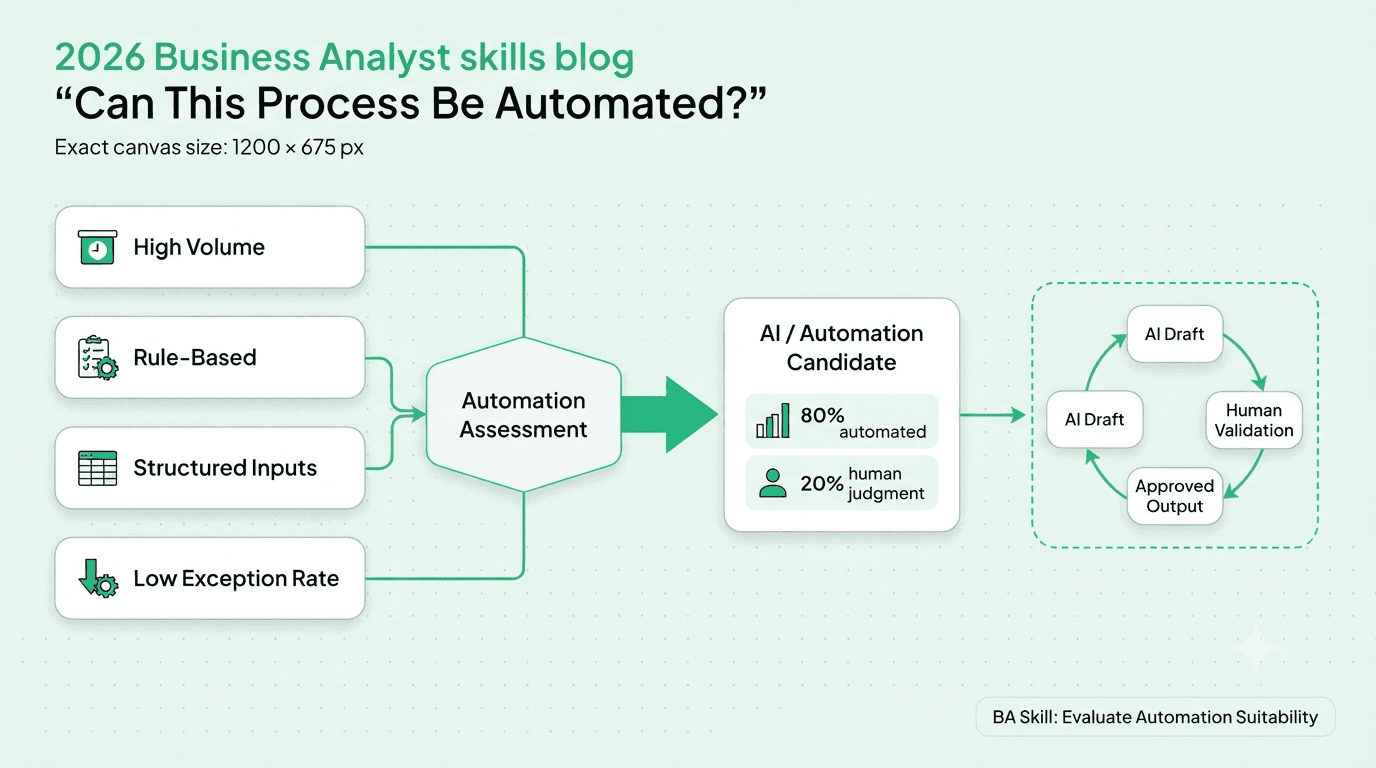
Not technical development skills. What is expected is a working understanding of process mining: tools that analyze system event logs to automatically generate process maps and identify process variants, bottlenecks, and compliance deviations. The ability to identify automation candidates from an AS-IS process analysis using specific criteria: high volume, rule-based decisions, stable process with few exceptions, structured data inputs. Understanding of the difference between Robotic Process Automation, which automates tasks a human performs on a screen, and workflow automation, which redesigns the process flow rather than mimicking the manual steps. Awareness of how AI is changing the BA's own workflow: AI tools that generate first-draft process maps from meeting transcripts, suggest requirements based on process descriptions, and synthesize research from multiple sources.
Interview Evaluation
Case study questions asking candidates to evaluate a described process for automation potential, identifying the specific criteria that make it a good or poor automation candidate. Questions about process mining, including what it reveals that manual process documentation cannot and how a BA would use process mining output to prioritize process improvement. Behavioral questions about how the candidate uses AI tools in their own BA practice and what they have learned about the boundaries of what AI tools do well versus poorly.
Real Workplace Example
A BA is asked to evaluate the accounts payable process for automation potential. Without AI literacy, they map the process and note that it is manual and repetitive. With AI literacy, they apply specific automation suitability criteria: the process handles approximately 2,000 invoices per month, the decision logic for approving an invoice is clearly defined in the company's procurement policy, structured data is available in a consistent format, and exceptions occur in less than five percent of cases. All four criteria point to high automation suitability. They also identify that three steps in the process involve judgment calls about vendor relationships that are not rule-based and are therefore not automation candidates. The recommendation separates the automatable eighty percent from the judgment-requiring twenty percent, rather than treating the entire process as either fully automatable or not automatable.
Fresher Expectations
Can identify whether a given process is a good automation candidate using a structured framework of criteria including volume, rule-based decision logic, structured inputs, and exception rate. Understands what process mining software does at a conceptual level and can describe the type of insight it produces that manual process documentation cannot.
Mid-Level Expectations
Uses AI tools to accelerate their own BA work including drafting documentation, synthesizing research, and generating first-pass process maps from transcripts, then evaluates and improves AI output rather than accepting it uncritically. Writes requirements for a robotic process automation implementation, including the exception handling logic that determines when the automation should hand off to a human.
Senior-Level Expectations
Leads process automation assessment programs, establishing the evaluation framework and the business case methodology for automation investments. Evaluates process mining output at scale to identify organization-wide process improvement and automation opportunities. Educates business stakeholders on AI capabilities and limitations to prevent both under-investment and unrealistic expectations.
Common Mistakes
Treating all repetitive manual processes as automation candidates without evaluating exception rate and decision complexity, which leads to automation implementations that break on a high percentage of cases and require more human intervention than the original manual process. Using AI tools to generate documentation without reviewing and correcting the output, which produces requirements or process models that are plausible-sounding but factually incorrect for the specific business context.
How to Build This Skill
Identify one repetitive process in your current organization, apply the automation suitability criteria of volume, rule-based logic, structured inputs, and exception rate, and write a one-page automation assessment documenting your findings and recommendation. Then use an AI tool to generate a first draft of a process description or requirements document from a meeting transcript or verbal description, and spend equal time reviewing and correcting the output. Note every correction you make. The corrections reveal the categories of business context that AI tools consistently miss.
Example Interview Questions
"How would you evaluate a process to determine whether it is a good candidate for robotic process automation?" "What is process mining and how would a business analyst use it differently from a traditional AS-IS process mapping exercise?" "How do you use AI tools in your BA practice, and where do you find them unreliable?"
Strong Sample Answer Direction
A strong AI literacy answer for a BA role connects AI capability to a specific BA deliverable: "I use process mining to validate that the AS-IS process map I built from stakeholder interviews reflects what the system actually records happening, because stakeholders often describe the process as it should work rather than as it does work, and the event logs reveal the gap. That gap is usually where the most significant process improvement opportunity is." This answer demonstrates practical AI tool use connected to a specific analytical purpose.
Skills Recruiters Value More Than Certifications
The CBAP (Certified Business Analysis Professional) and CCBA (Certification of Competency in Business Analysis) are the most recognized BA certifications. They demonstrate that a candidate has the required hours of BA experience and passed an exam on BABOK concepts. What they do not demonstrate is the quality of the deliverables that experience produced.
A hiring panel that must choose between a CBAP-certified candidate with no portfolio of work samples and a non-certified candidate with a portfolio of case studies, process models, and sample requirements documents that can be read and evaluated in the interview will almost always find the portfolio more informative. The certification proves the candidate has done BA work. The portfolio proves the candidate has done good BA work.
Certifications are most valuable in two specific scenarios: organizations that require CBAP as a qualification for senior BA roles, often in government, financial services, or consulting, and career switchers who need to demonstrate BA knowledge before they have BA job titles on their resume. In both cases, the certification is a screening threshold that the portfolio then distinguishes the candidate above.
The practical implication is this: invest first in building portfolio-quality deliverables, whether on live projects or on practice cases. The certification can follow once the work itself demonstrates the capability.
Skills That Are Becoming Less Important
The static Business Requirements Document written at project initiation and baselined before development begins is declining as the primary BA deliverable in most delivery environments. Candidates who can only produce BRDs without user stories, acceptance criteria, or agile-compatible requirements formats are evaluated as limited to waterfall projects, which is a shrinking share of the delivery environment most companies operate in.
Flowchart-only process modeling without BPMN notation is becoming a less valued skill at organizations that need process models to be interoperable with automation tools and process mining software, both of which use BPMN as a standard format.
Manual competitive feature matrices and industry benchmarking produced through web research alone are becoming less differentiating as AI tools can produce first drafts of these documents in minutes. The BA skill is now in designing the right framework for the analysis and evaluating and correcting the AI output, not in conducting the research manually.
Waterfall-only project experience without any agile delivery exposure is increasingly evaluated as a development need rather than a neutral experience description, because the majority of new project delivery is either fully agile or hybrid, and candidates with no exposure to iterative delivery will require a significant adjustment period.
AI Is Changing Business Analysis
Which skills AI is replacing: Meeting transcription and summarization, first-draft process documentation from verbal descriptions, initial requirements drafts from feature descriptions, competitive feature matrices from publicly available information, and basic data profiling from structured datasets are increasingly produced by AI tools faster than any analyst can produce them manually.
Which skills AI is enhancing: BAs with strong analytical frameworks can now complete research, documentation, and synthesis tasks in a fraction of the time they previously required, freeing time for the judgment work that AI cannot do: validating AI output against actual business context, conducting nuanced stakeholder conversations that require reading organizational dynamics, and making trade-off recommendations that require understanding of the organization's strategy and culture.
Which human skills are becoming more valuable: The ability to evaluate whether an AI-generated process model or requirements document is accurate for the specific organizational context, the ability to conduct stakeholder conversations that reveal unstated assumptions and political constraints that AI cannot access, and the business judgment to connect a process improvement recommendation to an organization's strategic priorities are all becoming sharper BA differentiators.
How professionals should adapt: Use AI tools to produce first drafts of documentation and research, then invest the time saved in deeper stakeholder engagement and more rigorous validation of the AI output against real business context. The BA who uses AI to produce a first-draft process model in ten minutes and then validates it against stakeholder interviews and system event logs produces better work faster than both the BA who produces the map manually and the BA who accepts the AI output without validation.
Skills That Instantly Differentiate Candidates
A candidate who can describe a requirement that a stakeholder could not articulate explicitly, explain specifically how the elicitation technique they used surfaced it, and connect it to a business outcome the project would have missed without it separates immediately from candidates who describe requirements as something stakeholders provide rather than something analysts surface.
A candidate who can show a process model with both the AS-IS and TO-BE, with the gap analysis connecting a specific process metric improvement to a specific process design change, demonstrates the analytical depth that most candidates claim in their resumes and cannot demonstrate in their portfolios.
A candidate who can describe a user story rejection during UAT, explain the specific acceptance criterion that was missing that would have prevented the rejection, and show the rewritten acceptance criterion they developed as a result demonstrates the kind of learning from mistakes that produces durable skill improvement rather than repeated errors.
A candidate who can describe an automation assessment they conducted using specific suitability criteria, distinguishing which parts of a process were good automation candidates from which required human judgment, demonstrates the AI literacy and process analytical skill that is increasingly rare and increasingly valued.
Common Skill Gaps Recruiters Notice
Candidates who describe requirements gathering as a process of recording what stakeholders say, revealing that they have never conducted a requirements analysis that challenged a stakeholder's stated requirement to surface the underlying need.
Candidates who describe data analysis experience without being able to write a SQL query that answers a basic business question, revealing that their data experience was consuming reports rather than producing analysis.
Candidates who have built process models but cannot describe the metric they used to evaluate whether the TO-BE process was an improvement, revealing that their process modeling is documentation rather than analysis.
Candidates who describe agile project experience without being able to write an acceptance criterion that a QA engineer could use to write a test case, revealing that their agile experience was participation in a process rather than ownership of a BA deliverable.
Candidates who cannot describe a business case they built that drove an investment decision, revealing that their analysis was informational rather than decision-driving.
Learning Roadmap
For Freshers
- Master requirements elicitation interview technique, specifically the ability to distinguish a stated requirement from an underlying business need, before attempting more advanced analysis techniques.
- Learn BPMN notation to the level of producing a readable process diagram from a verbal description, starting with the basic elements: tasks, gateways, swimlanes, and events.
- Build SQL proficiency through SELECT, JOIN, GROUP BY, and WHERE clause queries against a practice database with realistic business questions.
- Learn the user story format and practice writing acceptance criteria in Given-When-Then format until every criterion you write can be directly converted to a QA test case.
- Build a portfolio case study for one process or system, documenting your AS-IS analysis, requirements, and TO-BE design, even if the project is a practice case rather than a live project.
For Professionals With 1 to 3 Years of Experience
- Shift from documenting process descriptions to quantifying process performance using cycle time, error rate, and cost per transaction as your primary analysis metrics.
- Build data visualization proficiency in Power BI or Tableau, specifically designing dashboards for specific decisions rather than comprehensive data displays.
- Build and present a business case for a real or practice process improvement, including quantified current state costs and estimated TO-BE benefits using a defensible methodology.
- Develop AI tool fluency: use an AI tool to produce a first draft of a requirements document or process map, review and correct it, and document every correction as a learning data point about where AI tools require human validation.
- Practice facilitating a requirements workshop, even with a volunteer group, using a structured agenda and applying techniques for managing dominant participants and surfacing quiet ones.
For Professionals With 3 to 7 Years of Experience
- Build a complete process automation assessment capability, applying a structured suitability framework and writing requirements for an automation implementation including exception handling logic.
- Develop business case expertise that includes sensitivity analysis and multi-option comparison with total cost of ownership over a three to five year horizon.
- Mentor a junior BA on requirements writing precision, specifically teaching acceptance criteria quality as a specific writing discipline rather than a general communication skill.
- Build expertise in one industry domain, whether healthcare, financial services, retail, or another vertical, to the level of understanding the regulatory requirements and business model constraints that affect BA work in that domain.
- Lead a requirements program for a project with multiple stakeholder groups, designing the stakeholder engagement strategy and the conflict resolution process before the project begins.
For Senior Professionals
- Design the requirements management approach for a BA practice or delivery organization, including quality standards, templates, and review processes.
- Build and present strategic business cases that connect process improvement investment to organizational strategy, presenting at leadership or board level.
- Establish AI tool governance for a BA team, defining which AI-assisted deliverables require which level of human validation and how AI tool use should be documented in project records.
- Hire and evaluate other business analysts using the judgment-based standards outlined in this guide rather than certification credentials alone.
Self-Assessment Checklist
- I can describe a requirement that a stakeholder could not articulate explicitly, name the elicitation technique that surfaced it, and explain why it would have been missed without that technique.
- I can create a BPMN process diagram from a verbal description including at least one exception path and swimlanes for each role involved.
- I can write a SQL SELECT query with a JOIN and a GROUP BY aggregation to answer a business question about data in two related tables.
- I can write an acceptance criterion in Given-When-Then format that a QA engineer could use to write a test case without asking me a follow-up question.
- I have a quantified AS-IS process analysis where I measured at least one process performance metric and connected it to a specific business impact.
- I can build a basic business case that includes current state costs, TO-BE benefit estimates with stated assumptions, and a recommendation with supporting rationale.
- I can describe a stakeholder conflict I resolved by identifying the underlying business goals that the conflicting requirements were each trying to serve.
- I have designed a dashboard in Power BI or Tableau that was specifically designed for a decision a particular audience needed to make, not as a general data display.
- I can evaluate a process for automation suitability using specific criteria and distinguish which parts are automation candidates from which require human judgment.
If fewer than six of these are checked, the learning roadmap above is your concrete preparation plan before applying widely.
Portfolio or Resume Proof
| Skill | Resume | Portfolio | Interview Talking Point | |
|---|---|---|---|---|
| Requirements elicitation | Describe the elicitation technique used and the insight it produced, not just that requirements were gathered | Share a post on a requirements elicitation finding that changed a project direction | Publish an anonymized requirements document showing the business need, functional requirements, and non-functional requirements with clear distinctions | Name the elicitation technique, what it revealed that interviews alone would have missed, and the business decision it informed |
| Process modeling | Describe the process metric improved, not just that process mapping was completed | Share an anonymized BPMN diagram with annotations explaining the analysis findings | Build a case study showing AS-IS, identified problems with metrics, and TO-BE with expected improvement | Describe the specific process metric that revealed the problem and the process design change that addressed the root cause |
| SQL for business analysis | Describe a data validation exercise you conducted and what it found | Share a post on a data quality problem you discovered through querying | Include sample SQL queries in a portfolio case study with annotations explaining the business question each one answers | Describe the validation query you wrote, what it found, and what the consequence would have been if the problem had not been caught |
| Data visualization | Describe the decision the dashboard was designed to support, not just the tool used | Share a published or anonymized dashboard screenshot with an explanation of the decision it was designed for | Build a public portfolio dashboard using publicly available data with a written explanation of the design decisions | Walk through one design decision: why a specific chart was chosen for a specific audience with a specific decision to make |
| User story writing | Describe acceptance criteria quality standards you established or applied | Share a before and after example of an acceptance criterion you improved | Publish a sample user story set with acceptance criteria and annotations explaining the precision choices | Show a specific acceptance criterion, explain the edge case it covers that the obvious version misses, and describe the UAT failure it would have prevented |
| Stakeholder management | Describe a specific conflict resolved and the outcome, not just "cross-functional collaboration" | Share a post on a facilitation technique you use for requirements workshops | Include a stakeholder analysis document in a portfolio case study | Describe the two conflicting requirements, the underlying goals behind each, and the resolution that addressed both |
| Business case development | Quantify the business impact of projects on the resume using the same framework as the business case | Share a post on business case methodology with a specific example | Publish an anonymized or practice business case showing current state metrics, TO-BE estimates, and recommendation | Name the metric that quantified the current state problem, the methodology used to estimate the improvement, and the decision the business case produced |
| AI literacy | Describe automation assessments or process mining work, with the business outcome of the assessment | Share a post on AI tool use in BA practice with specific examples of where AI output required correction | Publish an automation assessment case study showing the suitability evaluation framework and findings | Describe the suitability criteria applied, which parts of the process qualified, which did not, and why |
Conclusion
Business analysis in 2026 rewards a combination of skills that has shifted meaningfully from even two years ago: requirements elicitation that surfaces the need behind the stated requirement, process analysis that quantifies the problem before designing the solution, data literacy that enables independent data validation rather than dependence on others for every data question, and AI literacy that turns process automation from a threat into an analytical contribution.
None of these skills require rare talent. They require deliberate practice at a layer of precision that most BAs never reach because they do not receive specific feedback on the quality of their requirements, their process models, or their business cases. The gap between a business case that gets funded and one that generates a polite thank-you is often not in the content but in how specifically the current state is quantified and how credibly the TO-BE benefit is estimated.
Explaining these distinctions clearly under interview pressure, when a hiring manager asks a specific follow-up question about a requirement you described or a process model you built, is a skill that is built through practice rather than through understanding. The candidates who consistently move past the initial interview screen are those who have rehearsed answering specific follow-up questions until the reasoning is automatic rather than effortful. That habit of clear reasoning under scrutiny is exactly what platforms like Mocklingo's AI mock interview practice are designed to build, giving you the realistic pressure and specific feedback that turns competent analysis into confident, compelling interview answers.