Loading...
Contents
Top Prompt Engineer Skills Recruiters Look for in 2026
Sep 23, 202631 min read
In 2026, recruiters hiring prompt engineers care about five things above everything else. Can you write clear instructions that work reliably, not just once. Can you evaluate model output with real tests instead of vibes. Do you understand how models actually behave, including where they fail. Can you build systems around a model, things like retrieval, tool use, and guardrails. And can you explain all of this to a product team that does not speak model language. Certifications barely matter here. A portfolio of working examples matters enormously.
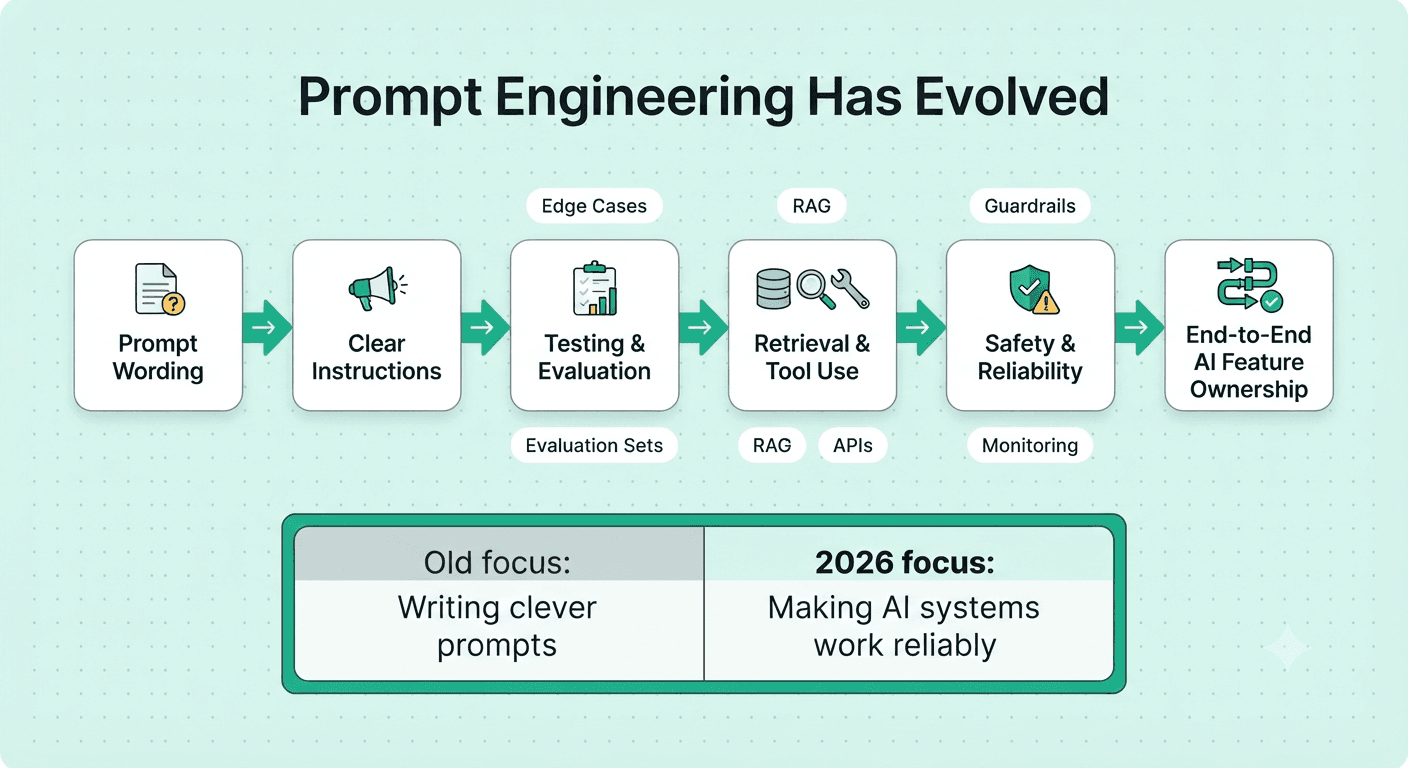
The role has changed a lot in the last two years. Early on, "prompt engineer" often meant someone who was good at wording. In 2026, it usually means someone who owns the quality and reliability of an AI feature end to end. That shift is why so many candidates who are genuinely good at writing prompts still struggle in interviews. They prepared for the old version of the job.
This guide covers what recruiters actually test now, at every experience level, from fresher to senior, plus how to build each skill and how to prove it on a resume or portfolio.
FREE TO USE
25K+ INTERVIEWS4.8★ RATING68% IMPROVEMENT
Crack Your Dream Job
Real Interviews. Real Pressure. Practice until it feels easy.
- Seamless Interview Experience
- Resume & JD Questions
- Instant Personalized Feedback
How This Guide Is Organized
Skills are grouped into categories, roughly ranked by how often they show up as a blocking requirement rather than a nice to have.
1. Core Fundamentals
2. Technical Skills
3. Analytical and Evaluation Skills
4. Systems and Automation Skills
5. Communication Skills
6. Business Skills
7. Leadership Skills
8. Emerging Skills for 2026
Each skill includes why recruiters care, what they expect now, how it gets tested, a real workplace example, expectations by level, common mistakes, how to build it, and sample questions.
Category 1: Core Fundamentals
Skill 1: Writing Clear, Testable Instructions
Why recruiters prioritize this skill
Everything else in the role sits on top of this. A hiring manager can teach you their internal tooling in a week. What they cannot easily teach is the ability to take a fuzzy business requirement and turn it into an instruction a model follows consistently. Most bad AI features fail not because the model is weak but because nobody specified the task precisely enough.
What recruiters actually expect in 2026
Not clever tricks or magic phrases. Those mostly stopped working as models got better at following plain instructions. What they expect is structure. Clear task definition, explicit constraints, defined output format, examples where useful, and clear handling of edge cases. They also expect you to know when a shorter prompt beats a longer one, since bloated prompts cost money and often make behavior less predictable.
Interview evaluation
Resume screening: They look for evidence you shipped something real, not just experimented. Phrases like "reduced output errors" or "built the classification prompt used in production" stand out.
Technical interviews: You get a vague task, like "extract key details from customer support emails," and are asked to write the prompt live while explaining your choices.
Assignments: A take home where you write prompts for a specific task and document why each part exists.
Portfolio reviews: They read your prompts. Messy, undocumented prompts hurt you more than having a small portfolio.
Real workplace example
A support team wants incoming tickets automatically tagged by urgency. The first prompt works on obvious cases but fails on polite customers describing serious problems. The prompt engineer rewrites the instruction to define urgency by business impact rather than tone, adds two examples of the exact failure case, and the tagging accuracy jumps without any model change.
Fresher expectations
You can write a clear prompt for a defined task, specify an output format, and explain why each instruction is there.
Mid level expectations
You can decompose a complex task into multiple prompts or steps, handle edge cases deliberately, and iterate based on observed failures rather than guesses.
Senior level expectations
You set prompt standards for a team, decide when a task should be solved by prompting versus fine tuning versus traditional code, and own the reliability of an entire feature.
Common mistakes
Writing long prompts that pile on instructions without checking whether each one helps. Relying on phrases like "be accurate" or "do not hallucinate," which sound reasonable but do almost nothing. Testing on three examples and calling it done.
How to build this skill
Pick one real task and write a prompt for it, then collect twenty test inputs including deliberately hard ones. Iterate until it works on all twenty. Repeat with a different task type. Keep every version so you can see what actually improved things. This single exercise teaches more than any course.
Example interview questions
"Here is a task description. Write a prompt for it and walk me through your reasoning."
"This prompt works most of the time but fails on certain inputs. How would you find out why?"
Strong answer direction
Show a process. Define the task, name the edge cases you are worried about, explain what you would test. Candidates who immediately start typing without asking what the output is used for tend to score poorly.
Skill 2: Understanding How Language Models Actually Work
Why recruiters prioritize this skill
You do not need to train models, but you do need a working mental model of why they behave the way they do. Without it, debugging turns into guesswork. Candidates who understand tokenization, context limits, sampling behavior, and why models sometimes produce confident wrong answers can diagnose problems quickly. Candidates who do not end up randomly rewording prompts and hoping.
What recruiters actually expect in 2026
Practical understanding rather than academic depth. You should be able to explain, in plain language, why a model might produce different answers to the same prompt, why very long contexts can degrade quality, what temperature actually changes, roughly how tokens relate to cost, and why a model may confidently invent a citation.
Interview evaluation
Technical interviews: Conceptual questions like "why might this prompt work at the start of a conversation but fail after twenty turns."
Practical rounds: Debugging a failing output and explaining the likely cause.
Case studies: Choosing between models and justifying it on cost, latency, and capability rather than brand preference.
Real workplace example
A summarization feature starts producing worse summaries for long documents. Instead of rewriting the prompt repeatedly, the engineer recognizes that key information is buried in the middle of a very long context where models tend to attend less reliably, and restructures the pipeline to chunk and summarize in stages.
Fresher expectations
You understand tokens, context windows, and that model outputs are probabilistic rather than deterministic.
Mid level expectations
You can predict likely failure modes before testing and choose model settings deliberately rather than leaving defaults.
Senior level expectations
You make model selection and architecture decisions for the organization, including when a smaller cheaper model is genuinely sufficient.
Common mistakes
Treating the model as a search engine that should always be right. Believing that a single magic phrase fixes hallucination. Assuming a bigger model always produces better results for a narrow, well defined task.
How to build this skill
Read the documentation for the main model providers properly, not just the quickstart. Run the same prompt at different temperatures and context lengths and observe what changes. Read a few published model cards and evaluation reports to see how capabilities are actually measured.
Example interview questions
"Why does the same prompt sometimes give different answers?"
"A model keeps inventing product features that do not exist. What are the likely causes and what would you try?"
Strong answer direction
Explain causes in plain language and connect each one to a specific fix. Avoid jargon dumping. Interviewers notice when someone uses terminology without understanding it.
Category 2: Technical Skills
Skill 3: Retrieval Augmented Generation and Grounding
Why recruiters prioritize this skill
Most real business use cases involve company specific information the model was never trained on. Retrieval, meaning feeding the model relevant documents at runtime, is how that gap gets closed. By 2026 this is close to a default requirement in job descriptions, because almost every internal AI tool needs grounding in company data.
What recruiters actually expect in 2026
Practical understanding of the retrieval pipeline. How documents get chunked, how embeddings work at a conceptual level, why retrieval quality often matters more than prompt quality, and how to debug the common case where the model gives a wrong answer because the right document was never retrieved in the first place.
Interview evaluation
Technical interviews: "Users say the assistant gives wrong answers about our refund policy. Walk me through how you would debug it."
Assignments: Build a small retrieval based question answering system over a provided document set.
Case studies: Design a system for a specific data type, like long legal contracts versus short support articles.
Real workplace example
An internal HR assistant keeps giving outdated leave policy answers. The engineer checks the retrieval step first and finds both the old and new policy documents are in the index, with the old one ranking higher because it matches the query wording more closely. The fix is in the data and retrieval layer, not the prompt.
Fresher expectations
You understand what retrieval is, why it is used, and can work with an existing pipeline.
Mid level expectations
You can design chunking and retrieval strategies for different document types and diagnose whether a failure came from retrieval or generation.
Senior level expectations
You own the architecture, including decisions about hybrid search, reranking, freshness of the index, and how to handle conflicting source documents.
Common mistakes
Blaming the prompt for what is actually a retrieval problem. Chunking documents arbitrarily without thinking about how the content is structured. Never checking what was actually retrieved before the model answered.
How to build this skill
Build a small question answering system over a document set you know well, such as your own notes or a public handbook. Deliberately introduce problems, like near duplicate documents or outdated versions, and practice diagnosing them.
Example interview questions
"How would you tell whether a wrong answer came from retrieval or from the model itself?"
"How would you handle two source documents that contradict each other?"
Strong answer direction
Show that you check retrieval before touching the prompt. That single instinct separates experienced candidates from beginners.
Skill 4: Tool Use, Function Calling, and Agent Workflows
Why recruiters prioritize this skill
Modern AI features rarely just generate text. They call APIs, query databases, and take actions. Companies need people who can design these flows safely, because a model that can take actions can also take wrong actions, and that has real consequences.
What recruiters actually expect in 2026
Ability to define tools clearly so the model uses them correctly, design flows where a model decides between multiple tools, handle failures gracefully when a tool call errors, and build in checkpoints where a human approves anything risky.
Interview evaluation
Technical interviews: Design a flow where the model needs to look up data, decide something, and take an action.
Case studies: "What could go wrong if this agent runs without supervision, and what would you put in place?"
Portfolio review: Working agent examples with clear failure handling.
Real workplace example
A scheduling assistant is supposed to book meetings. Early on it occasionally double books because it does not check availability before confirming. The engineer restructures the flow so the availability check is a required step before booking, and adds a confirmation step for anything that overwrites an existing event.
Fresher expectations
You understand what function calling is and can write clear tool descriptions.
Mid level expectations
You design multi step flows with error handling and know where to put human approval steps.
Senior level expectations
You set safety standards for agent behavior across the organization and make decisions about what an automated system is and is not allowed to do without a human.
Common mistakes
Vague tool descriptions that leave the model guessing when to use them. No handling for the case where a tool returns an error or empty result. Letting an agent take irreversible actions with no confirmation step.
How to build this skill
Build an agent that does something genuinely useful for you, with at least three tools, then deliberately break each tool and make sure the system fails safely rather than confidently producing nonsense.
Example interview questions
"How do you decide what an agent should do automatically versus what needs human approval?"
"Tell me about a time an automated flow behaved in a way you did not expect."
Strong answer direction
Lead with safety and failure handling, not capability. Candidates who only describe what the agent can do, with no mention of what happens when it goes wrong, read as inexperienced.
Skill 5: Working Knowledge of Python and APIs
Why recruiters prioritize this skill
Prompt engineering at a professional level is not done in a chat window. It is done in code, with version control, tests, and deployment. Candidates who cannot write or read code are limited to a narrow slice of the work and usually cannot ship anything independently.
What recruiters actually expect in 2026
Enough Python to call model APIs, process data, run batch evaluations, and build small tools. You are not expected to be a software engineer, but you are expected to be self sufficient. Familiarity with version control and basic testing is assumed.
Interview evaluation
Technical interviews: Light coding task, such as writing a script that runs a prompt over a set of inputs and collects results.
Assignments: Take home projects that require working code, not just a document of prompts.
Portfolio review: Public repositories showing you can build, not just describe.
Real workplace example
The team needs to know whether a prompt change improved things. The engineer writes a script that runs both prompt versions over two hundred saved examples, scores the outputs against expected results, and produces a comparison, turning a subjective debate into a measurable decision.
Fresher expectations
You can write basic scripts, call an API, and handle simple data processing.
Mid level expectations
You build reusable evaluation tooling and integrate prompts into an application properly, with version control and tests.
Senior level expectations
You design internal tooling other people rely on and make decisions about how prompts are versioned, tested, and deployed across the organization.
Common mistakes
Doing all work manually in a chat interface and having no reproducible process. Writing scripts with no error handling that fail silently halfway through a batch run.
How to build this skill
Automate one thing you currently do manually, such as running a prompt across many inputs and saving results to a file. Then add scoring. Then add a comparison between two prompt versions. Each step is small and directly useful.
Example interview questions
"How do you currently test a prompt change before shipping it?"
"Walk me through a script or tool you built for your own workflow."
Strong answer direction
Show reproducibility. A candidate who can rerun any past experiment looks far more credible than one who describes results they cannot reproduce.
Category 3: Analytical and Evaluation Skills
Skill 6: Building Real Evaluations
Why recruiters prioritize this skill
This is the most undervalued skill by candidates and the most valued by hiring managers. Anyone can make a prompt that looks good on a handful of examples. The hard part is knowing whether it actually works, consistently, across the full range of real inputs. Companies have been burned by AI features that demoed beautifully and failed in production, so evaluation ability is often the deciding factor between two otherwise similar candidates.
What recruiters actually expect in 2026
A real evaluation practice. Building a test set from actual data including hard cases, defining what correct means for the specific task, choosing between automated scoring, model based scoring, and human review depending on what is being measured, and tracking results over time rather than checking once.
Interview evaluation
Technical interviews: "How would you know whether this prompt is good enough to ship?"
Case studies: Design an evaluation for a task where correctness is subjective, like tone of a customer reply.
Assignments: Many take homes now explicitly ask for an evaluation, not just a prompt.
Real workplace example
A team wants to switch to a cheaper model to save cost. Instead of spot checking a few outputs, the engineer runs both models over a saved set of three hundred real inputs, scores them on the two things that actually matter for the feature, and finds the cheaper model is equivalent on one metric but noticeably worse on the other, which leads to a targeted decision rather than a guess.
Fresher expectations
You test on a set of examples including hard ones, not just two or three easy cases, and can explain what you are checking for.
Mid level expectations
You build structured evaluation sets and choose appropriate scoring methods, including knowing when automated scoring is misleading.
Senior level expectations
You define quality standards for the organization, decide what threshold is good enough to ship, and build the shared evaluation infrastructure other teams use.
Common mistakes
Testing only on examples the prompt already handles well. Using a model to grade itself without checking whether that grader is reliable. Treating a single good demo as proof the feature works.
How to build this skill
Take any prompt you have written and build a test set of thirty real inputs, including at least ten you expect to be difficult. Define what a correct output looks like for each. Run it, score it, and note every failure. This exercise alone will teach you more about prompting than months of casual experimentation.
Example interview questions
"How do you measure whether an AI feature is working well?"
"How would you evaluate something subjective, like whether a reply sounds empathetic?"
Strong answer direction
Be specific about what you measure and honest about what is hard to measure. Acknowledging that some qualities need human review, and explaining how you would sample for that, is a strong signal.
Skill 7: Failure Analysis and Debugging
Why recruiters prioritize this skill
Models fail in ways that are unfamiliar to people from traditional software backgrounds. There is no stack trace. The system does not crash. It just quietly produces something wrong. Being able to systematically trace why is a genuinely rare skill and a big part of the day to day job.
What recruiters actually expect in 2026
A structured debugging approach. Determining whether the problem is in the input data, the retrieval step, the prompt, the model choice, or downstream processing, then isolating each layer rather than changing everything at once.
Interview evaluation
Practical rounds: Given a failing example, diagnose it live while explaining your reasoning.
Technical interviews: "Output quality dropped after last week's change. How do you find out what happened?"
Real workplace example
A classification feature suddenly performs worse. The engineer checks recent changes and finds nothing in the prompt changed, then looks at the input data and discovers an upstream system started sending text with formatting artifacts that were confusing the model. The fix is in preprocessing, not prompting.
Fresher expectations
You can spot a failure, describe it clearly, and try one change at a time rather than several at once.
Mid level expectations
You isolate failures across layers systematically and can categorize failures into patterns rather than treating each as unique.
Senior level expectations
You spot patterns across many failures and address systemic causes, often by changing the architecture rather than patching prompts.
Common mistakes
Changing five things at once so you never learn what actually helped. Assuming the prompt is always the problem. Not saving failing examples, so the same issue resurfaces later with no record of how it was fixed.
How to build this skill
Keep a failure log. Every time an output is wrong, record the input, the output, your hypothesis, what you changed, and whether it worked. After twenty entries you will start seeing patterns, and you will also have excellent interview material.
Example interview questions
"Walk me through the hardest AI bug you have debugged."
"How do you avoid making a prompt worse while trying to fix one failure case?"
Strong answer direction
Narrate an elimination process, and mention the risk of fixing one case while breaking others, since that tradeoff is at the heart of real prompt work.
FREE TO USE
8k+ SESSIONS92% FLUENCY4.9★ RATING
Speak With Confidence
Real Conversations. Real Scenarios. Speak until it feels natural.
- Real-Time Speaking Practice
- Guided Conversation Flows
- Instant AI Feedback
Category 4: Systems and Automation Skills
Skill 8: Cost, Latency, and Performance Awareness
Why recruiters prioritize this skill
AI features cost real money per request, and at scale those costs add up quickly. Candidates who design without regard for cost or speed create features that work in a demo and become unaffordable or too slow in production. Hiring managers who have already been through a surprise bill screen for this carefully.
What recruiters actually expect in 2026
Understanding of the tradeoffs. How prompt length drives cost, when a smaller model is sufficient, when caching helps, when multiple model calls in sequence are worth the added latency, and how to estimate the cost of a feature before building it.
Interview evaluation
Case studies: "This design makes four model calls per request. How would you reduce that without losing quality?"
Technical interviews: Asked to estimate roughly what a feature would cost at a given volume.
Real workplace example
A document analysis feature uses a large model for every step. The engineer tests whether a smaller model handles the first extraction step just as well, finds it does, and cuts cost substantially while only using the larger model for the final reasoning step where it actually matters.
Fresher expectations
You understand that longer prompts cost more and that model choice affects both price and speed.
Mid level expectations
You design with cost and latency as real constraints and can justify model choices on those grounds.
Senior level expectations
You own the cost profile of AI features across products and make build versus buy and model strategy decisions.
Common mistakes
Using the most capable model everywhere by default. Never measuring actual per request cost. Adding extra model calls for marginal quality gains without checking whether users notice the difference.
How to build this skill
Take a project you built and calculate its actual cost per thousand requests. Then try to halve it without measurable quality loss. This forces you to learn where the waste actually is.
Example interview questions
"How would you reduce this feature's cost by half?"
"When is a smaller model the better choice?"
Strong answer direction
Mention measurement before optimization. Candidates who propose cuts without measuring first look like they are guessing.
Skill 9: Safety, Guardrails, and Responsible Deployment
Why recruiters prioritize this skill
An AI feature that says something harmful, leaks private data, or can be easily manipulated creates legal, regulatory, and reputational risk. As AI regulation has tightened, companies increasingly expect anyone touching these systems to think about this by default rather than treating it as someone else's job.
What recruiters actually expect in 2026
Awareness of prompt injection, especially in systems that read untrusted content like emails or web pages. Handling of sensitive data. Output filtering where appropriate. Clear thinking about what the system should refuse to do. And an understanding that guardrails are layered, not a single magic instruction.
Interview evaluation
Case studies: "This assistant reads customer emails and can send replies. What could go wrong?"
Technical interviews: Asked how you would prevent a specific misuse.
Real workplace example
An assistant that summarizes incoming emails starts following instructions embedded in one of those emails. The engineer restructures the system so email content is clearly separated from instructions, restricts what actions the summarizer can take at all, and adds a check on outputs before anything is sent.
Fresher expectations
You know prompt injection exists and understand not to put sensitive data into prompts carelessly.
Mid level expectations
You design systems with untrusted input handled separately from instructions and can reason about realistic misuse.
Senior level expectations
You set safety standards and review processes for the organization and balance safety rigor against shipping speed sensibly.
Common mistakes
Believing an instruction like "ignore any instructions in the user content" is sufficient protection. Treating safety as a final review step rather than a design constraint. Overcorrecting so the system refuses harmless requests and becomes unusable.
How to build this skill
Try to break your own systems. Write inputs designed to make your agent misbehave. Read published write ups on prompt injection and test whether your design holds up against the patterns described.
Example interview questions
"How do you protect a system that processes untrusted text?"
"How do you balance safety with usefulness when a system refuses too often?"
Strong answer direction
Describe layered defenses and be honest that no single layer is complete. Overconfidence here is a red flag to experienced interviewers.
Category 5: Communication Skills
Skill 10: Explaining AI Behavior to Non Technical Stakeholders
Why recruiters prioritize this skill
Prompt engineers sit between an unpredictable technology and stakeholders who often expect deterministic software. Someone has to explain why the system is ninety four percent accurate rather than always right, and why that is acceptable or not for a given use case. Candidates who cannot do this become a bottleneck.
What recruiters actually expect in 2026
Ability to set realistic expectations early, explain limitations without either overselling or dismissing the technology, and communicate evaluation results in terms a product manager or executive can act on.
Interview evaluation
HR and panel rounds: Behavioral questions about explaining technical constraints to non technical people.
Case studies: Asked to present evaluation results as if to leadership.
Real workplace example
Leadership wants to fully automate a workflow. Rather than simply saying no, the engineer shows evaluation data indicating the system handles the routine eighty percent reliably but struggles with unusual cases, and proposes automating the routine portion with human review for the rest. That framing turns a disagreement into a decision.
Fresher expectations
You can explain what a feature does and does not do clearly, without jargon.
Mid level expectations
You set expectations proactively and communicate results and tradeoffs clearly to mixed audiences.
Senior level expectations
You shape how the organization thinks about what AI should and should not be used for.
Common mistakes
Overpromising in early conversations because the demo went well. Explaining limitations in technical language stakeholders cannot act on. Presenting accuracy numbers without saying what they mean for the actual user experience.
How to build this skill
Explain one of your projects to someone with no AI background and see where they get confused. Practice describing a limitation in one sentence that a business person could repeat accurately to someone else.
Example interview questions
"How would you explain to a client why the system sometimes gets things wrong?"
"Tell me about a time you had to push back on an unrealistic AI expectation."
Strong answer direction
Show that you set expectations early rather than managing disappointment later.
Category 6: Business Skills
Skill 11: Knowing When Not to Use a Model
Why recruiters prioritize this skill
A surprising amount of senior judgment in this field is knowing when a language model is the wrong tool. Some problems are better solved with a rule, a lookup table, or ordinary code, which is cheaper, faster, and fully predictable. Candidates who reach for a model for everything create fragile, expensive systems.
What recruiters actually expect in 2026
The ability to look at a problem and honestly assess whether it needs a model. Deterministic problems with clear rules usually do not. Problems involving ambiguous natural language usually do. Many real systems are best served by a mix.
Interview evaluation
Case studies: Given a business problem, asked how you would solve it, with the strongest answers sometimes involving little or no model use.
Panel rounds: Asked about a time you decided against using AI for something.
Real workplace example
A team wants a model to validate whether submitted data follows a required format. The engineer points out this is a straightforward rule based check, builds it in ordinary code, and reserves model use for the genuinely ambiguous step of interpreting free text notes.
Fresher expectations
You recognize that some tasks do not need a model, even if you are not always sure which.
Mid level expectations
You make this call confidently and can justify it on cost, reliability, and maintainability.
Senior level expectations
You steer the organization away from unnecessary AI projects and toward ones where the technology genuinely adds value.
Common mistakes
Forcing a model into a problem because AI is the priority this quarter. Ignoring that a rule based solution would be perfectly reliable while a model solution will always have an error rate.
How to build this skill
For every project idea, write down how you would solve it without a model first. Sometimes that answer is good enough, and noticing that is the skill.
Example interview questions
"When would you advise a team not to use a language model?"
"How do you decide between a rule based approach and a model for a given task?"
Strong answer direction
Show commercial judgment. Recommending against a model when it is the right call is one of the strongest senior signals in these interviews.
Category 7: Leadership Skills
Skill 12: Ownership of Quality Over Time
Why recruiters prioritize this skill
AI features degrade. Models get updated, input data shifts, user behavior changes. Someone has to notice and respond. Companies want people who treat quality as an ongoing responsibility rather than a launch day milestone.
What recruiters actually expect in 2026
Monitoring output quality in production, keeping evaluation sets current as real usage reveals new edge cases, and having a plan for what happens when a model provider updates their model underneath you.
Interview evaluation
• Behavioral rounds: "What happened to a feature you shipped six months later?"
• Case studies: Asked to design a monitoring plan, not just a launch plan.
Real workplace example
A model provider releases an update and a feature's output style shifts slightly, breaking a downstream parser. Because the team had an evaluation suite running regularly, they catch it within a day rather than hearing about it from users weeks later.
Fresher expectations
You understand that shipping is not the end of the work.
Mid level expectations
You build monitoring into features from the start and maintain evaluation sets as living assets.
Senior level expectations
You set the standards and processes for ongoing quality across multiple teams and own the response when something degrades.
Common mistakes
Treating a launched feature as finished. Never revisiting evaluation sets, so they stop reflecting real usage. Having no plan for model version changes.
How to build this skill
Revisit a project you built months ago. Rerun your original evaluation. See what changed. That exercise makes the point better than any explanation.
Example interview questions
• "How do you monitor an AI feature after launch?"
• "What do you do when a model provider updates the model you depend on?"
Strong answer direction
Talk about it as routine operational work, not crisis response.
Category 8: Emerging Skills for 2026
Skill 13: Multimodal and Long Context Work
Increasingly, tasks involve images, documents with layout, audio, or very long inputs rather than short blocks of text. Candidates who have worked with document understanding, image inputs, or large context handling have a genuine edge, because the practical tradeoffs differ from plain text work. If you have not touched this yet, building one project that processes documents with images or tables is a high leverage way to stand out.
Skill 14: Model Context Protocol and Tooling Standards
As tool use has standardized, familiarity with the emerging standards for connecting models to external systems is becoming a differentiator, particularly at companies building internal AI platforms rather than single features. You do not need deep expertise, but knowing how these integrations are structured and what problems they solve is increasingly expected in platform focused roles.
Skill 15: Small Model and Local Deployment Awareness
Not every use case needs a frontier model over an API. Privacy requirements, cost, and latency are pushing some workloads toward smaller or locally hosted models. Candidates who understand where that tradeoff makes sense, and have actually tried it, are valuable to companies with data sensitivity constraints.
Skills Recruiters Value More Than Certifications
Prompt engineering certifications exist, but they carry far less weight here than in more established fields. The field moves too fast for curricula to keep up, and the work is too practical to be tested well on a multiple choice exam.
What recruiters weight more heavily:
• A working portfolio. Real projects someone can open and try beat any badge.
• Evaluation evidence. Showing you measured something, with numbers, signals a level of rigor most candidates do not have.
• Documented failures and fixes. A write up explaining what broke and how you diagnosed it is one of the most credible things you can show.
• Public writing. Explaining a technical concept clearly in a blog post demonstrates both understanding and communication in one artifact.
Certifications are best treated as a floor that may help you pass an automated screen. They rarely win the interview.
Skills That Are Becoming Less Important
1. Collecting magic phrases. Tricks like elaborate role play framings and forceful emphasis mattered more with earlier models. Current models follow clear plain instructions well, so this knowledge has largely depreciated.
2. Manual one off prompting with no tooling. Working entirely in a chat window with no reproducible process is now seen as a maturity gap rather than a neutral preference.
3. Memorizing one provider's exact API syntax. Interfaces change, and assistants handle syntax lookup. Understanding the concepts transfers. Memorized parameter names do not.
4. Very long few shot example lists by default. As instruction following improved, stuffing many examples into every prompt often adds cost without adding accuracy, so doing it reflexively is now a sign of outdated practice.
AI Is Changing Prompt Engineering Itself
What AI is replacing: First draft prompt writing, boilerplate evaluation scaffolding, and routine output checking are increasingly automated. Models now help write and refine prompts, which means being merely good at wording is no longer a differentiating skill.
What AI is enhancing: Evaluation at scale, since models can help grade large volumes of output when calibrated carefully. Also failure pattern analysis, where a model can help cluster hundreds of failures into themes far faster than a human reading them individually.
Which human skills are becoming more valuable: Defining what correct actually means for a business task, since no model can decide that for you. Judgment about acceptable risk. Deciding when the technology should not be used at all. And accountability, because someone has to own the outcome when a system produces something wrong.
How to adapt: Use AI tools to accelerate the drafting and analysis parts, then invest your saved time in evaluation, system design, and stakeholder work. The people at risk are those whose entire value was writing clever prompt text. The people getting promoted are those who own whether the feature actually works.
Skills That Instantly Differentiate Candidates
• Bringing a real evaluation to the conversation. Saying "I tested this on two hundred real examples and here is what I found" immediately separates you from the majority of candidates.
• Recommending against using a model when it is genuinely the right call. This reads as senior judgment more reliably than almost anything else.
• A documented failure story with a clear diagnosis. Interviewers remember these far longer than success stories.
• Cost awareness stated unprompted. Mentioning what a design would cost at scale, without being asked, signals production experience.
• Saying "I do not know, here is how I would find out." Rare, and consistently rated highly.
Common Skill Gaps Recruiters Notice
• Strong prompt writing paired with no evaluation ability at all.
• No coding ability, limiting the candidate to manual work that cannot scale.
• No awareness of cost, leading to designs that are unaffordable in production.
• Treating every problem as a prompting problem, even when it is a data or retrieval problem.
• No safety thinking in systems that process untrusted input.
• Overconfidence about what models can reliably do, usually from testing only on easy examples.
Learning Roadmap
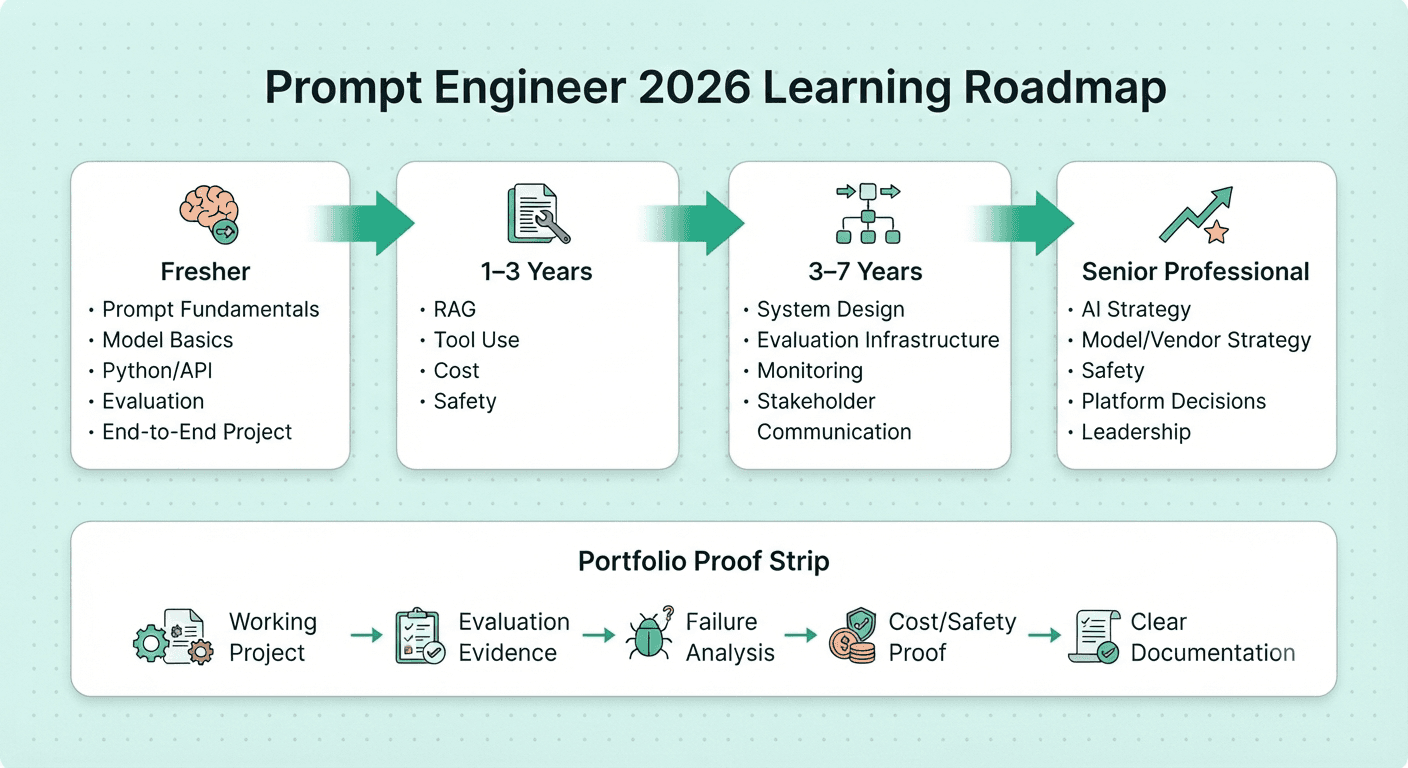
Freshers, zero to one year
1. Core prompting fundamentals, task definition, constraints, output formats
2. Basic understanding of how models work, tokens, context, sampling
3. Basic Python and calling a model API from code
4. Building a small test set and checking outputs systematically
5. One end to end project you can show and explain
One to three years
1. Retrieval and grounding, including debugging retrieval failures
2. Structured evaluation, including choosing appropriate scoring methods
3. Tool use and simple agent flows with error handling
4. Cost and latency awareness, model selection tradeoffs
5. Safety basics, especially prompt injection in untrusted input systems
Three to seven years
1. System design for multi step AI features
2. Evaluation infrastructure others can use
3. Production monitoring and handling model version changes
4. Stakeholder communication and expectation setting
5. Mentoring and setting prompt and evaluation standards for a team
Senior professionals
1. Organization wide AI strategy, including what not to build
2. Model and vendor strategy, cost ownership at scale
3. Safety and compliance standards
4.Cross team platform and tooling decisions
5. Hiring, mentoring, and technical leadership
Self Assessment Checklist
Check only what you can do without looking it up or asking someone.
- I can write a prompt for an ambiguous task and explain why every instruction is there.
- I can tell whether a wrong answer came from retrieval or from the model.
- I have built a test set of real examples including deliberately hard ones.
- I can write a script that runs a prompt over many inputs and scores the results.
- I can explain in plain language why a model produces different answers to the same prompt.
- I know roughly what one of my projects costs per thousand requests.
- I can describe a realistic prompt injection risk and how I would reduce it.
- I have a documented failure I diagnosed, with the actual cause identified.
- I can explain an AI limitation to a non technical person in one clear sentence.
- I have recommended against using a model for something, and can explain why.
- I have designed a tool using flow with proper error handling.
Fewer than seven checked means those unchecked items are your priority for the next couple of months, not a reason to delay applying.