Loading...
Contents
Effective AI Prompts for Job Searching, Tailoring Applications, and Interview Preparation
Oct 13, 202618 min read
Searching for a job involves more than finding vacancies and sending resumes. Candidates also need to identify suitable opportunities, adapt their applications to different roles, prepare for interviews, and keep track of their progress.
Artificial intelligence can help make these tasks more organized. With the right prompts, candidates can use AI tools to analyze job descriptions, identify relevant skills, improve application materials, and practice answering interview questions.
However, the quality of the output depends largely on the instructions provided. A vague prompt often produces generic suggestions, while a detailed prompt can generate more useful and relevant results.
This guide explains how to write effective AI prompts for different stages of the job search, with examples that can be adapted to individual needs.
FREE TO USE
25K+ INTERVIEWS4.8★ RATING68% IMPROVEMENT
Crack Your Dream Job
Real Interviews. Real Pressure. Practice until it feels easy.
- Seamless Interview Experience
- Resume & JD Questions
- Instant Personalized Feedback
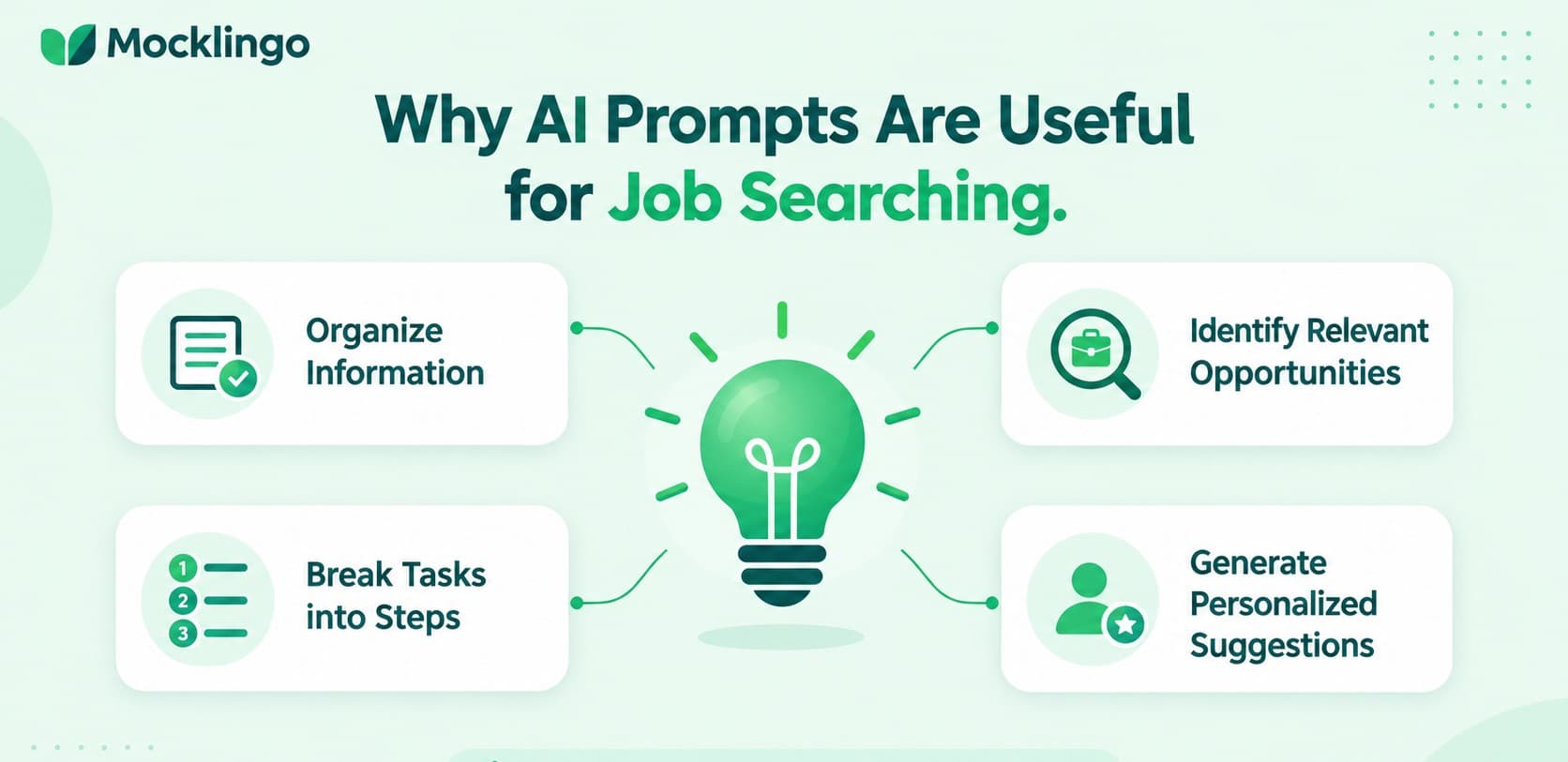
Why Are AI Prompts Useful for Job Searching?
AI tools can help candidates organize information, identify patterns, and generate ideas more quickly. They can also help break a large task, such as preparing for a new role, into smaller steps.
For example, instead of asking an AI tool to find a job, a candidate can provide a target role, preferred location, experience level, and relevant skills. The resulting suggestions are more likely to reflect the candidate's actual requirements.
AI is most useful when it supports decision-making rather than replacing it. Job listings, employer requirements, salary information, and application details should still be verified before taking action.
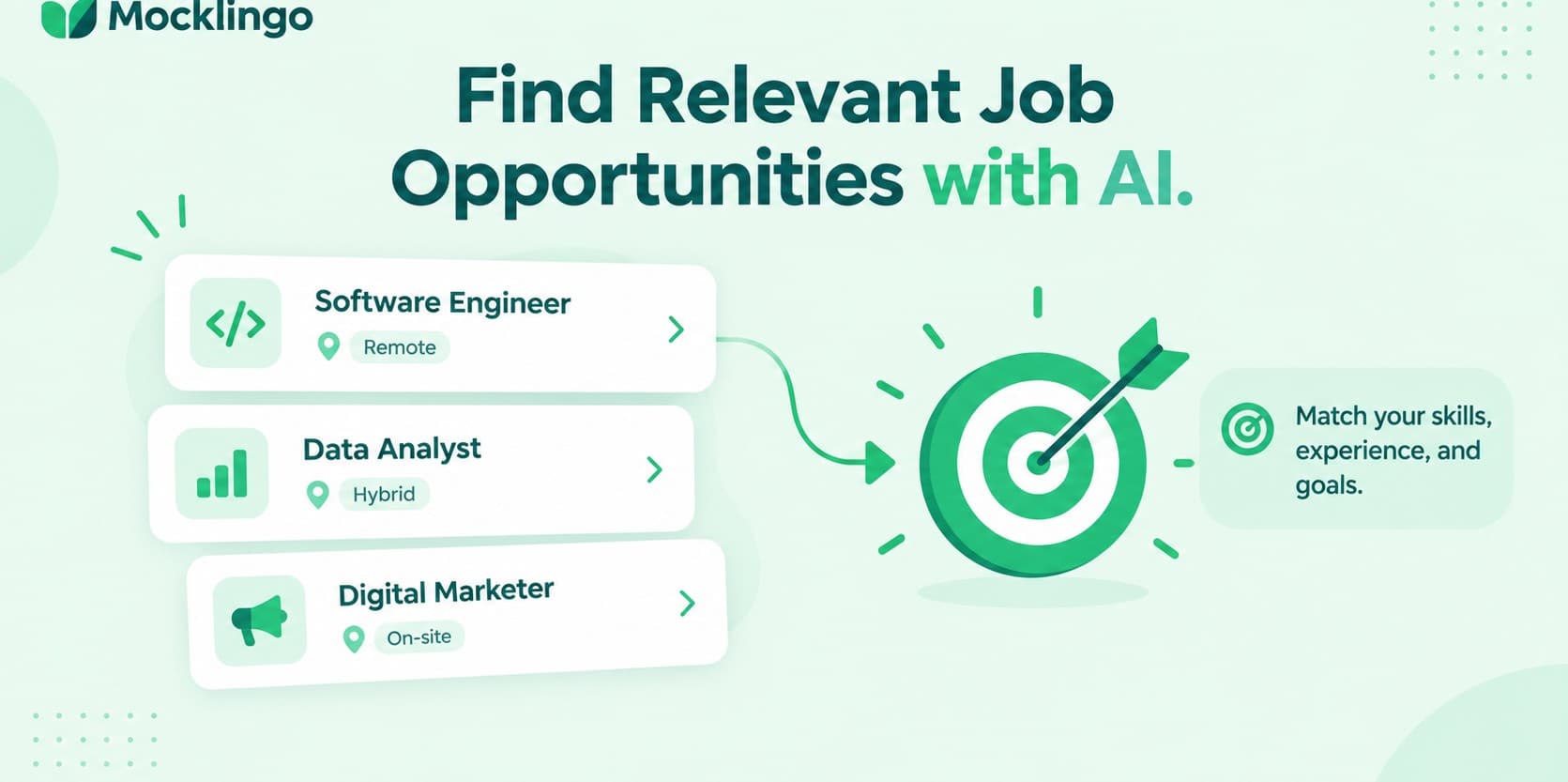
1. Finding Relevant Job Opportunities
Applying to every available vacancy can consume time without producing better results. A more focused search starts with identifying roles that match a candidate's skills, experience, and career goals.
AI can help generate relevant job titles, identify alternative career paths, and organize search criteria.
Prompt to Identify Suitable Job Titles
Example prompt:
"I have [X years of experience] in [current field or role]. My main skills are [list skills], and I am interested in [target field or career direction]. Suggest 15 job titles that match my background. Group them into roles that closely match my experience, adjacent roles, and roles that may require additional training. Explain the reasoning behind each suggestion."
This prompt helps candidates explore opportunities beyond their current job title without assuming that every suggested role is immediately suitable.
Prompt to Build a Job Search Strategy
Example prompt:
"Help me create a four-week job search plan. I am targeting [job titles] in [locations or remote work preferences]. I have [experience level] and can spend [hours] per week on applications. Divide the plan into job discovery, resume preparation, application submission, networking, and interview practice. Include realistic weekly goals and a simple way to track progress."
The resulting plan can provide structure to an otherwise inconsistent search. Candidates can adjust the schedule based on their availability and the number of relevant vacancies.
2. Tailoring a Resume to a Job Description
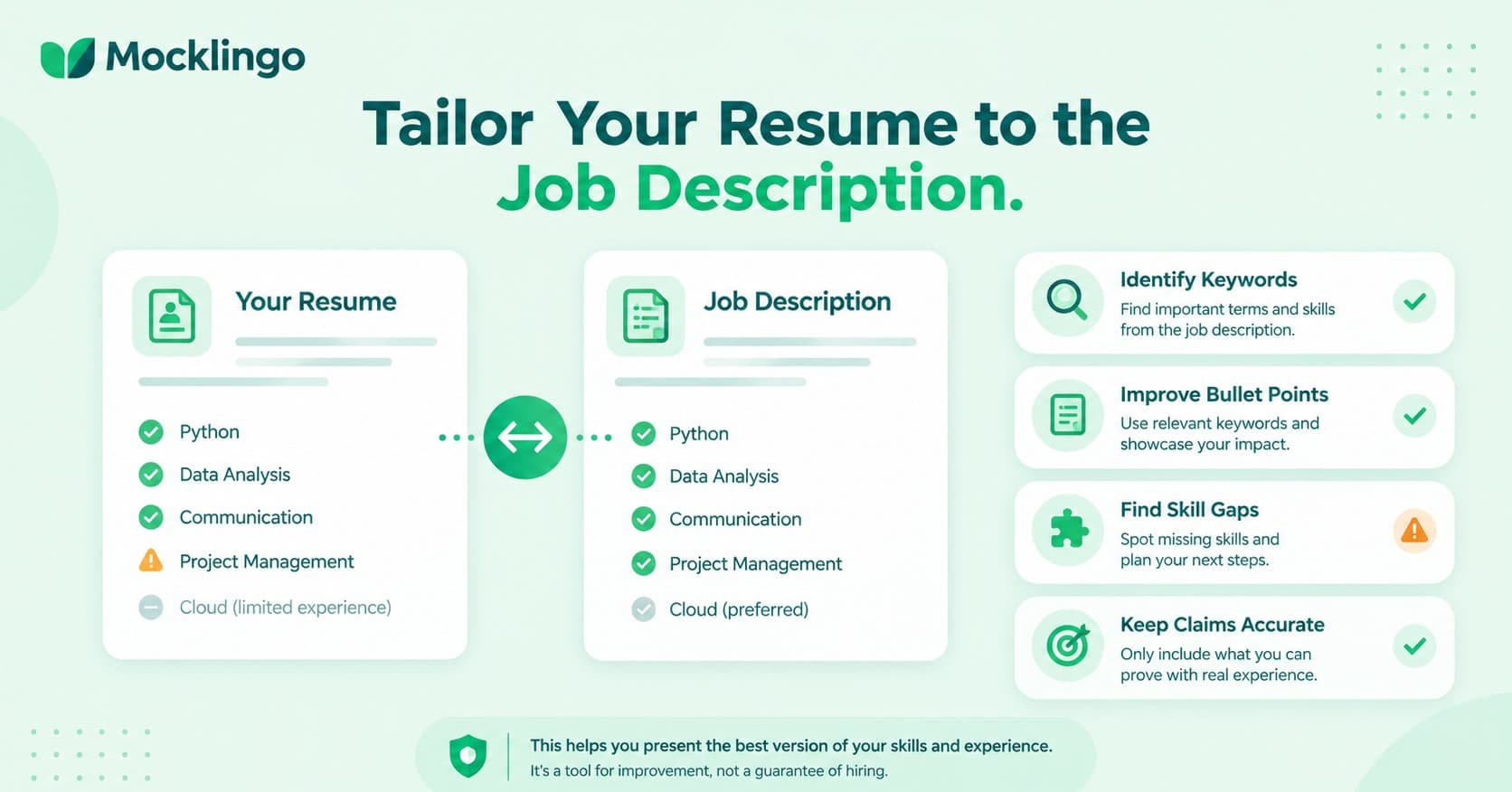
A resume should highlight the experience and skills most relevant to the position. However, identifying those details in a lengthy job description is not always straightforward.
AI can help compare a resume with a A resume should highlight the experience and skills most relevant to the position. However, identifying those details in a lengthy job description is not always straightforward.
Prompt to Analyze a Job Description
Example prompt:
"Analyze the job description below for a [target role]. Identify the five most important responsibilities, required skills, preferred qualifications, and recurring keywords. Separate mandatory requirements from desirable ones. Explain what evidence a candidate should include in a resume to demonstrate each requirement.
Job description: [Paste job description]"
This gives candidates a clearer picture of what the employer expects before they start editing their resume.
Prompt to Improve Resume Bullet Points
Example prompt:
"Review the following resume bullet points for a [target role]. Rewrite them to improve clarity, relevance, and readability. Emphasize specific actions, relevant skills, and measurable outcomes where supported by the information provided. Do not invent achievements, metrics, responsibilities, or qualifications.
Resume bullet points: [Paste existing bullet points]
Job description: [Paste job description]"
The important instruction is to avoid invented details. AI can improve how experience is communicated, but it should not create accomplishments that never happened.
Prompt to Identify Resume Gaps
Example prompt:
"Compare my resume with the job description below. Create a table with three columns: job requirement, evidence already present in my resume, and areas that need clarification or improvement. Identify missing evidence separately from skills I genuinely do not have. Suggest honest ways to address these gaps through relevant projects, training, or better descriptions of existing experience.
Resume: [Paste resume text]
Job description: [Paste job description]"
Candidates can also review their document with an AI CV Checker to identify formatting, keyword, and content issues. AI-generated feedback and automated scores should be treated as guidance, not as a guarantee that an employer's screening system will accept the application.
FREE TO USE
8k+ SESSIONS92% FLUENCY4.9★ RATING
Speak With Confidence
Real Conversations. Real Scenarios. Speak until it feels natural.
- Real-Time Speaking Practice
- Guided Conversation Flows
- Instant AI Feedback
3. Writing More Relevant Cover Letters
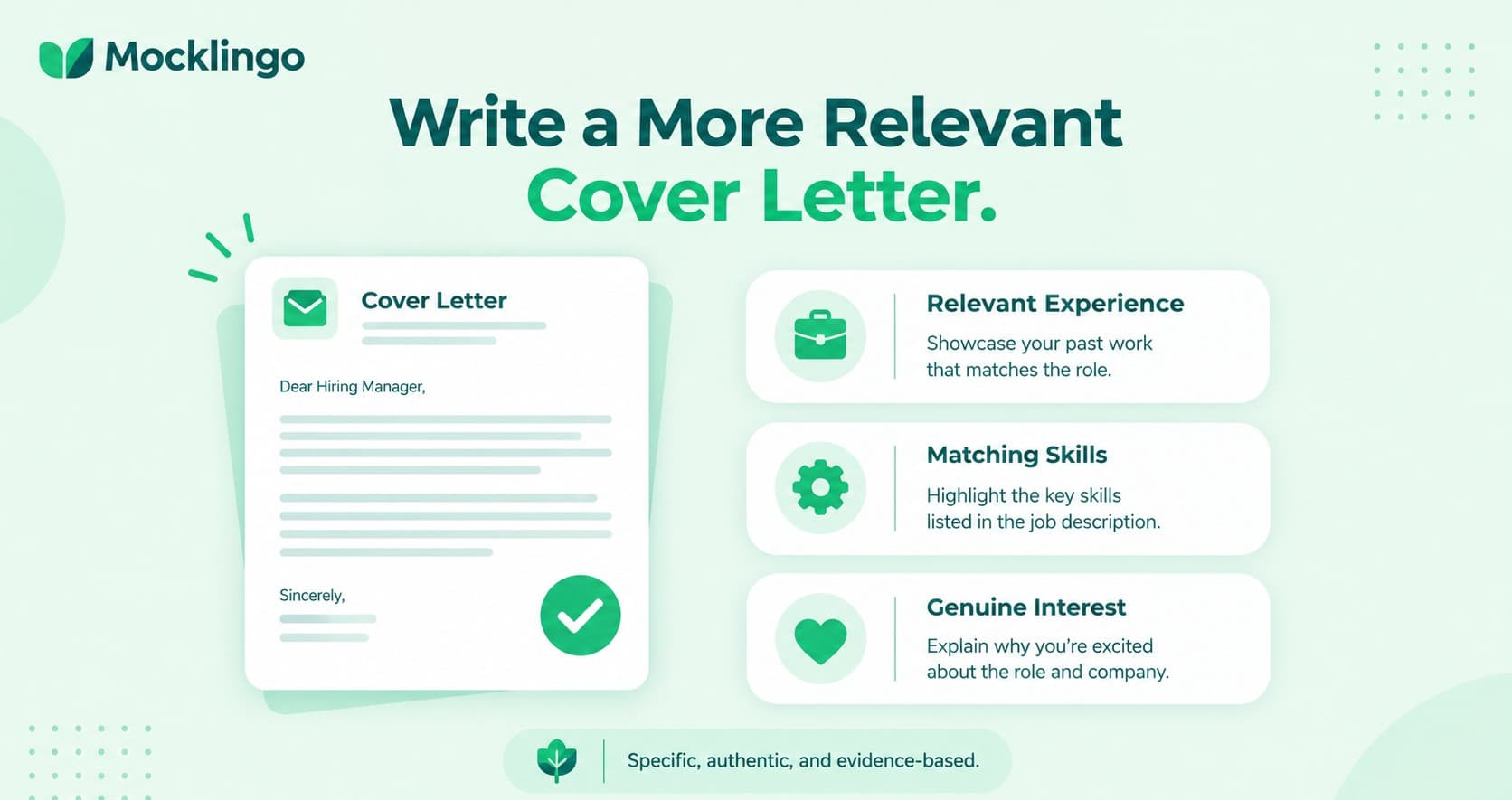
A cover letter should explain why the candidate is interested in the position and how their experience relates to the employer's needs. Generic letters that could be sent to any company often fail to make that connection.
Prompt to Draft a Cover Letter
Example prompt:
"Write a concise cover letter for the [job title] position at [company name]. Use the job description and my actual experience to explain why my background is relevant. Highlight two or three specific qualifications that match the role. Keep the tone professional and natural, avoid generic claims, and do not invent company information or personal motivations.
My experience: [Paste relevant experience]
Job description: [Paste job description]
Reason for applying: [Explain genuine interest]"
After generating the draft, candidates should check whether the letter sounds authentic and whether every claim is supported by their experience.
4. Preparing for Job Interviews
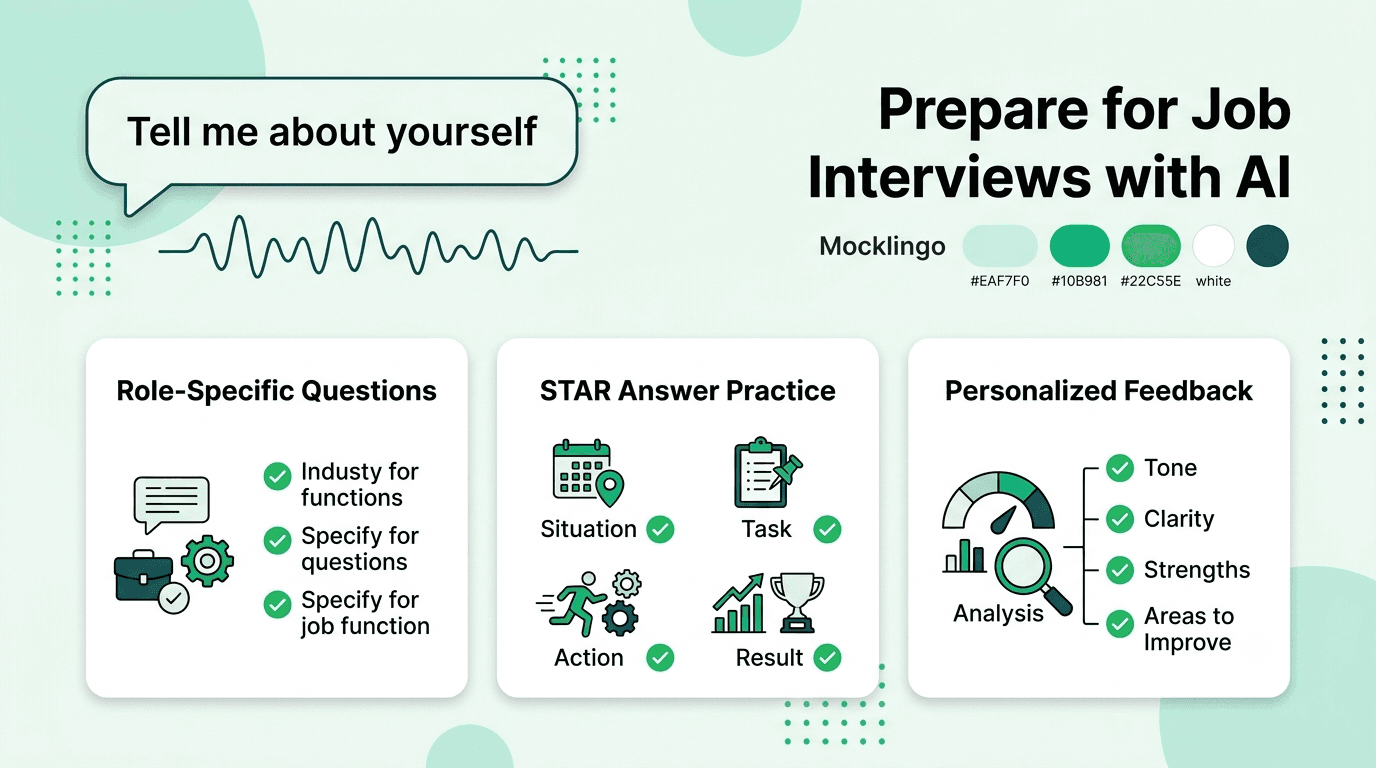
Interview preparation becomes more effective when it reflects the responsibilities of the target position. AI can turn a job description into practice questions, help organize answers, and identify areas that need further preparation.
Prompt to Generate Role-Specific Interview Questions
Example prompt:
"Act as an interviewer hiring for a [job title] position requiring [key skills]. Based on the job description below, generate 12 interview questions divided into technical, behavioral, situational, and experience-based categories. Explain what each question is intended to assess. Prioritize the requirements emphasized most strongly in the description.
Job description: [Paste job description]"
This helps candidates focus on relevant topics instead of relying entirely on generic interview question lists.
Prompt to Structure Behavioral Answers
Example prompt:
"Help me structure an answer to the following behavioral interview question using the STAR method: Situation, Task, Action, and Result. Ask me for missing details before drafting the answer. Use only the facts I provide, emphasize my personal contribution, and keep the final response concise enough to deliver naturally in an interview.
Interview question: [Paste question]
My real experience: [Describe the situation]"
This approach helps candidates organize their thoughts without memorizing a script. It is particularly useful for questions about teamwork, problem-solving,
Prompt to Practice a Mock Interview
Example prompt:
"Conduct a mock interview for a [job title] position using the job description below. Ask one question at a time and wait for my response before asking the next question. After each answer, evaluate its relevance, clarity, use of evidence, and completeness. Point out what could be improved and give me an opportunity to answer again before moving forward.
Job description: [Paste job description]"
Candidates can use this format to practice independently, although a dedicated interview practice tool may offer a more interactive experience.
5. Managing Applications More Efficiently
A job search can become difficult to manage when applications are spread across multiple websites, emails, and documents.
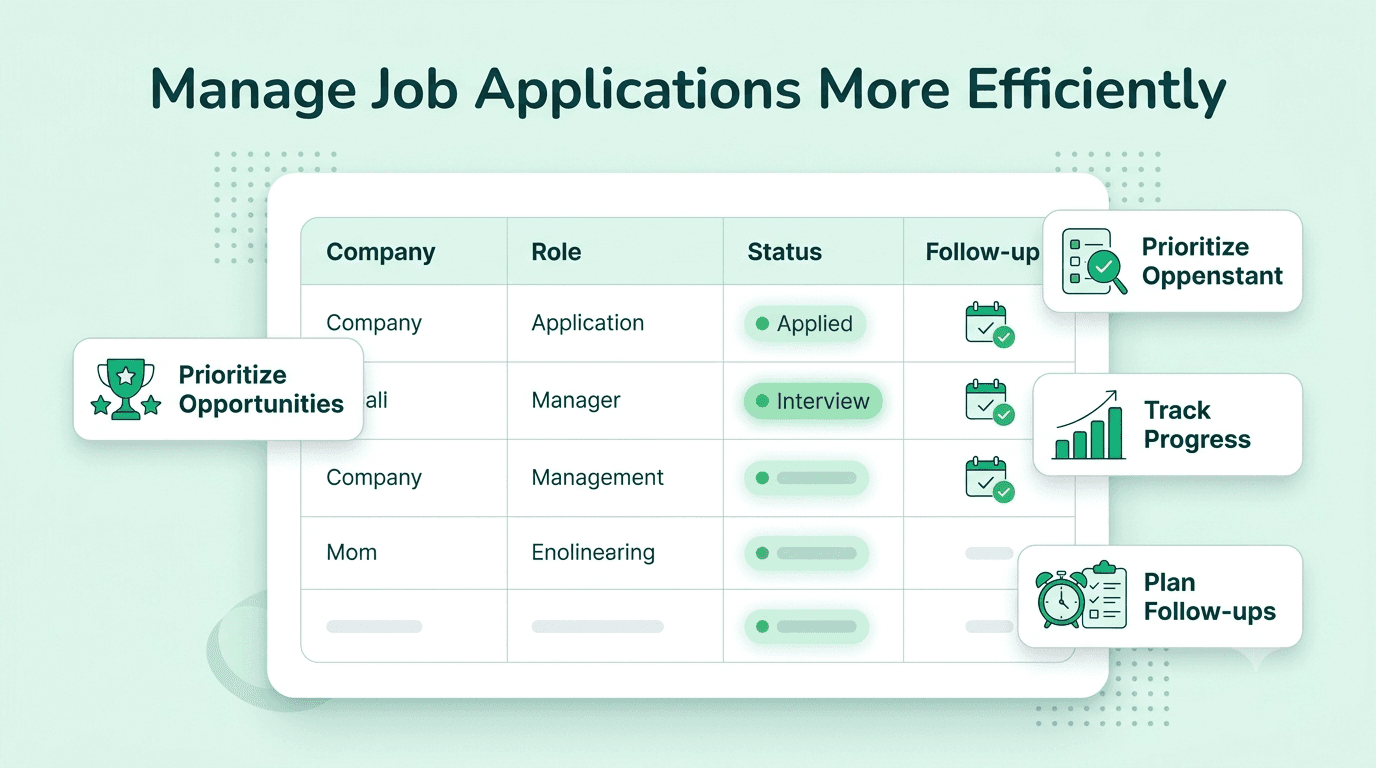
AI can help organize application information, prioritize opportunities, and create follow-up plans. Candidates who want to reduce repetitive job discovery and application tasks can also explore AI Job Automation tools, while continuing to review job relevance and application accuracy.
Prompt to Prioritize Job Applications
Example prompt:
"Review the following job opportunities against my experience, skills, preferred location, salary expectations, and career goals. Rank them by suitability and explain the reasoning behind each ranking. Flag missing information and distinguish between roles where I meet the stated requirements and those where I may need additional qualifications.
My profile: [Paste relevant details]
Job opportunities: [Paste job descriptions or verified listings]"
Prompt to Create an Application Tracker
Example prompt:
"Create a job application tracker with columns for company, job title, job URL, application date, key requirements, resume version used, application status, follow-up date, and next action. Organize the information I provide into a table. Leave unknown details blank rather than guessing.
Application details: [Paste available information]"
These prompts help candidates prioritize opportunities and maintain a clear record of their applications.
Common Mistakes to Avoid When Using AI for Job Searching
AI-generated suggestions can be useful, but they still require careful review.
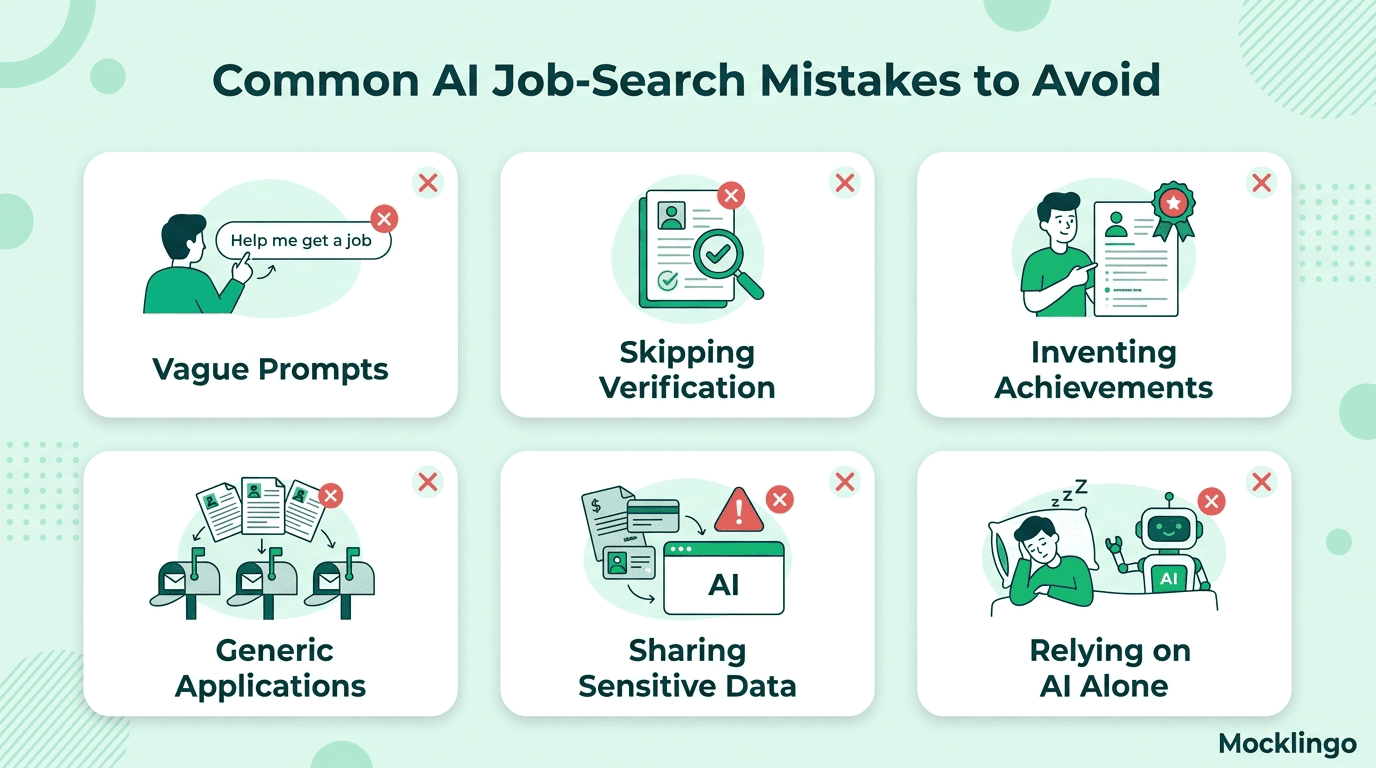
Some common mistakes include:
Using vague prompts: Requests such as 'find me a job' provide little context. Include relevant skills, experience, location, and preferences.
Accepting every suggestion without verification: Check job listings, employer details, deadlines, and application requirements.
Adding inaccurate information: Never include skills, achievements, or qualifications simply because AI recommends them.
Using identical application materials everywhere: Tailor the resume and cover letter to each relevant opportunity.
Sharing unnecessary personal information: Remove sensitive details from prompts and use only the information needed for the task.
Relying entirely on AI-generated interview answers: Practice explaining genuine experiences in your own words and verify any technical information.
The objective is to make job searching more organized and efficient without losing accuracy or authenticity.
A Checklist for Better AI Prompts
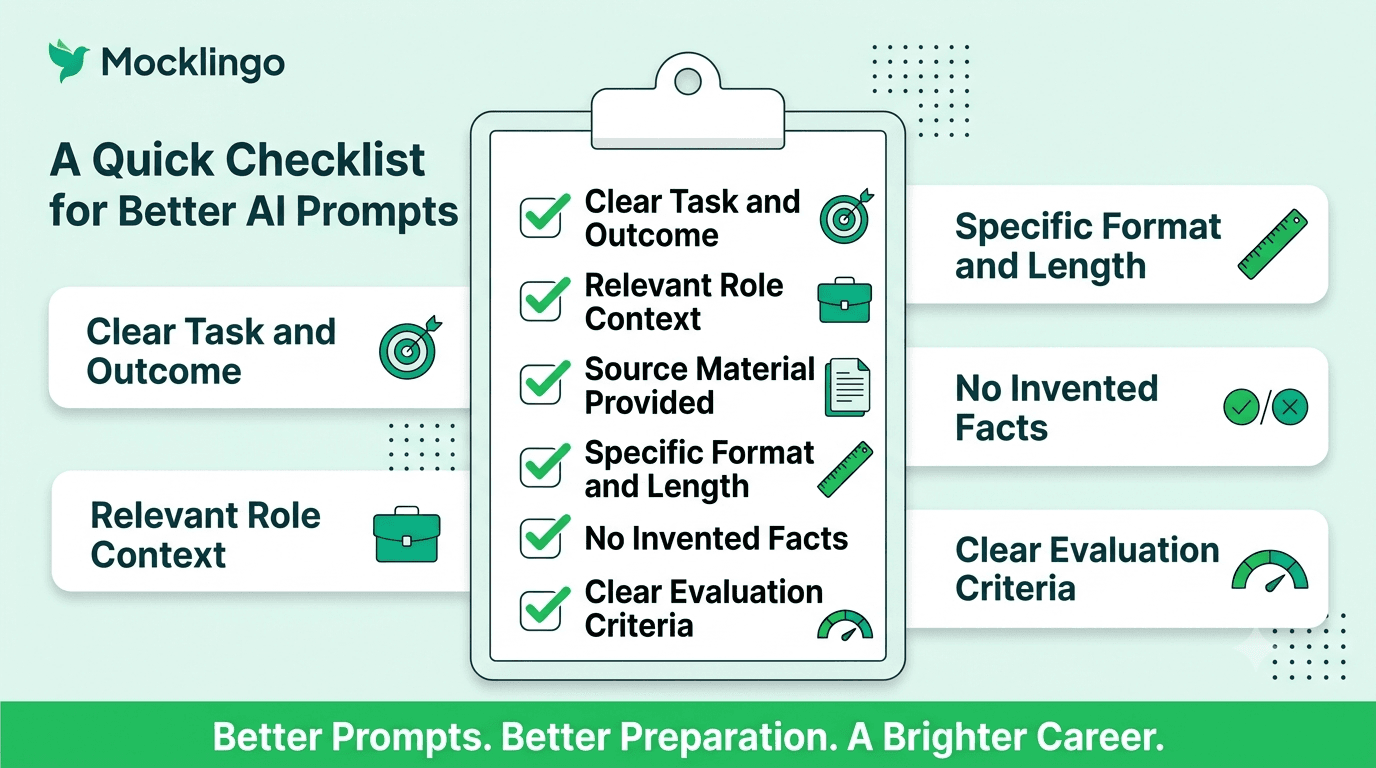
Before submitting a prompt, check whether it includes:
A clear task and desired outcome.
Relevant context about the target role.
The job description or other necessary source material.
Specific instructions about tone, format, or length.
Boundaries against invented facts or unsupported claims.
A clear way to evaluate the result.
A useful prompt does not need to be complicated. It needs to give the AI enough context to understand the task and clear instructions about what a good answer should contain.
Conclusion
AI can support nearly every stage of a job search, from identifying suitable roles to tailoring resumes, preparing cover letters, practicing interviews, and tracking applications.
The best results come from prompts that are specific, grounded in real information, and focused on a clear outcome. Instead of accepting the first response, candidates should review the suggestions, correct inaccuracies, and refine the output until it reflects their actual experience and goals.
AI can reduce repetitive work and make preparation more structured, but the final decisions still depend on the candidate. A thoughtful combination of relevant applications, accurate information, and consistent preparation creates a more effective approach to finding the right opportunity.