Loading...
Contents
Backend Developer Interview Preparation Guide
A Complete Roadmap for 2026
Aug 31, 202613 min readUpdated Oct 15, 2026
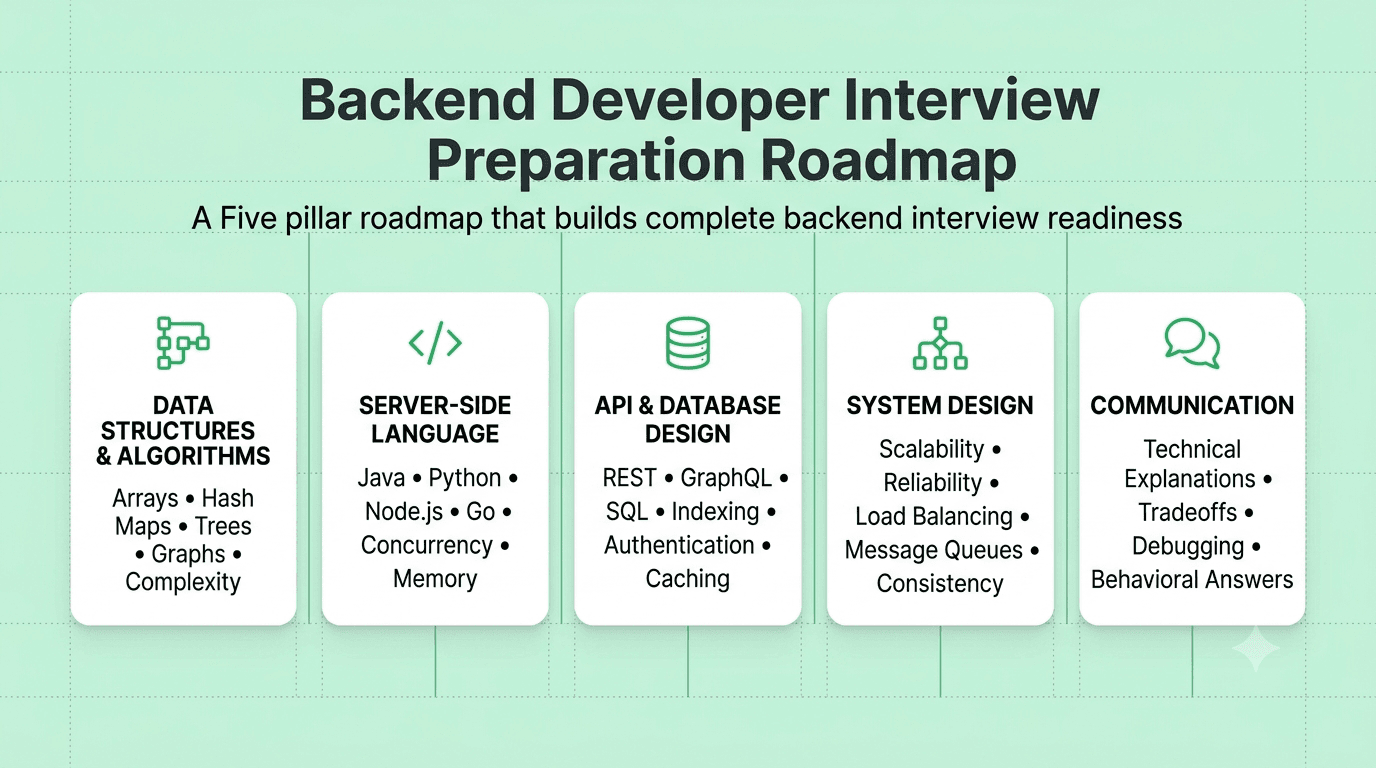
To prepare for a backend developer interview, focus on five pillars: data structures and algorithms fundamentals, depth in at least one server-side language and framework, strong database and API design skills, system design thinking for scalability and reliability, and clear verbal communication for explaining trade offs. Most interview loops include a resume screen, an online assessment or coding round, one or two technical interviews covering language and database depth, a system design round for experienced candidates, and a final hiring manager round. Candidates who can explain why they chose a specific database or architecture, not just describe what they built, consistently stand out.
If you are preparing for a backend developer interview, you already know the role is judged on more than working code. Companies want engineers who understand how systems behave under load, how to design APIs that other teams can rely on, and how to make sound trade offs between consistency, performance, and complexity. This guide covers everything you need, whether you are a fresher applying for your first backend role or an experienced engineer targeting a senior or lead position.
FREE TO USE
25K+ INTERVIEWS4.8★ RATING68% IMPROVEMENT
Crack Your Dream Job
Real Interviews. Real Pressure. Practice until it feels easy.
- Seamless Interview Experience
- Resume & JD Questions
- Instant Personalized Feedback
Section 1: Introduction to the Backend Developer Interview Process
Backend interviews test three things together: coding ability, system and database understanding, and the judgment to make sound architectural decisions under real constraints. A candidate who can write a correct API endpoint but cannot explain what happens when that endpoint receives ten thousand requests a second will struggle just as much as someone with strong theoretical knowledge who cannot write working code under time pressure.
Most processes run three to five rounds over two to five weeks. Larger companies typically separate a coding round from a dedicated system design round, often with different interviewers for each. Startups often compress these into fewer, broader conversations, sometimes including a take-home project that mirrors a real backend feature.
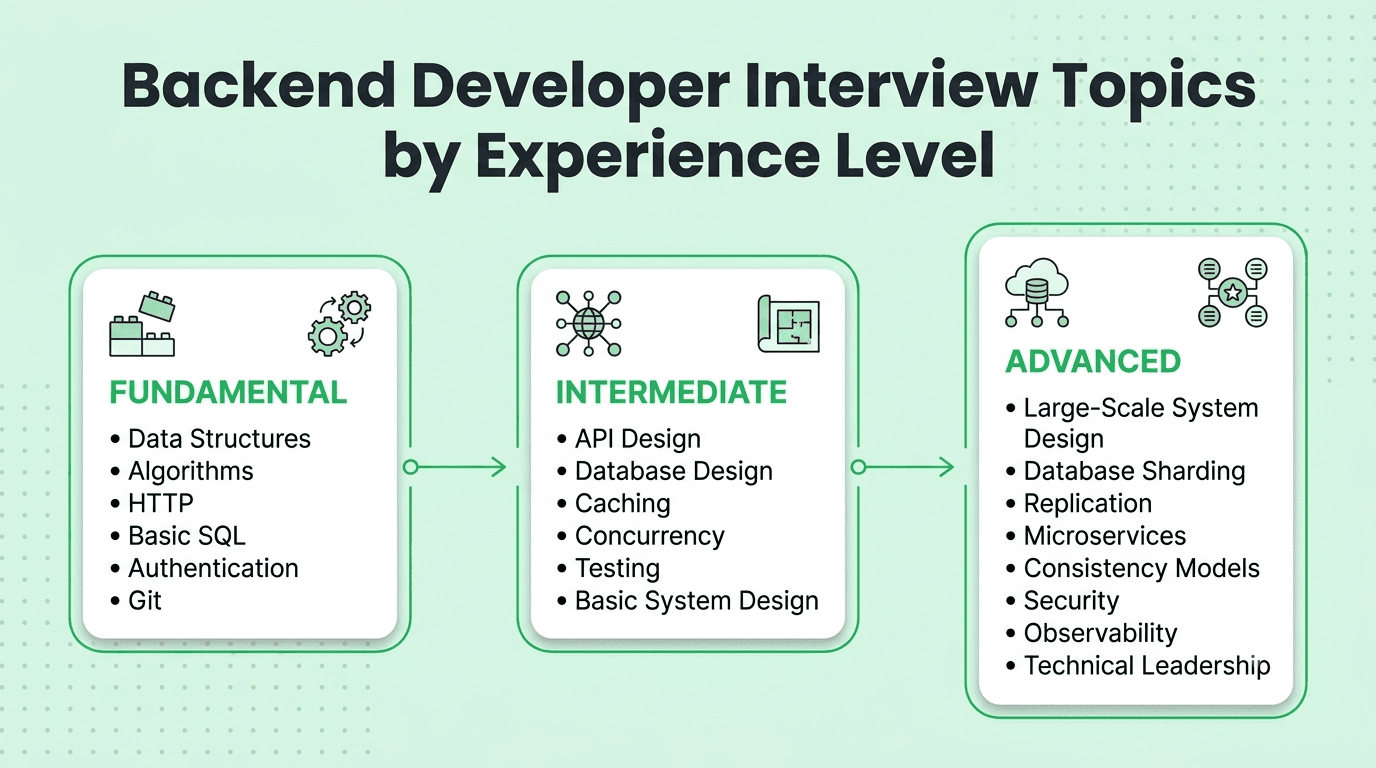
What changes with experience is depth and scope, not the topic list itself.
- Freshers are tested on programming fundamentals, basic API design, and simple database queries.
- Intermediate candidates (two to five years) are expected to design a service end to end, justify database and architecture choices, and handle moderately complex system design questions.
- Experienced professionals are evaluated on large-scale architecture decisions, reliability and scalability trade offs, mentoring, and how they have influenced technical direction on past teams.
Section 2: What Recruiters and Hiring Managers Look For
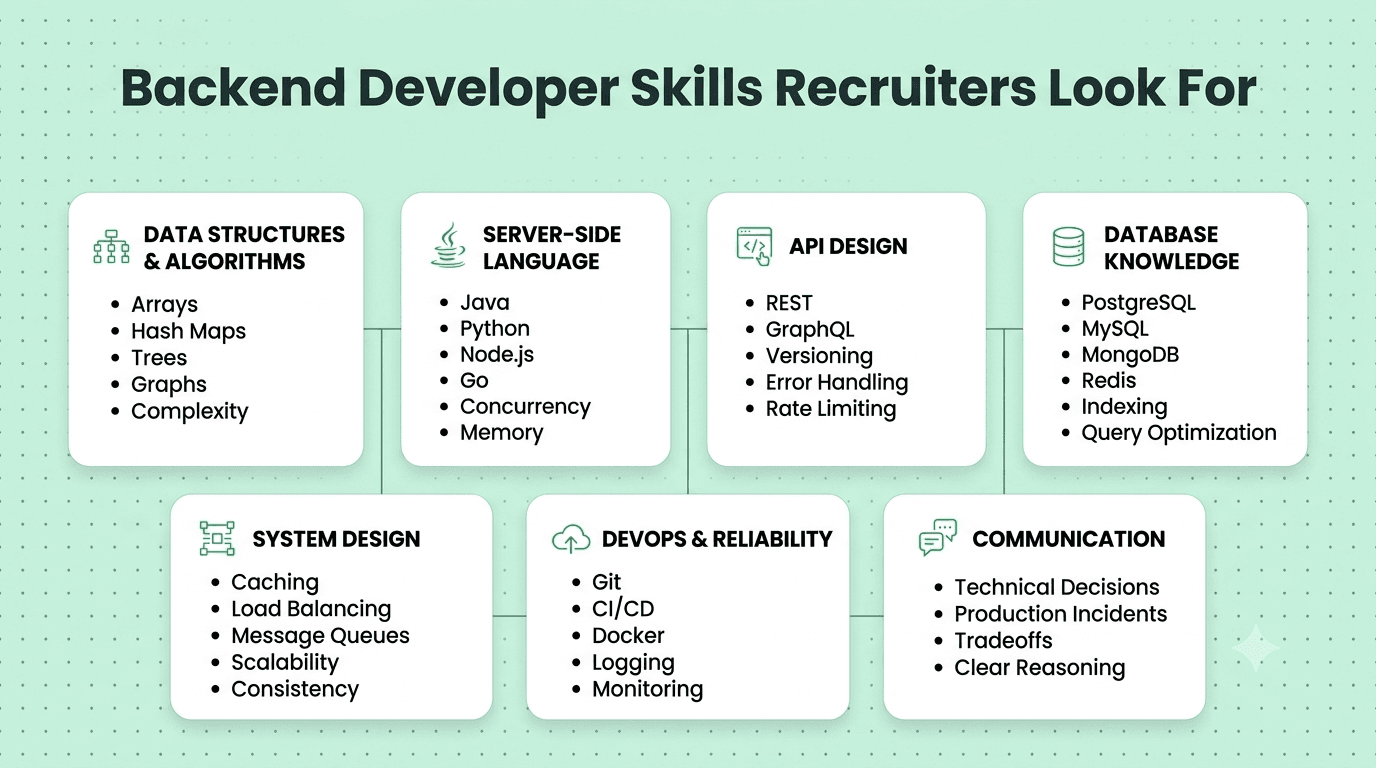
Recruiters and interviewers are trying to answer one core question: will this person build backend systems that are reliable, performant, and maintainable, and can they reason clearly about the trade offs involved.
Core skills recruiters expect:
1. Data structures and algorithms. Arrays, hash maps, trees, graphs, and the time and space complexity of common operations. Still central to most technical screens.
2. Server-side language depth. Real proficiency in a language like Java, Python, Node.js, or Go, including how it handles concurrency and memory.
3. API design. Ability to design REST or GraphQL APIs that are consistent, versioned properly, and handle errors gracefully.
4. Database knowledge. Strong command of relational databases like PostgreSQL or MySQL, including indexing and query optimization, plus conceptual familiarity with NoSQL options like MongoDB or Redis.
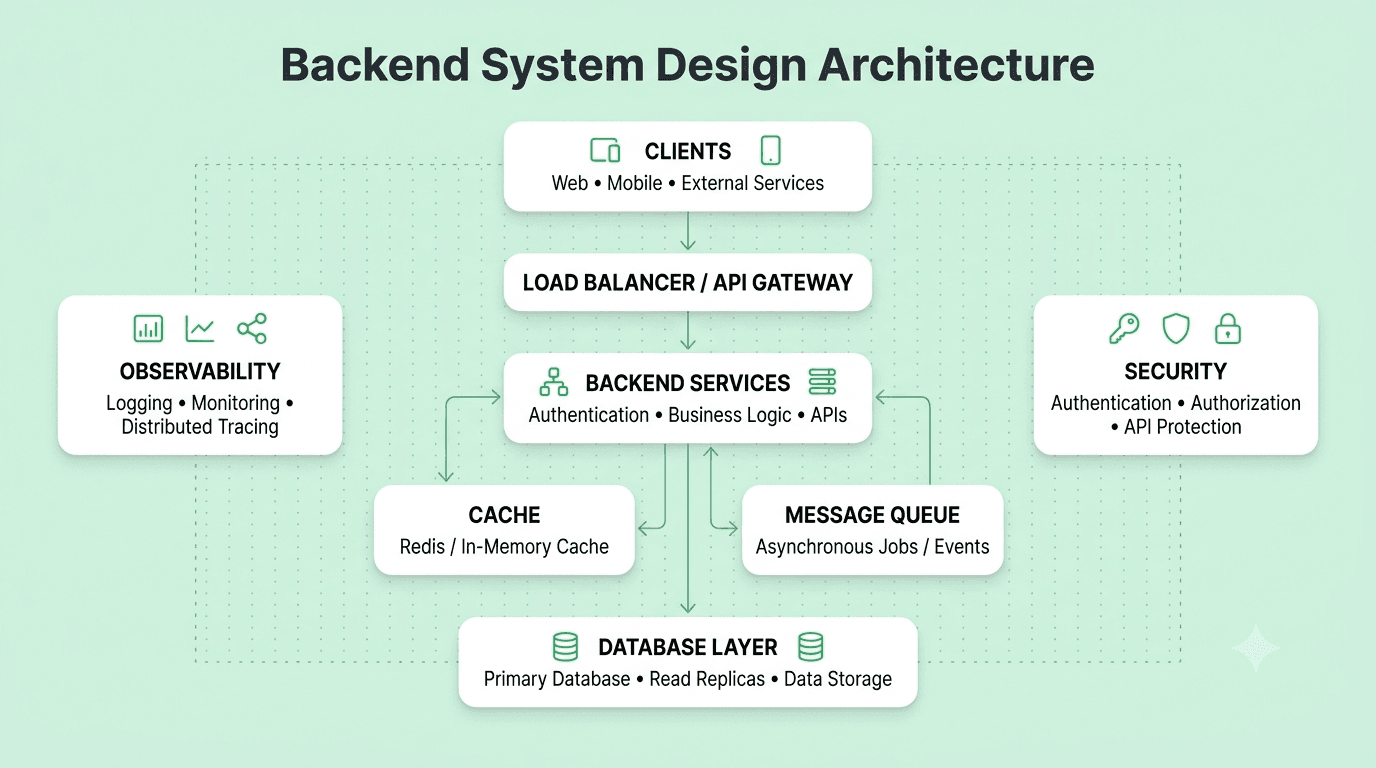
5. System design thinking. For intermediate and senior roles, the ability to design a scalable system, discuss caching, load balancing, message queues, and trade offs between consistency and availability.
6. DevOps and reliability awareness. Familiarity with Git workflows, CI/CD pipelines, containerization with Docker, logging, and monitoring practices.
7. Communication. The ability to explain a technical decision or a production incident clearly, especially in live coding or system design rounds where interviewers are grading your reasoning as much as your answer.
Hiring managers also watch for quieter signals: Do you consider failure modes and edge cases without being asked? Do you write code that is easy for someone else to maintain? Do you accept a hint or a challenge to your design gracefully?
Section 3: Resume and Portfolio Preparation
Your resume and portfolio are the first filter, so they need to demonstrate real, working backend systems rather than a list of technologies.
- Lead with impact, not just tools. Instead of listing "Node.js, PostgreSQL, Redis," describe what you built: "Designed a payment processing API handling 20,000 transactions daily, reducing failed transaction retries by 25 percent through better idempotency handling."
- Keep two or three strong portfolio projects, each showing a real backend system: a working API with authentication, a properly designed database schema, and evidence of thinking beyond the happy path, such as error handling or rate limiting.
- Include a clean GitHub repository with a clear README explaining the architecture, your database schema decisions, and how to run the project, since interviewers often review your code before the call.
- Avoid generic CRUD clones without a twist. A basic to-do API copied from a tutorial stands out far less than a smaller project solving a specific, real backend problem, such as a job queue or a caching layer.
- Quantify wherever possible: requests handled, latency reduced, uptime achieved, or database query performance improved.
Section 4: Core Topics to Study, Ranked by Interview Importance
Fundamental Concepts (asked in almost every interview)
Intermediate Concepts (common at two to five years experience)
Advanced Concepts (senior and lead roles)
Scenario Based Preparation Tips
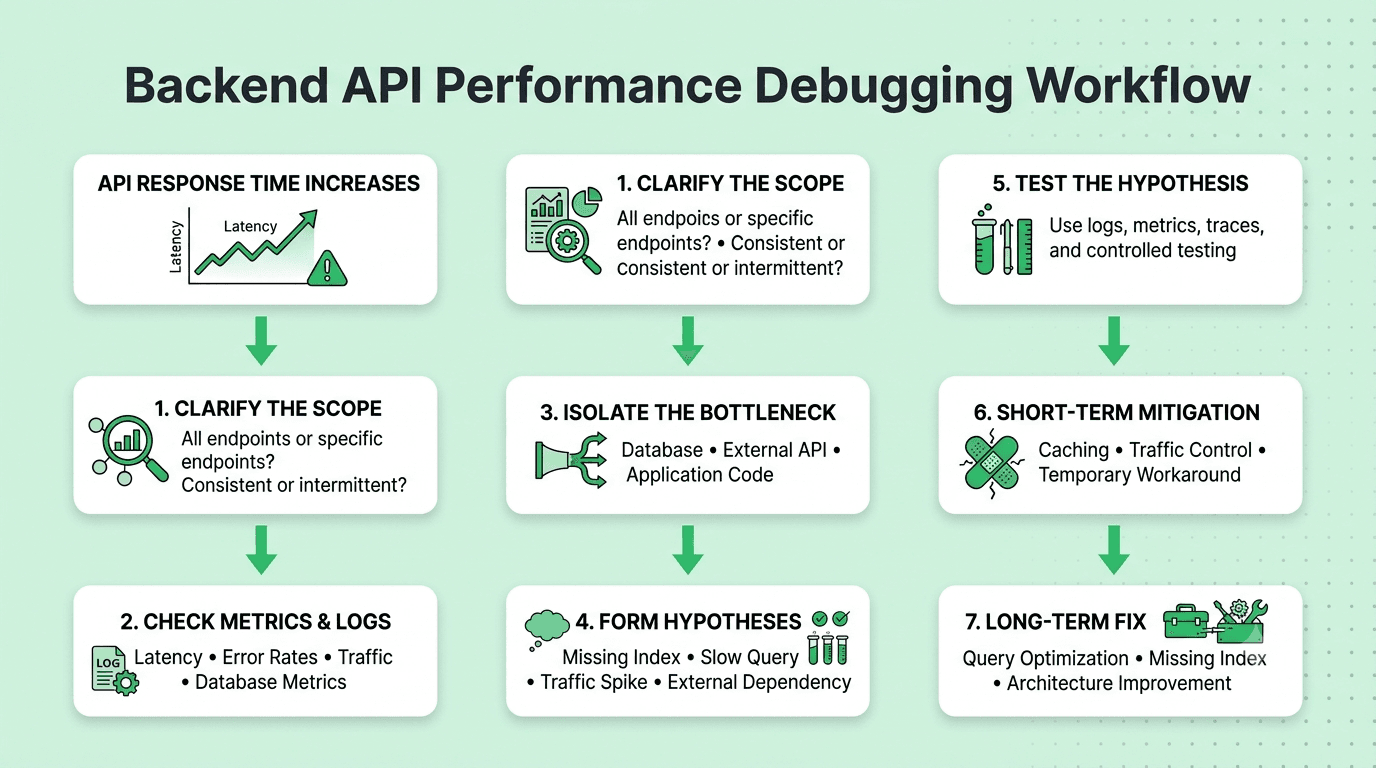
Interviewers often ask questions like "our API response times have doubled over the past week, how would you investigate this." Practice a repeatable framework:
- Clarify the scope: is this affecting all endpoints or specific ones, and is it consistent or intermittent.
- Check the obvious first: recent deployments, a spike in traffic, or a slow-running database migration.
- Narrow it down using metrics and logs to isolate whether the bottleneck is the database, an external API call, or application code.
- Form two or three hypotheses, such as a missing index causing slow queries under increased load, and explain how you would test each.
- Propose a short-term mitigation, like adding a cache in front of the slow query, and a longer-term fix, like adding the missing index or optimizing the query itself.
This structure demonstrates debugging maturity, which interviewers value more than guessing the exact root cause instantly.
Practical Preparation Exercises
FREE TO USE
8k+ SESSIONS92% FLUENCY4.9★ RATING
Speak With Confidence
Real Conversations. Real Scenarios. Speak until it feels natural.
- Real-Time Speaking Practice
- Guided Conversation Flows
- Instant AI Feedback
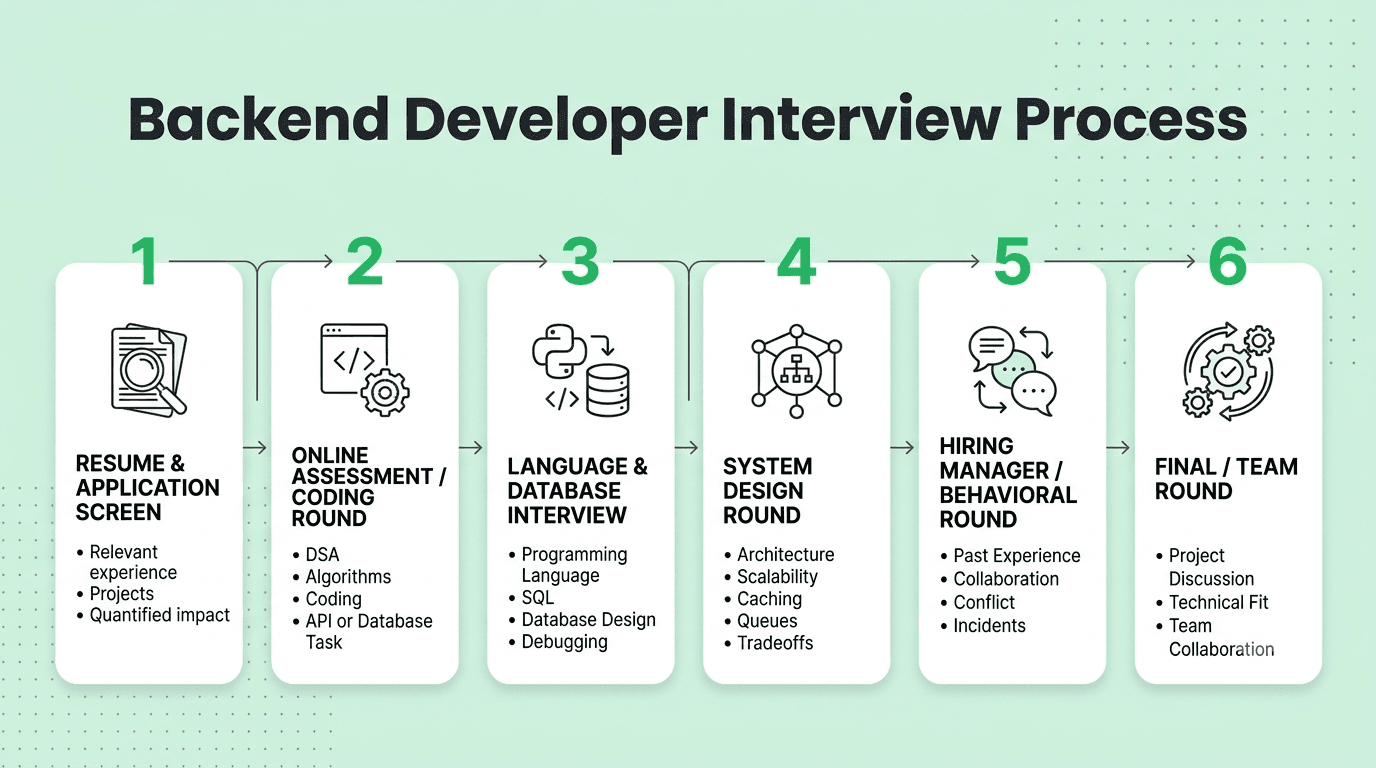
Section 5: Common Interview Rounds
Resume and application screen Recruiters look for relevant backend experience, clear project descriptions, and quantifiable impact. Vague bullet points like "worked with APIs" rarely survive this stage at competitive companies.
Online assessment or coding round A timed coding test, often on a platform like HackerRank or CodeSignal, covering data structures and algorithms, and sometimes a small database or API design task.
Technical interview: language and database A live coding or pairing session focused on your primary language and database skills, often involving building a small feature or fixing a bug in existing code while explaining your reasoning.
System design round For intermediate and senior roles, you are asked to design a system such as a notification service or a rate limiter, discussing trade offs between different architectural choices like caching, queuing, and database selection.
Hiring manager or behavioral round Focused on past experience, collaboration style, and how you have handled conflict, ambiguity, or a production incident on previous teams.
Final round or team round Often includes a presentation of a past project or an additional pairing session with future teammates to assess both technical fit and working style.
Section 6: Behavioral and Situational Interview Preparation
Behavioral rounds often decide close calls between candidates with similar technical scores.
- Use the STAR method: Situation, Task, Action, Result. Keep each story under two minutes and end with a clear outcome.
- Prepare five to six core stories covering a production incident you handled, a technical disagreement, a time you optimized a slow system, a mistake you made, and a time you influenced an architecture decision without formal authority.
- Be honest about failures. Interviewers are more interested in what you learned and changed afterward than in a flawless track record.
- Practice explaining trade offs, not just outcomes. "I chose eventual consistency here because the use case tolerated a short delay in exchange for better availability" shows judgment that a purely results-focused answer does not.
Section 7: How to Answer Confidently
- Think out loud during coding rounds. Silence makes interviewers uneasy and hides the reasoning process they are usually grading.
- Ask clarifying questions before writing code or designing a system. Confirm scale expectations, consistency requirements, and edge cases before diving in.
- Pause before answering system design questions. A brief pause to structure your answer reads as thoughtfulness, not hesitation.
- State assumptions explicitly. "I am assuming this system needs to handle about five thousand writes per second, let me know if that is off" shows structured thinking.
- Rehearse out loud, not just on paper. Many technically strong backend developers lose points simply because their spoken explanation of a design or bug fix is disorganized under pressure. Practicing full mock interviews with realistic follow-up questions, such as those on <a href="https://mocklingo.com/ai-mock-interview">Mocklingo's AI mock interview tool</a>, closes this gap faster than solo practice alone.
Mistakes to Avoid in 2026
- Jumping straight into coding or design without clarifying requirements. This is one of the most common mistakes in both coding and system design rounds.
- Memorizing solutions instead of understanding patterns. Interviewers frequently tweak a familiar problem slightly, and memorized answers fall apart under a small twist.
- Only listing technologies, not decisions. Saying "I used Redis" is weaker than explaining why Redis fit that specific caching or session storage need over alternatives.
- Ignoring failure modes. Candidates who only design for the happy path often lose points when interviewers ask what happens if a downstream service fails or a database connection drops.
- Rambling in behavioral answers. Long, unstructured stories lose the interviewer's attention. Stick to STAR and stay under two minutes.
- Skipping communication practice. Especially for candidates preparing in a second language, under-practicing spoken delivery is a bigger risk than under-practicing algorithms.
- Not testing your own code during live rounds. Walking through a sample input by hand before declaring the solution done signals discipline interviewers notice.
Best Practices to Follow
Final Interview Day Checklist
Industry Trends Shaping Backend Developer Interviews in 2026
- AI-assisted coding tools are now part of the conversation. Interviewers increasingly ask how candidates use tools like Copilot or Cursor, while still expecting candidates to understand and validate the generated code themselves.
- System design questions are appearing earlier in the loop, even for mid-level candidates, as companies test architectural thinking sooner rather than only at the senior level.
- Event-driven and message-queue-based architectures are increasingly common topics, reflecting the shift toward asynchronous, decoupled systems in modern backend design.
- Take-home assignments are shrinking in favor of live, conversational pairing sessions, since companies want to observe real-time reasoning and collaboration.
- Observability and reliability are treated as core skills, not specialized ones, with interviewers increasingly expecting candidates to discuss logging, monitoring, and incident response as part of system design answers.
FAQs
More Blogs
Oct 13, 2026
Effective AI Prompts for Job Searching, Tailoring Applications, and Interview Preparation
18 min read