Loading...
Contents
Can I Become a Python Developer Without a CS Degree?
Jun 25, 202621 min readUpdated Oct 2, 2026
Can I become a python developer without a CS degree? The honest answer is yes. But the full answer is more useful than that. Every week, thousands of people ask some version of this question. Commerce graduates. Mechanical engineers. Teachers. People who have been working in sales, finance, or operations for years and have decided they want to build things instead. They have started learning Python, they are making progress, and then they wonder whether the missing CS degree is going to stop them from ever getting hired. This blog is going to walk you through whether you can become a Python developer without a degree, what the path actually looks like, where the real obstacles are, and what your roadmap should look like in 2026.
FREE TO USE
25K+ INTERVIEWS4.8★ RATING68% IMPROVEMENT
Crack Your Dream Job
Real Interviews. Real Pressure. Practice until it feels easy.
- Seamless Interview Experience
- Resume & JD Questions
- Instant Personalized Feedback
Does a CS Degree Actually Matter for Python Developer Jobs?
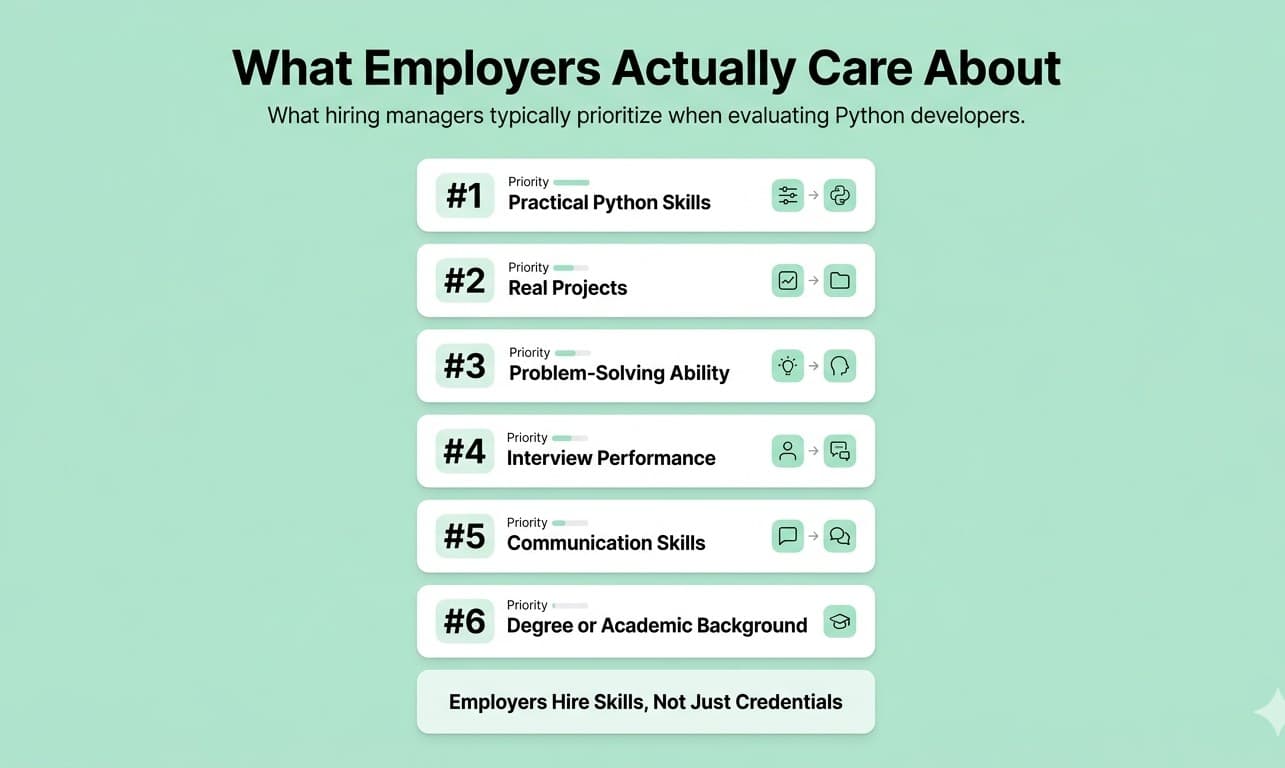
Let's answer this honestly. A Computer Science (CS) degree can help, but it is not a requirement for becoming a Python developer. Some large companies have traditionally preferred candidates with a CS degree because it shows they have studied programming fundamentals, data structures, algorithms, and computer systems. However, hiring practices are changing. Today, many startups, product companies, and tech firms are more interested in what you can do than what degree you have. If you can build projects, solve coding problems, and demonstrate your skills during interviews, many employers will consider you even if you don't have a CS degree. In fact, more companies are moving toward skills-based hiring, where practical skills matter more than academic qualifications. Employers want to know: Can you write clean Python code? Can you build real applications? Can you solve problems effectively? Can you explain your work during an interview? These things often carry more weight than a degree. That said, having a CS degree does provide an advantage. It acts as a signal that you've spent several years learning core computer science concepts in a structured environment. If you don't have that degree, you simply need other ways to prove your skills. You can do that through: Personal projects Internships Freelance work Open-source contributions Coding certifications Strong interview performance A portfolio showcasing real applications Think of it this way: A CS graduate starts with a degree that helps build credibility. A self-taught developer or someone from a non-CS background builds that credibility through projects and practical experience. Both paths can lead to the same Python developer job. One path relies more on academic credentials, while the other relies more on demonstrated skills. At the end of the day, employers hire developers because they can solve problems and build software, not simply because they have a particular degree.
Real Stories: Non-CS to Python Developer
Before getting into the roadmap, it helps to know this path is real and documented. There are Python developers working at product companies in India, the UK, the US, and Australia who came from commerce and business administration degrees, mechanical and civil engineering, teaching careers, marketing and operations roles, and completely unrelated fields like hospitality and healthcare. What they have in common is not a degree. It is a structured approach to learning, real projects they built and deployed, and the ability to talk about their code clearly in interviews. The path exists. Let us talk about what it looks like.
Python Developer Roadmap 2026: The Non-CS Path
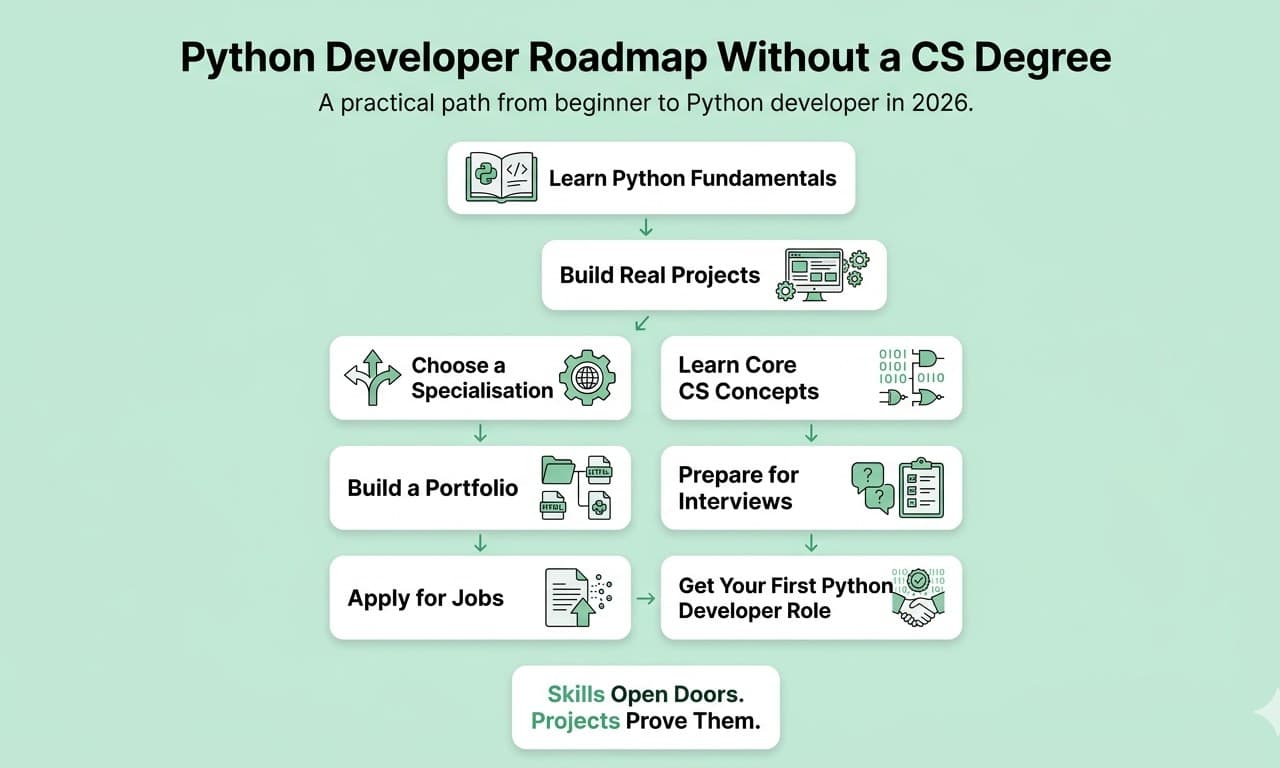
This is the roadmap that actually works for people coming from a non-CS background in 2026. It is not about learning everything. It is about learning the right things in the right order.
Phase 1: Python Fundamentals (2 to 3 months)
Do not rush this phase. The developers who struggle later are almost always the ones who moved too fast here. What to learn: Variables, data types, conditionals, loops Functions, scope, and return values Lists, dictionaries, tuples, and sets File handling and basic I/O Error handling with try and except Object-oriented programming basics: classes, objects, inheritance Where to learn: Python.org's official tutorial (free and underrated) Automate the Boring Stuff with Python by Al Sweigart (free online) CS50's Introduction to Programming with Python (free on edX) How to know you are ready to move on: You can build small programs that do something useful without looking up basic syntax. Not perfectly. But independently.
Phase 2: Build Real Projects Early (1 to 2 months)
This is where most self-taught developers make their biggest mistake. They keep learning and never build. Start building simple but real projects as soon as you finish Phase 1. Not calculator apps. Not "hello world" variations. Real things with a purpose. Good starter projects for non-CS Python learners: A CSV data cleaner that reads a messy file and outputs a structured one A web scraper that pulls data from a public website and saves it A simple command-line task manager that reads and writes to a JSON file A script that sends you a daily weather summary via email using an API These projects are small enough to finish but real enough to teach you how Python behaves outside of tutorials. They also give you something concrete to show before you have a large portfolio.
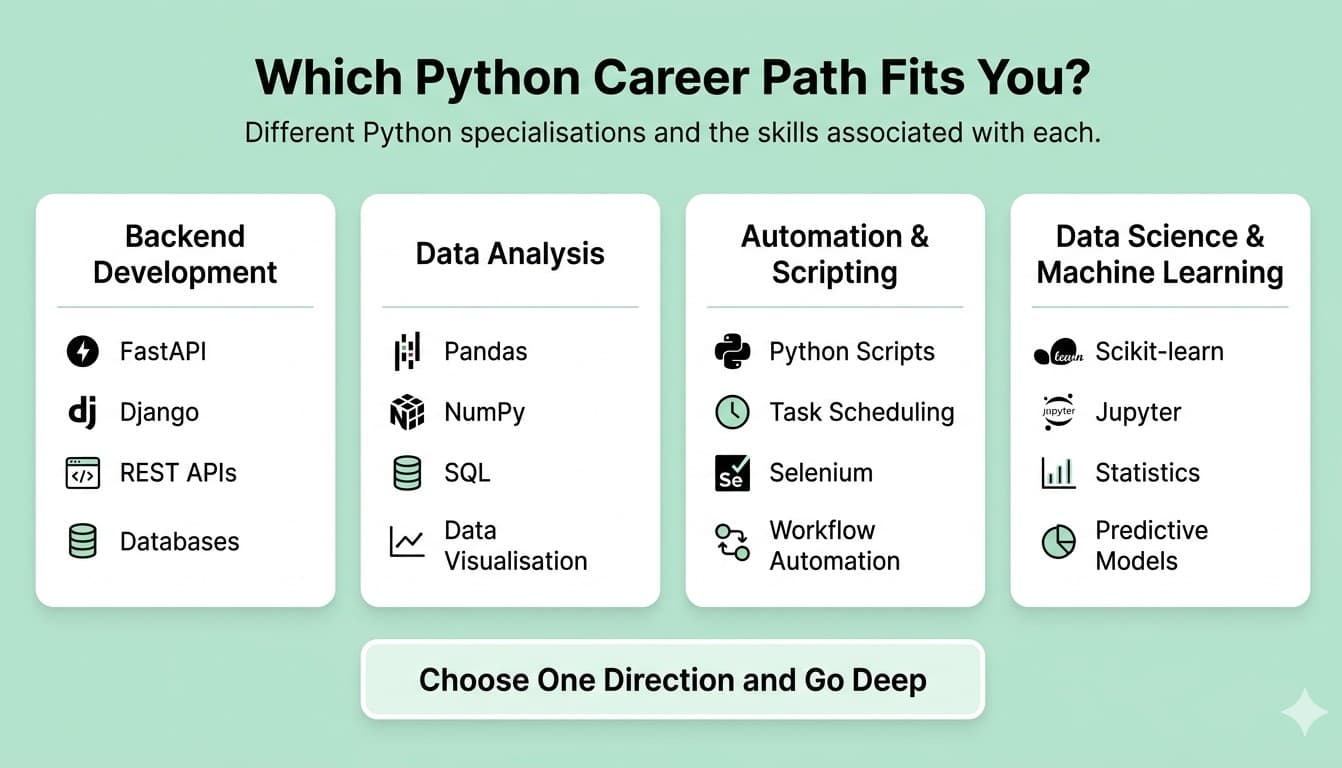
Phase 3: Choose Your Specialisation (2 to 3 months)
Python is used in several different areas. You do not need to master all of them. Pick one based on where you want to work and go deep. For most people asking how to become a Python developer from a non-CS background, backend web development is the most accessible path to a paid developer job. The skills are well-defined, the job market is large, and you do not need advanced mathematics to get started.
Phase 4: Learn What CS Graduates Know (Ongoing)
Here is the part most self-teaching roadmaps skip. To compete for developer roles, you need to know some of what CS graduates learn. Not all of it. The relevant parts. Core CS concepts worth learning as a self-taught Python developer: Data structures: Lists, stacks, queues, hash maps, trees. Understand when to use each. Algorithms basics: Sorting, searching, time complexity. Know what O(n) means. Databases: SQL queries, joins, indexes, basic schema design. Version control: Git confidently. Branching, merging, pull requests. Testing: Writing unit tests with pytest. Free resources like CS50, freeCodeCamp, and the official Python documentation cover most of this clearly without needing a textbook.
How to Get a Python Developer Job Without Experience
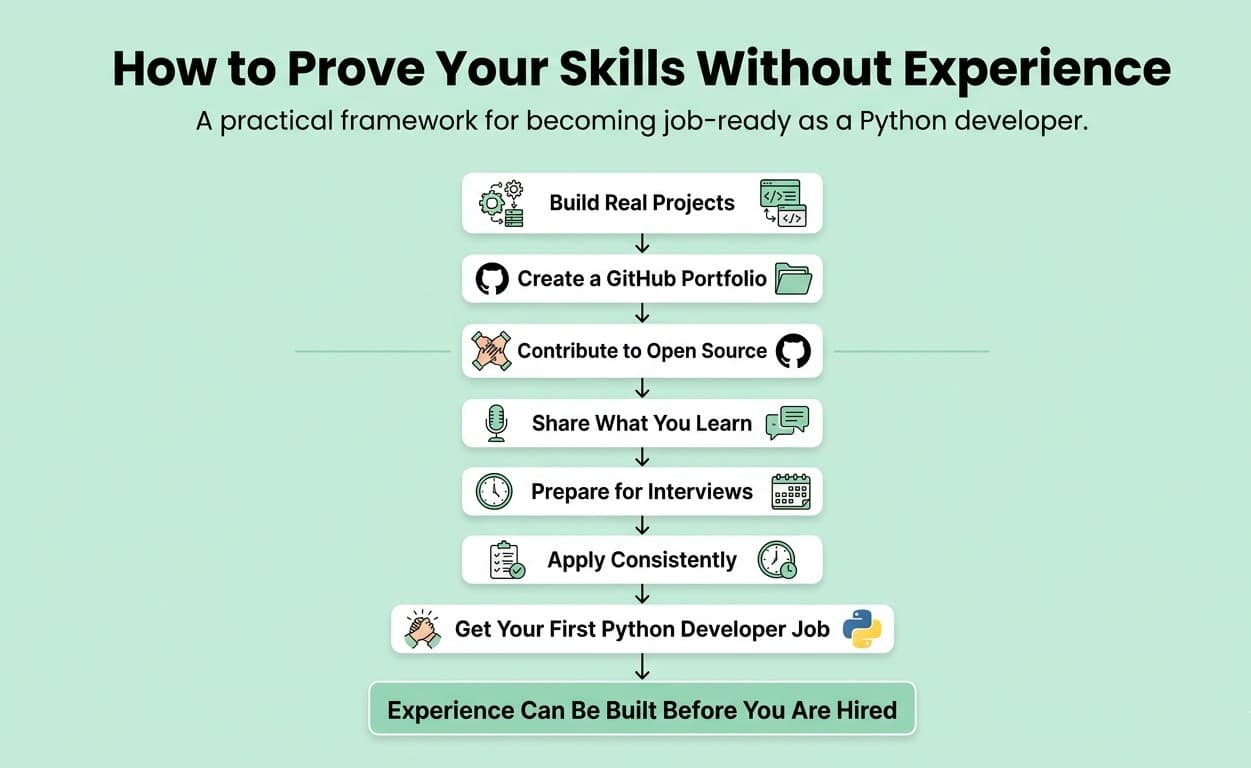
If you don't have professional experience, your goal is to prove your skills through practical work. Create 3–4 Python projects and deploy them online. Include the source code on GitHub and write a simple README explaining the project and technologies used. Keep your projects organized and active. Recruiters often check GitHub to see your coding skills and consistency. Even small contributions can help. It shows that you can understand and work with real-world codebases. Write LinkedIn posts or short blog articles about your projects, challenges, and lessons learned. This helps showcase both your technical and communication skills. Startups, small product companies, and agencies often care more about skills and projects than degrees or experience. Focus on common interview topics such as: Python basics and OOP List comprehensions, generators, and decorators Data structures and problem-solving Basic SQL queries Easy to medium coding questions Remember, your first job doesn't require years of experience. It requires proof that you can build, learn, and solve problems using Python.1. Build Real Projects
2. Create a Strong GitHub Profile
3. Contribute to Open Source
4. Share What You Learn
5. Apply to Skills-Focused Companies
6. Prepare for Python Interviews
FREE TO USE
8k+ SESSIONS92% FLUENCY4.9★ RATING
Speak With Confidence
Real Conversations. Real Scenarios. Speak until it feels natural.
- Real-Time Speaking Practice
- Guided Conversation Flows
- Instant AI Feedback
What Should Your Resume Highlight
Non-CS Python developers often undersell themselves by not knowing how to frame their background. Here is what to emphasise: Projects section at the top, not buried below education. Your projects are your degree. Skills with context. Instead of listing "Python, Django, SQL," write "built and deployed a REST API using FastAPI and PostgreSQL." Relevant domain background. If your previous career involved data, operations, or finance, mention it. A Python developer who understands that domain is more valuable to companies in that space. Certifications as supplementary signals. Google's Python Certificate on Coursera and the IBM Data Science Professional Certificate add credibility without a degree.
Conclusion
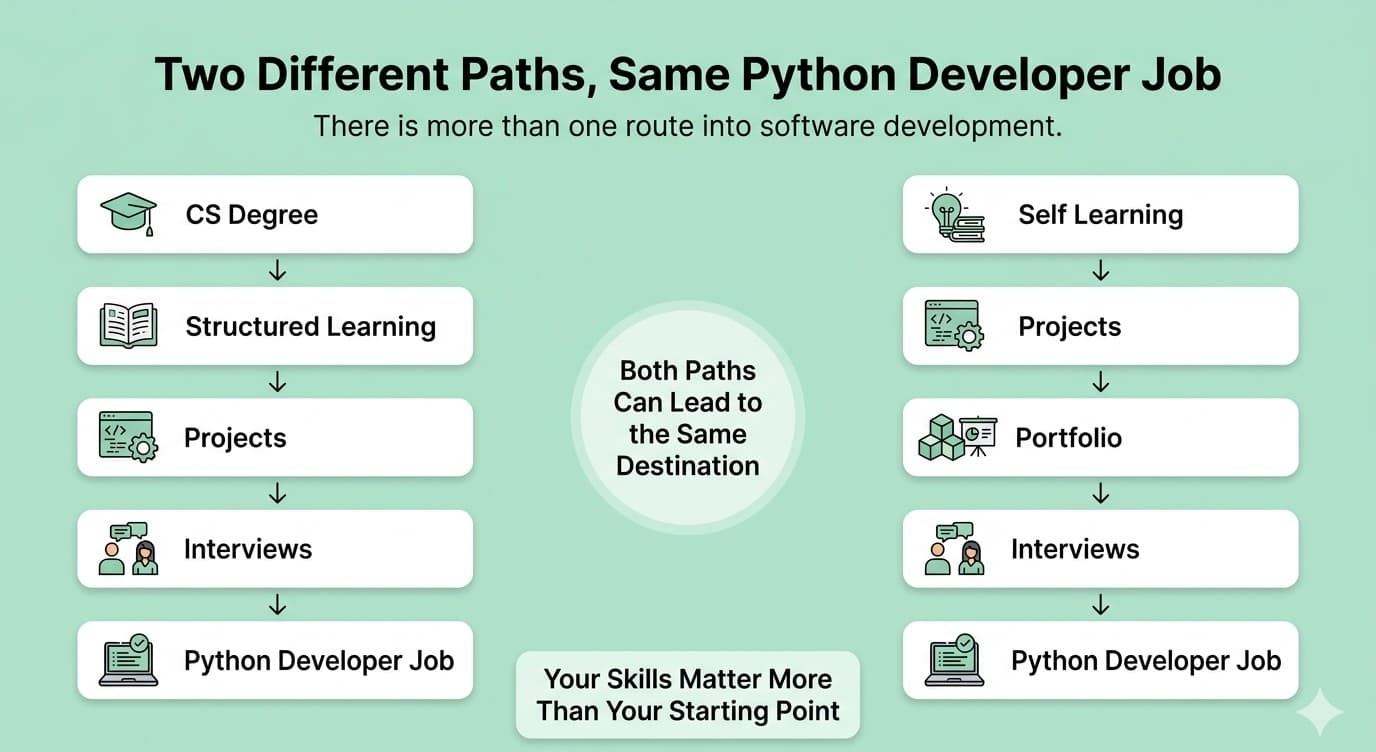
Can you become a Python developer without a CS degree? Yes, and many people have. The path is real, it is documented, and the companies hiring for it exist. What it requires is not a degree. It requires a structured roadmap, a portfolio of real deployed projects, preparation tailored to Python developer interviews, and enough persistence to keep going through the months when it feels like you are not making progress. The degree would have been one way to prove readiness. Building real things and demonstrating them clearly is another. In 2026, the second path is genuinely viable in a way that it was not ten years ago. Start with Phase 1. Build something real in Phase 2.
More Blogs
Sep 30, 2026
React Developer Interview Preparation Guide: A Complete Roadmap for 2026
31 min read
