Loading...
Contents
Can Non-Programmers Become Software Testers in 2026?
Jun 19, 202630 min readUpdated Sep 21, 2026
If you've been thinking about starting a career in IT but keep stopping because you don't know how to code, you're not alone.
One of the most common questions aspiring tech professionals ask is:
"Can I become a software tester without programming?"
The short answer is yes.
In fact, software testing remains one of the most accessible entry points into the technology industry. Many successful QA professionals started their careers with little or no coding knowledge and learned technical skills gradually as they gained experience.
However, software testing in 2026 looks different than it did a few years ago. Automation tools are becoming more common, AI is changing testing workflows, and employers increasingly value testers who understand both quality assurance and technology.
So while you can absolutely start without coding, it's important to understand what skills matter today and what opportunities exist for non-programmers.
In this guide, you'll learn whether manual testing without programming is still possible, what skills employers expect, and how to start a QA testing career without coding.
FREE TO USE
25K+ INTERVIEWS4.8★ RATING68% IMPROVEMENT
Crack Your Dream Job
Real Interviews. Real Pressure. Practice until it feels easy.
- Seamless Interview Experience
- Resume & JD Questions
- Instant Personalized Feedback
The Short Answer: Yes, Non-Programmers Can Become Software Testers
Let's address the main question first.
Many entry-level software testing roles do not require programming skills. Companies regularly hire freshers and career changers for manual testing positions where the primary responsibility is to test applications, identify bugs, verify features, and document issues.
A tester's job is different from a developer's job.
Developers create software while Testers evaluate software.
A good tester focuses on how users interact with an application, whether features behave as expected, and what happens when things go wrong. These activities rely more on observation, analytical thinking, and problem-solving than coding.
This is why people from commerce, arts, business, and other non-technical backgrounds successfully enter software testing every year.
What Does a Software Tester Actually Do?
Before worrying about programming, it's helpful to understand what software testers spend most of their time doing.
A software tester is responsible for ensuring that an application works correctly before it reaches customers.
This typically involves:
Verifying that features work as intended
Identifying defects and bugs
Writing and executing test cases
Reporting issues to developers
Retesting fixes
Validating user workflows
Ensuring a smooth user experience
For example, imagine you're testing a food delivery app
You might check:
Can users create an account successfully?
What happens if they enter an invalid phone number?
Does the payment process work correctly?
Can users track their orders?
What happens when the internet connection drops?
Notice that none of these tasks require writing code. They require curiosity and attention to detail.
Why Software Testing Is One of the Best IT Careers for Non-Coders
Software testing is often recommended to beginners because it focuses on understanding product behavior rather than building software from scratch.
1. It Focuses on User Experience
Testers think like users.
Their job is to understand how real people interact with software and identify issues that could affect usability, functionality, or reliability.
Logical Thinking Matters More Than Programming
Great testers constantly ask questions such as:
What happens if the user enters invalid data?
What happens if the server responds slowly?
What happens if a required field is left empty?
What happens if two actions occur simultaneously?
Finding answers to these questions often uncovers bugs.
3. Many Testing Tools Don't Require Coding
Modern QA teams use tools for: Test case management Bug tracking Documentation Collaboration Most of these tools can be used effectively without programming knowledge
4. Human Testing Still Has Value
Human testers are still needed to: Explore unexpected scenarios Evaluate usability Validate customer journeys Identify edge cases That's why manual testing continues to exist even as automation grows.
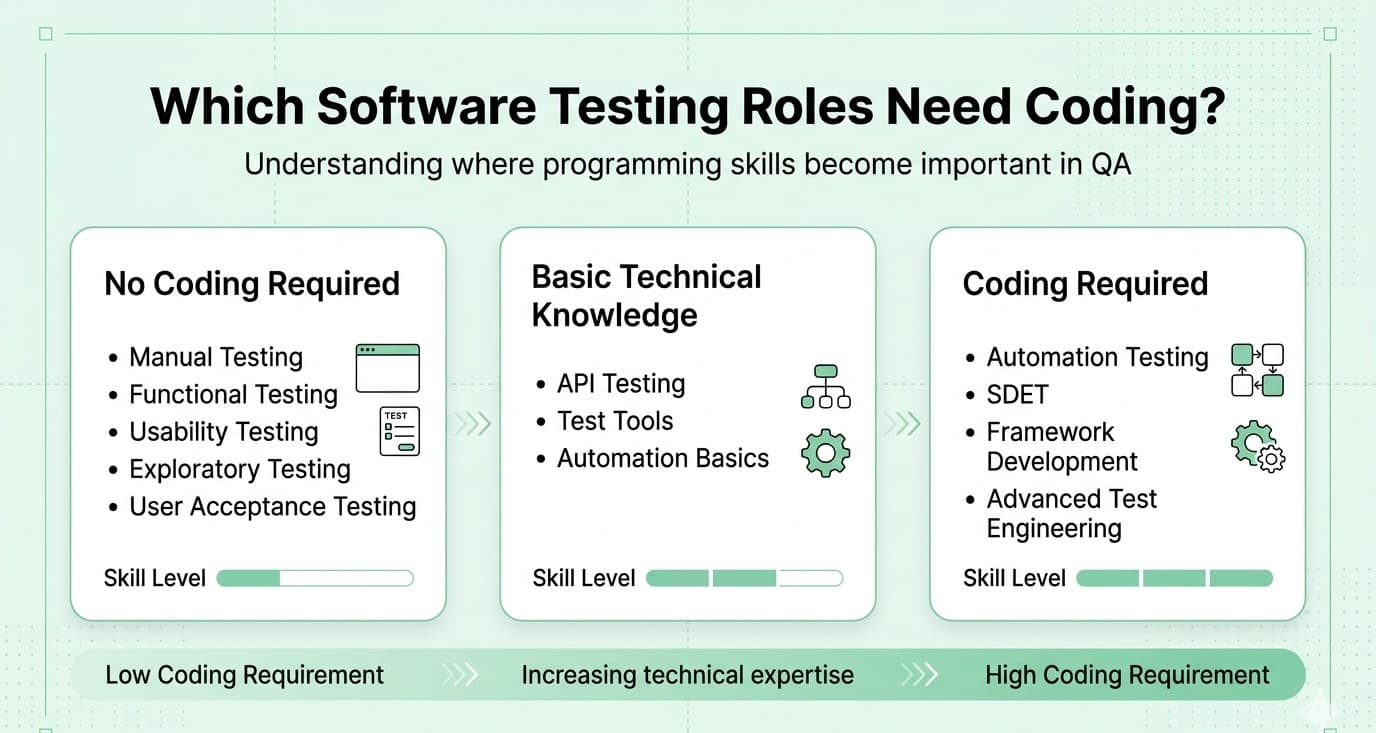
Do QA Testers Need Coding?
This is probably the second most common question after "Can I become a tester without programming?"
The answer depends on the role.
Testing Roles That Usually Don't Require Coding
Many testing activities can be performed without writing a single line of code.These include: Checking whether features work according to requirements. Evaluating how easy and intuitive an application is to use. Testing an application freely to discover unexpected issues. Verifying that software meets business and customer requirements. Ensuring that recent changes haven't broken existing functionality. These areas rely heavily on observation, analysis, and documentation.Functional Testing
Usability Testing
Exploratory Testing
User Acceptance Testing (UAT)
Regression Testing (Manual)
Testing Roles That Usually Don't Require Coding
As testers move into more technical areas, programming becomes increasingly valuable.
Examples include:
Automation Testing
Writing scripts to automate repetitive test cases.
API Testing
Testing communication between software systems.
Performance Testing
Measuring system behavior under heavy usage.
SDET Roles
Software Development Engineers in Test often combine testing and development skills.
The key takeaway is simple:
Coding is not required to start, but it can help later in your career.
FREE TO USE
8k+ SESSIONS92% FLUENCY4.9★ RATING
Speak With Confidence
Real Conversations. Real Scenarios. Speak until it feels natural.
- Real-Time Speaking Practice
- Guided Conversation Flows
- Instant AI Feedback
Is Manual Testing Still a Good Career Choice in 2026?
Yes. Despite the rise of automation, manual testing remains relevant.
Here's why.
Automation works best when tasks are repetitive and predictable.
But software isn't always predictable.
Companies still need testers who can:
Explore new features
Evaluate user experience
Validate business workflows
Test complex customer journeys
Identify issues that automated scripts miss
This is especially true for startups, mobile apps, SaaS products, and rapidly evolving platforms.
Many organizations continue hiring manual testers because human judgment remains difficult to automate completely.
For freshers, manual testing is still one of the most common entry points into QA.
Essential Software Tester Skills for Beginners
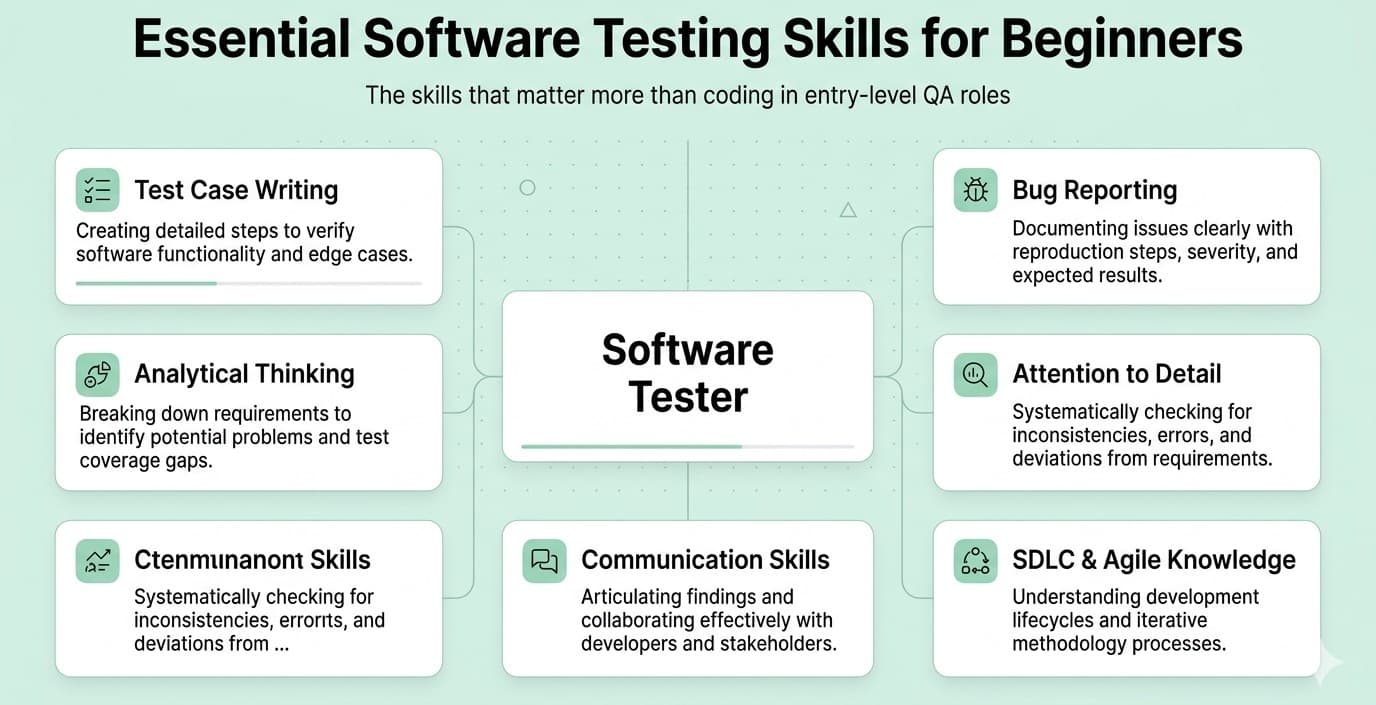
Even if you don't know programming, you'll need several important skills to succeed.
Understanding SDLC and Agile
Modern software teams follow structured development processes.
Understanding concepts like SDLC, Agile, and Scrum helps testers work effectively with developers and product teams.
Test Case Writing
A test case is a step-by-step guide for validating a feature.
Good test cases are:
Clear
Structured
Repeatable
Easy to understand
Bug Reporting
Finding bugs is only half the job. You must also communicate them effectively.
A strong bug report typically includes:
Steps to reproduce
Expected result
Actual result
Screenshots
Severity level
Analytical Thinking
Successful testers think beyond normal usage patterns. They constantly explore what could go wrong.
Attention to Detail
Small inconsistencies can become major issues in production environments. Good testers notice details that others overlook.
Communication Skills
Testing involves collaboration with developers, designers, product managers, and stakeholders.
Clear communication makes teams more effective.
Manual Testing Jobs for Freshers
Many companies hire freshers specifically for manual testing positions. Common entry-level roles include: QA Tester Manual Tester Software Test Engineer Junior QA Engineer Quality Assurance Analyst These roles typically focus on learning testing processes, understanding products, executing test cases, and reporting bugs. Employers usually value: Practical testing knowledge Strong communication Logical thinking Willingness to learn Much more than advanced coding skills.
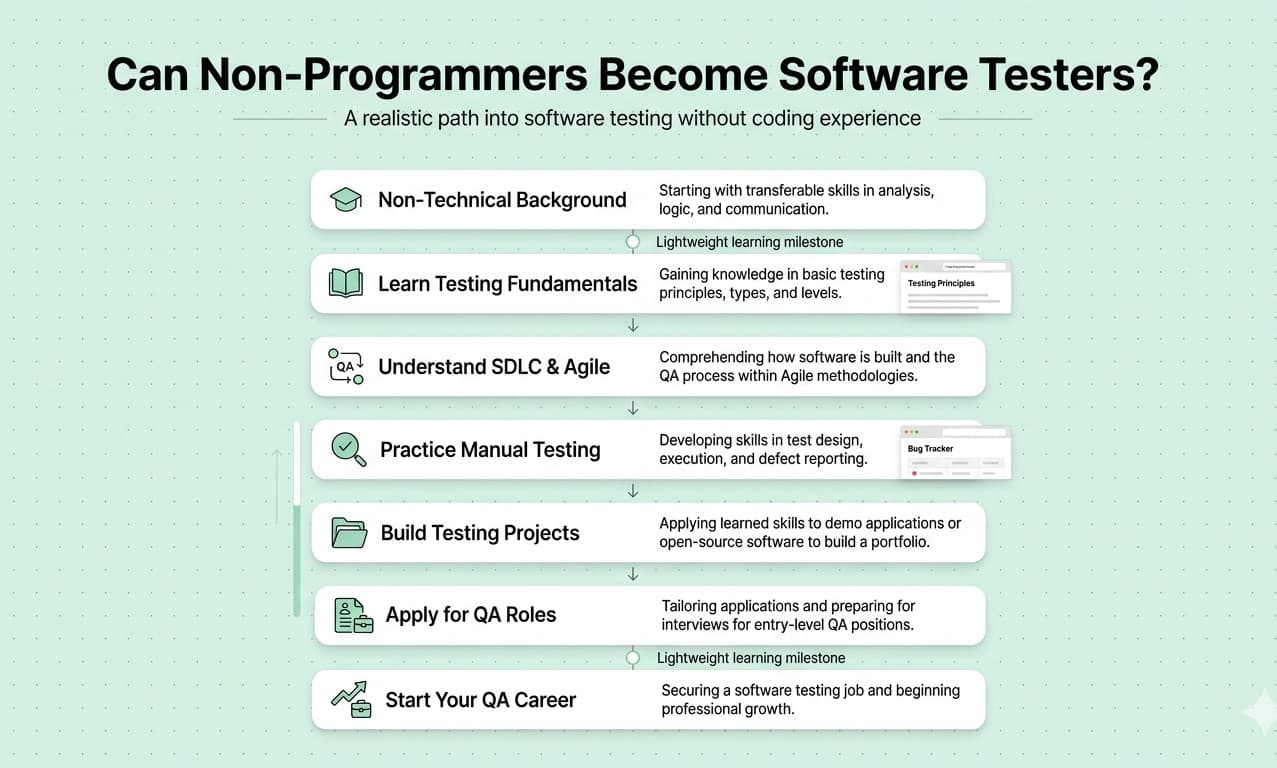
How to Start a QA Testing Career Without Coding
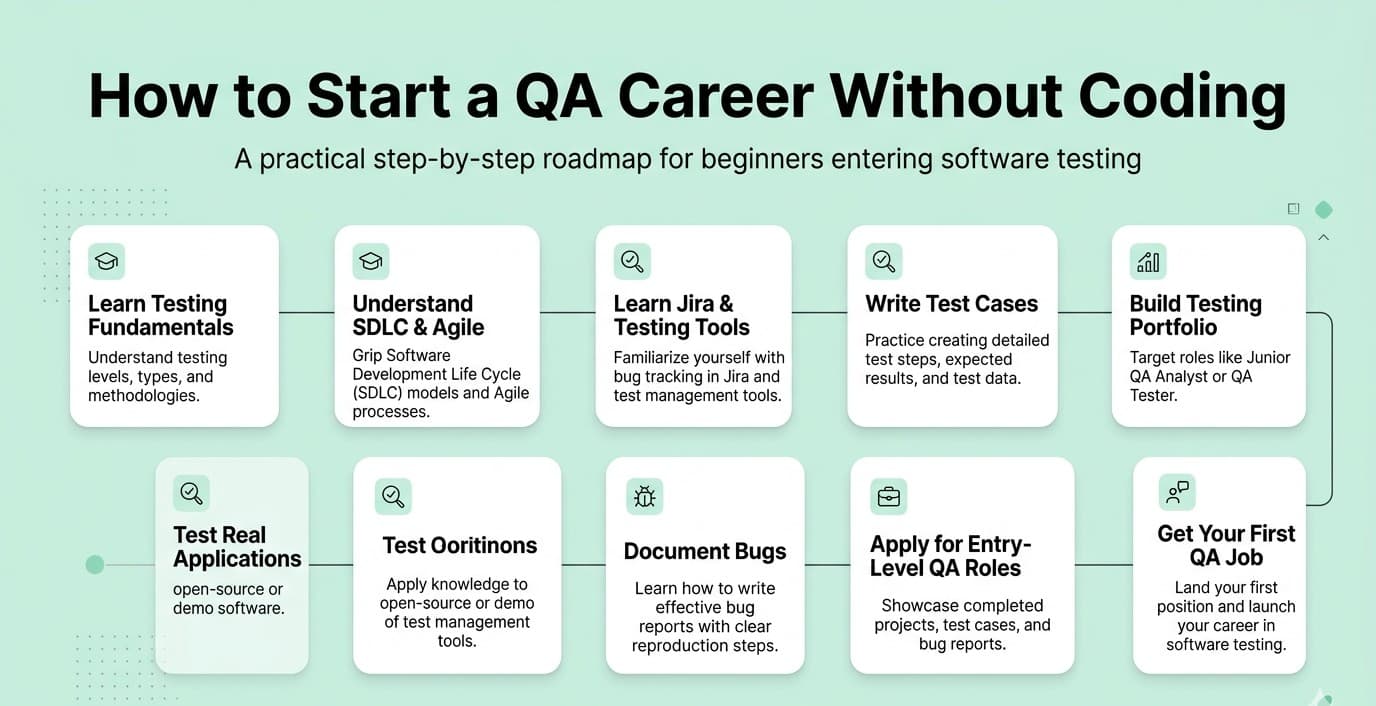
If you're starting from scratch, here's a practical roadmap. Understand: Functional testing Regression testing Smoke testing Test cases Bug life cycle Most modern teams use Agile development processes. Understanding how testing fits into Agile is essential. Choose a website or mobile app and create your own test cases. This develops structured testing thinking. Familiarize yourself with: Jira Test management tools Bug tracking systems API testing tools like Postman The best way to learn testing is by actually testing software. Document your findings and create a small portfolio. Look for: QA Internships Manual Tester Roles Junior QA Positions QA Trainee Programs Real projects and practical skills often matter more than certificates.Step 1: Learn Testing Fundamentals
Step 2: Learn SDLC and Agile
Step 3: Practice Writing Test Cases
Step 4: Learn Industry Tools
Step 5: Test Real Applications
Step 6: Apply for Entry-Level QA Roles
Should Non-Programmers Learn Coding Eventually?
Probably yes. Not because it's required for entry-level testing, but because it expands your opportunities. Learning basic programming can help you: Understand application behavior Collaborate better with developers Write automation scripts Perform API testing Move into higher-paying QA roles Many testers gradually learn Python, Java, or JavaScript after gaining industry experience. Think of coding as a career accelerator, not an entry requirement.
Career Growth in QA Without Coding
A common misconception is that manual testers have limited growth opportunities. That's not true. Many professionals start in manual testing and later move into roles such as: Handling complex testing activities and mentoring junior testers. Designing testing strategies and analyzing requirements. Managing testing teams and coordinating releases. Working closely with stakeholders and translating business needs into requirements. Some professionals eventually transition into automation testing, product management, or quality engineering roles. Manual testing is often the starting point, not the destination.Senior QA Engineer
QA Analyst
Test Lead
Business Analyst
Conclusion
So, can non-programmers become software testers in 2026? Absolutely.
Software testing remains one of the most beginner-friendly paths into the tech industry. Many entry-level roles focus on analytical thinking, product understanding, bug reporting, and user experience rather than programming.
At the same time, the industry continues to evolve.
While coding isn't necessary to get started, developing technical skills over time can unlock more opportunities and accelerate career growth.
If you're interested in software testing but don't know programming yet, don't let that stop you.
Start with the fundamentals, practice on real applications, build hands-on experience, and continue learning as you grow.
That's how many successful QA professionals started, and it's still one of the most practical ways to enter the IT industry today.