Loading...
Contents
Common Backend Developer Interview Mistakes to Avoid in 2026
Sep 1, 202645 min readUpdated Oct 22, 2026
The most common backend developer interview mistakes in 2026 are starting a system design answer without clarifying scale and failure tolerance requirements, designing only the happy path without naming what happens when each component fails, claiming database expertise without being able to read a query execution plan, implementing authentication without resource-level authorization, designing distributed operations without discussing idempotency, claiming observability knowledge without being able to describe specific signals used to diagnose a real incident, and not reviewing AI-generated backend code for the authorization vulnerability the tool almost always introduces. Every mistake below has a specific, rehearsable fix built around the exact mechanism that causes the failure, not a vague suggestion to "think more carefully."
Backend interviews are uniquely challenging because the most common failure mode is invisible to the candidate during their answer. A system design sounds comprehensive because it covers the main components. An API design looks correct because the endpoints do what was asked. A database schema appears well-thought-out because it is normalized and the foreign keys are right. The interviewer sits across the table, asks one follow-up question, and reveals that the design never considered what happens when the payment service is down, that the API has no resource-level authorization, or that the schema would require a full table scan on the most common query in the system.
This guide names thirteen backend-specific interview mistakes at the mechanism level, explains exactly why each one costs an offer, and gives a fix that is specific enough to rehearse before your next interview. The final category covers the mistakes that most interview prep content has not caught up to yet: the ones that only exist because AI tools are now part of the interview environment and introduce a specific category of backend vulnerability that experienced interviewers are actively screening for.
FREE TO USE
25K+ INTERVIEWS4.8★ RATING68% IMPROVEMENT
Crack Your Dream Job
Real Interviews. Real Pressure. Practice until it feels easy.
- Seamless Interview Experience
- Resume & JD Questions
- Instant Personalized Feedback
Why Backend Developer Interviews Expose Gaps That Candidates Do Not See Coming
Backend interviews test two things simultaneously: whether you can build a system that works, and whether you thought about every way it could fail before you started building. Most candidates prepare for the first half and arrive unprepared for the second, which is the half that experienced backend engineers evaluate most carefully because production failures are expensive in exactly the ways that happy-path thinking predicts.
Backend systems fail in specific, well-understood ways: network partitions, database connection exhaustion, message queue backlog, race conditions under concurrent writes, token validation gaps that allow unauthorized access, and queries that run fine with test data and fail catastrophically with production data volume. An experienced backend interviewer has seen every one of these failures in production and has learned to probe for exactly the thinking patterns that prevent them. Every mistake below is a specific probe that reveals whether a candidate's design would hold under real conditions or only under ideal ones.
Category 1: System Design Mistakes
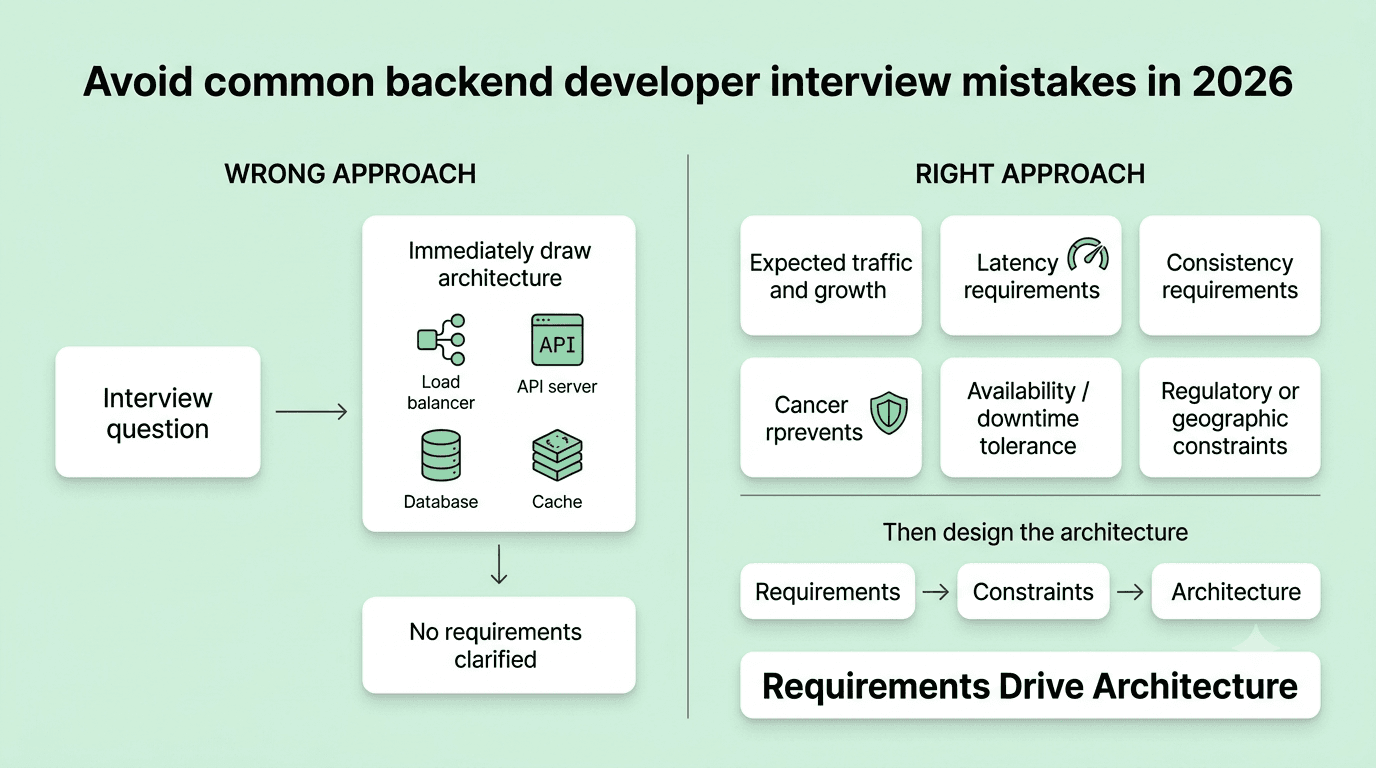
Mistake 1: Starting a System Design Answer With Architecture Before Clarifying Requirements
What This Looks Like
A candidate receives a system design prompt such as "design a URL shortening service" or "design a notification system for a social platform." Within thirty seconds they are drawing boxes and arrows: load balancer, application server, database, cache. They describe the components confidently, explain how data flows between them, and present a complete-looking architecture. The interviewer then asks "how many URLs per second does this need to handle" and the candidate realizes they have been designing for an unspecified scale that may be wrong by several orders of magnitude in either direction.
Why Recruiters Flag This
The architecture of a backend system is not determined by the feature being built. It is determined by the scale, consistency requirements, latency budget, and failure tolerance of that feature. A URL shortening service handling one hundred redirects per day needs a SQLite database and a single server. A URL shortening service handling one million redirects per second needs consistent hashing, a distributed cache layer, database read replicas, and a different data model entirely. These are not minor adjustments to the same design. They are fundamentally different systems. A candidate who draws the complex architecture without asking about scale reveals that they are performing a design rather than solving a problem.
The Real Cost
On the job, a developer who starts building a system without scoping requirements produces over-engineered systems for low-scale problems and under-engineered systems for high-scale ones. Both are expensive: the first wastes engineering time and creates operational complexity; the second requires a partial or complete rebuild when the system hits its limits under real traffic.
The Complete Fix
Build a mandatory five-question opener for every system design question and practice it until it is automatic. Before drawing a single component, ask: what is the expected read and write volume, and what is the growth trajectory? What is the acceptable latency for the primary operations? What are the consistency requirements, meaning is it acceptable for a user to see slightly stale data, or must every read reflect the most recent write? What is the acceptable downtime window, meaning how available does this system need to be? Are there regulatory or geographic constraints on where data is stored?
These five questions take under three minutes to ask and answer, and they change the architecture in specific, defensible ways. Tell the interviewer this explicitly: "Before I start designing, I want to make sure I understand the requirements that will drive the architecture choices." This framing signals structured engineering judgment rather than a candidate racing to fill the whiteboard.
Practice Method
Take ten system design questions from any question bank. For each one, write out five clarifying questions before designing anything. Then design two versions: one for low scale, perhaps ten thousand requests per day, and one for high scale, perhaps ten million requests per day. Compare how the designs differ and specifically name which requirements drove each difference. This exercise builds the instinct to connect requirements to architecture rather than treating architecture as a fixed template to apply.
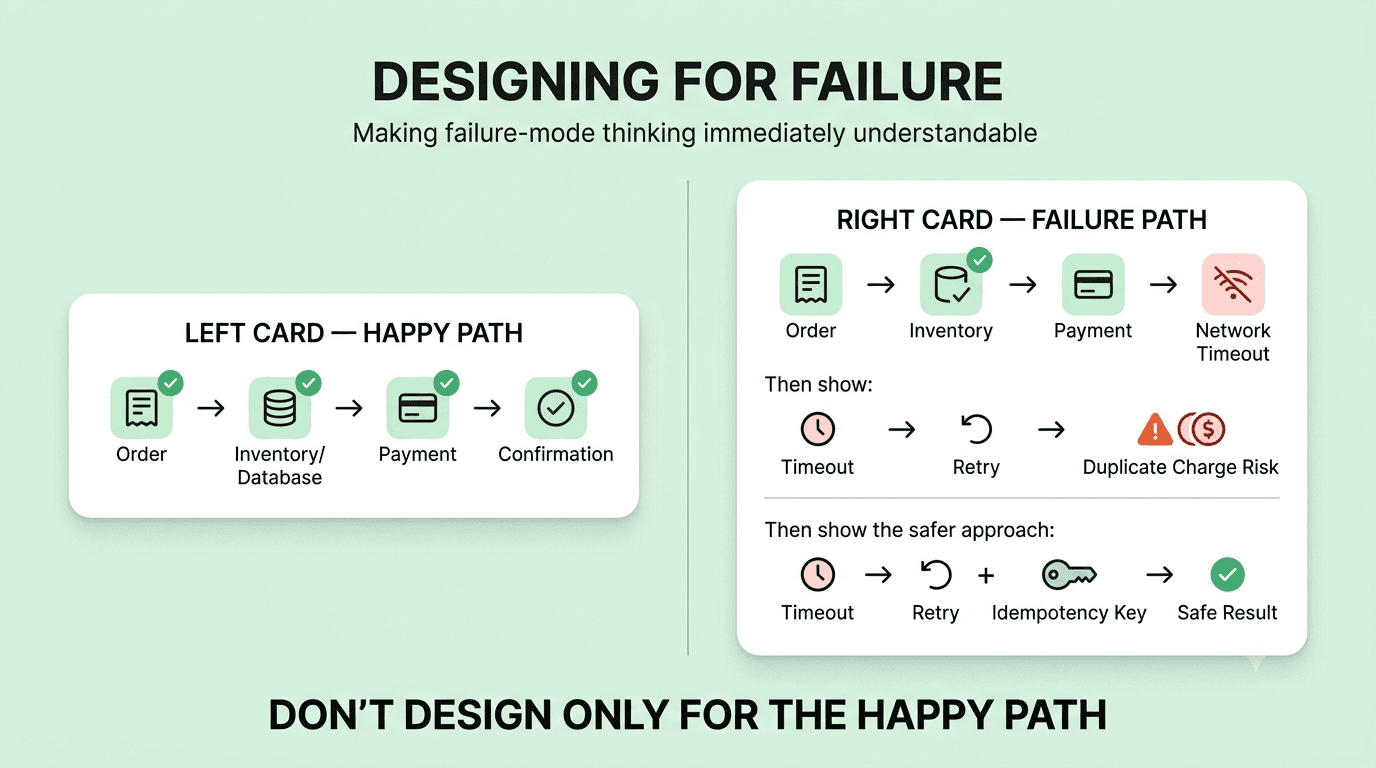
Mistake 2: Designing the Happy Path Without Naming What Happens When Each Component Fails
What This Looks Like
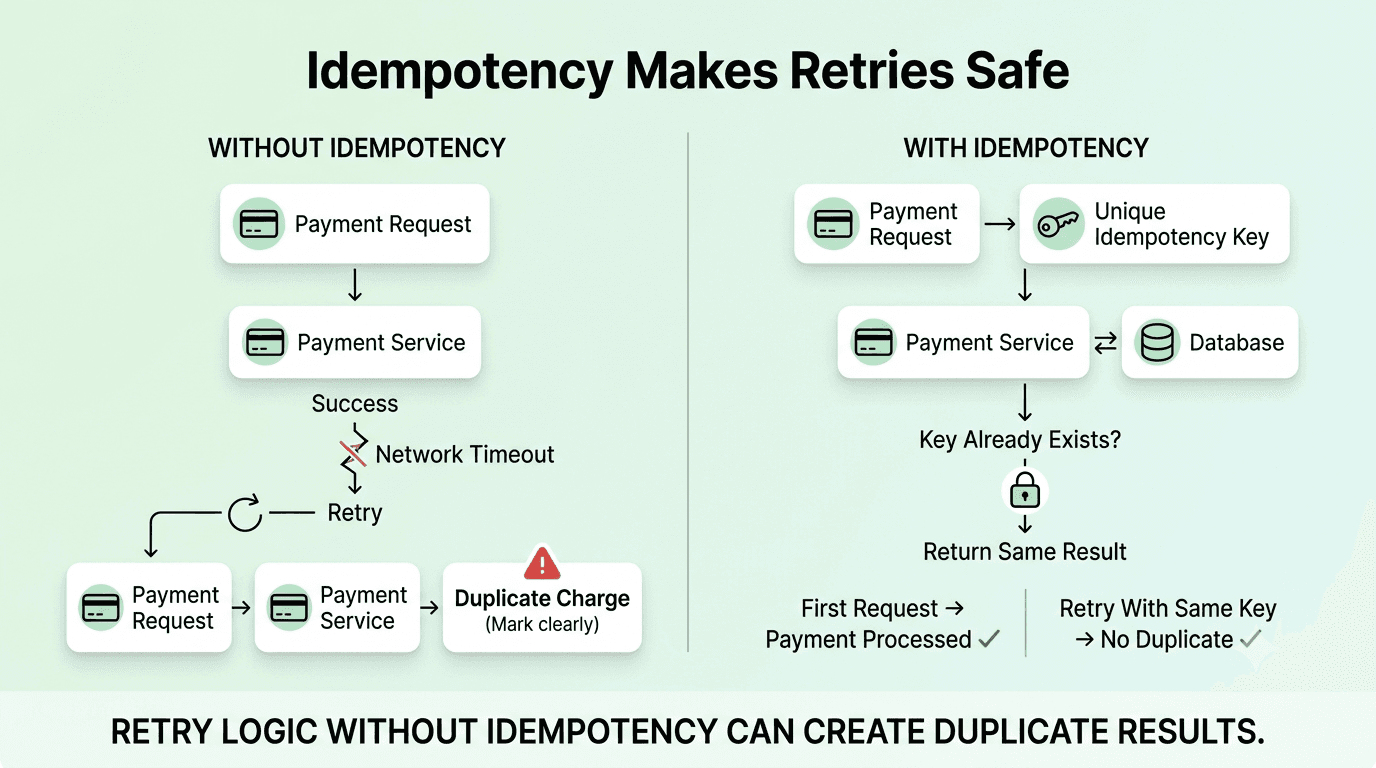
A candidate designs a multi-service order processing system: the API receives an order, calls the inventory service to reserve items, calls the payment service to charge the card, and writes the order to the database. The design handles every step in the normal case. The interviewer asks "what happens if the payment service is down when you call it" and the candidate either freezes, gives a vague answer about retrying, or proposes a solution that would charge the customer twice if the payment service succeeds but the confirmation response is lost in transit.
Why Recruiters Flag This
Production backend systems fail constantly. Network calls time out. Services restart. Databases reach their connection limit. Message queues fill up. A backend developer who designs only the happy path is designing a system that behaves correctly in testing and incorrectly in production, and production failures are significantly more expensive than design-time thinking. Interviewers probe failure scenarios specifically because they reveal whether a candidate has actually operated a real backend system under real conditions, or has only built systems that ran on a single machine in a controlled environment.
The Real Cost
A payment system that can charge a customer twice under a specific failure scenario will charge a customer twice eventually. Every backend system that handles money, inventory, or user data has at least one failure scenario that produces real financial or reputational damage if it is not handled correctly. The developer who did not think about these scenarios during design is the one whose name appears in the incident review.
The Complete Fix
After designing any component or interaction in a system design interview, run a mental fault injection test out loud: "Now I want to think through what happens if this step fails. If the payment service times out before responding, we do not know whether the charge succeeded or not. That means a simple retry would risk charging the customer twice. The correct pattern here is to use an idempotency key: we generate a unique key for this payment attempt before calling the payment service, include it in every call, and the payment service uses it to deduplicate attempts. That way a retry after a timeout either completes a charge that was already processed or initiates one that was not, but never creates a duplicate charge."
This narration pattern turns failure mode thinking into a visible skill rather than a private worry. It tells the interviewer that you have thought about these scenarios before, which is the specific signal that distinguishes a developer who has operated production systems from one who has only built features.
Practice Method
For any system design you practice, run a deliberate failure injection exercise after the initial design. For each service-to-service call and each database write, ask: what if this call times out? What if this service is down for thirty seconds? What if this write succeeds but the acknowledgment is lost? Write out the correct handling for each scenario before considering the design complete.
Mistake 3: Defaulting to Microservices for Every New Design Without Justifying the Operational Overhead
What This Looks Like
A candidate is asked to design a simple internal tool for a team of fifty people, such as an internal document management system or a project tracking API. They immediately propose a microservices architecture with separate services for authentication, document storage, search, notifications, and user management, each with its own database, its own deployment pipeline, and its own observability stack. When the interviewer asks why separate services are warranted for this scale, the candidate gives a generic answer about scalability and independent deployment.
Why Recruiters Flag This
Microservices impose real operational costs that a small team or low-scale system cannot justify: each service requires its own deployment, monitoring, alerting, and on-call rotation. Network calls between services are slower and less reliable than function calls within a single process. Distributed transactions across multiple services are significantly more complex than local transactions within one. A candidate who defaults to microservices without justifying the overhead based on the specific scale and organizational requirements reveals that they are applying an architectural pattern as a fashion statement rather than a reasoned trade-off decision.
The Real Cost
Teams that adopt microservices prematurely spend months managing the operational complexity of a distributed system without any of the scale benefits that justify it. This is a well-documented pattern with a specific name, distributed monolith, where you get the worst of both worlds: the operational overhead of microservices and the coupling of a monolith.
The Complete Fix
Internalize an explicit decision framework for service decomposition and use it out loud in design interviews. A microservices architecture is justified when specific services need to scale independently at a significantly different rate, when different parts of the system need to be deployed on different release cadences by different teams, or when a specific component has such different reliability or security requirements that isolation provides a meaningful benefit. For everything else, a well-structured monolith with clear internal module boundaries is faster to build, cheaper to operate, and easier to debug.
In a design interview, propose the architecture that fits the stated requirements rather than the most impressive-sounding one. Explicitly state the scale at which you would reconsider the architecture: "For this scale and team size, I would start with a well-modularized monolith. If the search functionality starts consuming resources that affect the rest of the system, that would be the first candidate for extraction into a separate service." This reasoning demonstrates architectural maturity rather than architectural trend-following.
Practice Method
For five system design problems you have practiced, write out the explicit justification for each service boundary you drew: what specific scaling, deployment, or isolation requirement justifies this separation rather than keeping it as a module in a monolith. If you cannot write a specific justification, merge the services and note what would have to change to justify splitting them.
Category 2: Database and API Design Mistakes
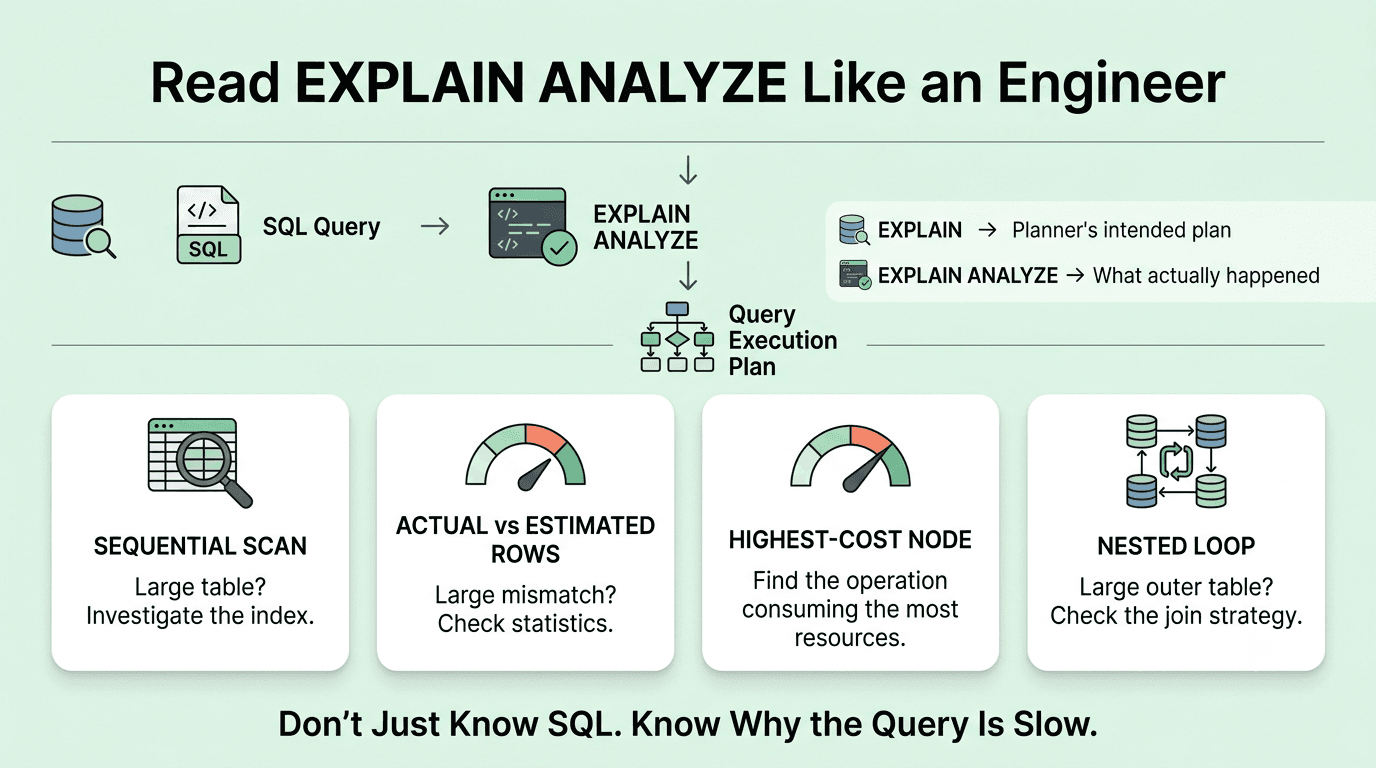
Mistake 4: Claiming Database Expertise Without Being Able to Read a Query Execution Plan
What This Looks Like
A candidate mentions database optimization on their resume and in their self-introduction. The technical interviewer shows them a slow query on a table with ten million rows and the output of EXPLAIN ANALYZE for that query. The candidate looks at the output and cannot identify whether the query is doing a sequential scan or an index scan, cannot see which join order the planner chose, cannot read the actual versus estimated row counts that reveal a stale statistics problem, and cannot identify the specific operation that is consuming the most time.
Why Recruiters Flag This
A query execution plan is the database's explanation of what it is actually doing, not what a developer hoped it would do. A developer who cannot read one cannot independently diagnose a slow query in production without asking for help, which means every database performance problem they encounter becomes a team effort that should have been a solo fifteen-minute investigation. Claiming database expertise without this skill is the database equivalent of claiming navigation expertise without being able to read a map.
The Real Cost
Production database performance problems are among the most time-sensitive backend incidents, because slow queries affect every user simultaneously and compound under load. A developer who cannot read an execution plan cannot confidently diagnose, fix, or prevent these problems independently, which makes them a team liability in exactly the high-pressure moments where self-sufficiency matters most.
The Complete Fix
Learn to read the four most important signals in a query execution plan before any interview where database expertise is claimed. Sequential scan versus index scan: a sequential scan on a large table is almost always a problem, and finding one tells you immediately that either an index is missing or the query planner determined it would not help. Actual rows versus estimated rows: a large discrepancy between these numbers means the planner's statistics are stale and it made a poor optimization decision, which points to a ANALYZE or VACUUM operation as the fix. Total cost and which node dominates it: the cost number is not in real time units but is a relative measure; the node with the highest cost is the operation to optimize first. Nested loop joins on large tables: a nested loop that processes a large number of outer rows, executing the inner query once per row, is almost always a problem that a hash join or a merge join would handle more efficiently.
Practice with EXPLAIN ANALYZE specifically, not just EXPLAIN, because EXPLAIN shows the planner's intention while EXPLAIN ANALYZE shows what actually happened, including actual row counts and actual execution times. Run it against five different slow queries you have encountered or can construct, read the output, and before looking at the query write down what the plan tells you about why the query is slow.
Practice Method
Enable PostgreSQL or MySQL's slow query log on a development database, generate some load, capture three slow queries, and run EXPLAIN ANALYZE on each one. For each output, write a diagnosis in plain language: what operation is slow, why the planner chose that operation, and what change would make it faster. Then make the change, run EXPLAIN ANALYZE again, and verify your prediction was correct.
Mistake 5: Missing the Data Access Pattern That Makes a Schema or Query Unworkable at Scale
What This Looks Like
In a system design round, a candidate designs a social feed where each request queries the posts table joined to the follows table to retrieve the posts of everyone a user follows, sorted by timestamp. The design looks correct: the tables are properly normalized, the foreign keys are right, and the query returns the correct result. The interviewer asks what happens when a user follows ten thousand accounts, each posting several times per day, and the candidate either cannot explain why this is a problem or proposes adding an index as if that resolves a fundamental data model issue.
Why Recruiters Flag This
This category of mistake reveals that a candidate can design a schema that is correct for small data but has not thought about whether it is correct for real data. The fan-out read problem in a social feed, the cartesian product explosion in a recommendation system, and the full table scan required by a "search by any field" query are all patterns that look fine in development and fail catastrophically in production. Recognizing these patterns before they are built is the skill that separates a backend developer who prevents production incidents from one who causes them.
The Real Cost
A data model that cannot efficiently serve its primary read pattern at production scale requires either a full migration of the data model, which is expensive and risky on a live system, or the addition of a pre-computed materialized view that is updated at write time, which adds complexity to every write path. Either fix is significantly more expensive than designing the read pattern correctly from the beginning.
The Complete Fix
Build a habit of defining the top three read queries explicitly before finalizing any schema design, and then verifying that the schema can serve each of those queries efficiently, meaning without a full table scan, without a nested loop join across large tables, and with an index that covers the filter and sort conditions of the query. If the schema cannot serve a read query efficiently, change the schema before building.
In a system design interview, state your read queries explicitly as part of the design: "The primary read query is to retrieve the fifty most recent posts from accounts a user follows. I am going to think about whether this schema can serve that query efficiently before moving on." Then reason through the index strategy, the join structure, and the expected row count at each step. If the naive approach is inefficient, propose the correct alternative, such as a pre-computed feed table written to at post creation time, and explain the trade-off: faster reads at the cost of more complex writes and eventual rather than immediate consistency.
Practice Method
Take any schema you have designed in the past and write out the five most common queries that would run against it in production. For each query, write out the query in SQL, then run EXPLAIN on it against a table populated with a realistic data volume, at least one hundred thousand rows. Identify every query that requires a sequential scan and either add the correct index or restructure the schema until every primary read query uses an index efficiently.
Category 3: Security Mistakes
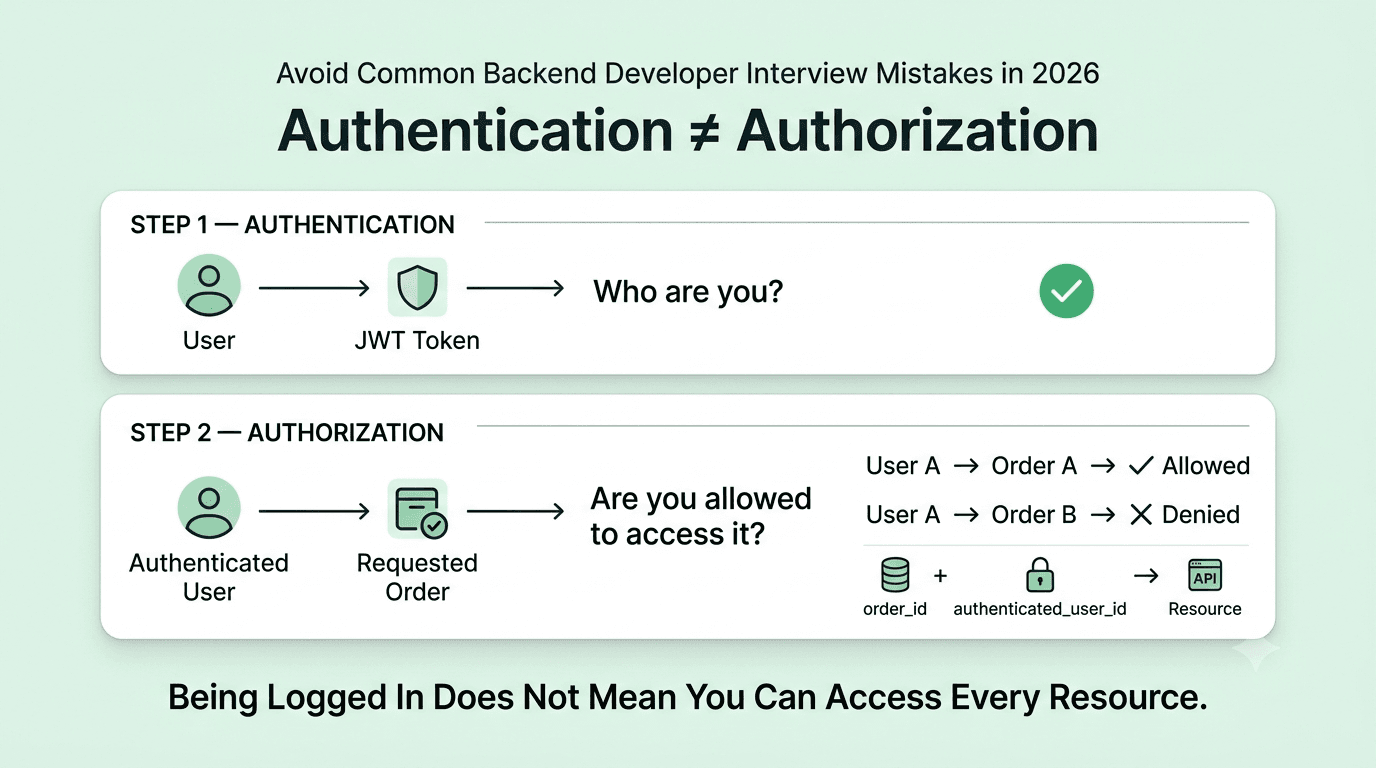
Mistake 6: Implementing Authentication Without Resource-Level Authorization
What This Looks Like
A candidate implements a GET /orders/{order_id} endpoint. They add authentication middleware that verifies a JWT token, so only logged-in users can call the endpoint. When the interviewer asks "what prevents user A from retrieving user B's order by changing the order_id in the URL," the candidate either did not consider this scenario, says the system would never send a link with someone else's order_id, or realizes the vulnerability in the moment but cannot explain how to implement the correct fix.
Why Recruiters Flag This
This is an insecure direct object reference vulnerability, consistently one of the most common and most damaging backend security failures, and it is evaluated at the code level in 2026 because teams have learned that architecture-level security discussions do not catch implementation-level authorization gaps. A candidate who does not instinctively add resource-level authorization to every resource retrieval endpoint will ship this vulnerability on the job, because the pattern of thinking "authentication is sufficient" applies to every resource endpoint they ever write.
The Real Cost
An insecure direct object reference in a system handling orders, medical records, financial data, or any other personal information is a data breach waiting to occur. Every authenticated user can access every other user's data by iterating through resource IDs. This is a breach that creates legal liability, mandatory disclosure requirements in many jurisdictions, and reputational damage that significantly exceeds the engineering cost of implementing authorization correctly.
The Complete Fix
Adopt a non-negotiable rule for every resource endpoint and recite it during any interview that involves writing or reviewing an API endpoint: after authentication verifies the caller's identity, a second check must verify that this specific caller is authorized to access this specific resource. These are two separate checks, and both must be present.
The specific implementation for the orders example is a query that includes the authenticated user's ID as a filter condition: SELECT * FROM orders WHERE id = $order_id AND user_id = $authenticated_user_id. If the query returns no rows, the endpoint returns 404 rather than 403, because returning 404 for an unauthorized resource prevents attackers from discovering which resource IDs exist. This query structure makes it impossible to retrieve another user's order even with a correct order_id, because the ownership check is embedded in the data access layer rather than applied as a separate conditional.
In any interview coding session, say this check out loud before writing the query: "Before I write the data access query, I need to make sure I am including the authenticated user's ID as a condition, so that this query can only return resources owned by the caller." This narration makes the authorization thinking visible to the interviewer and demonstrates that it is a design instinct rather than an afterthought.
Practice Method
Audit every resource endpoint in a project you have already built: every GET by ID, every PUT by ID, every DELETE by ID, and every POST that creates a resource under another resource. For each one, verify that the data access query includes the authenticated user's ownership condition, not as a separate conditional after the query, but as a filter in the query itself. Document every endpoint that is missing this check and fix it.
Mistake 7: Treating Verbose Error Responses as Helpful Without Recognizing the Security Implications
What This Looks Like
A candidate writes an API endpoint that returns detailed error messages including database error text, internal service names, stack traces, or query fragments in the response body. When asked why the error response is structured this way, the candidate says it makes debugging easier. When the interviewer asks what an attacker could learn from these error messages, the candidate either cannot articulate the risk or underestimates it.
Why Recruiters Flag This
Verbose error responses are one of the most common information leakage vulnerabilities in backend systems, and they are trivial to exploit because all an attacker needs to do is send malformed inputs and read the responses. A database error that reveals the table name and column structure helps an attacker craft targeted SQL injection attempts. A stack trace that reveals the framework version, the file paths, and the exact line of code that failed helps an attacker identify known vulnerabilities to exploit. An internal service name in an error response reveals the architecture of the system to an attacker mapping it for a broader attack.
The Real Cost
Information leakage vulnerabilities are specifically listed in the OWASP Top Ten and are a required check in most formal security assessments. A backend that routinely leaks internal details through error responses fails even the most basic security review and creates ongoing reconnaissance opportunity for attackers probing the system.
The Complete Fix
Implement a two-layer error model for every backend service: an internal error that contains all the detail needed for debugging, logged to the structured logging system with a correlation ID, and an external error response that contains only a generic error message and the correlation ID that a support engineer can use to look up the internal detail. The client never sees the database error, the stack trace, or the internal service name. They see a message like "An error occurred processing your request. Reference: err-8f3a2c" which gives them something to report while revealing nothing to an attacker.
In any interview where you write error handling code, state this pattern explicitly: "I am going to log the full error internally with the request correlation ID and return only a generic error message to the client, because returning internal error details would reveal system information to a potential attacker." This one sentence demonstrates security thinking at the implementation level rather than only at the architecture level.
Practice Method
Review a project you have already built and find every place where an error is returned to the client. For each one, check whether the response could contain database error text, stack trace information, internal service names, file paths, or query structure. Replace every verbose error response with a generic message plus correlation ID, and verify that the full error detail is still available internally through structured logs.
Mistake 8: Claiming API Security Knowledge While Missing Rate Limiting on Authentication Endpoints
What This Looks Like
A candidate designs an authentication system with a login endpoint, implements password hashing correctly, handles JWT expiration appropriately, and adds HTTPS. When the interviewer asks how the system prevents an attacker from making fifty thousand login attempts against a specific user account, the candidate either has not thought about this scenario, proposes a CAPTCHA as the primary defense, or says the account would lock out but cannot explain the lockout implementation or its susceptibility to denial-of-service abuse.
Why Recruiters Flag This
Brute force attacks against authentication endpoints are one of the most common attack types against web applications, and the absence of rate limiting makes them trivially executable with freely available tools. A candidate who implements authentication without rate limiting has secured the protocol while leaving the most basic attack vector open, which reveals that their security thinking covers the theoretical design but not the operational threat model.
The Real Cost
An authentication endpoint without rate limiting can be brute-forced continuously. Given a sufficiently weak password policy or user population, this attack succeeds against some percentage of accounts regardless of the technical sophistication of the attacker. This is a preventable breach that results from an implementation gap, not from a sophisticated attack.
The Complete Fix
Internalize three layers of brute force protection for any authentication endpoint and name them during any interview that involves authentication design. First, rate limiting per IP address: allow a maximum of ten authentication attempts per IP address per minute, returning 429 Too Many Requests beyond that threshold. Second, rate limiting per account: allow a maximum of ten failed attempts per username across any IP address over a rolling window, after which the account requires a secondary verification step before allowing further attempts, rather than a hard lockout which enables denial-of-service against known usernames. Third, exponential backoff for failed attempts: increase the response delay after each failed attempt, which makes automated brute force orders of magnitude slower without affecting legitimate users who fail once.
In a design interview, name these three layers explicitly when describing an authentication system: "I want to make sure I mention rate limiting on this endpoint, because without it the login endpoint is vulnerable to brute force. I would implement three layers: per-IP rate limiting, per-account failed attempt tracking with a secondary verification gate rather than a hard lockout to prevent denial of service, and response delay that increases with each failed attempt."
Practice Method
Add rate limiting to an authentication endpoint you have already built. Implement all three layers, verify that legitimate users are not affected by normal usage patterns, and verify that a script making one hundred rapid login attempts is blocked at the rate limit threshold. Then test that a distributed attack from multiple IPs against a single account is caught by the per-account failed attempt tracking rather than slipping past the per-IP limit.
FREE TO USE
8k+ SESSIONS92% FLUENCY4.9★ RATING
Speak With Confidence
Real Conversations. Real Scenarios. Speak until it feels natural.
- Real-Time Speaking Practice
- Guided Conversation Flows
- Instant AI Feedback
Category 4: Distributed Systems and Reliability Mistakes
Mistake 9: Designing a Multi-Service Operation Without Discussing Idempotency
What This Looks Like
A candidate designs an order checkout flow that calls a payment service, then an inventory service, then sends a confirmation notification. They design retry logic so that if any step fails, the system retries. When the interviewer asks what happens if the payment service successfully charges the customer but the network response is lost in transit, so the caller retries and calls the payment service again, the candidate either has not considered this scenario, says "the payment would fail the second time because the order already exists," or proposes a solution that cannot actually guarantee the idempotency property at the database level.
Why Recruiters Flag This
Idempotency is one of the most important correctness properties in distributed backend systems, and the failure to design for it is not a hypothetical risk. Network responses are lost regularly under real conditions. Services restart in the middle of processing. Clients retry after timeouts. Every backend system that makes external calls and uses retry logic will eventually encounter the scenario where a call succeeded but the success response was lost, and the retry may or may not encounter the same situation. A system without idempotency design will eventually charge a customer twice, create a duplicate record, or send a duplicate notification. A system with idempotency design handles all of these scenarios correctly by construction.
The Real Cost
A payment system that charges customers twice due to a network timeout and retry is not a hypothetical. It is a production incident that generates customer complaints, chargebacks, emergency engineering work, and potential regulatory scrutiny. The fix after the fact requires a reconciliation process to identify duplicate charges, a refund process to correct them, and a code change to add idempotency retroactively to a system that was not designed for it.
The Complete Fix
Build idempotency into the design of every external call that has a side effect, before writing any retry logic, using a specific pattern: generate a unique idempotency key for each logical operation before making the first call, pass that key to the external service in a header or as a request parameter, and design the external service to use that key to deduplicate requests.
At the database level, idempotency for a write operation looks like: use an INSERT ... ON CONFLICT DO NOTHING statement with the idempotency key as a unique constraint, so that a duplicate request arrives at the database, finds the key already present, and does nothing rather than creating a duplicate record. At the API level, return the same successful response for a duplicate request as for the original, so the caller cannot distinguish between a retry that completed a new operation and one that found an already-completed operation.
In any system design interview that involves calls between services, name idempotency explicitly when you introduce retry logic: "I want to pair the retry logic I just described with idempotency keys, because retry logic without idempotency guarantees means a lost response will result in duplicate charges or duplicate records. Here is how I would implement the idempotency key at the database level for this specific operation."
Practice Method
Implement an idempotent payment endpoint from scratch: the endpoint receives a payment request and an idempotency key, uses the key in an INSERT ... ON CONFLICT DO NOTHING structure, and returns the same response for a duplicate key as for the original request. Then write a test that sends the same request twice with the same key and verifies that the payment is only processed once, and a second test that sends the same request twice with different keys and verifies that two payments are created.
Mistake 10: Saying "We Use a Message Queue" Without Discussing What Happens When Message Processing Fails
What This Looks Like
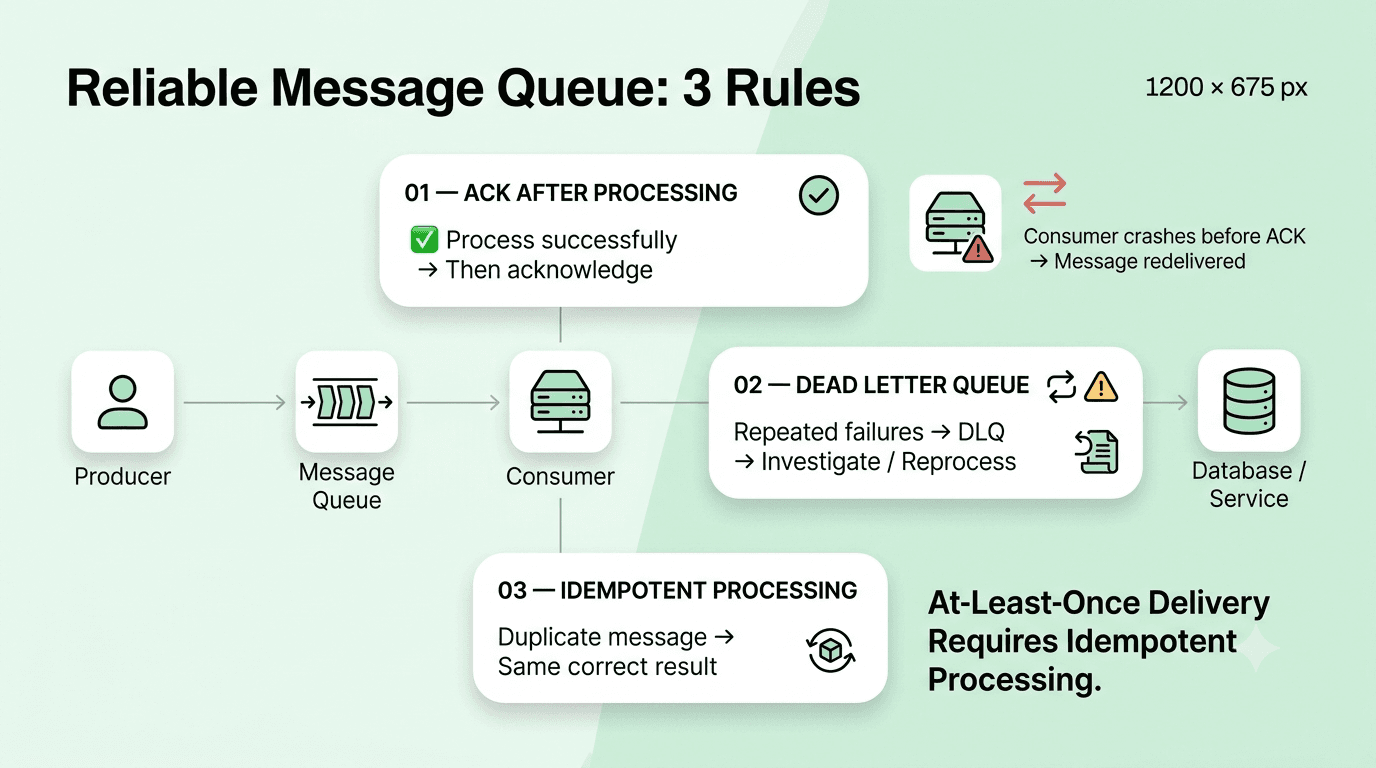
A candidate designs a system where order confirmations are sent by publishing events to a message queue and having a consumer process them. They describe the producer and consumer correctly for the happy path. The interviewer asks what happens if the consumer crashes after receiving a message but before successfully processing it, and the candidate either says the message would be lost, says the queue would automatically retry without explaining the acknowledgment model, or proposes a dead letter queue without being able to explain what it is and how it connects to the retry flow.
Why Recruiters Flag This
Message queues are not magic reliability infrastructure. They provide reliability guarantees only when the consumer is implemented correctly using the queue's acknowledgment model: a consumer must not acknowledge a message until it has successfully processed it, so that an unacknowledged message can be redelivered to another consumer instance after the original consumer fails. A consumer that acknowledges immediately on receipt, or a system that has no dead letter queue for messages that consistently fail processing, loses messages under real failure conditions regardless of the queue being present.
The Real Cost
A message queue consumer that acknowledges before processing creates the illusion of reliability. Events appear to be published and consumed, the queue depth stays low, and no errors are visible. But every time a consumer crashes between acknowledgment and processing, that event is silently lost. For a notification system this means missed notifications. For an order processing system it means unprocessed orders. For a billing system it means missed invoices.
The Complete Fix
Memorize a three-part reliable consumer design and name all three parts whenever a message queue appears in a system design answer. First, acknowledge only after successful processing: the consumer must complete its processing logic, including any database writes and any downstream calls, before sending the acknowledgment to the queue. If the consumer crashes before acknowledging, the queue redelivers the message to another consumer instance. Second, implement a dead letter queue: after a configurable number of delivery attempts, messages that cannot be processed successfully are moved to a dead letter queue where they can be inspected and reprocessed manually rather than being silently discarded. Third, make processing idempotent: because at-least-once delivery means a message may be delivered more than once, the consumer must be designed to produce the correct result regardless of whether it processes the same message once or ten times.
In any design interview that includes a message queue, state all three components explicitly: "I want to be specific about the reliability model here. The consumer will acknowledge only after successful processing, not on receipt. I will configure a dead letter queue so that messages that fail after, say, five attempts are available for investigation rather than dropped. And I will make the processing logic idempotent so that a redelivered message produces the same result as the original."
Practice Method
Build a consumer for any queue technology that deliberately implements all three reliability patterns: acknowledgment after processing with a simulated crash between receipt and processing to verify redelivery, a configured dead letter queue with a retry limit, and an idempotent processing function verified by reprocessing the same message twice and confirming only one output is produced. Run each failure scenario explicitly and verify the system behaves correctly in each one.
Category 5: Observability and Behavioral Mistakes
Mistake 11: Claiming Observability Experience Without Being Able to Describe Specific Signals Used in a Real Incident
What This Looks Like
A candidate lists observability, monitoring, or Datadog on their resume. The interviewer asks them to describe a production incident they investigated and specifically how they used their observability stack to diagnose it. The candidate gives a vague answer: "our monitoring alerted on high error rates and we investigated the logs." When the interviewer probes further, asking what specific metrics triggered the alert, what the logs showed that narrowed down the cause, and whether distributed tracing was available to pinpoint the failing component, the candidate cannot answer at this level of specificity.
Why Recruiters Flag This
Observability is a backend engineering discipline, not a product feature that comes with a monitoring tool subscription. A team has observability when its engineers have designed specific signals, defined meaningful alerts, and practiced the diagnostic workflow that those signals enable. A candidate who has worked in a team with Datadog installed but has never personally designed a metric, written a structured log event, or used a distributed trace to diagnose an incident has observability awareness but not observability engineering experience. These are different skills and the interview reveals which one a candidate actually has within the first follow-up question.
The Real Cost
On the job, an engineer who cannot design effective observability leaves a system unobservable. When that system has a production incident, the team spends hours reading unstructured log files, guessing at causes, and applying fixes without knowing whether they worked. The cost of a production incident in an unobservable system is measured in hours of engineering time per incident and user experience degradation during the diagnosis period.
The Complete Fix
Prepare a specific observability story for any interview where backend experience is discussed: one incident, the specific signals that revealed it, and the diagnostic workflow those signals enabled. The story needs enough specificity that it could not apply to any other candidate: not "error rates spiked and we investigated," but "the p99 latency on the payment confirmation endpoint crossed our 2000ms alert threshold at 2:17 PM, which was the first signal. I opened the distributed traces for requests in that time window and found that the database query for order verification was taking 1400ms rather than its normal 12ms, which narrowed the cause immediately. I checked the database metrics and found lock wait time spiking on the orders table, which led me to a long-running transaction from a batch job that had acquired a table-level lock. I killed the batch job, latency returned to normal within thirty seconds."
This level of specificity is only possible if you have actually used your observability stack to diagnose real incidents. If you have not, the practice method below will help you build both the experience and the story.
Practice Method
Deliberately introduce a performance degradation or a simulated failure into a personal project that has observability instrumentation, then diagnose it using only the signals you instrumented, without reading the source code to find the cause. Document the diagnostic workflow: which signal alerted first, which signal narrowed the cause, and which signal confirmed the fix worked. This exercise builds both the observability engineering skill and the incident story that interviews require.
Mistake 12: Describing Past Distributed Systems as Reliable Without Acknowledging the Consistency Trade-Offs Made
What This Looks Like
A candidate describes a past project involving multiple services or a distributed database and presents it as reliable and correct. The interviewer asks whether the system guaranteed strong consistency or eventual consistency across services, and the candidate either does not know the difference, says it had strong consistency when the described architecture makes that impossible, or says "it was always consistent" without being able to explain the consistency model the database or queue provided and what guarantees that model actually makes.
Why Recruiters Flag This
Every distributed system makes explicit or implicit trade-offs between consistency, availability, and partition tolerance. A candidate who has worked on a distributed system but cannot articulate its consistency model has been using a system without understanding its guarantees, which means they could not have designed the correct error handling, could not have reasoned about the edge cases where inconsistency would be observable, and could not have made the right trade-offs for new systems they design in the future.
The Real Cost
A developer who assumes their distributed system provides strong consistency when it provides eventual consistency will design features that behave incorrectly under real conditions: displaying a balance that reflects a transfer that has not yet propagated, showing an inventory count that has not yet updated after a sale, or sending a notification about a state that has not yet been committed to the primary database.
The Complete Fix
For every distributed system you have worked on, know the specific consistency model of each storage and messaging component you used, and be able to describe a scenario where that consistency model's trade-offs are observable. For a system using PostgreSQL with read replicas: replicas operate with replication lag, so a write to the primary is not immediately visible on a replica, and reading from a replica after a write may return the pre-write value for a window of time. For a system using Kafka: message ordering is guaranteed within a partition but not across partitions, so a consumer that processes events from multiple partitions cannot assume they arrive in the order they were produced.
Prepare a one-sentence description of the consistency model for each storage and messaging component in any system you would discuss in an interview, and be ready to describe a specific edge case where that model's trade-offs would be observable. This preparation demonstrates that you understood the systems you worked on rather than simply operated them.
Practice Method
For each storage and messaging component in your most recent backend project, look up its consistency guarantees and write out two sentences: what the consistency model guarantees, and one specific scenario where a user or the system could observe the trade-off. This exercise forces engagement with the actual guarantees of the systems you use rather than the idealized behavior you may have assumed.
Category 6: AI-Era Mistakes Specific to Backend Interviews
Mistake 13: Not Reviewing AI-Generated Backend Endpoints for the Authorization Vulnerability the Tool Almost Always Introduces
What This Looks Like
A candidate uses an AI coding tool during a live round or take-home assignment to generate a backend endpoint that retrieves a user resource. The tool generates a working endpoint with authentication middleware, a database query that retrieves the correct resource, and proper error handling. The code looks complete and passes the functional test case the candidate runs. The candidate submits it. The reviewer calls the endpoint with a valid token for user A, changes the resource ID in the URL to a resource belonging to user B, and the endpoint returns user B's data because the AI-generated query filters by resource ID but not by the authenticated user's ownership.
Why Recruiters Flag This
This is the most specific and most consistent AI-generated backend security vulnerability in 2026: AI coding tools generate authentication correctly and generate resource retrieval correctly, but they almost never generate resource-level authorization correctly because they do not model the threat of a legitimate authenticated user accessing another user's data. The tool does not generate the ownership check because no test in its context asked it to prevent that specific scenario. A candidate who reviews AI-generated backend code must specifically check for this pattern on every resource endpoint, because the absence of this check is the most likely place the tool introduced a vulnerability.
The Real Cost
A submitted take-home with this vulnerability sends a specific, clear signal: the candidate used an AI tool and did not review its output for the most common and most consequential security failure it produces. This is worse than the vulnerability itself. It reveals that the candidate's AI review process has a gap in exactly the area where backend security most commonly fails.
The Complete Fix
Build a backend-specific AI code review checklist of five checks that you run on every AI-generated endpoint before submitting or merging it, regardless of whether the endpoint passes its functional tests.
First, and most important: does every resource retrieval, update, and delete endpoint verify that the authenticated user owns or is authorized to access the specific resource, not just that the user is authenticated? Check this by tracing from the authentication middleware to the data access query and confirming the user's identifier appears as a filter condition in the query, not as a separate conditional check after the data is fetched.
Second: does any error response include database error text, stack trace information, or internal service names? If yes, replace with a generic message plus correlation ID.
Third: do any endpoints that accept user input use parameterized queries or an ORM that parameterizes automatically, with no string concatenation used in a query construction? If string concatenation appears anywhere near a query, treat it as a SQL injection vulnerability until proven otherwise.
Fourth: do authentication endpoints have rate limiting configured? If the AI generated a login or password reset endpoint without rate limiting middleware, add it before submitting.
Fifth: are passwords being compared using a constant-time comparison function rather than a standard equality check, to prevent timing attacks that reveal whether a guessed password was close to correct?
Narrate this checklist out loud during any live round that involves AI-assisted backend coding: "Before I consider this endpoint complete, I am running through my security checklist. Ownership check: present, the query includes user_id as a filter. Error response: generic message only, full detail goes to structured logs. Parameterized query: yes, using the ORM. Rate limiting: I should add that to the authentication endpoint specifically." This narration is the visible demonstration of security discipline that separates candidates who use AI tools responsibly from those who use them carelessly.
Practice Method
Generate ten backend endpoints using an AI coding tool, specifically including endpoints that retrieve, update, and delete user resources. For each generated endpoint, apply the five-check checklist before looking at whether the endpoint is functionally correct. Record which check fails most often across the ten endpoints. Use this frequency data to prioritize which check you lead with in future reviews, since the most common failure is the one most worth catching automatically.
Self-Check: Are You Making These Mistakes Without Realizing It
If more than three of these are unchecked, this list is your concrete interview preparation plan for the next two weeks, not supplemental reading.
Conclusion
Thirteen backend-specific interview mistakes, each with a mechanism-level explanation and a rehearsable fix. The pattern connecting all of them is the same one that connects every backend production incident worth studying: the difference between a system that works when everything goes as expected and a system that works correctly when the network is unreliable, the database is slow, the message is delivered twice, and an authenticated user tries to access data they do not own.
Every fix in this guide is a habit, not a reminder. Asking clarifying questions before designing is a habit. Running fault injection on every component is a habit. Adding the ownership check to every resource query is a habit. Running the five-check security review on every AI-generated endpoint is a habit. The challenge is not learning that these habits exist. The challenge is building them strongly enough that they survive the specific pressure of a live interview follow-up question that you did not expect.
That is exactly the gap that structured, pressure-tested practice closes. Knowing that you should ask clarifying questions and actually doing it when an interviewer is watching and a timer is running are different skills. Building the second through repeated practice under realistic interview conditions, specifically the kind where follow-up questions probe the failure modes you did not mention, is where platforms like Mocklingo's AI mock interview practice make the most difference: giving you the repetitions that build automatic habits before those habits have to hold in an interview that decides your offer.
FAQs
More Blogs


Oct 22, 2026
UI/UX Designer Interview Preparation Guide: A Complete Roadmap for 2026
38 min read

