Loading...
Contents
Top 100 Backend Developer Interview Question asked in 2026
Sep 1, 2026123 min readUpdated Oct 23, 2026
This manual tags every question with the role level where it's most likely to come up - JR (junior/entry screens), MID (mid-level technical rounds), SR (senior/staff rounds involving architecture and tradeoffs), or ALL (asked at every level, just with rising expected depth). Use the tags to triage: if you're interviewing for a senior role, don't skip the ALL questions, interviewers expect senior candidates to answer them with more nuance, not skip them.
Sections:
Core Backend Fundamentals & HTTP — Q1–Q12
API Design (REST, GraphQL, gRPC) — Q13–Q24
Databases: SQL & NoSQL — Q25–Q38
System Design & Scalability — Q39–Q52
Caching, Messaging & Async Processing — Q53–Q62
Security — Q63–Q70
Testing & Code Quality — Q71–Q78
DevOps, Deployment & Observability — Q79–Q88
Scenario-Based & Behavioral — Q89–Q95
Industry Trends — Q96–Q100
FREE TO USE
25K+ INTERVIEWS4.8★ RATING68% IMPROVEMENT
Crack Your Dream Job
Real Interviews. Real Pressure. Practice until it feels easy.
- Seamless Interview Experience
- Resume & JD Questions
- Instant Personalized Feedback
Section 1: Core Backend Fundamentals & HTTP
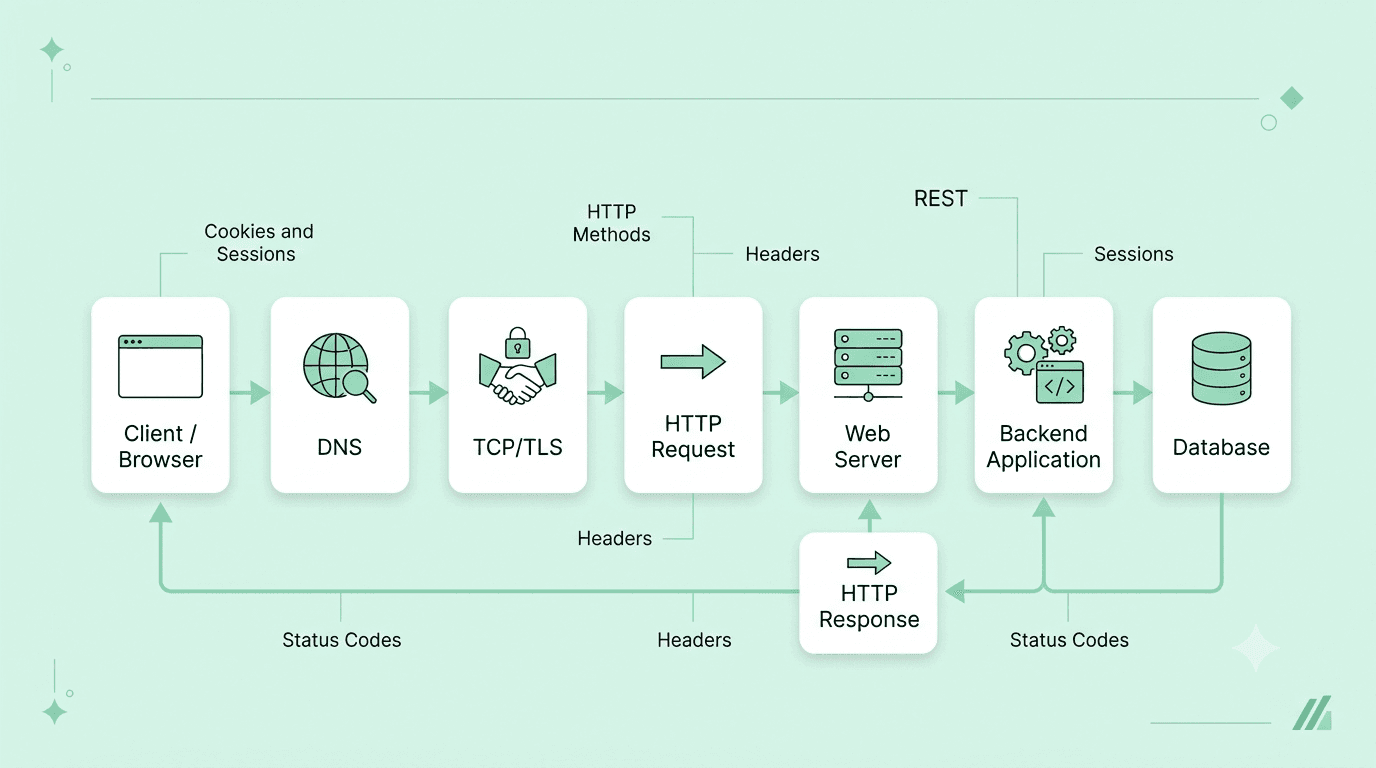
Q1 · [ALL] What happens between a client sending an HTTP request and a server sending back a response?
Answer: The client resolves the server's domain to an IP via DNS, opens a TCP connection (with a TLS handshake if HTTPS), sends the HTTP request line, headers, and optional body, the server's application processes it (routing, business logic, database calls) and constructs a response with a status code, headers, and body, which travels back over the same connection.
Explanation: This is the single most foundational question in backend interviewing — it reveals whether a candidate actually understands the request lifecycle or has only ever worked one layer up inside a framework's abstractions.
Real-World Example: Debugging a slow API endpoint often starts by figuring out which stage is slow — DNS resolution, connection setup, server processing, or network transfer — and each stage points to a completely different fix.
Common Mistakes: Jumping straight to "the server runs some code and sends JSON back" without mentioning DNS, TCP, or TLS at all, which suggests the candidate has never had to debug a real network-level issue.
Follow-up Questions: What's the difference between TCP and UDP, and why does HTTP use TCP? What happens differently on a subsequent request to the same server (connection reuse, DNS caching)? How does HTTP/2 change this picture?
Q2 · [ALL] What's the difference between HTTP status code categories (1xx, 2xx, 3xx, 4xx, 5xx)?
Answer: 1xx are informational (rare, like 100 Continue), 2xx indicate success (200 OK, 201 Created, 204 No Content), 3xx indicate redirection (301 permanent, 302/307 temporary), 4xx indicate a client-side error (400 bad request, 401 unauthorized, 404 not found), and 5xx indicate a server-side error (500 internal error, 503 service unavailable).
Explanation: Correct status code usage is a basic but very frequently checked signal of whether a candidate builds APIs that behave predictably for consumers, versus one that just returns 200 for everything with an error message buried in the body.
Real-World Example: A payment API returning 200 with {"success": false} instead of an appropriate 4xx/5xx code forces every client integration to parse the response body just to know if something failed, breaking standard HTTP tooling and monitoring that keys off status codes.
Common Mistakes: Using 200 for all responses regardless of outcome, or confusing 401 (not authenticated) with 403 (authenticated but not authorized).
Follow-up Questions: When would you use 422 versus 400? What status code would you return for a resource that exists but the user isn't allowed to know exists? How should a client behave differently on 429 versus 503?
Q3 · [ALL] What's the difference between stateless and stateful backend architecture?
Answer: A stateless backend treats each request independently, with no server-side memory of prior requests from that client — any needed state is passed in the request itself (like a token) or stored externally (in a database or cache). A stateful backend keeps request-related context in server memory between requests (like an in-memory session), tying a client to a specific server instance.
Explanation: Statelessness is a core enabling principle for horizontal scaling, since any request can be routed to any server instance without needing "sticky" routing to whichever server happens to hold that client's session state.
Real-World Example: A stateless JWT-based API can freely load-balance requests across any number of server instances, while a stateful in-memory-session API requires sticky sessions at the load balancer, complicating scaling and failover.
Common Mistakes: Building a "stateless" API that quietly relies on in-memory caching of per-user data between requests, which breaks the moment the app is scaled to more than one instance.
Follow-up Questions: How would you migrate a stateful session-based app to a stateless architecture? What are the tradeoffs of storing session state in Redis versus a JWT? How does statelessness affect horizontal scaling specifically?
Q4 · [ALL] What is idempotency, and why does it matter for API design?
Answer: An idempotent operation produces the same end result no matter how many times it's performed — calling it once or ten times leaves the system in the same state. GET, PUT, and DELETE are meant to be idempotent by HTTP convention; POST generally is not.
Explanation: Idempotency is critical for building reliable systems that can safely retry failed requests (due to a network timeout, for example) without risking duplicate side effects like double-charging a customer.
Real-World Example: A payment API accepting a client-generated idempotency key ensures that if a network timeout causes a client to retry a charge request, the server recognizes the duplicate key and returns the original result instead of charging the customer twice.
Common Mistakes: Assuming POST endpoints are safe to blindly retry on timeout without an idempotency mechanism, which can cause real financial or data-integrity damage in production.
Follow-up Questions: How would you implement idempotency keys server-side? Is DELETE truly idempotent if the second call returns a 404 instead of a 204 — does that violate idempotency? How does idempotency relate to at-least-once versus exactly-once message delivery?
Q5 · [MID] What's the difference between synchronous and asynchronous request handling on the backend, and why does it matter for throughput?
Answer: Synchronous handling blocks the handling thread/worker until an operation (like a database query or external API call) completes, tying up that worker for the full duration. Asynchronous handling lets the runtime free up the worker to handle other requests while waiting on I/O, resuming the original request once the awaited operation completes — enabling a single process to handle far more concurrent I/O-bound requests with the same number of workers.
Explanation: This distinction underlies a huge amount of backend architecture decisions, from choosing a runtime (Node.js, async Python frameworks) to sizing thread/worker pools correctly.
Real-World Example: A traditional synchronous WSGI-based Python app might need dozens of worker processes to handle moderate concurrent traffic if each request involves a slow external API call, while an async framework can handle the same load with far fewer workers since each one isn't blocked waiting.
Common Mistakes: Calling a blocking, synchronous library function from within an async request handler, which silently blocks the entire event loop and defeats the purpose of using an async framework at all.
Follow-up Questions: How would you size a worker pool for a synchronous framework handling a known request rate and average response time? What happens to an async server if a handler performs CPU-bound work synchronously? How does this tradeoff differ for CPU-bound versus I/O-bound workloads?
Q6 · [MID] What is a race condition in a backend context, and how would you prevent one?
Answer: A race condition occurs when the correctness of an operation depends on the unpredictable relative timing of concurrent requests accessing shared state — like two simultaneous requests both reading a stock count of 1, both deciding it's available, and both decrementing it, resulting in an oversold item. Prevention typically uses database-level locking (row locks, SELECT ... FOR UPDATE), atomic operations, or optimistic concurrency control with version checks.
Explanation: Race conditions are one of the most common sources of subtle, hard-to-reproduce production bugs in backend systems handling concurrent requests against shared state.
Real-World Example: An e-commerce inventory system without proper locking can oversell a limited-stock item during a flash sale when many concurrent purchase requests all read the same stale inventory count before any of them commits their decrement.
Common Mistakes: Relying on a "check then act" pattern (checking a condition, then acting on it in a separate step) without any locking or atomicity, leaving a window where another concurrent request can invalidate the assumption.
Follow-up Questions: What's the difference between optimistic and pessimistic locking, and when would you choose each? How would you implement this specific inventory-decrement operation atomically at the database level? How does this problem change in a distributed system spanning multiple databases?
Q7 · [ALL] What is the difference between horizontal and vertical scaling for a backend service?
Answer: Vertical scaling increases the resources (CPU, RAM) of a single server instance — simple but has a hard ceiling and remains a single point of failure. Horizontal scaling adds more server instances and distributes load across them via a load balancer — offers much greater scale and resilience but requires the application to be designed statelessly (or with externalized state) to work correctly.
Explanation: A foundational scalability concept that interviewers use to gauge whether a candidate can reason about tradeoffs rather than reflexively citing "just scale horizontally" as a universal answer.
Real-World Example: A backend service relying on in-memory caching of user sessions can't simply be horizontally scaled without first externalizing that session state to something like Redis, or requests for the same user might unpredictably hit a server that doesn't have their session.
Common Mistakes: Recommending horizontal scaling without acknowledging the architectural changes (statelessness, externalized state, database connection pool sizing) it actually requires to work correctly.
Follow-up Questions: What application changes are needed to make a stateful service horizontally scalable? How does horizontal scaling affect database load, and how would you address that? At what point does vertical scaling stop being a reasonable option?
Q8 · [JR/MID] What is the difference between a monolithic and a microservices backend architecture?
Answer: A monolith is a single, unified deployable application containing all functionality, simpler to develop, test, and deploy, especially for a small team. Microservices decompose the application into small, independently deployable services communicating over a network, enabling independent scaling and deployment per service, at the cost of significantly more operational complexity — distributed tracing, network latency, and cross-service data consistency.
Explanation: A very commonly tested architectural tradeoff question, testing whether a candidate treats microservices as a universal best practice or understands the real complexity cost involved.
Real-World Example: A small startup team typically benefits from starting with a well-organized monolith, retaining the option to extract specific services later once a genuine, demonstrated need for independent scaling or deployment emerges.
Common Mistakes: Recommending microservices by default for a small team or early-stage product without acknowledging the substantial added operational overhead relative to the team's actual current scale and needs.
Follow-up Questions: How would you decide on service boundaries when breaking apart a monolith? How do microservices typically handle a transaction that needs to span multiple services? What signals would tell you a team is genuinely ready for microservices?
Q9 · [JR] What is the difference between GET and POST, and when would you use each?
Answer: GET requests data and should be safe (no side effects) and idempotent, with parameters typically passed in the URL — suitable for caching and bookmarking. POST submits data to create or modify a resource, is not idempotent by convention, and typically carries data in the request body rather than the URL, which also avoids URL length limits and keeps sensitive data out of browser history/logs.
Explanation: A very foundational HTTP question, testing basic REST literacy that underlies almost all API design work.
Real-World Example: A search feature uses GET (so results are bookmarkable and shareable via URL), while a login form uses POST (so credentials aren't exposed in the URL, browser history, or server access logs).
Common Mistakes: Using GET for an operation with side effects (like a "delete" link triggered by a simple GET request), which breaks safely and can be accidentally triggered by prefetching, crawlers, or browser back/forward navigation.
Follow-up Questions: Why should GET requests never have side effects, even in principle? What's the practical size/security difference between passing data via a URL query string versus a POST body? How does this relate to CSRF vulnerability differences between GET and POST endpoints?
Q10 · [MID] What is connection pooling, and why is it essential for backend performance?
Answer: Connection pooling maintains a reusable set of already-established database (or other resource) connections that the application borrows and returns, rather than opening a brand-new connection for every single request — since establishing a connection carries real overhead (TCP handshake, authentication), pooling significantly improves throughput and prevents the backend from overwhelming the database's own maximum connection limit under load.
Explanation: A very practical, frequently tested backend infrastructure concept, since misconfigured connection pooling is a genuinely common real-world cause of production outages under traffic spikes.
Real-World Example: A backend service handling thousands of concurrent requests without connection pooling would attempt to open thousands of individual database connections simultaneously, likely exceeding the database's connection limit and causing cascading failures.
Common Mistakes: Setting a connection pool size without considering the database's actual maximum connection limit, or without accounting for multiple horizontally-scaled application instances each maintaining their own separate pool.
Follow-up Questions: How would you determine an appropriate pool size for a given expected traffic level? What happens to a request when the pool is fully exhausted? How does connection pooling need to be reconsidered when horizontally scaling the application across many instances?
Q11 · [MID] What is backpressure in a backend system, and how would you handle it?
Answer: Backpressure occurs when a system receives requests or data faster than it can process them, and handling it well means the system explicitly signals or slows the sender rather than silently queueing unboundedly (risking memory exhaustion) or dropping data unpredictably — common approaches include rate limiting, bounded queues that reject or shed load once full, and circuit breakers that stop forwarding requests to an overwhelmed downstream service.
Explanation: A more advanced but increasingly commonly tested resilience concept, since properly handling overload conditions is what separates systems that degrade gracefully from ones that fail catastrophically.
Real-World Example: A message queue consumer that can't keep up with incoming message volume needs an explicit backpressure strategy (like pausing consumption, or scaling out more consumers) rather than allowing an unbounded in-memory queue to grow until the process runs out of memory and crashes.
Common Mistakes: Building a system with unbounded queues or unlimited retry logic that assumes downstream systems can always eventually catch up, without any explicit strategy for what happens under sustained overload.
Follow-up Questions: How would you implement a circuit breaker, and what state transitions does it go through? How would you decide between load shedding (dropping requests) versus queueing them? How does backpressure handling differ between a synchronous request/response API and an asynchronous message-based system?
Q12 · [JR/MID] What is the difference between a 4xx and 5xx error, and how should a backend handle each differently?
Answer: A 4xx error indicates the client made a mistake (bad input, missing auth, requesting a nonexistent resource) — the server should return a clear, specific error message so the client can correct its request. A 5xx error indicates the server itself failed to fulfill an otherwise valid request — this should be logged with full diagnostic detail server-side, while the client-facing message stays generic to avoid leaking internal implementation details.
Explanation: A foundational error-handling distinction that also tests awareness of the security implications of what information gets exposed to clients versus kept in internal logs.
Real-World Example: A production API returning a full stack trace and database error message to the client on a 500 error both confuses legitimate users and can hand a malicious actor valuable information about the internal system architecture.
Common Mistakes: Returning detailed internal error messages or stack traces directly in client-facing 5xx responses, or conversely returning a generic 500 for what's actually a client input error that should be a specific, actionable 4xx.
Follow-up Questions: How would you structure your error logging to capture enough detail for debugging without over-logging sensitive data? How would you monitor and alert on a spike in 5xx error rates? What's an appropriate client-facing message for an unexpected 500 error?
Q11 · [MID] What is backpressure in a backend system, and how would you handle it?
Answer: Backpressure occurs when a system receives requests or data faster than it can process them, and handling it well means the system explicitly signals or slows the sender rather than silently queueing unboundedly (risking memory exhaustion) or dropping data unpredictably — common approaches include rate limiting, bounded queues that reject or shed load once full, and circuit breakers that stop forwarding requests to an overwhelmed downstream service.
Explanation: A more advanced but increasingly commonly tested resilience concept, since properly handling overload conditions is what separates systems that degrade gracefully from ones that fail catastrophically.
Real-World Example: A message queue consumer that can't keep up with incoming message volume needs an explicit backpressure strategy (like pausing consumption, or scaling out more consumers) rather than allowing an unbounded in-memory queue to grow until the process runs out of memory and crashes.
Common Mistakes: Building a system with unbounded queues or unlimited retry logic that assumes downstream systems can always eventually catch up, without any explicit strategy for what happens under sustained overload.
Follow-up Questions: How would you implement a circuit breaker, and what state transitions does it go through? How would you decide between load shedding (dropping requests) versus queueing them? How does backpressure handling differ between a synchronous request/response API and an asynchronous message-based system?
Q12 · [JR/MID] What is the difference between a 4xx and 5xx error, and how should a backend handle each differently?
Answer: A 4xx error indicates the client made a mistake (bad input, missing auth, requesting a nonexistent resource) — the server should return a clear, specific error message so the client can correct its request. A 5xx error indicates the server itself failed to fulfill an otherwise valid request — this should be logged with full diagnostic detail server-side, while the client-facing message stays generic to avoid leaking internal implementation details.
Explanation: A foundational error-handling distinction that also tests awareness of the security implications of what information gets exposed to clients versus kept in internal logs.
Real-World Example: A production API returning a full stack trace and database error message to the client on a 500 error both confuses legitimate users and can hand a malicious actor valuable information about the internal system architecture.
Common Mistakes: Returning detailed internal error messages or stack traces directly in client-facing 5xx responses, or conversely returning a generic 500 for what's actually a client input error that should be a specific, actionable 4xx.
Follow-up Questions: How would you structure your error logging to capture enough detail for debugging without over-logging sensitive data? How would you monitor and alert on a spike in 5xx error rates? What's an appropriate client-facing message for an unexpected 500 error?
Section 2: API Design (REST, GraphQL, gRPC)
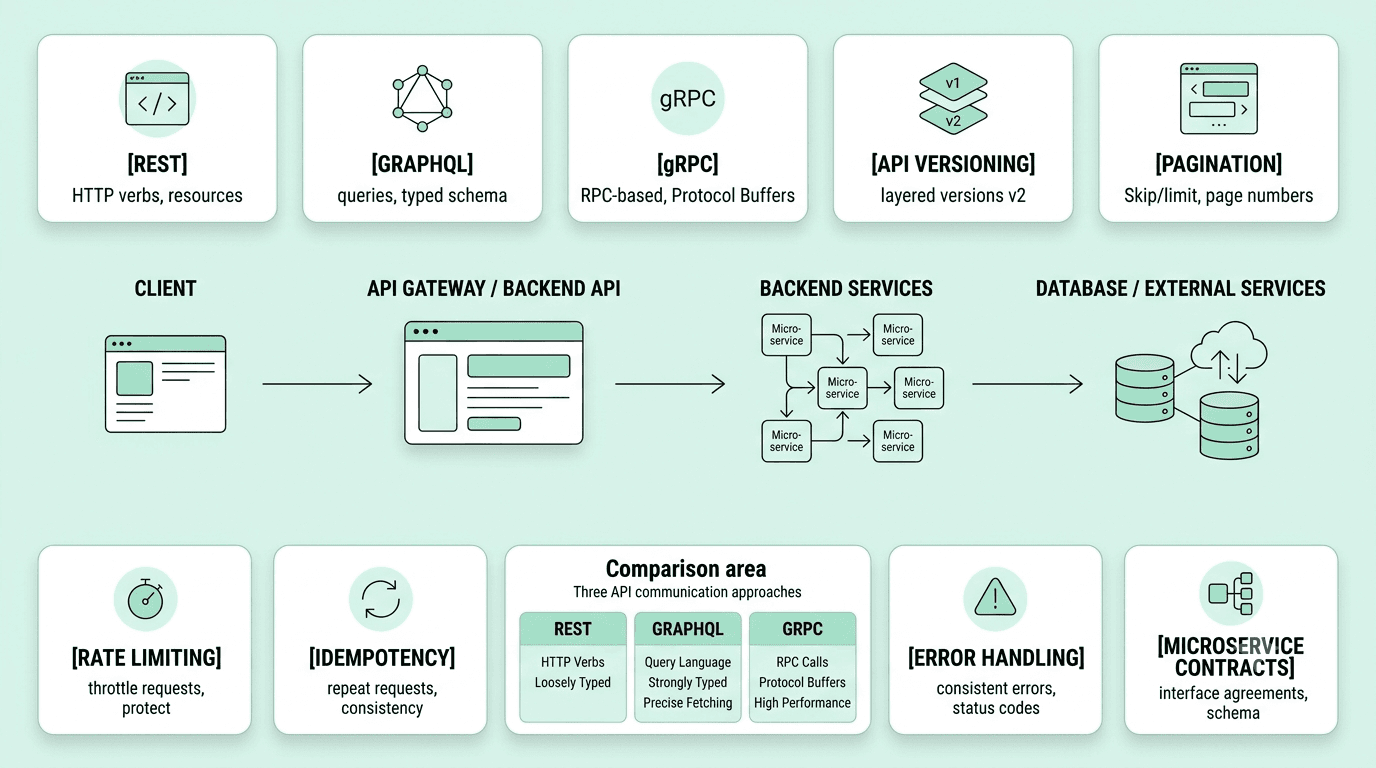
Q13 · [ALL] What makes an API "RESTful," and what common mistakes violate REST principles?
Answer: REST principles include resource-based URLs (nouns, not verbs), statelessness (no server-side session between requests), proper use of HTTP methods and status codes, and a uniform, predictable interface. Common violations include verb-based endpoints (/getUser instead of GET /users/{id}), returning 200 for all outcomes regardless of success/failure, and embedding session state server-side that breaks statelessness.
Explanation: A very commonly tested foundational API design question, testing whether a candidate follows established conventions that make an API predictable and easy for other developers to integrate with.
Real-World Example: A well-designed articles API exposes GET /articles, POST /articles, GET /articles/{id}, and DELETE /articles/{id} — clear, resource-based, and consistent with widely-understood REST conventions, versus an API with endpoints like /fetchArticleById and /removeArticle.
Common Mistakes: Using verb-based URLs instead of resource nouns combined with proper HTTP methods, which breaks the predictability and tooling compatibility that makes REST valuable in the first place.
Follow-up Questions: How would you design a nested resource, like comments belonging to an article? How would you handle an action that doesn't map cleanly to a CRUD operation, like "publish this article"? What does HATEOAS mean, and how often is it actually implemented in practice?
Q14 · [MID] How would you design pagination for an API returning a potentially very large collection?
Answer: Two main approaches: offset-based pagination (?page=2&limit=20), simple to implement and understand but can produce inconsistent results if data changes between requests and gets slower on large offsets; and cursor-based pagination (?after=<cursor>&limit=20), using a stable pointer (often an encoded ID or timestamp) that remains consistent even as underlying data changes, and performs consistently regardless of how deep into the collection you paginate.
Explanation: A very commonly asked practical API design question, since pagination strategy has real performance and correctness implications at scale that many candidates haven't thought through.
Real-World Example: A social media feed uses cursor-based pagination specifically because offset-based pagination would show duplicate or skipped posts as new content is continuously inserted at the top while a user scrolls.
Common Mistakes: Defaulting to simple offset-based pagination for a rapidly-changing, high-volume dataset without considering the consistency and performance problems it introduces at scale.
Follow-up Questions: Why does offset-based pagination get slower for higher page numbers on large tables? How would you encode a cursor to make it opaque and tamper-resistant to clients? How would you communicate total result count to clients using cursor-based pagination, given it doesn't map naturally to page numbers?
Q15 · [MID] What's the difference between REST and GraphQL, and when would you choose GraphQL for a backend?
Answer: REST exposes multiple fixed endpoints per resource, simple to cache and reason about but prone to over-fetching or under-fetching data. GraphQL exposes a single endpoint where clients specify exactly the fields they need, reducing over/under-fetching and round trips, at the cost of added backend complexity — resolver design, the N+1 query problem, and more complex HTTP-level caching since it typically uses a single POST endpoint.
Explanation: A very commonly tested architectural comparison, testing genuine understanding of tradeoffs rather than treating either approach as universally superior.
Real-World Example: A mobile app needing a user's profile plus several selectively-needed nested resources in one request benefits significantly from GraphQL's precise field selection, avoiding several separate REST round trips or a bespoke, inflexible custom endpoint.
Common Mistakes: Recommending GraphQL without acknowledging its added backend complexity, particularly the N+1 resolver problem that requires a solution like DataLoader to avoid a performance disaster.
Follow-up Questions: How does GraphQL address the N+1 query problem on the backend? How would you implement caching for a GraphQL API given its typical single-endpoint design? What are the security considerations specific to GraphQL, like query depth/complexity limiting?
Q16 · [ADVANCED/SR] What is gRPC, and when would you choose it over REST or GraphQL for a backend service?
Answer: gRPC is a high-performance RPC framework using Protocol Buffers for efficient binary serialization and HTTP/2 for multiplexed, low-latency communication, generating strongly-typed client/server code from a shared schema (.proto file) — well suited for internal service-to-service communication where performance and strict typing matter, but less ideal for public-facing APIs consumed directly by web browsers (which historically have limited native gRPC support) or where broad client compatibility and human-readable payloads matter more.
Explanation: A commonly tested question at companies with a microservices architecture, testing awareness of the appropriate tool for internal versus external-facing API communication.
Real-World Example: A company's internal microservices might communicate via gRPC for its performance and strict contract benefits, while the same company's public-facing API (consumed by third-party developers and browsers) uses REST or GraphQL for broader compatibility and easier debugging.
Common Mistakes: Choosing gRPC for a public-facing API primarily consumed by web browsers without accounting for the added complexity of browser compatibility (requiring gRPC-Web or a proxy layer).
Follow-up Questions: How does Protocol Buffers' binary serialization compare to JSON in terms of size and parsing performance? How would you handle versioning a .proto schema without breaking existing clients? What's gRPC streaming, and what use cases does it enable that REST doesn't handle as naturally?
Q17 · [MID] How would you version an API to support breaking changes without disrupting existing clients?
Answer: Common strategies include URI versioning (/v1/users, /v2/users — simple and highly visible but can lead to code duplication), header-based versioning (specifying a version in a custom request header, keeping URLs clean but less discoverable), and content negotiation via the Accept header. Whichever strategy is chosen, the key practice is maintaining the older version for a defined deprecation window with clear communication to consumers before fully sunsetting it.
Explanation: A commonly tested API design and long-term maintainability question, testing forward-thinking awareness of how to evolve an API responsibly.
Real-World Example: Well-known public APIs like Stripe's use explicit versioning specifically to allow introducing breaking changes over time without forcing every existing integration to update simultaneously.
Common Mistakes: Making a breaking change to a live, actively-used endpoint without any versioning strategy, immediately breaking every existing client depending on that endpoint's previous behavior.
Follow-up Questions: How would you handle deprecating and eventually fully sunsetting an older API version responsibly? What are the tradeoffs between URI-based and header-based versioning? How does GraphQL's schema evolution approach differ from typical REST versioning?
Q18 · [MID] How would you design an API to be idempotent for a payment or order-creation endpoint?
Answer: Require the client to generate and pass a unique idempotency key with the request; the server stores the result of the first request keyed by that idempotency key, and any subsequent request with the same key returns the original stored result rather than re-executing the operation — critically, the check-and-store must happen atomically (often via a unique database constraint) to avoid a race condition on concurrent retries.
Explanation: A very commonly asked practical implementation question given how common and business-critical payment/order flows are, testing understanding of idempotency beyond the abstract definition.
Real-World Example: Stripe's API requires an Idempotency-Key header on payment creation requests precisely so a network timeout followed by a client retry doesn't result in a customer being charged twice.
Common Mistakes: Implementing idempotency key checking and the actual operation as two separate, non-atomic steps, leaving a race condition window where two near-simultaneous retries with the same key could both slip through.
Follow-up Questions: How long should idempotency keys be retained before expiring? How would you handle a request that's still in-progress when a retry with the same key arrives? How would you extend idempotency across a distributed system spanning multiple services?
Q19 · [MID] What is rate limiting, and how would you implement it for a backend API?
Answer: Rate limiting restricts the number of requests a client can make within a given time window, protecting the API from abuse and accidental overload. Implementation typically uses an algorithm like token bucket (allows bursts, refills at a fixed rate) or sliding window counters, commonly backed by a fast shared store like Redis so the limit is enforced consistently across multiple horizontally-scaled server instances, returning 429 when a client exceeds their limit.
Explanation: A commonly tested practical infrastructure question, important for building resilient, production-ready backend services that can survive traffic spikes or abusive clients.
Real-World Example: A public API might limit each API key to 100 requests per minute using Redis to atomically increment a per-key counter with a TTL, consistently enforced across all server instances.
Common Mistakes: Implementing rate limiting with only an in-memory counter on a single server instance, which fails to work correctly once horizontally scaled since each instance tracks its own separate, inconsistent count.
Follow-up Questions: How would token bucket differ in behavior from a fixed window counter, especially around burst traffic at window boundaries? How would you communicate remaining quota to clients via response headers? How would you rate-limit per-user versus per-IP, and what are the tradeoffs?
Q20 · [SR] How would you design an API to support long-running operations (like generating a large report) without blocking the client?
Answer: Use an asynchronous processing pattern: the initial request queues the work (via a message queue or background job processor) and immediately returns a 202 Accepted with a job ID, while a worker processes the actual task; the client then polls a status endpoint using the job ID, or is notified via webhook/WebSocket once the task completes.
Explanation: A very commonly tested practical backend architecture question, testing awareness of asynchronous processing patterns essential for building responsive APIs that don't time out on genuinely long-running work.
Real-World Example: Generating a large financial report or processing a bulk data export is typically handled by immediately queuing the job and returning a job ID, with the client polling a /jobs/{id}/status endpoint until the report is ready.
Common Mistakes: Attempting to process a genuinely long-running task synchronously within the original request-response cycle, risking client or gateway timeouts.
Follow-up Questions: How would you design the status-polling endpoint to communicate progress, not just a final done/not-done state? What are the tradeoffs of polling versus webhooks or WebSockets for notifying completion? How would you handle a failed background job and communicate that back appropriately?
Q21 · [JR/MID] What is the difference between authentication and authorization in an API context?
Answer: Authentication verifies who a client/user is (logging in, presenting a valid token). Authorization determines what an authenticated client is actually allowed to do (which resources, which actions) — a request can be fully authenticated (the server knows exactly who you are) yet still be denied due to insufficient authorization.
Explanation: A foundational, extremely commonly tested distinction, essential vocabulary for correctly designing access control and correctly using 401 versus 403 status codes.
Real-World Example: A logged-in regular user attempting to access an admin-only endpoint is correctly authenticated (the server knows who they are) but not authorized (they lack the necessary permission), which should return 403, not 401.
Common Mistakes: Conflating the two concepts and returning the wrong status code, or implementing authentication thoroughly while leaving authorization checks inconsistent or missing on certain endpoints.
Follow-up Questions: How would you implement role-based access control (RBAC) versus attribute-based access control (ABAC), and when would each be more appropriate? How would you structure authorization checks to avoid duplicating logic across many endpoints? What's a broken access control vulnerability, and how would you test for one?
Q22 · [MID] How would you design an API's error response format to be consistent and genuinely useful to consumers?
Answer: Use a consistent structure across all error responses (a machine-readable error code, a human-readable message, and optionally field-level validation details), combined with the appropriate HTTP status code, so client applications can reliably parse and handle errors programmatically rather than having to guess based on inconsistent, ad hoc response shapes per endpoint.
Explanation: A commonly tested practical API design detail that's frequently overlooked in early-stage projects but causes real integration pain as an API gains external consumers.
Real-World Example: A validation error response like {"error": {"code": "VALIDATION_ERROR", "message": "Invalid input", "fields": {"email": "must be a valid email"}}} lets a frontend map the fields object directly to form field errors, rather than parsing a generic string message.
Common Mistakes: Returning inconsistent error shapes across different endpoints (sometimes a plain string, sometimes a nested object, sometimes varying key names), forcing every client integration to special-case each endpoint's error handling.
Follow-up Questions: How would you handle localizing error messages for different client locales? How would you avoid leaking sensitive internal details in error responses while still being genuinely useful to the client? How would you document this error format so API consumers can build reliable error handling?
Q23 · [MID] How would you design an API endpoint to support partial updates versus full resource replacement?
Answer: Use PUT for full resource replacement (the client sends the complete representation, and any omitted fields are effectively cleared/reset) and PATCH for partial updates (the client sends only the fields that should change, leaving the rest untouched) — PATCH typically uses a defined partial-update format like JSON Merge Patch or JSON Patch to unambiguously express the intended change.
Explanation: A commonly tested REST semantics question, testing whether a candidate correctly distinguishes these two methods rather than treating them interchangeably.
Real-World Example: Updating just a user's email address should use PATCH with only that field in the body, since using PUT would require sending the user's entire profile and risks accidentally clearing any fields the client's request happened to omit.
Common Mistakes: Using PUT for what's actually intended as a partial update, which can silently null out fields the client didn't include in the request body.
Follow-up Questions: What's the difference between JSON Merge Patch and JSON Patch as partial-update formats? Is PATCH idempotent, and does that depend on the specific patch format used? How would you handle a PATCH request attempting to update a field that doesn't exist on the resource?
Q24 · [SR] How would you design an internal API contract between two microservices to minimize the risk of breaking changes?
Answer: Use a formal schema definition (like Protocol Buffers, an OpenAPI spec, or a GraphQL schema) as the enforced source of truth, run contract testing (like Pact) in CI to catch breaking changes before deployment, follow backward-compatible change practices (adding new optional fields rather than removing or renaming existing ones), and maintain clear deprecation timelines communicated to consuming teams before removing anything.
Explanation: A more advanced, architecture-level question testing awareness of how larger organizations manage the real-world coordination challenge of many independently-deployed services depending on each other's APIs.
Real-World Example: A team introducing contract testing between a checkout service and an inventory service can catch a breaking schema change in CI before it's ever deployed, rather than discovering the incompatibility only after it causes a production incident.
Common Mistakes: Relying purely on documentation and inter-team communication to prevent breaking changes, without any automated contract testing to catch violations before deployment.
Follow-up Questions: What is contract testing, and how does it differ from a typical integration test? How would you roll out a genuinely breaking change across multiple dependent services safely? How does a schema registry help manage compatibility for event-driven or message-based service communication?
Section 3: Databases: SQL & NoSQL
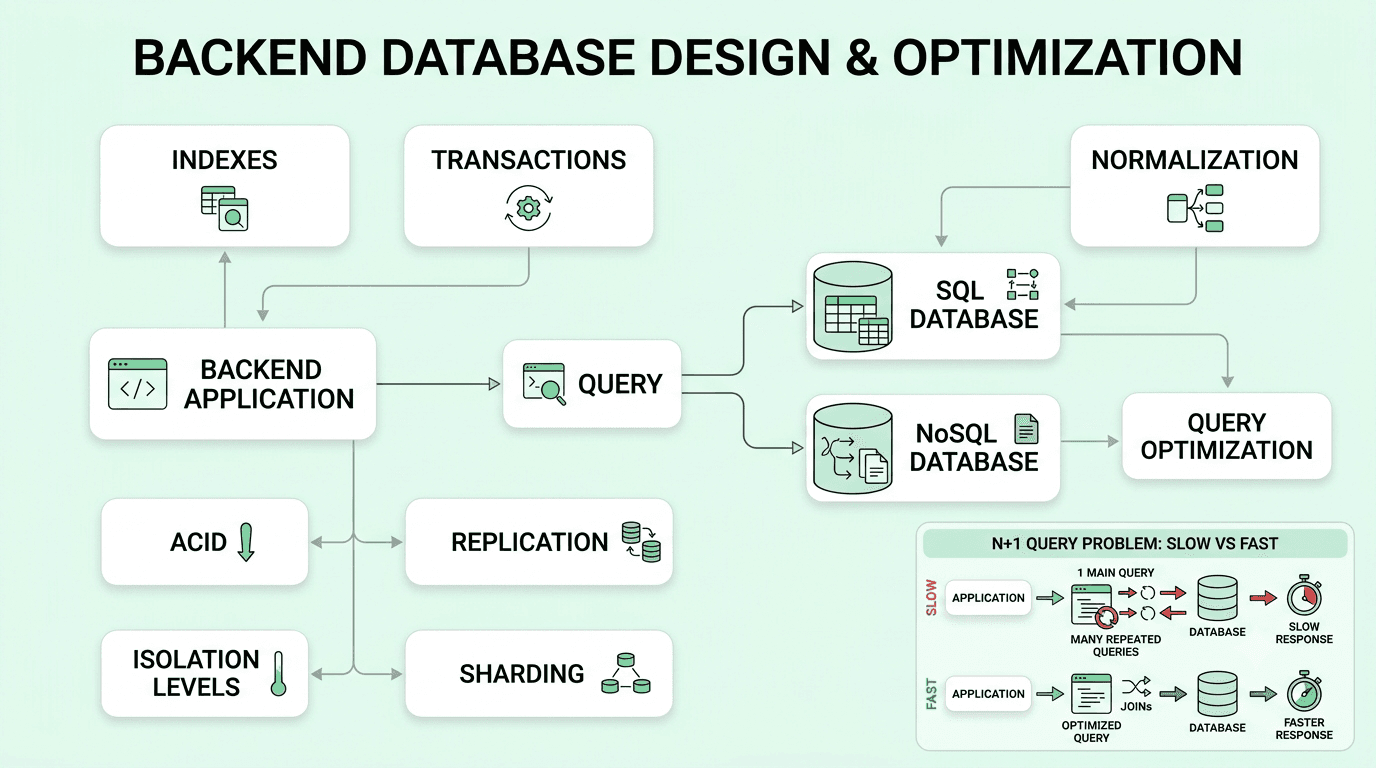
Q25 · [ALL] What's the difference between SQL and NoSQL databases, and how do you decide which to use?
Answer: SQL (relational) databases enforce a fixed schema, support strong ACID transactional guarantees, and excel at complex queries/joins over structured, interrelated data. NoSQL databases (document, key-value, wide-column, or graph) offer flexible schemas and often easier horizontal scalability, typically chosen when data is naturally unstructured or highly variable, access patterns are simple and high-volume, or massive horizontal scale is a primary requirement from the outset.
Explanation: One of the most frequently asked backend architecture questions, testing whether a candidate makes a data-driven choice rather than defaulting to whichever type they're personally more familiar with.
Real-World Example: An order and payment system needing strong transactional guarantees and complex relational queries typically fits SQL well, while a product catalog with highly variable, category-specific attributes often fits more naturally into a flexible NoSQL document store.
Common Mistakes: Choosing a database type based on current trends rather than the project's actual data structure, consistency requirements, and query patterns.
Follow-up Questions: When would you choose a graph database over a relational one? How do modern SQL databases address horizontal scalability concerns that historically favored NoSQL? How would you model a many-to-many relationship in a NoSQL document store, given it lacks native joins?
Q26 · [ALL] Explain ACID properties and why they matter for transactional systems.
Answer: Atomicity (a transaction either fully completes or fully rolls back), Consistency (a transaction brings the database from one valid state to another, respecting all constraints), Isolation (concurrent transactions don't observe each other's uncommitted intermediate state), and Durability (once committed, changes survive a subsequent system failure) — together these guarantees make transactions safe to use for operations that must succeed or fail as a single, indivisible unit.
Explanation: A foundational database concept, essential for correctly implementing any multi-step operation (like a funds transfer) that must be all-or-nothing.
Real-World Example: Transferring money between two bank accounts (debiting one, crediting another) must be wrapped in a single transaction — if the credit fails after the debit succeeds, the entire transaction must roll back to avoid the money simply vanishing.
Common Mistakes: Performing multiple related, interdependent writes as separate operations without wrapping them in an explicit transaction, risking inconsistent, partially-applied data on failure.
Follow-up Questions: What are the different transaction isolation levels, and what specific anomalies does each prevent? How would you handle a transaction spanning multiple separate databases or services? What's the difference between optimistic and pessimistic locking for concurrent updates?
Q27 · [MID] What is a database index, and what are the tradeoffs of adding one?
Answer: An index is a separate data structure (commonly a B-tree) mapping column values to row locations, dramatically speeding up lookups and range queries on that column, at the cost of additional storage and somewhat slower writes since every index must be updated on every insert, update, or delete affecting the indexed column.
Explanation: A very commonly tested, highly practical performance concept, essential for any backend developer expected to diagnose and fix slow queries in production.
Real-World Example: Adding an index on a frequently-queried email column used for login lookups can transform a slow full table scan into a near-instant lookup on a table with millions of rows.
Common Mistakes: Assuming more indexes are unconditionally beneficial without acknowledging the write-performance and storage cost tradeoffs, or not knowing the difference between a clustered and non-clustered index.
Follow-up Questions: What's a composite index, and how does column order affect its usefulness? How would you decide which columns genuinely warrant an index? How would you use EXPLAIN to verify whether a query is actually using an available index?
Q28 · [MID] How would you diagnose and fix a slow-running SQL query in production?
Answer: Use EXPLAIN/EXPLAIN ANALYZE to inspect the actual query execution plan and identify whether it's performing an inefficient full table scan or a poorly-ordered join, verify appropriate indexes exist on the filtered and joined columns, avoid selecting unneeded columns, consider rewriting inefficient correlated subqueries as joins, and consider caching or a read replica for particularly frequent, expensive read queries.
Explanation: A very practical, commonly tested troubleshooting question, since diagnosing real-world database performance issues is a routine part of backend development work.
Real-World Example: A dashboard endpoint that becomes slower as the dataset grows is often traced, via EXPLAIN ANALYZE, to a missing index on a heavily-filtered column, with a well-targeted index addition dramatically improving performance.
Common Mistakes: Jumping directly to adding a caching layer or rewriting application code without first diagnosing the actual root cause using the database's own query plan analysis tools.
Follow-up Questions: How would you identify whether a specific slow query is CPU-bound or I/O-bound? What's the N+1 query problem, and how would you detect and fix it? How would you decide between adding an index versus introducing an application-level cache?
Q29 · [SR] What is database sharding, and what are the common sharding strategies?
Answer: Sharding splits a large database horizontally into smaller, independent pieces (shards) distributed across multiple servers, enabling horizontal scaling beyond what a single database server can handle. Strategies include range-based sharding (splitting by key ranges, simple but can create hotspots), hash-based sharding (hashing the shard key for even distribution, but complicating range queries), and directory-based sharding (a lookup service maps keys to shards, flexible but adds a dependency).
Explanation: A commonly tested database scalability concept for backend roles working at or anticipating significant scale, testing awareness of the real operational complexity sharding introduces.
Real-World Example: A multi-tenant SaaS application often shards by tenant/customer ID, keeping each customer's data together on one shard, simplifying most queries and enabling natural per-tenant horizontal scaling.
Common Mistakes: Choosing to shard prematurely, before it's genuinely necessary, introducing substantial complexity (harder cross-shard queries and transactions) without an actual corresponding scale problem.
Follow-up Questions: How would you handle a query or transaction that needs to span data across multiple shards? How would you rebalance data as the dataset grows and new shards are added? What's a "hot shard," and how would you avoid one?
Q30 · [MID] What is database replication, and what's the difference between synchronous and asynchronous replication?
Answer: Replication copies data from a primary database to one or more replicas for redundancy and read scaling. Synchronous replication waits for a replica to confirm the write before acknowledging success to the client, giving stronger consistency but higher latency; asynchronous replication acknowledges immediately and replicates in the background, giving lower latency but risking data loss if the primary fails before replication completes.
Explanation: A commonly tested distributed database concept, testing understanding of the consistency/latency tradeoff inherent in replicated systems.
Real-World Example: Most cloud-managed databases default to asynchronous replication for read replicas to avoid the latency penalty, while financial systems requiring zero data loss may pay the latency cost of synchronous replication for critical writes specifically.
Common Mistakes: Assuming replication alone provides high availability without discussing failover mechanics — how a replica actually gets promoted to primary when the original primary fails.
Follow-up Questions: How does failover work when a primary database goes down? What is replication lag, and how can it cause bugs in an app reading from a replica immediately after a write? What's multi-master replication, and what conflicts can arise from it?
Q31 · [MID] What is the N+1 query problem, and how would you fix it?
Answer: The N+1 problem occurs when fetching a list of N items with one query, then executing an additional query per item (N more queries) to fetch related data, instead of fetching everything efficiently in one or two batched queries. It's solved via eager loading — a JOIN, or a single batched query with WHERE id IN (...), or an ORM's built-in eager-loading feature.
Explanation: An extremely common real-world performance bug, especially prevalent when using an ORM, testing whether a candidate can spot this pattern in generated queries, not just define it in the abstract.
Real-World Example: Fetching a list of 100 blog posts, then separately querying each post's author individually, turns what should be 1 efficient query into 101, a very common and often initially hidden ORM pitfall.
Common Mistakes: Not recognizing the pattern in ORM-generated code (since it's hidden behind abstraction), or over-correcting by eager-loading everything by default even when it's unnecessary, wasting data transfer.
Follow-up Questions: How would you detect an N+1 problem in a production application? How does GraphQL's DataLoader pattern address this same problem at the resolver level? What's the difference between eager loading and lazy loading in an ORM context?
Q32 · [ADVANCED/SR] What are transaction isolation levels, and what anomalies does each one prevent?
Answer: Read Uncommitted (weakest, allows dirty reads), Read Committed (prevents dirty reads but allows non-repeatable reads), Repeatable Read (prevents dirty and non-repeatable reads but may allow phantom reads depending on the database), and Serializable (strongest, fully isolated, transactions behave as if executed sequentially) — each stronger level trades some concurrency/performance for a stronger consistency guarantee.
Explanation: A deeper dive into ACID's Isolation pillar, testing whether a candidate understands the specific anomalies each level trades off against performance, rather than just naming the levels.
Real-World Example: PostgreSQL defaults to Read Committed for a reasonable balance of consistency and concurrency, while a financial reconciliation job might explicitly use Serializable to guarantee no anomalies at the cost of reduced throughput.
Common Mistakes: Listing the isolation levels without being able to explain what specific anomaly each one prevents or allows, or assuming higher isolation is always better without acknowledging its performance cost.
Follow-up Questions: What's a phantom read, and which isolation level specifically prevents it? How does MVCC (multi-version concurrency control) relate to these isolation levels? What isolation level would you choose for a high-throughput analytics query, and why?
Q33 · [MID] How would you design a database schema to represent a many-to-many relationship?
Answer: Use a junction (association) table containing foreign keys referencing both related tables' primary keys, plus any relationship-specific attributes (like a timestamp). For example, students and courses connect through an enrollments junction table with student_id, course_id, and possibly enrollment_date.
Explanation: A foundational schema modeling skill, commonly tested via a practical exercise, testing whether a candidate avoids the common anti-pattern of storing multiple related IDs in a single denormalized column.
Real-World Example: A blog's tags feature (posts can have multiple tags, tags apply to multiple posts) requires a post_tags junction table rather than storing a comma-separated list of tag names directly in a column.
Common Mistakes: Storing multiple related IDs as a comma-separated string within a single column, breaking normalization entirely and making querying, filtering, and indexing significantly harder.
Follow-up Questions: How would you enforce that a specific relationship (like a student's enrollment in a course) can't be duplicated? How would you efficiently query for all items related to one specific record through this junction table? How does this modeling approach change in a NoSQL context?
Q34 · [SR] How would you approach migrating a production database schema with zero downtime?
Answer: Use an expand-and-contract approach: first add the new schema element (a new column, table) without removing the old one, deploy application code that writes to both old and new structures, backfill existing data into the new structure, deploy code that reads from the new structure, and only once fully migrated and verified, remove the old structure in a final cleanup step — each step deployed and verified independently to avoid a single, risky, all-at-once cutover.
Explanation: A more advanced, senior-level operational question, testing understanding of how real production systems evolve their schemas without requiring risky downtime or a "big bang" migration.
Real-World Example: Renaming a column in a live production database can't simply be done directly — the expand-and-contract approach adds the new column, has the app write to both old and new during a transition period, backfills historical data, switches reads to the new column, and only then drops the old one.
Common Mistakes: Attempting a single, all-at-once schema change and application deployment simultaneously, creating a risky window where a deployment failure or rollback leaves the schema and application code out of sync.
Follow-up Questions: How would you handle backfilling a very large table without locking it for an extended period? How would you safely roll back partway through an expand-and-contract migration if a problem is discovered? How does this approach change for a genuinely breaking schema change, like changing a column's data type?
Q35 · [MID] What is a database transaction deadlock, and how would you diagnose and prevent one?
Answer: A deadlock occurs when two or more transactions each hold a lock the other needs, creating a circular wait where neither can proceed — most databases automatically detect this and abort one of the transactions. Prevention includes acquiring locks in a consistent order across all transactions, keeping transactions short, and using appropriate indexing to minimize the range of rows locked.
Explanation: A commonly tested concurrency/database concept, testing both theoretical understanding and practical prevention strategies for a real, frequently-encountered production issue.
Real-World Example: Two concurrent transactions each transferring money between the same two accounts but in opposite order (one locks account A then B, the other locks B then A) can deadlock; the database typically detects this and aborts one transaction, which the application must be prepared to retry.
Common Mistakes: Not writing application logic to gracefully catch and retry a deadlock-aborted transaction, causing a legitimate operation to simply fail from the user's perspective instead of transparently retrying.
Follow-up Questions: How would you design your transaction logic to consistently acquire locks in the same order and avoid this deadlock pattern? How does your application know a transaction failed due to deadlock versus another kind of error? What's the difference between a deadlock and simple lock contention/waiting?
Q36 · [MID] What's the difference between a clustered and non-clustered index?
Answer: A clustered index determines the physical storage order of the table's actual data rows (a table can have only one, since data can only be physically sorted one way), typically the primary key. A non-clustered (secondary) index is a separate structure pointing back to the data's location, and a table can have several of these to speed up different query patterns.
Explanation: A commonly tested, more precise database internals question, testing whether a candidate understands index mechanics beyond just "indexes make queries faster."
Real-World Example: A table clustered on its primary key id will retrieve rows very efficiently when queried by ID directly, while a query filtering on a different column relies on a separate non-clustered index (if one exists) that then points back to the actual row location.
Common Mistakes: Assuming a table can have multiple clustered indexes, or not understanding why a non-clustered index lookup typically requires an extra step (a "bookmark lookup") to retrieve the full row.
Follow-up Questions: Why can a table have only one clustered index but multiple non-clustered indexes? How does choosing a poor clustering key (like a random UUID) affect insert performance? What's a covering index, and how does it avoid the extra bookmark lookup?
Q37 · [JR/MID] What is database normalization, and when might you deliberately denormalize?
Answer: Normalization organizes relational data into related tables to minimize redundancy and prevent update anomalies, typically following normal forms up to 3rd normal form in most practical applications. Denormalization intentionally introduces some redundancy to reduce the number of costly joins needed for common read queries, trading storage space and update complexity for improved read performance.
Explanation: A foundational database design concept, testing understanding that schema design is a genuine tradeoff, not a simple "more normal is always better" rule.
Real-World Example: A read-heavy content platform might deliberately store a cached author name directly on each article record rather than always joining to a separate authors table, trading minor update complexity for significantly faster common reads.
Common Mistakes: Treating normalization as unconditionally better without recognizing legitimate scenarios (read-heavy reporting, caching) where deliberate denormalization is a reasonable, well-justified tradeoff.
Follow-up Questions: Can you explain 3rd normal form with an example violation? How would you keep denormalized, redundant data consistent when the source of truth changes? What's a star schema, and why is it commonly used in data warehouses?
Q38 · [MID] How would you decide between using a relational database and a key-value store like Redis for a specific piece of data?
Answer: Relational databases are the right choice for data with complex relationships, needing strong transactional guarantees, and requiring flexible ad hoc querying. A key-value store is the right choice for simple, high-throughput lookups by a known key, where data doesn't need complex relational querying and speed is the priority — often used as a cache or session store layered in front of a relational database, rather than as a full replacement.
Explanation: A commonly tested practical architecture decision, testing whether a candidate matches storage technology to actual access patterns rather than defaulting to a single tool for everything.
Real-World Example: A user's shopping cart, looked up almost exclusively by user ID with simple read/write access, is a natural fit for a fast key-value store like Redis, while the underlying order and payment records, needing relational integrity and complex reporting queries, remain in a relational database.
Common Mistakes: Using a key-value store as the sole source of truth for data that genuinely needs relational querying or strong transactional guarantees, later discovering the need to bolt on relational-style queries it wasn't designed for.
Follow-up Questions: How would you handle keeping data consistent between a cache like Redis and the underlying source-of-truth database? What are the durability guarantees of Redis compared to a traditional relational database? When would you use Redis as more than just a cache — as a primary data store?
Section 4: System Design & Scalability
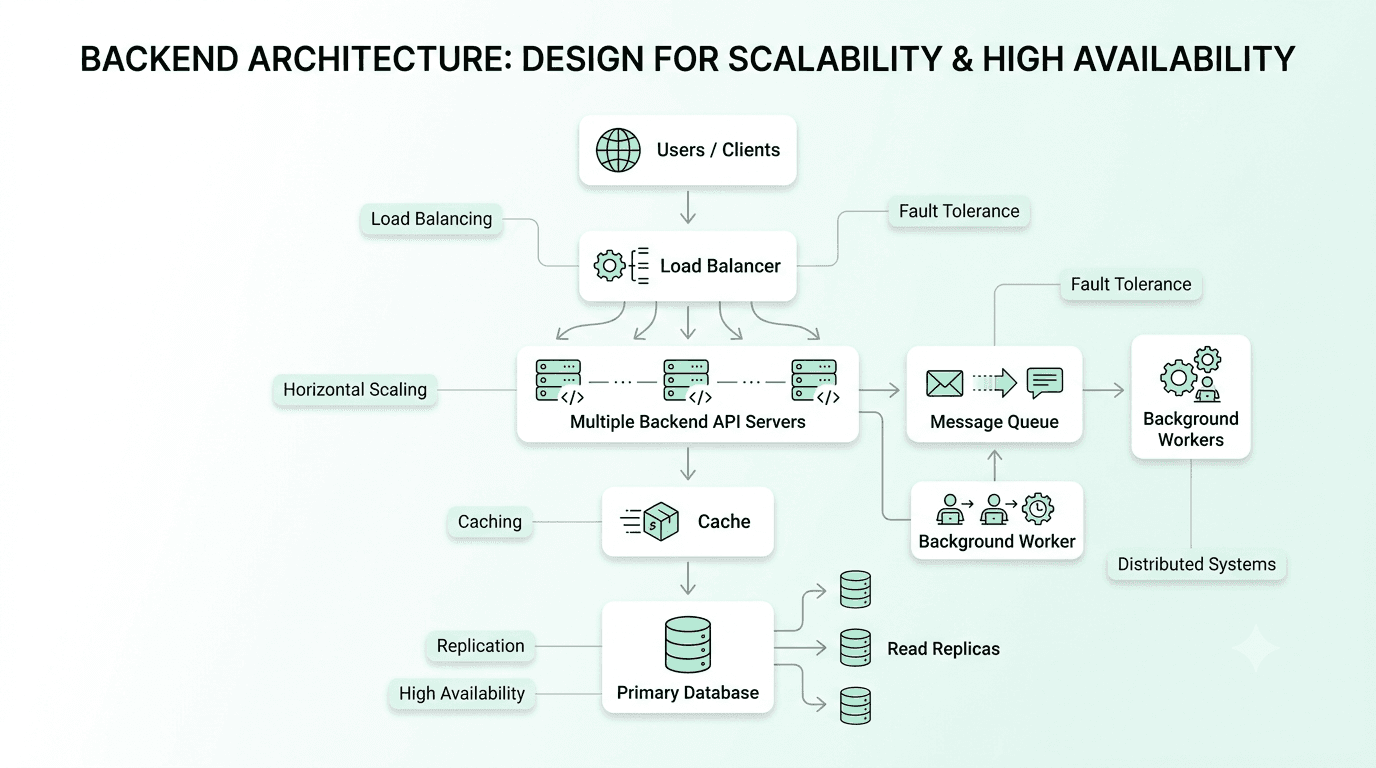
Q39 · [SR] How would you approach a system design interview question in general?
Answer: A structured approach: clarify requirements and scope (functional and non-functional, like expected scale, latency, read/write ratio), estimate scale with back-of-envelope calculations (QPS, storage), design a high-level architecture (API, data model, major components), deep-dive into the most critical components, explicitly discuss bottlenecks and tradeoffs, and address failure modes and monitoring.
Explanation: This meta-question tests process and communication as much as technical knowledge — interviewers are evaluating whether a candidate can drive an ambiguous, open-ended design conversation productively.
Real-World Example: In real engineering organizations, this mirrors an actual design-doc review process, where a proposal is scoped, estimated, architected, and critiqued by peers before implementation begins.
Common Mistakes: Jumping straight into a detailed database schema before clarifying requirements, or going too deep on one component while running out of time to address others.
Follow-up Questions: How do you handle a requirement you weren't given? How would you prioritize which components to deep-dive on given limited interview time? How do you incorporate non-functional requirements like security or cost into the design?
Q40 · [SR] How would you design a URL shortener service (like bit.ly)?
Answer: Key components: a base62-encoding scheme (of an auto-incrementing ID) to generate short codes, a fast key-value-style database mapping short codes to original URLs, a caching layer (Redis) given the extremely read-heavy traffic pattern (redirects vastly outnumber creation), and secondary consideration for custom aliases and link expiration.
Explanation: One of the most commonly asked introductory system design questions, testing structured thinking on a bounded problem covering data modeling, read/write tradeoffs, and caching.
Real-World Example: Real URL shorteners typically rely on base62 encoding of an incrementing counter for compact, collision-free codes, combined with an aggressive caching layer since redirect requests vastly outnumber new link creation requests.
Common Mistakes: Over-focusing on hash collision handling while neglecting the more architecturally significant read/write ratio and the resulting need for an effective caching strategy.
Follow-up Questions: How would you handle 100,000 redirect requests per second at scale? How would you shard the underlying database as stored URLs grow significantly over time? How would you prevent the service from being used to distribute phishing links?
Q41 · [SR] What is the CAP theorem, and what are its practical implications for backend system design?
Answer: In a distributed system, you can guarantee at most two of Consistency (all nodes see the same data at once), Availability (every request gets a response), and Partition Tolerance (the system continues despite network failures) — since network partitions are unavoidable in practice, real systems must choose between CP (consistent but may reject requests during a partition) and AP (available but may serve stale data).
Explanation: One of the most commonly asked distributed systems theory questions, testing whether a candidate can connect the theory to real database and architecture choices.
Real-World Example: DynamoDB and Cassandra are typically tuned for AP (favoring availability, eventual consistency), while a system relying on Zookeeper or a traditional relational database with synchronous replication favors CP.
Common Mistakes: Claiming you can have all three simultaneously, or being unable to name real systems that exemplify the CP versus AP tradeoff.
Follow-up Questions: What is eventual consistency, and how do applications handle it in practice? How does the more nuanced PACELC theorem extend CAP? Can you give an example of a system choosing CP over AP, and why that choice makes sense there?
Q42 · [SR] How would you design a rate limiter as a standalone system?
Answer: Choose an algorithm (Token Bucket for burst tolerance, Sliding Window for more accurate limiting), implement it with a fast shared data store like Redis using atomic increment operations with TTLs so the limit is enforced correctly across multiple server instances, and design the system to fail open or fail closed deliberately (deciding what happens if the rate-limiting store itself becomes unavailable).
Explanation: A very commonly asked system design and coding question, testing understanding of the tradeoffs between accuracy, memory, and burst tolerance in a distributed context.
Real-World Example: API gateways like AWS API Gateway use token-bucket-style rate limiting to protect backend services from abuse while still allowing short bursts of legitimate traffic.
Common Mistakes: Not considering the distributed nature of the problem, implementing rate limiting only in local memory on a single server, which fails once multiple server instances are involved.
Follow-up Questions: How would you make this rate limiter work correctly across multiple data centers with network latency between them? What happens to your API if the Redis instance backing the rate limiter goes down — how do you degrade gracefully? How would you rate-limit differently per user tier (free versus paid)?
Q43 · [SR] How would you design a notification system supporting email, SMS, and push notifications?
Answer: Architecture: an internal notification API that accepts requests and publishes them to a message queue, separate dedicated worker processes per channel that consume from the queue and integrate with the relevant third-party provider, a template/rendering system for consistent formatting, and retry logic with exponential backoff specifically for handling transient failures from third-party providers.
Explanation: A commonly asked practical system design question, testing understanding of decoupled, asynchronous architecture and awareness of real-world reliability considerations when integrating external services.
Real-World Example: Rather than a checkout service directly and synchronously calling an email provider's API inline (creating a fragile dependency), a decoupled architecture publishes a "send confirmation email" event to a queue, processed independently by a dedicated email worker.
Common Mistakes: Designing tightly-coupled, synchronous calls directly to third-party providers within critical, primary request flows, creating unnecessary fragility if that provider is slow or briefly unavailable.
Follow-up Questions: How would you handle a specific third-party provider being temporarily down? How would you prevent sending duplicate notifications for the same triggering event? How would you respect user notification preferences consistently across channels?
Q44 · [SR] How would you design a system to handle 1 million concurrent users?
Answer: Key strategies: horizontal scaling with stateless application servers behind a load balancer, a CDN for static assets, caching layers to reduce database load, database read replicas and sharding for write scaling, asynchronous processing via message queues for non-critical-path work, and connection pooling and efficient resource management at every layer.
Explanation: An open-ended scale question testing whether a candidate can reason across the whole stack rather than focusing narrowly on one layer.
Real-World Example: Streaming platforms handling live events combine CDN edge caching for content delivery with autoscaled stateless API tiers to absorb concurrent viewer spikes.
Common Mistakes: Only discussing "add more servers" without addressing the database as the likely bottleneck, or ignoring the need for stateless application design to enable horizontal scaling in the first place.
Follow-up Questions: Where's the likely bottleneck at this scale, and how would you identify it? How would you handle a sudden 10x traffic spike? How do you keep sessions consistent across many stateless servers?
Q45 · [SR] How would you design a distributed caching layer for a large-scale application?
Answer: Key design elements: consistent hashing to distribute keys across cache nodes (minimizing rehashing when nodes are added or removed), an eviction policy (LRU, LFU) per node, replication for fault tolerance, and a deliberate cache invalidation strategy (TTL, write-through, or write-behind) to avoid serving problematically stale data.
Explanation: Tests knowledge of caching strategies and the notoriously hard problem of cache invalidation, a very commonly asked follow-up in broader system design interviews.
Real-World Example: Redis Cluster uses consistent hashing to shard keys across nodes, minimizing data movement when nodes are added or removed compared to simple modulo-based hashing.
Common Mistakes: Using simple modulo hashing (causing massive rehashing when the number of nodes changes) instead of consistent hashing, or not addressing cache stampede — many requests hitting the database simultaneously when a popular key expires.
Follow-up Questions: How would you prevent a cache stampede? What's the difference between write-through and write-behind caching? How would you handle cache invalidation consistently across multiple cache nodes?
Q46 · [MID/SR] What's the difference between load balancing algorithms, and how would you choose one?
Answer: Round Robin (simple, cycles through servers), Least Connections (routes to the server with fewest active connections, good for uneven request durations), IP Hash (consistently routes a client to the same server, useful for session stickiness), and Weighted variants (accounting for differing server capacity).
Explanation: A foundational infrastructure concept directly applicable to real production system design, relevant to any backend developer's understanding of how a scaled, deployed application actually works.
Real-World Example: A service with long-lived connections or highly variable request durations benefits from least-connections routing rather than simple round robin, which doesn't account for uneven load per connection.
Common Mistakes: Defaulting to round-robin as a universal answer without considering whether requests genuinely have unequal cost or duration.
Follow-up Questions: What's the difference between Layer 4 and Layer 7 load balancing? How does a load balancer detect and route around an unhealthy backend instance? How would you achieve sticky sessions without relying on IP hashing?
Q47 · [SR] How would you design a system to ensure exactly-once processing of messages from a queue?
Answer: True exactly-once delivery is practically very hard to guarantee end-to-end; most systems instead achieve effectively-exactly-once behavior by combining at-least-once delivery with idempotent consumers — the consumer tracks processed message IDs (in a database or dedicated dedup store) and skips any message it's already processed, so duplicate deliveries don't cause duplicate side effects.
Explanation: A more advanced distributed systems question, testing whether a candidate understands the practical reality behind the commonly-cited "exactly-once" terminology.
Real-World Example: A payment processing consumer reading from a message queue records each processed transaction ID; if the same message is redelivered due to a consumer crash before acknowledgment, the consumer recognizes the duplicate ID and skips reprocessing it.
Common Mistakes: Assuming a message queue technology's "exactly-once" marketing claim eliminates the need for idempotent consumer logic entirely, without understanding the practical caveats involved.
Follow-up Questions: What's the difference between at-least-once, at-most-once, and exactly-once delivery semantics? How would you design the deduplication store to avoid it becoming a bottleneck itself? What happens if the consumer crashes after processing but before recording the message as processed?
Q48 · [SR] How would you design a system to support a real-time leaderboard for a game with millions of active players?
Answer: Use a sorted-set data structure (like Redis's ZSET) keyed by player ID with score as the sort key, giving efficient O(log n) score updates and O(log n + k) retrieval of top-k rankings — periodically or asynchronously persist to a durable database for long-term storage and disaster recovery, since an in-memory structure alone risks data loss on failure.
Explanation: A commonly asked practical system design question testing knowledge of a specific, well-suited data structure for a common real-world problem, beyond generic "use a database" answers.
Real-World Example: Many real-time gaming and social platforms use Redis sorted sets specifically for leaderboard functionality because of their efficient ranked-retrieval and update performance at scale.
Common Mistakes: Proposing to compute rankings via a full sort over a relational database table on every request, which doesn't scale to millions of players and frequent score updates.
Follow-up Questions: How would you handle a player's rank when many players share the same score? How would you scale this if the leaderboard needs to be segmented by region or game mode? How would you ensure the persisted database stays reasonably in sync with the in-memory sorted set?
Q49 · [SR] How would you design a URL/content deduplication system for a system that ingests large volumes of data?
Answer: Use a hash of the content (or URL) as a deduplication key, storing seen hashes in a fast lookup structure — for very large volumes where storing every exact hash is impractical, a probabilistic structure like a Bloom filter can efficiently check "definitely not seen" with a small, tunable false-positive rate, trading a small amount of accuracy for dramatically reduced memory usage.
Explanation: A more advanced, sometimes surprising system design question testing awareness of specialized data structures like Bloom filters that many candidates haven't encountered outside of pure computer science coursework.
Real-World Example: A web crawler ingesting billions of URLs uses a Bloom filter to efficiently and cheaply check whether a URL has likely already been crawled, avoiding the memory cost of storing every single URL in a full hash set.
Common Mistakes: Not knowing about Bloom filters at all and proposing a naive exact-hash-set approach that doesn't scale to the described volume without prohibitive memory usage.
Follow-up Questions: How does a Bloom filter's false-positive rate relate to its size and number of hash functions? What happens when a Bloom filter reports a false positive in this deduplication context, and is that an acceptable tradeoff? Can you remove an item from a standard Bloom filter, and if not, what alternative structure would allow that?
Q50 · [SR] How would you design the backend architecture for a ride-sharing app's driver-matching feature?
Answer: Key components: a geospatial index (using a technique like geohashing or a database with native geospatial support) to efficiently find nearby available drivers, a matching service that considers proximity, driver rating, and estimated arrival time, a real-time location update pipeline (drivers periodically broadcasting location via a lightweight, high-frequency update channel), and careful handling of race conditions when multiple riders might be matched to the same driver simultaneously.
Explanation: A commonly asked, domain-flavored system design question testing the ability to identify and address the specific, non-obvious hard problems in a real-world scenario (geospatial querying, real-time updates, and matching race conditions).
Real-World Example: Real ride-sharing platforms use geospatial indexing structures to efficiently query "drivers within X km of this rider" without scanning the entire driver database on every match request.
Common Mistakes: Proposing a naive approach of scanning all drivers and calculating distance to each one on every match request, which doesn't scale as the number of active drivers grows.
Follow-up Questions: How would you prevent two riders from both being matched to the same available driver simultaneously? How would you handle a driver going offline mid-match? How would you scale the real-time location update pipeline for millions of concurrently active drivers?
Q51 · [SR] How would you approach designing a system for handling and processing webhook events from third-party services reliably?
Answer: Accept the webhook quickly and durably (write it to a queue or database immediately, returning a 200 to the sender promptly) rather than processing it synchronously within the request, process it asynchronously from the queue with retry logic for transient failures, implement idempotency to handle the very common case of a third-party redelivering the same webhook multiple times, and verify the webhook's authenticity (typically via a signature header) before trusting its contents.
Explanation: A commonly tested practical integration pattern question, since webhook handling has several well-known pitfalls that experienced backend developers specifically know to guard against.
Real-World Example: Stripe explicitly documents that webhook consumers should expect and handle duplicate deliveries, since Stripe's own retry logic can redeliver the same event if it doesn't receive a timely 200 response.
Common Mistakes: Processing the webhook's full business logic synchronously within the request handler, risking a timeout on the sender's side if processing takes too long, which triggers an unnecessary and confusing redelivery.
Follow-up Questions: How would you verify a webhook's authenticity to prevent a malicious actor from sending fake events? How would you handle out-of-order webhook delivery? How would you design monitoring to detect if webhook processing is silently falling behind?
Q52 · [SR] How would you design a system to support feature flags at scale across a large application?
Answer: Store flag definitions and targeting rules in a fast, low-latency store (often cached locally in each application instance with periodic or event-driven refresh, to avoid a network call on every single flag check), evaluate targeting rules (user attributes, percentage rollout) client-side within the application process for speed, and maintain an audit log of flag changes for accountability and quick rollback.
Explanation: A commonly tested modern backend infrastructure question, testing awareness of how feature flag systems are designed to be both flexible and fast enough to check on every request without adding meaningful latency.
Real-World Example: A feature flag check needs to add negligible latency to a hot request path, so most production feature flag systems evaluate rules against a locally cached copy of flag configuration rather than making a network call to a central service on every check.
Common Mistakes: Designing a feature flag system that requires a network round trip to a central service for every single flag evaluation, adding unacceptable latency to hot request paths at scale.
Follow-up Questions: How would you keep each application instance's local flag cache reasonably fresh without adding excessive load to the central flag service? How would you handle a feature flag that needs to be instantly disabled across the entire fleet during an incident? How would you avoid flag configuration sprawl becoming unmanageable over time?
FREE TO USE
8k+ SESSIONS92% FLUENCY4.9★ RATING
Speak With Confidence
Real Conversations. Real Scenarios. Speak until it feels natural.
- Real-Time Speaking Practice
- Guided Conversation Flows
- Instant AI Feedback
Section 5: Caching, Messaging & Async Processing
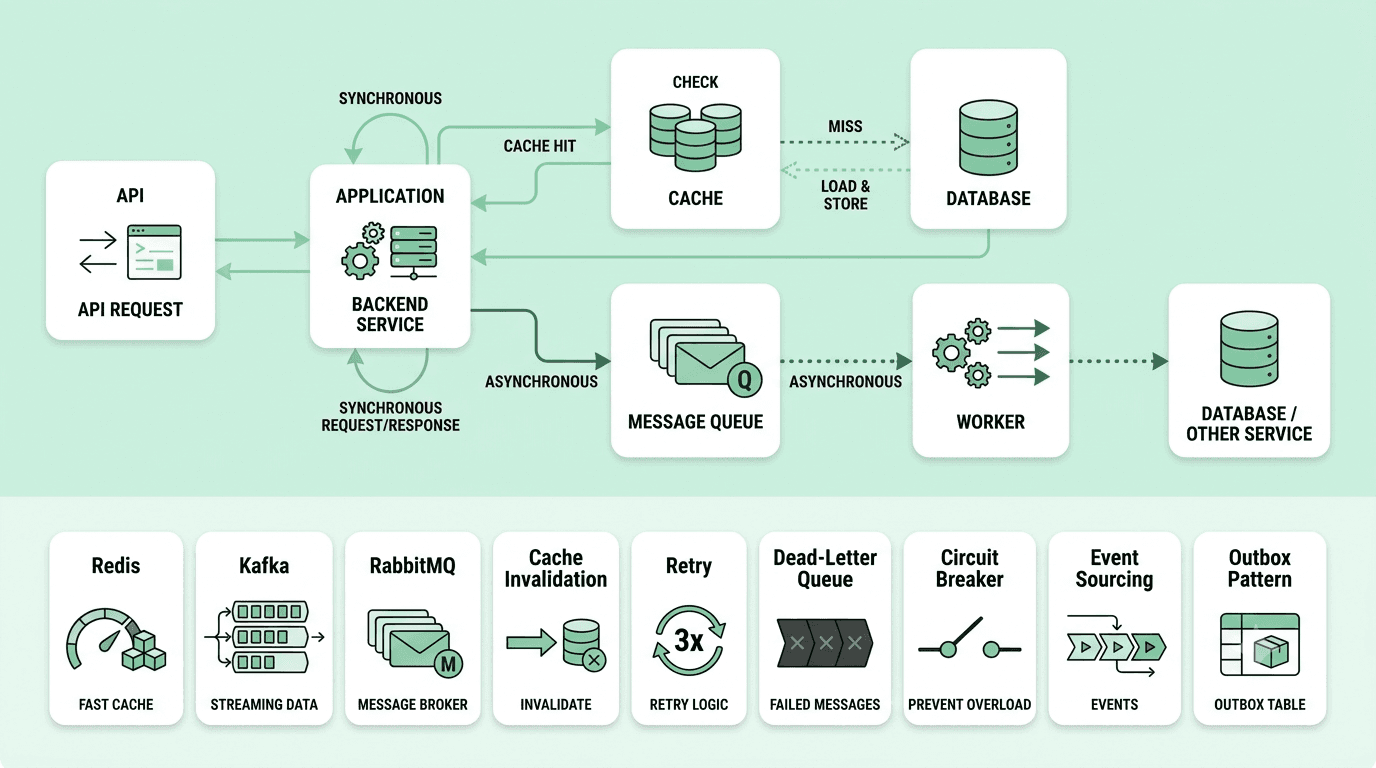
Q53 · [MID] What is a message queue, and why would a backend system use one instead of direct synchronous calls between services?
Answer: A message queue decouples the producer of a piece of work from the consumer that actually processes it, letting the producer publish a message and move on immediately rather than waiting for the work to complete — this improves resilience (the consumer can be temporarily down without the producer failing), enables load leveling (absorbing traffic spikes into a buffer), and allows independent scaling of producers and consumers.
Explanation: A very commonly tested foundational async architecture concept, essential for understanding why so much real backend architecture relies on message queues rather than direct service-to-service calls.
Real-World Example: An order-processing system publishes an "order placed" event to a queue rather than directly and synchronously calling the inventory, shipping, and email services in sequence, letting each of those services process the event independently and resiliently.
Common Mistakes: Using direct synchronous service calls for a workflow with several independent downstream steps, creating a fragile dependency chain where any one slow or failing service blocks the entire request.
Follow-up Questions: What's the difference between a message queue and a pub/sub system? How would you handle a message that repeatedly fails processing (a dead-letter queue)? How does a message queue help with load leveling during a traffic spike?
Q54 · [MID] What's the difference between a message queue (like RabbitMQ) and a distributed log/streaming platform (like Kafka)?
Answer: A traditional message queue typically removes a message once it's been consumed and acknowledged, and generally supports one logical consumer group per message. A distributed log like Kafka retains messages for a configurable retention period regardless of consumption, allowing multiple independent consumer groups to each read the same stream at their own pace, and supports replaying historical messages — well suited for event-sourcing-style architectures and stream processing.
Explanation: A commonly tested distinction for backend developers working with event-driven architectures, testing whether a candidate understands these are genuinely different tools for different needs, not interchangeable synonyms.
Real-World Example: A company wanting both a real-time fraud-detection service and a separate analytics pipeline to independently process the exact same stream of transaction events benefits from Kafka's ability to have multiple independent consumer groups reading the same retained log at their own pace.
Common Mistakes: Treating Kafka and RabbitMQ as directly interchangeable, without recognizing Kafka's retention and replay capabilities versus a traditional queue's typical consume-and-remove model.
Follow-up Questions: How does Kafka's partitioning model affect ordering guarantees within a topic? When would you choose RabbitMQ over Kafka for a specific use case? How would you handle exactly-once processing semantics differently on each platform?
Q55 · [MID] What is a dead-letter queue, and why is it an important part of a robust message-processing system?
Answer: A dead-letter queue is a separate queue where messages are routed after they've failed processing a defined number of times, preventing a persistently failing message from blocking the main queue or being retried indefinitely, while preserving it for later investigation, manual reprocessing, or alerting.
Explanation: A commonly tested practical resilience pattern, testing whether a candidate has thought through what happens when message processing doesn't go according to plan, not just the happy path.
Real-World Example: An order-processing consumer that repeatedly fails on a specific malformed message (due to a bug or unexpected data) would otherwise retry that one message indefinitely, potentially blocking the processing of all subsequent, valid messages behind it — a dead-letter queue isolates the problem message so processing can continue.
Common Mistakes: Implementing retry logic without any dead-letter queue or cap on retry attempts, allowing a single poison-pill message to block a queue indefinitely or generate an unbounded flood of retries.
Follow-up Questions: How would you set up alerting so a team is notified when messages start landing in the dead-letter queue? How would you decide on an appropriate number of retry attempts before dead-lettering a message? How would you safely reprocess messages from the dead-letter queue once the underlying issue is fixed?
Q56 · [MID] What is cache invalidation, and what strategies would you use to keep a cache reasonably fresh?
Answer: Cache invalidation is the process of ensuring cached data doesn't remain stale after its underlying source changes. Common strategies: TTL-based expiration (simple, but the cache can be stale for up to the TTL duration), write-through caching (updating the cache synchronously whenever the underlying data changes), and explicit invalidation (deleting or updating the specific cache entry immediately when the source data changes).
Explanation: Famously one of the "two hard things in computer science," and a very commonly tested practical caching concept given how much real backend performance work involves caching.
Real-World Example: A product catalog cache might use a moderate TTL for general browsing (acceptable staleness), combined with explicit invalidation triggered immediately whenever a product's price is actually updated, so pricing changes take effect right away rather than waiting out the TTL.
Common Mistakes: Relying purely on a long TTL for data that genuinely needs to be fresh (like inventory counts or pricing), leading to users seeing outdated information for an unacceptable period.
Follow-up Questions: What's a cache stampede, and how would you prevent one when a popular cache entry expires? How would you handle cache invalidation across multiple cache nodes in a distributed cache? What's the difference between write-through and write-behind caching?
Q57 · [MID] What is a circuit breaker pattern, and when would you use one in a backend system?
Answer: A circuit breaker monitors calls to a downstream dependency and, after detecting a threshold of failures, "opens" to stop sending further requests to that dependency for a period, failing fast instead — this prevents a struggling downstream service from being overwhelmed further and prevents the calling service from wasting resources on calls likely to fail, while periodically allowing a test request through to check if the dependency has recovered.
Explanation: A commonly tested resilience pattern, especially relevant in microservices architectures where cascading failures across service dependencies are a genuine, well-known risk.
Real-World Example: A service calling a downstream recommendation service that starts timing out under load would, with a circuit breaker, quickly stop sending further requests and instead serve a fallback (like generic recommendations) rather than piling up slow, doomed requests that make the downstream service's overload even worse.
Common Mistakes: Not implementing any circuit breaker for calls to external dependencies, allowing a single struggling downstream service to cause cascading failures and resource exhaustion across calling services.
Follow-up Questions: What are the different states of a circuit breaker (closed, open, half-open), and how does it transition between them? How would you choose an appropriate failure threshold and timeout for opening the circuit? How does a circuit breaker relate to and complement retry logic?
Q58 · [MID] How would you design a system to process a large batch of data asynchronously without blocking the requesting user?
Answer: Accept the request and immediately queue the batch job, returning a job ID and a 202 Accepted response, process the batch asynchronously via a worker (potentially splitting it into smaller sub-tasks processed in parallel), track progress in a database the client can poll, and notify the user (via email, webhook, or in-app notification) once processing completes.
Explanation: A very commonly asked practical backend architecture question, testing awareness of asynchronous processing patterns essential for handling genuinely long-running operations gracefully.
Real-World Example: A bulk CSV import feature accepting a file with 100,000 rows would queue the import and process it in the background, showing the user a progress indicator rather than making them wait on a single, long-blocking HTTP request that risks timing out.
Common Mistakes: Attempting to process a large batch synchronously within a single request-response cycle, risking client or gateway timeouts on genuinely large inputs.
Follow-up Questions: How would you handle a partial failure where some rows in the batch process successfully and others fail? How would you communicate granular progress back to the client during processing? How would you make this batch processing resumable if it's interrupted partway through?
Q59 · [SR] What is event sourcing, and what problem does it solve compared to traditional state-based persistence?
Answer: Event sourcing persists a sequence of immutable events representing every change that's happened to an entity, rather than just its current state — the current state is derived by replaying those events. This provides a complete audit trail, enables rebuilding state at any point in history, and makes certain kinds of debugging and analytics considerably easier, at the cost of added architectural complexity compared to simply storing and updating current state directly.
Explanation: A more advanced architectural pattern, increasingly commonly tested at companies dealing with complex domains requiring strong auditability, like finance or healthcare.
Real-World Example: A banking system using event sourcing stores every individual transaction event (deposit, withdrawal, transfer) rather than just the current balance, allowing the system to reconstruct the account's exact state and history at any past point in time for auditing or dispute resolution.
Common Mistakes: Adopting event sourcing for a simple CRUD application that doesn't genuinely need its added complexity and auditability benefits, unnecessarily increasing the system's overall difficulty to build and reason about.
Follow-up Questions: How would you handle querying current state efficiently without replaying the entire event history every single time (hint: snapshots)? How does event sourcing relate to and often pair with CQRS? How would you handle a bug that requires "correcting" a past event, given events are meant to be immutable?
Q60 · [MID] What's the difference between a synchronous cache-aside pattern and a write-through cache pattern?
Answer: In cache-aside (lazy loading), the application checks the cache first, and on a miss, reads from the database and populates the cache for next time — simple and only caches what's actually requested, but the first request after an expiration is always slower. In write-through, the application writes to the cache and the database together (synchronously) on every write, keeping the cache always warm and consistent with the database, at the cost of added write latency and potentially caching data that's never actually read.
Explanation: A commonly tested caching strategy comparison, testing whether a candidate understands the practical tradeoffs of each pattern rather than treating "add a cache" as a single undifferentiated technique.
Real-World Example: A read-heavy product catalog with relatively infrequent writes fits cache-aside well, while a system where reads must never be stale immediately after a write (like a user's own profile settings) might justify the added write latency of write-through caching.
Common Mistakes: Using write-through caching for data that's rarely actually read, unnecessarily adding write latency and wasting cache space on data that provides little actual read-performance benefit.
Follow-up Questions: What's write-behind (write-back) caching, and what risk does it introduce compared to write-through? How would you handle a cache-aside cache miss storm when a popular key simultaneously expires under high load? Which pattern would you choose for a shopping cart service, and why?
Q61 · [SR] How would you design a system to guarantee message ordering when processing events from a queue with multiple parallel consumers?
Answer: Use a partitioning strategy that routes all events for the same logical entity (like the same user or order) to the same partition/queue, consumed by a single consumer for that partition — this preserves ordering within each partition while still allowing overall parallelism across different partitions, rather than requiring a single global consumer that would eliminate parallelism entirely.
Explanation: A more advanced distributed systems question, testing understanding of a genuine tension between parallelism (for throughput) and ordering guarantees (for correctness) that many real event-driven systems have to resolve deliberately.
Real-World Example: Kafka's partitioning model guarantees ordering only within a single partition, so a system needing per-user event ordering would key/partition messages by user ID, ensuring all of one user's events go to the same partition and are processed in order by a single consumer.
Common Mistakes: Assuming a message queue guarantees global ordering across all messages by default, without realizing that most horizontally-scaled queue systems only guarantee ordering within a partition or a similar sub-stream.
Follow-up Questions: What happens to ordering guarantees if a partition's consumer crashes and processing is picked up by another consumer? How would you choose an appropriate partitioning key for a given domain? What's the tradeoff between the number of partitions and overall system parallelism?
Q62 · [MID] What is the outbox pattern, and what problem does it solve in a system using both a database and a message queue?
Answer: The outbox pattern solves the problem of atomically updating a database and publishing a corresponding event, which can't be done as a single true distributed transaction across two different systems — instead, the event is written to an "outbox" table within the same database transaction as the actual data change, and a separate background process reliably reads from the outbox table and publishes those events to the message queue, guaranteeing the event is eventually published if and only if the database transaction actually committed.
Explanation: A more advanced but increasingly commonly tested distributed systems pattern, addressing a genuinely subtle and easy-to-get-wrong consistency problem in event-driven architectures.
Real-World Example: An order service that both saves a new order to its database and publishes an "order created" event to a queue risks a dangerous inconsistency (the database write succeeds but the event publish fails, or vice versa) without the outbox pattern ensuring both happen atomically together.
Common Mistakes: Publishing an event to a message queue directly after committing a database transaction as two separate, non-atomic steps, risking a gap where one succeeds and the other fails, leaving the system in an inconsistent state.
Follow-up Questions: How would the background process reliably read from and clear the outbox table without publishing the same event twice? How does this pattern relate to change data capture (CDC) as an alternative implementation approach? What happens if the background publishing process itself crashes partway through?
Section 6: Security
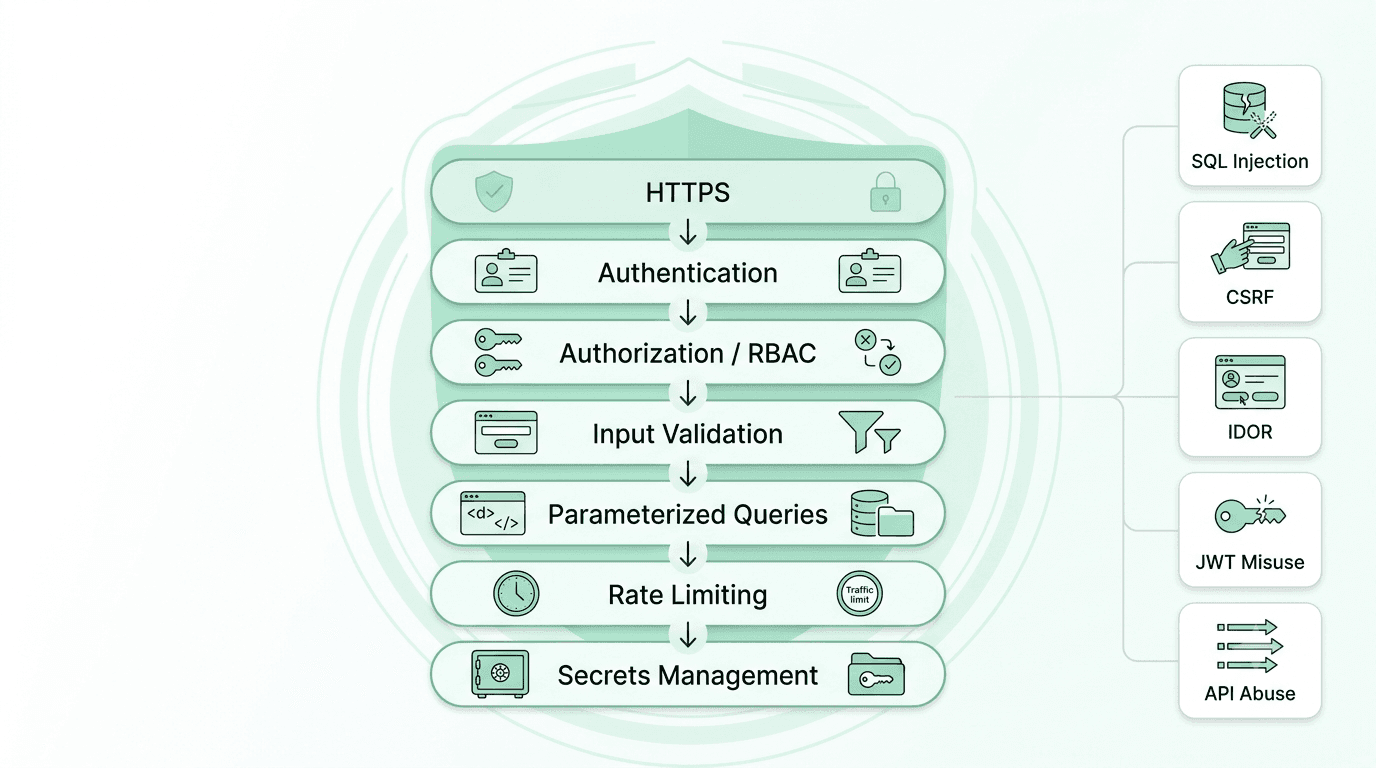
Q63 · [ALL] What is SQL injection, and how would you prevent it?
Answer: SQL injection occurs when an attacker manipulates a query by injecting malicious SQL through unsanitized user input directly concatenated into the query string, potentially allowing them to read, modify, or delete unauthorized data. Prevention: always use parameterized queries or prepared statements, which treat user input strictly as data, never as executable code, and never directly concatenate raw user input into a query string.
Explanation: One of the most fundamental, longest-standing, and most commonly tested web security vulnerabilities, essential knowledge given the severe potential impact of a successful attack.
Real-World Example: A poorly-written login query directly concatenating user input could allow an attacker to submit a specially crafted username that fundamentally alters the query's logic, potentially bypassing authentication entirely without needing a valid password.
Common Mistakes: Directly concatenating or string-interpolating raw user input into a SQL query instead of using parameterized queries or an appropriately safe ORM method.
Follow-up Questions: How do parameterized queries prevent SQL injection at a technical level? Does using an ORM entirely eliminate this risk, or are there still ways it could be introduced? How would you audit an existing codebase for potential SQL injection vulnerabilities?
Q64 · [ALL] How would you securely store and manage sensitive credentials (API keys, database passwords) in a backend application?
Answer: Never hardcode credentials directly in source code; use environment variables for local development, and a dedicated secrets management service (like AWS Secrets Manager or HashiCorp Vault) for production, ensuring secrets are encrypted at rest and access is appropriately restricted and audited.
Explanation: A very commonly tested, fundamental security best practice, since accidentally committing genuine credentials to source control is an unfortunately very common and consequential real-world mistake.
Real-World Example: A publicly accessible repository accidentally containing a hardcoded, valid AWS access key can be discovered and exploited by automated bots within minutes of being pushed, potentially resulting in significant unauthorized cloud usage and cost.
Common Mistakes: Committing a .env file with genuine production secrets to source control, or hardcoding a credential temporarily "just for local testing."
Follow-up Questions: How would you handle rotating a compromised credential across all environments and services using it? What tools have you used for secrets management? How would you prevent secrets from being accidentally committed in the first place?
Q65 · [MID] What is a broken access control vulnerability, and how would you test for one?
Answer: Broken access control occurs when an application fails to properly enforce that users can only access resources and perform actions they're actually authorized for — commonly manifesting as an Insecure Direct Object Reference (IDOR), where changing a resource ID in a request lets a user access another user's data that the application should have blocked. Testing involves attempting to access resources belonging to another user by manipulating IDs or parameters, and verifying every endpoint properly checks authorization, not just authentication.
Explanation: Consistently ranked among the most common and severe real-world web application vulnerabilities, testing whether a candidate thinks about authorization as a per-request, per-resource check rather than a one-time login gate.
Real-World Example: An API endpoint /api/orders/{id} that returns order details without verifying the requesting user actually owns that order allows any authenticated user to view any other user's order simply by changing the ID in the URL.
Common Mistakes: Implementing authentication thoroughly but treating authorization as an afterthought, checking it inconsistently across endpoints rather than systematically on every resource access.
Follow-up Questions: How would you systematically test an API for IDOR vulnerabilities? How would you design a consistent authorization-checking pattern to avoid missing it on any given endpoint? What's the difference between horizontal and vertical privilege escalation?
Q66 · [MID] How would you implement secure password storage in a backend system?
Answer: Hash passwords using a slow, purpose-built algorithm designed specifically for password storage (bcrypt, scrypt, or argon2), which includes a per-password salt automatically and is deliberately computationally expensive to slow down brute-force attacks — never use a fast, general-purpose hash function like MD5 or unsalted SHA-256, and never store passwords in plaintext or with reversible encryption.
Explanation: A very commonly tested, fundamental security question, since password storage mistakes remain a common and severe real-world vulnerability.
Real-World Example: A password database breach where passwords were hashed with bcrypt is vastly less damaging than one where passwords were hashed with unsalted MD5, since bcrypt's deliberate slowness makes brute-forcing the original passwords from the hashes computationally impractical at scale.
Common Mistakes: Using a fast, general-purpose hash function (MD5, SHA-1, or even unsalted SHA-256) for password hashing, which can be brute-forced far too quickly with modern hardware.
Follow-up Questions: Why is a deliberately slow hashing algorithm actually a security feature rather than a performance downside in this specific context? What is a salt, and why does bcrypt handle it automatically? How would you handle a suspected credential-stuffing attack against your login endpoint?
Q67 · [MID] What is Cross-Site Request Forgery (CSRF), and how would you protect a backend API against it?
Answer: CSRF tricks an authenticated user's browser into unknowingly making an unwanted request to an application they're logged into, exploiting the fact that browsers automatically attach cookies to requests regardless of which site initiated them. Protection: use CSRF tokens (a unique, unpredictable token that must be included with any legitimate state-changing request), and configure cookies with the SameSite attribute to restrict when they're sent along with cross-site requests.
Explanation: A commonly tested web security vulnerability, particularly relevant for any backend relying on cookie-based session authentication.
Real-World Example: Without CSRF protection, a malicious site could embed a hidden auto-submitting form that, when visited by a user also logged into their bank in another tab, silently submits a funds transfer request that the bank's server would otherwise mistakenly treat as legitimate.
Common Mistakes: Relying solely on cookie-based authentication for state-changing operations without any CSRF token protection or a restrictive SameSite cookie setting.
Follow-up Questions: How does the SameSite cookie attribute help protect against CSRF, and what are the differences between its Strict, Lax, and None values? Why are token-based authentication schemes using an Authorization header generally less vulnerable to traditional CSRF? How would you implement CSRF token validation on the backend?
Q68 · [MID] How would you design an API's authentication system using JWT, and what are the common pitfalls?
Answer: The server issues a signed token after successful login containing claims (user ID, roles, expiration), verified statelessly on each subsequent request without a database lookup. Common pitfalls include storing overly sensitive data in the token payload (which is only signed, not encrypted, and readable by anyone), using an excessively long expiration without a proper refresh mechanism, and not having a genuine strategy for revoking a token before its natural expiration, since JWTs are inherently hard to invalidate early.
Explanation: A very commonly tested practical implementation question, testing both conceptual understanding and awareness of the specific, well-known pitfalls of this extremely common authentication pattern.
Real-World Example: A typical modern setup issues a short-lived JWT access token (limiting the damage window if compromised) paired with a longer-lived refresh token stored in an HttpOnly cookie, used to silently obtain new access tokens without requiring repeated logins.
Common Mistakes: Storing sensitive data directly in the JWT payload without realizing it's merely signed (tamper-evident) rather than encrypted (unreadable), meaning anyone can decode and read its contents.
Follow-up Questions: How would you implement a "logout everywhere" feature given JWTs are inherently stateless and hard to invalidate before expiry? What's the purpose of a refresh token, and how does it improve security compared to one long-lived access token? Where should a JWT be stored client-side, and why does that choice matter for security?
Q69 · [SR] How would you design an authorization system to support fine-grained, role-based access control across a large application?
Answer: Define roles as collections of specific permissions rather than hardcoding role checks scattered throughout the codebase, centralize authorization logic into a reusable middleware or policy-checking layer applied consistently across all endpoints, and store role/permission assignments in a way that can be audited and updated without requiring a code deployment.
Explanation: A more architecture-level security question, testing whether a candidate can design authorization as a systematic, maintainable concern rather than ad hoc checks scattered inconsistently throughout the code.
Real-World Example: A SaaS application with multiple permission levels (viewer, editor, admin) per workspace benefits from centralizing permission checks in a single reusable policy layer, rather than having each individual endpoint implement its own bespoke, easily-inconsistent authorization logic.
Common Mistakes: Scattering ad hoc if user.role == 'admin' checks throughout individual route handlers, making it very easy to forget a check on a new endpoint and creating an inconsistent, hard-to-audit authorization surface.
Follow-up Questions: How would you design this system to support permissions that vary per resource, not just globally per user? How would you audit the system to verify every sensitive endpoint has an appropriate authorization check? What's the difference between RBAC and ABAC, and when would you choose the latter?
Q70 · [MID] How would you conduct a basic security review of a backend API before a production launch?
Answer: Systematic review across key areas: authentication and authorization (secure password handling, proper session/token management, robust access control enforcement), input validation (checking for injection vulnerabilities), dependency security (scanning for known vulnerabilities in third-party packages), secure transport (HTTPS enforced everywhere), secrets management, and appropriate rate limiting on sensitive endpoints — often combined with an automated security scanning tool as a first pass, in addition to careful manual review.
Explanation: A holistic, practically important pre-launch checklist question, testing whether a candidate has comprehensive security awareness spanning the entire application rather than a narrow focus on just one vulnerability type.
Real-World Example: A pre-launch security review might use an automated dependency scanner to catch a known critical vulnerability in an outdated library, while manual review separately catches a subtle authorization bug allowing a user to access another user's private data via a manipulated resource ID.
Common Mistakes: Focusing a security review narrowly on only one area (like authentication alone) while neglecting other equally important dimensions like input validation, authorization logic, or dependency management.
Follow-up Questions: What automated security scanning tools have you used, and what kinds of vulnerabilities are they typically most effective at catching? How would you prioritize which identified security issues to fix first if you find several at once? How would you specifically test for a broken access control vulnerability during this review?
Section 7: Testing & Code Quality
Q71 · [ALL] What's the difference between unit, integration, and end-to-end tests for a backend service, and what proportion of each would you write?
Answer: Unit tests verify individual functions/classes in isolation with mocked dependencies (fast, cheap). Integration tests verify multiple components working together, like an API endpoint interacting with a real test database. End-to-end tests verify a complete flow through the fully running system (slowest, most realistic, but also the most brittle). Following the "testing pyramid," most tests should be fast unit tests, a moderate number integration tests, and relatively few, carefully chosen E2E tests covering critical flows.
Explanation: A foundational testing strategy question, testing whether a candidate understands the cost/confidence tradeoff at each layer rather than over-investing in only one.
Real-World Example: A checkout flow might have dozens of unit tests for pricing/discount logic, several integration tests verifying the checkout API correctly interacts with the database and payment service, and one or two E2E tests confirming the full happy-path flow works end-to-end.
Common Mistakes: Over-investing in slow, brittle E2E tests at the expense of fast unit tests, inverting the testing pyramid into a much less efficient "ice cream cone" anti-pattern.
Follow-up Questions: How would you handle flaky integration tests that intermittently fail in CI? What's the difference between mocking and using a real test database for an integration test? How would you decide what genuinely warrants an integration test versus being adequately covered by unit tests alone?
Q72 · [MID] How would you write an effective test for a function that depends on an external API call?
Answer: Mock the external dependency rather than making a genuine network call during the test, configuring the mock's response (or raised exception) to precisely simulate different scenarios — success, various failure modes, and timeouts — allowing the test to reliably and deterministically verify your own code's behavior without depending on the real external service's actual current availability.
Explanation: A very commonly tested practical testing technique, essential for writing fast, reliable, and properly isolated tests for code with external dependencies.
Real-World Example: Testing a function that fetches and processes data from a third-party API would mock that call to return a controlled sample response, allowing the test to verify the processing logic in isolation, independent of the real API's live behavior.
Common Mistakes: Writing a test that makes a genuine real network call to an external API, resulting in a test that's slow, unreliable, and potentially costly to run repeatedly in CI.
Follow-up Questions: How would you test your code's behavior when the mocked external call raises a timeout or returns an unexpected error? How would you verify a mocked function was called with the exact arguments you expected? When would you choose to test against a real sandbox/staging instance of an external API rather than a mock?
Q73 · [MID] What is contract testing, and why is it particularly useful in a microservices architecture?
Answer: Contract testing verifies that a service's API genuinely matches the expectations of its consumers, without requiring both services to actually be deployed and running together — a consumer defines its expectations as a "contract," and the provider's tests verify it satisfies that contract, catching breaking changes before deployment rather than only discovering them in a slower, more expensive full integration environment.
Explanation: A more advanced testing concept, increasingly commonly tested at companies with many independently-deployed services, testing awareness of a practical solution to a genuine coordination problem.
Real-World Example: A team introducing contract testing (using a tool like Pact) between a checkout service and an inventory service can catch a breaking schema change in CI before it's ever deployed, rather than discovering the incompatibility only after a production incident.
Common Mistakes: Relying purely on end-to-end integration tests across all services to catch API incompatibilities, which is slow, brittle, and often only run infrequently, allowing breaking changes to slip through undetected for longer.
Follow-up Questions: How does contract testing differ from a typical integration test in terms of what's actually run and verified? How would you integrate contract tests into a CI/CD pipeline across multiple independently-deployed teams? What happens when a provider's contract test fails — what's the appropriate next step?
Q74 · [MID] How would you approach load testing a backend API before a major product launch?
Answer: Define realistic target load based on expected traffic (with headroom for spikes), use a load testing tool (like k6, Locust, or JMeter) to simulate that traffic against a staging environment closely resembling production, monitor key metrics (response time percentiles, error rate, resource utilization) during the test, and identify the actual breaking point and specific bottleneck before it's discovered in production under real load.
Explanation: A very practical, commonly tested pre-launch readiness question, testing whether a candidate proactively validates performance rather than only discovering problems reactively once real users hit them.
Real-World Example: A team preparing for a major marketing campaign launch would load test their checkout API to a level well above the expected peak traffic, discovering (and fixing) a database connection pool bottleneck before it caused a real outage during the actual campaign.
Common Mistakes: Load testing against a staging environment that's meaningfully under-provisioned compared to production, producing misleadingly optimistic (or pessimistic) results that don't actually reflect real production behavior.
Follow-up Questions: What specific metrics would you monitor during a load test beyond just average response time (hint: p95/p99 latency)? How would you distinguish between a bottleneck in the application layer versus the database layer during a load test? How would you decide on a realistic target load to test against?
Q75 · [JR/MID] How do you decide what to mock versus what to test with real dependencies in a given test?
Answer: Mock dependencies that are slow, non-deterministic, external, or have side effects you don't want during testing (network calls, sending real emails, charging real payments), while using real, lightweight dependencies (like an in-memory or fast local test database) when the interaction with that specific dependency is genuinely the thing you're trying to verify, since over-mocking can result in tests that pass while the real integration is actually broken.
Explanation: A commonly tested practical judgment question, testing whether a candidate has genuine hands-on experience calibrating this very common and easy-to-get-wrong tradeoff.
Real-World Example: A unit test for pricing calculation logic should mock the database entirely (the calculation logic itself doesn't need a real database), while an integration test specifically verifying that an order is correctly persisted should use a real, isolated test database rather than mocking it away.
Common Mistakes: Over-mocking to the point where a test suite passes consistently while the actual real integration between components is silently broken, giving false confidence.
Follow-up Questions: Can you give an example from your own experience where over-mocking hid a real bug that only surfaced in production? How do you decide when a test needs a real database versus an in-memory fake? How would you balance test speed against the confidence that comes from testing against real dependencies?
Q76 · [MID] What is code review, and what would you specifically look for when reviewing a backend pull request?
Answer: Focus on correctness (does the logic actually do what it's supposed to, including edge cases), security (input validation, authorization checks, no hardcoded secrets), performance (any obvious N+1 queries or inefficient loops), test coverage (are the changes genuinely tested, including edge cases), and maintainability (is the code reasonably clear and consistent with the codebase's existing conventions) — while leaving purely stylistic nitpicks to automated linting/formatting tools rather than human review time.
Explanation: A commonly tested collaboration and code-quality question, testing whether a candidate reviews code with genuine substance rather than only superficial style comments.
Real-World Example: A thorough backend code review might catch a missing authorization check on a new endpoint, or a database query inside a loop that would cause an N+1 problem at scale, both far more valuable catches than a purely stylistic comment about variable naming.
Common Mistakes: Focusing review comments primarily on subjective style preferences rather than substantive correctness, security, or performance issues, especially when those style concerns should be handled by an automated linter instead.
Follow-up Questions: How would you handle a genuine technical disagreement with another reviewer about a specific design approach? How do you review a very large pull request effectively without missing important issues? What would you do if you noticed a recurring pattern of similar issues across a specific team member's pull requests?
Q77 · [SR] How would you approach introducing automated testing into a legacy backend codebase that has little to no existing test coverage?
Answer: Start by adding tests around the most critical, highest-risk business logic first (rather than attempting comprehensive coverage all at once), use characterization tests to capture and lock in the system's actual current behavior before making any changes (particularly useful when the intended behavior isn't fully documented), and require new code changes going forward to include tests, gradually increasing coverage over time rather than attempting a disruptive, all-at-once retrofit.
Explanation: A more senior, pragmatic question testing realistic judgment about incrementally improving a genuinely difficult, common real-world situation rather than proposing an unrealistic "rewrite everything with full coverage" approach.
Real-World Example: A team inheriting a large, untested legacy billing system might first write characterization tests around the core billing calculation logic (the highest-risk, most business-critical part) before attempting any refactoring, ensuring any unintended behavior change is caught immediately.
Common Mistakes: Proposing to halt all feature work in order to retroactively write comprehensive tests for the entire legacy codebase at once, an approach that's rarely realistic or well-received by business stakeholders.
Follow-up Questions: What is a characterization test, and how does it differ from a typical test written against a well-understood specification? How would you prioritize which parts of a large legacy system to test first? How would you get buy-in from the team and management to invest time in this kind of incremental testing effort?
Q78 · [MID] How would you measure and improve code quality across a backend team, beyond just code review?
Answer: Combine automated tooling (linters, static analysis, and a required minimum test coverage threshold enforced in CI) with team practices (regular code review, documented architectural decisions, and periodic retrospectives on recurring issues), while being mindful that metrics like raw code coverage percentage are useful signals but not a complete measure of genuine code quality on their own.
Explanation: A holistic engineering practice question, testing whether a candidate thinks about code quality as a sustained team practice rather than a one-time or purely individual concern.
Real-World Example: A team noticing recurring, similar bugs related to inconsistent error handling might introduce a shared linting rule or a documented pattern specifically to catch and prevent that recurring class of issue automatically going forward, rather than relying purely on individual reviewers to catch it every time.
Common Mistakes: Treating a single metric like code coverage percentage as a complete proxy for code quality, without recognizing its real, well-known limitations (100% coverage doesn't guarantee the tests are actually meaningful).
Follow-up Questions: What specific automated tools have you used to help enforce code quality standards in CI? How would you handle a recurring quality issue that keeps slipping through code review despite reviewers' efforts? How do you balance investing in code quality practices against delivery velocity?
Section 8: DevOps, Deployment & Observability
Q79 · [MID] What is CI/CD, and how would you set up a basic pipeline for a backend service?
Answer: Continuous Integration automatically builds and tests every code change to catch integration issues early; Continuous Deployment/Delivery automates the subsequent release process so validated code can be reliably deployed. A basic pipeline runs linters and the automated test suite on every pull request, builds a deployable artifact (like a Docker image) on merge to main, and deploys it to staging and then production (either automatically or with a manual approval gate).
Explanation: Core, foundational DevOps vocabulary and practical setup knowledge relevant to virtually every modern backend team, frequently tested for practical familiarity beyond just terminology.
Real-World Example: A typical pipeline runs the test suite and static analysis on every pull request as a required, blocking check, and upon merging to main, automatically builds and deploys a container image through staging before production.
Common Mistakes: Not requiring the test suite to pass as a blocking check before allowing a merge, allowing broken or regressive code into the main branch without adequate, timely detection.
Follow-up Questions: What's the difference between Continuous Delivery and full Continuous Deployment? How would you design an appropriate rollback strategy for a bad deployment? What is a blue-green deployment, and how does it reduce deployment risk?
Q80 · [MID] What is the difference between blue-green deployment and canary deployment, and when would you choose each?
Answer: Blue-green deployment maintains two complete, identical environments, deploying the new version fully to the currently inactive one, testing it, and then switching all traffic over instantly — enabling a very fast, simple rollback by switching back. Canary deployment instead gradually shifts a small percentage of live traffic to the new version first, closely monitoring for issues, and progressively increasing that percentage over time.
Explanation: A commonly tested deployment strategy comparison, testing understanding of different concrete approaches to reducing risk during deployment.
Real-World Example: A team deploying a significant, potentially risky backend change might use canary deployment specifically to catch a subtle performance regression from just 5% of live traffic before it's ever fully rolled out to the entire user base.
Common Mistakes: Not being able to clearly articulate the practical difference — blue-green is an instant, complete traffic switch between two full environments, while canary is a gradual, incremental, and closely-monitored shift.
Follow-up Questions: What infrastructure is specifically needed to properly implement a canary deployment? How would you decide on an appropriate initial canary traffic percentage? What are the relative cost implications of maintaining a full blue-green setup compared to a canary approach?
Q81 · [SR] What is infrastructure as code (IaC), and what benefits does it provide for backend infrastructure?
Answer: IaC defines and manages infrastructure (servers, databases, networking) declaratively through version-controlled configuration files (using a tool like Terraform), rather than manually provisioning resources through a cloud console — enabling infrastructure changes to be code-reviewed, tested, reliably reproduced, and easily reverted, just like application code.
Explanation: An increasingly important and commonly tested DevOps concept for backend developers, especially relevant as more developers take on meaningful infrastructure responsibilities.
Real-World Example: A team using Terraform to define their complete cloud infrastructure can reliably reproduce an identical staging environment for realistic testing and review infrastructure changes through the same pull-request process used for application code.
Common Mistakes: Manually provisioning infrastructure through a cloud console without any accompanying version-controlled configuration, making the setup difficult to reliably reproduce, audit, or confidently modify.
Follow-up Questions: How would you handle managing sensitive secrets securely within an IaC workflow? What is "configuration drift," and how does IaC help prevent it? Have you personally used Terraform — what was your hands-on experience?
Q82 · [MID] What is containerization, and why would a backend team use Docker?
Answer: Docker packages an application together with all its dependencies and precise runtime environment into a portable, isolated container, ensuring consistent behavior across different environments (a developer's machine, staging, production) and eliminating the "it works on my machine" class of problem.
Explanation: A very commonly tested, practical modern development tooling question, essential for understanding how most modern backend services are packaged, deployed, and run consistently.
Real-World Example: A backend service with a specific required runtime version and various precise dependencies can be run identically on any team member's local machine and equally consistently in production, using Docker containers defined via a shared, version-controlled Dockerfile.
Common Mistakes: Creating an unnecessarily large, bloated Docker image by including unneeded build tools in the final image, rather than using a multi-stage build to keep the production image lean.
Follow-up Questions: What is a multi-stage Docker build, and why is it beneficial? What's the difference between Docker and a full orchestration platform like Kubernetes? How would you manage environment-specific configuration and secrets when using Docker across environments?
Q83 · [SR] How would you design a health check and readiness/liveness probe strategy for a backend service running in a container orchestrator?
Answer: A liveness probe checks whether the running process is still healthy and responsive, restarting the container if it isn't. A readiness probe checks whether the service is actually ready to receive traffic (like having successfully connected to its database), removing it from the load balancer's rotation if not — these are distinct checks, since a service can be alive but not yet ready (still starting up), or ready initially but later become unhealthy without necessarily needing an immediate restart.
Explanation: A commonly tested Kubernetes/orchestration-adjacent concept, testing whether a candidate understands the practical distinction that governs correct, resilient rolling deployments and automatic recovery.
Real-World Example: A service that's slow to establish its initial database connection at startup needs a readiness probe that fails until that connection succeeds, preventing the orchestrator from routing traffic to an instance that isn't actually ready yet, even though the process itself is technically running.
Common Mistakes: Using a single combined health check for both liveness and readiness, which can cause an orchestrator to unnecessarily restart a service that's simply still starting up, or continue routing traffic to a service that's alive but genuinely not ready.
Follow-up Questions: What should a readiness check actually verify — just process health, or downstream dependency health too? How would you avoid a readiness check itself becoming a cascading failure point if a downstream dependency is briefly degraded? How would you tune the failure threshold and check interval for these probes?
Q84 · [MID] What is observability, and what's the difference between logs, metrics, and traces?
Answer: Logs are discrete, timestamped records of individual events, useful for detailed debugging of a specific incident. Metrics are aggregated numerical measurements over time (like request rate, error rate, latency percentiles), useful for spotting trends and triggering alerts. Traces track a single request's journey across multiple services in a distributed system, useful for pinpointing exactly where latency or an error originated in a complex call chain.
Explanation: A very commonly tested foundational observability question, essential for understanding how backend teams actually diagnose issues in production systems, especially distributed ones.
Real-World Example: Diagnosing a slow checkout request in a microservices architecture typically starts with metrics (noticing elevated p99 latency), narrows down using a distributed trace (identifying which specific downstream service call is actually slow), and finally uses detailed logs from that specific service to find the precise root cause.
Common Mistakes: Relying on logs alone for observability in a distributed system, without metrics for trend detection or traces for following a request across service boundaries, making diagnosis of cross-service issues far slower.
Follow-up Questions: How would you set up alerting based on metrics without generating excessive false-positive noise? How does distributed tracing actually propagate context across service boundaries? What's cardinality, and why does it matter when designing metrics/logging labels?
Q85 · [MID] How would you diagnose a production backend service that's suddenly experiencing high latency?
Answer: Check monitoring/observability dashboards first for the affected layer (application response times, database query performance, external dependency latency), narrow down whether the issue is isolated to a specific component or broadly affecting the whole system, review recent deployments or configuration changes as a likely initial suspect, and check infrastructure metrics (CPU, memory, database connection pool utilization) for genuine resource exhaustion.
Explanation: A very practical, commonly tested troubleshooting scenario, testing systematic debugging methodology across the stack rather than immediately guessing at a single layer without supporting evidence.
Real-World Example: A sudden latency spike traced back to a recent deployment that unintentionally removed a critical database index is a common, realistic scenario — systematic investigation starting from monitoring dashboards would typically reveal the affected query and its changed execution plan relatively quickly.
Common Mistakes: Guessing at a likely root cause and attempting a fix immediately without first checking available monitoring data to narrow down which layer is actually responsible.
Follow-up Questions: What key metrics would you want readily available on a dashboard to help quickly diagnose this kind of issue? How would you distinguish a genuine database bottleneck from an application server issue? How would you safely and quickly roll back a suspect recent deployment?
Q86 · [SR] How would you design a graceful shutdown process for a backend service to avoid dropping in-flight requests during a deployment?
Answer: On receiving a shutdown signal, the service should stop accepting new requests (deregister from the load balancer/service discovery), allow currently in-flight requests to finish processing within a bounded grace period, then close remaining resources (database connections, open files) cleanly, and only then actually terminate — an orchestrator typically enforces a maximum grace period before forcibly killing the process if it hasn't shut down cleanly by then.
Explanation: A commonly tested operational readiness concept, testing whether a candidate has thought through the details of how deployments avoid dropping legitimate in-flight user requests.
Real-World Example: A rolling deployment that simply kills old service instances immediately without a graceful shutdown period would abruptly drop any requests those instances were still actively processing, causing visible errors for real users during every single deployment.
Common Mistakes: Not implementing any graceful shutdown handling at all, relying purely on the orchestrator's default (often abrupt) termination behavior, which causes real, avoidable errors on every deployment.
Follow-up Questions: How would you handle a request that's still in-flight when the maximum grace period expires? How does this graceful shutdown process interact with the readiness probe discussed earlier? How would you test that your graceful shutdown logic actually works correctly before relying on it in production?
Q87 · [MID] How would you approach capacity planning for a backend service ahead of an expected traffic spike (like a major sale event)?
Answer: Analyze historical traffic patterns and the specific expected multiplier for the event, load test the system at the projected peak (plus a safety margin) to identify the actual breaking point and bottleneck, ensure autoscaling policies and limits are properly configured to handle the expected load, verify downstream dependencies (database, third-party APIs) can also handle the increased load, and have a clear on-call and rollback plan in place for the event itself.
Explanation: A very practical, commonly tested operational planning question, testing whether a candidate thinks proactively about scale rather than only reactively responding once problems occur.
Real-World Example: An e-commerce team preparing for a major annual sale would load test their checkout flow well above the projected peak traffic multiplier, often discovering and fixing a database connection pool or third-party payment gateway bottleneck that wouldn't have surfaced under normal day-to-day load.
Common Mistakes: Focusing capacity planning only on the application server layer while neglecting to verify that downstream dependencies (database, third-party APIs, payment gateways) can also actually handle the increased load.
Follow-up Questions: How would you set appropriate autoscaling thresholds to react quickly enough to a sudden traffic spike? How would you verify a third-party dependency can handle your expected increased load? What would your rollback plan look like if the system starts struggling during the actual event?
Q88 · [SR] How would you design an incident response process for a backend team, from detection through postmortem?
Answer: Detection via automated alerting on key metrics, a clear on-call rotation and escalation path, an immediate focus on mitigation (rollback, feature flag, failover) before deep root-causing if a known-good state exists, regular status communication during the incident, and a blameless postmortem afterward focused on identifying systemic contributing factors and concrete follow-up action items, rather than assigning individual blame.
Explanation: A commonly tested operational maturity question, testing whether a candidate has genuine experience with (or thoughtful awareness of) how mature engineering teams handle production incidents.
Real-World Example: A team noticing an error rate spike after a deploy would typically roll back immediately to restore service, then investigate the root cause in a stable environment afterward, followed by a blameless postmortem identifying that better pre-deployment testing could have caught the issue.
Common Mistakes: Prioritizing deep root-cause investigation while the system is actively down, rather than prioritizing a fast, safe mitigation first to stop user impact.
Follow-up Questions: How do you decide between rolling back versus forward-fixing during an active incident? What makes a postmortem genuinely "blameless," and why does that matter for a team's long-term culture? How would you track and ensure postmortem action items are actually followed through on?
Section 9: Scenario-Based & Behavioral
Q89 · [S] Tell me about a time you had to diagnose a production incident under real time pressure. Walk me through your process.
Answer: A strong answer describes a structured incident response: quickly assessing impact and severity, prioritizing mitigation over deep investigation while the system is actively degraded, using available monitoring/logging to narrow down the cause methodically, communicating status clearly to stakeholders throughout, and following up with a proper postmortem and concrete preventive action items afterward.
Explanation: One of the most commonly asked behavioral questions for backend roles, since production incidents are a near-universal experience, and how a candidate handles pressure and ambiguity reveals a lot about their actual operational maturity.
Real-World Example: A candidate might describe an incident where error rates spiked after a deployment, immediately rolling back to restore service before investigating further, then discovering the root cause was a missing database index that only became a problem at production data volume, and implementing a load-testing step in the deploy pipeline going forward.
Common Mistakes: Describing a chaotic, unstructured response without a clear methodology, or focusing the story entirely on the technical fix without mentioning communication or the follow-up prevention work.
Follow-up Questions: How did you communicate the incident's status to non-technical stakeholders while it was ongoing? What would you have done differently if you'd had even less time to investigate? What specific process change came out of the postmortem?
Q90 · [S] Describe a time you had to make a significant architectural tradeoff (like choosing between consistency and availability) and how you approached it.
Answer: A strong answer describes genuinely weighing the specific business context (what actually matters more for this particular use case), articulating the concrete tradeoff considered, and explaining the reasoning behind the final decision — showing the candidate can reason about architecture as a series of context-dependent tradeoffs rather than reflexively applying a single "best practice" universally.
Explanation: Tests architectural judgment and the ability to communicate technical reasoning clearly, an important differentiator especially for mid-to-senior backend roles.
Real-World Example: A candidate might describe choosing eventual consistency for a social media "like count" feature (favoring availability and low latency, since a brief delay in an exact count is harmless) while choosing strong consistency for an inventory-decrement operation in the same system (where overselling has real business cost).
Common Mistakes: Describing a decision made without genuinely considering the specific tradeoffs involved, or being unable to articulate why the chosen approach was actually appropriate for that specific context versus another reasonable alternative.
Follow-up Questions: What would have changed your decision if the business requirements had been different? How did you communicate this tradeoff to non-technical stakeholders? Looking back, would you make the same choice again?
Q91 · [S] Tell me about a time you disagreed with a technical decision made by your team or a more senior colleague.
Answer: A strong answer describes voicing disagreement constructively and specifically, backed by concrete reasoning or evidence, remaining genuinely open to being wrong or missing context, and ultimately either reaching mutual agreement or professionally committing to the team's decision even if it wasn't the candidate's original preference.
Explanation: Tests communication, collaboration, and professional maturity — a common differentiator for team fit separate from raw technical skill.
Real-World Example: A candidate might describe disagreeing with a team's choice of database technology for a new service, presenting relevant data or concerns, and — after the team ultimately chose the original option for reasons the candidate hadn't fully considered — professionally committing to helping make that choice succeed.
Common Mistakes: Choosing an example where the candidate was simply, unambiguously "right" with no real nuance, or an example that reflects poorly on collaboration, like continuing to resist a decision after it was already made.
Follow-up Questions: How did you know when it was time to stop pushing your position and commit to the team's decision? What would you have done if that decision had later turned out badly? How do you generally handle being overruled on something you feel strongly about?
Q92 · [S] How do you approach estimating the time a backend feature or task will take, especially when there's genuine technical uncertainty?
Answer: A strong answer describes breaking the work into smaller pieces, explicitly identifying genuine unknowns and flagging them for a small time-boxed technical spike before committing to a full estimate, accounting for testing and code review time as part of the estimate, and communicating a range or confidence level rather than an artificially precise single number for larger or less well-understood work.
Explanation: A practical process question testing organizational and communication skills relevant to working effectively within a real team, not just raw technical execution ability alone.
Real-World Example: A candidate might describe a task that seemed straightforward but revealed a genuine unknown around a third-party API's rate limits, prompting a quick spike to properly understand that constraint before committing to a confident estimate for the full feature.
Common Mistakes: Providing an artificially precise single-number estimate without acknowledging genuine underlying uncertainty, which can lead to friction later when the work inevitably takes longer than that falsely precise estimate suggested.
Follow-up Questions: How do you communicate a missed deadline proactively to your team once you realize an estimate was wrong? How do you factor in code review and testing time when estimating? How would you break down a genuinely large, complex backend feature into smaller, independently estimable pieces?
Q93 · [S] Describe a situation where you had to balance technical debt against shipping a feature on a tight deadline.
Answer: A strong answer describes a clear-eyed assessment of the specific tradeoff (what shortcut is being taken and its likely future cost), transparent communication of that tradeoff to the team rather than silently cutting corners, and ideally a concrete follow-up plan to address the resulting debt once the immediate deadline pressure has passed.
Explanation: Tests pragmatic engineering judgment and honest communication under real, common time pressure — a very frequent tension in backend development work.
Real-World Example: A candidate might describe deliberately hardcoding a specific business rule to meet an urgent deadline, explicitly flagging it as known technical debt (via a tracked ticket) to properly generalize once initial user feedback validated the underlying feature's direction.
Common Mistakes: Describing silently cutting corners without transparently communicating the tradeoff to the team, or conversely refusing to make any pragmatic tradeoffs at all even when a genuinely fixed deadline reasonably requires some.
Follow-up Questions: How do you decide which corners are genuinely reasonable to cut under deadline pressure versus which absolutely shouldn't be? How do you ensure technical debt you've deliberately taken on doesn't get silently forgotten? How do you communicate this kind of tradeoff to a non-technical stakeholder or product manager?
Q94 · [S] Tell me about a time you had to learn a new technology or system quickly to solve a problem.
Answer: A strong answer describes an efficient, structured learning approach — identifying the specific core concepts genuinely needed for the task, building a small proof-of-concept to validate key assumptions before committing to a full implementation, and leveraging documentation or knowledgeable colleagues effectively — combined with concrete evidence of successfully applying that knowledge under real time constraints.
Explanation: Tests learning agility, an important trait for backend developers given how frequently new tools, services, and system components need to be understood quickly.
Real-World Example: A candidate might describe needing to quickly understand a new message queue technology for a project, building a small focused proof-of-concept first to validate their understanding of its delivery guarantees before confidently committing to using it in the actual production feature.
Common Mistakes: Describing a vague, generic learning process without concrete evidence of successfully applying the newly learned technology to deliver real value under genuine time constraints.
Follow-up Questions: How do you decide what to prioritize learning first when facing something genuinely unfamiliar under time pressure? What resources do you typically turn to first? How do you evaluate whether a new technology is actually production-ready before committing to it?
Q95 · [S] How would you handle a situation where a product manager asks for a feature that you believe has a significant, unaddressed security or scalability risk?
Answer: A strong answer describes raising the concern clearly and specifically, backed by concrete reasoning about the actual risk and its potential impact, proposing a reasonable alternative approach or mitigation where possible, and working collaboratively toward a solution that addresses both the business need and the genuine technical risk, rather than either silently building something risky or unilaterally refusing without adequate explanation.
Explanation: Tests the ability to advocate for sound engineering practice while still being a genuinely collaborative, business-aware partner — an important balance for backend developers who often see risks that aren't obvious to non-technical stakeholders.
Real-World Example: A candidate might describe being asked to skip proper input validation to ship a feature faster, clearly explaining the concrete security risk involved, and proposing a slightly adjusted timeline that still included the necessary validation rather than either silently complying or flatly refusing.
Common Mistakes: Describing an approach that either silently complies with an unsafe request without voicing any concern, or one that comes across as unilaterally and unhelpfully blocking the work without proposing any constructive alternative.
Follow-up Questions: How would you handle it if the product manager still wanted to proceed despite your concern? How do you communicate a technical risk in terms a non-technical stakeholder can genuinely understand and weigh? Can you describe a time this kind of conversation didn't go the way you'd hoped, and what you learned from it?
Section 10: Industry Trends
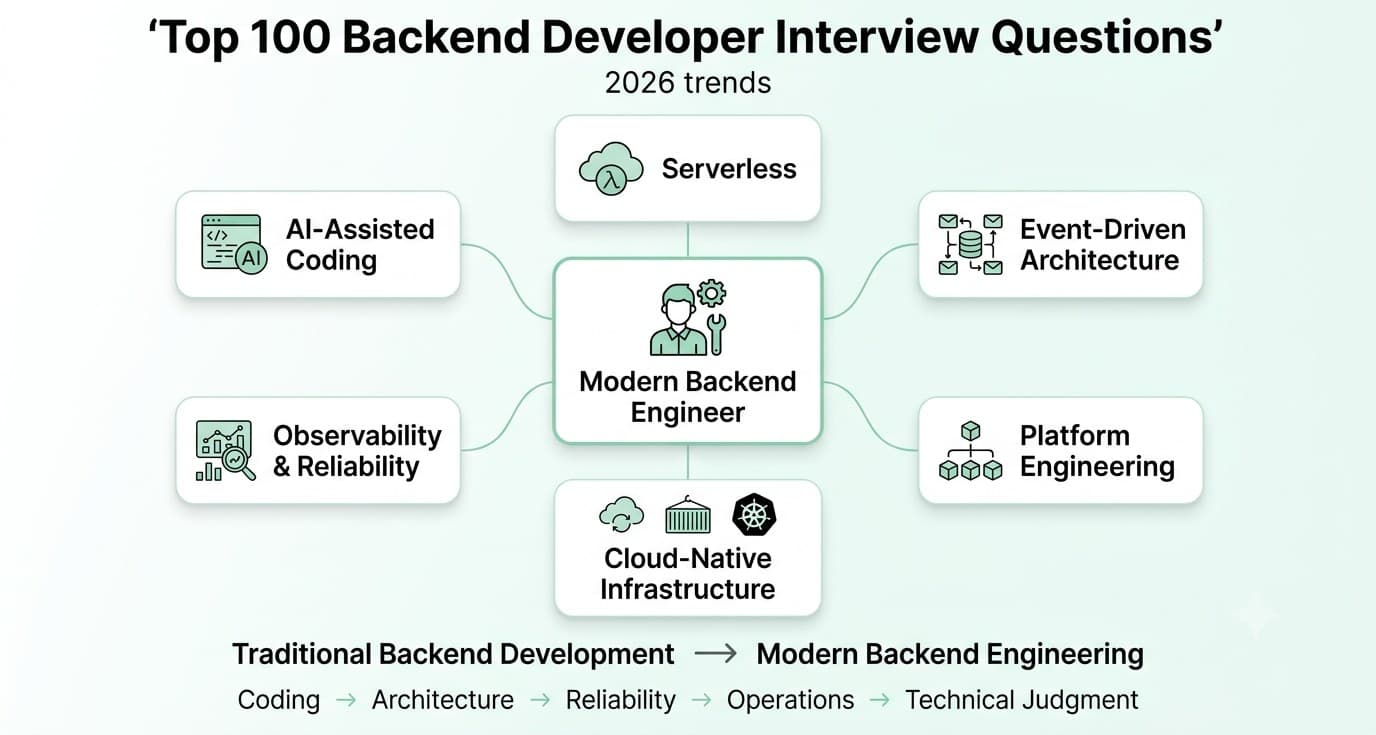
Q96 · [ALL] How are AI coding assistants changing backend development practice?
Answer: AI coding assistants increasingly accelerate writing boilerplate code, drafting initial API implementations, and generating test scaffolding — shifting a backend developer's core value further toward system design, careful code review, and critically validating AI-generated code for subtle correctness, security, and performance issues, since AI-generated code still requires genuine human judgment before being trusted in production.
Explanation: A highly current, frequently tested trend question, testing whether a candidate has genuine, hands-on perspective rather than either dismissing or blindly hyping these tools.
Real-World Example: Many backend developers now use AI assistants to quickly scaffold a new endpoint's boilerplate structure, then apply their own judgment to review the generated code for correctness, missing authorization checks, or SQL injection risk before committing it.
Common Mistakes: Describing uncritical trust in AI-generated code without any independent review step, especially concerning for security-sensitive backend code.
Follow-up Questions: How do you validate AI-generated code is genuinely secure and correct before merging it? What are the specific risks of over-relying on these tools for backend code specifically? How do you think backend skill requirements will shift as these tools mature?
Q97 · [MID/SR] What is the growing role of serverless computing in backend architecture, and what are its tradeoffs?
Answer: Serverless (functions-as-a-service, like AWS Lambda) lets backend developers deploy individual functions without managing underlying servers, automatically scaling with demand and charging only for actual usage — well suited for unpredictable or spiky workloads and event-driven processing, but introduces tradeoffs like cold-start latency, more limited execution duration, and potential vendor lock-in.
Explanation: Tests awareness of an increasingly common architectural option, and genuine judgment about when its tradeoffs are actually worth it versus a traditional always-on server architecture.
Real-World Example: A backend team might use serverless functions for infrequent, bursty background processing (like image thumbnail generation on upload) while keeping their core, latency-sensitive API on traditional always-on infrastructure to avoid cold-start latency on critical request paths.
Common Mistakes: Recommending serverless as a universal replacement for traditional server architecture without acknowledging cold-start latency and execution duration limits that make it a poor fit for certain workloads.
Follow-up Questions: How would you mitigate cold-start latency for a latency-sensitive serverless function? What kinds of workloads are genuinely well-suited to serverless, and which aren't? How does serverless pricing compare to traditional infrastructure at sustained high traffic?
Q98 · [MID/SR] How is the growing adoption of the modern data stack and event-driven architecture affecting backend system design?
Answer: More backend systems now emit events representing state changes (rather than only exposing synchronous request/response APIs), feeding into a broader ecosystem of downstream consumers — analytics pipelines, search indexing, notification systems — via a shared event stream, reducing tight point-to-point coupling between services and enabling new consumers to be added without modifying the original producing service.
Explanation: Tests awareness of a meaningful architectural shift many organizations have made or are actively making, relevant to how backend systems are increasingly designed to be extensible.
Real-World Example: An e-commerce backend emitting an "order placed" event that's independently consumed by inventory, shipping, analytics, and fraud-detection systems avoids the original order service needing to know about or directly call each of those downstream consumers individually.
Common Mistakes: Designing every new downstream need as a direct, synchronous integration with the original service, creating tight coupling and a growing, fragile web of point-to-point dependencies over time.
Follow-up Questions: How would you handle a downstream consumer needing historical events that were emitted before it existed? What are the tradeoffs of event-driven architecture compared to a more traditional synchronous service-to-service API approach? How would you ensure event schemas evolve without breaking existing consumers?
Q99 · [SR] How is the growing emphasis on platform engineering and internal developer platforms affecting how backend teams work?
Answer: Platform engineering teams build internal, self-service tooling (deployment pipelines, infrastructure provisioning, observability dashboards) that reduces cognitive load on product-focused backend teams, letting them focus on business logic rather than infrastructure complexity — treating internal tooling as a genuine product with other developers as its customers.
Explanation: Tests awareness of an evolving trend in how larger engineering organizations are structuring themselves as they scale, relevant to understanding modern backend team dynamics.
Real-World Example: A backend team at a company with a mature internal developer platform can deploy a new service through a simple, standardized self-service workflow without needing deep infrastructure expertise, in contrast to a company where every team must independently navigate raw cloud infrastructure.
Common Mistakes: Confusing platform engineering with traditional DevOps/SRE without recognizing the key difference — platform engineering focuses on building reusable, self-service internal products, not just operating infrastructure directly.
Follow-up Questions: How would you measure whether an internal developer platform is actually succeeding? What's the difference between platform engineering and traditional SRE? How do you balance platform standardization against individual team autonomy?
Q100 · [ALL] How do you personally stay current with the evolving backend development landscape?
Answer: A strong answer describes a concrete, sustainable approach: following relevant technical blogs or specific respected voices, participating in developer communities, hands-on experimentation with new tools on side projects, and periodically and critically reassessing whether a given new tool or technique is genuinely worth adopting versus representing short-lived hype.
Explanation: A very common closing question testing genuine intellectual curiosity and a professional growth mindset, particularly relevant given how quickly backend tooling and best practices continue to evolve.
Real-World Example: A candidate might describe regularly reading specific engineering blogs from companies operating at meaningful scale, combined with periodically building a small side project using a new tool specifically to gain genuine hands-on familiarity before recommending its adoption at work.
Common Mistakes: Giving a vague, generic answer without any specific, concrete examples of resources or recent tools/techniques genuinely learned and evaluated.
Follow-up Questions: What's a specific new backend tool or technique you've evaluated recently, and how did you decide whether it was worth adopting? Can you name a few specific resources you follow regularly? How do you decide which emerging trends are genuinely worth investing time in versus likely short-lived hype?
Red Flag Checklist: Signs You Need More Prep
Before your interview, honestly check yourself against these. If more than a couple feel shaky, go back to that section first.
- I can explain the difference between 401 and 403 without hesitating.
- I can describe the N+1 query problem and name a specific fix, not just define it abstractly.
- I can walk through ACID properties with a concrete example for each letter, not just the acronym.
- I have at least one real story ready for "tell me about a production incident you diagnosed."
- I can explain CAP theorem and name real databases that lean CP versus AP.
- I know the difference between horizontal and vertical scaling and what changes an app needs to actually scale horizontally.
- I can explain idempotency with a payment-related example, not just a dictionary definition.
- I understand why SQL injection happens at a technical level, not just "use parameterized queries" as a memorized phrase.
- I can describe at least one caching invalidation strategy and its specific tradeoff.
- I have a structured framework ready for open-ended system design questions (clarify → estimate → design → deep-dive → tradeoffs).
- Read More: Common Backend developer Interview mistakes to avoid in 2026
60-Second Answers: The Rapid-Fire Round
Use these as a final warm-up the morning of your interview — cover them out loud, without notes, in under a minute each.
- PUT vs. PATCH? PUT replaces the whole resource; PATCH updates only specified fields.
- Optimistic vs. pessimistic locking? Optimistic checks for conflicts at commit time (via a version number); pessimistic locks the row upfront to prevent conflicts entirely.
- At-least-once vs. exactly-once delivery? At-least-once may redeliver and requires idempotent consumers; true exactly-once is practically achieved by combining at-least-once delivery with deduplication.
- Vertical vs. horizontal scaling, one sentence each? Vertical = bigger machine; horizontal = more machines, which requires statelessness to work well.
- Read replica vs. sharding? A read replica copies all data for read scaling; sharding splits data across servers for both read and write scaling.
- Synchronous vs. asynchronous processing? Synchronous blocks until done; asynchronous lets the caller move on and get notified or poll for the result later.
- Circuit breaker, one sentence? Stops calling a failing downstream dependency temporarily so it can recover and so you fail fast instead of piling up doomed requests.
- JWT vs. session cookie, one key tradeoff? JWT is stateless and scales easily but is hard to revoke early; sessions are easy to revoke but require centralized session storage.
- Cache-aside vs. write-through? Cache-aside populates the cache lazily on a miss; write-through updates the cache synchronously on every write.
- CAP theorem in one sentence? During a network partition, you must choose consistency or availability — you can't fully have both.
More Blogs


Oct 22, 2026
UI/UX Designer Interview Preparation Guide: A Complete Roadmap for 2026
38 min read

