Loading...
Contents
Top Backend Developer Skills Recruiters Look for in 2026
Aug 31, 202644 min readUpdated Oct 15, 2026
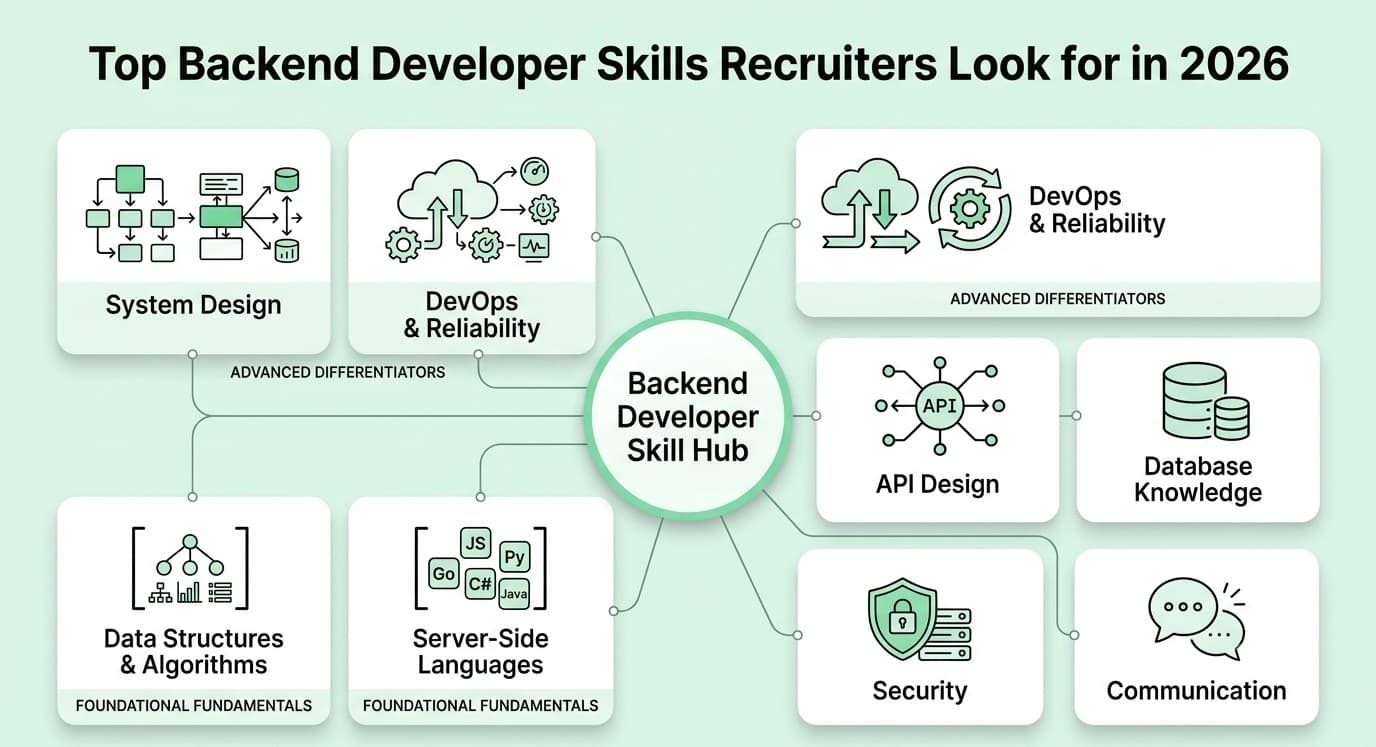
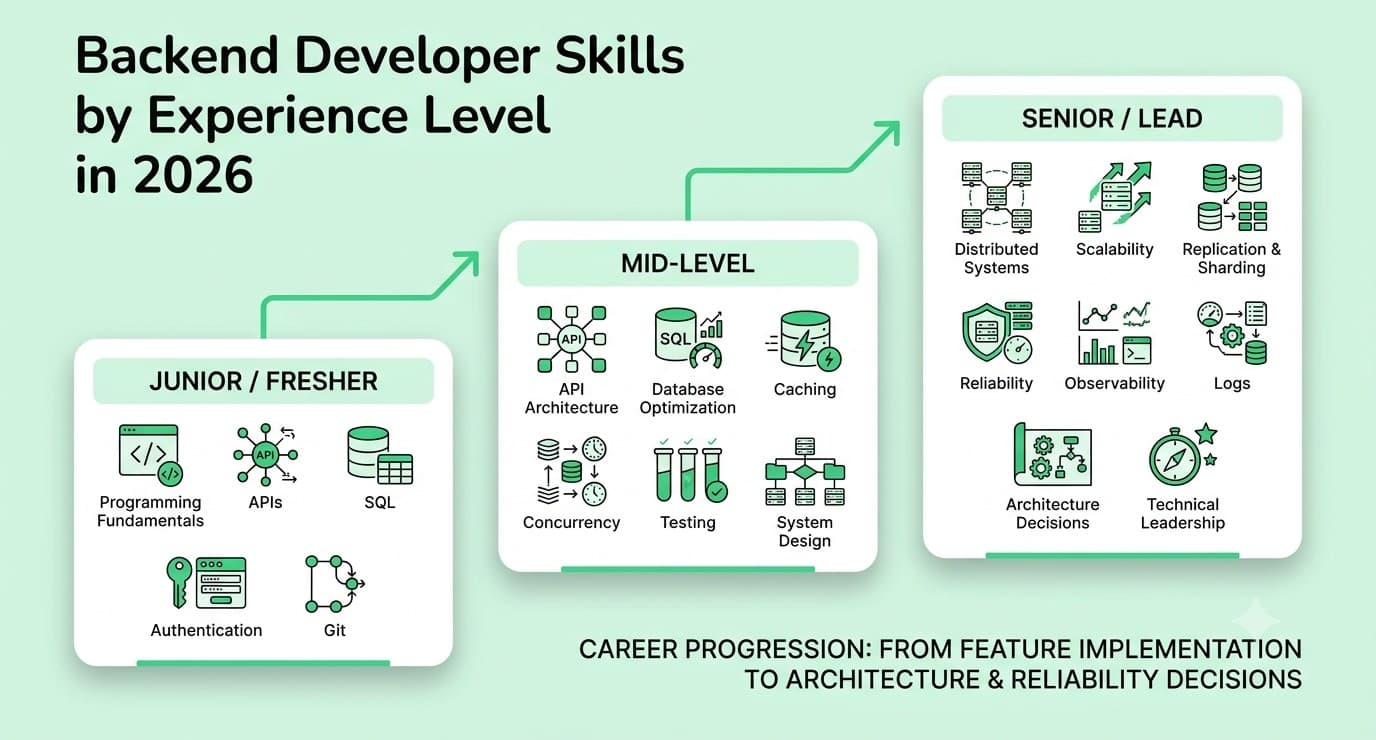
In 2026, recruiters hiring backend developers prioritize deep language fluency in at least one modern backend language with growing preference for Go alongside Python and Node.js, production-grade API design judgment across REST and gRPC, database schema design and query optimization beyond basic CRUD, distributed systems fundamentals including message queues and eventual consistency, security engineering baked into development rather than added at review, full-stack observability using structured logging and distributed tracing, and the ability to integrate and serve AI and LLM workloads as backend infrastructure. Certifications remain largely irrelevant against deployed systems you can explain under technical pressure. Fresher expectations center on clean API design, correct SQL, and security basics. Senior expectations center on architecture decisions, system reliability ownership, and cross-team technical leadership.
Backend development in 2026 is both more demanding and more clearly defined than it was two years ago. The demand side: distributed systems knowledge that was once reserved for senior interviews now appears at the mid-level. Security awareness that was once treated as a separate specialty is now expected in every backend pull request. Observability that was once the SRE team's concern is now a daily backend engineering practice. And AI integration that was once a data science problem has become a backend infrastructure problem that engineering teams ship, serve, and maintain.
The clearly defined side: the skills that separate consistently hireable backend developers from the rest are not a mystery. I have interviewed backend candidates at companies ranging from early-stage startups to organizations with hundreds of millions of users, and the same gaps appear repeatedly. Candidates who understand the system they are designing before they write a line of code. Candidates who think about failure modes before they think about the happy path. Candidates who can explain tradeoffs without prompting. These are the candidates who get offers, and these are the skills this guide will help you build.
FREE TO USE
25K+ INTERVIEWS4.8★ RATING68% IMPROVEMENT
Crack Your Dream Job
Real Interviews. Real Pressure. Practice until it feels easy.
- Seamless Interview Experience
- Resume & JD Questions
- Instant Personalized Feedback
How Hiring for Backend Developers Has Changed Going Into 2026
The two biggest shifts are that system design questions now appear earlier in interview pipelines, reaching mid-level candidates with two to three years of experience, and that AI integration has become a backend engineering concern rather than a data science concern. Both shifts demand broader technical range from candidates at every experience level.
Several forces are reshaping what backend developer hiring looks like this year:
System design has moved earlier in the interview pipeline. Companies that previously reserved architecture discussions for senior candidates are now asking mid-level candidates lightweight system design questions in second-round interviews, because the gap between someone who writes code and someone who designs systems is the most expensive gap to hire around.
Security is now evaluated at the code level, not just the architecture level. Take-home assignments are regularly reviewed for SQL injection vulnerabilities, improperly scoped JWT claims, and missing rate limiting, because teams have learned the hard way that security problems in backend code compound into breaches that are far more expensive to remediate than to prevent.
Go has become a tier-one backend language expectation. Multiple companies now list Go alongside Python and Node.js as an expected or preferred language, and candidates who can demonstrate Go fluency alongside their primary language are consistently more competitive than candidates with depth in a single language.
AI integration is now a backend engineering problem. Serving model inference, building retrieval-augmented generation pipelines, managing vector database queries alongside relational data, and designing APIs that abstract AI behavior for frontend and mobile clients are now backend engineering tasks at companies of all sizes.
Observability has become a first-class backend engineering skill. Candidates who cannot discuss structured logging, metric instrumentation, and distributed tracing are increasingly screened out at mid-level and above, because teams that cannot observe their own systems cannot reliably debug or scale them.
Core Fundamentals
Backend Language Depth: Go, Python, Node.js, and the Polyglot Expectation
Why Recruiters Prioritize This Skill
Backend language depth is evaluated differently from frontend language depth because the performance, concurrency, and memory characteristics of a backend language directly affect system behavior under real load. A recruiter hiring for a backend role is evaluating not just whether a candidate can write working code, but whether they understand the language's runtime model well enough to reason about performance, debug unexpected behavior in production, and make informed decisions about where the language is the right tool versus where a different one would be more appropriate.
What Recruiters Actually Expect in 2026
For Python: understanding of the GIL and its implications for CPU-bound versus I/O-bound concurrency, async patterns using asyncio, and the ability to profile and optimize slow code. For Node.js: deep understanding of the event loop, non-blocking I/O patterns, and stream-based processing for large data volumes. For Go: understanding of goroutines and channels as concurrency primitives, the memory model, and the explicit error handling philosophy. For Java: understanding of the JVM's garbage collection behavior and how it affects latency-sensitive services.
The polyglot expectation is new: many backend roles in 2026 no longer expect fluency in a single language but rather fluency in one language with demonstrated ability to read, contribute to, and reason about code written in another. Go and Python appearing together on a single role is common. Node.js and Go pairing is increasingly common at companies running polyglot service architectures.
Interview Evaluation
Resume screening looks for language-specific depth signals: mentions of concurrency patterns, profiling work, or performance optimization specific to a language, rather than just the language name. Technical interviews include language-specific questions that probe beyond syntax: what happens to goroutines when the function that launched them returns, or what makes Python's GIL irrelevant for I/O-bound async code but not for CPU-bound parallel computation. Practical rounds may ask candidates to write idiomatic code in their primary language and then read or explain code in a secondary language.
Real Workplace Example
A backend service is experiencing high latency under load. A developer with shallow language knowledge tries random performance fixes without a diagnostic framework. A developer with deep Python knowledge knows to profile using cProfile, identify whether the bottleneck is CPU-bound work that threading cannot parallelize due to the GIL or I/O-bound work that asyncio can handle concurrently, and chooses the right concurrency model based on the diagnosis. The difference between these two approaches is months of wasted debugging versus hours of structured diagnosis.
Fresher Expectations
Solid command of one language's idiomatic patterns, understands the language's concurrency model at a conceptual level, and can write clean, readable code that does not require an interviewer to ask what a line does.
Mid-Level Expectations
Can profile and optimize code in their primary language, understands the runtime model deeply enough to explain unexpected performance behavior, and can read and contribute to code in a secondary backend language without needing to learn it from scratch first.
Senior-Level Expectations
Makes technology selection decisions about which language to use for a new service based on the service's specific requirements: latency sensitivity, throughput needs, team familiarity, and operational characteristics. Mentors other developers on language-specific performance patterns and common anti-patterns.
Common Mistakes
Claiming fluency in a language based on framework usage without understanding the language's runtime model. Claiming Go experience based on writing basic HTTP handlers without understanding goroutine lifecycle, channel semantics, or the select statement. These gaps surface within two questions of any experienced language-specific interviewer.
How to Build This Skill
Build a moderately complex service, such as a rate-limited API proxy or a job queue processor, in your primary language using only the standard library and one or two dependencies. Then build the same service in a secondary language. The constraint of avoiding heavy frameworks forces engagement with the language's own concurrency and I/O primitives rather than a framework's abstraction of them.
Example Interview Questions
"Explain what happens in Python when you await a coroutine inside a for loop versus using asyncio.gather for the same coroutines." "In Go, what is the difference between a buffered and an unbuffered channel, and when would you use each?" "What would cause a Node.js event loop to become blocked even in code that uses async/await correctly?"
Strong Sample Answer Direction
A strong answer connects the language mechanism to a real consequence. For the Python gather question, the mechanism is sequential versus concurrent execution and the consequence is whether the total wait time is the sum of all coroutine latencies or the maximum of them. Mechanism plus consequence demonstrates language understanding, not syntax recall.
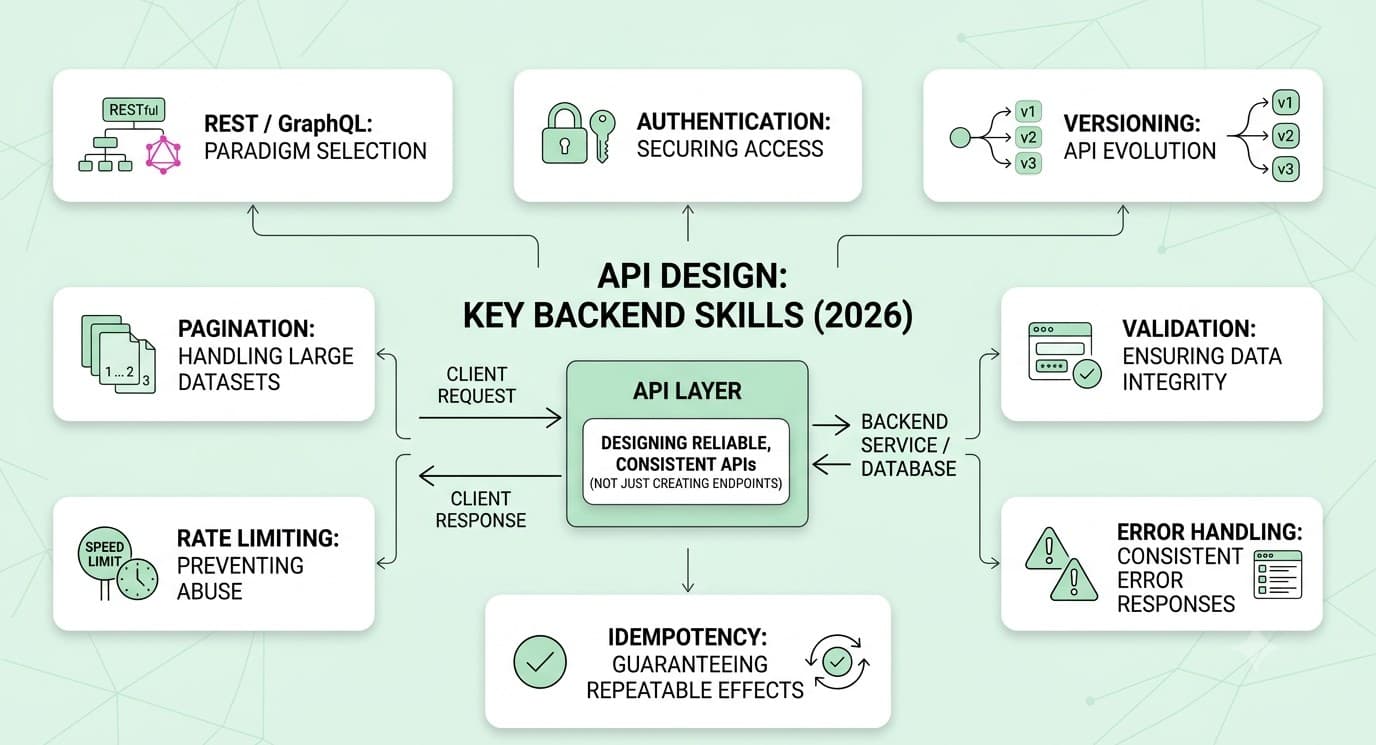
API Design: REST, gRPC, and GraphQL Architecture and Tradeoffs
Why Recruiters Prioritize This Skill
APIs are the contracts between services and between services and their clients. Poorly designed APIs create coupling that makes future changes expensive, inconsistencies that confuse consumers, and performance characteristics that do not fit the access patterns they need to serve. Recruiters evaluate API design because it is the skill that most directly predicts whether a candidate's backend code will integrate cleanly with the systems around it or create persistent friction for every team that touches it.
What Recruiters Actually Expect in 2026
REST fluency including correct resource modeling, status code usage, pagination design, versioning strategy, and backward compatibility management. Practical understanding of gRPC including when to prefer it over REST for internal service communication, how Protocol Buffer schema evolution works, and what bidirectional streaming enables that REST cannot. Awareness of GraphQL's resolver model and the N+1 problem it introduces if data loading is not handled with batching, along with an honest understanding of which use cases GraphQL solves better than REST and which it does not.
The 2026 expectation that was not present in 2023 is that candidates should be able to articulate the tradeoffs between all three without a strong personal preference coloring their judgment, because companies now commonly use all three for different internal and external communication needs.
Interview Evaluation
System design questions that include an API component ask candidates to justify their protocol and structure choices with specific reasons tied to the requirements. Take-home assignments are reviewed for resource naming consistency, correct status codes, appropriate pagination design, and whether the error response format provides enough information to debug without exposing internal system details. Senior interviews include questions about API versioning strategy and how to manage breaking changes without forcing all consumers to upgrade simultaneously.
Real Workplace Example
A platform team is building an internal API that will serve three different client types: a web application that needs filtered lists of resources, a mobile application that needs compact responses to minimize data transfer, and a data pipeline that needs to stream large volumes of records efficiently. A developer with real API design judgment evaluates all three communication patterns, proposes REST with field selection for the web client, a more compact response format for the mobile client, and a gRPC streaming endpoint for the data pipeline, rather than using the same REST endpoint shape for all three and paying a performance penalty on two of them.
Fresher Expectations
Designs clean, consistent REST APIs with correct resource naming, appropriate HTTP methods, meaningful status codes, and basic input validation and error formatting. Can explain why PUT is idempotent and POST is not, and why this matters for retry behavior.
Mid-Level Expectations
Designs APIs that handle pagination, filtering, partial updates, and versioning correctly. Understands the gRPC model well enough to write and consume a service definition and can explain when gRPC is preferable to REST for a given communication pattern.
Senior-Level Expectations
Makes protocol selection decisions for new services, establishes API design standards for a team, and manages backward compatibility through API evolution without forcing big-bang migrations on consumers. Reviews API designs from other teams for long-term maintainability and integration cost.
Common Mistakes
Designing APIs around the immediate frontend's exact needs rather than around a stable resource model that can serve multiple consumers over time. Using 200 OK for every response regardless of what happened in the system, which destroys the ability to build reliable retry and error handling in clients.
How to Build This Skill
Design an API for a non-trivial domain, such as a multi-tenant project management system, writing out every endpoint, its request and response shapes, its status codes, its pagination strategy, and how it would handle a breaking schema change six months from now. Then implement it, build a client that consumes it, and notice every place where your design creates friction for the consumer.
Example Interview Questions
"How would you design a paginated list API that supports both offset pagination and cursor pagination, and what are the tradeoffs of each?" "When would you choose gRPC over REST for a new internal microservice, and what would change your mind?" "How would you introduce a breaking change to a public API without forcing all consumers to migrate immediately?"
Strong Sample Answer Direction
A strong API design answer starts with the consumer's access pattern before proposing any structure, because good API design begins with understanding how the API will be used, not what data the backend happens to have available.
Technical Skills
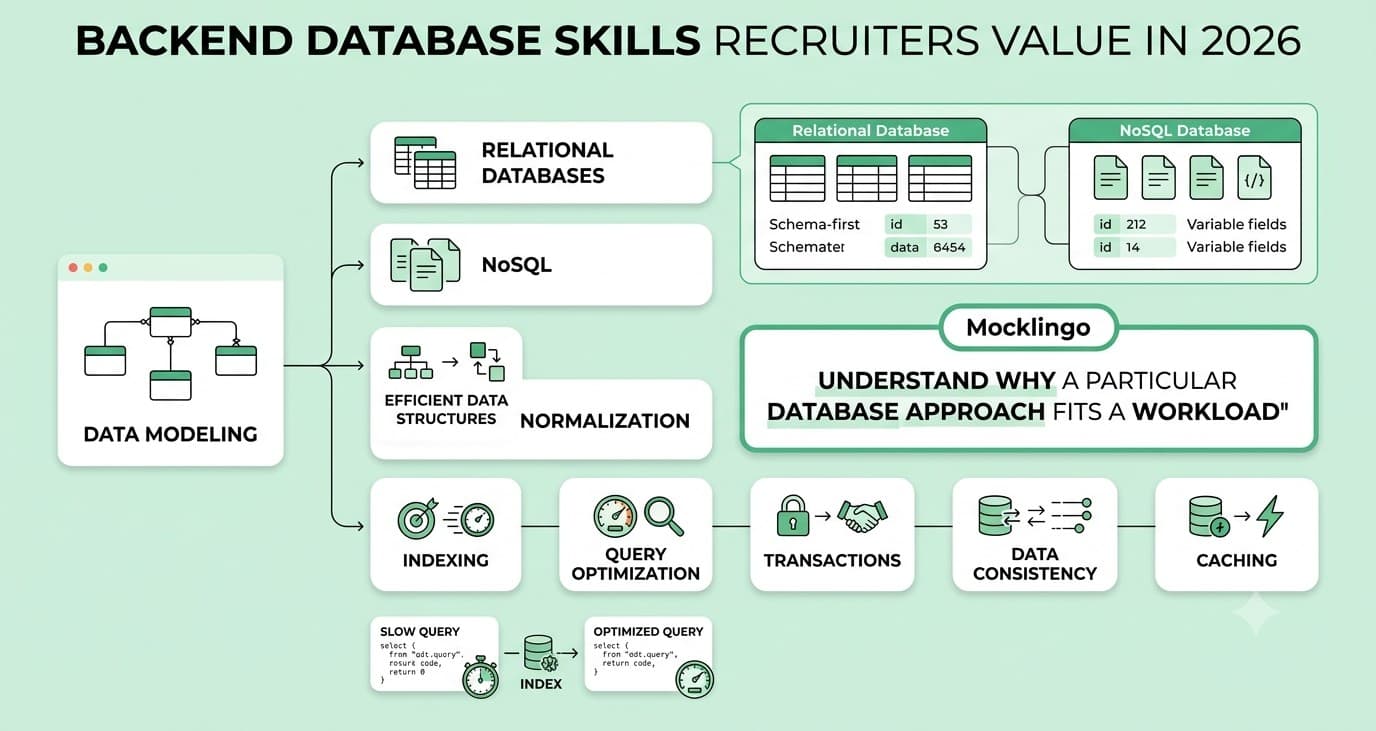
Database Engineering: Schema Design, Indexing, and Query Optimization
Why Recruiters Prioritize This Skill
The database layer is where most backend performance problems actually live, where most data integrity violations originate, and where the most expensive technical debt accumulates when early decisions are made without adequate thought. Recruiters test database engineering because it reveals whether a candidate thinks ahead about access patterns, scale, and consistency before writing a single query, or whether they treat the database as a black box that will sort itself out later.
What Recruiters Actually Expect in 2026
Schema design that starts from access patterns rather than the data's conceptual shape. Indexing knowledge that includes composite indexes, partial indexes, covering indexes, and the ability to read a query execution plan and identify why a query is slow. Transaction isolation level awareness, specifically understanding the difference between read committed and serializable isolation and when each is appropriate. Basic understanding of when to consider a NoSQL or time-series database rather than defaulting to relational, with specific reasons tied to the data's structure and access patterns.
Interview Evaluation
Schema design exercises given a domain description, evaluated on whether the candidate starts by asking about access patterns or starts by drawing entity relationships. Query optimization exercises showing a slow query with a table schema and asking the candidate to diagnose and fix the performance problem. Transaction design questions asking candidates to design a sequence of operations that must succeed or fail atomically, including what happens under concurrent access.
Real Workplace Example
A social platform needs to show a user's activity feed: the posts of everyone they follow, sorted by time, with the most recent appearing first. A developer without database engineering depth writes a query that joins the follows table to the posts table and sorts the result, which becomes catastrophically slow as users accumulate follows and posts because the sort operates on the full join result. A developer with real database depth recognizes this as a fan-out write pattern, designs a dedicated feed table that is written to at post creation time rather than computed at read time, and uses an index on user_id plus created_at to serve the feed in sub-millisecond read latency regardless of the follower count.
Fresher Expectations
Designs a normalized schema for a moderately complex domain, understands what an index is and why adding one to a frequently queried column speeds up reads, and can write queries with joins, aggregations, and basic subqueries correctly.
Mid-Level Expectations
Reads a query execution plan and identifies missing indexes, understands transaction isolation levels and their performance trade-offs, and makes deliberate denormalization decisions based on specific access pattern requirements rather than defaulting to the most normalized structure.
Senior-Level Expectations
Designs database architecture for scale and reliability, makes technology selection decisions between relational, document, and time-series databases based on specific requirements, leads schema migration strategy for live databases with millions of rows, and establishes query review practices that prevent N+1 and missing-index problems from reaching production.
Common Mistakes
Designing schemas that look correct on paper but require multi-table joins for every common read operation, not thinking about index strategy until a query is already slow in production, and using database transactions without understanding what isolation level the database is operating at by default.
How to Build This Skill
Enable query logging in a database you are already using and spend two hours reading every query generated by your five most common application operations. Find the query that surprises you most, use EXPLAIN ANALYZE to understand its execution plan, add an appropriate index, and measure the before and after execution time. This exercise teaches more about database engineering than any tutorial.
Example Interview Questions
"Design a schema for a multi-tenant SaaS application where each tenant's data must be isolated. What are the tradeoffs of your approach?" "This query is running in eight seconds on a table with ten million rows. Here is the execution plan. What is causing the problem and how would you fix it?" "When is it appropriate to denormalize a schema, and how would you decide which data to duplicate?"
Strong Sample Answer Direction
A strong schema design answer asks about access patterns before proposing any table structure, explains the reasoning behind each design choice, and describes at least one trade-off accepted by the chosen approach and one alternative that would have been appropriate under different requirements.
Distributed Systems Fundamentals: Message Queues, Event-Driven Architecture, and Consistency
Why Recruiters Prioritize This Skill
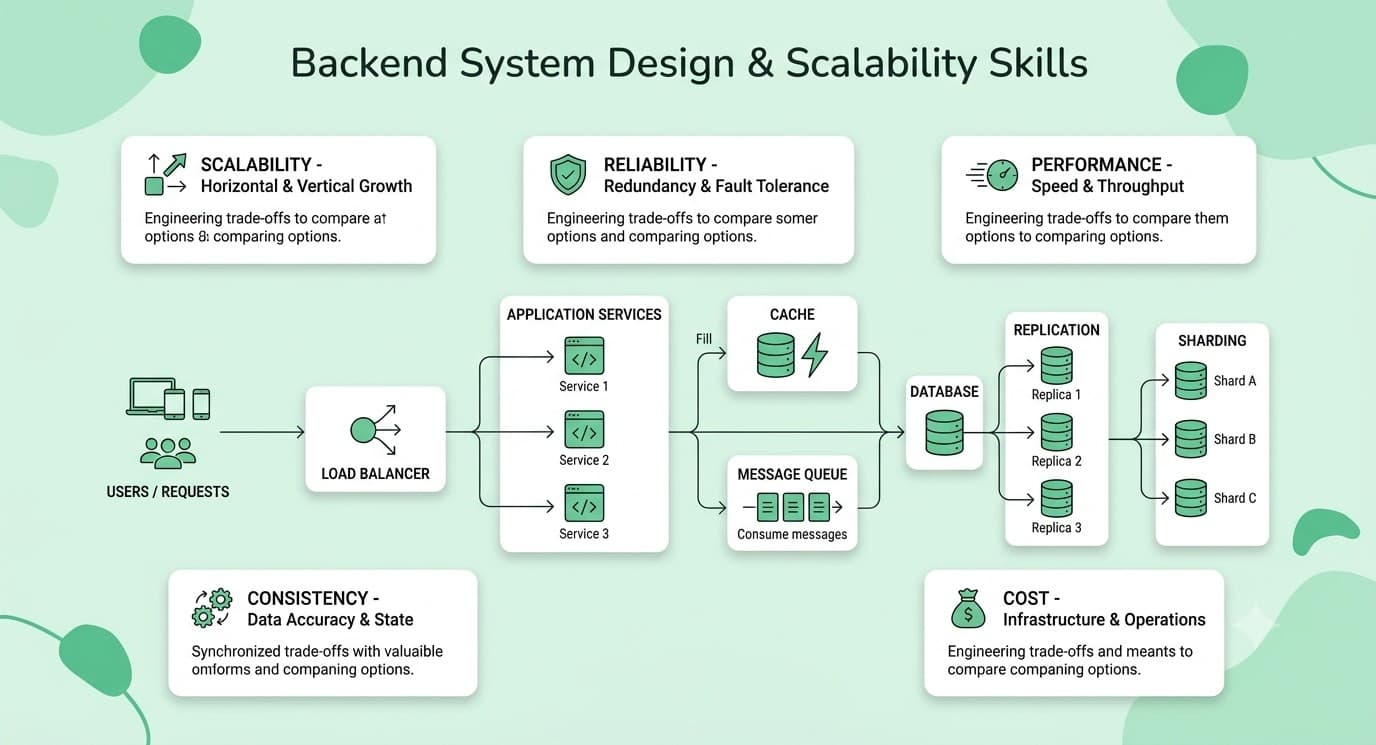
Almost every backend system at any meaningful scale is a distributed system. Understanding the fundamental properties and failure modes of distributed systems, including how consistency and availability trade off under network partitions, how message queues enable decoupling and fault tolerance, and how to design operations that are safe to retry, is what separates a developer who can build systems that work in ideal conditions from one who can build systems that stay correct under real-world failure conditions.
What Recruiters Actually Expect in 2026
CAP theorem understood at the practical level: not just that you cannot have consistency, availability, and partition tolerance simultaneously, but specifically what that trade-off looks like in the database or messaging system you are using and how to design around it. Message queue fluency including producer and consumer design, dead letter queues, consumer group semantics, and backpressure handling. Idempotency design: understanding why operations that might be retried must be designed to produce the same result regardless of how many times they are executed, and how to implement this correctly using idempotency keys, conditional writes, and deduplication.
Interview Evaluation
System design questions that include a message queue component, asking candidates to explain why they chose asynchronous processing over synchronous and how they handle failed message processing. Scenario questions about what happens when a service goes down in the middle of a distributed transaction, and how to design the recovery. Questions about eventual consistency: given that two databases might be temporarily out of sync, how does the system behave during that window, and how does it detect and resolve the inconsistency?
Real Workplace Example
An e-commerce platform processes payments and then sends a confirmation email. A developer without distributed systems depth implements this as a synchronous sequence: charge the card, then send the email. When the email service is slow or unavailable, the entire checkout flow blocks or fails. A developer with distributed systems depth publishes a payment-confirmed event to a message queue after charging the card, with the email service consuming that event independently. The checkout flow always completes quickly, email delivery is retried automatically on failure, and a dead letter queue captures any events that could not be processed for investigation.
Fresher Expectations
Understands conceptually why message queues exist and what problem they solve, knows the difference between synchronous and asynchronous processing and when each is appropriate, and can explain what eventual consistency means in plain language.
Mid-Level Expectations
Designs producer and consumer systems with correct error handling including dead letter queues, understands idempotency and can design an operation to be safely retried, and can explain the consistency guarantees of the databases and queues they use rather than assuming they have stronger guarantees than they do.
Senior-Level Expectations
Designs distributed transaction patterns for multi-service operations that must be atomic, establishes message queue infrastructure standards for a team, reasons about ordering guarantees and their implications, and identifies when eventual consistency is acceptable versus where strict consistency is required and what it costs to achieve it.
Common Mistakes
Designing distributed operations without thinking about what happens when they fail partway through. Assuming that publishing to a message queue and the consumer processing that message happen reliably without implementing producer confirmation, consumer acknowledgment, and dead letter queue handling for the failure cases.
How to Build This Skill
Build a small system with at least two services communicating through a message queue, deliberately introducing failures at every step: the producer failing before publishing, the queue service being temporarily unavailable, the consumer failing after receiving a message but before acknowledging it, and the consumer's downstream dependency being unavailable. Observe what happens in each failure scenario and implement the correct handling for each.
Example Interview Questions
"How would you ensure that a payment is charged exactly once even if the payment service receives the same request multiple times?" "Design the order processing flow for an e-commerce platform where the payment, inventory, and notification systems are all separate services. What happens if the inventory service fails after the payment succeeds?" "What is the difference between at-least-once and exactly-once delivery semantics, and what does your application need to implement to handle at-least-once delivery safely?"
Strong Sample Answer Direction
A strong answer on distributed transaction design names the pattern being used, whether saga, two-phase commit, or outbox, explains why it was chosen over the alternatives for this specific scenario, and explicitly describes the failure cases it handles and the ones it accepts as trade-offs.
Security Engineering: Authentication, Authorization, and Vulnerability Prevention
Why Recruiters Prioritize This Skill
Backend developers are the last line of defense between user input and the systems that store, process, and expose sensitive data. Security failures at the backend layer have consequences that are qualitatively different from other bugs: they expose user data, create legal liability, damage company reputation, and in regulated industries, trigger mandatory breach reporting. Recruiters now evaluate security awareness at the code level, not just the architecture level, because the security failures that lead to breaches most commonly originate in individual endpoint implementations, not in high-level architectural diagrams.
What Recruiters Actually Expect in 2026
Authentication and authorization designed correctly from the start: understanding the difference between authentication (who are you) and authorization (what are you allowed to do), implementing token-based authentication with correct expiration and rotation, designing role-based or attribute-based authorization that prevents horizontal privilege escalation where one user can access another user's resources by changing a parameter. Input validation and parameterized queries as a default, never as an afterthought. Rate limiting and brute force protection on authentication endpoints. Basic understanding of the OWASP Top Ten vulnerabilities with the ability to identify each in a code review.
Interview Evaluation
Take-home assignments are now routinely reviewed for security issues: SQL injection vectors, missing authorization checks on individual resources, improperly scoped tokens, and error messages that reveal internal system details. Technical interviews include "find the security problem in this code" exercises specifically designed around common OWASP vulnerabilities. Senior interviews include questions about threat modeling: given this architecture, what are the most likely attack vectors and how have you mitigated them?
Real Workplace Example
A developer implements an endpoint to retrieve a user's order details at /orders/{order_id}. They implement authentication, so only logged-in users can call the endpoint. But they do not implement resource-level authorization, so any authenticated user can retrieve any order by changing the order_id in the URL. This is an insecure direct object reference vulnerability, one of the most common and damaging backend security failures, and it is invisible in testing because tests run as specific users who happen to own the resources they are testing against.
Fresher Expectations
Uses parameterized queries instead of string concatenation for every database query, stores passwords using a proper hashing algorithm rather than encryption or plaintext, and understands that authentication and authorization are two separate checks that must both be implemented.
Mid-Level Expectations
Implements JWT-based authentication correctly including appropriate claim structure, expiration, and rotation, designs authorization checks at the resource level rather than only at the route level, applies rate limiting to sensitive endpoints, and can identify the most common OWASP vulnerabilities in a code review.
Senior-Level Expectations
Conducts threat modeling for new systems, sets security review standards for a team, makes decisions about security tooling including static analysis and dependency scanning, and responds to security incidents with root cause analysis and remediation that addresses the class of vulnerability rather than only the specific instance.
Common Mistakes
Implementing authentication without resource-level authorization, which allows any authenticated user to access any resource regardless of ownership. Handling errors with stack traces or internal database error messages in API responses, which reveals system internals to potential attackers.
How to Build This Skill
Audit a project you have already built specifically looking for the OWASP Top Ten vulnerabilities. Specifically: check every query for parameterization, check every resource endpoint for both authentication and resource-level authorization, check every error response for internal detail leakage, and check every authentication flow for brute force protection and appropriate token expiration. Document every issue you find and fix each one.
Example Interview Questions
"What is the difference between authentication and authorization, and describe a bug that arises from implementing authentication without resource-level authorization?" "How would you store user passwords in a database, and why is your approach more secure than encryption?" "What is a JWT, what claims would you include in a token for an API that serves multiple tenants, and how would you handle token revocation before expiration?"
Strong Sample Answer Direction
A strong security answer describes the threat model before the solution: what is the specific attack being prevented, what does the attacker need to execute it, and how does the proposed control prevent or detect the attack. This framing demonstrates security thinking rather than security trivia.
Observability: Structured Logging, Metrics, and Distributed Tracing
Why Recruiters Prioritize This Skill
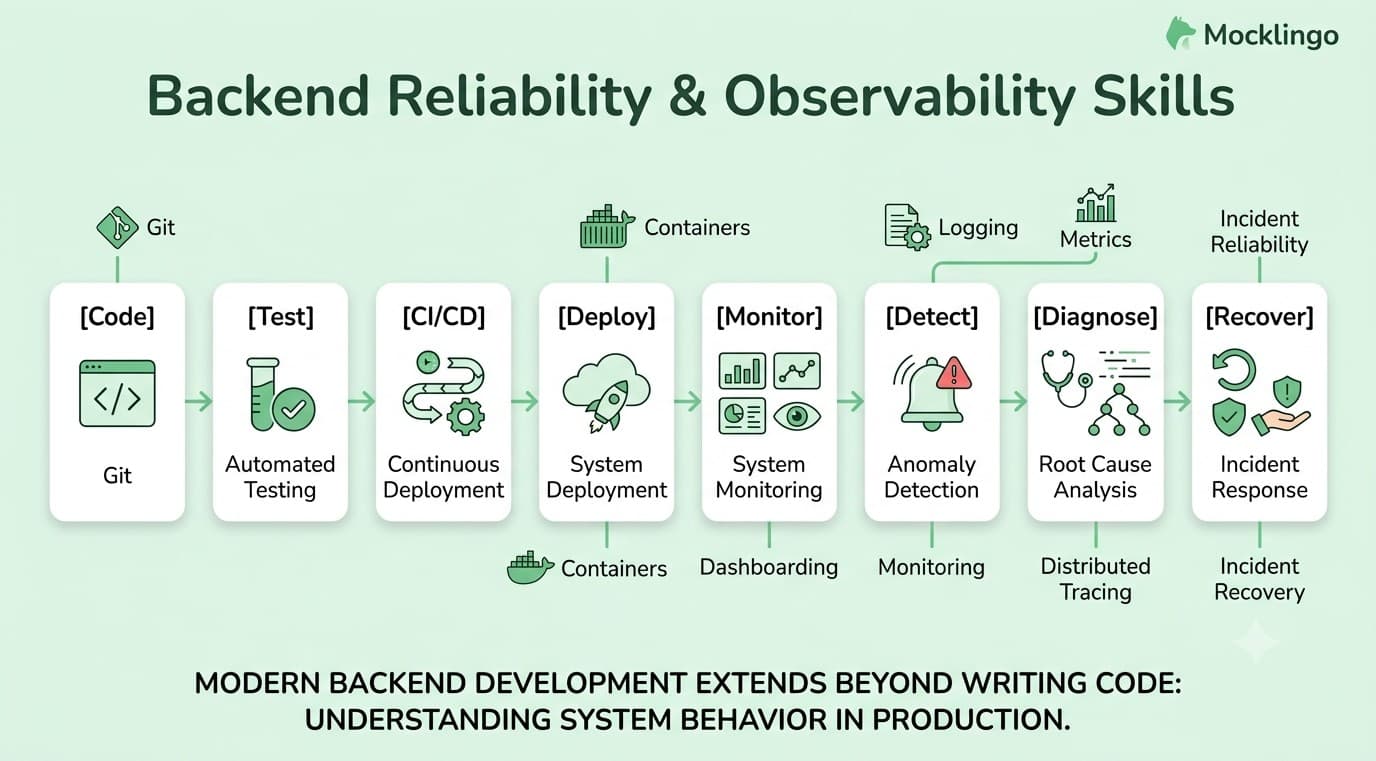
A backend system that cannot be observed cannot be debugged, scaled, or improved with confidence. Observability has moved from a specialized SRE skill to a standard backend engineering expectation because the cost of a production incident in an unobservable system is dramatically higher than in a system where the relevant signals were designed in from the start. Recruiters test this skill because it is one of the clearest predictors of production reliability: candidates who build observable systems catch problems before they escalate, and those who do not leave teams flying blind.
What Recruiters Actually Expect in 2026
Structured logging as a default: emitting log events as JSON or another structured format with consistent field names, appropriate log levels, and correlation IDs that connect log events to the request that produced them. Metric instrumentation: defining and emitting business and technical metrics, understanding the difference between counters, gauges, and histograms and when to use each. Distributed tracing: understanding that a single user request in a microservices architecture may pass through multiple services, that tracing connects these spans into a complete picture of what happened, and that OpenTelemetry has become the standard instrumentation library for implementing this across languages and frameworks.
Interview Evaluation
System design questions that include an "how would you know if this is working correctly in production" component. Portfolio reviews that look for any evidence of logging, metric, or alerting design in described past work. Behavioral questions asking candidates to describe a production incident they investigated and how they used available observability signals to diagnose it.
Real Workplace Example
A payment service experiences increased error rates on Friday afternoon. A service without observability produces a log file with unstructured text entries and no correlation between the error logs and the specific requests that failed. The on-call developer spends three hours reading log files before narrowing down the cause. A service with proper observability has structured logs indexed by request ID, a dashboard showing error rates segmented by endpoint and payment provider, and a distributed trace that shows exactly which downstream service call is failing and what error it is returning. The diagnosis takes fifteen minutes.
Fresher Expectations
Understands the difference between log levels and applies them appropriately: DEBUG for development detail, INFO for significant events, WARN for potentially problematic situations, ERROR for failures that require attention. Adds request IDs to log entries to enable tracing a request through a system.
Mid-Level Expectations
Implements structured logging consistently, instruments key operations with metrics using appropriate metric types, and understands how to use a distributed trace to diagnose a latency problem that spans multiple services.
Senior-Level Expectations
Designs the observability strategy for a service or system including the specific signals that would reveal the most important failure modes, sets instrumentation standards for a team, builds or configures alerting based on meaningful signal thresholds rather than simple availability checks, and uses observability data to make capacity planning and reliability improvement decisions.
Common Mistakes
Logging at ERROR level for every exception including expected operational errors like client validation failures, which creates alert fatigue and obscures genuine errors. Logging unstructured human-readable text instead of structured events, which makes programmatic querying and aggregation impossible.
How to Build This Skill
Add structured logging, at least three meaningful metrics, and OpenTelemetry distributed tracing to a project you have already built. Then simulate a failure scenario and practice diagnosing it using only the signals you instrumented, without reading the source code. Every signal you need that you did not add reveals a gap in your instrumentation design.
Example Interview Questions
"How would you design the logging for an API endpoint so that you can investigate any reported error within two minutes, given only the error ID the user received?" "What is the difference between a counter and a histogram metric, and give an example of something you would measure with each?" "A user reports that their request was slow. How would you use distributed tracing to identify which part of the system was responsible?"
Strong Sample Answer Direction
A strong observability answer starts from a specific failure scenario and works backward to the signals needed to diagnose it, rather than describing the tools in the abstract. "If the payment service starts returning 500 errors, I would need to know whether the error originates from our code, the database connection, or the payment provider API, which means I need a trace that shows all three spans and their outcome for any failed request."
FREE TO USE
8k+ SESSIONS92% FLUENCY4.9★ RATING
Speak With Confidence
Real Conversations. Real Scenarios. Speak until it feels natural.
- Real-Time Speaking Practice
- Guided Conversation Flows
- Instant AI Feedback
AI and Automation Skills
Building AI and LLM Integrations as Backend Infrastructure
Why Recruiters Prioritize This Skill
The AI integration layer has become a backend engineering problem. Every company building AI-powered features needs backend infrastructure to reliably call inference APIs, manage prompt construction and response validation, implement retrieval-augmented generation pipelines, store and query vector embeddings alongside relational data, and serve AI-powered responses within latency budgets that users will accept. This work requires backend engineering skills, not machine learning skills, and recruiters are actively seeking backend developers who can build it.
What Recruiters Actually Expect in 2026
Not model training or ML research skills. What is expected is the ability to design reliable integrations with LLM APIs including retry logic, rate limit handling, timeout management, and response validation. Understanding of retrieval-augmented generation at the architectural level: how to chunk and embed documents, store embeddings in a vector database, query for relevant context, and include that context in a prompt without exceeding token limits. Awareness of vector databases including when they are the right tool versus when a simple keyword search or traditional database query serves the use case better. Cost and latency awareness: understanding that LLM API calls are expensive and slow compared to deterministic code, and designing systems that use them only where they genuinely add value.
Interview Evaluation
Take-home assignments at AI-adjacent companies may include building a small RAG pipeline or an endpoint that wraps an LLM API with proper error handling and output validation. System design questions may ask candidates to design the backend for an AI-powered feature including how they would handle model latency, cost management, and response quality monitoring.
Real Workplace Example
A legal tech company builds a document analysis feature that extracts specific clause types from uploaded contracts. A naive implementation calls an LLM API with the full document text on every request, which costs several dollars per document, takes fifteen seconds, and occasionally returns malformed output. A backend developer with AI integration experience chunks the document into sections, generates embeddings and stores them in a vector database on upload, retrieves only the relevant sections at query time using similarity search, validates the model's structured output against an explicit schema, and caches results for documents that have already been analyzed, reducing cost by ninety percent and latency to under two seconds.
Fresher Expectations
Can call an LLM API reliably with basic error handling, understands that model output must be validated rather than trusted unconditionally, and knows what a vector embedding is and what problem vector similarity search solves.
Mid-Level Expectations
Designs LLM integrations that handle rate limits, timeouts, and malformed responses gracefully, implements a basic RAG pipeline, manages token costs through prompt design and context selection, and monitors integration reliability and cost in production.
Senior-Level Expectations
Designs the AI backend infrastructure for a product including the data pipeline for keeping embeddings current, the caching and cost management strategy, the quality monitoring pipeline for detecting model output degradation, and the architectural decisions about when to use an LLM versus a deterministic solution.
Common Mistakes
Treating LLM API calls as reliable and fast when they are neither, and designing synchronous flows where the user waits for a response that may take ten to thirty seconds. Not validating structured output against an explicit schema, which creates unpredictable failures that only appear under specific inputs or model versions.
How to Build This Skill
Build a RAG pipeline from scratch for a real document set: chunk the documents, generate embeddings, store them in a vector database, build a query interface that retrieves relevant chunks, assembles a prompt, calls an LLM API, and validates and formats the response. Then add token usage logging, error rate monitoring, and a cache for repeated queries.
Example Interview Questions
"How would you design the backend for a chatbot that can answer questions about a company's internal documentation?" "How would you handle rate limiting from an LLM provider in a service that needs to process a high volume of requests?" "When would you choose a vector database over a traditional full-text search index for a retrieval system?"
Strong Sample Answer Direction
A strong answer on RAG pipeline design explains the chunking strategy and why it matters for retrieval quality, the embedding model selection and its trade-offs with the vector database's similarity search characteristics, and how the system handles the case where no relevant documents are found in the similarity search rather than hallucinating an answer.
Containerization, Cloud-Native Deployment, and Infrastructure Awareness
Why Recruiters Prioritize This Skill
Backend developers in 2026 are expected to deploy and maintain the services they build, not hand them off to a separate operations team. Container-native development, cloud infrastructure awareness, and the ability to read and write deployment configuration are now considered part of the backend developer job description at most companies. Recruiters test this because a developer who cannot deploy their own service and understand its operational behavior creates a team bottleneck that slows every release.
What Recruiters Actually Expect in 2026
Comfortable Docker usage including writing production-appropriate Dockerfiles with multi-stage builds and non-root user configuration. Kubernetes awareness at the operational level: understanding what a Deployment, Service, and ConfigMap do, knowing how to check the status of a running pod and read its logs, and understanding liveness and readiness probes and why they matter for zero-downtime deployments. Familiarity with at least one major cloud platform's managed services for databases, queues, and container orchestration. Basic CI/CD pipeline configuration: writing a pipeline that builds, tests, and deploys a backend service.
Interview Evaluation
Take-home assignments are frequently evaluated on whether the submission includes a Dockerfile and a basic docker-compose configuration that a reviewer can run without manual setup. Technical interviews at infrastructure-aware companies include questions about container resource limits, horizontal pod autoscaling triggers, and how to debug a service that is passing health checks but returning errors.
Real Workplace Example
A backend service begins returning 503 errors under traffic spikes. A developer without container-native operations experience calls the infrastructure team and waits. A developer with Kubernetes awareness can inspect the Deployment to confirm the pod count is not scaling, check the HorizontalPodAutoscaler to see whether it is configured with appropriate CPU thresholds, look at pod events to identify whether pods are crashing under load, and review resource limits to determine whether the pods are being OOMKilled. This self-service diagnosis, done in fifteen minutes rather than waiting for an infrastructure team, is the capability recruiters are evaluating.
Fresher Expectations
Can write a Dockerfile for a backend service, understands what docker-compose does and can write a basic compose file for local development, and knows what a Kubernetes pod is and how to check its logs.
Mid-Level Expectations
Writes production-quality Dockerfiles with multi-stage builds and security best practices, configures Kubernetes Deployments with appropriate resource requests and limits, liveness and readiness probes, and environment variable injection from Secrets and ConfigMaps.
Senior-Level Expectations
Designs the deployment infrastructure for a service including autoscaling configuration, rolling update strategy, secret management, and observability integration. Makes cloud provider service selection decisions and evaluates the operational trade-offs of managed versus self-hosted infrastructure components.
Common Mistakes
Running services as root inside containers, not setting resource limits on container deployments which allows a single misbehaving service to starve other services of CPU or memory on the same node, and not configuring readiness probes which causes traffic to be routed to pods that are still starting up.
How to Build This Skill
Deploy a personal backend project to a real Kubernetes cluster rather than only running it locally. Configure health checks, set resource limits, write a CI/CD pipeline that builds and pushes a Docker image and applies updated Kubernetes manifests, and practice diagnosing a failure by deliberately breaking the deployment and using kubectl logs, kubectl describe, and kubectl events to identify the problem.
Example Interview Questions
"What is the difference between a liveness probe and a readiness probe in Kubernetes, and what happens to traffic routing in each case when the probe fails?" "How would you safely deploy a new version of a backend service to production without causing downtime?" "What is a multi-stage Docker build and why would you use one for a production backend service?"
Strong Sample Answer Direction
A strong Kubernetes health probe answer explains the operational consequence of each: a failing liveness probe causes the container to restart, which is appropriate for a service that has locked up, while a failing readiness probe removes the pod from the Service's endpoints without restarting it, which is appropriate for a service that is temporarily unable to handle traffic while it warms up or waits for a dependency.
Skills Recruiters Value More Than Certifications
Cloud certifications such as AWS Solutions Architect or Google Cloud Professional Developer validate that a candidate passed an exam on cloud service configuration. A deployed backend service running in production with demonstrable availability, observability, and recovery behavior validates that the candidate can actually operate a system, which is a meaningfully different and more valuable credential for a backend developer role.
Backend-specific certifications have an even weaker signal than cloud certifications, because backend engineering is assessed through demonstrated systems that behave correctly under real conditions, not through answers to multiple choice questions. A backend developer who can walk through a deployed service, explain every architectural decision with its specific tradeoff, show the observability dashboard, and describe how they would debug a specific failure will consistently outperform a certified candidate who cannot do any of these things.
Certifications are most useful for backend developers in two narrow situations: satisfying automated resume screening filters at large companies that use keyword matching before human review, and demonstrating structured learning for career switchers who have no other evidence of backend knowledge. For anyone with two or more years of backend experience, a well-documented deployed system is a far more powerful credential than any certification.
Skills That Are Becoming Less Important
Monolithic application architecture as a primary design skill has declined in importance at most companies, as the operational and organizational benefits of service decomposition have become better understood. Knowing how to build a monolith is still useful for appropriate-scale projects, but expertise in decomposing a monolith into services is now considered the more relevant architectural skill.
SOAP and XML-based service integration knowledge is now a legacy specialization rather than a general backend skill. Almost no new systems use SOAP, and candidates who list it as a current skill without REST or gRPC alongside it raise questions about the recency of their experience.
ORM-only database interaction without any raw SQL or query plan reading ability is increasingly a concern rather than a neutral credential, because ORMs' abstractions hide the database behaviors that cause most production performance problems.
Hand-managed virtual machine provisioning, as distinct from container-native and infrastructure-as-code approaches, is now considered a legacy operational pattern at most companies. Candidates whose infrastructure experience is primarily at the VM level without container and orchestration experience are evaluated as needing significant reskilling.
AI Is Changing Backend Development
Which skills AI is replacing: Boilerplate CRUD endpoint generation, basic database migration writing, repetitive test scaffolding, and standard configuration file generation are now commonly produced by AI coding assistants faster than a developer can type them. Developers who define their value primarily through writing boilerplate face real pressure.
Which skills AI is enhancing: Backend developers with strong system design judgment can now prototype and validate multiple architectural approaches in the time it used to take to implement one, because AI tools accelerate the implementation between a design decision and working code. Developers with security expertise can use AI tools to help identify vulnerabilities in generated code that they might otherwise have missed on a manual review.
Which human skills are becoming more valuable: Distributed systems design judgment, security threat modeling, observability design, performance diagnosis, and the critical review of AI-generated code for correctness, security, and production suitability are all becoming sharper differentiators as the boilerplate layer gets automated.
How professionals should adapt: Treat AI coding tools as a fast but security-unaware, performance-unaware junior developer. Use them to reduce the time from design to working prototype, then invest the saved time in the work they cannot do: reasoning about failure modes, reviewing generated code for security vulnerabilities, measuring and diagnosing performance behavior under real load.
Skills That Instantly Differentiate Candidates
A deployed backend system with a demonstrable observability stack, where the candidate can show the dashboard, explain what each metric measures, and describe how they would diagnose a specific failure using the signals available.
A distributed systems war story: a specific problem involving consistency, ordering, or fault tolerance that the candidate encountered, diagnosed, and fixed, explained at the mechanism level rather than at the abstraction level.
Fluent idempotency design: the ability to explain why an operation must be idempotent, how to implement idempotency using a specific mechanism such as idempotency keys or conditional writes, and what the behavior is when a duplicate request arrives.
A real security fix that the candidate caught in a code review or discovered through an audit, described at the vulnerability level rather than just "I found a security issue."
An AI backend integration project with explicit discussion of reliability, cost management, and output validation, demonstrating practical AI engineering judgment rather than theoretical familiarity.
Common Skill Gaps Recruiters Notice
Candidates who can design an API schema but cannot explain what happens to the system when the database behind it goes down temporarily, revealing distributed systems shallowness that surfaces quickly in system design questions.
Candidates who list security as a skill but implement resource retrieval endpoints with authentication and no resource-level authorization, which is the most common and most damaging backend security failure.
Candidates who claim database expertise but have never read a query execution plan, meaning they cannot independently diagnose a slow query in production.
Candidates who describe observability as "we had Datadog" without being able to explain what metrics they defined, what log structure they emitted, or how they used those signals to diagnose a specific problem.
Candidates who have never deployed their own service to a real cloud environment and cannot discuss the operational behavior of their own projects under real conditions.
Learning Roadmap
For Freshers
- 1. One backend language studied past the framework level, including concurrency model, error handling patterns, and standard library usage.
- 2. REST API design principles: resource naming, status codes, pagination, input validation, and error formatting.
- 3. SQL fundamentals through joins, aggregations, and basic indexing on a relational database with at least one real project using it.
- 4. Security basics: parameterized queries by default, password hashing with bcrypt or Argon2, the difference between authentication and authorization.
- 5. One deployed project on a real cloud platform with Docker containerization and basic structured logging.
For Professionals With 1 to 3 Years of Experience
- 1. Message queues and async processing: build a system with at least one queue-based integration including dead letter queue handling.
- 2. Database performance: enable query logging, read execution plans, add appropriate indexes, and measure the before and after impact.
- 3. JWT-based authentication with resource-level authorization implemented correctly including horizontal privilege escalation prevention.
- 4. Structured observability: add structured logging, three to five meaningful metrics, and a distributed trace to an existing project.
- 5. Go or another secondary backend language at the level of reading and contributing to code, not just reading documentation.
For Professionals With 3 to 7 Years of Experience
- 1. Distributed systems patterns: saga, outbox, idempotency key implementation, and consumer group design for at-least-once delivery.
- 2. System design practice at the level of designing a moderately complex service end to end with explicit attention to failure modes.
- 3. AI integration engineering: build a RAG pipeline with proper error handling, cost monitoring, and output validation.
- 4. Kubernetes operational fluency: deploy a service, configure autoscaling and health probes, and practice incident diagnosis using kubectl tools.
- 5. Security threat modeling: for a system you have built, formally identify the attack surface, the highest-risk vectors, and the controls in place.
For Senior Professionals
- 1. Cross-system architecture: design a system involving multiple services, data stores, and asynchronous communication with explicit consistency and reliability trade-off documentation.
- 2. Observability program leadership: design the observability strategy for a service including alert definitions, runbook connections, and on-call feedback loops.
- 3. Security program ownership: establish code review standards, static analysis tooling, and incident response processes for a backend team.
- 4. Hiring and evaluating other backend developers using the judgment-based standards outlined in this guide.
Self-Assessment Checklist
- I can explain the concurrency model of my primary backend language and describe a real scenario where it matters for performance.
- I can design a REST API for a non-trivial domain, justify every resource structure decision, and explain how I would manage a breaking change without forcing all consumers to migrate simultaneously.
- I can read a database query execution plan and identify why a query is slow.
- I can design an operation that is safe to retry by making it idempotent, using a specific mechanism I can explain.
- I can identify an insecure direct object reference vulnerability in a code snippet and explain specifically what attack it enables.
- I can describe the observability signals I would instrument in a new backend service to diagnose its most likely failure modes.
- I can explain the difference between a liveness probe and a readiness probe in a container deployment and describe the consequence of each type of failure.
- I have built and deployed an LLM or AI API integration that handles rate limiting, output validation, and a failure fallback.
- I have at least one deployed backend project I can walk through end to end, including its failure handling, its observability signals, and its security controls.
If fewer than six of these are checked, the learning roadmap above is your concrete preparation plan before applying widely.
Conclusion
Backend development in 2026 rewards a combination of skills that has shifted meaningfully from even two years ago: language depth that includes runtime understanding and concurrency modeling, API design judgment that starts from consumer access patterns rather than data availability, distributed systems literacy that covers the failure cases as carefully as the happy path, security thinking embedded in every endpoint implementation, observability designed in rather than added as an afterthought, and increasing comfort with AI integration as a backend infrastructure problem.
None of these skills require rare talent or access to unusual learning environments. They require deliberate practice at the layer beneath what tutorials cover, building systems that actually fail and learning how to make them recover, and honest assessment of which skills you can explain under follow-up questioning versus which ones you have listed on a resume because you used a framework that abstracted them away.
Explaining these skills under follow-up pressure in an interview, the kind where the interviewer asks why you made a specific design choice and expects a mechanism-level answer rather than a general preference, is the hardest part to prepare for alone. That is the gap that structured, realistic practice is specifically designed to close, and it is where tools like Mocklingo's AI mock interview practice deliver the most value: building the habit of reasoning out loud under pressure before that habit has to hold in an interview that decides your offer.
1 / 2
More Blogs
Oct 13, 2026
Effective AI Prompts for Job Searching, Tailoring Applications, and Interview Preparation
18 min read