Loading...
Contents
Common Business Analyst Interview Mistakes to Avoid in 2026
Sep 18, 202625 min read
If you keep interviewing for business analyst roles and keep hearing "we went with another candidate," there is a good chance it is not because you lack the skills. It is usually because of a handful of mistakes that show up again and again in BA interviews, mistakes that quietly undo an otherwise strong candidate. This guide walks through those mistakes one at a time, explains why they actually cost you the offer, and gives you a real way to fix each one. Not vague tips like "communicate better." Actual steps you can practice this week. Business analyst interviews are tricky because the role itself sits in the middle of a lot of things. You talk to business stakeholders one hour and to engineers the next. You need to be precise with data but also good at explaining things simply. That mix is exactly why small mistakes get noticed so easily. An answer that is too vague, too technical, or too one sided tells the interviewer a lot about how you would actually behave on the job. Let's go through the mistakes one by one.
FREE TO USE
25K+ INTERVIEWS4.8★ RATING68% IMPROVEMENT
Crack Your Dream Job
Real Interviews. Real Pressure. Practice until it feels easy.
- Seamless Interview Experience
- Resume & JD Questions
- Instant Personalized Feedback
Mistake 1: Describing tasks instead of the actual problem you solved
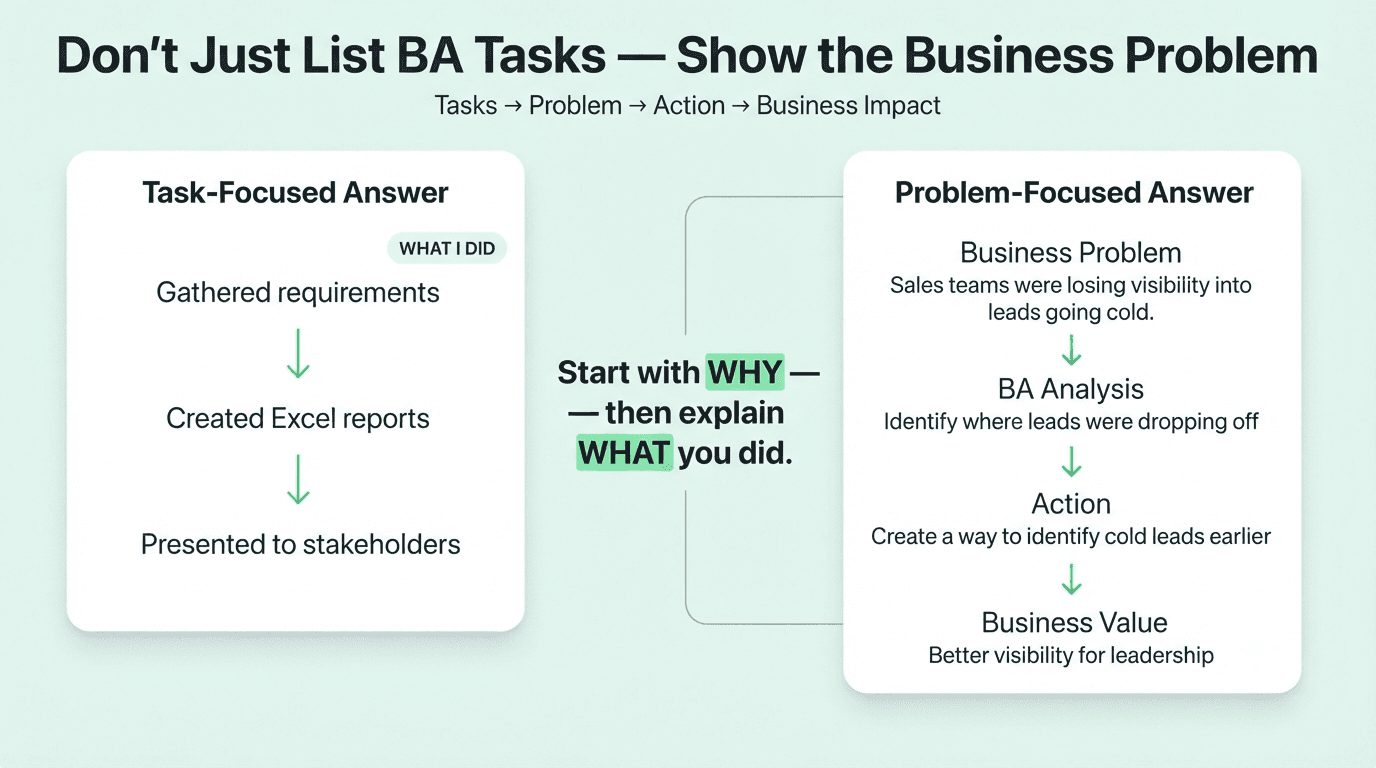
What this looks like Asked about a past project, the candidate says something like, "I gathered requirements, made a few reports in Excel, and presented them to the stakeholders." It is a list of activities. There is no mention of what business problem the work was actually solving. Why this hurts you Interviewers already assume you can do basic BA tasks. What they actually want to know is whether you understood why the work mattered. An answer built around tasks instead of the problem behind them makes it hard for the interviewer to judge whether you were solving something real or just following instructions. The real fix Before you describe any project, start with one sentence about the actual business problem. Something like, "the sales team was losing visibility into which leads were going cold, so leadership needed a way to catch that earlier." Only after that should you walk through what you did. This small change reframes the whole story from a list of chores into a piece of work that mattered. Go back through your last three or four projects and write one sentence for each describing the real business problem before you describe any task. If you struggle to write that sentence, that itself is useful information, since it means you may not have fully understood the point of the work at the time.
Mistake 2: Talking about requirements gathering with no mention of stakeholders disagreeing
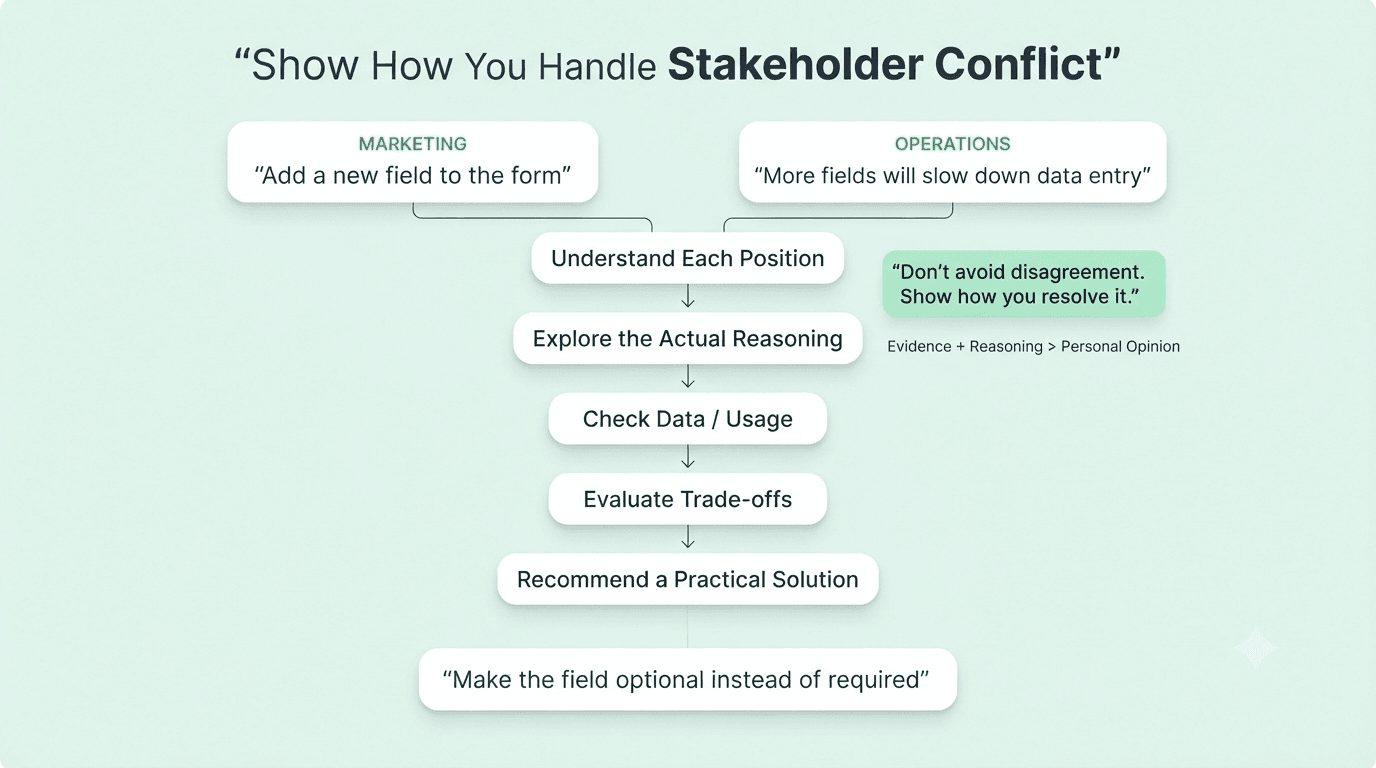
What this looks like The candidate describes requirements gathering as a smooth, tidy process. "I met with stakeholders, wrote down what they needed, and created a requirements document." No mention of anyone disagreeing, changing their mind, or asking for something unrealistic. Why this hurts you In real projects, stakeholders almost never agree completely, and requirements almost always shift. A story with no friction at all sounds rehearsed or incomplete, and it worries interviewers because handling disagreement between stakeholders is one of the hardest and most important parts of the job. The real fix Pick a real example where stakeholders disagreed or where requirements changed partway through, and be ready to explain how you handled it. A simple structure works well here. Explain what the disagreement was about, how you got each side to explain their actual reasoning rather than just their position, and how you found a solution or made a recommendation based on that. For example, "the marketing team wanted a new field added to the form, but the operations team was worried it would slow down data entry, so I looked at how often that field would actually be used and proposed making it optional instead of required, which satisfied both sides." Write out one story like this in full detail before your interview, so you are not trying to recall it from memory in the moment
Mistake 3: Explaining data findings with no context for what they mean to the business
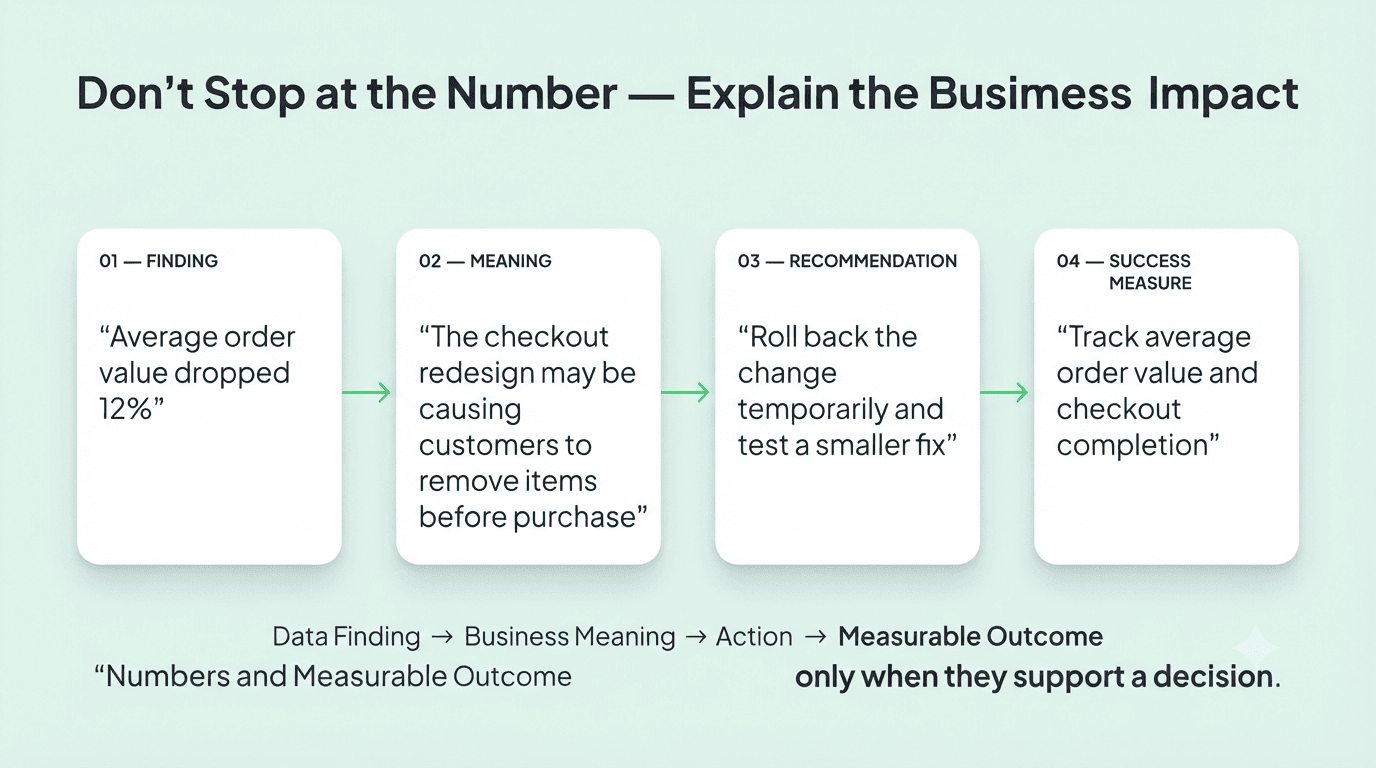
What this looks like Asked to explain a piece of analysis, the candidate describes it purely in technical terms. "I ran a query joining these three tables and found that the average value dropped by 12 percent." No mention of what that drop actually meant for the business or what should happen next. Why this hurts you A number by itself is not useful to a business. The whole point of a business analyst is to translate data into something decision makers can act on. An answer that stops at the number, without connecting it to a business impact or a recommendation, makes the interviewer wonder if you actually understood what you found, or if you just ran a query someone else asked for. The real fix Every time you describe a piece of analysis, follow it with what it meant and what you recommended because of it. Use a simple structure. State the finding, explain why it mattered to the business, and say what you suggested doing about it. For example, "average order value dropped 12 percent after the checkout redesign, which suggested the new layout was making people remove items before completing their purchase, so I recommended we roll back the change for a week while we tested a smaller fix instead of the full redesign." Practice this with your last few analysis projects. If any of them end at "and I found the number," add the missing second half before your interview.
Mistake 4: Giving textbook definitions of BA techniques instead of showing how you actually used them
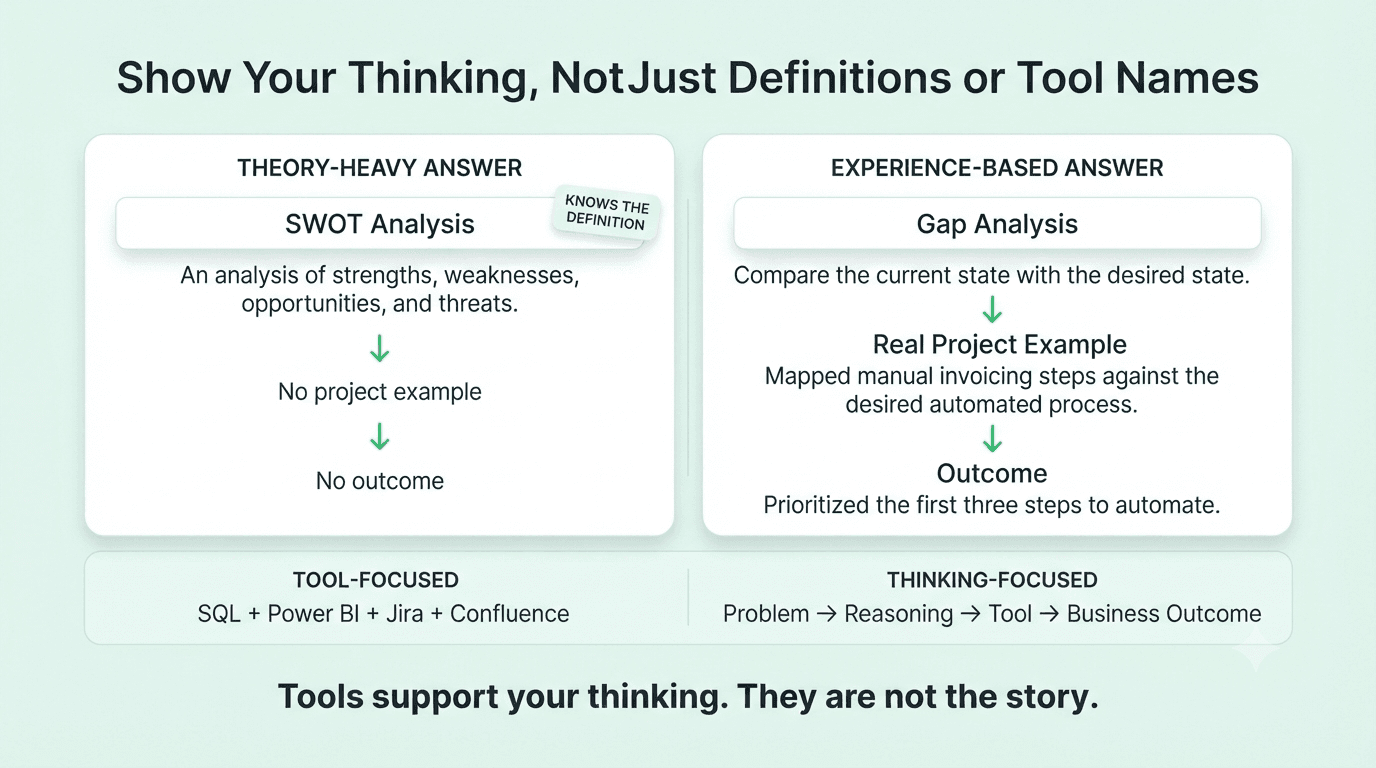
What this looks like Asked to explain something like a SWOT analysis, gap analysis, or use case diagram, the candidate recites a clean definition, almost word for word from a textbook or a certification course, with no mention of using it on a real project. Why this hurts you Interviewers can usually tell within a sentence or two whether an answer is coming from memorized theory or real experience. A definition with no real example attached signals that you may know the concept in name only, which is a real concern for a role that is meant to be practical, not academic. The real fix Whenever you are asked to explain a technique, briefly define it in one sentence, then immediately move into a real example of when you used it and what came out of it. For example, "a gap analysis compares where a process currently stands against where it needs to be. I used one when our client wanted to automate part of their invoicing process. We mapped out the current manual steps against the ideal automated flow, and that comparison is what helped us prioritize which three steps to automate first." If there is a technique you have studied but never actually applied, be honest about that rather than pretending otherwise, and instead explain how you would apply it if given the chance.
FREE TO USE
8k+ SESSIONS92% FLUENCY4.9★ RATING
Speak With Confidence
Real Conversations. Real Scenarios. Speak until it feels natural.
- Real-Time Speaking Practice
- Guided Conversation Flows
- Instant AI Feedback
Mistake 5: Case study or scenario answers that skip straight to a recommendation
What this looks like Given a business scenario, like "a retail client's online returns have doubled in the last quarter, what would you do," the candidate jumps straight to a recommendation, something like "I would add a size guide to the product pages," without asking any questions first or explaining any reasoning. Why this hurts you This is one of the most common reasons candidates lose case study rounds. A recommendation with no investigation behind it looks like a guess, not analysis. Interviewers are testing whether you can break down an ambiguous problem in a structured way, not whether you can guess the right answer quickly. The real fix Before offering any recommendation, ask clarifying questions and lay out your thinking. A useful structure is to first understand the scope of the problem, then form a few possible explanations, then narrow down using whatever information you are given. For the returns example, you might ask whether the increase is happening across all products or specific categories, whether it started after a certain date that lines up with any changes, and whether the return reason is tracked anywhere. Only once you have a clearer picture should you offer a recommendation, and even then, tie it directly back to what you just uncovered rather than a generic idea. Practice this by taking five sample case study questions, easy to find online, and forcing yourself to spend the first two minutes purely on questions and reasoning, with no recommendation allowed, before moving forward.
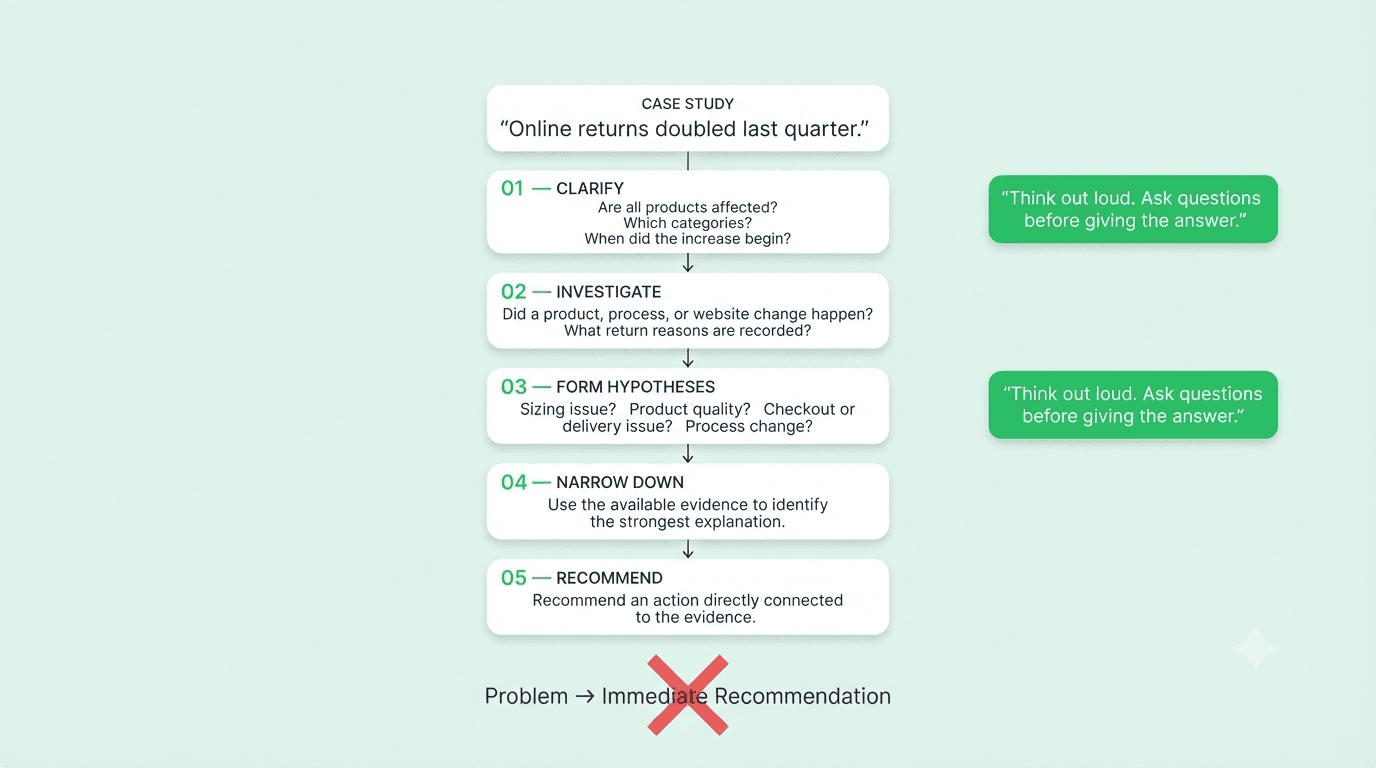
Mistake 6: Overusing tool names instead of explaining the actual thinking behind the work
What this looks like Every answer is packed with tool names. "I used SQL, Power BI, Jira, and Confluence for this project." The intervier learns what software touched the project but nothing about what the candidate actually figured out or decided. Why this hurts you Tools change constantly, and most companies expect to train you on their specific stack anyway. What they actually want to know is how you think through a problem. An answer that leans entirely on tool names, with no explanation of the reasoning behind using them, can come across as someone who followed steps rather than someone who understood why those steps made sense. The real fix Mention tools briefly, as a supporting detail, but spend most of your answer on the thinking. Instead of "I used SQL to pull the data and Power BI to build a dashboard," say something like, "I needed to understand where customers were dropping off in the signup process, so I pulled the funnel data using SQL and built a simple dashboard in Power BI so the product team could see the drop off points themselves without needing to ask me for updates every week." The tools are still mentioned, but they support a clear story about why the work mattered.
Mistake 7: Talking about documentation as if it does not matter
What this looks like Asked about how they handle documentation, like requirements documents or process maps, the candidate treats it as a minor chore. "I just write it up after the meeting and send it out," with no mention of how they make sure it is accurate, clear, or actually used by the team. Why this hurts you Poor documentation is one of the most common real causes of project failure, since it leads to misunderstandings between business and technical teams. An answer that treats documentation casually suggests you might not fully appreciate how much confusion bad documentation can cause down the line. The real fix Explain your documentation process with enough detail to show you actually think about who will read it and how it will be used. For example, "after any requirements meeting, I write up the notes the same day while everything is fresh, then I send them back to the stakeholders and specifically ask them to confirm anything that seems different from what they meant, since it is much easier to fix a misunderstanding on paper than after something has already been built." This shows documentation as a tool for preventing problems, not just a formality. If you have ever caught a misunderstanding early because of a documentation review, that is a strong example to have ready, since it directly shows the value of doing this step carefully.
Mistake 8: Behavioral answers about conflict that avoid any real tension
What this looks like Asked about a time they disagreed with a stakeholder or a team member, the candidate picks an example with almost no actual conflict in it, or describes simply going along with whatever the other person wanted to avoid friction. Why this hurts you Business analysts often sit between groups with different priorities, like business teams wanting speed and technical teams wanting stability. An answer where you just agree with everyone all the time suggests you might struggle to push back when it actually matters, which can lead to problems later when nobody raised a concern early enough. The real fix Prepare a real example where you respectfully disagreed with someone and explain how you handled it. A useful structure is to explain what the disagreement was, how you supported your position with data or reasoning rather than just opinion, and how the situation was resolved. For example, "a stakeholder wanted a new report built immediately, but based on the current data quality, I explained that the numbers would likely be misleading until we cleaned up a few fields first, and showed a quick example of the kind of error that could happen. We agreed to spend two days on data cleanup before building the report, which avoided a much bigger issue later." This shows you can hold your ground while still working well with others.
Mistake 9: Treating technical conversations as something outside their job
What this looks like When a technical topic comes up, like how a database is structured or what an API actually does, the candidate either gives a vague or incorrect answer with confidence, or says something like, "that is more of a developer question," and moves on quickly. Why this hurts you You are not expected to code, but you are expected to understand enough to have a real conversation with developers and to know when a requirement is technically realistic or not. Avoiding the topic entirely, or bluffing through it, both raise concern about how well you would actually work with a technical team day to day. The real fix When a technical question comes up and you are not sure, say so honestly and ask a real follow up question instead of guessing or shutting the topic down. Something like, "I am not fully sure how that integration works under the hood, could you walk me through it, I want to understand the constraint you are describing so I can factor it into the requirements." This shows curiosity and honesty together, which almost always reads better than either bluffing or avoiding. Outside interviews, spend real time learning the basics of how systems are built and how data flows between them, so you have a genuine foundation instead of nothing at all.
Mistake 10: Metrics or success criteria that are vague or missing entirely
What this looks like Describing a project, the candidate never mentions how success was actually measured. "The new process worked really well and everyone was happy with it," with no specific measure of what "worked well" actually meant. Why this hurts you Business analysis is fundamentally about measurable outcomes. A story with no clear success measure makes it hard to tell whether the project actually delivered value, or whether the candidate simply assumes it did because nobody complained. The real fix For every project story, know the specific measure that was used to judge success, even if it is a simple one. Something like, "processing time for each request dropped from around three days to same day in most cases," or "the error rate in the monthly report dropped from about eight percent to under one percent after we added the new validation step." If you genuinely do not know the exact number for an older project, at least know the rough direction and be upfront that it is an estimate rather than stating it as a precise fact you cannot back up.
Mistake 11: Not asking specific questions about how the analyst role actually works at that company
What this looks like At the end of the interview, when asked if they have any questions, the candidate asks something generic like "what is the company culture like," or has no questions prepared at all. Why this hurts you This is often one of the last impressions you leave, and a lack of specific curiosity about the actual role can suggest you have not thought carefully about whether this job is a good fit, or that you are applying to many roles without much focused interest in this particular one. The real fix Prepare a few specific questions ahead of time based on what you know or suspect about the role. Good examples include asking how requirements typically move from business stakeholders to the development team at that company, what tools the analyst team relies on day to day, or what a recent project the team worked on actually looked like from start to finish. These questions do two things. They leave a strong final impression, and they genuinely help you figure out whether this is a team and a way of working that suits you.
Mistake 12: Rehearsed answers that fall apart under a follow up question
What this looks like The candidate delivers a polished, almost scripted answer to a common question, but as soon as the interviewer asks a small follow up, like "what would you have done if the stakeholder had said no," the candidate stumbles because they had not thought past the version they memorized. Why this hurts you Interviewers can usually tell when an answer has been rehearsed word for word, and a good one will often test it with a follow up question specifically to see if the story holds up. Falling apart at that point raises doubt about whether the story was fully true or fully understood in the first place. The real fix Instead of memorizing an exact script, know the real shape of each story well enough that you could explain it slightly differently every time and still be accurate. Practice this by telling the same story out loud to two different people on two different days without notes, and see if it still comes out consistent in the key facts while sounding a little different in the details. Also spend a few minutes before your interview thinking through one or two likely follow up questions for each of your main stories, so you are not caught off guard.
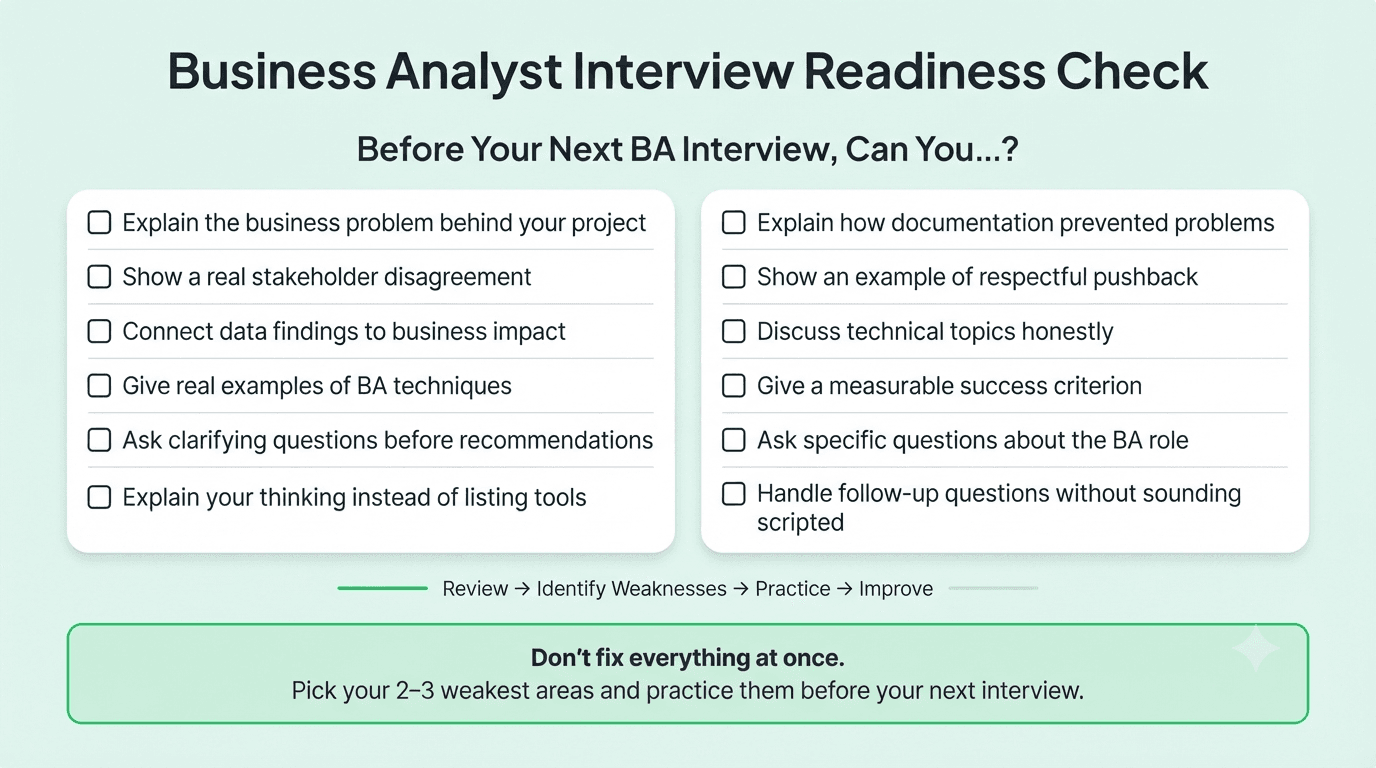
A quick way to check yourself before your next interview
Go through this list honestly before your next interview. Do your project stories start with the actual business problem, not just a list of tasks. Do you have at least one story involving real disagreement between stakeholders. Do you explain what your findings meant for the business, not just the number itself. Can you explain a BA technique using a real example, not just a textbook definition. Do you ask clarifying questions before jumping to a recommendation in case studies. Do your answers focus more on your thinking than on the tools you used. Do you treat documentation as something that prevents real problems, not just paperwork. Do you have a real story about respectfully pushing back on someone. Can you talk about technical topics honestly, asking questions instead of avoiding them. Do you know the actual measure of success for your key project stories. Have you prepared specific questions about how the role actually works at this company. If several of these feel weak right now, that is completely normal. The point is not to fix everything overnight. Pick the two or three that feel most relevant to you and work on those before your next round of interviews.