Loading...
Contents
Common DevOps Engineer Interview Mistakes to Avoid in 2026
(With Complete Fixes)
Sep 10, 202645 min readUpdated Oct 24, 2026
The DevOps candidates who get rejected in 2026 rarely fail because they don't know Kubernetes or Terraform they fail because they can't narrate their thinking, they treat tools as trivia instead of judgment, they can't explain a real incident with a clear timeline, and they skip cost/security reasoning entirely. Below are the mistakes that actually show up in hiring-manager debrief notes, why they happen, and the exact fix for each, not "practice more," but a specific replacement habit or answer structure.
This isn't a generic "don't be nervous, be confident" list. Every mistake here is paired with what a rejected answer sounds like, what a hired candidate's answer sounds like instead, and a concrete method to close the gap before your next interview.
FREE TO USE
25K+ INTERVIEWS4.8★ RATING68% IMPROVEMENT
Crack Your Dream Job
Real Interviews. Real Pressure. Practice until it feels easy.
- Seamless Interview Experience
- Resume & JD Questions
- Instant Personalized Feedback
Why This List Is Different
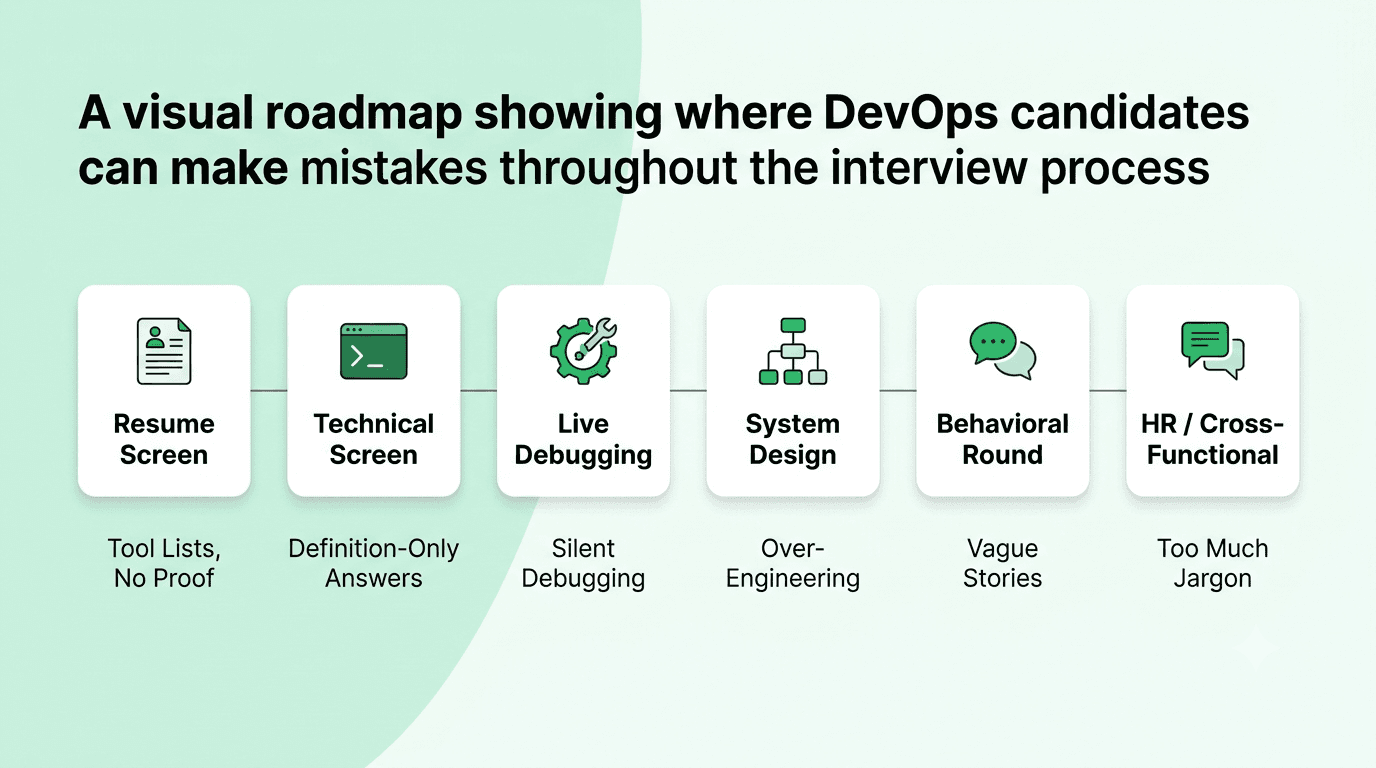
Most "interview mistakes" articles repeat the same three lines: "don't badmouth your last job," "ask questions at the end," "research the company." Those are true and boring. This guide focuses on the mistakes that are specific to DevOps hiring, the ones a hiring manager actually writes in a rejection note: "couldn't explain the blast radius of their own change," "gave textbook Kubernetes answers with no operational depth," "no ownership language in incident story." Each mistake below maps to a specific interview stage (resume screen, technical screen, live debugging round, system design, behavioral round, final panel) so you know exactly where it costs you.
Category 1: Resume & Application Mistakes
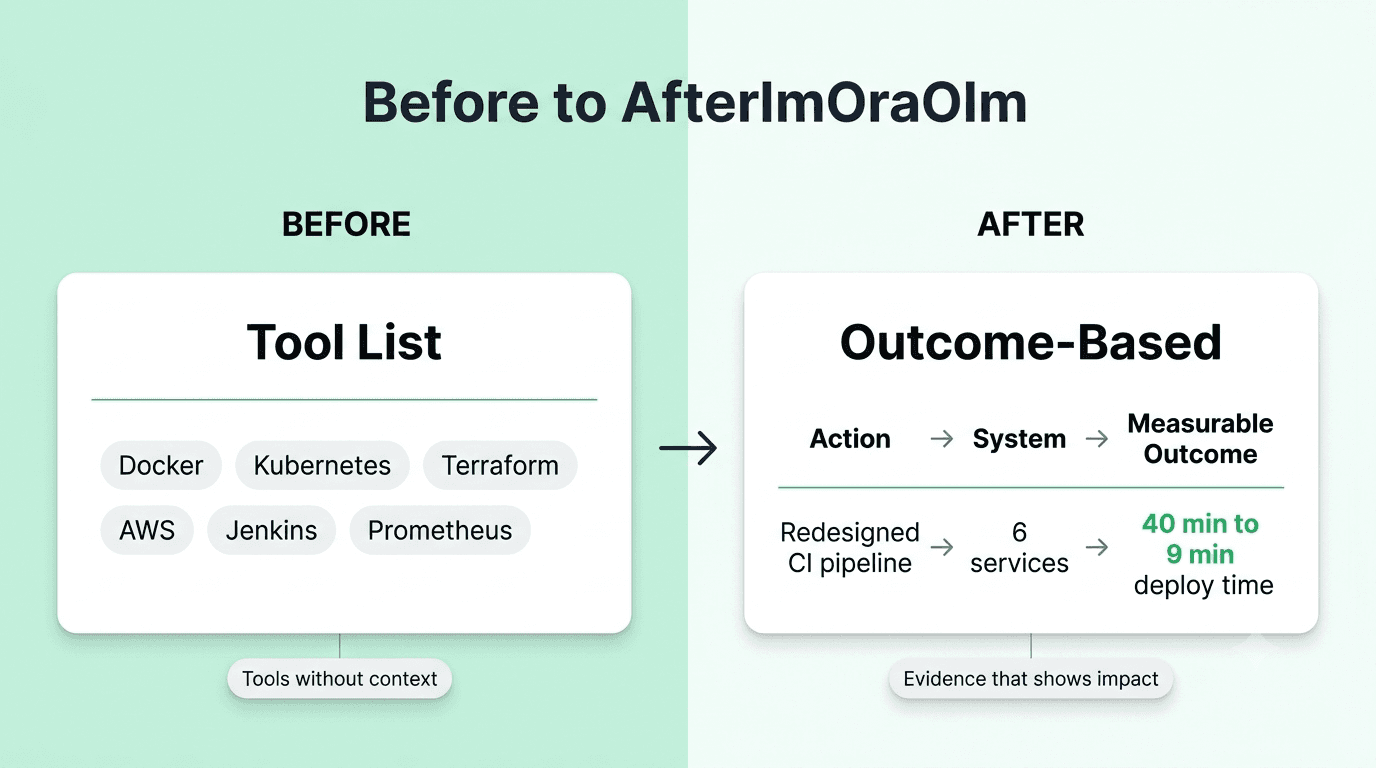
What This Looks Like "Skills: Docker, Kubernetes, Terraform, Jenkins, AWS, Python, Ansible, Prometheus, Grafana." A wall of tool names with no context for what was built, fixed, or improved. Why This Fails Candidates Recruiters screen 100+ resumes for a single role. A tool list is indistinguishable between a candidate who deployed one tutorial pod and one who runs production Kubernetes at scale. It gives the screener zero signal to rank you against other candidates, so you get filtered out by keyword-matching software or a bored human skim — neither of which rewards you for "knowing" a tool. Real Example of the Mistake "Proficient in Kubernetes, Terraform, and CI/CD pipelines." The Complete Fix Rewrite every bullet as: [Action] + [System] + [Measurable Outcome]. Specifically: Pull up your last 3 projects or work tasks. For each, answer: What was broken/slow/manual before? What did you change? What number moved (time, cost, incidents, deploy frequency)? Rewrite as one line: "Redesigned CI pipeline stage ordering and caching, cutting average deploy time from 40 minutes to 9 minutes across 6 services." If you genuinely don't have a number (side project, learning exercise), be honest about scope instead of inflating it: "Built a 3-node Kubernetes home lab to practice autoscaling and node-failure recovery; documented findings in a blog post" is more credible than a vague production claim a recruiter can't verify. Before/After Before: "Experience with Terraform and AWS." After: "Migrated 12 manually-provisioned EC2 environments to reusable Terraform modules, eliminating configuration drift incidents and cutting new-environment setup time from 2 days to 40 minutes." What This Looks Like A resume and LinkedIn with no GitHub link, no blog, no write-up — nothing a recruiter can check that isn't self-reported. Why This Fails Candidates In a market where AI tools make resumes easy to polish and exaggerate, recruiters increasingly weight verifiable proof over claims. No public evidence means every claim on the resume rests entirely on how well you perform in a live interview — which is a much higher-stakes bet for both sides, and often means you don't even get invited to that interview. The Complete Fix Pick one real (not tutorial-copied) project: a home lab, a small open-source contribution, or a documented incident from your own infrastructure. Publish a short write-up (500–800 words) explaining the problem, what you tried, what failed, and what worked. Failure detail is more convincing than a clean success story — it proves you actually did the work. Put the GitHub/blog link directly under your name on the resume, not buried at the bottom. Keep it updated — a repo untouched for two years signals stalled growth as much as no repo at all.Mistake 1: Listing Tools Instead of Outcomes
Mistake 2: No Evidence of Independent Work
Category 2: Technical Screen Mistakes
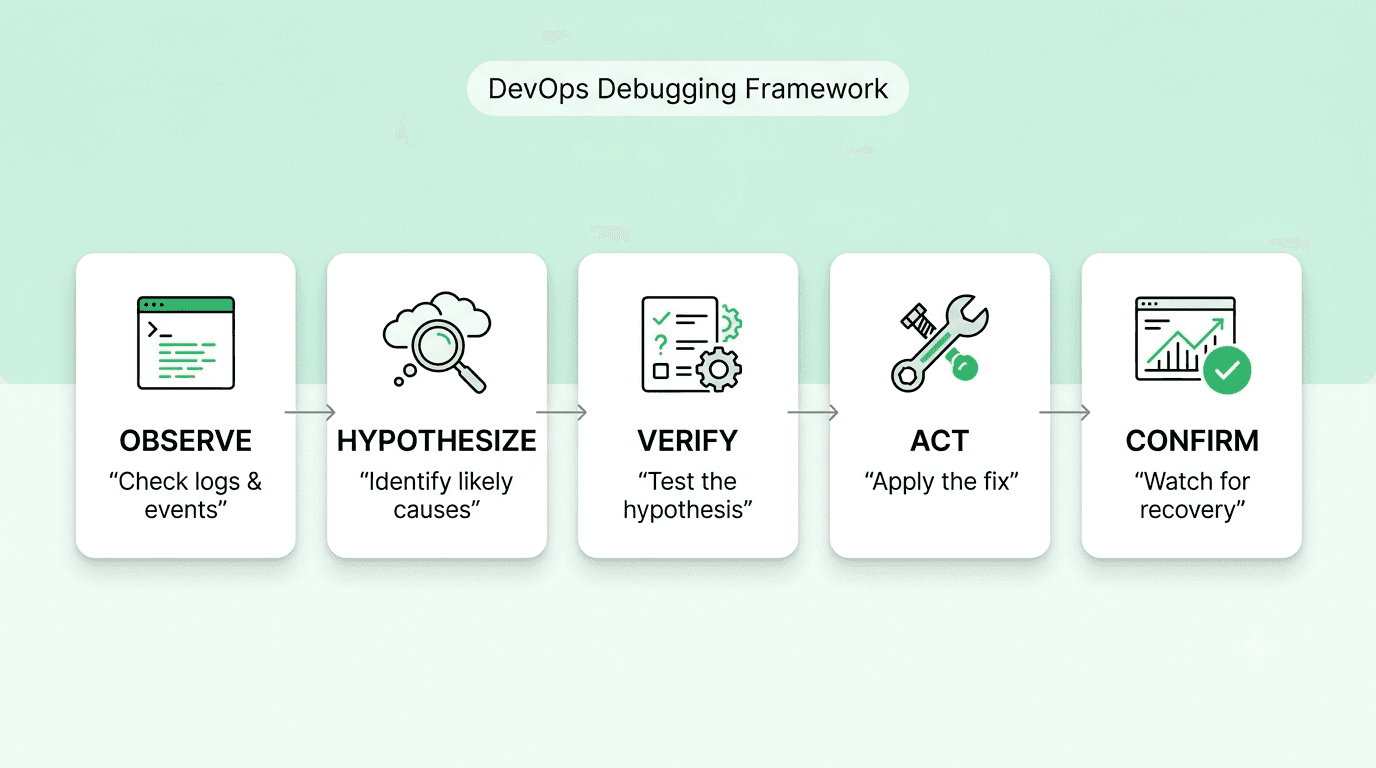
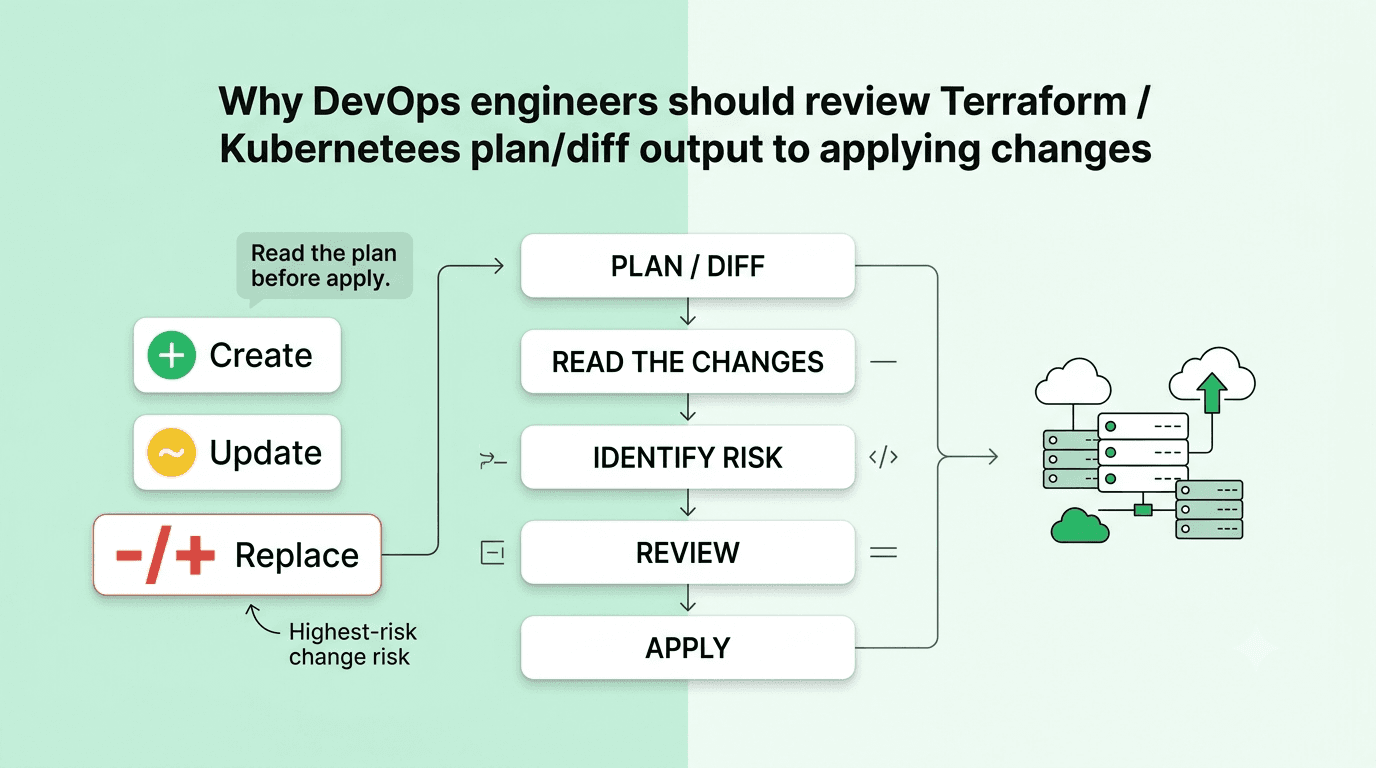
What This Looks Like Interviewer: "A pod keeps restarting — what do you check?" Candidate: "CrashLoopBackOff means the container is crashing repeatedly and Kubernetes is backing off before retrying." — a textbook-accurate definition that never answers the actual question of what you'd do. Why This Fails Candidates Interviewers already know the definition — they're testing your debugging process, not your vocabulary. A candidate who defines terms instead of walking through an investigation reads as someone who has studied about the job but hasn't done it. This is the single most common technical-screen rejection reason cited by hiring managers. The Complete Fix Adopt a fixed narration structure for every "what would you check" question — Observe → Hypothesize → Verify → Act → Confirm: Observe: "First I'd run kubectl describe pod to see recent events and kubectl logs --previous to see the crash output." Hypothesize: "Common causes are OOMKill, a failed liveness probe, or an application error on startup — the events output usually tells me which." Verify: "If it's OOMKilled, I'd check kubectl top pod against the configured limits to confirm." Act: "I'd either raise the memory limit if it's a real requirement change, or investigate a memory leak if usage is growing unexpectedly." Confirm: "After the fix, I'd watch restart count and memory usage for a full traffic cycle before calling it resolved." Practice this structure out loud, on a whiteboard or alone, for 10 common scenarios (pod crash, DNS failure, high latency, failed deploy, disk full, certificate expiry) until it's automatic — not memorized word-for-word, but structurally automatic. What This Looks Like Given SSH/kubectl access to a broken sandbox, the candidate goes quiet, types commands, and only speaks when they find the answer — or worse, stalls in silence when stuck. Why This Fails Candidates The interviewer usually cares more about your process than whether you find the exact bug in the time limit. Silence gives them nothing to evaluate. A candidate who narrates a wrong hypothesis and self-corrects looks stronger than one who silently guesses right, because real incidents require exactly that kind of visible, collaborative reasoning under pressure. The Complete Fix Before touching the keyboard, say out loud what you're about to check and why: "I'll start by checking service status since that's the fastest way to rule out the obvious." When a hypothesis is wrong, say so explicitly instead of silently pivoting: "That's not it — logs look clean, so let's check networking next." If you get stuck, say what you'd do next in a real job instead of freezing: "At this point I'd normally check with whoever deployed last, or pull up recent deploy history — is that visible here?" Practice this with a friend or mock-interview partner specifically on "think out loud" — most candidates have never rehearsed narrating under time pressure, and it's a distinct skill from solving the problem itself. What This Looks Like Shown a terraform plan or a YAML diff and asked "what will happen here," the candidate skims and answers based on what the code is supposed to do rather than what the tool is actually reporting it will do — missing an unintended resource replacement or destructive change. Why This Fails Candidates This exact scenario mirrors the single most common real-world Terraform incident: someone applies a plan without reading it and causes an outage. Interviewers use this test specifically because it separates candidates who've internalized "always read the plan" from those who haven't actually felt the consequences of skipping it. The Complete Fix Build a personal habit, starting now, of never running apply on your own projects without reading every line of plan output first — even on toy projects. Muscle memory built here transfers directly to interviews. Learn to specifically scan for the words -/+ (replace, often destructive) versus ~ (in-place update) versus + (create) in Terraform output, and say explicitly in the interview: "This line shows a replace, not an update — that means downtime unless it's stateless, so I'd flag this before applying." For Kubernetes diffs, explicitly check whether a change affects a field that forces pod recreation (like certain volume or resource changes) versus one that's a rolling update.Mistake 3: Reciting Definitions Instead of Reasoning Through Scenarios
Mistake 4: Treating Live Debugging Rounds Like a Silent Exam
Mistake 5: Not Reading the Terraform/Kubernetes Plan Output Before Answering
Category 3: System Design / Practical Round Mistakes
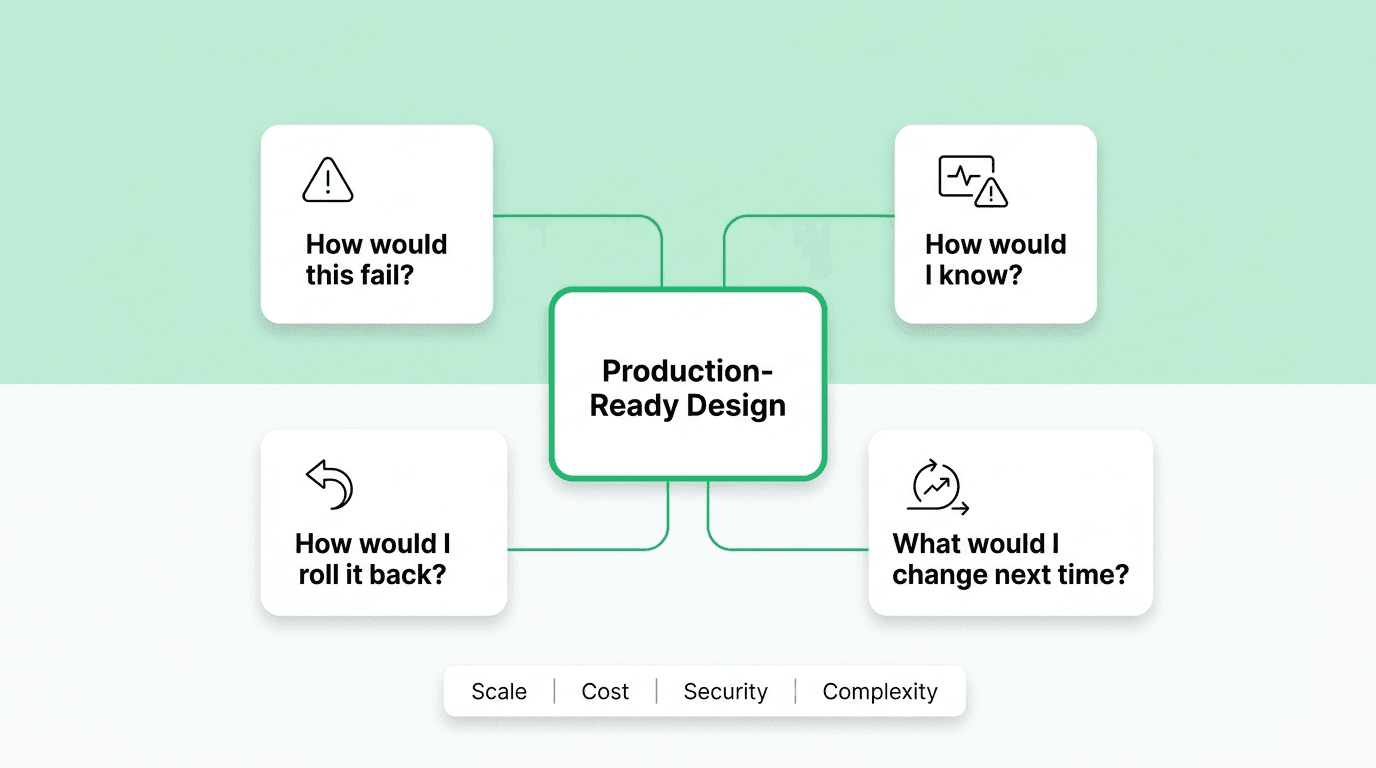
What This Looks Like Asked to design a deployment pipeline or infrastructure for a small team's app, the candidate immediately proposes a multi-region, service-mesh, five-nines architecture — over-engineering relative to the stated requirements. Why This Fails Candidates This is one of the fastest ways to signal inexperience with real budgets and real team size. Senior engineers are valued specifically for right-sizing solutions; over-engineering in an interview reads as someone who's absorbed a lot of "best practice" content without ever having to justify infrastructure cost to a manager. The Complete Fix Before proposing any design, ask (or state your assumption explicitly if you can't ask): "What's the expected traffic/team size/budget/compliance requirement here?" Present a simple baseline first, then explicitly name what you'd add and when — "I'd start with a single-region setup with basic autoscaling; I'd only add multi-region once we have a specific latency or compliance requirement driving it, since it roughly doubles operational complexity." Always mention the cost or complexity trade-off of anything advanced you propose, not just the benefit. This single habit — stating trade-offs unprompted — is one of the clearest senior-vs-junior signals in a design interview. What This Looks Like The candidate designs a clean happy-path pipeline or architecture and stops — no discussion of what happens when a deploy fails, how they'd know, or how they'd recover. Why This Fails Candidates Production systems are defined by how they fail, not how they succeed. A design with no failure handling signals someone who has only ever operated in environments where someone else handled incidents. The Complete Fix For any design question, build in a fixed closing checklist you run through even if not asked: "How would this fail?" — name at least one realistic failure mode. "How would I know it failed?" — specific alert/metric, not "monitoring." "How would I roll it back?" — specific mechanism (previous image tag, terraform state rollback, feature flag). "What would I do differently next time?" — shows postmortem thinking even in a hypothetical. Say this out loud unprompted at the end of any design answer: "One more thing — for failure handling, I'd..." This single addition consistently moves candidates from "technically fine" to "clearly thinks like an operator" in interviewer notes.Mistake 6: Designing for Scale Nobody Asked For
Mistake 7: No Mention of Rollback, Monitoring, or Failure Handling
FREE TO USE
8k+ SESSIONS92% FLUENCY4.9★ RATING
Speak With Confidence
Real Conversations. Real Scenarios. Speak until it feels natural.
- Real-Time Speaking Practice
- Guided Conversation Flows
- Instant AI Feedback
Category 4: Behavioral & Incident Story Mistakes
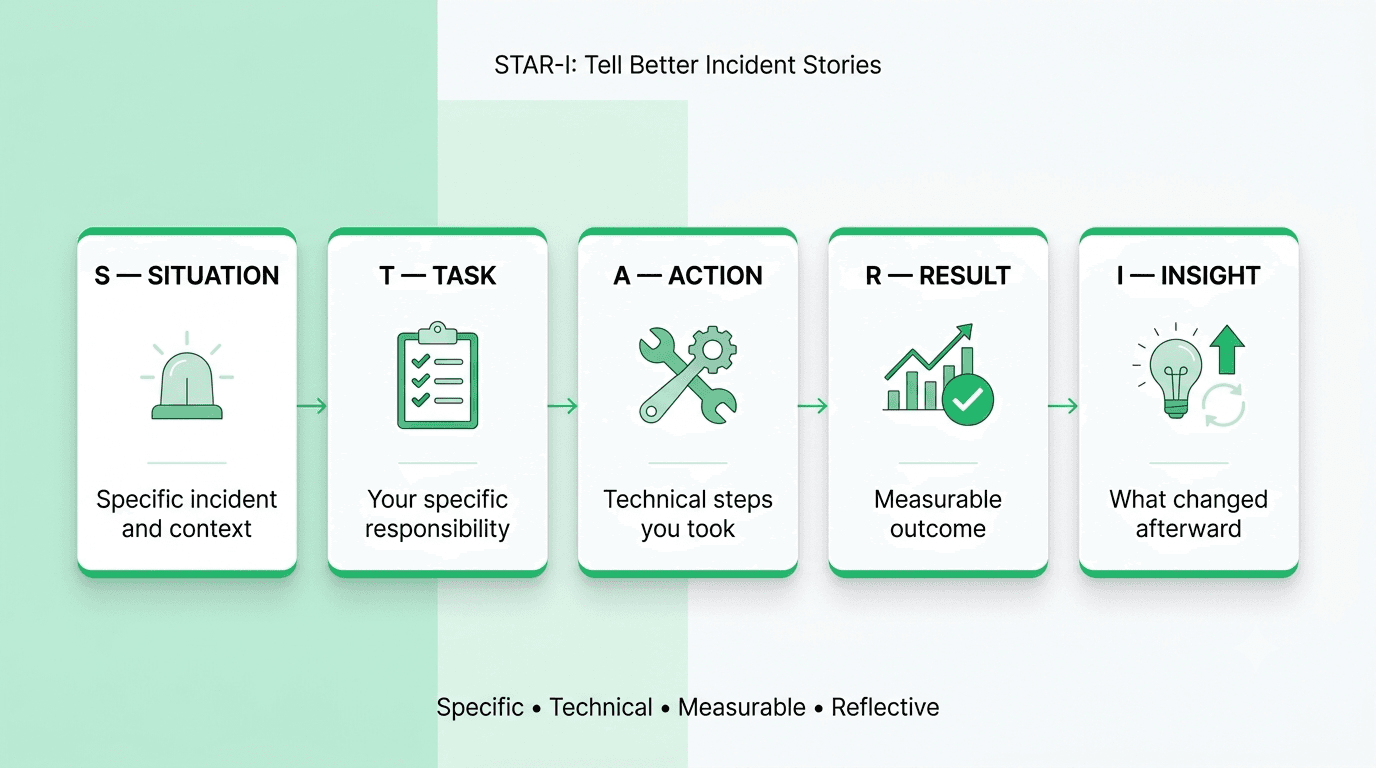
What This Looks Like "We had an outage once and I helped fix it by looking at the logs and figuring out what was wrong." No timeline, no specific technical detail, no clear individual contribution. Why This Fails Candidates This is the single most common failure point in behavioral rounds for DevOps roles. Vague stories can't be probed with follow-up questions, and experienced interviewers will probe — "what did the logs actually show," "what was your specific role versus the team's," "how long did it take." A candidate who can't answer follow-ups on their own story is either exaggerating their involvement or didn't process the incident deeply enough to learn from it. The Complete Fix Prepare 2–3 real incident stories in advance using the STAR-I structure (Situation, Task, Action, Result, Insight): Situation: Specific and dated in your memory — "A payment service started returning 500s during a Black Friday-equivalent traffic spike." Task: Your specific role — "I was the on-call engineer for infrastructure, not the app team." Action: The actual technical steps, in order, including at least one wrong turn — "I initially suspected the database given the error pattern, but connection pool metrics were normal, so I checked the load balancer next and found it was hitting connection limits." Result: A specific, ideally quantified outcome — "Increased the connection limit and added autoscaling triggers on that metric; the fix took 22 minutes from alert to resolution." Insight: What changed afterward — "We added that metric to our standard dashboard for every new service after that, since it wasn't being tracked before." Write these out fully in advance, then practice telling them in under 2 minutes without reading — a story that takes 8 minutes to tell, or one you can only tell while reading notes, isn't ready yet. What This Looks Like "The outage happened because a junior engineer pushed to production without testing" — framing an incident around an individual's failure rather than the process gap that allowed it. Why This Fails Candidates Blameless postmortem culture is a well-established DevOps/SRE norm, and interviewers — especially at companies with mature engineering cultures — treat blame-framing as a red flag for how you'd behave on their team during a real incident, and whether you'd be safe to bring bad news to. The Complete Fix Rehearse describing any team-involved incident purely in terms of process: "There was no pre-deploy check that would have caught this" instead of "someone forgot to check." Practice the reframe explicitly: take a story you'd naturally tell with blame and rewrite it once, out loud, replacing every person-focused sentence with a system-focused one. If directly asked "whose fault was it," answer with systems language: "It wasn't really about one person — we didn't have a safeguard in place, so we added one afterward so it couldn't happen again regardless of who was deploying." What This Looks Like When asked "any questions for me," the candidate asks only about salary, remote policy, or says "no, I think you covered it all" — or worse, asks something clearly answered on the company's public website. Why This Fails Candidates This is one of the last impressions an interviewer forms, and a lack of technical curiosity here undercuts an otherwise strong technical performance. It particularly hurts DevOps candidates because curiosity about how things actually run is core to the job. The Complete Fix Prepare 3–4 specific, non-generic questions in advance, tailored by interviewer type: For the hiring manager: "What does your current deploy frequency look like, and what's the biggest bottleneck to improving it?" For a peer engineer: "What's the last production incident that changed how the team works?" For anyone: "What does the on-call rotation actually look like day to day — how often does it page, and for what?" These questions do double duty: they show genuine operational curiosity, and the answers help you evaluate whether the team's actual maturity matches what the job description implied.Mistake 8: Vague or Unverifiable Incident Stories
Mistake 9: Blaming People Instead of Systems
Mistake 10: No Questions, or Only Logistics Questions, at the End
Category 5: Communication & Presence Mistakes
What This Looks Like In an HR or cross-functional round, the candidate answers "tell me about a project you're proud of" with dense Kubernetes internals and acronyms the interviewer visibly can't follow. Why This Fails Candidates Many companies include a non-technical or cross-functional interviewer specifically to assess whether you can communicate outward — a core DevOps skill given how often the role interfaces with product, security, and leadership. Losing this round on communication grounds happens even to technically excellent candidates. The Complete Fix Before any round, ask (or infer from the calendar invite/title) whether the interviewer is technical, and calibrate before you start answering. Prepare one version of each key story at three depths: a one-sentence business-impact version, a two-minute overview version, and a deep technical version — and let the interviewer's follow-up questions pull you deeper rather than front-loading jargon. Test this in advance: explain your proudest project to a non-technical friend or family member. If they can't follow it, your default explanation is too technical for mixed audiences. What This Looks Like Given an ambiguous prompt ("design a CI/CD pipeline for our team"), the candidate immediately starts describing a specific solution without clarifying scale, constraints, or existing tooling. Why This Fails Candidates Ambiguous prompts are often intentionally underspecified to see whether you ask questions before committing to a solution — jumping straight to an answer signals someone who might do the same thing on the job, building the wrong thing quickly instead of the right thing after two minutes of clarification. The Complete Fix Build a habit of asking at least 2 clarifying questions before any design or scenario answer, even if you think you know what's being asked: "What's the team size and current deploy frequency?" "Are there existing tools/constraints I should design around, or is this greenfield?" If the interviewer says "just make reasonable assumptions," state them out loud before proceeding: "Okay — I'll assume a team of about 10 engineers, a few services, and no existing CI/CD tooling in place." This shows the same instinct without stalling the interview.Mistake 11: Over-Technical Answers to Non-Technical Interviewers
Mistake 12: Not Asking Clarifying Questions Before Diving In
Category 6: Judgment & Mindset Mistakes
What This Looks Like Asked about an unfamiliar tool or scenario, the candidate bluffs a confident-sounding but vague or incorrect answer rather than admitting the gap. Why This Fails Candidates Experienced interviewers can usually tell when a candidate is bluffing, and it costs more trust than admitting a gap would have. Given how fast the DevOps tooling landscape moves, hiring managers explicitly value candidates who are honest about the edges of their knowledge over ones who project false confidence — because the honest ones are safer during real incidents. The Complete Fix Prepare a standard, confident way to handle unknown-territory questions instead of bluffing: "I haven't worked directly with [tool/scenario], but here's how I'd approach it: I'd check [documentation/similar tool I do know]'s approach, look for how it differs from [X, which I do know], and probably spend 30 minutes in a sandbox before touching anything real." This answer demonstrates method and honesty simultaneously — often scoring better than a shaky guess at the real answer would have. What This Looks Like Every technical answer focuses purely on "does it work," with no mention of what it costs, what it exposes, or what happens if it's misused — even when the scenario clearly invites it (e.g., IAM policy design, architecture questions). Why This Fails Candidates In 2026, cost and security are treated as first-class engineering constraints, not separate concerns for finance or a security team to handle later. Answers that ignore them read as junior by default, regardless of technical correctness. The Complete Fix Build a mental checklist to run silently before finalizing any technical answer: "Have I mentioned what this costs, and have I scoped permissions/access to the minimum needed?" Practice adding one sentence to your answers specifically covering this — "I'd scope this IAM role to only the specific bucket and actions needed, not a wildcard, since overly broad access here would be a real risk if the service were compromised." What This Looks Like When asked how they use AI coding/ops assistants, candidates either claim not to use them at all (signaling being behind current practice) or describe using them uncritically with no verification step (signaling risk). Why This Fails Candidates By 2026 this question is common in DevOps interviews specifically because unreviewed AI-generated infrastructure changes are a real, recent category of production incidents. Interviewers are testing your verification discipline, not your AI tool preference. The Complete Fix Prepare a specific answer with a real example: name a tool you use, describe a concrete task you used it for, and specifically describe how you verified the output before shipping it — e.g., "I used it to draft a Terraform module for a new service, then manually reviewed the plan output and caught that it had defaulted to public S3 access, which I fixed before applying." This shows productive use and the exact verification habit interviewers are checking for.Mistake 13: Claiming to Know Everything Instead of Showing How You'd Find Out
Mistake 14: No Cost or Security Framing in Technical Answers
Mistake 15: Not Preparing Questions or Framing Around AI Tool Usage
Mistakes Mapped by Interview Stage
The 2-Week Pre-Interview Fix Plan
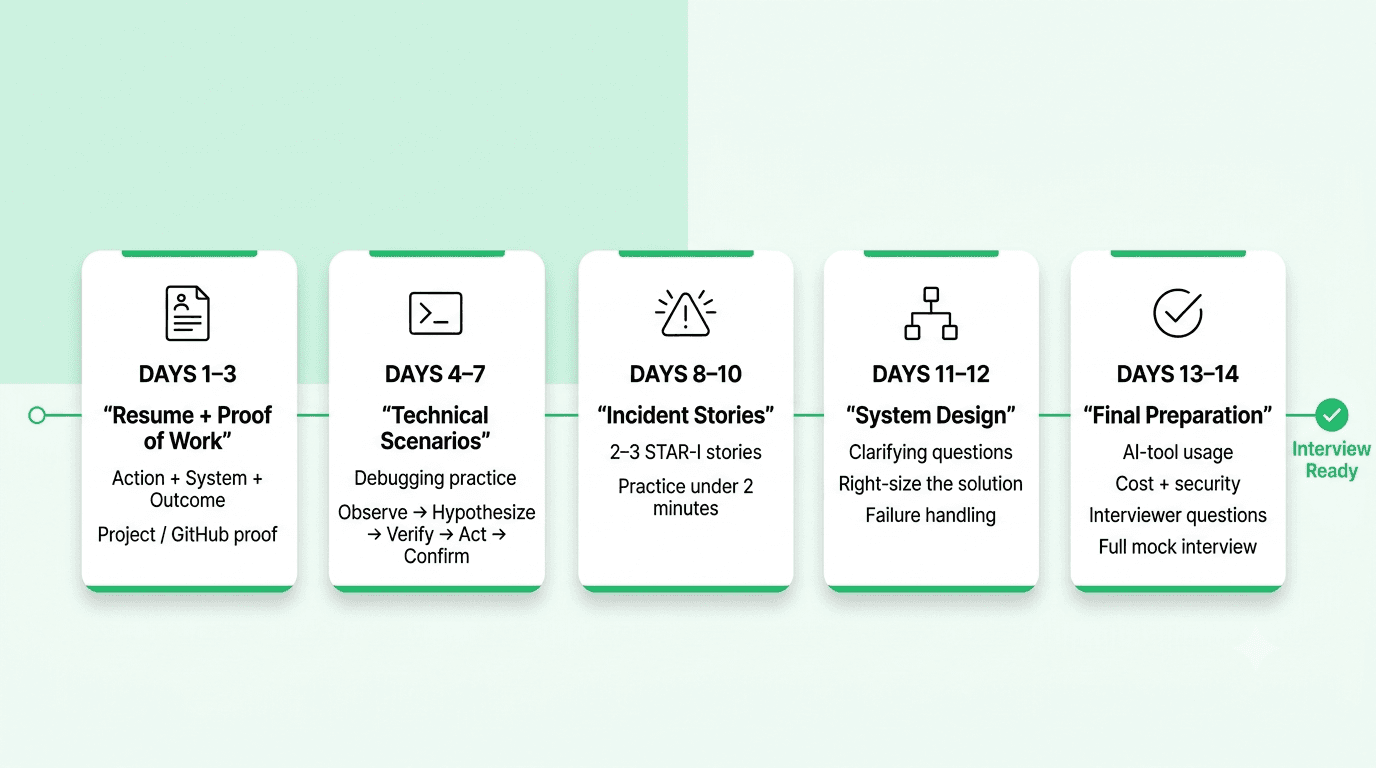
Days 1–3: Rewrite your resume bullets using the Action + System + Outcome format (fixes Mistake 1); publish or update one project write-up (fixes Mistake 2). Days 4–7: Pick 8–10 common technical scenarios (pod crash, DNS failure, deploy rollback, high latency, disk full, cert expiry, IAM misconfiguration, CI pipeline failure) and practice the Observe → Hypothesize → Verify → Act → Confirm narration out loud for each (fixes Mistakes 3, 4, 5). Days 8–10: Write out 2–3 real incident stories in full STAR-I format and practice telling each in under 2 minutes; deliberately rewrite any blame-framed language into systems language (fixes Mistakes 8, 9). Days 11–12: Practice 2–3 system design scenarios, forcing yourself to ask clarifying questions first, right-size the solution, and always close with failure handling (fixes Mistakes 6, 7, 12). Days 13–14: Prepare your AI-tool-usage story, your "how I handle not knowing something" answer, your cost/security framing habit, and your 3–4 questions for the interviewer (fixes Mistakes 10, 13, 14, 15). Do one full mock interview, ideally recorded, and review it specifically for silence, jargon-only answers, and missing trade-off discussion (fixes Mistake 11 and reinforces everything above).
Self-Check: Am I Making These Mistakes?
[ ] My resume bullets have numbers or specific outcomes, not just tool names. [ ] I have a public GitHub/blog link a recruiter can actually check. [ ] I can narrate a debugging process out loud without going silent. [ ] I always mention reading the plan/diff output before saying what will happen. [ ] My design answers include failure handling and rollback without being asked. [ ] I have 2–3 incident stories I can tell in under 2 minutes, in systems-not-blame language. [ ] I have specific, non-generic questions ready for the interviewer. [ ] I can explain my proudest project to a non-technical person and have them follow it. [ ] I ask clarifying questions before diving into ambiguous design prompts. [ ] I have a ready, honest answer for "what if you don't know something." [ ] I mention cost or security trade-offs unprompted in technical answers. [ ] I have a concrete, verification-focused answer about how I use AI tools. If more than 3 boxes are unchecked, that's your priority list for the next two weeks not a reason to postpone applying, but a reason to run the fix plan above in parallel with interviewing.
FAQs
More Blogs


Oct 22, 2026
UI/UX Designer Interview Preparation Guide: A Complete Roadmap for 2026
38 min read

