Loading...
Contents
The Complete Interview Preparation Guide for DevOps Engineers
Sep 3, 202629 min readUpdated Oct 23, 2026
Whether you're a fresher trying to break into DevOps, a mid-level engineer aiming for your next role, or a seasoned professional targeting a senior/lead position, this guide walks you through everything you need to prepare from fundamentals to advanced scenario-based questions.
FREE TO USE
25K+ INTERVIEWS4.8★ RATING68% IMPROVEMENT
Crack Your Dream Job
Real Interviews. Real Pressure. Practice until it feels easy.
- Seamless Interview Experience
- Resume & JD Questions
- Instant Personalized Feedback
Introduction
DevOps interviews are unlike traditional software interviews. They test a blend of coding, systems thinking, automation, cloud infrastructure, and collaboration skills. Interviewers aren't just checking if you know tools like Jenkins, Docker, or Kubernetes — they want to see if you can think in systems, troubleshoot under pressure, and bridge the gap between development and operations. Expect a mix of: Conceptual questions (CI/CD, IaC, containers, orchestration) Hands-on tasks (writing a script, debugging a pipeline, fixing a broken deployment) Scenario-based questions ("Production is down — walk me through your steps") Behavioral questions (incident handling, cross-team collaboration, ownership) The bar has risen significantly — companies increasingly expect DevOps engineers to understand cloud-native architectures, security (DevSecOps), and cost optimization, not just pipeline automation.
What Recruiters Look For
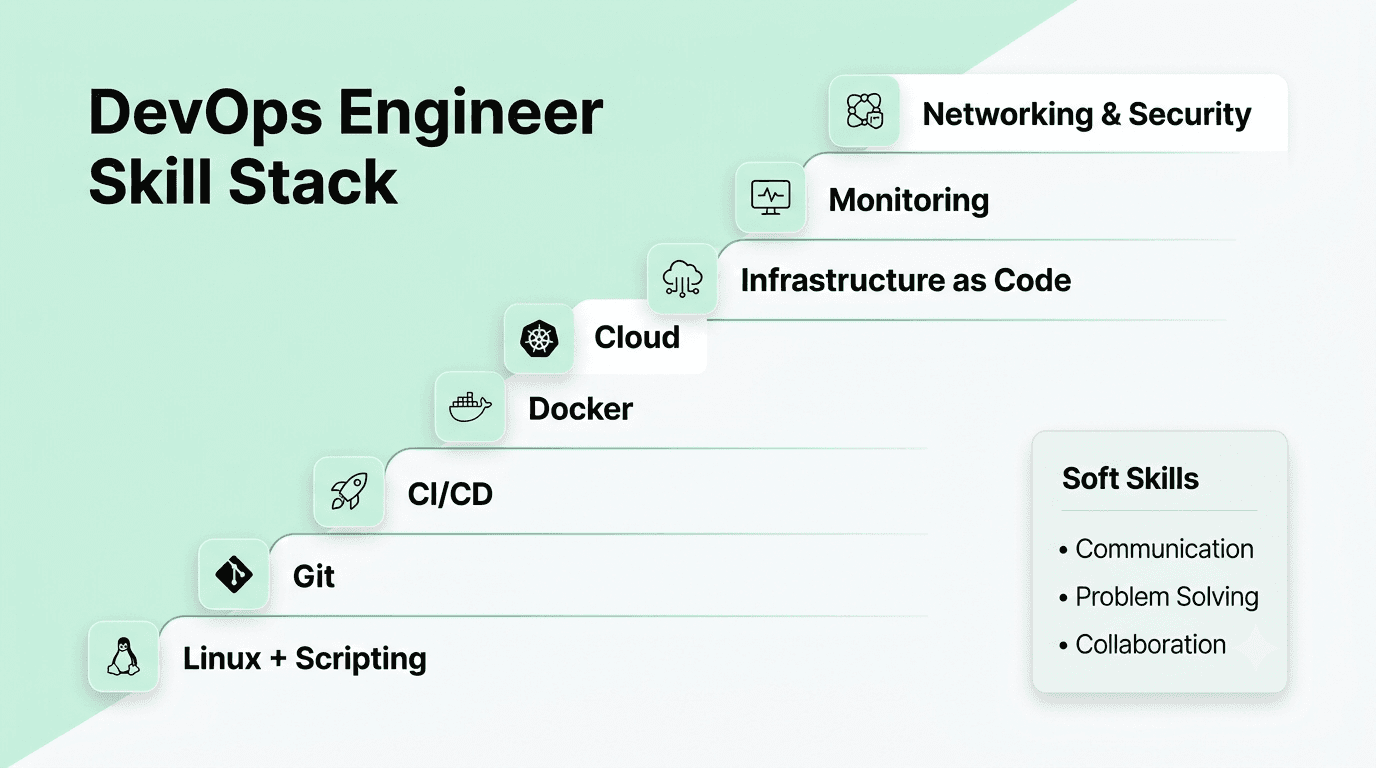
Linux fundamentals — file systems, permissions, process management, networking basics Scripting — Bash and Python are the two most commonly expected languages Version control — Git (branching strategies, merge conflicts, rebasing) CI/CD pipelines — Jenkins, GitLab CI, GitHub Actions, CircleCI Containerization — Docker (images, volumes, networking) Orchestration — Kubernetes (pods, services, deployments, helm charts) Infrastructure as Code (IaC) — Terraform, Ansible, CloudFormation Cloud platforms — AWS, Azure, or GCP (at least one, deeply) Monitoring & logging — Prometheus, Grafana, ELK/EFK stack, Datadog Networking basics — DNS, load balancers, VPCs, firewalls, TLS/SSL Ownership mentality — treating production issues as your responsibility, not "someone else's" Clear communication — explaining technical incidents to non-technical stakeholders Calm under pressure — especially for on-call/incident scenarios Collaboration — DevOps sits between dev, QA, security, and operations Automation-first thinking — always asking "can this be scripted/automated?" Linux + scripting (Bash/Python) CI/CD pipeline design Docker & Kubernetes Cloud platform (AWS is most common globally) IaC (Terraform is the industry favorite) Monitoring/observability Networking & security basics Behavioral/incident management questionsCore Technical Skills
Soft Skills & Traits
Ranking by Importance (Most → Least Frequently Tested)
How to Prepare — Step-by-Step Roadmap
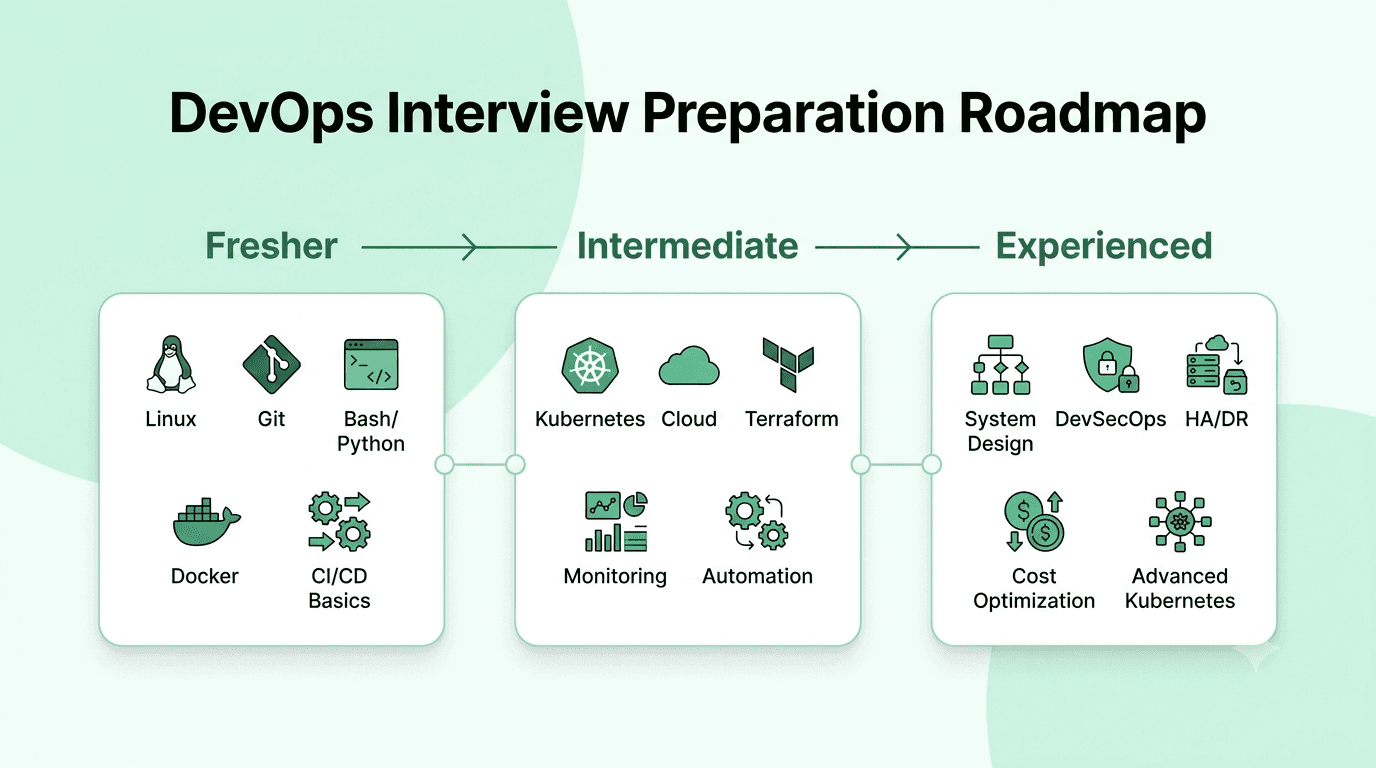
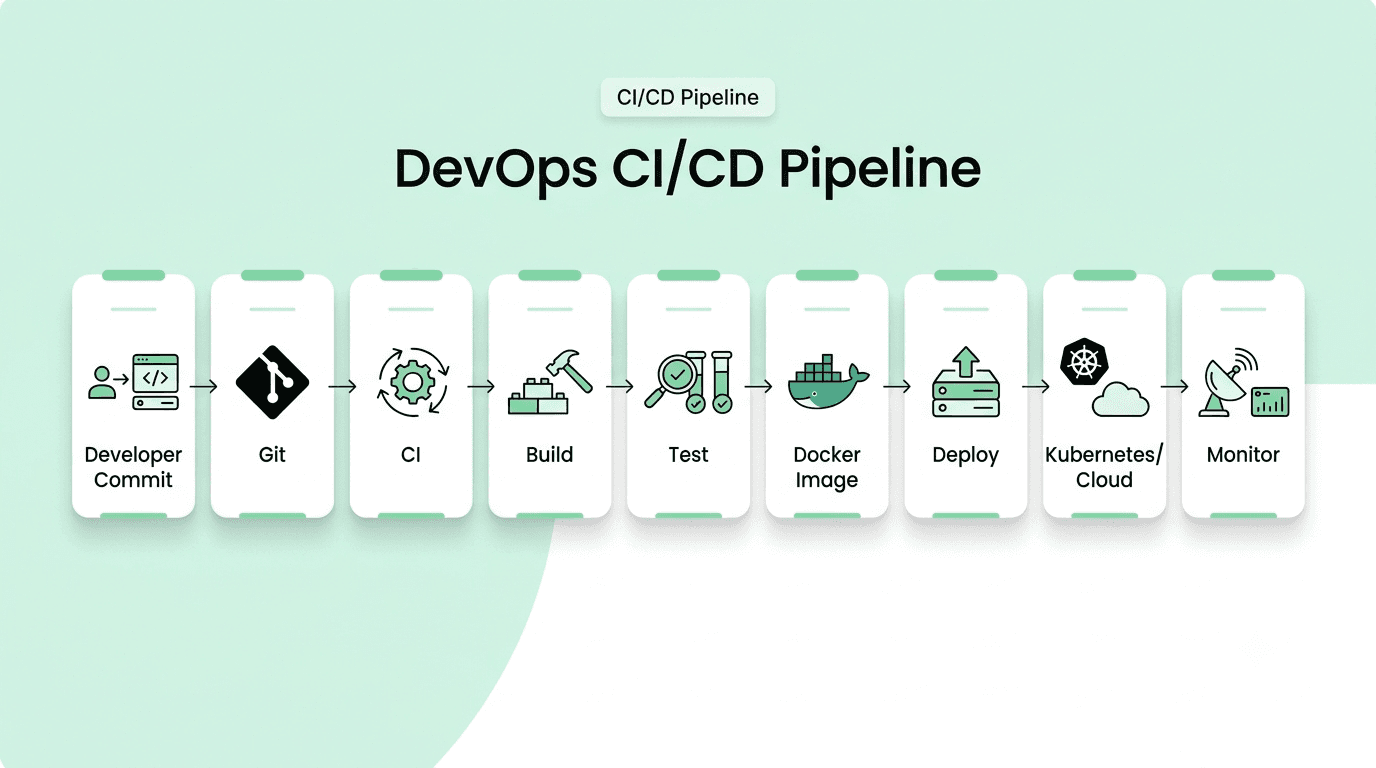
Build strong Linux command-line fluency (practice daily on a VM or WSL) Learn Git thoroughly — not just add/commit/push, but branching, rebasing, resolving conflicts Learn one scripting language deeply (Python or Bash) and automate small real tasks Set up a personal CI/CD pipeline (e.g., GitHub Actions) for a sample project Learn Docker by containerizing a small app end-to-end Get familiar with one cloud provider's free tier (AWS/GCP/Azure) Build 2–3 portfolio projects that show the full pipeline: code → build → test → deploy Deepen Kubernetes knowledge — deployments, services, ingress, config maps, secrets Learn Terraform and write real IaC modules (not just tutorials — build something) Practice designing CI/CD pipelines from scratch, including rollback strategies Study monitoring/observability — set up Prometheus + Grafana for a sample app Review real incident case studies and practice explaining root cause analysis Get comfortable with cost optimization and security basics (IAM, least privilege) Prepare to discuss system design — how you'd architect a scalable, resilient CI/CD and infrastructure setup Be ready with 3–4 detailed incident stories (STAR format) showing leadership and decision-making Study multi-cloud/hybrid-cloud trade-offs and enterprise-scale IaC patterns (Terraform modules, workspaces, state management) Understand DevSecOps — shifting security left, vulnerability scanning, compliance automation Be ready to mentor/lead discussions — interviewers at this level assess architectural judgment, not just tool knowledgeFor Freshers
For Intermediate Candidates
For Experienced Professionals
Core Topics to Study
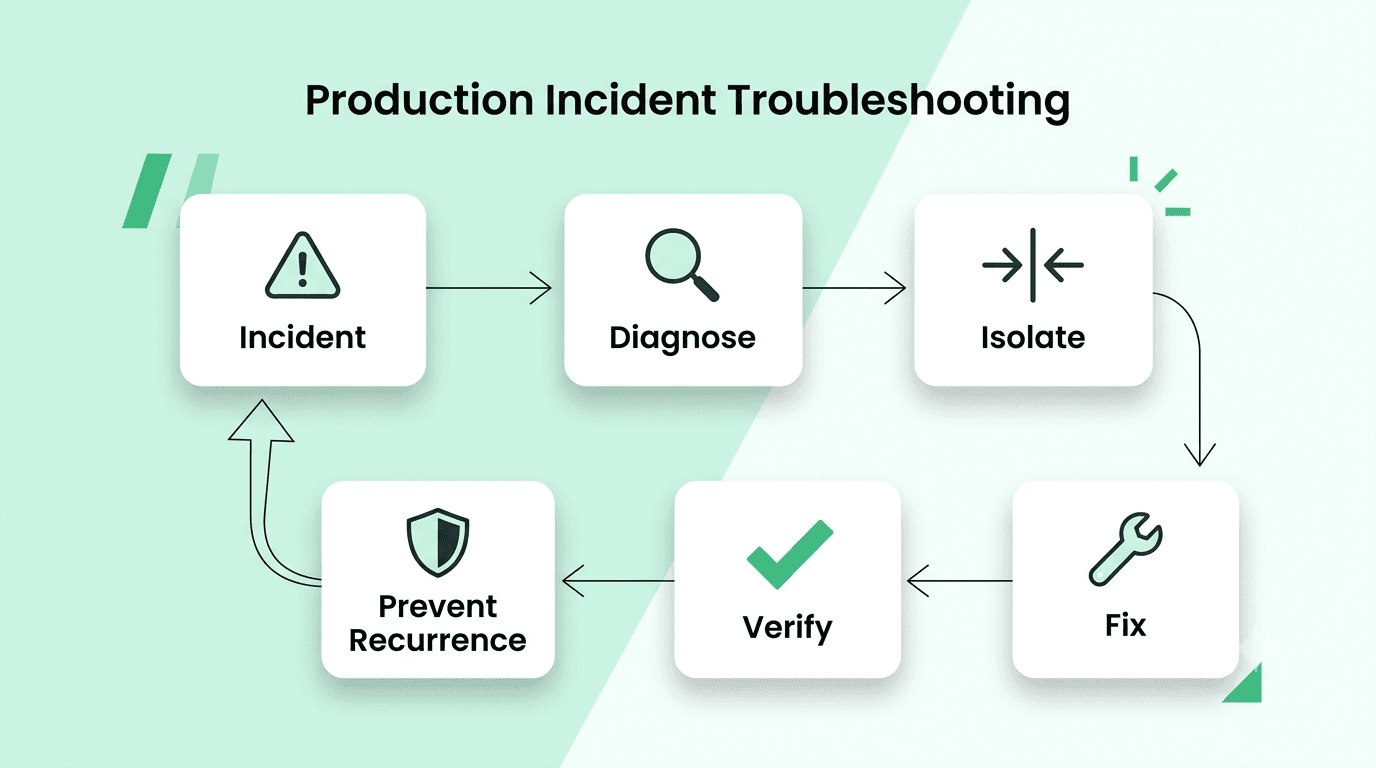
Linux basics: processes, permissions, systemd, cron jobs Networking: DNS, HTTP/HTTPS, load balancing, VPNs, ports Git workflows: feature branching, GitFlow, trunk-based development Basic scripting: loops, conditionals, functions, error handling What is DevOps? CI vs. CD vs. Continuous Deployment Docker basics: images vs. containers, Dockerfile, docker-compose CI/CD pipeline design: stages, artifacts, triggers, parallel jobs Kubernetes architecture: control plane, nodes, pods, kubelet, etcd Configuration management: Ansible playbooks, idempotency IaC principles: declarative vs. imperative, state management Cloud fundamentals: VPCs, subnets, security groups, IAM roles Logging & monitoring: metrics, alerts, dashboards, SLIs/SLOs Kubernetes advanced: autoscaling (HPA/VPA), service mesh (Istio), operators, CRDs Terraform at scale: modules, remote state, workspaces, drift detection Blue-green, canary, and rolling deployment strategies Disaster recovery and high availability design DevSecOps: SAST/DAST tools, secrets management (Vault), image scanning Cost optimization strategies across cloud providers Chaos engineering and resilience testing Practice answering questions like: "A deployment just failed in production — walk me through your debugging process." "How would you design a CI/CD pipeline for a microservices architecture with 20 services?" "Your Kubernetes cluster is running out of resources — what do you check first?" "How would you reduce our AWS bill by 30% without impacting performance?" Tip: Structure your answers as: Diagnose → Isolate → Fix → Prevent recurrence. Interviewers want to see a methodical process, not guesswork. Containerize an application and deploy it to a local Kubernetes cluster (minikube/kind) Write a Terraform module to provision a VPC + EC2 instance + security group Build a CI/CD pipeline that runs tests, builds a Docker image, and deploys automatically Set up centralized logging with the ELK stack for a sample application Simulate an incident (kill a pod, break a config) and practice recovering itFundamental Concepts
Intermediate Concepts
Advanced Concepts
Scenario-Based Preparation Tips
Practical Preparation Exercises
1 / 2
FREE TO USE
8k+ SESSIONS92% FLUENCY4.9★ RATING
Speak With Confidence
Real Conversations. Real Scenarios. Speak until it feels natural.
- Real-Time Speaking Practice
- Guided Conversation Flows
- Instant AI Feedback
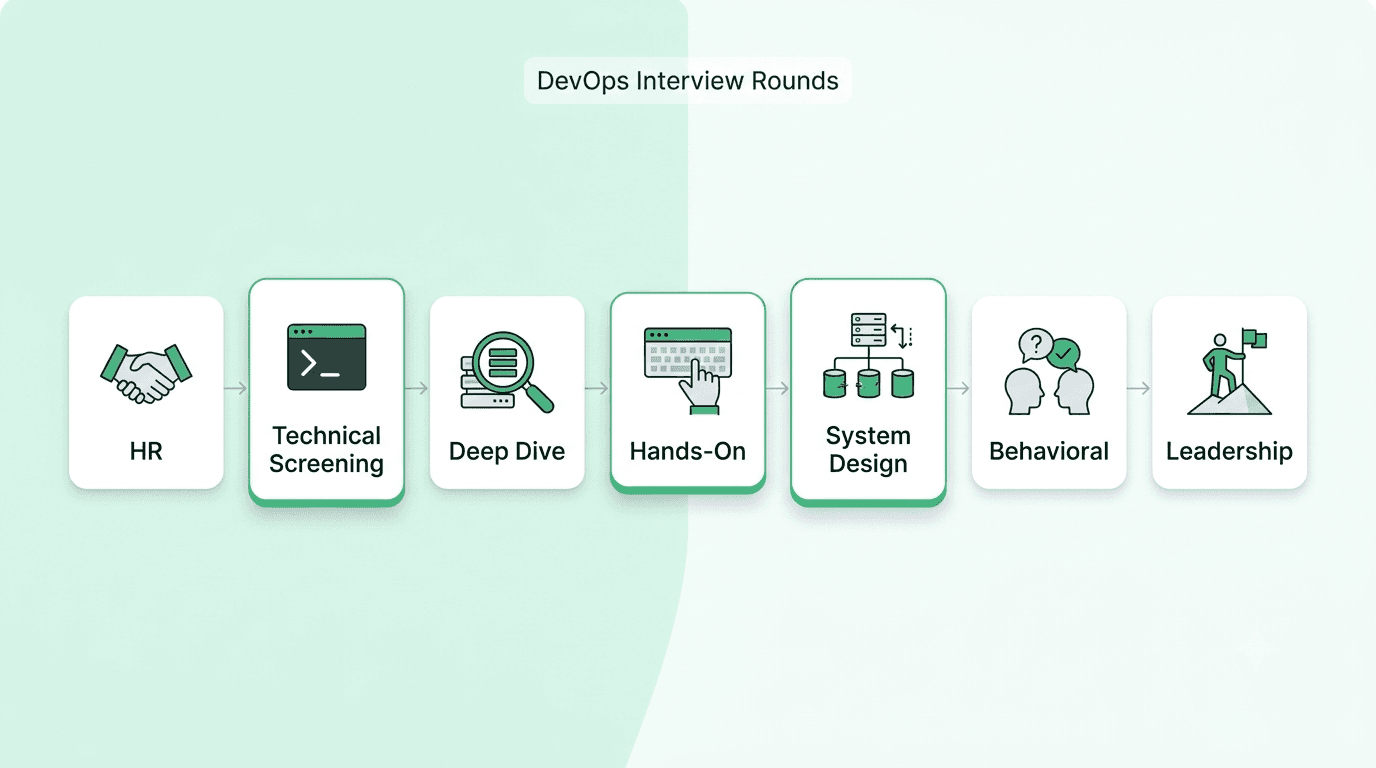
Common Interview Rounds
HR/Recruiter Screening — background, motivation, salary expectations, culture fit Technical Screening (Online Assessment or Phone Screen) — scripting problems, Linux commands, basic Docker/K8s questions Technical Deep-Dive Round — CI/CD design, Kubernetes troubleshooting, Terraform code review Hands-On/Take-Home Task — build a pipeline, fix a broken Dockerfile, write an Ansible playbook System Design Round (mid-to-senior level) — design a scalable deployment architecture or monitoring system Behavioral/Managerial Round — incident stories, teamwork, ownership, conflict resolution Final Round with Leadership — culture fit, long-term vision, sometimes a case study discussion
Best Practices to Follow
Build real projects, not just tutorials. Recruiters can tell the difference between "I followed a course" and "I built and debugged this myself." Know your resume inside out. Every tool or project listed should be something you can explain in depth. Practice explaining out loud. Technical fluency in your head is different from articulating it clearly under pressure. Use the STAR method (Situation, Task, Action, Result) for behavioral questions. Keep a "war stories" list - 4–5 real incidents you've handled, ready to adapt to different questions. Stay current - follow release notes for Kubernetes, Terraform, and major cloud providers. Mock interviews - practice with peers or record yourself answering common questions. Ask clarifying questions before diving into scenario/system design answers - this signals maturity.
Mistakes to Avoid in Devops engineer interview
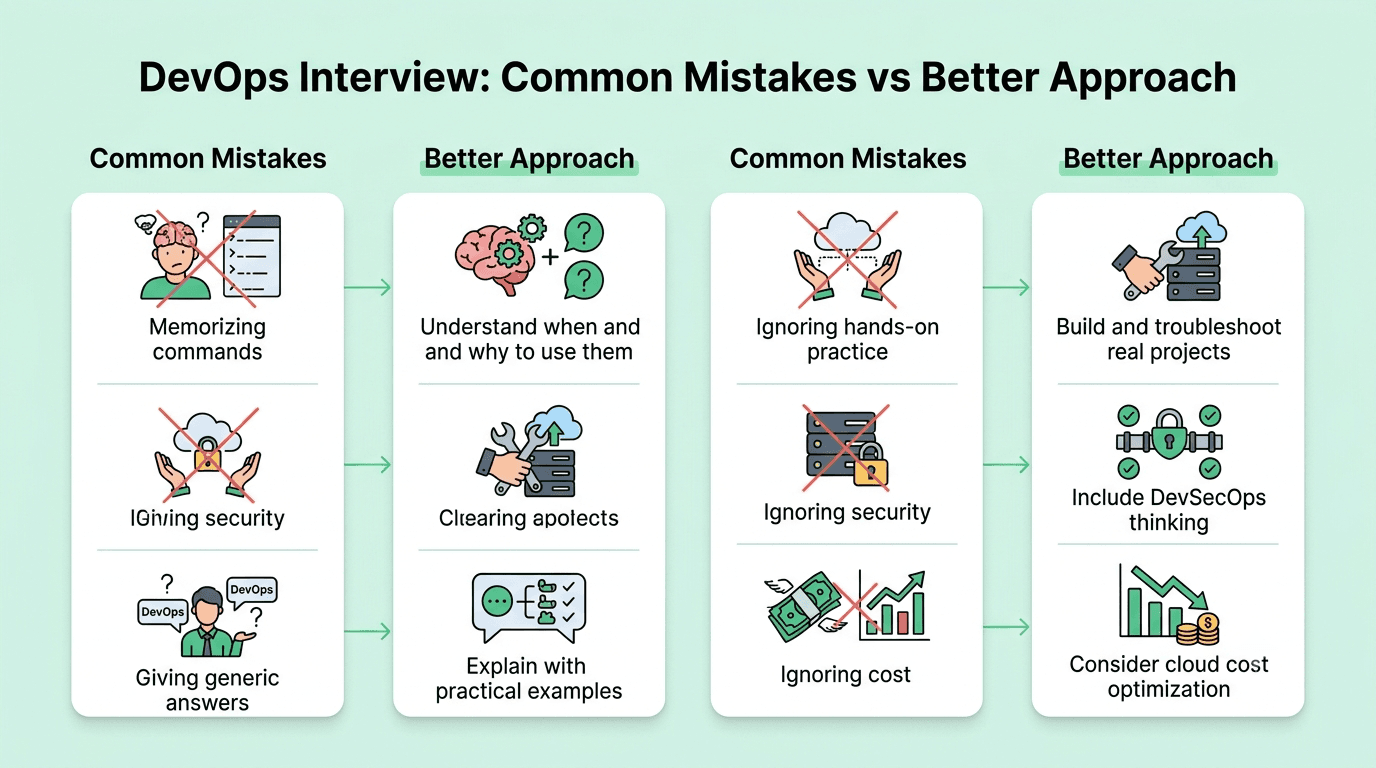
Memorizing commands without understanding why they work Listing tools on your resume you can't explain in detail Ignoring the "soft" side — poor communication sinks otherwise strong technical candidates Not practicing hands-on tasks — many candidates can talk about Kubernetes but freeze during a live exercise Giving vague answers to scenario questions instead of a structured troubleshooting approach Neglecting security and cost considerations when discussing infrastructure design Not asking questions back to the interviewer — it can seem like disinterest Overlooking behavioral prep — assuming technical skill alone will carry the interview
Final Interview-Day Checklist
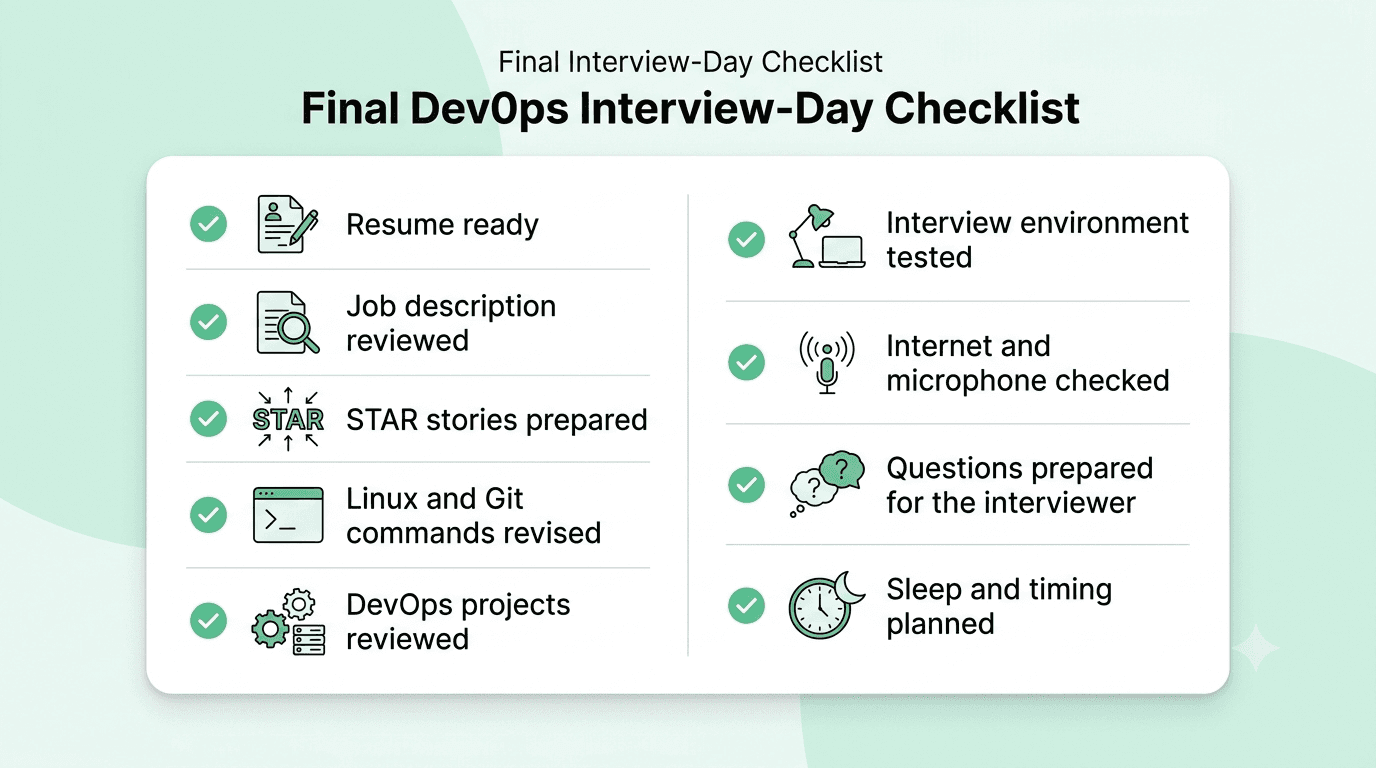
[ ] Review the job description and align your examples to the required skills [ ] Re-read your resume and be ready to explain every project/tool listed [ ] Prepare 3–4 STAR-format incident/behavioral stories [ ] Do a quick refresh of core commands (Git, Docker, kubectl, Terraform) [ ] Set up a quiet, tested environment if the interview is remote/hands-on [ ] Prepare 2–3 thoughtful questions to ask the interviewer [ ] Get a good night's sleep — troubleshooting questions require clear thinking [ ] Have a notebook/whiteboard ready for system design or architecture questions [ ] Test your internet connection and screen-sharing setup in advance
Industry Trends in DevOps
Platform Engineering — building internal developer platforms (IDPs) to self-serve infrastructure needs GitOps — using Git as the single source of truth for infrastructure and deployments (ArgoCD, Flux) DevSecOps — security shifting left into the CI/CD pipeline itself FinOps — cloud cost management becoming a core DevOps responsibility AI-assisted operations (AIOps) — using ML for anomaly detection and predictive alerting Service Mesh adoption — Istio/Linkerd for fine-grained traffic control and observability Multi-cloud and hybrid-cloud strategies — reducing vendor lock-in, increasing resilience Infrastructure as Code maturity — more organizations enforcing policy-as-code (OPA, Sentinel)
Conclusion
DevOps interviews reward candidates who can connect the dots from writing a script, to designing a pipeline, to explaining why a production incident happened and how you prevented it from happening again. Build real projects, practice explaining your thinking clearly, and you'll walk into any DevOps interview with confidence.
More Blogs


Oct 22, 2026
UI/UX Designer Interview Preparation Guide: A Complete Roadmap for 2026
38 min read

