Loading...
Contents
Common Product Manager Interview Mistakes to Avoid in 2026
Sep 11, 202618 min readUpdated Oct 27, 2026
If you have been interviewing for product manager roles and keep getting close but not getting the offer, the reason is usually not your product sense. It is usually one of a small set of mistakes that show up again and again in PM interviews. This guide walks through those mistakes in detail, explains why they actually hurt you, and gives you a real way to fix each one. Not vague advice like "be more confident." Actual steps you can practice this week.
Product management interviews are unusual because they test several very different skills in one sitting. You need to think like a business person, an engineer, a designer, and a leader, sometimes in the same 45 minute conversation. That is exactly why small mistakes get magnified. A single answer that is too vague, too narrow, or too rehearsed can make an interviewer doubt your judgment even if your instincts are actually good.
Let's go through the mistakes one by one.
FREE TO USE
25K+ INTERVIEWS4.8★ RATING68% IMPROVEMENT
Crack Your Dream Job
Real Interviews. Real Pressure. Practice until it feels easy.
- Seamless Interview Experience
- Resume & JD Questions
- Instant Personalized Feedback
Mistake 1: Jumping straight into solutions
What this looks like
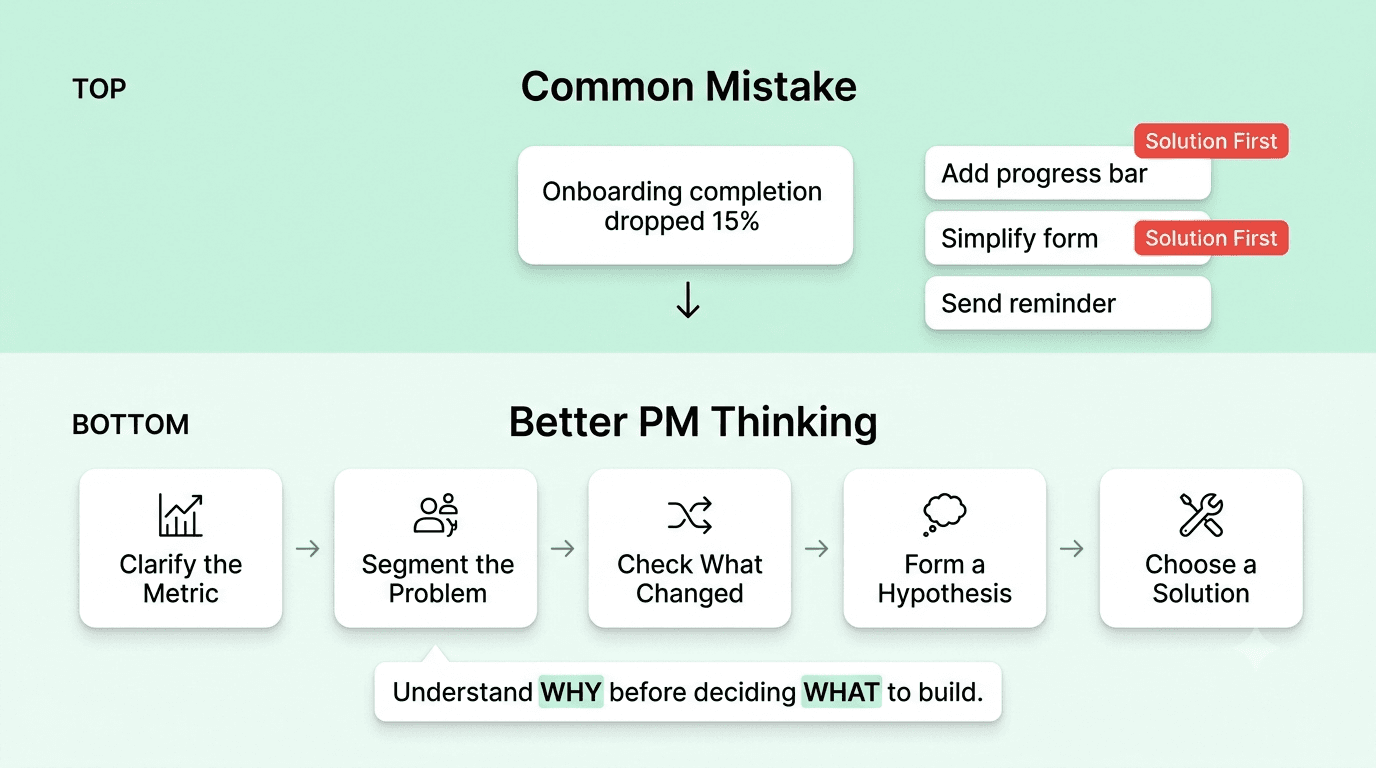
The interviewer describes a problem, something like "our app's onboarding completion rate dropped 15 percent last month." The candidate immediately starts listing fixes. Add a progress bar. Simplify the form. Send a reminder email.
Why this hurts you
This is probably the single most common reason strong candidates get rejected in product sense interviews. Jumping to solutions before understanding the problem tells the interviewer you do not slow down before acting. In a real job, that habit leads to teams building things nobody needed, because nobody asked why the problem happened in the first place.
The real fix
Before you say a single solution, ask questions and form a hypothesis about the cause. A simple structure that works well is this. First, clarify the metric. What exactly dropped, and compared to what baseline. Second, segment the problem. Did it drop for all users or a specific group, like a certain platform, region, or user type. Third, ask about anything that changed recently, like a new release, a pricing change, or a marketing campaign. Only after you have a clear, testable idea of what caused the drop should you talk about what to do about it.
Practice this by taking five random product problems (search a list of PM case study questions online) and forcing yourself to spend the first two minutes only asking questions and writing down your hypothesis, with zero solutions allowed, before you let yourself move to the next step.
Mistake 2: Giving answers with no numbers at all
What this looks like
"We launched the feature and it did really well. Users loved it and engagement went up." No actual number, no timeframe, no way to check if that is true.
Why this hurts you
Product management is a role built around measuring impact. An answer with no numbers signals either that you did not actually track the outcome of your work, or that you are exaggerating. Either read is bad. Interviewers, especially ones who have hired many PMs, notice this immediately and often ask a sharp follow up like "how much did it go up, and how do you know?" If you cannot answer that, the story loses most of its value.
The real fix
Before your interview, go back through your last two years of work and write down, for each project, the actual number that changed. If you genuinely do not know the exact number, at least know the rough direction and size, like "roughly a 10 to 15 percent increase based on the dashboard we had at the time." Being honest about an estimate is fine. Having no number at all is not.
Also prepare the number behind the number. If you say retention went up, be ready to explain how retention was defined and measured, because a good interviewer will ask.

Mistake 3: Talking only about what you personally did, never about the team
What this looks like
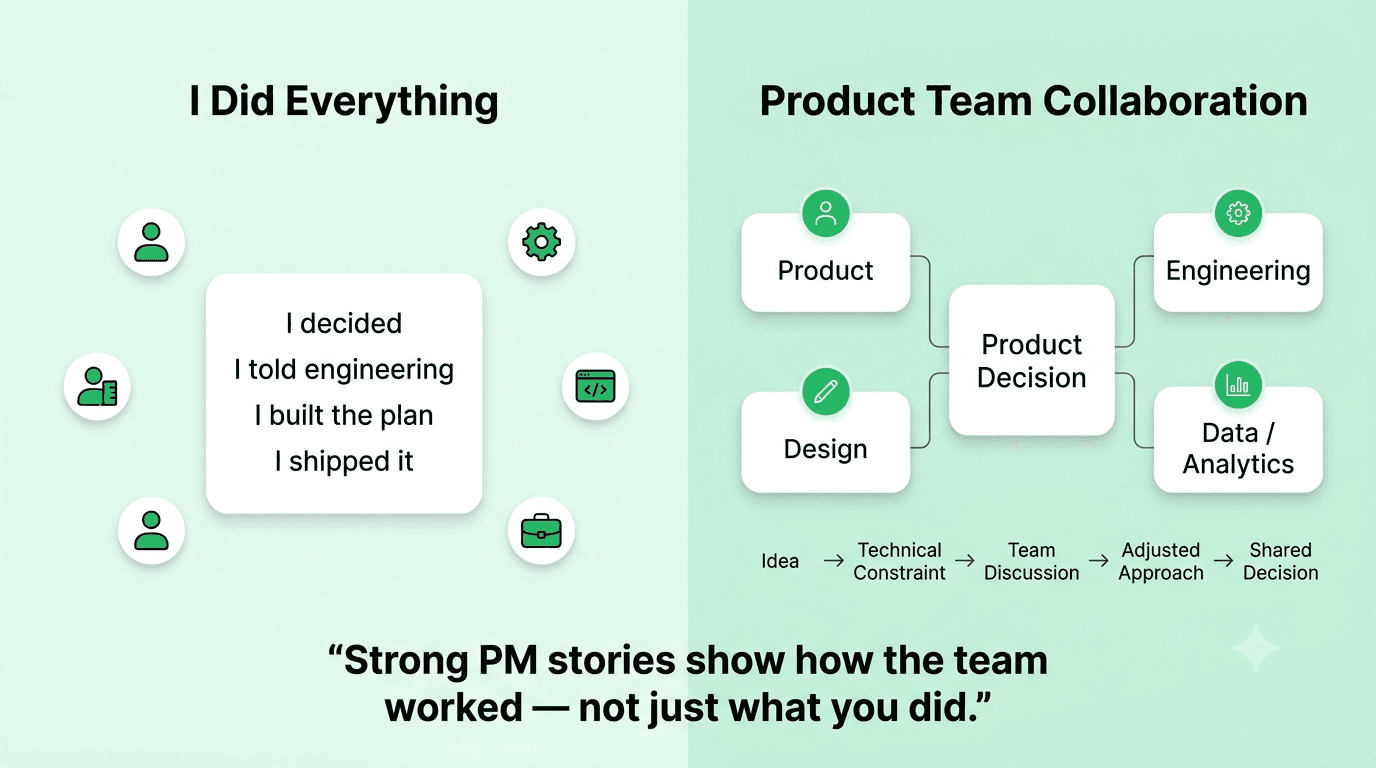
Every sentence starts with "I decided," "I built," "I told engineering to." No mention of designers, engineers, data analysts, or other stakeholders, as if the candidate worked entirely alone.
Why this hurts you
Product managers do not build anything themselves. They work through other people. An answer that never mentions collaboration makes an interviewer wonder if you actually understand how the work got done, or worse, if you are the kind of PM who dictates instead of partners with the team. This is especially damaging in behavioral rounds where the interviewer is specifically checking how you work with others.
The real fix
Rebuild your stories so they show the real process. Instead of "I decided we should build X," say something like "I brought the idea to the team, our lead engineer flagged a technical constraint we had not considered, so we adjusted the approach together before committing to a plan." This is not weaker. It actually makes you look more capable, because real product work is full of exactly this kind of back and forth.
A simple trick: after writing any story, count how many times you mention another person or team by name or role. If the answer is zero, rewrite it.
Mistake 4: Prioritization answers that are just a list with no reasoning
What this looks like
Asked how they would prioritize a set of features, the candidate rattles off an order, like "I would do A first, then B, then C," with no explanation of why.
Why this hurts you
The order itself rarely matters much to the interviewer. What they actually want to see is your reasoning process, because that is what you will use on the job when priorities are unclear and stakeholders disagree. An answer with no reasoning gives them nothing to evaluate except a guess.
The real fix
Use a clear framework and say it out loud as you use it. A simple one is effort versus impact. For each item, estimate roughly how much value it creates and roughly how much work it takes, then explain your ordering based on that comparison. If there are real constraints, like a hard deadline or a dependency between two features, name those explicitly too. For example, "B has to happen before C because C depends on the data B produces, so even though C has higher impact, B has to come first."
If you do not know a common framework yet, learn two or three well, such as effort versus impact, RICE, or a simple cost of delay approach, and practice applying one out loud to five different scenarios until the reasoning becomes natural instead of memorized.

FREE TO USE
8k+ SESSIONS92% FLUENCY4.9★ RATING
Speak With Confidence
Real Conversations. Real Scenarios. Speak until it feels natural.
- Real-Time Speaking Practice
- Guided Conversation Flows
- Instant AI Feedback
Mistake 5: Estimation questions where the process gets lost
What this looks like
Asked something like "how many coffee shops are there in your city," the candidate gives an answer with almost no visible math, or gets so lost in the calculation that they forget to actually answer the question.
Why this hurts you
These questions are not really about the final number. They are testing whether you can break a big fuzzy problem into smaller, reasonable pieces, and whether you can think clearly under a bit of pressure. A silent or disorganized answer gives the interviewer nothing to judge except a random guess.
The real fix
Break the estimate into clear steps and say each one out loud. For the coffee shop example, you might start with the city's population, estimate how many people visit a coffee shop regularly, guess how many customers a typical shop serves in a day, and divide from there. The actual number matters far less than showing a logical chain that someone else could follow and challenge.
Practice three or four classic estimation questions on your own with a timer, writing your steps down as you go, until you can do the whole thing in under three minutes without freezing.
Mistake 6: Metrics answers that repeat the same generic set every time
What this looks like
Every single metrics question gets the same three answers. Daily active users, retention, and revenue. Even when the product in the question is something like a hospital scheduling tool where those three metrics barely apply.
Why this hurts you
This tells the interviewer you have memorized a list rather than actually thought about the specific product in front of you. Good product thinking means picking metrics that fit the actual goal and actual users of that specific product, not applying the same template everywhere.
The real fix
Before naming any metric, first state what success actually means for this particular product and this particular question. Ask yourself what the product is trying to achieve for the user and for the business, and only then pick metrics that reflect that. For the hospital scheduling tool, a much stronger answer would involve things like reduction in missed appointments, average time to book an appointment, or how many appointments get rescheduled versus cancelled, because those actually reflect whether the tool is doing its job.
A good habit is to always separate your metrics into a primary success metric and a couple of guardrail metrics that make sure you are not accidentally causing harm somewhere else, like a scheduling tool that books more appointments but increases no shows.
Mistake 7: Talking about a past product failure with no real reflection
What this looks like
Asked about a project that did not go well, the candidate either avoids the question by picking a fake failure that is actually a disguised success, or describes a real failure but blames external factors the whole time, like the market, another team, or bad timing.
Why this hurts you
Interviewers ask this question specifically to see how you handle failure and what you learn from it. A fake failure story is usually easy to spot and comes across as dishonest. A real failure told with only blame shows a lack of self awareness, which is a serious concern for a role that requires taking ownership of outcomes.
The real fix
Pick a real failure, one where you genuinely made a decision that did not work out. Explain what you decided, why it seemed reasonable at the time, what actually happened, and most importantly, what you would do differently now. The learning part is the part interviewers care about most, so do not rush past it. A strong closing line sounds something like, "since then, I always do a small test with a limited group before rolling something out fully, because that project taught me how expensive it is to find out too late."
Prepare this story in advance and practice saying it without sounding defensive. If you notice yourself explaining why it was not really your fault, that is a sign the story needs more honest reflection before your interview.
Mistake 8: Saying yes to every stakeholder request in role play or behavioral answers
What this looks like
In a scenario where a stakeholder is pushing hard for a feature, or in a story about a real disagreement, the candidate describes simply agreeing to avoid conflict, with no pushback, no questions, and no attempt to find a better path.
Why this hurts you
Part of the PM job is saying no, or at least saying not now, in a way that keeps the relationship healthy. An answer where you just agree to keep the peace suggests you might struggle to protect the team's time and focus once you are actually in the role, which leads to messy roadmaps and burned out engineers.
The real fix
Prepare a real story where you pushed back on a request, respectfully, and explain how you did it. A good structure is to acknowledge the request, explain the tradeoff clearly, and offer an alternative. For example, "I understood why the request mattered to them, but agreeing would have delayed two other commitments, so I proposed a smaller version we could ship in two weeks instead of the full version in two months, and they were on board with that." This shows you can handle disagreement without becoming difficult to work with.
If you genuinely have never pushed back on anything, use this as a signal to practice it in a small way in your current job before your next interview, so you have a real story rather than a hypothetical one.
Mistake 9: Not asking any questions about how the interviewer's own team actually works
What this looks like
At the end of the interview, when asked "do you have any questions for me," the candidate asks something generic like "what is the company culture like," or worse, says they have no questions at all.
Why this hurts you
This is one of the last things the interviewer remembers about you, and a lack of specific curiosity about the actual team and actual work suggests you have not thought carefully about whether this role is really a fit, or that you are applying broadly without much genuine interest.
The real fix
Prepare a small set of specific questions ahead of time, tailored to who you are talking to. For a hiring manager, you might ask what the biggest challenge the team is facing this quarter is, or how they decide what gets prioritized when there is disagreement. For someone from engineering or design, you might ask what it is actually like working with the product team day to day. These questions do two things at once. They make a strong final impression, and they genuinely help you figure out if this is a team you want to join.
Mistake 10: Over rehearsed answers that sound like a script
What this looks like
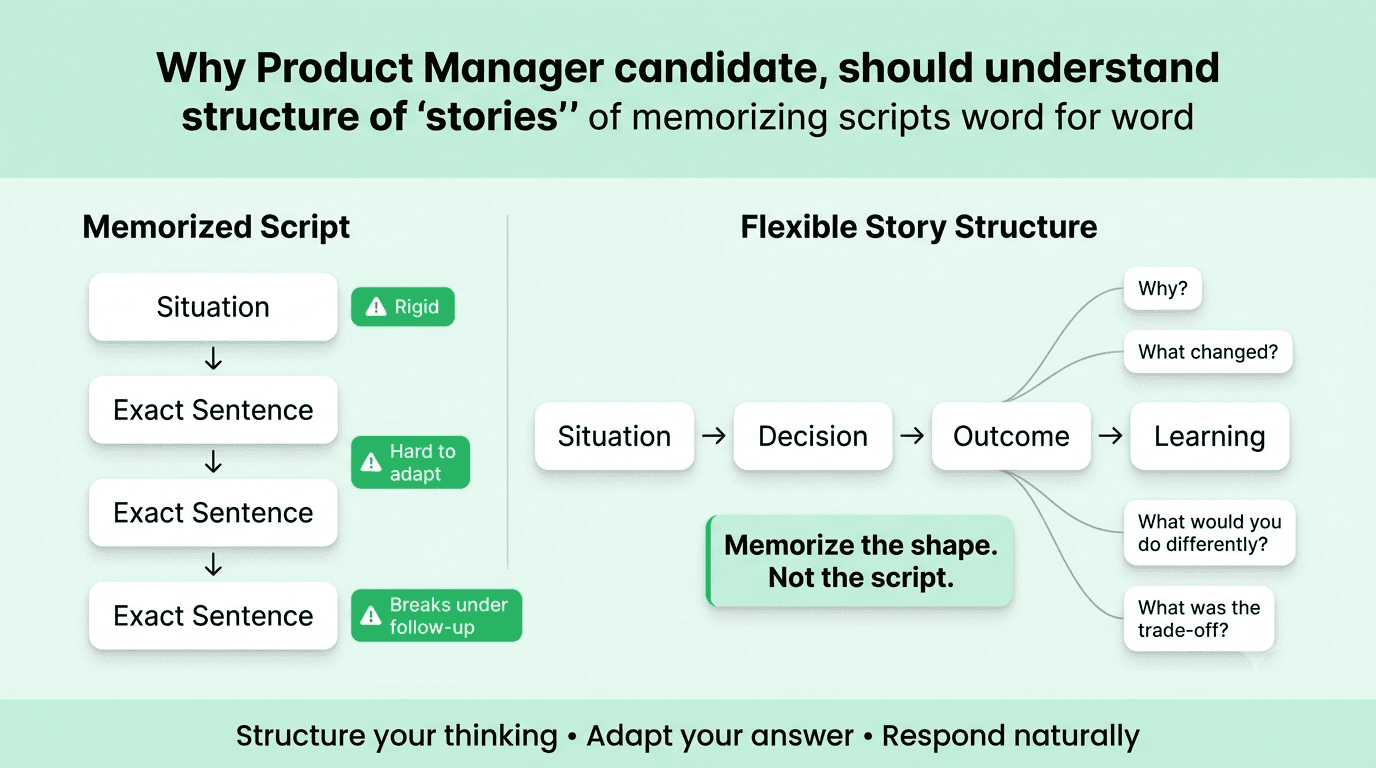
The candidate has clearly memorized a perfect version of each story and recites it in a flat, practiced way, with no natural pauses, no reaction to follow up questions, and very little flexibility when the interviewer asks something slightly different than expected.
Why this hurts you
Interviewers can tell when an answer is memorized word for word, and it makes it hard to trust that the story is fully genuine. It also creates a problem when they ask a follow up question that does not fit the script, because the candidate often struggles to respond naturally once they are off the memorized path.
The real fix
Instead of memorizing exact sentences, memorize the shape of each story, meaning the key points in order. What was the situation, what did you decide, what happened, what did you learn. Practice telling it a few different ways out loud so you get comfortable with the content rather than the exact wording. This way, if an interviewer interrupts with a question in the middle, you can answer naturally and come back to the rest of the story without losing your place.
A good test is to tell the same story to two different friends on two different days and see if it comes out a little differently each time while still hitting the same key points. If it does, you are in good shape.
Mistake 11: Not tailoring answers to the specific company or product
What this looks like
The candidate gives the same generic examples and the same generic product opinions in every interview, regardless of whether they are talking to a fintech company, a healthcare startup, or a consumer social app.
Why this hurts you
This signals that you have not actually spent time thinking about their specific product, their specific users, or their specific business model. In a competitive market, interviewers notice the difference between a candidate who clearly understands their product and one who is giving the same pitch everywhere.
The real fix
Before every interview, spend real time using the company's actual product if you can, reading recent updates or blog posts about it, and forming a genuine opinion about what is working well and what could be better. Bring at least one specific, thoughtful observation into the conversation, something like "I noticed your checkout flow asks for account creation before showing the price, which might be causing drop off, have you looked at that." This kind of comment shows real engagement rather than generic preparation.
Mistake 12: Treating technical questions as something to avoid instead of engage with
What this looks like
When a technical topic comes up, like how an API works or what a database migration involves, the candidate either bluffs with confident sounding nonsense, or shuts down and says "I am not technical, I leave that to engineering."
Why this hurts you
You do not need to code, but you do need to understand enough to have a real conversation with engineers and make reasonable tradeoffs. Bluffing is risky because a technical interviewer will usually catch it fast, and it damages trust. Completely avoiding the topic suggests you might struggle to work closely with engineering, which is a core part of the job.
The real fix
When you do not know something technical, say so honestly, then ask a real question to learn more, the same way you would with a business question you did not know the answer to. Something like, "I am not fully sure how that caching layer works, can you walk me through it, I want to understand the tradeoff you are describing." This shows curiosity and honesty at the same time, which reads much better than a guess. Outside of interviews, spend time actually learning the basics of how software gets built, things like what an API is, what a database migration involves, and roughly how a mobile app talks to a server, so you have a real foundation rather than nothing at all.
A quick way to check yourself before your next interview
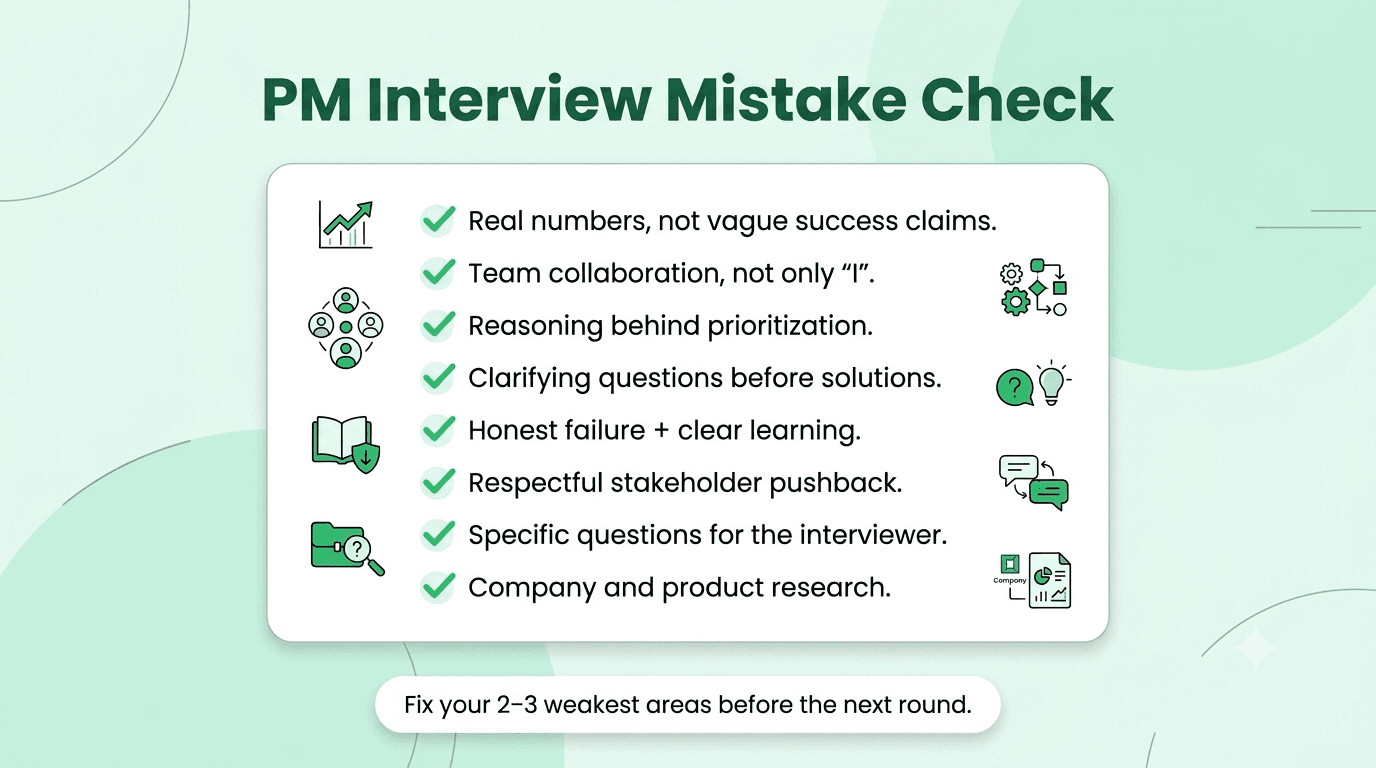
Go through this list honestly before you walk into your next interview.
Do your stories include real numbers, not just vague claims of success. Do your stories mention other people and how you worked with them, not just what you personally did. Can you explain your reasoning out loud for any prioritization decision, not just state an order. Do you ask clarifying questions before jumping into solutions. Do you have one real, honest failure story ready, with a clear lesson at the end. Do you have a real example of pushing back on a stakeholder respectfully. Have you prepared specific questions for the interviewer about their actual team. Have you researched the specific company and formed a real opinion about their product. Can you talk about technical topics honestly, asking questions instead of bluffing or avoiding them.
If several of these are still weak, that is completely normal. The goal is not to be perfect everywhere. The goal is to notice which of these mistakes you are actually making, and fix the two or three that matter most before your next round of interviews.
FAQs
More Blogs


Oct 22, 2026
UI/UX Designer Interview Preparation Guide: A Complete Roadmap for 2026
38 min read

