Loading...
Contents
Common Python Developer Interview Mistakes to Avoid in 2026
Aug 13, 202644 min readUpdated Sep 27, 2026
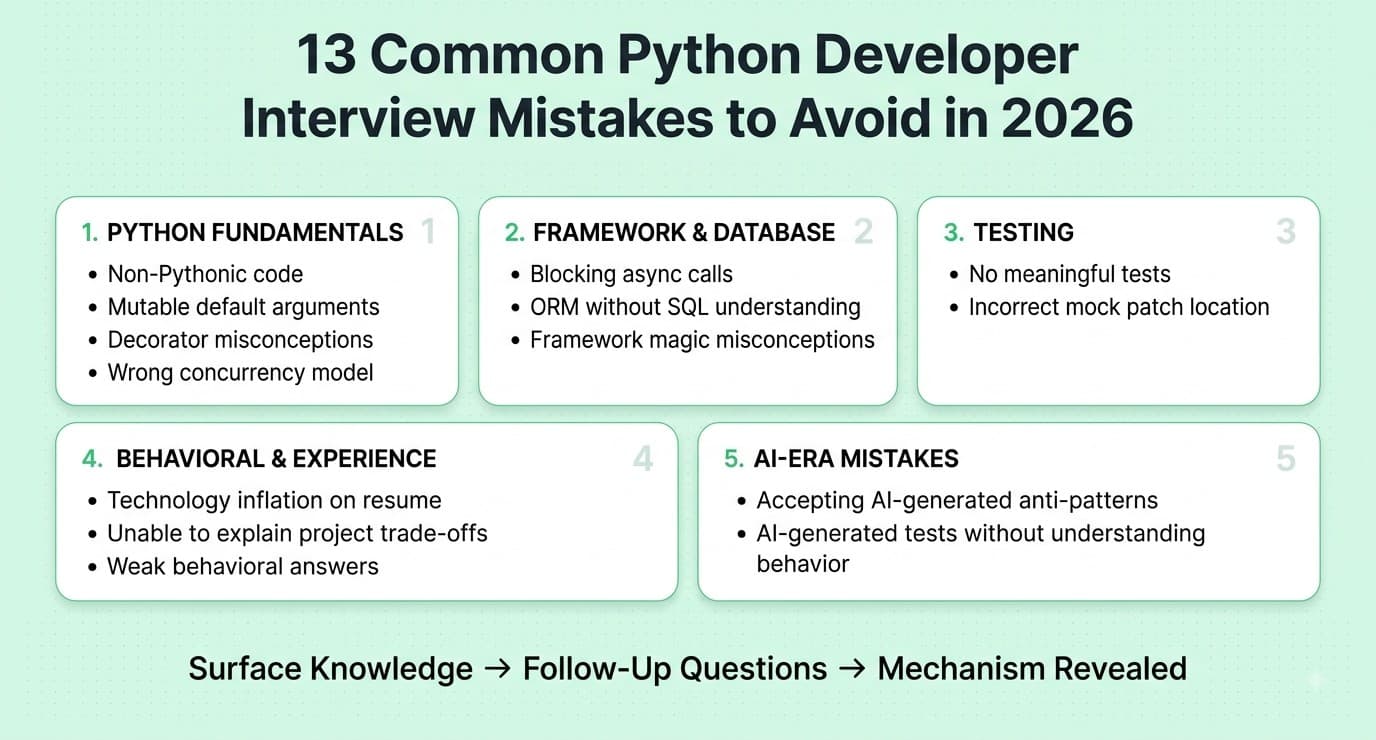
The most common Python developer interview mistakes in 2026 are writing working code that reveals non-Pythonic thinking without being able to explain why a better approach exists, knowing the name of a Python gotcha like mutable defaults without understanding the mechanism behind it, choosing the wrong concurrency model for a given problem, submitting take-home assignments with no real test coverage, patching an external dependency in the wrong location during a live round, and failing to catch Python-specific anti-patterns in AI-generated code. Every mistake below has a specific, rehearsable fix built around the actual mechanism that causes the failure, not a vague suggestion to study more.
Python interviews have a problem that no other language interview quite shares: the language is easy enough to write at a surface level that candidates with genuinely shallow knowledge can produce working code that looks reasonable to a casual glance, but falls apart the moment an interviewer asks a single layer deeper. A candidate who memorized that mutable default arguments are dangerous can write a warning comment above them in their code. They cannot explain why it happens, which is the question every experienced Python interviewer asks immediately after seeing the comment.
This guide covers the mistakes that specifically trip up Python developer candidates in 2026, not generic developer mistakes reworded for Python. Each one is named precisely, its real cost explained, and the fix is specific enough to practice before your next interview. The final category covers mistakes that most current prep guides have not addressed: the mistakes that only exist because AI coding tools are now part of the interview environment.
FREE TO USE
25K+ INTERVIEWS4.8★ RATING68% IMPROVEMENT
Crack Your Dream Job
Real Interviews. Real Pressure. Practice until it feels easy.
- Seamless Interview Experience
- Resume & JD Questions
- Instant Personalized Feedback
Why Python Developer Interviews Catch More Candidates Off Guard Than They Expect
Python's permissiveness is the reason. The language lets you write working code using patterns learned from JavaScript, Java, or tutorials without ever confronting the language's actual model. Interviews expose this because experienced Python interviewers know exactly which questions reveal surface knowledge from genuine depth, and they ask them within the first five minutes.
Python is the language where the distance between "I know how to write it" and "I understand what it does" is largest. A Java developer who does not understand generics will write code that fails to compile. A Python developer who does not understand generators, the GIL, or late-binding closures will write code that runs, produces output, and is quietly wrong or inefficient in ways that only appear under real conditions. Interviewers have refined their question sets around exactly these failure modes. Every mistake below is a reflection of that pattern.
Read More: How to prepare for python developer interview in 2026
Category 1: Python Language Fundamentals Mistakes
Mistake 1: Writing Working Python That Reveals Non-Pythonic Thinking Without Being Able to Justify It
What This Looks Like
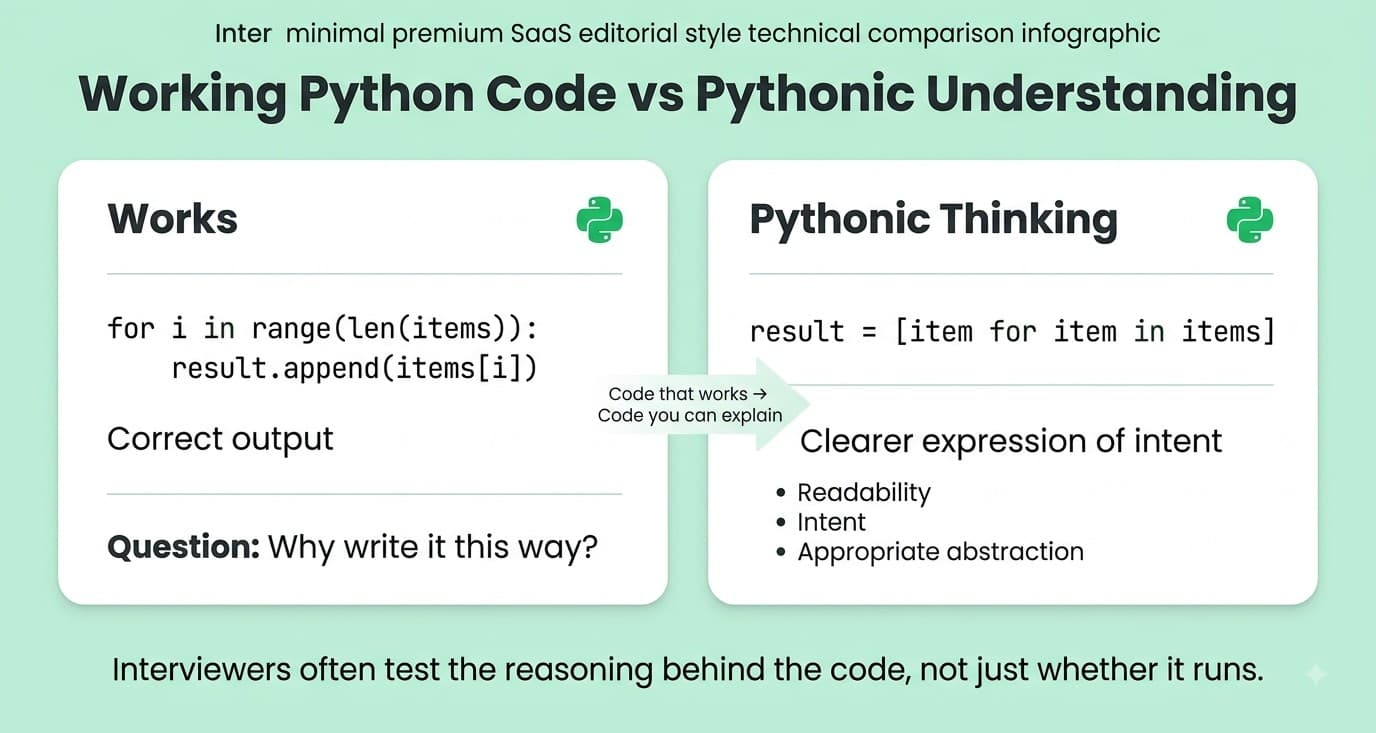
A candidate writes a loop that iterates over a list using range and an index variable to access elements, builds a result list by calling append inside a for loop instead of using a list comprehension, or implements a simple accumulator pattern that a generator expression would handle more cleanly. The code produces the correct output. When the interviewer asks "is there a more Pythonic way to write this," the candidate either does not know what that means in this specific case, or agrees there might be but cannot articulate what it would look like or why it would be better.
Why Recruiters Flag This
Pythonic code is not a style preference. It reflects how the language is designed to be used, and code written against Python's idioms is harder to maintain, often less performant, and signals to every future reader that the original author did not really know the language they were working in. A Python developer who writes Java-style Python is going to produce a codebase that confuses other Python developers and misses the performance and readability benefits the language provides.
The Real Cost
This mistake does not just cost an interview point. On the job, non-Pythonic code patterns accumulate into a codebase that is genuinely harder to work with, and the developer who wrote them often cannot explain why their code is slow or hard to read when a senior reviewer identifies the problem.
The Complete Fix
Build a personal checklist of the five most common Pythonic rewrites and practice reaching for them automatically, before an interviewer has to prompt you. Whenever you are about to write a for loop that appends to a list, ask yourself first whether a list comprehension, a generator expression, or a call to map or filter expresses the intent more directly. Whenever you write range over a sequence just to access elements by index, ask yourself whether enumerate would be clearer. Whenever you open a file or a connection, ask yourself whether a context manager is available.
The deeper fix is being able to explain not just what the Pythonic version is, but specifically why it is better for this case: whether the reason is memory efficiency, readability, or expressing the intent in fewer moving parts. An interviewer who hears you say "I would use a generator expression here instead of building a list because the caller only needs to iterate once, so there is no reason to materialize the full list in memory" is evaluating a candidate who thinks about Python's resource model. One who hears "I would use a list comprehension because it's more Pythonic" is evaluating a candidate who has memorized a style preference.
Practice Method
Take any function you have written in the past month using imperative loops and rewrite it using only built-in Python tools: comprehensions, generators, map, filter, zip, and enumerate. For each rewrite, write one sentence explaining the specific reason the new version is better for this particular case, not just that it is more Pythonic in general.
Mistake 2: Knowing the Mutable Default Argument Gotcha by Name But Not by Mechanism
What This Looks Like
A candidate is shown a function with a mutable default argument, a list or a dict, and correctly identifies it as a problem. When the interviewer follows up with "why does this happen exactly, and what is Python actually doing," the candidate gives a vague answer like "Python reuses the same object" without being able to explain the specific mechanism: that default argument values are evaluated exactly once, when the function definition is executed, and stored as attributes of the function object itself.
Why Recruiters Flag This
This question is used specifically to separate candidates who have read a Python gotchas list from candidates who understand Python's object model. Knowing that something is dangerous is not the same as understanding why, and the why is what lets you catch the same root cause expressed differently, such as a mutable class attribute being shared across all instances, which is the exact same mechanism expressed at the class level.
The Real Cost
A developer who knows the pattern but not the mechanism will catch the exact case they have been warned about and miss every variation. They will define a mutable class-level default and be confused when changes to one instance's attribute appear on another instance. They will not recognize the pattern in code review when it is expressed slightly differently.
The Complete Fix
Memorize the exact mechanism in one sentence, then connect it to every place the same mechanism appears in Python. The sentence is: default argument values are evaluated once when the function definition is executed and stored as the function object's _defaults_ attribute, meaning every call to the function shares the same object unless the caller passes a new one. You can verify this in a Python shell by calling _defaults_ on any function with a default argument and seeing the exact object stored there.
Then extend this understanding to class-level attributes: a mutable object defined as a class attribute is shared across all instances for the same reason, because it is evaluated once when the class definition is executed. Once you understand the mechanism, both patterns are the same problem in different syntax.
The fix for the function case is the None sentinel pattern: default to None and assign the mutable inside the function body on each call. Be ready to explain that this works because None is immutable and the assignment inside the function body creates a fresh object on each invocation, rather than modifying the shared default.
Practice Method
Open a Python shell and inspect the _defaults_ attribute of a function with a mutable default argument. Append a value to the default list by calling the function without arguments, then inspect _defaults_ again and observe that the same list now contains the appended value. Then write the None sentinel version and explain out loud why it does not have the same problem. Doing this live, not just reading about it, builds the mechanical understanding that survives a follow-up question.
Mistake 3: Claiming Decorator Fluency Without Being Able to Explain What a Decorator Does to the Function Object
What This Looks Like
A candidate lists decorators on their resume or mentions using them in a past project. The interviewer asks them to write a simple decorator from scratch without using functools.wraps, and the candidate produces something that works for the basic case but loses the original function's name and docstring. When asked why, they cannot explain that the decorator replaced the original function object with the wrapper function object, which has different attributes.
Why Recruiters Flag This
Decorators are one of the clearest signals of genuine Python depth versus tutorial-level exposure, because they require understanding that functions are first-class objects, that a decorator is simply a function that takes a function and returns a function, and that the replacement of the original function object has observable consequences including the loss of metadata. Candidates who have only used decorators without understanding what they do cannot write their own, cannot debug unexpected decorator behavior, and cannot reason about stacked decorators in the right order.
The Real Cost
In real codebases, custom decorators are used for authentication, rate limiting, caching, logging, and retry logic. A developer who cannot write or reason about decorators is dependent on library decorators they do not fully understand and cannot extend or debug when they behave unexpectedly.
The Complete Fix
Practice writing three types of decorators from scratch without any library help: a basic decorator that wraps a function, a decorator that accepts arguments, and a decorator that preserves the original function's metadata using functools.wraps. For each one, explain out loud what is happening at the object level: the decorator is called with the function object, returns a new function object, and that new object replaces the original name in the enclosing scope.
Then practice explaining why functools.wraps exists: it copies the _name_, _doc_, and _wrapped_ attributes from the original function to the wrapper, so that debugging tools, documentation generators, and introspection code see the original function's identity rather than the wrapper's. Being able to explain this clearly, without checking documentation, is the signal interviewers are looking for.
Practice Method
Write a decorator that logs the execution time of any function it wraps. Then write it again so it accepts a log level as an argument. Then verify that the wrapped function's _name_ attribute shows the original function name, not "wrapper," with and without functools.wraps, and explain the difference. Record yourself explaining what the decorator does at the object level in under sixty seconds.
Mistake 4: Choosing the Wrong Concurrency Model for the Problem Described
What This Looks Like
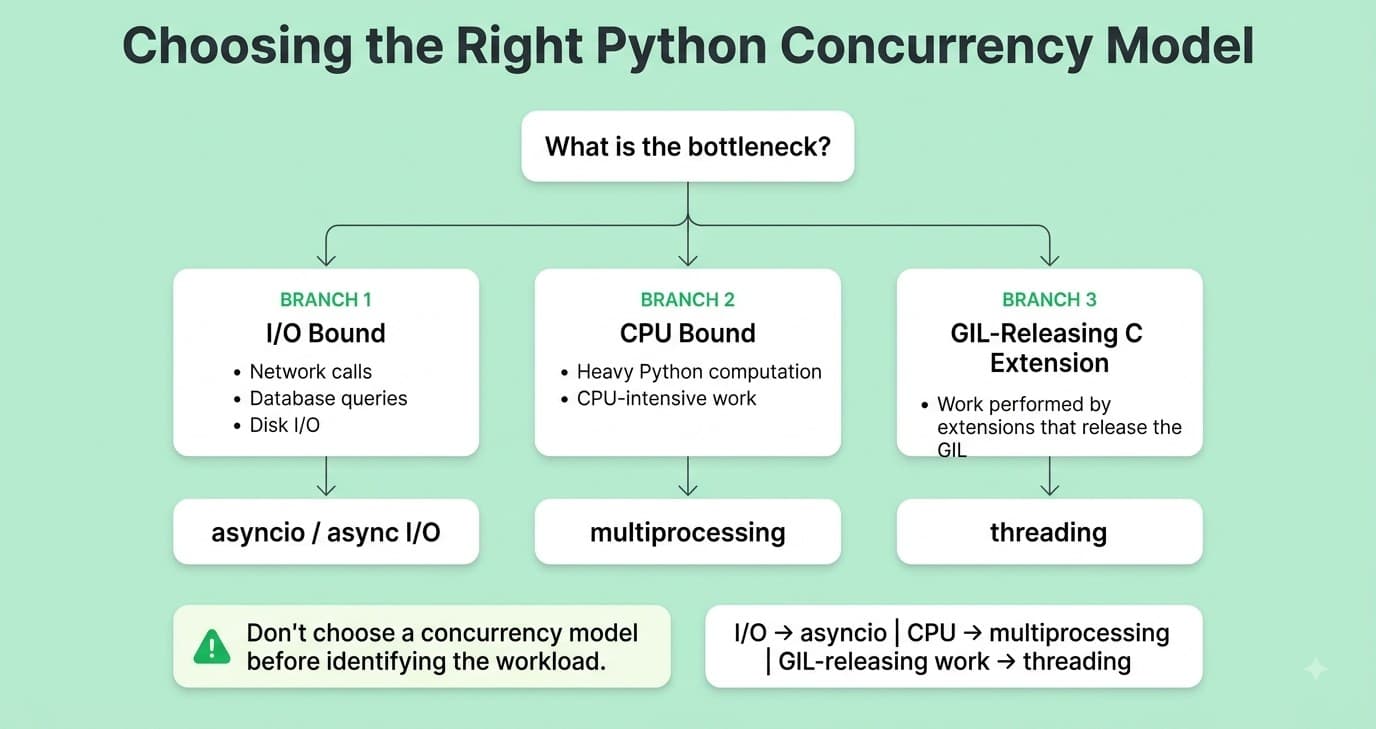
A candidate is asked how they would speed up a Python script that makes one hundred sequential API calls. They propose threading, or multiprocessing, when asyncio with async HTTP calls is the correct answer for I/O-bound work. Or they propose asyncio for a task that involves CPU-heavy data processing, where multiprocessing is the correct answer because the GIL prevents true parallelism for CPU-bound work in threads or coroutines.
Why Recruiters Flag This
This question tests whether a candidate understands the three fundamentally different concurrency models Python offers, why each exists, and the specific limitation of the GIL that makes the choice between them non-trivial. Giving the wrong answer reveals either that the candidate does not understand the GIL at all, or that they do not understand the difference between I/O-bound and CPU-bound work.
The Real Cost
Choosing threading for CPU-bound work produces code that is more complex and no faster than single-threaded code, sometimes slower due to thread management overhead. Choosing multiprocessing for I/O-bound work is unnecessarily heavy, uses more memory per process, and adds serialization overhead that asyncio avoids entirely.
The Complete Fix
Internalize a three-part decision framework and practice applying it to specific scenarios until it is automatic. First: is the bottleneck I/O, meaning the code spends most of its time waiting for network responses, disk reads, or database queries? If yes, asyncio with async I/O is the most efficient model. Second: is the bottleneck CPU, meaning the code spends most of its time doing computation in pure Python? If yes, multiprocessing is the correct model, because it bypasses the GIL by using separate processes with separate memory spaces. Third: is the task a mix, or does it involve calling a C extension library that releases the GIL during computation, like NumPy? This is where threading can be appropriate, because C extensions that release the GIL do allow true parallelism within threads.
Practice applying this framework to five or six different scenarios, saying the decision out loud each time with the specific reason. The specific reason is the part most candidates skip, and it is the part interviewers are evaluating.
Practice Method
Write three small scripts: one that makes ten async HTTP calls concurrently using asyncio and aiohttp, one that processes a large numerical computation using multiprocessing.Pool, and one that calls a GIL-releasing NumPy operation in multiple threads. Time each one with and without concurrency. The visceral experience of seeing the speedup appear only in the right scenario is more educational than any explanation.
Category 2: Framework and Database Mistakes
Mistake 5: Claiming ORM Expertise While Being Unable to Explain the SQL It Generates
What This Looks Like
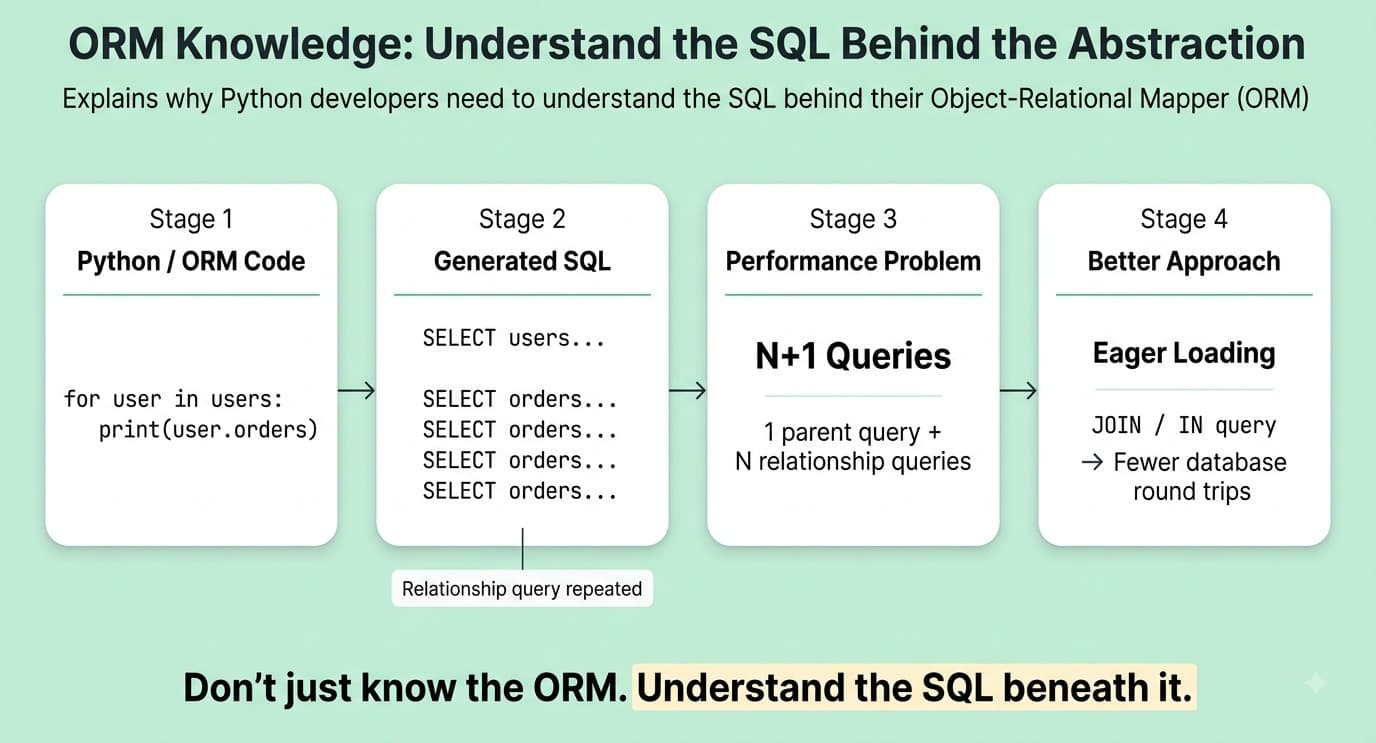
A candidate mentions SQLAlchemy or Django's ORM extensively in their resume or in their description of past work. The interviewer asks them to explain what SQL gets executed when you access a relationship attribute on a model that was loaded without an explicit loading strategy. The candidate cannot explain lazy loading, cannot describe the N+1 problem at the query level, and has no clear picture of what is actually happening in the database when their ORM code runs.
Why Recruiters Flag This
The ORM abstraction is valuable precisely because it hides complexity, but a developer who cannot see through the abstraction cannot debug performance problems, cannot identify when an innocent-looking loop is generating hundreds of database queries, and cannot explain to a database administrator why a particular operation is slow. Claiming ORM expertise while only knowing how to write ORM code without understanding the SQL beneath it is one of the most common forms of resume inflation in Python developer interviews.
The Real Cost
A developer without ORM transparency will ship the N+1 query pattern repeatedly, often without anyone noticing until a feature starts affecting database performance at real scale. By the time the problem is identified, the ORM code that caused it is often woven through multiple parts of the codebase, making it expensive to fix.
The Complete Fix
Enable SQLAlchemy's echo mode or Django's query logging on a project you have already built and read every query that gets generated for your three most-used endpoints. For each query, understand specifically why it was generated: what ORM operation triggered it and what loading strategy was in effect. Then identify the most expensive pattern you find, typically a relationship accessed inside a loop, and fix it with an appropriate eager loading strategy.
Practice explaining the N+1 problem at the SQL level, not just the ORM level. The SQL-level explanation is: one query fetches the parent records, then for each parent record a separate query fetches the related records, so the total number of queries is one plus the number of parents returned by the first query. Then explain the fix at the SQL level: joinedload rewrites the query to use a JOIN, returning all the data in one roundtrip, and selectinload issues a second query using an IN clause to fetch all related records at once for the full set of parents. These SQL-level explanations are what interviewers expect from a candidate claiming ORM expertise.
Practice Method
Take any project that uses an ORM and spend one session with query logging enabled, reading every SQL statement generated by your five most-used code paths. Write down the three that surprised you most and explain in writing what ORM behavior caused them and how you would fix them.
Mistake 6: Blocking the Event Loop With a Synchronous Call Inside an Async Endpoint
What This Looks Like
A candidate writes a FastAPI endpoint using async def but inside it calls a synchronous database driver, a synchronous HTTP library, or a blocking file operation directly, without wrapping it in run_in_executor or replacing it with an async equivalent. The endpoint looks async from the outside and behaves identically to a synchronous one in testing, because the blocking call prevents any other coroutine from running while it waits.
Why Recruiters Flag This
This is the most dangerous Python async mistake because it is completely invisible until the application is under real concurrency pressure. An endpoint that blocks the event loop will handle one request at a time regardless of how many concurrent connections the server accepts, exactly negating the benefit of using async in the first place, and without producing any error or warning that anything is wrong.
The Real Cost
A FastAPI application with a blocking database call in an async endpoint under concurrent load will perform identically to a synchronous application, but with the added complexity and overhead of asyncio. Developers who do not understand this will spend weeks debugging "why is our async API still slow under load" before finding the blocking call.
The Complete Fix
Internalize a single rule: inside an async def function, you may only call other async functions using await, or synchronous functions that are guaranteed to be non-blocking. Any synchronous function that does I/O must either be replaced with an async equivalent, such as asyncpg instead of psycopg2, or wrapped in asyncio.get_event_loop().run_in_executor so the blocking call runs in a thread pool and does not hold the event loop.
Practice identifying blocking calls by asking a specific question about every function call inside an async context: does this function do any I/O, and if so, does it use async I/O internally? If the answer to the first part is yes and the second part is no, it is a blocking call in an async context and needs to be addressed.
In an interview, if you write an async endpoint, proactively mention the I/O dependencies it has and how you are ensuring each one is genuinely non-blocking. This narration demonstrates the awareness that distinguishes a candidate who understands async Python from one who knows the syntax.
Practice Method
Write a FastAPI application with two endpoints: one that uses a genuinely async database call and one that uses a synchronous blocking call inside an async def. Use a load testing tool to send ten concurrent requests to each endpoint and observe the difference in throughput. The contrast between them is the most effective way to permanently understand why blocking an async event loop matters.
Mistake 7: Relying on Framework Magic Without Understanding the Layer Beneath
What This Looks Like
A candidate demonstrates comfort with a framework's high-level features, such as Django's authentication middleware, FastAPI's dependency injection, or SQLAlchemy's session management, but cannot explain what actually happens when those features are invoked. They cannot explain what FastAPI's dependency injection resolver does between receiving a request and calling the route function. They cannot explain what a Django middleware is actually doing at the request/response cycle level. They cannot explain what SQLAlchemy's session tracks and why you must close it.
Why Recruiters Flag This
Framework magic that is not understood becomes a source of mysterious bugs. A developer who does not know what SQLAlchemy's session is tracking will not understand why a stale object appears in one request after being modified in another. A developer who does not know what Django's authentication middleware does will not be able to extend it or debug unexpected authentication behavior.
The Real Cost
Every production system eventually encounters behavior the framework did not anticipate, and that moment requires a developer who can reason about what the framework is actually doing rather than assuming the magic will handle it.
The Complete Fix
For each major framework feature you claim to know, practice explaining it in terms of what it does to the request, the response, or the data structure, without using the framework's own marketing language. For FastAPI dependency injection: the framework inspects the route function's type annotations, identifies parameters typed as Depends, calls each dependency callable before the route function, and passes the results as arguments. For SQLAlchemy sessions: the session is an identity map and unit of work that tracks all objects loaded in its scope, buffers changes, and flushes them to the database on commit. Closing the session releases the database connection and clears the identity map, which is why objects accessed after the session closes raise a DetachedInstanceError.
Practice giving the mechanism explanation for three framework features you use most often, without referencing the framework's documentation or high-level descriptions.
Practice Method
Pick one framework feature you use daily and read its source code, just the first few levels, not exhaustively, until you can describe what it does in plain terms that do not use the feature's own name. This exercise, done even once for each major feature, fundamentally changes how you reason about unexpected behavior.
Category 3: Testing Mistakes
Mistake 8: Submitting a Take-Home With No Tests, or Tests That Only Check the Happy Path
What This Looks Like
A candidate submits a take-home assignment where the core functionality works correctly, but there is no test file at all, or there is a test file that contains one test that calls the main function with valid input and asserts the expected output. The error paths, the edge cases, the behavior when an external dependency is unavailable, are all untested.
Why Recruiters Flag This
Take-home assignments are specifically designed to reveal how a candidate works when they have adequate time and no one watching them. No tests under these conditions is not a time management problem, it is a professional standards problem. It tells the reviewer exactly what the codebase this developer produces at work looks like, and it removes any doubt about whether the candidate actually writes tests in their normal workflow.
The Real Cost
A developer who does not write tests in a take-home will not write them on the job either. The cost of this in a real codebase is not abstract: it is every bug that only gets found in production, every refactor that breaks a behavior no one knew to check, and every hour of debugging time that would have been a failing test.
The Complete Fix
Build a personal take-home checklist that requires tests before you consider any assignment complete, and structure your time allocation to protect test writing time rather than treating it as optional cleanup. A reasonable allocation for a take-home is roughly equal time between building the feature and writing tests for it. If you run out of time, submit with fewer features and more test coverage rather than more features and no coverage, because reviewers consistently evaluate test-disciplined candidates more highly than feature-complete but untested ones.
For every function you write in a take-home, write at minimum three test cases: the happy path with valid input, at least one error path where input is invalid or a dependency fails, and at least one edge case that is not immediately obvious. For functions that call external services, write a test that mocks the external call and asserts the correct behavior when it fails.
Document what you would test if you had more time. If a take-home's scope meant you could only write partial coverage, a comment in the test file or a README note saying "I would additionally test X and Y behaviors, specifically the case where the external service times out" demonstrates testing judgment even where time prevented full coverage.
Practice Method
Take a project you have already submitted or built that has incomplete test coverage. Write tests for the three most important error paths it is missing. Time how long this takes and use that data to calibrate how much time you should budget for testing in future take-homes.
Mistake 9: Patching an External Dependency in the Wrong Location
What This Looks Like
A candidate attempts to mock an external function or class in a test using unittest.mock.patch, but patches it at its definition location rather than where it is imported and used by the module under test. The test runs, the mock is applied, but the real function still gets called because the module under test already holds a reference to the original function object through its import statement.
Why Recruiters Flag This
This is one of the most specifically Python mistakes on this list, one that cannot be understood without knowing how Python's import system works at the module level. A candidate who patches in the wrong location and cannot explain why their mock did not work reveals a gap in understanding Python's name resolution model that affects their ability to write any non-trivial test involving external dependencies.
The Real Cost
A test that fails to mock correctly either runs the real external dependency, making the test non-deterministic and slow, or silently does not test what it appears to test. The latter is worse: a test suite full of mocks that did not actually intercept the target gives false confidence about coverage.
The Complete Fix
Memorize one rule and understand the reason behind it: patch the name as it is used in the module under test, not where it is defined. If the module under test contains the line "from requests import get" and then calls "get(...)", you must patch "mymodule.get," not "requests.get," because the module under test already bound the name "get" to the requests.get function object at import time. Patching requests.get after that import does not affect the name "get" inside mymodule, because mymodule holds its own reference to the original function object.
If the module under test contains "import requests" and then calls "requests.get(...)", patching "requests.get" works, because "requests" in the module refers to the requests module object, and patching requests.get replaces the attribute on that shared module object, which all code using requests.get will see.
Practice explaining this distinction using the terms "name binding" and "attribute access" rather than the abstract rule alone, because understanding the underlying model is what allows you to figure out the correct patch target in any new situation without guessing.
Practice Method
Write a small module that imports an external function in each of the two ways described above. Write tests for both using the correct patch target for each. Then deliberately patch in the wrong location for each and observe that the real function still gets called, using a side effect on the mock to verify. This exercise makes the name resolution model visceral rather than theoretical.
FREE TO USE
8k+ SESSIONS92% FLUENCY4.9★ RATING
Speak With Confidence
Real Conversations. Real Scenarios. Speak until it feels natural.
- Real-Time Speaking Practice
- Guided Conversation Flows
- Instant AI Feedback
Category 4: Behavioral and Mindset Mistakes
Mistake 10: Listing Technologies on the Resume That Cannot Survive Three Questions Deep
What This Looks Like
A candidate's resume lists Redis, Celery, Docker, and "machine learning" under skills or technologies. The interviewer picks any one of these and asks: what is it, when would you use it, and what is one specific thing that goes wrong if you configure it incorrectly. The candidate can answer the first question, gives a vague answer on the second, and has nothing for the third.
Why Recruiters Flag This
A Python developer resume listing is treated as a claim that the technology is something you can work with productively from day one. Three questions is the minimum depth any technology deserves on a professional resume. A candidate who cannot reach that third question on every listed technology is implicitly misrepresenting their experience, and interviewers use this to calibrate the trustworthiness of the entire resume.
The Real Cost
Resume inflation is a trust issue. When a candidate cannot support a specific claim on their resume, it raises doubt about every other claim, including the ones about technologies they actually do know well.
The Complete Fix
Apply the three-question test to every technology on your resume before submitting any application. The three questions are: what is this technology and what problem does it solve? When would you choose to use it versus a simpler alternative? What is one specific operational or configuration decision that matters and why? If you cannot answer all three questions for a technology, either remove it from the resume or qualify it clearly, for example "basic familiarity with Redis for session caching" instead of simply listing "Redis."
For Python-specific technologies that commonly appear on resumes without sufficient depth: Celery requires knowing what a task broker is, why tasks fail silently when a broker is misconfigured, and how to handle task retries safely. Redis requires knowing the difference between using it as a cache versus a persistent store and what happens when maxmemory is hit with different eviction policies. Docker requires knowing the difference between CMD and ENTRYPOINT and why a container that works locally fails in production because of environment variable differences.
Practice Method
Take your current resume and write out the three questions and your answers for every technology listed. Do this before your next interview. Any technology where you stumble on the third question needs either deeper research before the interview or removal from the resume.
Mistake 11: Presenting Python Project Experience Without Tradeoffs, Failures, or Specific Learnings
What This Looks Like
Asked to describe a Python project they are proud of, the candidate gives a summary of what the project does, what technologies were used, and that it was successfully completed. There is no mention of a decision that was harder than expected, a technical mistake that was caught and fixed, or anything they would approach differently with current knowledge.
Why Recruiters Flag This
Python projects have real tradeoffs. Choosing between synchronous and async architecture has tradeoffs. ORM versus raw SQL has tradeoffs. The decision to write a custom solution versus use a library has tradeoffs. A project narrative with no tradeoffs is either describing a project so simple it has no meaningful decisions, or describing a project through a filter that removes all evidence of the candidate's judgment and growth.
The Real Cost
Interviewers use this question to assess self-awareness, learning orientation, and whether a candidate can reflect critically on their own work. A story with no tension or growth tells them almost nothing useful, and a candidate who can only present successes is less predictable to manage than one who can articulate what they learned from a mistake.
The Complete Fix
For every project in your interview preparation, prepare a version of the story that explicitly includes three elements: a technical decision you made and the specific tradeoff it involved, something that did not go as planned and how you discovered it, and one thing you would change if you started the same project today with your current knowledge. These additions make the story useful to an interviewer without making you look incompetent, because they demonstrate the experience and self-awareness that only comes from having done real work.
A specific example structure for a Python project: "I chose to use SQLAlchemy's ORM rather than writing raw SQL because I wanted to iterate quickly on the schema, but I later discovered that the default lazy loading behavior was causing significant database load on our most common endpoint. I fixed it by profiling the query count with logging enabled and adding selectinload for the relationships accessed in that endpoint. If I started today, I would enable query logging from the beginning of the project rather than only when a performance problem appeared."
Practice Method
Write a one-paragraph "honest version" of every project currently on your resume, specifically including a mistake, a tradeoff, and a thing you would change. Do this before the interview, not during it, so the content is thoughtful rather than improvised.
Category 5: AI-Era Mistakes Most Guides Have Not Addressed
Mistake 12: Not Catching Python-Specific Anti-Patterns in AI-Generated Code
What This Looks Like
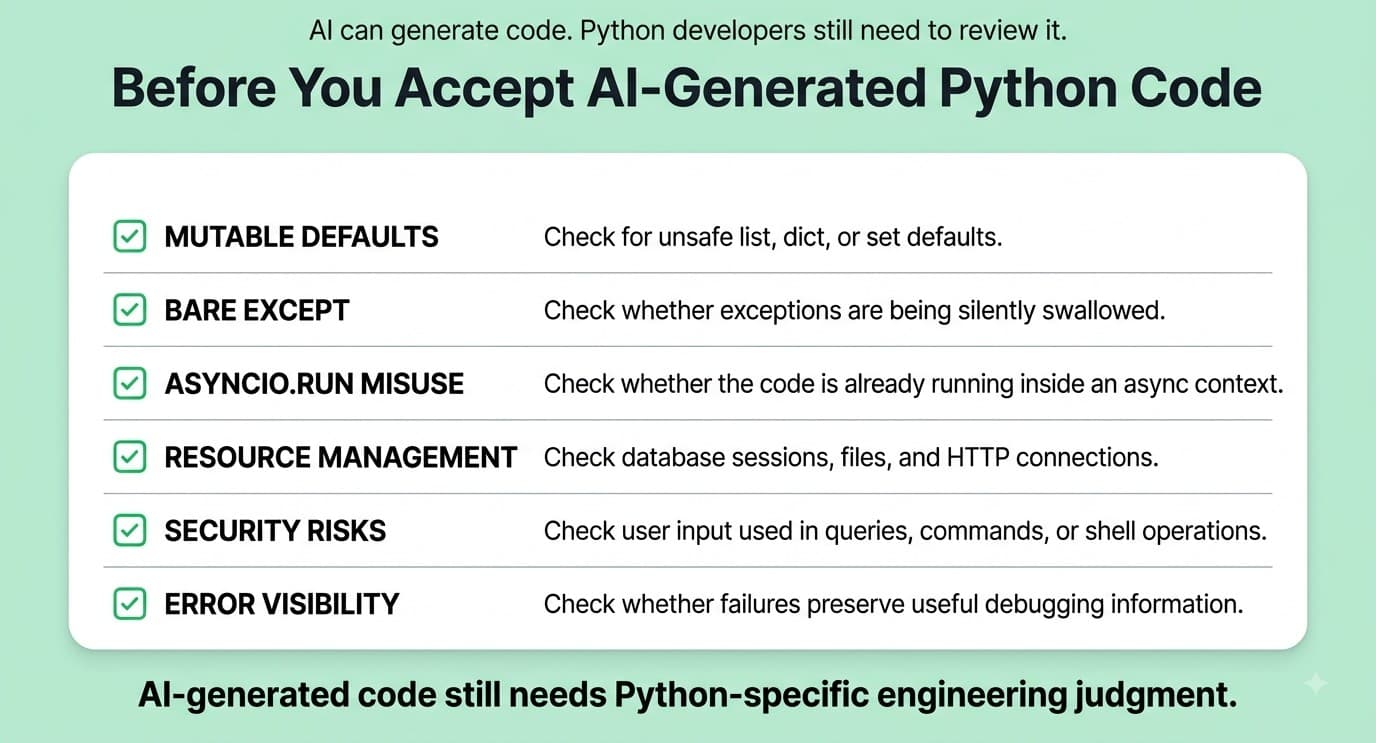
A candidate uses an AI coding tool to write a function during a take-home or in a live round where such tools are permitted. The generated code is syntactically correct and produces the right output for the test cases provided. But it contains a mutable default argument that will accumulate state across calls, or a bare except clause that silently swallows all exceptions including keyboard interrupts, or an asyncio.run call inside a function that is itself called from an async context, which will fail with an error that only surfaces at runtime in an async environment.
Why Recruiters Flag This
These Python-specific anti-patterns are exactly what AI tools most commonly produce because they produce code that works for the test cases at hand without understanding the execution context. A candidate who submits this code without catching these issues has demonstrated that they are using AI tools to substitute for understanding rather than to accelerate it, which is the specific outcome companies are most worried about as AI coding becomes ubiquitous.
The Real Cost
A mutable default argument bug is invisible in testing and surfaces unpredictably in production depending on call order. A bare except that swallows all exceptions turns observable failures into silent incorrect behavior that is extremely hard to debug. An asyncio.run nested in an async context raises a RuntimeError that crashes at the worst possible moment. All of these are production consequences, not just interview points.
The Complete Fix
Build a Python-specific AI code review checklist of six items that you run through before accepting any AI-generated Python code, regardless of whether it produces the correct output for your test cases.
First: does any function have a mutable default argument, a list, dict, or set, rather than None? If yes, rewrite using the None sentinel pattern. Second: are there any bare except clauses that catch all exceptions without re-raising them? If yes, replace with specific exception types or at minimum a logged bare except that re-raises. Third: is there any asyncio.run call inside a function that could be called from an async context? If yes, understand the calling context before using asyncio.run. Fourth: are there any database sessions, file handles, or HTTP connections opened without a context manager or explicit close? If yes, wrap in a context manager. Fifth: is there any user-supplied input being used in a string format used as a database query, a subprocess command, or a shell operation? If yes, this is a security vulnerability. Sixth: does the error handling communicate enough information to debug the problem in production, or does it silently swallow the exception's message and traceback?
Narrating this checklist aloud during a live round transforms AI tool use into a visible strength rather than a risk, because interviewers see exactly the review discipline that distinguishes responsible AI use from unchecked output acceptance.
Practice Method
Ask an AI coding tool to write five different Python functions for tasks of moderate complexity. Before running them, go through your six-item checklist for each one and write down every issue you find. Then run them and observe whether the issues you found caused actual test failures or whether they are latent problems that the test cases did not expose. The ratio of found-to-exposed issues is a calibration of how well your review checklist catches problems that tests would not catch.
Mistake 13: Having AI Write Tests That Do Not Actually Test the Behavior They Claim to Test
What This Looks Like
A candidate uses an AI tool to generate a test suite for their take-home submission. The test file has fifteen test functions with descriptive names. On review, the tests either mock so aggressively that the function under test is never actually called, assert the input rather than the output, or test an implementation detail that would break on any refactor while leaving the actual behavior completely unchecked.
Why Recruiters Flag This
A test suite that does not actually test the claimed behavior is worse than no tests at all, because it provides false confidence while adding maintenance burden. Reviewers who read AI-generated test suites carefully, and experienced ones now routinely do, can identify whether the tests were understood by the person who submitted them within a few minutes. A candidate who cannot explain what a specific test in their submission is actually asserting, and why that assertion proves the behavior is correct, has revealed that the tests were generated rather than designed.
The Real Cost
False test coverage is a liability that costs real time in exactly the moments when tests are supposed to save it: during a refactor or a bug investigation when a developer trusts the green test suite to tell them whether something is broken and it does not.
The Complete Fix
Apply a single verification test to every test function in any AI-generated test suite before submitting it: can you explain, in one sentence, what behavior this test would fail to catch if it were broken? If you cannot answer that question for a specific test, you do not understand what the test is for, and you should either rewrite it until you do or delete it.
More specifically, review AI-generated tests for the four most common failure modes. Tests that mock the function under test itself, meaning the test never exercises any real code. Tests that assert the mock was called, meaning the test verifies the function tried to do something but not whether it did it correctly. Tests that patch so many dependencies that the function effectively runs in a vacuum with no real logic being tested. Tests with assertions that are always true regardless of the function's behavior, such as asserting that a return value is not None when the function always returns something.
When submitting a take-home with AI-assisted tests, be prepared to explain each test's intent in the follow-up interview. If you cannot, rewrite or remove the test before submitting. A smaller, genuinely understood test suite evaluates better than a large, hollow one.
Practice Method
Take an AI-generated test suite for any project and apply the four-failure-mode review to every test function. Rewrite every test that fails any of the four checks. Compare the number of tests before and after, and reflect on what the difference tells you about what the original AI-generated suite was actually verifying versus what it appeared to verify.
Self-Check: Are You Making These Mistakes Without Realizing It
- When you write a for loop over a list, do you automatically ask yourself whether a comprehension or generator would be more appropriate and why?
- Can you explain the mutable default argument problem at the mechanism level, specifically what Python stores where and when?
- Can you write a decorator that accepts arguments from scratch, without functools.wraps first, and then explain why you need to add it?
- Can you apply the three-part framework, I/O-bound versus CPU-bound versus GIL-releasing, to choose the correct concurrency model for a specific scenario?
- Can you enable query logging in your ORM of choice and read the SQL generated by your five most-used code paths?
- Can you identify a blocking call in an async endpoint by asking specifically whether each called function does I/O and whether it uses async I/O internally?
- Can you explain in plain terms what at least two framework features you use daily actually do at the layer beneath the framework's abstractions?
- Does every project you build have tests that cover at least one error path alongside the happy path?
- Do you know the correct patch location for the two different import styles, "from module import func" versus "import module," and can you explain why they differ?
- Can you answer three progressively deeper questions about every technology currently listed on your resume?
- Does every project story you tell include a tradeoff you made, something that went wrong, and something you would change?
- Do you run a Python-specific checklist on AI-generated code before accepting it, covering mutable defaults, bare except, asyncio misuse, and resource management?
- Can you explain what every test in a generated test suite is actually verifying, specifically what broken behavior it would catch?
If more than three of these are unchecked, this list is your concrete interview prep plan for the next two weeks, not supplemental reading.
Conclusion
Thirteen specific Python developer interview mistakes, all of them fixable. The pattern connecting them is the same one that connects every other language-specific interview failure: the gap between knowing how to write something and understanding what it does. Python widens this gap more than most languages because its permissiveness rewards surface-level knowledge with working code, right up until an interviewer asks the follow-up question that reveals the mechanism was never understood.
None of these fixes require rare talent or extraordinary preparation time. They require specific, targeted practice built around the actual mechanism of each mistake: running Python's mutable default behavior in a shell and reading the function object's attributes, timing async versus synchronous code under real concurrency, reading the SQL your ORM generates, and patching dependencies incorrectly on purpose to see exactly why the mock did not intercept the call. These hands-on exercises build mechanical understanding that survives follow-up questions in a way that reading about the concept cannot replicate.
The hardest part is that these explanations need to survive pressure. Reading a clear explanation of late binding closures at your desk and explaining it fluently when an interviewer is watching and has just asked a follow-up you did not expect are meaningfully different challenges. Practicing explanation under realistic interview pressure, specifically the kind that includes unexpected follow-up questions, is where the gap between knowing the answer and being able to give it under scrutiny gets closed. That is the specific value of structured mock interview practice with platforms like Mocklingo, where the follow-up questions are designed to surface exactly the gaps that matter.
Practice python developer interview with Mocklingo