Loading...
Contents
Full Stack Projects That Actually Get You Hired in 2026
Jun 11, 202618 min readUpdated Sep 13, 2026
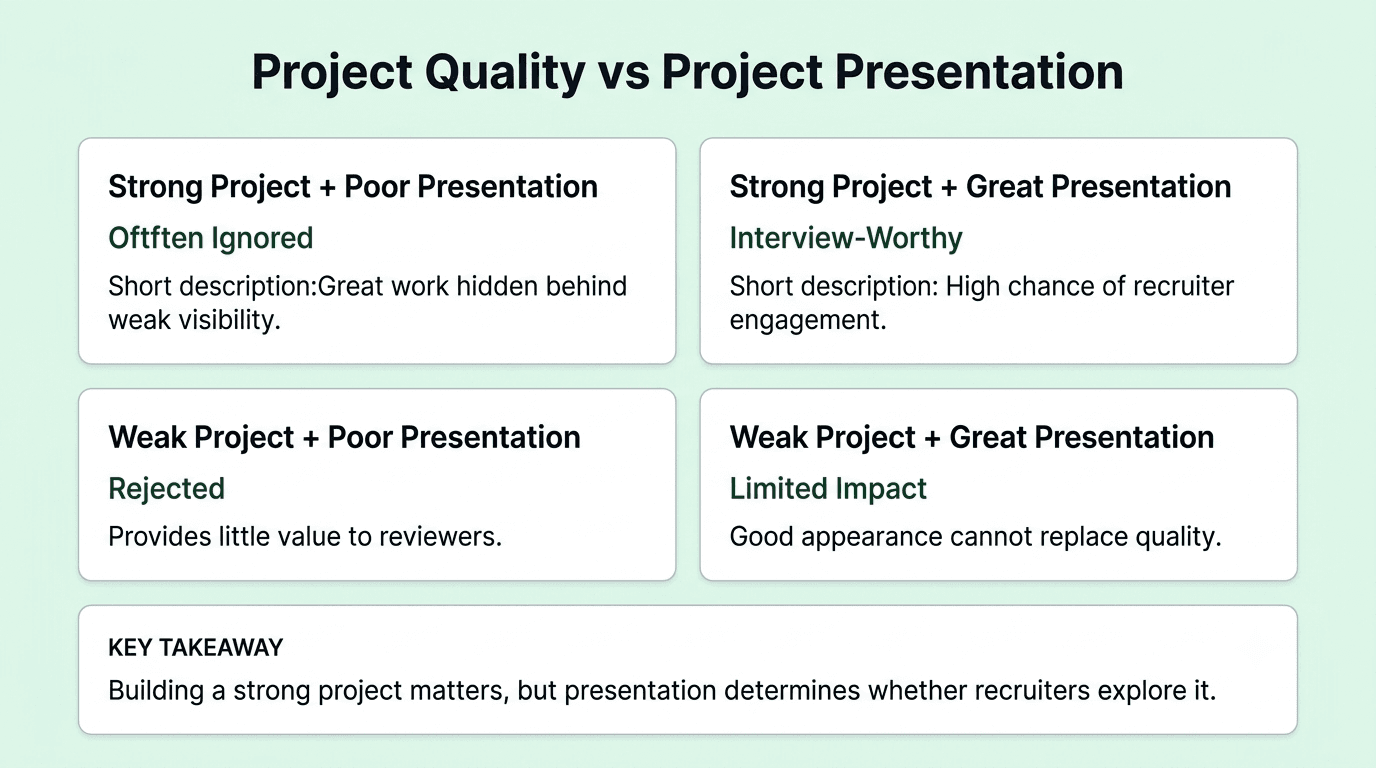
Most developers are building the wrong projects. Not wrong in the sense that they are learning nothing from them. Wrong in the sense that those projects are not moving the needle when it comes to getting hired. The todo app. The weather app. The Netflix clone was built by following a 12-hour YouTube tutorial. These are fine for learning. But they are not what gets a recruiter to stop scrolling. In 2026, the bar for a full stack developer portfolio has moved. Not impossibly high, but meaningfully higher than it was a couple of years ago. Companies are selective. Hiring managers have seen hundreds of portfolios. And the ones that stand out share a few things in common that most candidates are not focusing on. This blog will walk you through the projects that actually work, why they work, and what to keep in mind when building and presenting them.
FREE TO USE
25K+ INTERVIEWS4.8★ RATING68% IMPROVEMENT
Crack Your Dream Job
Real Interviews. Real Pressure. Practice until it feels easy.
- Seamless Interview Experience
- Resume & JD Questions
- Instant Personalized Feedback
What Recruiters Are Actually Looking For
Before we talk about specific project ideas, it helps to understand what a recruiter is trying to answer when they look at your GitHub or portfolio. They are asking three things. Can this person build something that works end to end? Can they make sensible technical decisions? And can they write code that someone else could read and work with? They are not asking whether you know every framework or whether your project is entirely original. They want evidence that you can take a problem, think about it properly, and ship something real. The full stack projects for beginners that impress are not the most complex ones. They are the ones where every piece has a clear reason to exist and the whole thing actually runs without breaking.
1. A Multi-User Expense Tracker With Real Authentication
An expense tracker sounds simple, and the basic version is. But building it properly with multi-user support, real login, and persistent data is a different story. Here is what makes this project stand out in a full stack developer portfolio. It requires a real backend with a database. It requires user authentication with sessions or JWT tokens. It requires per-user data isolation, meaning one user should never see another user's expenses. And it requires a frontend that stays in sync with what is happening on the server. Build it with React on the frontend and Node with Express on the backend. Use PostgreSQL or MongoDB for the database. Add proper error handling so the app does not crash when someone enters bad data. Deploy it on Render or Railway so it is live and accessible. The reason this project works is that it mirrors exactly what most real web applications do. Authenticate a user, store their data, let them read and update it, keep it secure. Any company building a SaaS product will recognize these patterns immediately.
2. A Job Application Tracker With a Kanban Board
This one solves a problem that every developer applying for jobs actually has, which is the best kind of project to build. A Kanban board where users can create cards for job applications, drag them between columns like Applied, Interview Scheduled, Offer, and Rejected, and add notes to each card. Save the state in a database so it persists across sessions. What makes this impressive as a portfolio project is that drag and drop interactions are genuinely tricky to implement well. Getting the layout right, handling state updates correctly when a card moves columns, and making it work smoothly on mobile all require real frontend skill. It also shows product thinking. You built this because it solves a real problem. That narrative matters when you present it. Recruiters respond to developers who think about users, not just code. Tech stack suggestion: React with a drag and drop library on the frontend, Node and Express on the backend, PostgreSQL for storage. Deploy it and use it yourself during your job search.
3. A Real-Time Chat Application
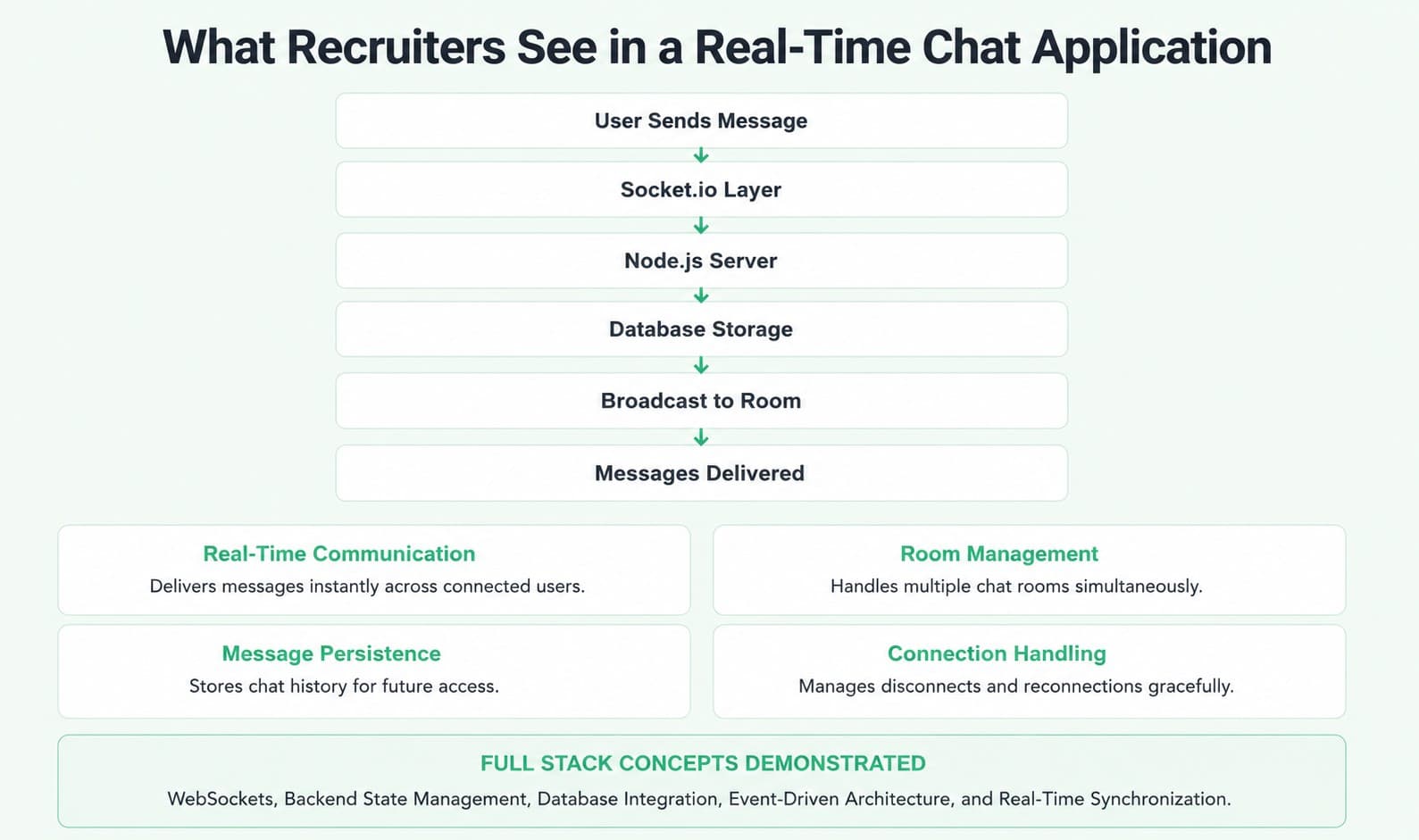
This is one of the most effective real world full stack projects you can build because it requires something most other projects do not: real-time communication between client and server. Build a chat application where multiple users can join rooms and send messages that appear instantly for everyone in that room. Use WebSockets via Socket.io to handle the real-time layer. Add message persistence so users can see previous messages when they join a room. You can extend this with features like typing indicators, online user counts, and read receipts. Each of these additions shows that you can think about the edge cases and small details that make a product feel complete. The reason this project works for github full stack projects is that real-time systems come up in a large number of technical interviews. Having built one means you can speak about it from experience, not just theory. You will know what happens when a user disconnects unexpectedly. You will know how to manage room state on the server. That practical knowledge is obvious in interviews.
FREE TO USE
8k+ SESSIONS92% FLUENCY4.9★ RATING
Speak With Confidence
Real Conversations. Real Scenarios. Speak until it feels natural.
- Real-Time Speaking Practice
- Guided Conversation Flows
- Instant AI Feedback
4. An E-Commerce Store With Payments
This one takes more effort than the others but it is one of the best full stack projects for beginners who want to go from portfolio to first job quickly. Build a small online store. Products with images, descriptions, and prices. A cart that persists. Checkout using Stripe's test mode. Order history for logged-in users. Every company with a product that costs money has implemented some version of this. Building it teaches you how payment flows actually work, how to handle webhooks from a payment provider, how to manage cart state across sessions, and how to structure an order management system. Use Next.js for this one rather than a separate React frontend and Node backend. Next.js handles both in one project and using it signals that you are working with modern tooling. Deploy on Vercel, which is where most Next.js projects live. Be clear in your GitHub README that the payments are in test mode and explain how to trigger the test checkout flow. Reviewers will not enter real card details, so guiding them through the test experience shows thoughtfulness.
5. A Developer Tool That You Actually Use
This category is broad by design because the best version of this project is specific to you. Is there something in your daily workflow as a developer that is annoying or slower than it should be? A tool that combines two things you always need open? A dashboard that shows information you check in five different places? Build it. Use it. Improve it based on what you actually need. The reason developer tools are powerful projects for full stack developer portfolio presentations is that they are instantly credible. When you tell a recruiter "I built this because I was tired of switching between four tabs every morning," that is a real user story. The project exists for a reason beyond the portfolio. That distinction is easy for hiring managers to recognise. These projects also tend to be genuinely interesting to technical interviewers because they invite conversation about the problem rather than just the implementation. What did you try first? What did not work? How did you decide what features to add?
6. An API-Driven Dashboard With Third Party Data
Many companies need to display and interact with data from external sources. Build a project that does this well and you are demonstrating a skill that is directly applicable to most frontend and full stack roles. Pick an API that returns interesting data. It could be financial data, sports statistics, weather and climate data, or public government datasets. Build a dashboard that fetches this data, displays it clearly, handles loading and error states properly, and lets users filter or interact with what they see. The technical challenge here is not the data itself. It is building a frontend that feels responsive and handles real-world API behaviour. APIs go down. They return unexpected shapes. They rate limit you. A good dashboard handles all of these gracefully. Add a backend layer that caches API responses so you are not hitting rate limits every time someone loads the page. That small addition shows you think about production concerns, not just happy path behaviour.
What Makes a GitHub Project Actually Impressive
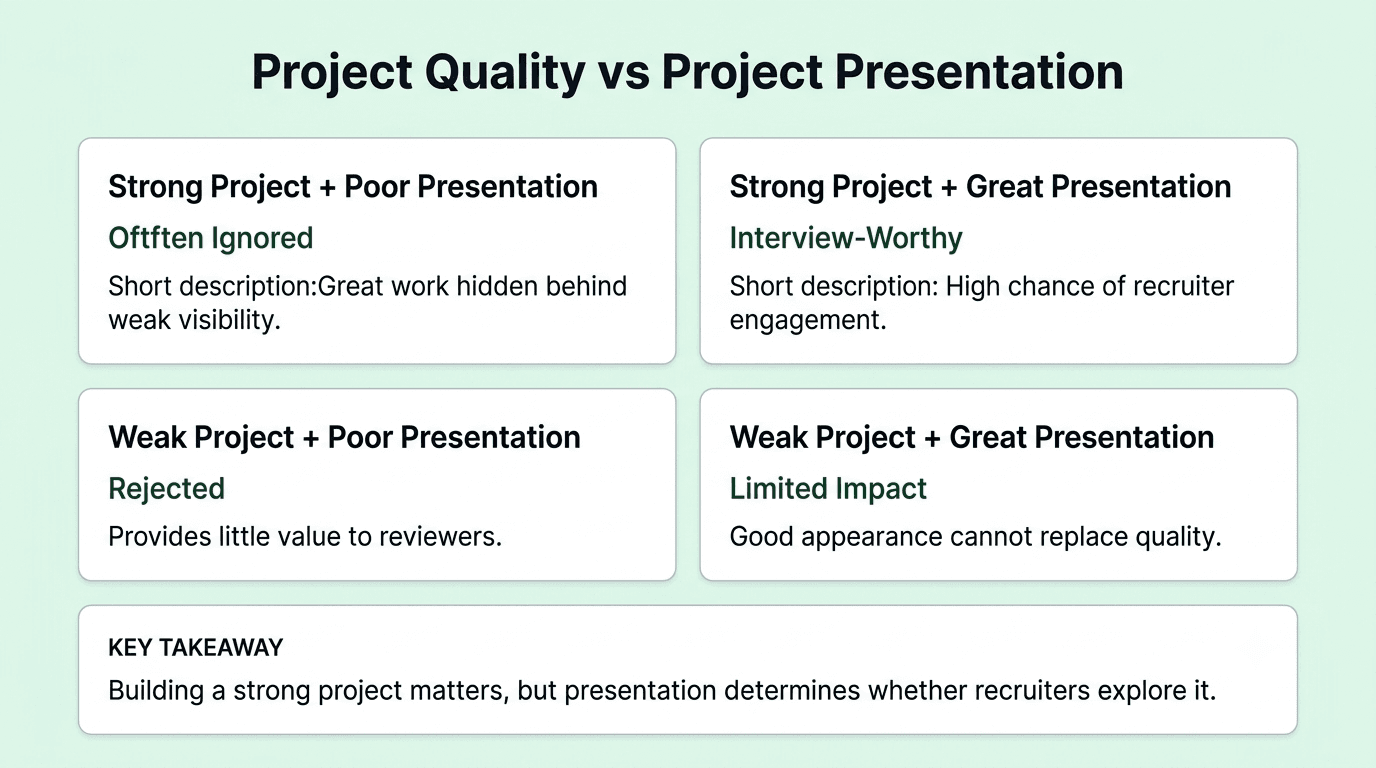
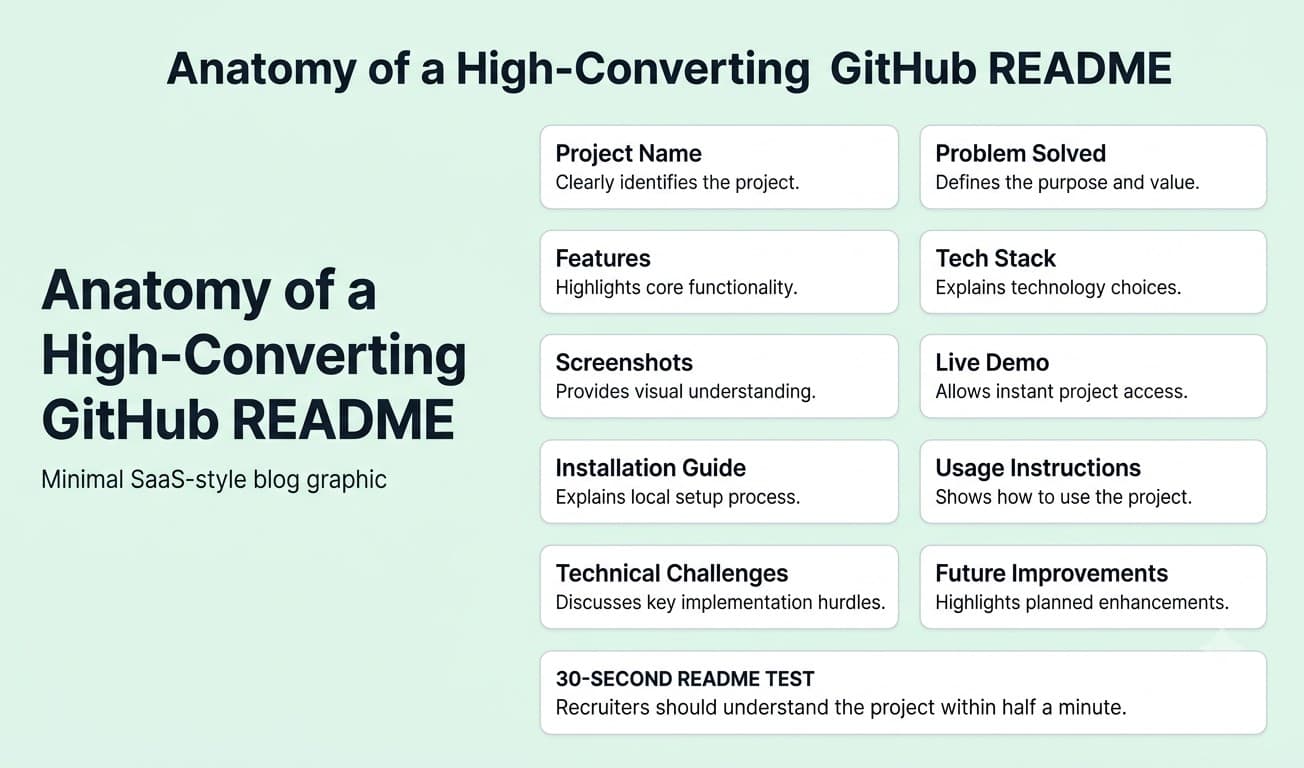
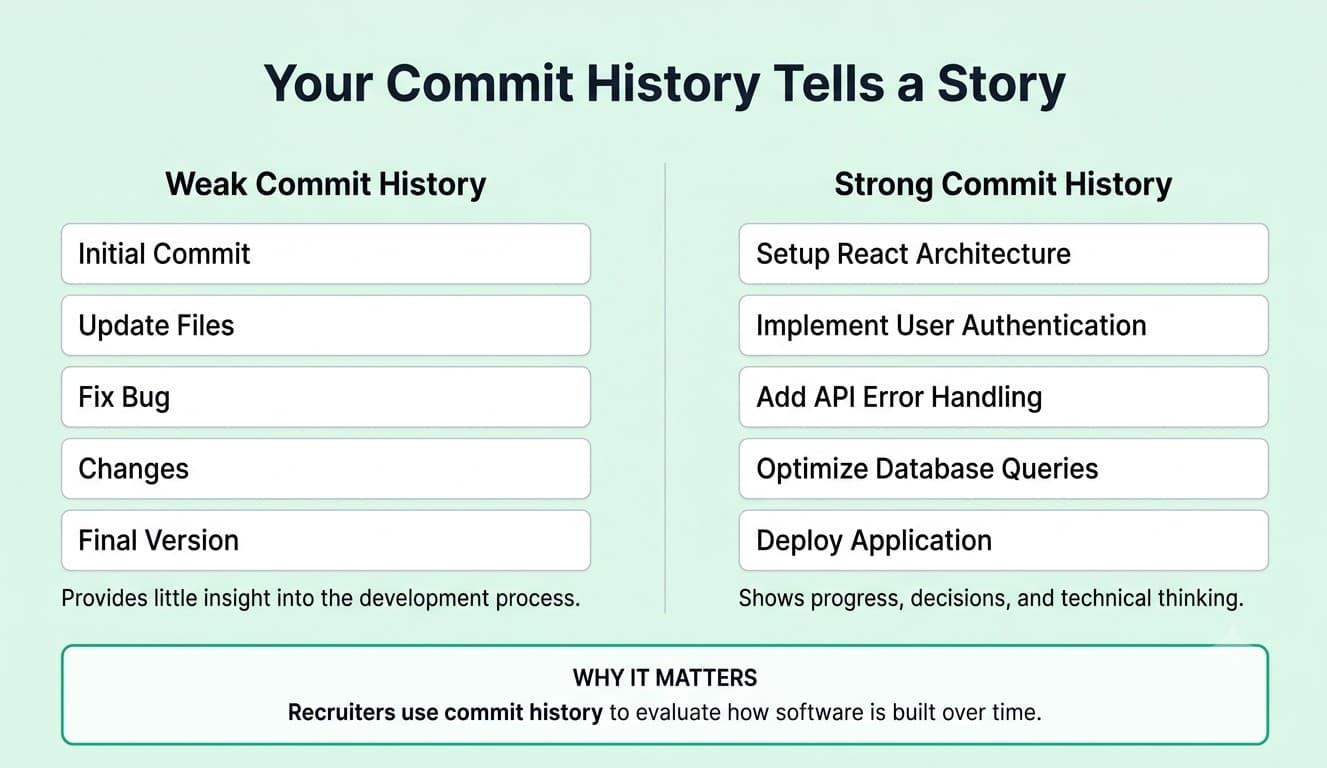
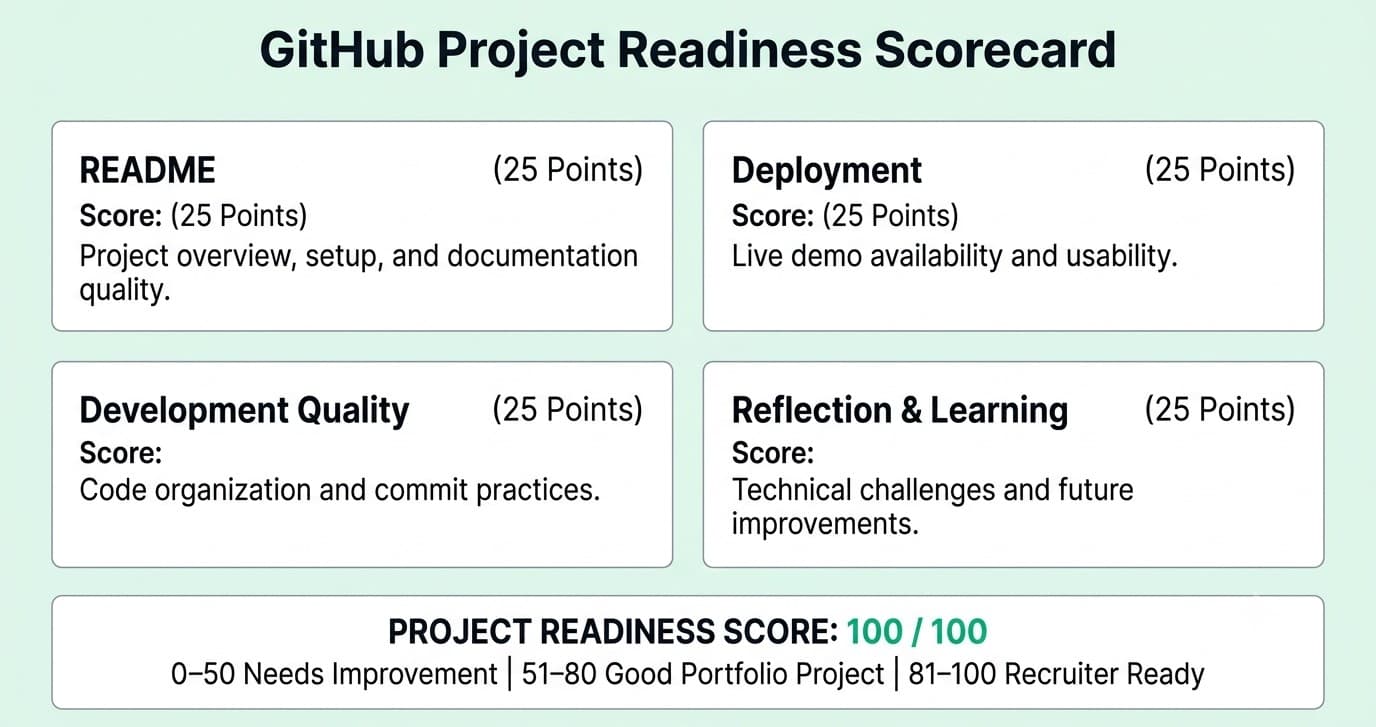
Building a strong project is only half the battle. The way you present it on GitHub is just as important as the code itself. Every project should include a well-structured README that covers: What the project does, explained in plain language The tech stack used and why each technology was chosen Clear instructions for running the project locally A link to the live demo A live demo is essential. Recruiters rarely clone repositories, install dependencies, and configure environments just to evaluate a project. If they cannot see it working immediately, they will often move on. Use free deployment platforms such as Vercel, Netlify, and Render. Your commit history also matters because it tells the story of how the project was built. Instead of making a single commit like "initial", create meaningful commits throughout development. Each commit message should clearly explain:”What changed” and “Why the change was made” Finally, include a short reflection section in your README that discusses: The most technically challenging parts of the project Key lessons learned during development What you would improve or do differently if you rebuilt it today This is the section many candidates overlook, yet it often leaves the strongest impression on technical reviewers because it demonstrates critical thinking, self-awareness, and genuine engagement with the work.
How Many Projects Is Enough
Three to four strong, deployed, well-documented projects are better than ten weak ones. Each project in your portfolio should show something distinct. One should demonstrate authentication and data persistence. One should show real-time or async behaviour. One should involve an external API or third party integration. One should show you can build something with genuine product thinking behind it. You do not need to cover every framework or every database. Depth in a consistent stack is more reassuring to hiring managers than evidence that you started ten projects in ten different technologies and finished none of them well.
Conclusion
The projects that get developers hired are not necessarily the most technically complex. They are the ones where the developer clearly understood what they were building, made deliberate choices, and can explain those choices in a real conversation. A simple project that you built to solve a real problem, deployed properly, documented clearly, and can talk about with genuine depth will beat a complex project you half-understand every time. Build with that in mind and the portfolio will take care of itself.