Loading...
Contents
How AI Test Automation Is Changing the Role of QA Engineers
Jun 20, 20268 min readUpdated Sep 17, 2026
AI is changing software testing in a big way. A lot of the repetitive, rule-based QA work is getting automated now, things like writing regression scripts, running smoke tests, and spotting obvious UI breaks.
What used to take me days of scripting can now be done by an AI tool in a fraction of the time. And yes, that changed my job. Just not in the scary way I thought it would.
FREE TO USE
25K+ INTERVIEWS4.8★ RATING68% IMPROVEMENT
Crack Your Dream Job
Real Interviews. Real Pressure. Practice until it feels easy.
- Seamless Interview Experience
- Resume & JD Questions
- Instant Personalized Feedback
The Week I Realized Something Had Changed
I remember the exact moment.
I had spent most of a Tuesday writing Selenium scripts for a login flow. Nothing fancy. Just the usual stuff: valid credentials, invalid credentials, locked accounts, session timeouts. I pushed my work, went home, and the next morning my tech lead sent me a message in Slack.
“Hey, I ran Testim on the same flow last night just to compare. It generated 14 test cases in 22 minutes. Yours took a day and a half.”
He was not being rude. He was honestly curious. But I stared at that message for longer than I care to admit.
That was two years ago. Since then, I have watched AI testing tools quietly take over the kind of work that junior and mid-level QA engineers used to spend a huge amount of time on.
And that forced me to ask a tough question:
If AI can write my test scripts, what exactly is my role now?
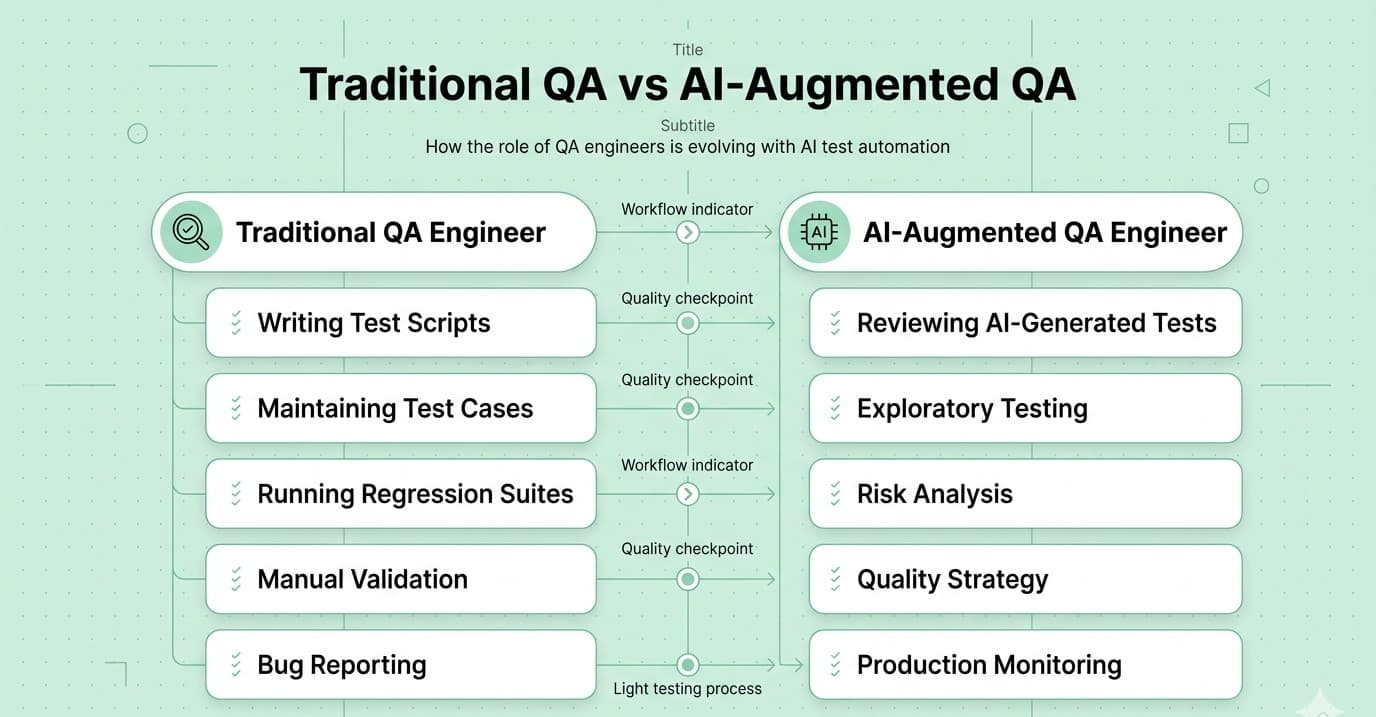
What Is Actually Happening in Software Testing
Before jumping to conclusions, it helps to be realistic about what is going on.
A lot of the conversation around AI in QA swings between two extremes. One side says AI will replace every tester. The other side says AI is just hype. The truth is somewhere in the middle.
AI is already useful in testing, and teams are using it in real ways. It is not magic, but it is not a gimmick either.
The big wins are showing up in places like:
• generating test scripts from existing user flows and UI patterns
• keeping test suites alive when the interface changes
• visual regression testing across many screens and browsers
• running large test suites faster by prioritizing and parallelizing them
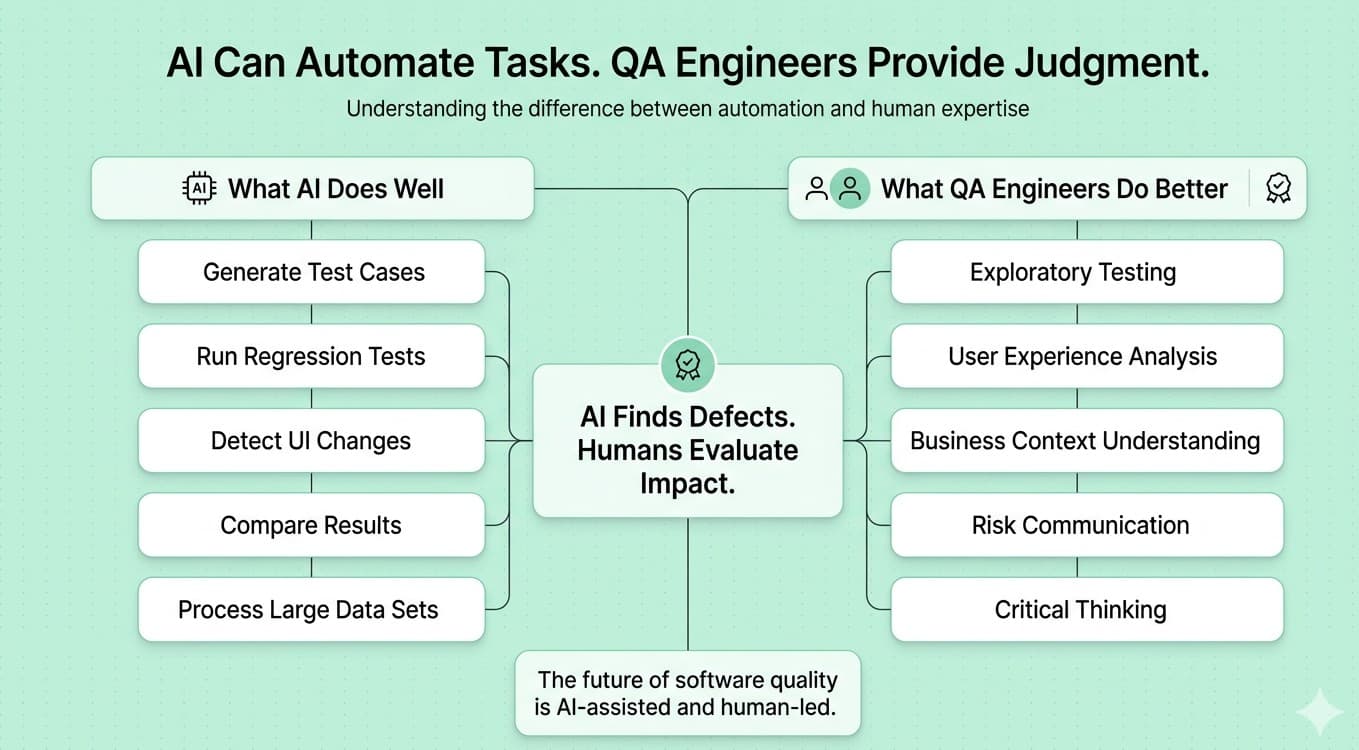
In other words, AI is very good at the mechanical side of QA.
But that is only one part of the job.
What AI Is Still Bad At
This is the part people usually skip. AI can do a lot, but it still struggles with the things that make testing actually valuable.
• It can check whether a button works. It cannot tell you whether that button is in the wrong place for the user’s mental model.
• It can generate test cases. It cannot naturally think, “What if a real user does something weird here?”
• It can detect a failure. It cannot always explain what that failure means for the business.
• It can pass a form submission test. It cannot tell you that the flow feels confusing, clunky, or frustrating.
• It can help you cover more ground. It cannot decide what matters most when time is short and the release is close.
That is the shift. AI is not killing QA. It is removing the repetitive layer and making the judgment layer more important.
What I Do Now Instead
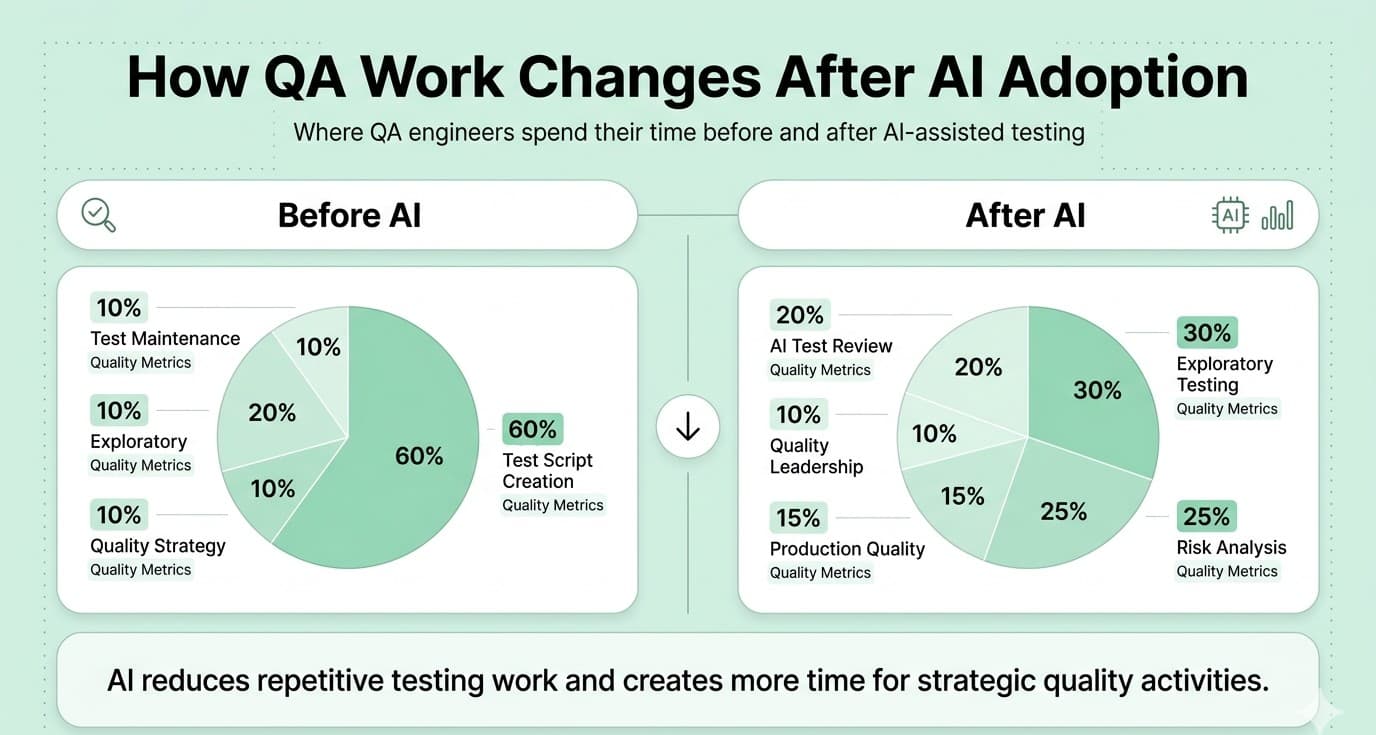
When AI took over about 40% of my scripting work, I did not lose 40% of my value. I just started spending my time differently.
My week looks very different now.
Earlier, most of my time went into writing and maintaining scripts. Now I spend much less time on that and much more time reviewing what AI produces, refining it, and catching the cases it misses.
The rest of the time goes into things like this:
I join design reviews earlier. That means I am involved before a feature is fully built, not just after. I ask the questions that prevent defects from getting baked into the product in the first place.
I think more about test strategy. Not just “what tests can we write,” but “what risks matter most,” “which flows are business-critical,” and “where are we pretending we have coverage when we really do not?”
I spend more time on exploratory testing. This is the messy, curious, human kind of testing. The kind where you deliberately try odd combinations, break assumptions, and look for weak spots that no script would naturally find.
I pay more attention to production quality. Pre-release testing is important, but it is only part of the story. You also need to understand what happens after release, what the metrics are saying, and where real users are getting stuck.
And I communicate more. I explain risk to product teams. I help developers think about testability. I write clearer post-mortems. Honestly, this is some of the most valuable work I do now.
AI did not make me less useful. It made me focus on the work that actually matters.
FREE TO USE
8k+ SESSIONS92% FLUENCY4.9★ RATING
Speak With Confidence
Real Conversations. Real Scenarios. Speak until it feels natural.
- Real-Time Speaking Practice
- Guided Conversation Flows
- Instant AI Feedback
The Part I Wish Someone Had Told Me Earlier
Here is the big realization:
AI did not replace the job of a tester. It replaced the job of a script writer.
Those are not the same thing.
The best QA people I have worked with were never valuable because they could type Selenium code quickly. They were valuable because they knew how to spot risk, think like a user, and ask uncomfortable questions before a problem turned into a production issue.
That part of testing still matters. In fact, it matters more now.
Because the repetitive work is being handled by machines, the human part of QA is becoming more visible. The judgment, the communication, the curiosity, the product thinking, that is the real skill set now.
The AI Testing Tools Worth Knowing
If you are working in QA or development and trying to keep up with this shift, a few tools are especially worth watching.
Testim is strong for self-healing web tests. It helps reduce maintenance when UI elements change.
Mabl combines test creation, execution, and analysis in one place. It is useful for teams that want AI-assisted testing without building everything from scratch.
Applitools stands out for visual testing. It is especially good at spotting visual regressions that functional tests often miss.
GitHub Copilot is handy for writing unit tests faster. It is not perfect, but it is a practical helper for developers.
Diffblue Cover is especially interesting for Java teams. It automatically generates unit tests from code, which can save a lot of time in large codebases.
Katalon sits somewhere in the middle, making it a decent option for teams moving from manual testing to more automated, AI-assisted workflows.
None of these tools make human judgment obsolete. They just make good judgment more efficient.
What This Means in Practice
If you are in QA, the honest takeaway is this:
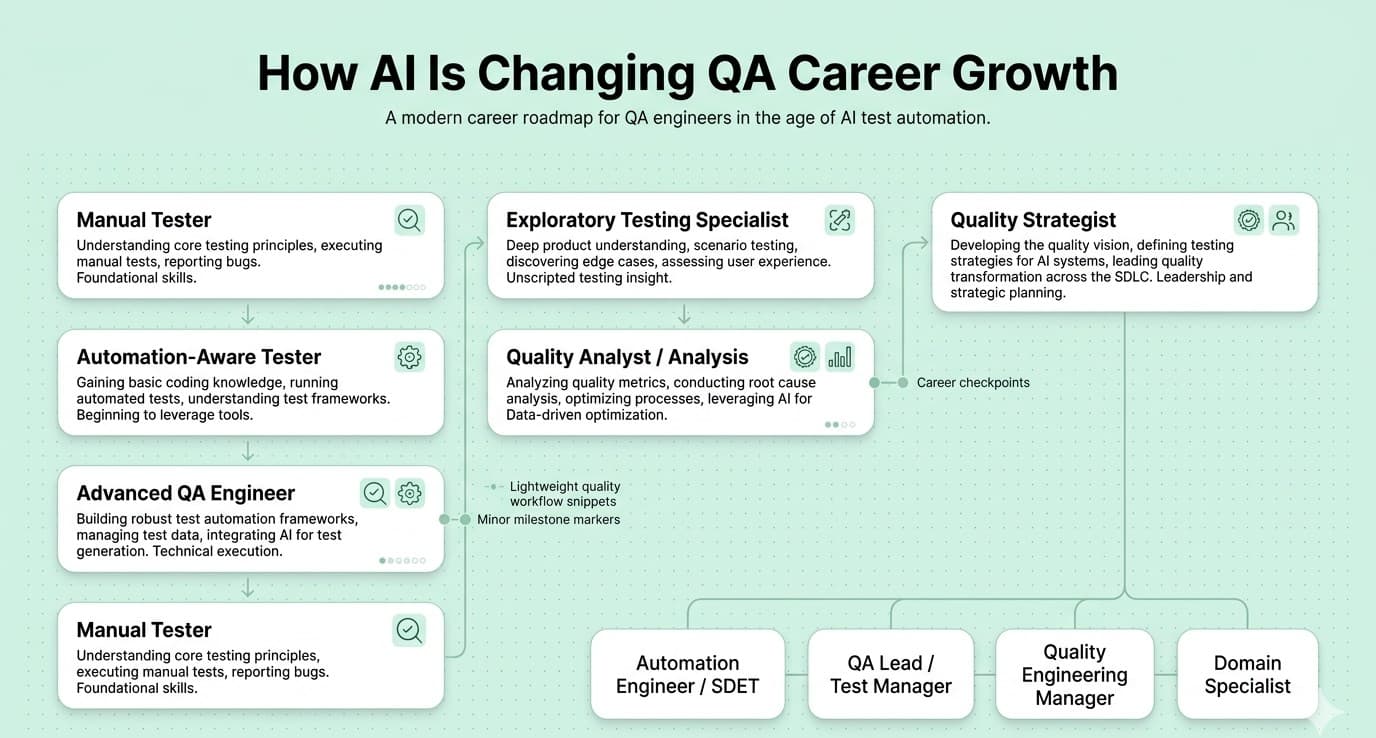
The part of the job that is mostly repetitive, like writing the same kind of tests over and over, maintaining fragile selectors, and running large regression suites manually, is shrinking fast.
The part of the job that depends on judgment, creativity, risk awareness, and understanding users is becoming the core of the role.
That is not a bad thing. In many ways, it is an upgrade. The question is not whether AI will change QA. It already has. The real question is whether you will keep spending your time on the parts AI can do, or move into the parts only a human can do well.
My advice is simple: look at your current work and ask how much of it could already be automated. Then think about what you would do with that saved time. Start doing more of that now.
Because the QA people who will thrive in this new era are not the ones fighting the tools. They are the ones using the tools to do better, sharper, more meaningful work.