Loading...
Contents
Machine Learning Engineer Interview Preparation Guide: A Complete Roadmap for 2026
Sep 28, 202627 min read
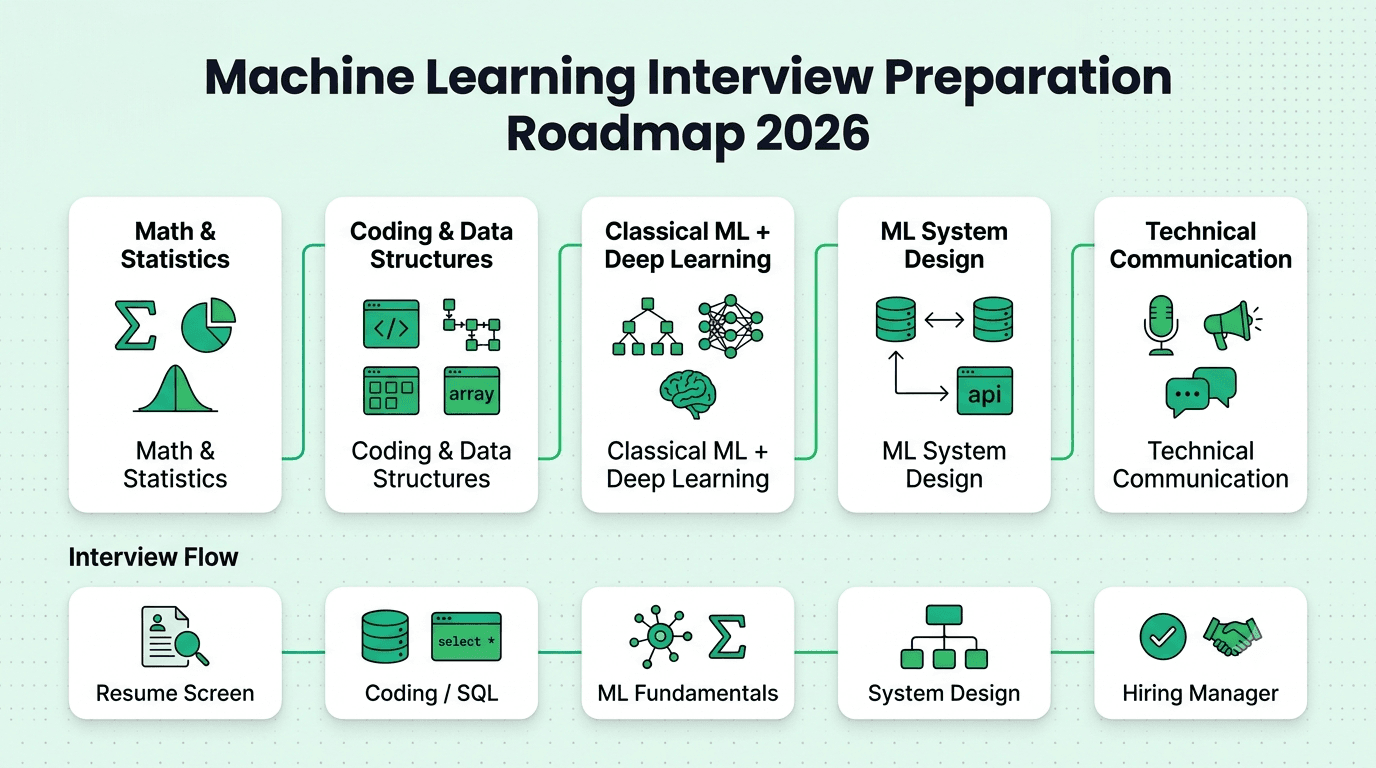
To prepare for a machine learning interview, focus on five pillars: strong math and statistics fundamentals, solid coding and data structures skills, depth in classical machine learning and at least one deep learning framework, the ability to design and reason about an end to end ML system, and clear verbal communication for explaining model choices to both technical and non-technical audiences. Most interview loops include a resume screen, a coding or SQL round, an ML fundamentals or case study round, an ML system design round for experienced candidates, and a final hiring manager round. Candidates who can explain why a model works and what could go wrong with it, not just recite an accuracy score, consistently stand out.
If you are preparing for a machine learning interview, you already know the field has grown far beyond fitting a model and reporting a metric. Companies now expect ML candidates to understand the full lifecycle: framing a business problem as a machine learning problem, choosing the right evaluation metric, handling messy real world data, and reasoning about what happens when a model meets production traffic. This guide covers everything you need, whether you are a fresher applying for your first ML role or an experienced practitioner targeting a senior or lead position.
FREE TO USE
25K+ INTERVIEWS4.8★ RATING68% IMPROVEMENT
Crack Your Dream Job
Real Interviews. Real Pressure. Practice until it feels easy.
- Seamless Interview Experience
- Resume & JD Questions
- Instant Personalized Feedback
Section 1: Introduction to the Machine Learning Interview Process
Machine learning interviews test several things at once: coding ability, statistical reasoning, applied ML knowledge, and the judgment to make sound trade offs given messy data and real constraints. A candidate who can explain every detail of a neural network but cannot write clean, working code will struggle just as much as a strong coder who cannot explain why a model is overfitting.
Most processes run four to six rounds over three to six weeks, often longer than pure software roles because ML interviews frequently include a take-home case study or a dedicated applied ML round. Larger companies typically separate coding, ML theory, and system design into distinct rounds with different interviewers. Startups often combine these into fewer, broader conversations built around a real business problem the team is solving.
What changes with experience is depth and scope, not the topic list itself.
Freshers are tested on statistics fundamentals, basic Python and coding skills, and core classical ML algorithms.
Intermediate candidates (two to five years) are expected to design a full modeling pipeline, justify their metric and model choices, and reason about deployment and monitoring.
Experienced professionals are evaluated on ML system architecture at scale, model reliability in production, mentoring, and how they have influenced the modeling strategy of past teams.
Section 2: What Recruiters and Hiring Managers Look For
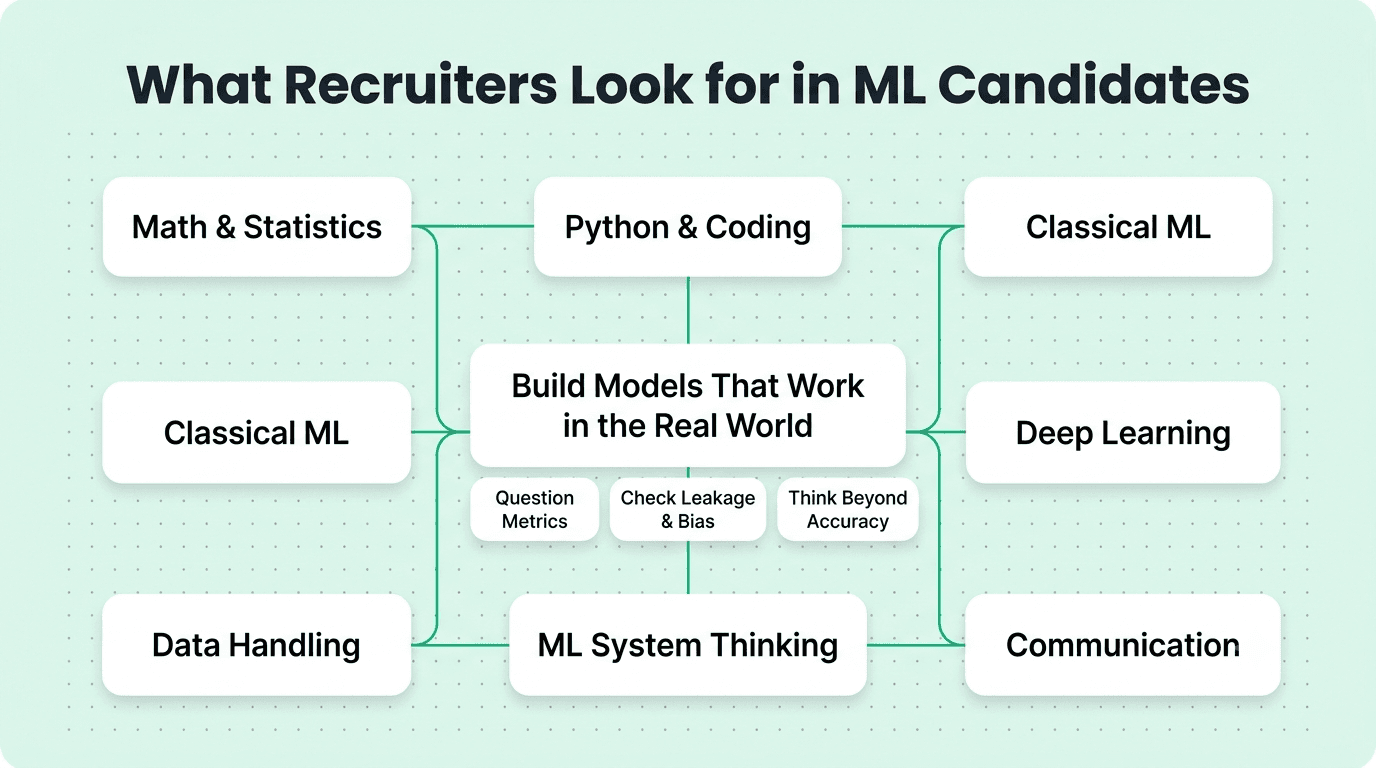
Recruiters and interviewers are trying to answer one core question: will this person build models that actually solve the business problem and behave predictably once deployed, not just perform well on a notebook.
Core skills recruiters expect:
1. Math and statistics fundamentals. Probability, distributions, hypothesis testing, and linear algebra concepts that underpin most ML algorithms.
2. Coding proficiency. Strong Python skills, comfort with libraries like NumPy and pandas, and the ability to write clean, testable code, not just notebook scripts.
3. Classical machine learning depth. Understanding of regression, classification, tree-based models, and clustering, including their assumptions and failure modes.
4. Deep learning familiarity. Working knowledge of neural network fundamentals and at least one framework like PyTorch or TensorFlow, scaled to the role's requirements.
5. Data handling skills. Ability to clean messy data, handle missing values and class imbalance, and engineer meaningful features.
6. ML system thinking. For intermediate and senior roles, the ability to reason about the full pipeline: data collection, training, evaluation, deployment, and monitoring for drift.
7. Communication. The ability to explain a model's behavior, limitations, and business impact clearly, especially to stakeholders without a technical background.
8. Hiring managers also watch for quieter signals: Do you question whether a metric actually reflects business value? Do you consider data leakage and bias without being prompted? Do you accept that a model can be wrong and explain how you would find out?
Section 3: Resume and Portfolio Preparation
Your resume and portfolio are the first filter, and for ML roles, interviewers look closely for evidence of real, end to end project experience rather than isolated notebook exercises.
Lead with outcomes, not just algorithms. Instead of listing "XGBoost, scikit-learn, PyTorch," describe what you built: "Built a churn prediction model that improved retention campaign targeting, increasing win-back conversion by 18 percent."
Keep two or three strong portfolio projects that show a complete pipeline: problem framing, data cleaning, model selection, evaluation, and a clear discussion of limitations, not just a final accuracy number.
Include a clean GitHub repository with a clear README explaining your approach, your metric choice, and why you chose one model over another, since interviewers often review this before the call.
Avoid generic Kaggle-only portfolios without context. A single top-leaderboard Kaggle result stands out far less than a smaller, well-explained project solving a specific, real problem end to end.
Quantify wherever possible: business impact, model performance improvement, latency reduction, or the scale of data the model was trained or served on.
Section 4: Core Topics to Study, Ranked by Interview Importance
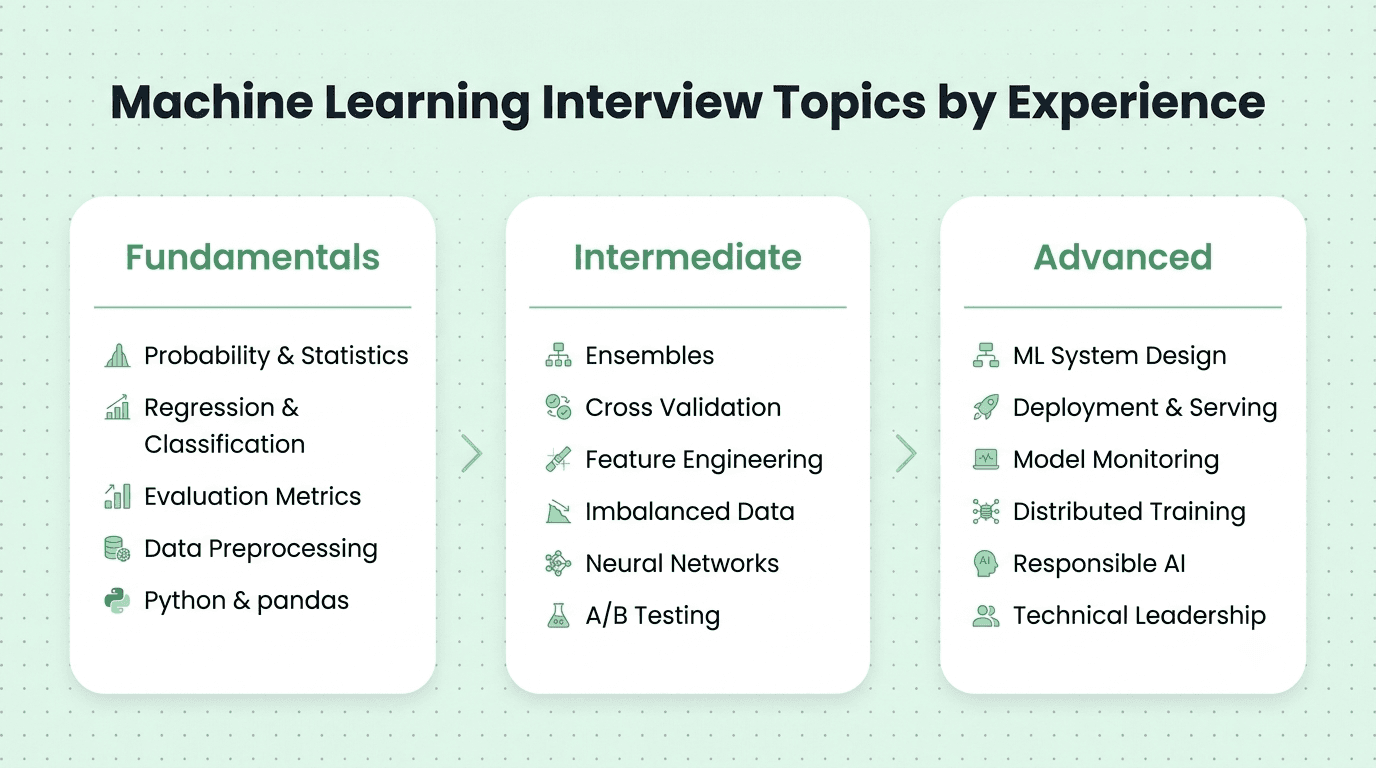
Fundamental Concepts (asked in almost every interview)
Probability and statistics: distributions, conditional probability, and the central limit theorem
Bias and variance trade off, and overfitting versus underfitting
Core algorithms: linear and logistic regression, decision trees, and k-nearest neighbors
Evaluation metrics: accuracy, precision, recall, F1 score, and when each one matters
Data preprocessing: handling missing values, scaling, and encoding categorical variables
Basic Python and pandas for data manipulation
Intermediate Concepts (common at two to five years experience)
Ensemble methods: random forests, gradient boosting, and why they typically outperform single models
Cross validation strategies and avoiding data leakage
Feature engineering and feature selection techniques
Handling imbalanced datasets: resampling, class weighting, and choosing the right metric
Neural network fundamentals: activation functions, backpropagation, and regularization techniques like dropout
A/B testing and experiment design for evaluating a model's real world impact
Advanced Concepts (senior and lead roles)
ML system design: designing a recommendation system, a fraud detection pipeline, or a search ranking model end to end
Model deployment and serving: batch versus real time inference, and latency versus throughput trade offs
Model monitoring: detecting data drift, concept drift, and setting up alerting for silent model degradation
Scaling training: distributed training, handling large datasets, and managing compute cost
Responsible AI: fairness, bias detection, and explainability techniques like SHAP values
Technical leadership: setting modeling standards, reviewing experiment design, and mentoring on ML best practices
Scenario Based Preparation Tips
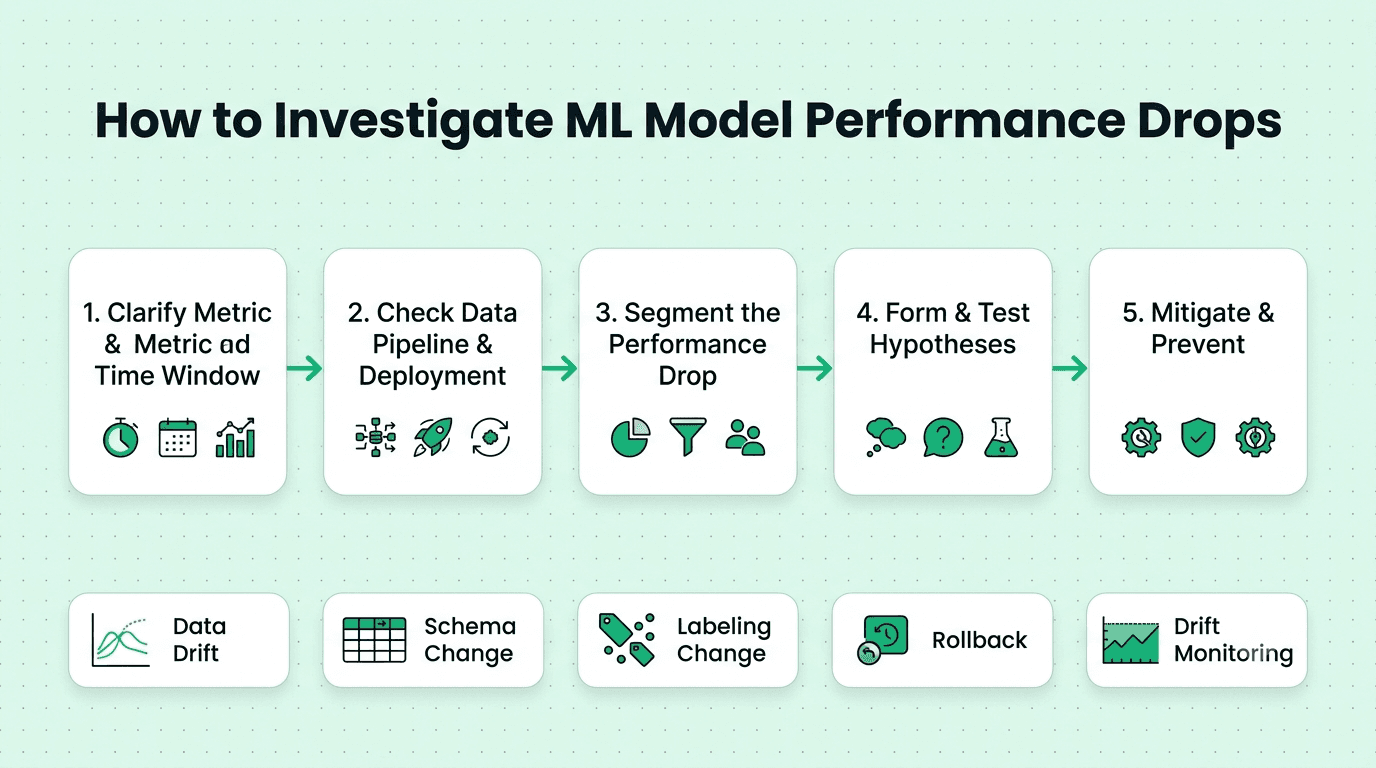
Interviewers often ask questions like "your model performed well in testing but its accuracy has dropped significantly in production, how would you investigate this." Practice a repeatable framework:
Clarify the metric and the time window: is the drop sudden or gradual, and is it affecting all segments equally.
Check the obvious first: a change in the input data pipeline, a schema change, or a recent model redeployment.
Narrow it down by segment, checking whether specific user groups, regions, or time periods are driving the drop.
Form two or three hypotheses, such as data drift in a key feature or a labeling change upstream, and explain how you would test each.
Propose a short-term mitigation, like rolling back to a previous model version, and a longer-term fix, like adding drift monitoring on that feature.
This structure demonstrates production maturity, which interviewers value more than guessing the exact cause instantly.
Practical Preparation Exercises
Take a public dataset and build a full pipeline within a fixed three hour window: clean the data, engineer features, train two different models, and write a short summary comparing them.
Practice explaining a project's metric choice out loud, defending why you picked precision over recall or vice versa for that specific business context.
Implement a classical algorithm, such as logistic regression or k-means, from scratch without a library to strengthen your understanding of the underlying math.
Time yourself solving three medium-level Python or SQL coding problems in forty five minutes to simulate real technical screen pressure.
Take a project you have already built and write out how you would monitor it in production, including what would trigger a retraining decision.
FREE TO USE
8k+ SESSIONS92% FLUENCY4.9★ RATING
Speak With Confidence
Real Conversations. Real Scenarios. Speak until it feels natural.
- Real-Time Speaking Practice
- Guided Conversation Flows
- Instant AI Feedback
Section 5: Common Interview Rounds
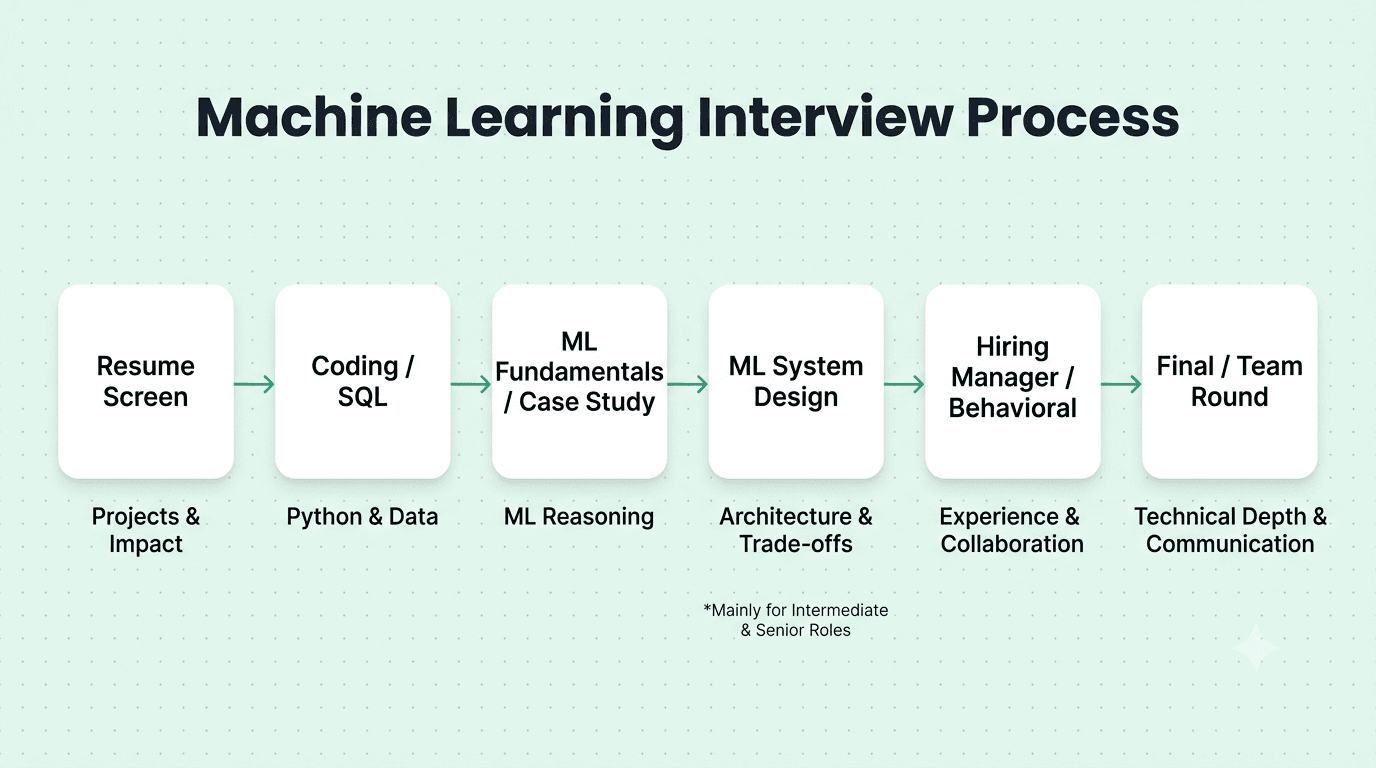
Resume and application screen Recruiters look for relevant ML experience, clear project descriptions with measurable business impact, and evidence of complete, end to end project work. Vague bullet points like "built machine learning models" rarely survive this stage at competitive companies.
Coding or SQL round A timed coding test, often on a platform like HackerRank or CoderPad, covering Python fundamentals, data manipulation, and sometimes a data structures and algorithms problem.
ML fundamentals or case study round A conversation or live exercise focused on classical ML concepts, metric selection, and reasoning through a business scenario, such as how you would frame a churn or fraud detection problem.
ML system design round For intermediate and senior roles, you are asked to design an ML system such as a recommendation engine or a search ranking pipeline, discussing trade offs in data collection, model choice, and serving infrastructure.
Hiring manager or behavioral round Focused on past experience, collaboration style with data and engineering teams, and how you have handled ambiguity or a failed modeling approach on previous projects.
Final round or team round Often includes a presentation of a past project to a panel or an additional pairing session with future teammates to assess both technical depth and communication.
Section 6: Behavioral and Situational Interview Preparation
Behavioral rounds often decide close calls between candidates with similar technical scores, and ML roles especially value the ability to work across data, engineering, and product teams.
Use the STAR method: Situation, Task, Action, Result. Keep each story under two minutes and end with a clear outcome.
Prepare five to six core stories covering a model that did not perform as expected, a disagreement over metric choice, a time you simplified a complex model for a business stakeholder, a mistake you made, and a time you influenced a modeling decision without formal authority.
Be honest about failures. Interviewers are more interested in what you learned and changed afterward than in a flawless track record.
Practice explaining trade offs, not just outcomes. "I chose a simpler logistic regression model over a more complex ensemble because the business needed an explainable decision for compliance reasons" shows judgment that a purely results-focused answer does not.
Section 7: How to Answer Confidently
Think out loud during coding and case study rounds. Silence makes interviewers uneasy and hides the reasoning process they are usually grading.
Ask clarifying questions before proposing a solution. Confirm the business goal, the available data, and any constraints like latency or explainability before recommending a model.
Pause before answering deeper conceptual questions. A brief pause to structure your answer on something like bias variance trade off reads as thoughtfulness, not hesitation.
State assumptions explicitly. "I am assuming we have labeled historical data for at least a year, let me know if that is not the case" shows structured thinking.
Rehearse out loud, not just on paper. Many technically strong ML candidates lose points simply because their spoken explanation of a model choice or a failure is disorganized under pressure. Practicing full mock interviews with realistic follow-up questions, such as those on Mocklingo's AI mock interview tool, closes this gap faster than solo practice alone, and pairing that with structured speaking practice on Mocklingo's English communication coaching can help candidates who want to sound sharper explaining technical trade offs under pressure.
Section 8: Mistakes to Avoid
Jumping straight to a model without clarifying the business problem. This is one of the most common mistakes in both case study and system design rounds.
Over-relying on a single metric like accuracy. Interviewers frequently probe whether you understand why accuracy can be misleading on imbalanced data.
Only listing algorithms, not decisions. Saying "I used XGBoost" is weaker than explaining why gradient boosting fit that specific problem's data characteristics over a simpler alternative.
Ignoring data quality and leakage. Candidates who jump straight to modeling without discussing data cleaning or leakage risks often lose points in deeper technical rounds.
Rambling in behavioral answers. Long, unstructured stories lose the interviewer's attention. Stick to STAR and stay under two minutes.
Skipping communication practice. Especially for candidates preparing in a second language, under-practicing spoken delivery is a bigger risk than under-practicing math.
Not discussing what happens after deployment. Stopping the answer at "the model performed well in testing" without addressing monitoring or retraining signals limited production experience.
Section 9: Best Practices
Keep a running list of quantified project outcomes and modeling decisions, updated continuously, not just before an interview cycle.
Practice both coding problems and ML case studies weekly, rather than over-preparing one side.
Time-box your case study and system design practice to match real interview conditions, usually thirty to forty five minutes per question.
Read the company's engineering or data science blog if one exists, since ML system design questions are often inspired by real challenges the team has faced.
Do at least two full mock interviews before the real thing, covering both technical and behavioral rounds, ideally with feedback on delivery as well as content.
Section 10: Final Interview Day Checklist
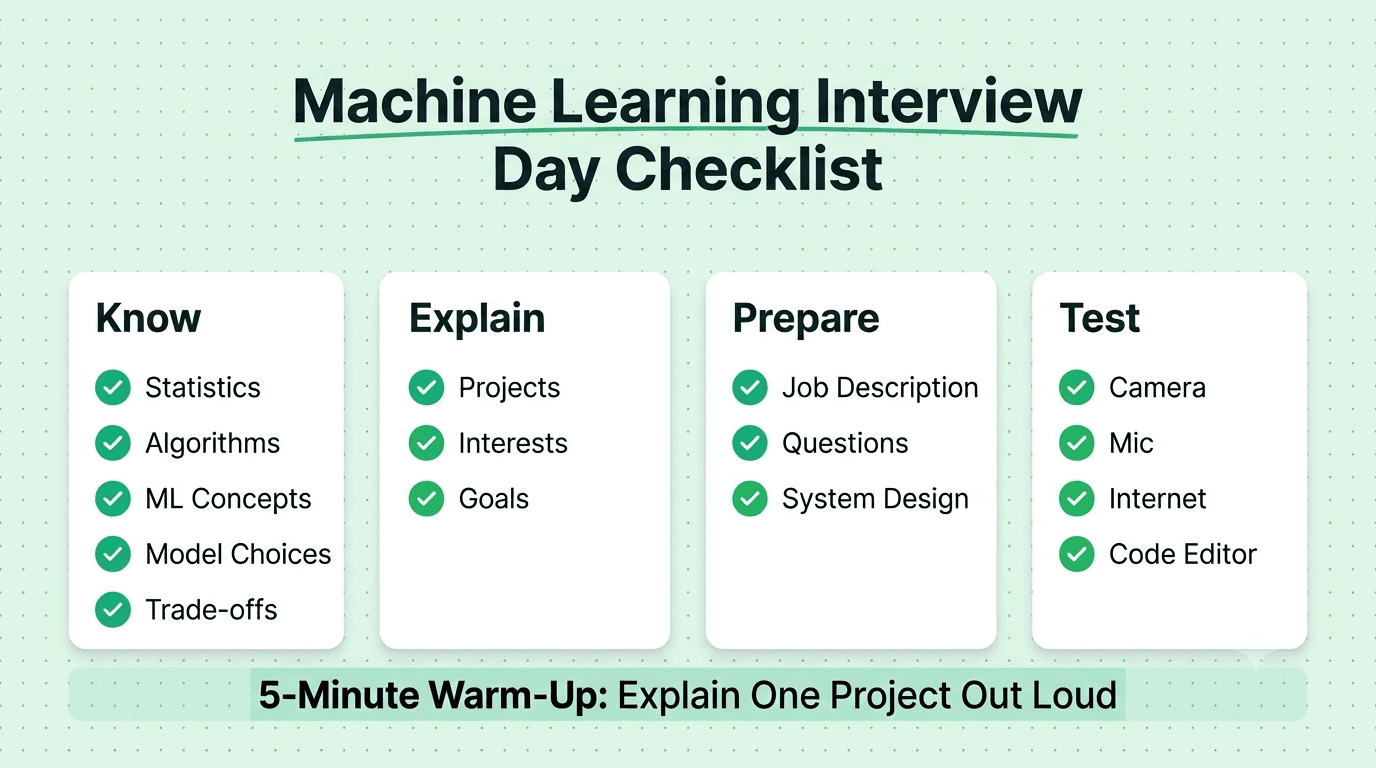
Review your two or three portfolio projects and be ready to explain the problem framing, model choice, and business impact of each in under two minutes.
Refresh core statistics concepts and the strengths and weaknesses of common algorithms.
Re-read the job description and note two or three specific tools or techniques to emphasize.
Prepare three to five thoughtful questions about the team's data infrastructure, model deployment process, and how they measure model success.
Test your camera, microphone, code editor, and internet connection if the interview is remote.
Have a notepad or blank document ready for system design rounds to sketch a pipeline diagram.
Do a five minute warm-up: explain one project's approach out loud before the call starts.
Section 11: Industry Trends Shaping Machine Learning Interviews in 2026
Large language models and generative AI are now a common interview topic, with candidates increasingly expected to understand prompt design, fine tuning, and retrieval augmented generation at a conceptual level, even outside pure LLM roles.
MLOps skills are treated as core knowledge, not a specialized add-on, with interviewers expecting candidates to discuss model versioning, monitoring, and retraining pipelines as a normal part of the job.
Responsible AI questions are appearing more frequently, with interviewers asking how candidates would detect and address bias or fairness issues in a model.
Take-home assignments are shrinking in favor of live, conversational case studies, since companies want to observe real-time reasoning rather than a polished, possibly AI-assisted, take-home submission.
Practical data skills are being tested earlier in the loop, with more companies including a dedicated SQL or data manipulation round before diving into deeper ML theory.
Preparing for your next machine learning interview? Practicing out loud with realistic follow-up questions is one of the fastest ways to close the gap between knowing the material and performing well under pressure.