Loading...
Contents
System Design Interview Failures: Why Backend Developers Struggle
Jun 25, 202616 min readUpdated Sep 16, 2026
Backend developers fail system design interviews not because they lack technical knowledge, but because they approach the interview like a coding problem instead of an engineering conversation. The gap between knowing how systems work and being able to design one under pressure, out loud, with a stranger watching you, is wider than most developers expect until they are already sitting in that room. This blog is about closing that gap before you get there.
FREE TO USE
25K+ INTERVIEWS4.8★ RATING68% IMPROVEMENT
Crack Your Dream Job
Real Interviews. Real Pressure. Practice until it feels easy.
- Seamless Interview Experience
- Resume & JD Questions
- Instant Personalized Feedback
Why Did You Fail?
Here is what makes system design interviews different from everything else in the hiring process. In a coding interview, there is a problem. There is a correct answer. You either get there or you do not, but at least the target is clear. In a system design interview, nothing is that clean. You are given a vague prompt. Build Instagram. Design WhatsApp. Architect a URL shortener. And then you are expected to lead. You are expected to ask the right questions, make reasonable tradeoffs, explain your thinking, and arrive at something defensible without anyone telling you if you are on the right track. Most backend developers spend years writing code that someone else architected. They implement features inside systems that already exist. When they suddenly have to build the entire thing from scratch, in 45 minutes, on a whiteboard, they freeze or they rush or they go deep on one layer and completely ignore everything else. That is not a knowledge problem. That is a preparation problem. And that is exactly what this blog addresses.
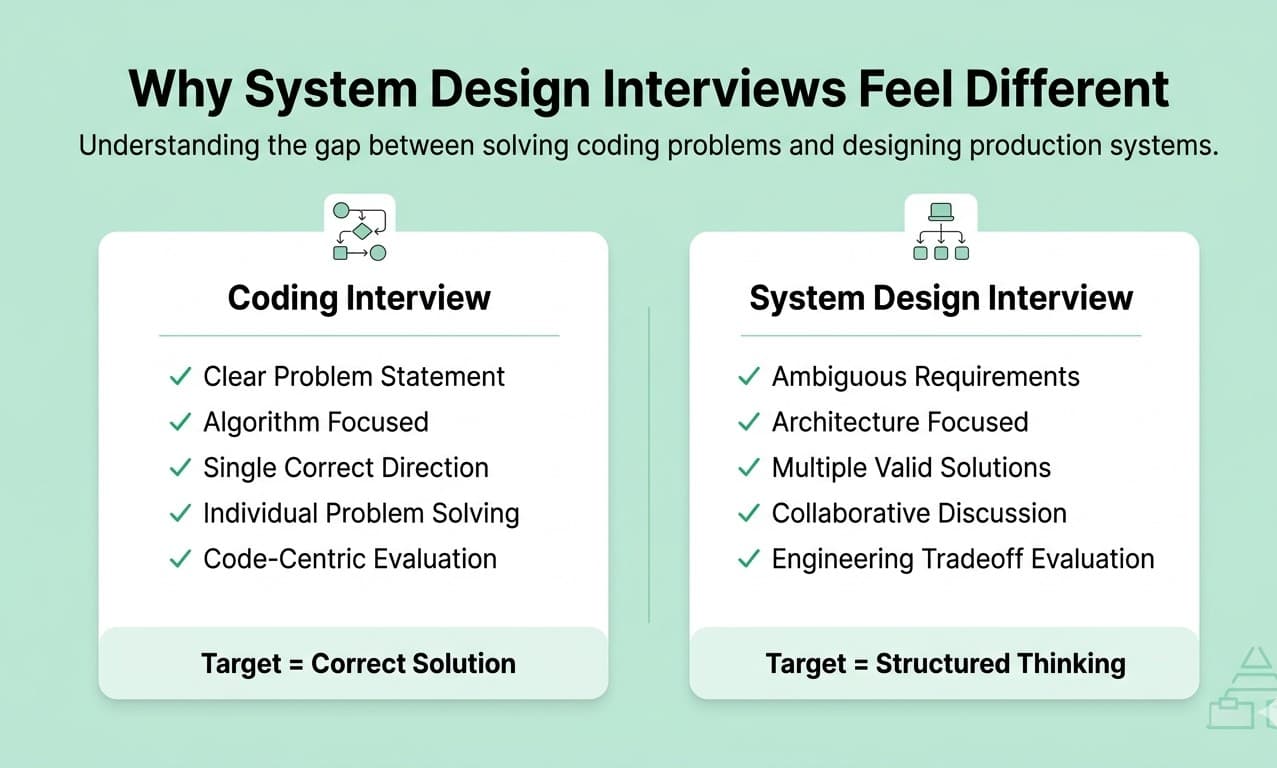
The Framework Behind System Design Interviews
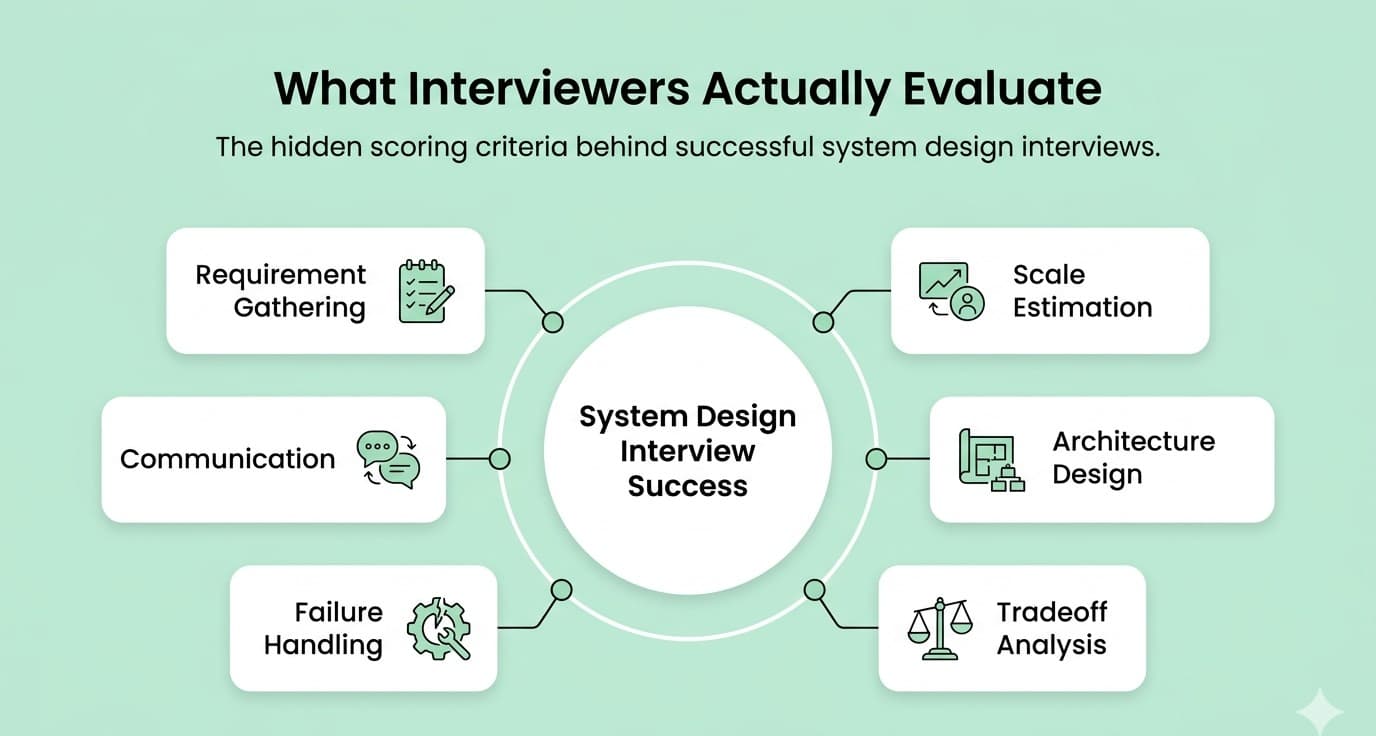
Before looking at the specific mistakes, you need to understand what the interviewer is actually evaluating. They are not checking whether your design is perfect. They are checking whether you think like someone who has shipped production systems. That means they want to see you clarify requirements before you start drawing boxes. They want to see you estimate scale so your architecture decisions make sense. They want to see you identify bottlenecks before they ask you to. They want to see tradeoffs acknowledged out loud, not hidden. The hidden scoring rubric in most system design interviews looks something like this. Did you ask the right questions? Did you start with a simple design and layer complexity? Did you explain why you are choosing each component? Did you proactively bring up failure modes? Did you stay on track or get lost in one layer? The developers who pass are not necessarily the ones with the most knowledge. They are the ones who demonstrate structured, communicative thinking under ambiguity. That is the real skill being tested.
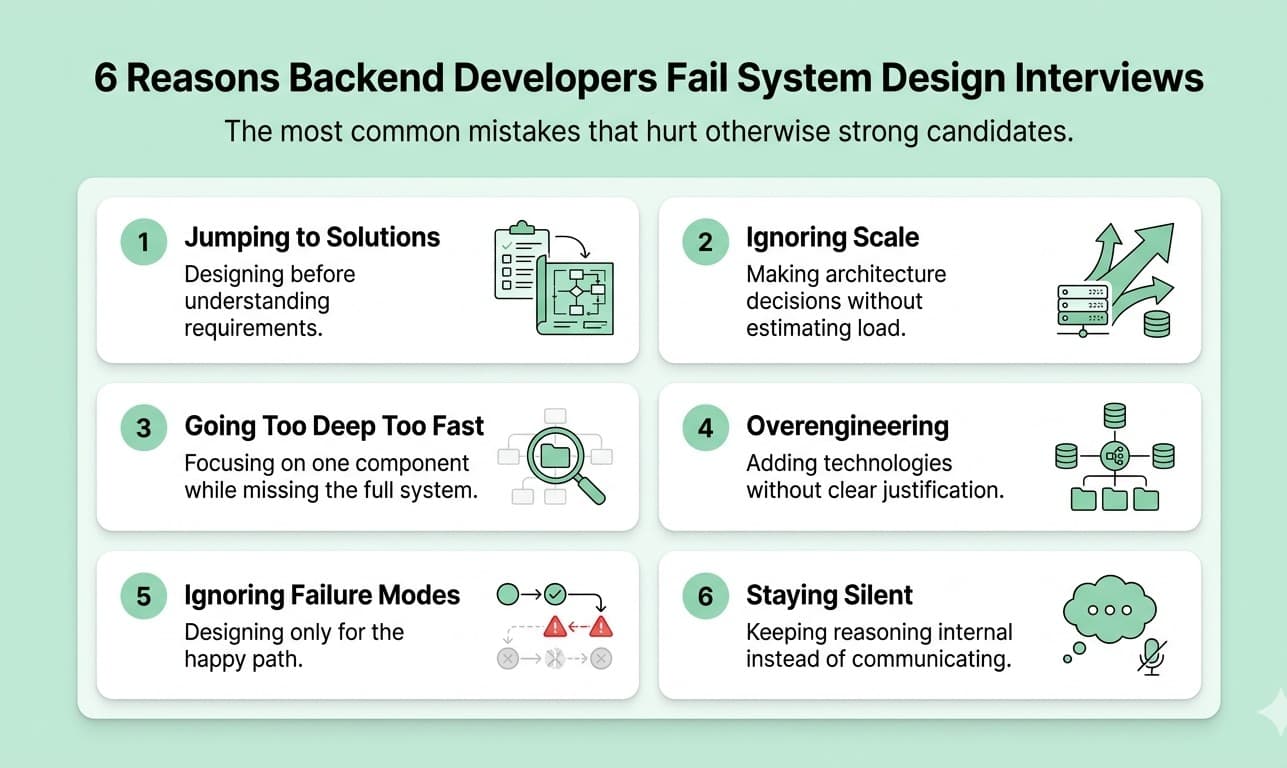
The Most Common System Design Interview Mistakes
Jumping to the solution before understanding the problem This is the most frequent mistake and it costs candidates more than any other. An interviewer says: "Design a notification system." And the developer immediately starts drawing boxes. Kafka here, Redis there, microservices everywhere. The interviewer is already unimpressed and the candidate has not noticed. A notification system for 1,000 users per day is architecturally completely different from one serving 100 million. Push notifications versus email versus SMS require entirely different components. Real-time versus near-real-time changes the stack. Mobile versus web changes the delivery mechanism. None of that is in the prompt. And if you do not ask, you are designing a system for a problem you invented in your head. The first two to three minutes of a system design interview should be spent entirely on questions. What is the scale? Who are the users? What are the latency requirements? What does success look like? Is this a new system or an extension of something existing? This is not wasting time. This is the interview. The questions you ask tell the interviewer more about your engineering instincts than the boxes you draw. Ignoring scale entirely Most backend developers work at companies where their database has a few million rows at most. Their mental model of scale is shaped by that reality. A system design interview often involves numbers that feel abstract. 10 million daily active users. 100,000 writes per second. A petabyte of storage per year. The mistake is designing as if those numbers are the same as what you are used to. When scale enters the picture, everything changes. A single relational database cannot handle 100,000 writes per second. A monolithic deployment cannot serve 50 million concurrent users without thoughtful load balancing. A file system is not a media storage solution for a platform the size of YouTube. You need to do back-of-envelope math out loud. How many requests per second? How much data are we storing? What are our read-to-write ratios? Those calculations directly drive your architectural decisions and demonstrating that chain of reasoning is exactly what a senior engineer looks like. Going too deep too fast This one is subtle and it costs a lot of developers who actually know their stuff. The interview starts. The developer gets excited about one piece of the system, maybe the caching layer or the message queue, and spends twenty minutes going deep on that one component. Then the interviewer starts gently steering them toward other parts of the design. And suddenly there are only ten minutes left to cover everything that was skipped. The result is a design that has one beautifully detailed section and a bunch of boxes with question marks. Interviewers reward breadth first, depth on request. The right approach is to sketch the entire system at a high level in the first ten minutes. Show that you understand all the major components and how they connect. Then invite the interviewer to go deeper on whichever area they care most about. This approach has two advantages. First, it ensures the overall design is coherent even if you run out of time. Second, it signals that you understand how systems actually work, as interconnected things where every piece affects every other piece. Choosing every technology at once This is the distributed systems overengineering trap. Kafka, Redis, Cassandra, Elasticsearch, Kubernetes, GraphQL. A developer who has read a lot of engineering blogs can rattle off every modern infrastructure component and sometimes that knowledge actually works against them in an interview. If you propose Kafka for a system that processes 100 events per minute, the interviewer notices. If you add Elasticsearch before you have even established why search needs to be fast, the interviewer notices. If your architecture looks like a distributed systems conference poster for what is essentially a CRUD application with modest scale requirements, the interviewer notices. The companies whose engineering blogs you are reading operate at a scale that justifies extreme infrastructure complexity. You are designing a system for a fictional company in an interview. Start simple. Add complexity only when you have a concrete reason for it. Not talking about failure Most backend developers think of system design as designing the happy path. The user sends a request. The system processes it. The user gets a response. Production systems spend as much engineering energy on what happens when things go wrong as on what happens when things go right. Interviewers expect you to bring up failure modes without being prompted. What happens when the database goes down? How do you handle a spike in traffic? What if the payment service returns a timeout? How do you deal with duplicate messages in your queue? Discussing these scenarios is not pessimism. It is the difference between someone who has thought about systems in production and someone who has only thought about systems in theory. Staying silent A system design interview is a conversation, not an exam. The biggest invisible mistake is doing your thinking internally and only surfacing conclusions. An interviewer cannot evaluate your reasoning if you do not share it. And if you go quiet for three minutes while you think, they have no way of knowing whether you are making progress or completely lost. Think out loud. Say what you are considering. Say why you are making a particular choice. Say what the tradeoffs are. If you are unsure between two options, say both, explain the difference, and ask if there is a particular constraint that would tip the decision. This kind of collaborative, communicative thinking is what engineers actually do when they design systems together. The interview is testing whether you can do that naturally.
What Passing This Interview Actually Looks Like
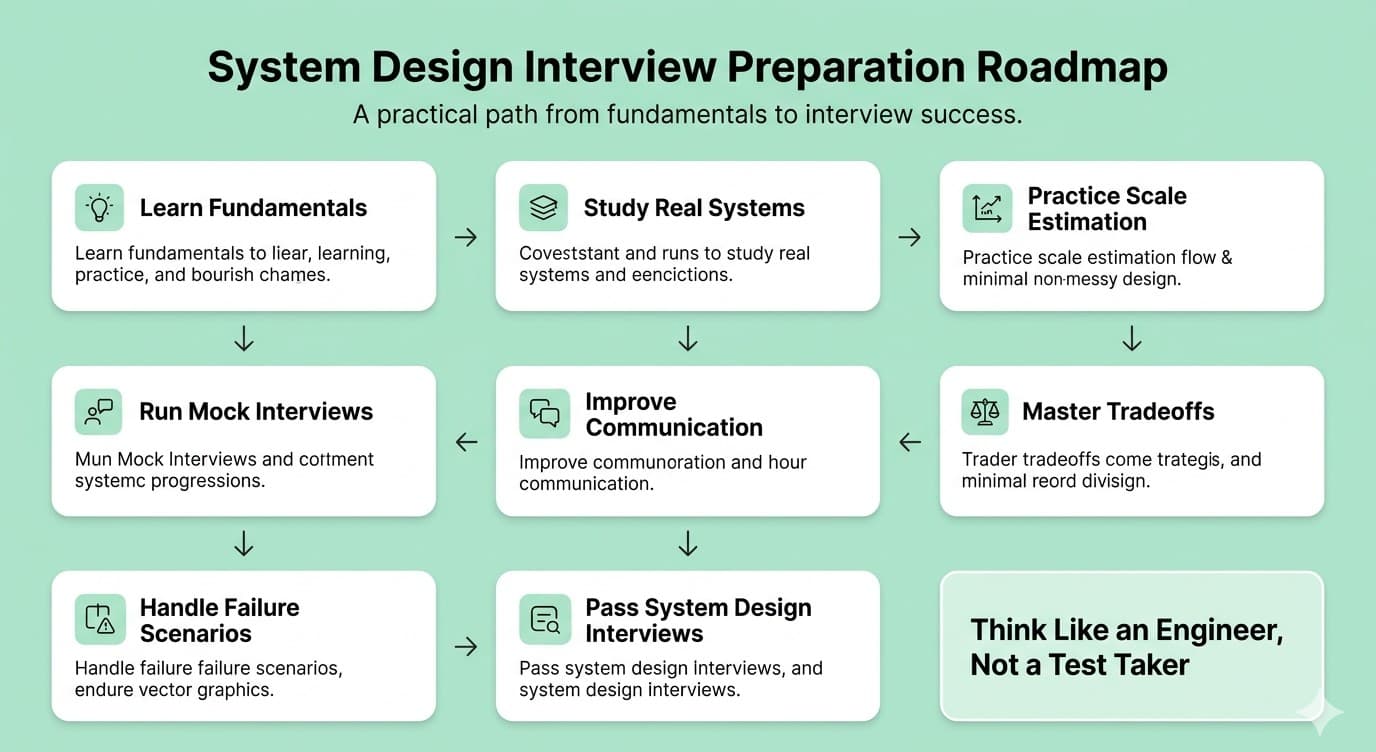
The developers who consistently perform well in system design interviews share a few habits that have nothing to do with memorizing system design patterns. They practice talking through designs out loud, not just thinking through them. There is a real difference between understanding a concept and being able to articulate it clearly under pressure. The only way to develop the second skill is to practice it, with another person listening. They study real systems with humility. Reading about how Instagram built its feed or how Stripe processes payments is valuable, but the goal is not to memorize their architecture. The goal is to understand why they made the decisions they made, what constraints drove those decisions, and what tradeoffs they accepted. They do mock interviews with feedback. Reading about system design mistakes is one thing. Discovering you are making them while designing a system in real time, with someone watching, is a completely different experience. That discomfort is useful. It surfaces the specific gaps in your thinking that you cannot discover by reading alone. They stay curious about the problem. The developers who struggle in these interviews often want to get to the answer quickly, as if speed signals competence. The developers who perform well are genuinely interested in the problem. They ask questions because they want to understand, not because they have been told that asking questions is important.
FREE TO USE
8k+ SESSIONS92% FLUENCY4.9★ RATING
Speak With Confidence
Real Conversations. Real Scenarios. Speak until it feels natural.
- Real-Time Speaking Practice
- Guided Conversation Flows
- Instant AI Feedback
The One Insight That Changes How You Prepare
Here is what almost nobody tells you when you start preparing for system design interviews. The interview is not a test of your knowledge. It is a simulation of a real engineering discussion. Think about what happens on a senior engineering team when a new system needs to be built. Someone leads the discussion. They gather requirements. They sketch options. They explain tradeoffs. They invite disagreement. They update their thinking when someone points out a flaw. They end with a design that the team can commit to. That is the interview. The whiteboard is not a place to demonstrate what you know. It is a place to demonstrate how you think, communicate, and collaborate on hard problems. When you prepare with that framing, everything changes. You stop trying to memorize the "correct" architecture for every type of system. You start practicing the process of working through a design systematically, out loud, with another person.
Conclusion
System design interview mistakes almost always come down to the same root cause. Treating a collaborative engineering exercise like a technical quiz with a correct answer at the end. The fix is not to study harder. It is to practice differently. Ask more questions before you start designing. Estimate scale before you propose solutions. Sketch the full system before going deep on any one part. Talk through failure modes without being prompted. Keep the conversation moving. Think out loud. One action step before your next system design interview: do one full mock session out loud, with a timer, for a system you have never designed before. Do not read the answer after. Record yourself and listen back. Notice where you went silent. Notice where you got stuck. Notice what you skipped. That single exercise will teach you more about your actual gaps than weeks of reading system design guides.
Want to practice system design interviews in a structured way?
Mocklingo gives backend developers a dedicated space to run mock system design interviews with structured feedback on the exact dimensions that matter: requirement gathering, scale estimation, architectural breadth, tradeoff articulation, and failure handling. If the mistakes in this blog felt familiar, Mocklingo is where you go from recognizing the problem to actually fixing it.
More Blogs

Sep 30, 2026
React Developer Interview Preparation Guide: A Complete Roadmap for 2026
31 min read
