Loading...
Contents
The Complete Business Analyst Interview Preparation Guide
Sep 18, 202623 min read
Business Analyst roles sit at the crossroads of business needs and technical solutions. Because of this, interviews for this role test a wide mix of skills, communication, analytical thinking, requirement gathering, documentation, tools, and business judgment. This guide is built to help freshers stepping into their first BA role, intermediate analysts moving to a new company, and experienced professionals aiming for senior or lead BA positions.
FREE TO USE
25K+ INTERVIEWS4.8★ RATING68% IMPROVEMENT
Crack Your Dream Job
Real Interviews. Real Pressure. Practice until it feels easy.
- Seamless Interview Experience
- Resume & JD Questions
- Instant Personalized Feedback
Section 1: Introduction
A Business Analyst interview rarely tests one single skill. Instead, it checks whether you can understand a business problem, translate it into clear requirements, work with different stakeholders, and help deliver a solution that actually solves the problem. Interviewers want to see how you think, not just what you know. Depending on the company and the industry, such as banking, healthcare, retail, or technology, the depth of domain knowledge expected will vary. However, the core expectations remain fairly consistent everywhere: strong communication, structured thinking, requirement gathering ability, and comfort working with data and documentation. The interview process usually blends technical or domain knowledge with behavioral and situational questions. Some companies also include case studies or practical exercises like writing a sample requirement document or analyzing a small dataset. The good news is that most of this can be prepared for systematically with the right practice and structure.
Section 2: What Recruiters Look For
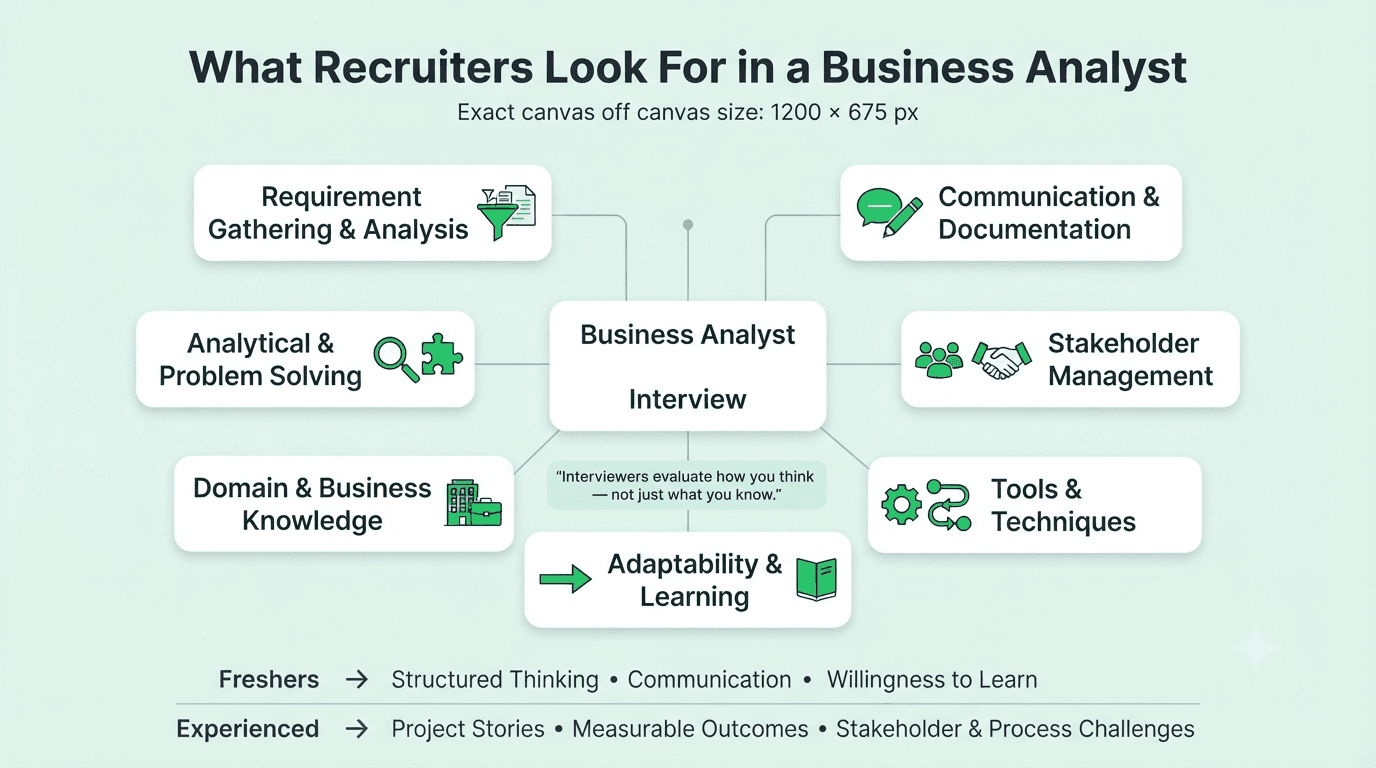
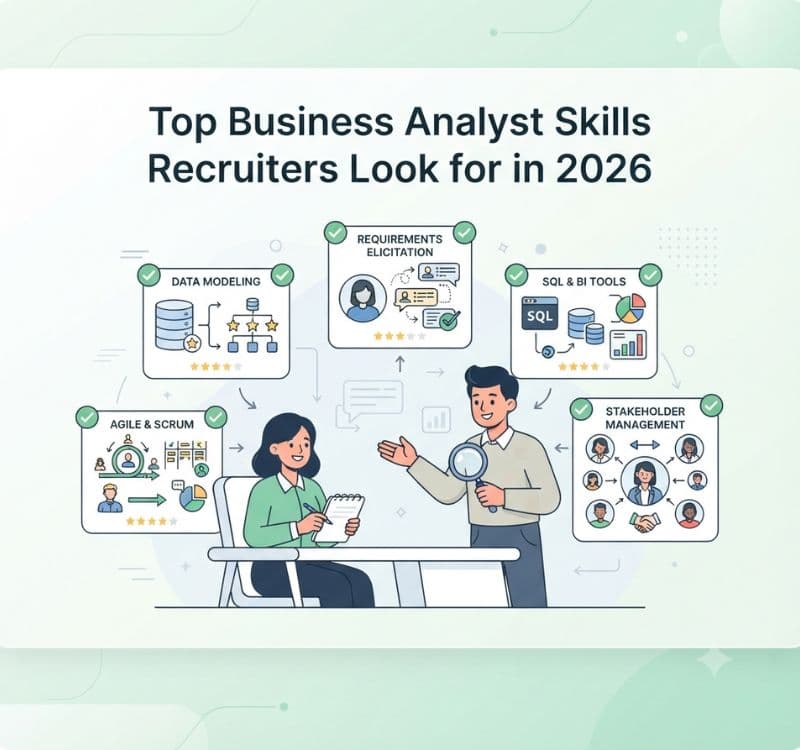
Recruiters and hiring managers typically evaluate the following, roughly in order of importance. Requirement gathering and analysis skills - Can you ask the right questions to uncover what stakeholders actually need, not just what they say they want. Communication and documentation - Can you write clear requirement documents, user stories, or process flows that both business and technical teams can understand. Analytical and problem solving ability - Can you break down a business problem, spot patterns in data, and suggest practical solutions. Stakeholder management - Can you work with people who have conflicting priorities and still keep a project moving forward. Domain and business knowledge - Do you understand the industry you are applying to, at least at a working level. Tool and technique familiarity - Are you comfortable with common BA tools such as Excel, SQL, Jira, Confluence, Visio, or Power BI. Adaptability and learning mindset - Can you quickly pick up new domains, tools, or processes when a project demands it. For freshers, recruiters place more weight on structured thinking, communication, and willingness to learn. For experienced candidates, recruiters expect real project stories, measurable outcomes, and stronger command over stakeholder and process challenges.
Section 3: How to Prepare
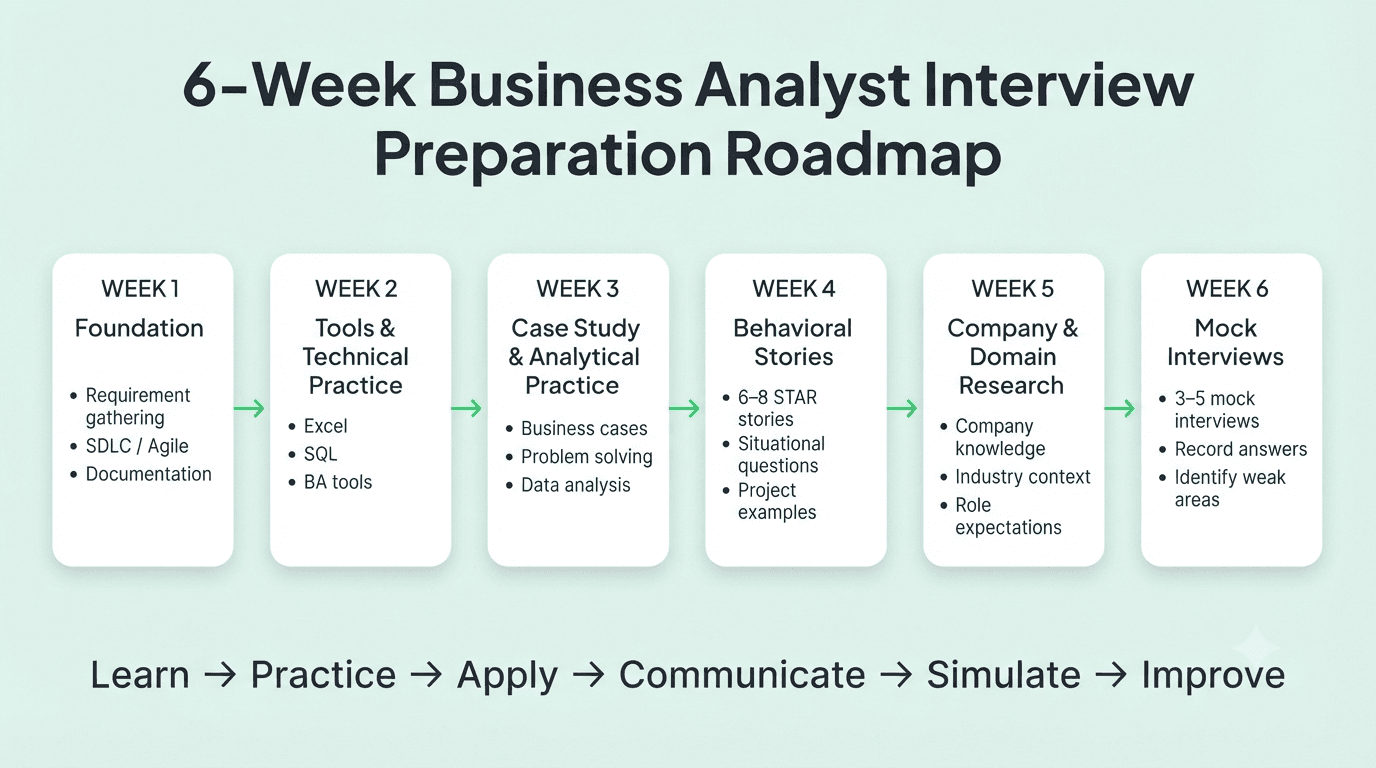
Here is a step-by-step preparation roadmap you can follow over four to six weeks. Week 1: Foundation Revise the core BA concepts listed in Section 4. Learn the basic vocabulary of requirement types, documentation standards, and common frameworks used in the industry you are targeting. Week 2: Tools and Technical Practice Practice writing user stories, use cases, and simple process flow diagrams. If SQL or Excel is part of the role, spend time on real practice exercises such as writing queries or building pivot tables from sample data. Week 3: Case Study and Analytical Practice Practice solving small business case studies. Take a business problem, for example, declining customer retention, and practice breaking it down, identifying possible causes, and proposing next steps. Week 4: Behavioral Stories Prepare six to eight stories from past projects or coursework using the STAR method, covering conflict with stakeholders, handling changing requirements, mistakes you made, and successful project outcomes. Week 5: Company and Domain Research Research the company, its products, its industry, and any recent business news. Understand what business problems that company likely faces, so you can speak their language in the interview. Week 6: Mock Interviews Do at least three to five mock interviews with peers, mentors, or by recording yourself. Review your answers for clarity, structure, and confidence, then refine. Repeat and adjust the plan based on your weakest areas as you go through practice sessions.
Section 4: Core Topics to Study
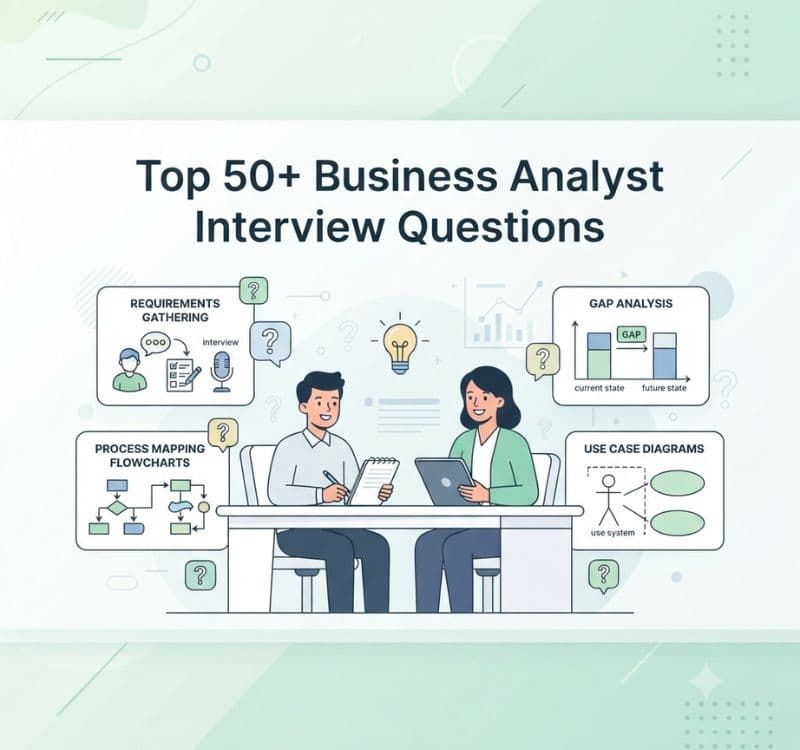
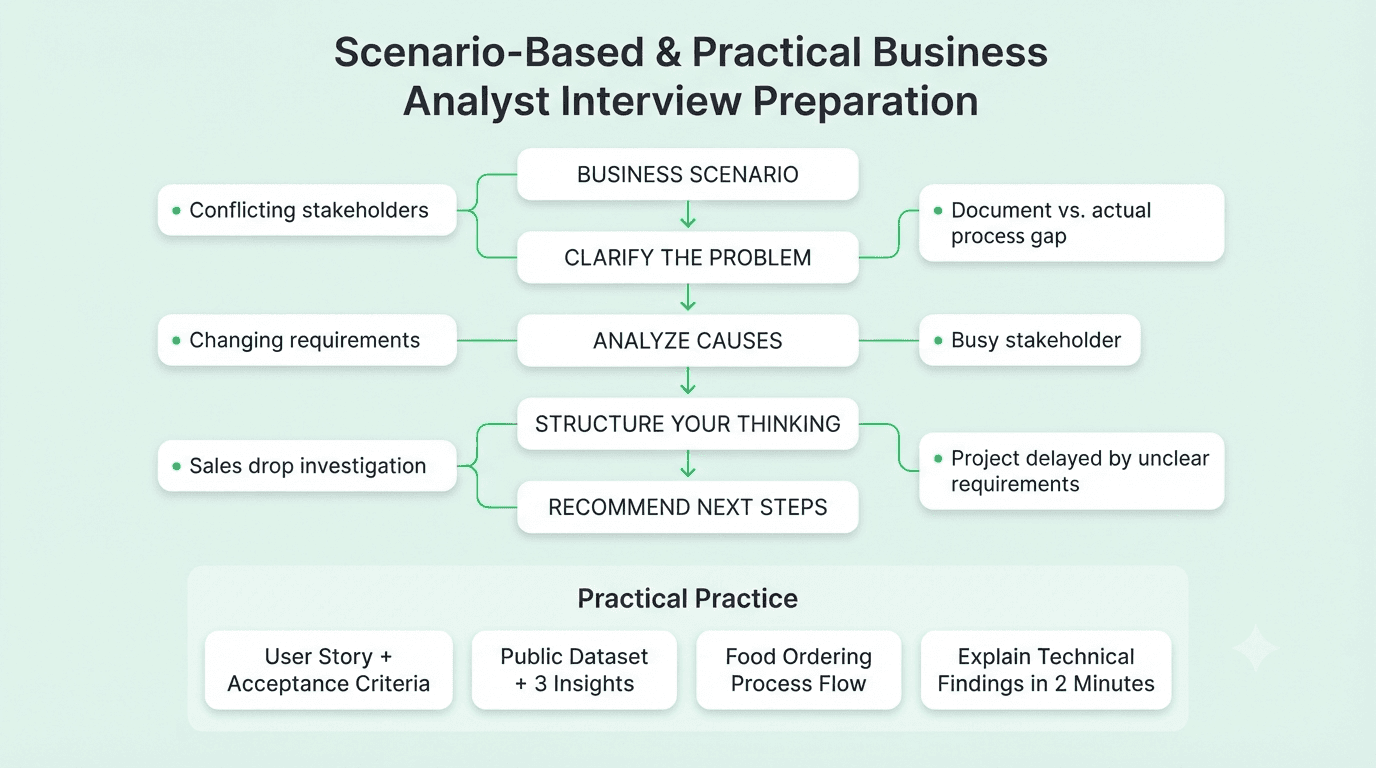
Topics below are ranked from most frequently tested to least, based on common BA interview patterns. Fundamental Concepts (must know) Requirement gathering techniques (interviews, workshops, surveys, observation) Types of requirements (business, functional, non-functional, stakeholder requirements) Documentation basics (Business Requirement Document, Functional Specification Document, user stories) Software Development Life Cycle and Agile basics (Scrum roles, sprints, backlogs) Basic data analysis skills (Excel functions, pivot tables, simple SQL queries) Intermediate Concepts Process modeling (flowcharts, swimlane diagrams, BPMN basics) Gap analysis and current state versus future state mapping Prioritization techniques (MoSCoW, Kano model) User story writing and acceptance criteria Basic wireframing and understanding of UI or UX collaboration with design teams Advanced Concepts Business case development and cost benefit analysis Change management and impact analysis for large projects Data modeling basics and understanding of databases and reporting tools Stakeholder mapping and influence strategy for complex projects Vendor evaluation and solution assessment frameworks Scenario-Based Preparation Practice these common scenario types out loud. Two stakeholders want opposite features in the same release, how do you resolve it A client keeps changing requirements midway through the project, how do you manage it Sales numbers dropped last quarter, how would you investigate the possible causes You discover a gap between what was documented and what the development team built, how do you handle it You need to gather requirements from a stakeholder who is too busy to meet regularly A project is running behind schedule due to unclear requirements early on, how do you get it back on track Practical Preparation Exercises Write a complete user story with acceptance criteria for a feature idea, such as adding a wishlist to an e-commerce app Take a public dataset and identify three interesting insights using Excel or SQL Draw a simple process flow diagram for an everyday process, such as ordering food online Practice explaining a technical or data related finding to a non-technical audience in under two minutes
FREE TO USE
8k+ SESSIONS92% FLUENCY4.9★ RATING
Speak With Confidence
Real Conversations. Real Scenarios. Speak until it feels natural.
- Real-Time Speaking Practice
- Guided Conversation Flows
- Instant AI Feedback
Section 5: Common Interview Rounds
Screening or HR Round Covers your background, career motivation, salary expectations, and basic fit for the company culture. Keep answers honest, clear, and enthusiastic. Technical or Domain Round Tests your knowledge of BA concepts, tools such as SQL or Excel, documentation standards, and possibly basic knowledge of the industry the company operates in. Case Study Round You are given a business problem or dataset and asked to analyze it, ask clarifying questions, and propose a structured recommendation. This round tests your analytical thinking as much as your final answer. Behavioral or Situational Round Focuses on past project experiences, stakeholder conflicts, handling ambiguity, and how you manage pressure and changing priorities. Uses the STAR method heavily. Manager or Team Round Often checks whether you would work well with the specific team, how you communicate, and how you handle feedback or disagreement with a manager. Client or Stakeholder Facing Round (for senior roles) Tests your ability to present findings clearly, handle pushback professionally, and manage expectations with non-technical business stakeholders.
Section 6: Best Practices
Always clarify the business goal behind a request before diving into requirements or solutions. Practice active listening, many BA interview questions are really testing whether you understand the problem before jumping to answers. Use simple, structured frameworks when answering case studies rather than jumping randomly between ideas. Bring specific numbers and outcomes when describing past projects, this makes your experience credible. Practice explaining technical or data findings in plain language, since much of a BA's daily work involves bridging both worlds. Prepare a few thoughtful questions about the company's current projects or challenges to ask the interviewer. Time your practice answers so you get comfortable with typical thirty to forty five minute interview slots. Record yourself during at least one mock interview to catch habits you might not notice while speaking live.
Section 7: Mistakes to Avoid
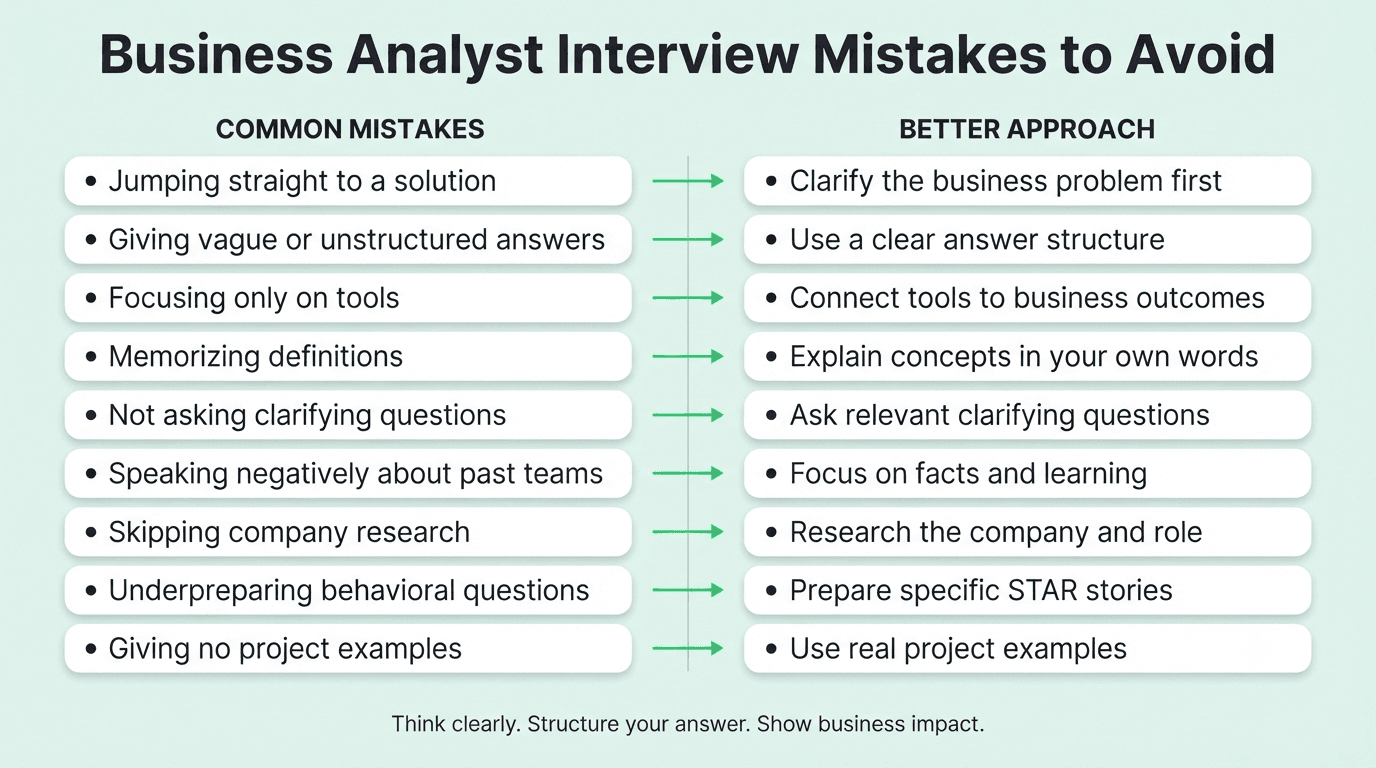
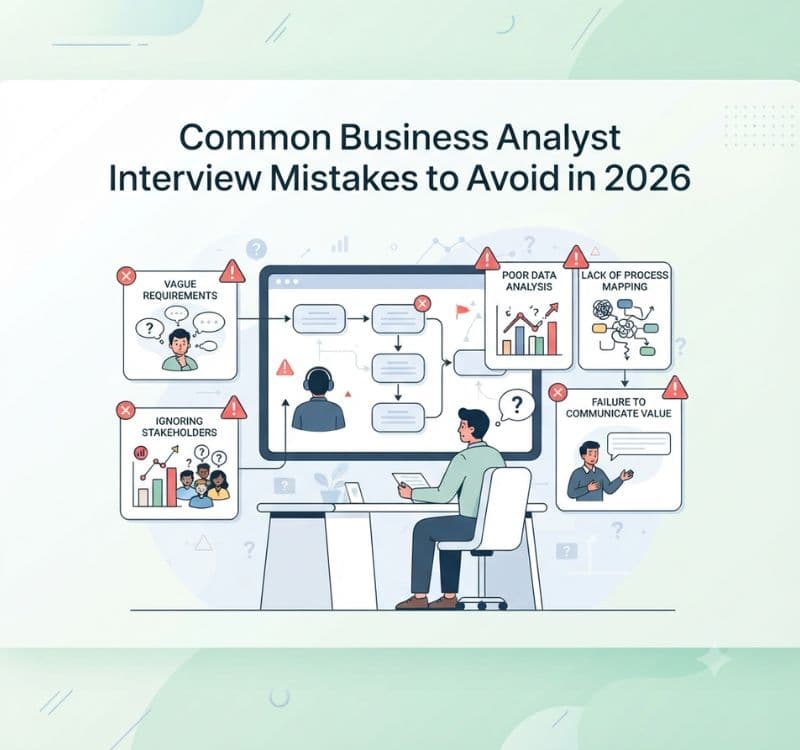
umping straight to a solution without fully understanding the business problem Giving vague or unstructured answers instead of a clear, step-by-step response Focusing only on tools and technical skills while ignoring communication and stakeholder management questions Memorizing definitions without being able to apply them to a real scenario Failing to ask clarifying questions during case study or scenario-based prompts Speaking negatively about past teams, clients, or managers Not researching the company's business model or industry before the interview Underpreparing behavioral questions compared to technical ones Not having specific project examples ready when describing past experience
Section 8: Final Checklist
The night before Review your prepared behavioral stories and refresh key BA frameworks Read recent news or updates about the company and its industry Prepare two or three thoughtful questions for the interviewer Get a full night of sleep, tired thinking shows quickly during case study discussions On interview day Arrive or log in ten minutes early Keep a notebook and pen ready to note down case study details or questions Take a moment to think before answering, brief pauses are completely fine Ask clarifying questions before diving into any open-ended case or scenario Narrate your thought process clearly instead of going silent while thinking Summarize your answer at the end of each response for clarity Thank the interviewer and send a short thank you note if appropriate
Section 9: Industry Trends
Growing demand for data literacy: Companies increasingly expect BAs to be comfortable with SQL, dashboards, and basic data analysis rather than relying only on Excel. AI and automation in analysis work: Many organizations now use AI tools to speed up data analysis and documentation, so BAs are expected to know how to use these tools effectively rather than avoid them. Agile and product-oriented BA roles: Business Analyst responsibilities are increasingly blending with product roles, with more focus on continuous discovery rather than one-time requirement documents. Emphasis on business outcomes over documentation volume: Companies are shifting focus from producing large requirement documents to ensuring measurable business results from projects. Remote and cross-time-zone stakeholder management: With more distributed teams, BAs are expected to manage stakeholder communication effectively across different time zones and cultures. Rising importance of soft skills: As technical tools become more automated, interviewers are placing greater weight on communication, negotiation, and stakeholder influence skills.
Conclusion
Preparing well for a Business Analyst interview comes down to building a repeatable way of thinking through business problems, practicing clear communication, and being ready with real examples from your experience. Practice consistently, seek feedback, and walk into your interview ready to think through problems calmly and clearly.