Loading...
Contents
The Complete Product Manager Interview Preparation Guide
Sep 11, 202616 min readUpdated Oct 27, 2026
Landing a Product Manager role is one of the toughest journeys in the job market today. Companies want people who can think like a business leader, act like an engineer, and communicate like a storyteller, all at once. This guide walks you through everything you need to prepare, whether you are a fresher trying to break into product management, a working professional switching careers, or an experienced PM aiming for a senior role.
FREE TO USE
25K+ INTERVIEWS4.8★ RATING68% IMPROVEMENT
Crack Your Dream Job
Real Interviews. Real Pressure. Practice until it feels easy.
- Seamless Interview Experience
- Resume & JD Questions
- Instant Personalized Feedback
Section 1: Introduction
Product Manager interviews are different from most other job interviews. There is rarely one right answer. Interviewers are not just checking what you know, they are watching how you think, how you prioritize, how you handle ambiguity, and how you work with people who disagree with you.
A typical PM interview process tests four broad areas: product sense, execution ability, analytical thinking, and leadership or behavioral skills. Depending on the company and seniority level, some areas get more weight than others. Early career roles lean more on execution and communication. Senior roles lean more on strategy, influence, and leadership.
The good news is that PM interviews are learnable. Unlike some technical interviews that reward memorization, PM interviews reward structured thinking and practice. If you learn the frameworks, practice out loud, and study real products, you can walk in prepared and confident.
Section 2: What Recruiters Look For
Recruiters and hiring managers are usually scanning for the following, roughly in order of importance.
- Structured thinking - Can you break a vague problem into smaller, logical pieces instead of jumping straight to a solution.
- Customer empathy - Do you genuinely understand user needs, or do you only think about features and metrics.
- Communication clarity - Can you explain a complex idea simply, and can you listen well.
- Business and metrics sense - Do you understand how a product decision connects to revenue, growth, retention, or cost.
- Execution and ownership - Have you actually shipped things, and can you talk about what happened, good and bad.
- Collaboration and influence - Can you work with engineers, designers, and stakeholders without formal authority over them.
- Curiosity and learning ability - Do you ask good questions and adapt quickly to new information.
For freshers, recruiters weigh potential and thinking ability more heavily since you may not have direct experience. For experienced candidates, recruiters expect real stories with real outcomes, not just theory.

Section 3: How to Prepare
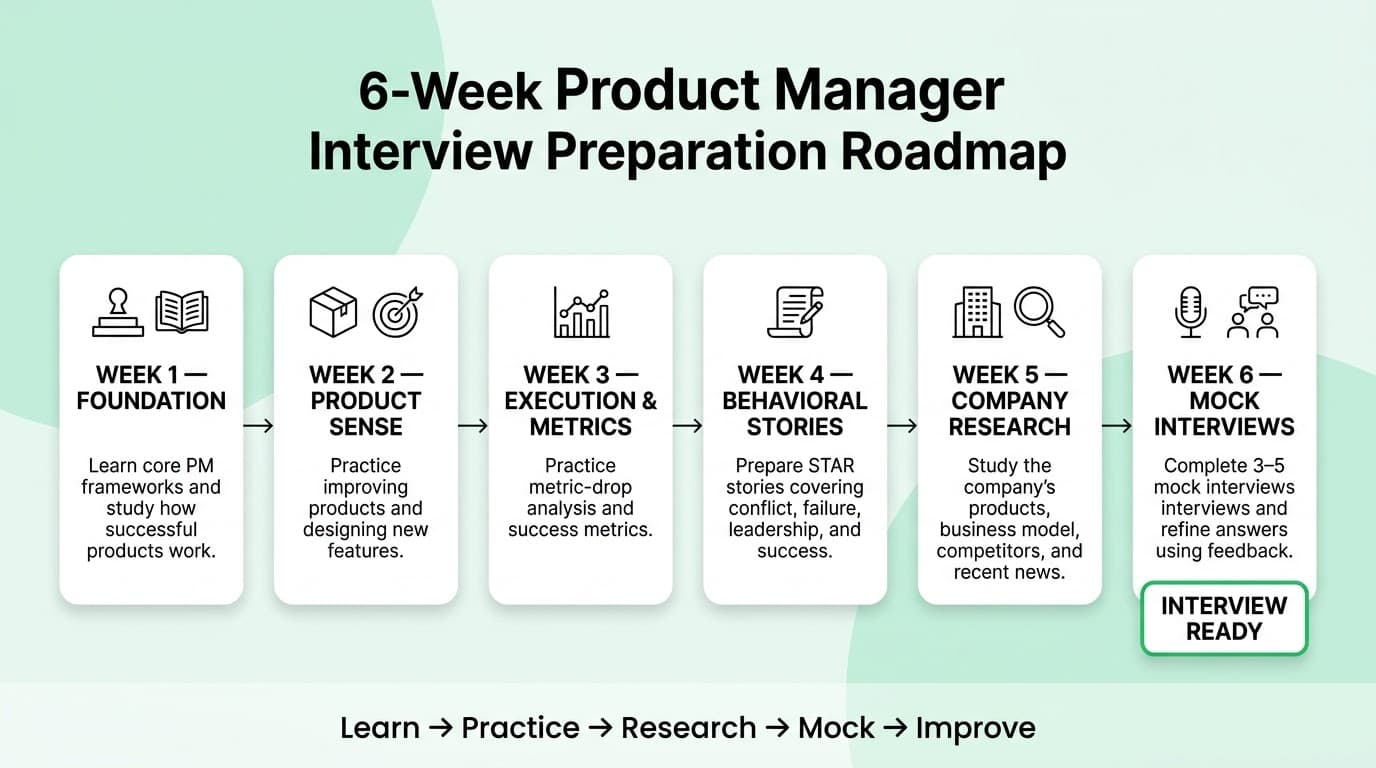
Here is a step-by-step roadmap you can follow over four to six weeks.
Week 1: Foundation Learn the core frameworks (listed in Section 4). Read about how well-known products work. Start a document where you log interesting product observations from apps you use daily.
Week 2: Product Sense Practice Pick five to ten products. For each one, practice answering "How would you improve this product" and "Design a new feature for this product" using a structured framework.
Week 3: Execution and Metrics Practice Practice root cause analysis questions such as "Metric X dropped 20 percent last week, how do you investigate." Practice defining success metrics for features.
Week 4: Behavioral Stories Prepare six to eight stories from your past work or projects using the STAR method (Situation, Task, Action, Result). Cover conflict, failure, leadership, and success stories.
Week 5: Company Research Study the specific company's products, business model, recent news, and competitors. Prepare questions to ask the interviewer.
Week 6: Mock Interviews Do at least three to five mock interviews with peers, mentors, or by recording yourself answering out loud. Review and refine based on feedback.
Repeat this cycle, focusing more time on your weakest area as you go.

Section 4: Core Topics to Study
Section 4: Core Topics to Study
Below are the topics ranked from most frequently tested to least, based on common interview patterns.
Fundamental Concepts (must know)
- Product sense and feature design frameworks
- Prioritization frameworks (RICE, MoSCoW, Impact vs Effort)
- Metrics definition (North Star metric, input vs output metrics, leading vs lagging indicators)
- User research basics (qualitative vs quantitative, interviews, surveys)
- Product lifecycle stages (idea, discovery, build, launch, iterate, sunset)
Intermediate Concepts
- Root cause analysis for metric drops
- A/B testing and experimentation basics
- Go-to-market strategy basics
- Roadmapping and stakeholder communication
- Trade-off analysis between speed, quality, and scope
Advanced Concepts
- Product strategy and vision setting
- Platform thinking and ecosystem effects
- Pricing and monetization strategy
- Organizational design for product teams
- Cross-functional leadership without direct authority
Scenario-Based Preparation Practice these common scenario types out loud:
- Design a product for a specific user group (for example, design an app for elderly people to manage medication)
- Improve an existing product (for example, improve Instagram Stories)
- Diagnose a metric drop (for example, daily active users fell 15 percent)
- Prioritize a set of competing feature requests with limited engineering time
- Handle a disagreement between engineering and design over a launch timeline
- Decide whether to build, buy, or partner for a new capability
- Estimate market size or usage numbers (Fermi estimation questions)
Practical Preparation Exercises
- Write one full feature design answer per day for a week, using a framework end to end
- Keep a "product teardown" notebook where you analyze one app per day, noting what works and what does not
- Practice explaining a technical concept to a non-technical person in under two minutes
- Create a one-page product requirements document for a feature idea and share it for feedback
FREE TO USE
8k+ SESSIONS92% FLUENCY4.9★ RATING
Speak With Confidence
Real Conversations. Real Scenarios. Speak until it feels natural.
- Real-Time Speaking Practice
- Guided Conversation Flows
- Instant AI Feedback
Section 5: Common Interview Rounds
Screening or HR Round Focuses on your background, motivation for switching or applying, salary expectations, and basic culture fit. Keep answers honest, concise, and enthusiastic. Product Sense Round You get an open-ended prompt like "Design a product for X" or "How would you improve Y." The interviewer wants to see your framework, creativity, and prioritization skills, not a perfect answer. Execution or Analytical Round Focuses on metrics, experimentation, and root cause analysis. You may be given a scenario with data and asked to diagnose a problem or define success metrics for a launch. Strategy Round (mid to senior roles) Tests your ability to think about markets, competition, business models, and long-term direction. Expect questions like "Should Company X enter Market Y" or "What should be the three-year strategy for this product." Behavioral or Leadership Round Focuses on past experiences, conflict resolution, failure stories, and how you influence people without authority. Uses the STAR method heavily. Case Study Round (common in consulting-style or senior PM interviews) A structured business problem is presented, and you must think aloud through the situation, ask clarifying questions, and arrive at a recommendation. Hiring Manager or Bar Raiser Round Often a mix of everything above, plus a deeper check on whether you would thrive in that specific team and company culture.
Best Practices to follow
Always clarify the problem before jumping to a solution. Asking good clarifying questions is itself a signal of strong product thinking. Think out loud. Interviewers cannot read your mind, so narrate your reasoning as you go. Use frameworks as a guide, not a script. Adapt them naturally instead of reciting them mechanically. Always tie your answer back to the user and the business impact, not just the feature itself. Practice summarizing your answer in the final thirty seconds so the interviewer remembers your key point. Prepare thoughtful questions to ask the interviewer, this shows genuine interest and curiosity. Time yourself during practice so you get comfortable with typical interview time limits, usually thirty to forty five minutes per round. Record yourself at least once during preparation, watching it back reveals habits you cannot notice while speaking.
Mistakes to Avoid

Jumping straight into a solution without understanding the problem or the target user Giving vague answers without structure, jumping randomly between ideas Ignoring the business side and focusing only on features you personally find exciting Memorizing answers word for word instead of understanding the underlying thinking Failing to ask clarifying questions in open-ended prompts Talking too long without checking in with the interviewer Not preparing specific metrics or numbers when discussing past project outcomes Speaking negatively about past teams, managers, or companies Not researching the company's actual product before the interview Treating behavioral questions as an afterthought compared to product sense questions

Final Checklist
The night before Review your prepared stories and refresh key frameworks Read the latest news about the company and its main product Prepare two or three thoughtful questions for the interviewer Get a full night of sleep, tired thinking shows up quickly in structured interviews On interview day Arrive or log in ten minutes early Have a notebook and pen ready to jot down the question and structure your thoughts Take a breath before answering, a few seconds of silence to think is completely fine Ask clarifying questions before diving into any open-ended prompt Narrate your thinking clearly, do not go silent while working through a problem Summarize your answer at the end of each response Thank the interviewer and follow up with a short thank you note if appropriate
Industry Trends
AI-native product thinking: Companies increasingly expect PMs to understand how to design products with AI features, not just as an add-on but as core functionality, and to reason about data, model behavior, and user trust. Outcome over output focus: Teams are moving away from just shipping features toward measuring real outcomes like retention, activation, and revenue impact. Growth and lifecycle specialization: Many companies now hire PMs for specific lifecycle stages, such as growth PM, retention PM, or platform PM, rather than one generalist role. Cross-functional AI collaboration: PMs are expected to work closely with data science and machine learning teams, understanding enough about models and data pipelines to make informed product trade-offs. Leaner teams, broader scope: With smaller product teams becoming common, PMs are expected to handle more of the analytical and even some design work themselves. Emphasis on ethical and responsible product decisions: Especially with AI features, companies are testing candidates on how they think about privacy, fairness, and unintended consequences. Preparing well for a Product Manager interview is less about memorizing perfect answers and more about building a repeatable way of thinking. Practice consistently, get feedback from people who have been through the process, and walk into your interview ready to think out loud with confidence.
More Blogs


Oct 22, 2026
UI/UX Designer Interview Preparation Guide: A Complete Roadmap for 2026
38 min read

