Loading...
Contents
Top Machine Learning Engineer Skills Recruiters Look for in 2026
Sep 28, 202640 min read
In 2026, recruiters hiring DevOps engineers prioritize five things above everything else: strong Linux and networking fundamentals, hands-on Infrastructure as Code (Terraform/OpenTofu), container orchestration (Docker + Kubernetes), CI/CD pipeline design, and cloud cost-and-security literacy — combined with the judgment to know when not to automate something. Certifications help you get noticed; production incident stories get you hired.
This guide is written the way an actual hiring loop works — resume screen, recruiter call, technical screen, system design/practical round, and final panel — so you know exactly where each skill gets tested and what "good" looks like at fresher, mid, and senior level.
FREE TO USE
25K+ INTERVIEWS4.8★ RATING68% IMPROVEMENT
Crack Your Dream Job
Real Interviews. Real Pressure. Practice until it feels easy.
- Seamless Interview Experience
- Resume & JD Questions
- Instant Personalized Feedback
How ML Engineer Hiring Has Shifted Going Into 2026
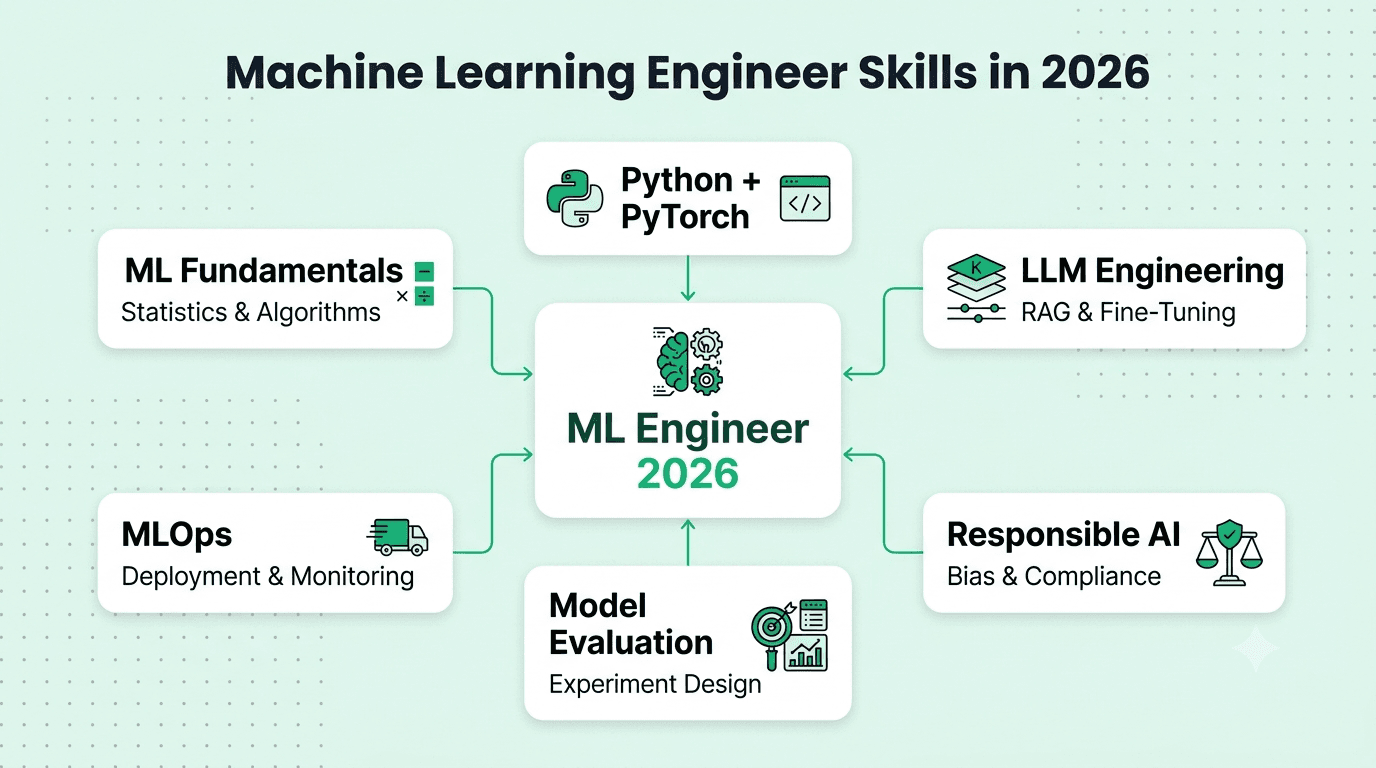
The two biggest changes are that LLM engineering skills, including RAG, fine-tuning, and LLM evaluation, are now tested in standard ML interviews rather than only at AI-focused companies, and that MLOps has become a baseline expectation rather than a specialized track. Candidates who only know how to train models in notebooks are increasingly screened out at mid-level roles.
Several specific forces are reshaping ML hiring:
LLM engineering has merged with the ML engineering job description. Companies that are not building foundation models are still building products on top of them, which means their ML engineers are designing retrieval systems, evaluating model outputs, managing fine-tuning experiments, and building the infrastructure to serve LLM-powered features reliably. These are engineering skills with specific failure modes, and recruiters are testing for them.
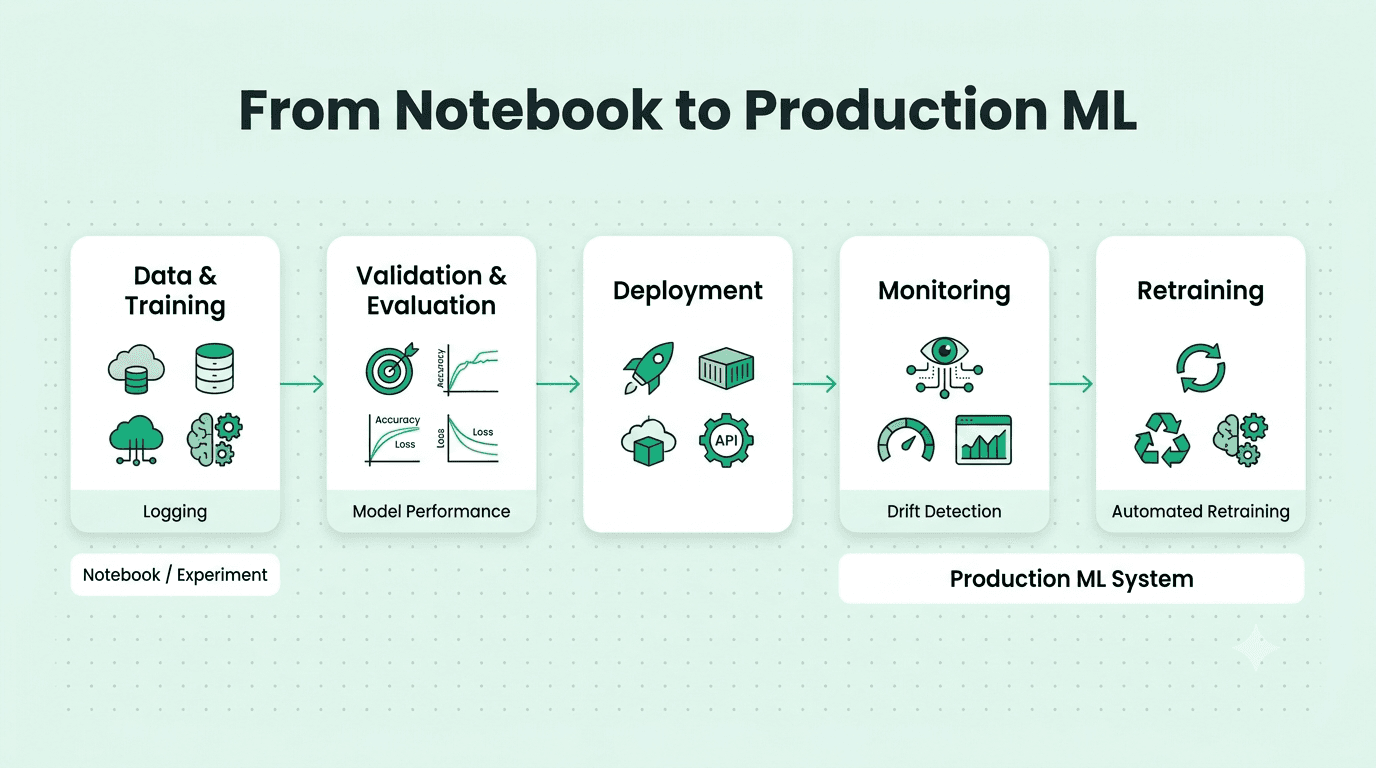
MLOps has become a universal expectation at mid-level. The ability to take a trained model from a notebook to a deployed, monitored, automatically retrained production system is no longer evaluated only at senior levels. Mid-level ML engineers are expected to build pipelines, manage model registries, and implement drift detection without waiting for a dedicated MLOps engineer to help them.
The research-to-production gap is the primary screen. Hiring managers at product companies have learned to distinguish candidates who can fit a model from candidates who can build a reliable, maintainable ML system. The interview questions that reveal this gap are not about algorithm theory; they are about what happens when a production model starts behaving differently than it did during training.
Responsible AI has moved from an ethics discussion to a technical requirement. GDPR enforcement in Europe, emerging AI regulations in multiple jurisdictions, and documented consequences of biased model outputs mean that ML engineers are now expected to implement bias detection, document models formally, and make defensible decisions about model fairness.
Core Fundamentals
Statistical and Algorithmic Foundations
Why Recruiters Prioritize This Skill
An ML engineer who does not understand why a model behaves the way it does cannot debug it when it behaves incorrectly. Statistical foundations are not academic requirements; they are the diagnostic toolkit that determines whether a model failure is caused by insufficient data, wrong model class, data leakage, distribution shift, or a hyperparameter problem. Recruiters test this because its absence produces engineers who tune hyperparameters randomly, interpret metrics incorrectly, and make model selection decisions based on defaults rather than reasoning.
What Recruiters Actually Expect in 2026
Not the ability to derive gradient descent from first principles in an interview. What is expected is the practical application of statistical reasoning to real modeling scenarios: understanding what a learning curve reveals about whether a model needs more data or a different regularization strategy, knowing the specific conditions under which tree-based models outperform neural networks on tabular data, understanding why high accuracy on an imbalanced dataset can indicate a model that predicts the majority class exclusively, and being able to explain what regularization actually does to the parameter space rather than just knowing that it prevents overfitting.
The 2026 expectation that is often missing from junior candidates is knowing when not to use ML. A heuristic or rule-based system that achieves 93% of the performance of an ML model at 5% of the maintenance cost is frequently the right engineering decision, and candidates who can make that case demonstrate the judgment that distinguishes an ML engineer from an ML practitioner.
Interview Evaluation
Diagnostic case studies where candidates are shown a model's learning curves, validation curves, and test metrics and asked what they reveal and what they would do next. These are not trick questions; they test whether a candidate has internalized the visual and numerical signatures of specific modeling problems. Algorithm selection questions that give a dataset description and ask which model class is most appropriate and why, evaluated on the reasoning rather than the answer. Probability and statistics questions focused on the specific distributions and tests that ML engineers encounter in practice.
Real Workplace Example
A fraud detection model achieves 99.2% accuracy on the test set. A team without statistical foundations ships it. A team with statistical foundations asks why 99.2% should be suspicious: if 0.8% of transactions are fraudulent in the training data, a model that predicts "not fraud" for every transaction achieves 99.2% accuracy with zero fraud detection capability. The relevant metrics are precision, recall, and F1 on the positive class. When those are evaluated, the model achieves 12% recall, meaning it catches only one in eight fraudulent transactions. The model had to be rebuilt from the ground up with a different evaluation framework.
Fresher Expectations
Understands bias-variance tradeoff at the visual level, can read a confusion matrix and calculate precision and recall correctly, knows when to use cross-validation versus a holdout set, and can explain why accuracy is the wrong metric for imbalanced classification.
Mid-Level Expectations
Diagnoses modeling problems from learning curves, understands the statistical assumptions of the models they use and what happens when those assumptions are violated, makes model selection decisions based on dataset characteristics rather than defaults, and knows when to stop modeling and build a rule-based system instead.
Senior-Level Expectations
Designs the evaluation framework for a new ML problem including the choice of metric, the test set construction strategy, and the analysis plan for investigating failure cases. Makes technology and architecture decisions based on a rigorous understanding of the trade-offs between model classes for specific data regimes.
Common Mistakes
Optimizing for accuracy on imbalanced problems without recognizing that accuracy is uninformative in that context. Treating validation accuracy as a reliable estimate of test performance without investigating the gap between them. Selecting a complex model when a simpler one would achieve comparable performance with less data, less compute, and lower maintenance cost.
How to Build This Skill
Take a Kaggle dataset with an imbalanced label distribution, train three different model classes on it, and evaluate each using accuracy, precision, recall, F1, and AUC-ROC. Then deliberately introduce a data leakage problem by including a feature that is derived from the label, observe the validation accuracy increase, and practice identifying the leakage from the metrics signature. This exercise builds the diagnostic instincts that interviews test.
Example Interview Questions
"Your model achieves 96% accuracy. Your stakeholder is happy. Should you be? What would you check?" "A learning curve shows that training loss is low and validation loss is high and not improving with more data. What does this tell you and what would you do?" "When would you choose gradient boosting over a neural network for a structured data problem?"
Strong Sample Answer Direction
A strong answer on model diagnostics names the specific phenomenon the metrics signature reveals, explains the mechanism by which it produces that signature, and proposes a specific next step rather than a general investigation plan. "The learning curve pattern shows low training loss and high, plateaued validation loss, which is classic high variance caused by overfitting. The gap is not closing with more training data, which means more data alone will not solve it. I would first try increasing regularization, then consider a simpler model class, and if neither works, investigate whether the training and validation distributions are actually comparable."
Python and the ML Engineering Stack
Why Recruiters Prioritize This Skill
Python fluency in ML is not the same as Python fluency in web development. ML code has specific performance requirements that make the gap between idiomatic and non-idiomatic code far more consequential: a training loop written with Python loops instead of vectorized NumPy operations can be ten to one hundred times slower. A data loading pipeline that materializes the entire dataset in memory before training will OOM-kill on any reasonably large dataset. A model that works on CPU silently moves to incorrect results on GPU due to a device mismatch bug. These are not edge cases; they are the failure modes that differentiate ML engineers who have built production systems from those who have only completed tutorials.
What Recruiters Actually Expect in 2026
PyTorch fluency is the dominant expectation in 2026 across both research and production ML roles, with TensorFlow remaining relevant in some production deployment contexts. Specific expectations include: understanding of PyTorch's autograd system well enough to debug a training failure caused by gradient computation errors, proficiency with the Hugging Face ecosystem including transformers, datasets, and peft libraries for working with pre-trained models, memory-efficient data loading using DataLoader with appropriate num_workers and pin_memory settings, and vectorized data manipulation with NumPy and pandas that does not rely on row-wise iteration for performance.
Interview Evaluation
Live coding sessions that include a small ML implementation task evaluated on whether the code is correct, efficient, and idiomatic. Common tasks include implementing a custom PyTorch dataset and dataloader, writing a training loop with gradient accumulation, or implementing a specific loss function from scratch. Code review exercises where candidates are shown ML code and asked to identify performance problems, memory issues, or correctness bugs.
Real Workplace Example
A training pipeline is running significantly slower than expected on a GPU cluster. An engineer with shallow Python ML knowledge tries adjusting batch size and learning rate. An engineer with production ML stack fluency profiles the pipeline and identifies that the bottleneck is in data loading: the DataLoader is running with num_workers=0, meaning the GPU is idle while the CPU fetches and preprocesses each batch sequentially. Setting num_workers to 4 and enabling pin_memory for faster GPU transfers reduces training time by 60% without changing any model code.
Fresher Expectations
Can write a working PyTorch training loop from scratch including forward pass, loss computation, backward pass, and optimizer step. Understands why vectorized NumPy operations are faster than Python loops and writes code accordingly. Can load, preprocess, and batch data using PyTorch DataLoader correctly.
Mid-Level Expectations
Writes memory-efficient data pipelines for datasets that do not fit in memory. Debugs training instability using gradient norms, loss curves, and activation statistics. Uses the Hugging Face ecosystem to load, fine-tune, and evaluate pre-trained models with appropriate configuration choices.
Senior-Level Expectations
Optimizes distributed training pipelines across multiple GPUs, makes framework selection decisions for production systems, and establishes ML stack standards for a team including tooling, versioning, and experimentation tracking.
Common Mistakes
Writing training loops that accumulate the full training loss history in a Python list, which causes memory overflow over long training runs. Not moving model and data to the same device before computing a forward pass, which produces a cryptic RuntimeError that appears more complex than it is. Using pandas apply for row-wise operations when a vectorized operation would be orders of magnitude faster.
How to Build This Skill
Implement a complete training pipeline for any task from scratch using only PyTorch, without using a trainer API. Include a custom Dataset class, a DataLoader with multiple workers, a training loop with gradient clipping and loss logging, a validation loop, model checkpointing, and a learning rate scheduler. Then profile the pipeline using PyTorch's profiler and find the three slowest operations.
Example Interview Questions
"Implement a custom PyTorch Dataset class for a text classification task where the labels are in one file and the texts are in another." "What happens when you call loss.backward() twice without calling optimizer.zero_grad() in between?" "How would you implement gradient accumulation and why would you use it?"
Strong Sample Answer Direction
A strong backward pass question answer explains the mechanism: calling backward() accumulates gradients in the .grad attribute of each parameter, so calling it twice without zeroing gradients doubles the gradient magnitude, which will cause the optimizer to take a step twice as large as intended, typically destabilizing training. This mechanism explanation is what interviewers are testing, not just the fact that you should call zero_grad.
Technical Skills
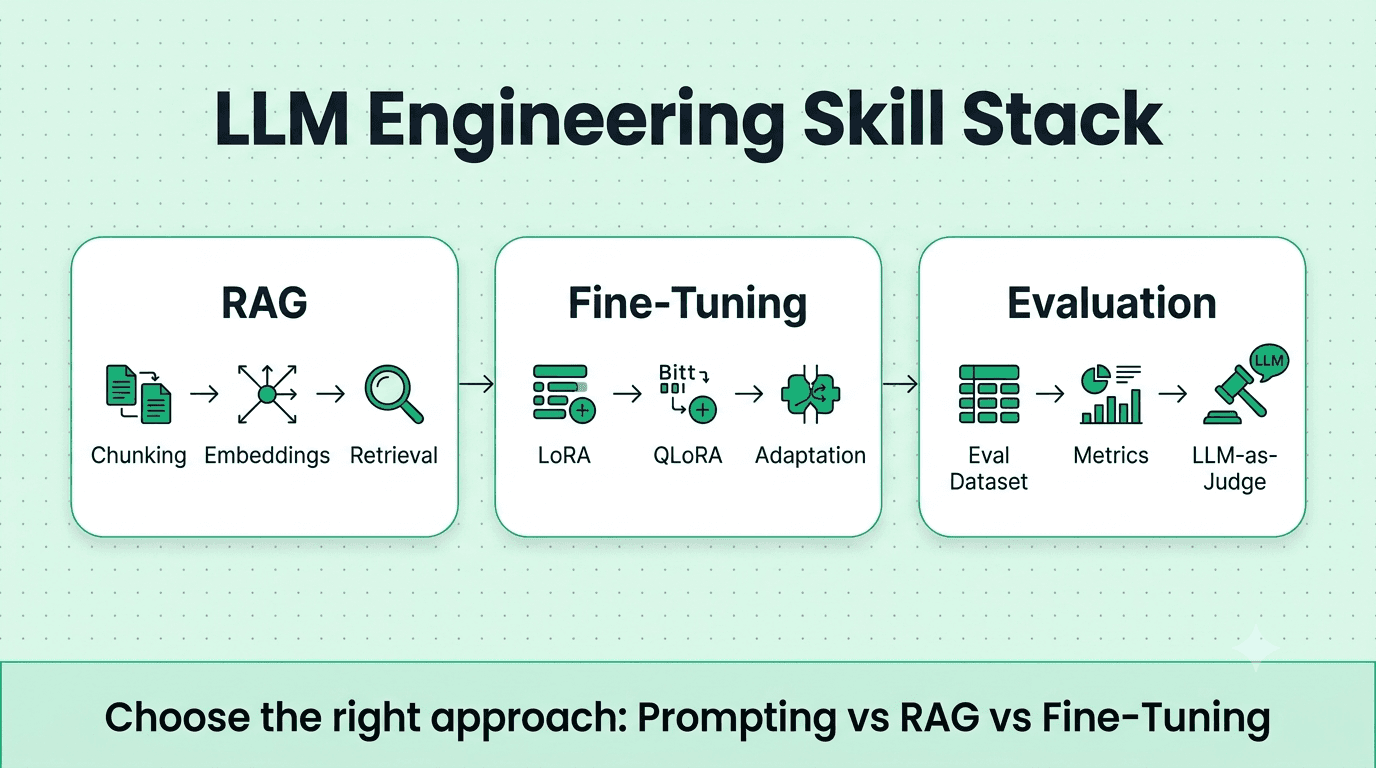
LLM Engineering: RAG, Fine-Tuning, and Evaluation
Why Recruiters Prioritize This Skill
LLM engineering is the fastest-growing component of the ML engineering job description. Companies that built their first AI features in 2023 using simple prompt engineering have discovered that production LLM systems require exactly the same rigor as traditional ML systems: careful evaluation, drift monitoring, cost management, and failure handling. The engineers who understand how to build reliable, cost-effective LLM-powered systems are in significantly higher demand than those who only know how to call an API and process the response.
What Recruiters Actually Expect in 2026
The ability to design a RAG pipeline including the specific decisions about chunking strategy, embedding model selection, retrieval evaluation, and context assembly that determine whether the system actually improves over a naive prompt. Understanding of when to use retrieval-augmented generation versus fine-tuning versus prompt engineering, with a clear articulation of the trade-offs of each approach for a specific use case. Familiarity with parameter-efficient fine-tuning methods, specifically LoRA and QLoRA, well enough to explain what they do and when they are the right choice. A framework for evaluating LLM outputs that goes beyond human spot-checking to include automated evaluation using LLM-as-judge, reference-based metrics where applicable, and structured evaluation datasets.
Interview Evaluation
System design questions that ask candidates to design an LLM-powered feature end to end, including the specific technology choices and their justifications. Evaluation questions that ask candidates how they would measure whether an LLM-based system is working correctly and detect when it degrades. Technical questions about the trade-offs between RAG and fine-tuning for specific scenarios.
Real Workplace Example
A company builds a customer service chatbot using a simple retrieval-augmented generation pipeline that retrieves the top three most similar support articles for any customer question. The system works reasonably well on simple questions but fails on questions that require synthesizing information from multiple sources or involve recent policy changes not in the knowledge base. An ML engineer with genuine RAG depth redesigns the pipeline: implements a hierarchical chunking strategy that preserves document structure, adds a reranking step using a cross-encoder to improve retrieval precision, implements a query expansion step that generates multiple query variants to retrieve more comprehensive context, and adds a hallucination detection step that verifies the model's response is grounded in the retrieved documents. The redesigned system reduces customer escalation rate by forty percent.
Fresher Expectations
Understands the basic RAG architecture and can explain why retrieval improves LLM responses for knowledge-intensive tasks. Can implement a simple RAG pipeline using an embedding model, a vector database, and an LLM API. Understands the difference between fine-tuning and prompt engineering at a conceptual level.
Mid-Level Expectations
Makes informed decisions about chunking strategy, embedding model selection, and retrieval evaluation for a specific use case. Can implement LoRA fine-tuning using the Hugging Face PEFT library with appropriate hyperparameter selection. Designs an evaluation framework for an LLM application that includes automated metrics and handles the absence of a single ground truth answer.
Senior-Level Expectations
Designs the overall LLM system architecture for a product including the build versus buy decisions for embedding models, vector databases, and base LLMs. Establishes evaluation infrastructure including evaluation datasets, automated scoring pipelines, and regression testing for model updates. Makes cost-performance trade-off decisions across the LLM stack.
Common Mistakes
Using fixed-size chunking for RAG without considering that fixed-size chunks often split sentences or paragraphs mid-thought, destroying the semantic coherence that embedding models depend on. Evaluating a RAG system only on retrieval precision without evaluating whether the retrieved context actually improves the LLM's response quality, which can miss cases where relevant documents are retrieved but the LLM fails to use them correctly.
How to Build This Skill
Build a complete RAG system for a real document collection, such as technical documentation, company policies, or academic papers, and design a systematic evaluation for it: a set of question-answer pairs where the correct answer is in the documents, a set where it is not, and a set where it requires synthesis from multiple documents. Measure retrieval recall and response accuracy for each category and use the results to identify the specific failure mode of your initial implementation.
Example Interview Questions
"When would you choose RAG over fine-tuning for a question-answering system, and what would change your mind?" "How would you evaluate whether your RAG pipeline's retrieval step is working well?" "Explain what LoRA does at the parameter level and why it requires significantly less compute than full fine-tuning."
Strong Sample Answer Direction
A strong RAG versus fine-tuning answer structures the decision around the nature of the knowledge required: "RAG is better when the knowledge is factual, frequently updated, or specific to external documents that can be retrieved at inference time. Fine-tuning is better when the knowledge is about style, format, or behavior that should be deeply embedded in the model's generation patterns rather than looked up. If the task requires both current factual knowledge and a specific response style, you often want both."
MLOps: Pipelines, Model Monitoring, and Production Deployment
Why Recruiters Prioritize This Skill
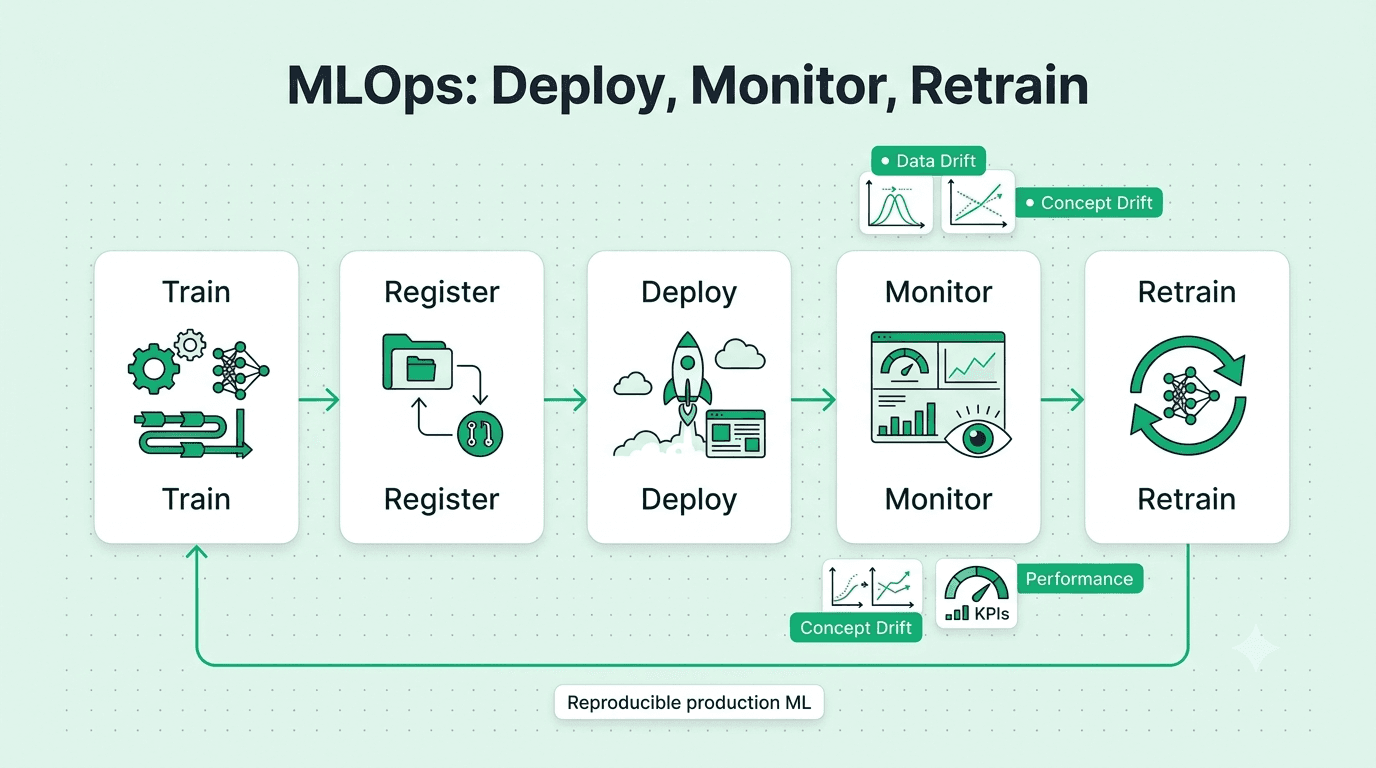
A model that lives in a Jupyter notebook is not a product. MLOps is the set of practices that takes a trained model from experimental code to a reliable, maintainable, automatically retrained production system. Recruiters prioritize this because companies have spent years discovering the cost of deploying ML without proper MLOps: models that degrade silently over months as the data distribution shifts, manual retraining processes that cannot keep pace with data changes, and deployment pipelines so fragile that pushing a model update requires a senior engineer's full day of attention. MLOps fluency is now the primary signal that a candidate has shipped ML in a real production environment.
What Recruiters Actually Expect in 2026
A training pipeline that is reproducible from version-controlled code and configuration rather than a notebook that requires manual environment setup. A model registry that tracks model versions, metrics, and metadata so that any deployed model can be identified, reproduced, and compared to alternatives. Deployment infrastructure that allows a model to be served reliably at scale, whether through a REST API, a batch inference job, or a streaming pipeline. Monitoring that detects three distinct types of model degradation: data drift, where the input distribution shifts; concept drift, where the relationship between inputs and outputs changes; and performance degradation, where tracked business metrics decline. Automated retraining triggers connected to the monitoring system.
Interview Evaluation
System design questions asking candidates to design the MLOps infrastructure for a specific model type, evaluated on whether they include the monitoring, versioning, and retraining components rather than only the training and serving components. Behavioral questions about production ML incidents candidates have managed and how the monitoring system did or did not help them identify the problem. Technical questions about specific MLOps tools and the trade-offs between them.
Real Workplace Example
A recommendation model is deployed to production and initially performs well. Three months later, business metrics begin declining. Without MLOps monitoring, the team spends three weeks investigating before connecting the decline to the model: a seasonal shift in user behavior caused the model's learned patterns to become less predictive. With proper drift detection, the monitoring system would have flagged input feature distribution changes within a week of the shift beginning, triggered a retraining pipeline automatically, and deployed the updated model before the business metric decline became visible. The three-week investigation becomes a one-week automated response.
Fresher Expectations
Understands the difference between a training pipeline and a serving pipeline and why they need to be separate. Can use MLflow or Weights and Biases for experiment tracking. Understands what model drift is and can name the two main types.
Mid-Level Expectations
Builds reproducible training pipelines using a workflow orchestration tool such as Airflow, Prefect, or Kubeflow Pipelines. Implements data drift detection using statistical tests on feature distributions. Deploys models using a serving framework and implements basic health monitoring for the serving endpoint.
Senior-Level Expectations
Designs the complete MLOps infrastructure for an organization including the feature store, model registry, training orchestration, serving layer, and monitoring system. Makes build versus buy decisions for each component. Establishes the retraining strategy including trigger criteria, evaluation gates before promotion to production, and rollback procedures.
Common Mistakes
Implementing monitoring that tracks technical metrics like API latency and error rate but not model-level metrics like feature drift and prediction distribution, which means the monitoring system will not detect the most common form of model degradation. Treating model deployment as a one-time event rather than as the beginning of a lifecycle that includes monitoring, retraining, and version management.
How to Build This Skill
Deploy any trained model to a simple REST API using FastAPI or Flask, add a logging layer that records input features and predictions, build a drift detection script that runs daily against the logged data using a statistical test such as the Kolmogorov-Smirnov test on continuous features, and implement a retraining trigger that fires when drift exceeds a threshold. This end-to-end implementation builds the MLOps instinct that interviews are evaluating.
Example Interview Questions
"How would you detect that a production model's performance is degrading before it shows up in business metrics?" "Design the MLOps infrastructure for a fraud detection model that needs to be retrained weekly and deployed without downtime." "What is the difference between data drift and concept drift, and how would you monitor for each?"
Strong Sample Answer Direction
A strong drift detection answer names the specific statistical test appropriate for the feature type, explains what the test statistic measures and what the threshold represents, and connects the detection to a concrete operational response: "For continuous features, I would use the KS test comparing the current week's feature distribution to a reference window from training. For categorical features, I would use chi-squared. A p-value below 0.05 on any high-importance feature triggers a review; a p-value below 0.01 triggers automatic retraining pipeline initiation."
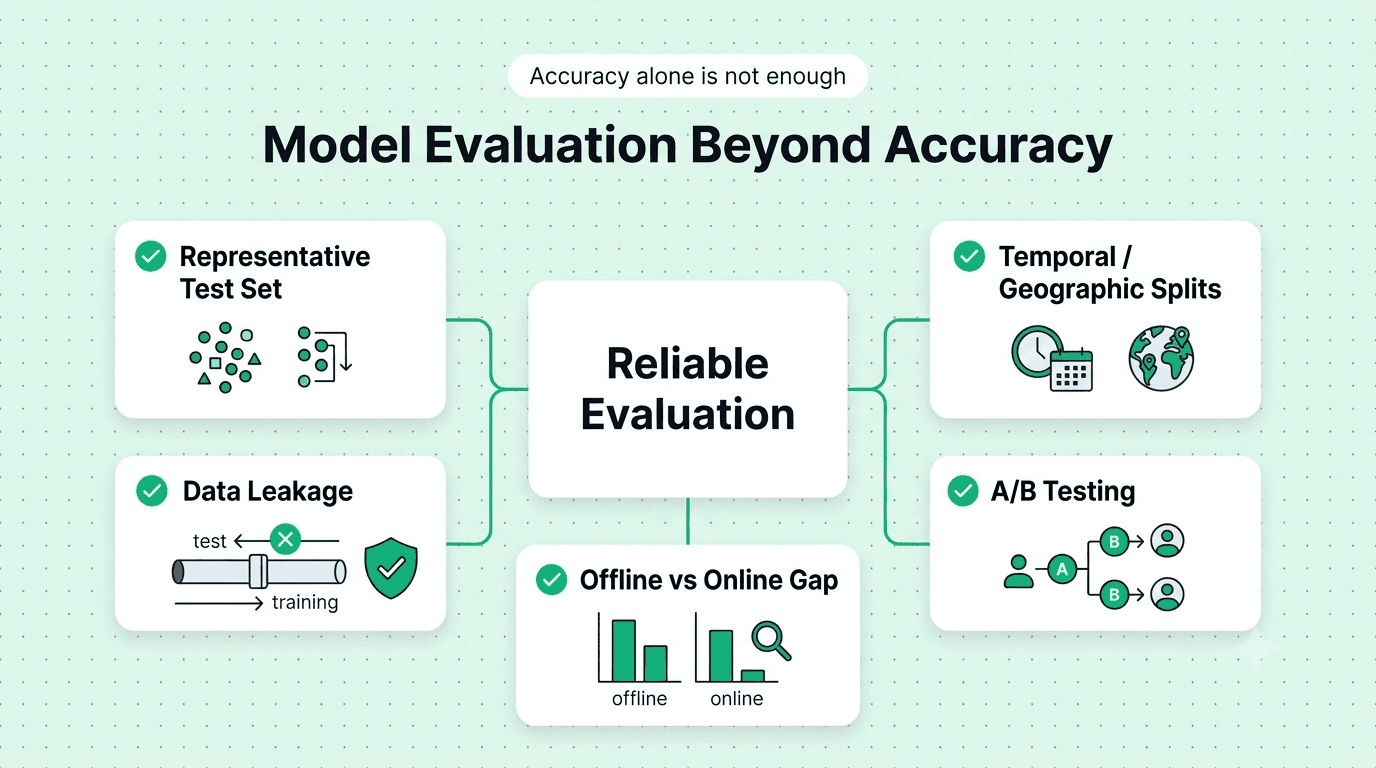
Model Evaluation and Experiment Design
Why Recruiters Prioritize This Skill
Evaluation is the most frequently done wrong and most consequential ML skill. A model evaluated incorrectly produces false confidence: the team believes the model is ready for production when it is not, or believes model A is better than model B when the reverse is true. The specific mistakes that produce false confidence are well-known and well-documented, and experienced ML interviewers probe for them directly because they predict whether a candidate's models will perform as expected in production or will degrade unexpectedly.
What Recruiters Actually Expect in 2026
The ability to construct a test set that is genuinely representative of production conditions and genuinely independent of the training set, which for time-series problems means temporal splitting, for geographic problems means geographic holdouts, and for recommendation systems means user or item-level splits rather than row-level splits. Understanding of the specific offline-to-online gap: why a model that performs well in offline evaluation sometimes underperforms in an online A/B test, and the most common causes of that gap. The ability to design an online A/B test for an ML model update, including sample size calculation, success metric definition, guardrail metric definition, and a valid runtime duration.
Interview Evaluation
Case study questions that describe a dataset with a specific structure and ask candidates to design an appropriate evaluation methodology, tested on whether they identify the specific leakage risks in naive random splitting for that dataset type. Questions about past evaluation mistakes candidates have made or witnessed, evaluated on whether they can articulate the mechanism by which the mistake produced a misleading result.
Real Workplace Example
A recommendation system is evaluated using random train-test split, achieving impressive offline metrics. The system is deployed in an A/B test and shows no improvement over the baseline. Post-analysis reveals the problem: the random split allowed the same user's historical interactions to appear in both training and test sets, meaning the model learned to predict items the user had already interacted with in the training set. The offline evaluation measured memorization, not generalization. A proper user-level split, where all interactions from a given user are in either train or test but not both, would have revealed the model's actual generalization performance before deployment.
Fresher Expectations
Can identify the most common evaluation mistakes for standard classification and regression tasks. Knows why random train-test split is problematic for time-series data and how to perform a proper temporal split. Understands the difference between precision and recall and knows how to choose between them based on the cost of each error type.
Mid-Level Expectations
Designs evaluation methodologies for complex ML problems including recommendation systems, time-series forecasting, and ranking tasks, with appropriate handling of the specific leakage risks each problem type presents. Can design and analyze an A/B test for an ML model update.
Senior-Level Expectations
Establishes evaluation standards for an ML team including the construction of evaluation datasets, the choice of metrics connected to business outcomes, and the criteria for promoting a model from offline evaluation to online A/B testing.
Common Mistakes
Using row-level random splitting for datasets where rows from the same entity appear multiple times, such as a user who has multiple transactions or a product with multiple reviews. This creates label leakage where the model can effectively "remember" the correct answer from training.
How to Build This Skill
Take a Kaggle competition that involves time-series or user-level data and implement three different evaluation methodologies: random split, temporal split, and group-based split. Compare the metric scores across all three methodologies and build an understanding of which one best predicts competition leaderboard performance. The discrepancy between methodologies is the educational insight.
Example Interview Questions
"How would you construct a proper train-test split for a recommendation system where you have user-item interaction data?" "You train a model and get 92% offline accuracy. You run an A/B test and see no improvement. What are the possible explanations?" "When would you use AUC-ROC versus precision-recall AUC as your primary evaluation metric?"
Strong Sample Answer Direction
A strong A/B test discrepancy answer names the specific mechanisms by which offline evaluation can produce false confidence: label leakage from improper splitting, distribution shift between training data and production traffic, position bias in training labels for ranking problems, and novelty effects that inflate short-term A/B test results. Naming specific mechanisms rather than "evaluation might be wrong" demonstrates production ML experience
Vector Databases and Embedding Systems
Why Recruiters Prioritize This Skill
Vector databases and embedding systems have moved from a specialized infrastructure component to a mainstream ML engineering tool in approximately eighteen months. They are the foundation of every RAG system, every semantic search application, and every recommendation system that uses learned embeddings. An ML engineer who cannot reason about embedding model selection, approximate nearest neighbor algorithms, and vector index trade-offs cannot design or debug any of these systems, which now constitute a large fraction of the ML-powered features companies are building.
What Recruiters Actually Expect in 2026
Practical understanding of how to select an embedding model for a specific task and evaluate whether it produces meaningful similarities for the data in question. Knowledge of approximate nearest neighbor algorithms at the conceptual level: understanding that algorithms like HNSW and IVF trade some recall for dramatically faster search, and that the right balance depends on the application's requirements. Familiarity with at least one vector database, whether Pinecone, Weaviate, Chroma, or FAISS, including its indexing options and the operational considerations that determine which is appropriate for a given scale and use case.
Interview Evaluation
System design questions that include a semantic search or RAG component, asking candidates to specify their embedding model choice and vector database configuration with justifications. Technical questions about what approximate nearest neighbor algorithms trade off and how to evaluate the quality of a vector index.
Real Workplace Example
An ML team builds a semantic search system that works well in testing but performs significantly worse than expected in production on short queries of two to three words. Investigation reveals that the embedding model chosen, trained on sentence-level documents, produces poor embeddings for very short inputs because it was not trained to produce meaningful representations at that granularity. Switching to an embedding model trained on shorter text, specifically designed for query-document matching, restores expected performance. The lesson is that embedding model selection must be validated on text distributions representative of the actual inference-time inputs, not only on the document collection being indexed.
Fresher Expectations
Understands what a vector embedding is and why cosine similarity is typically used as the distance metric for text embeddings. Can use a vector database library to store and retrieve embeddings for a simple semantic search task.
Mid-Level Expectations
Evaluates embedding model quality for a specific task using appropriate measures such as MTEB benchmark scores for the relevant task category and custom evaluation against held-out examples. Understands the trade-off between exact nearest neighbor search and approximate nearest neighbor search and knows when each is appropriate.
Senior-Level Expectations
Designs the embedding infrastructure for a production system including the indexing strategy, the update pipeline for keeping embeddings current as the underlying data changes, and the monitoring strategy for detecting embedding quality degradation.
Common Mistakes
Using a general-purpose embedding model for a specialized domain without evaluating whether the model produces meaningful similarities for domain-specific vocabulary. Choosing an exact nearest neighbor index for a collection of tens of millions of vectors, where the computational cost makes real-time retrieval infeasible, when an approximate index would deliver the required latency with minimal recall loss.
How to Build This Skill
Build a semantic search system for any domain-specific document collection and evaluate it properly: create a test set of query-document pairs with human relevance labels, run the queries against your system, and calculate recall at k. Then swap the embedding model for a different one, regenerate all embeddings, and compare the recall at k across the two models. The comparison builds practical intuition for embedding model selection that theoretical understanding cannot provide.
Example Interview Questions
"How would you choose an embedding model for a semantic search system over legal documents?" "What is the trade-off between an HNSW index and an IVF index in a vector database?" "How would you keep a vector database current when the underlying documents are updated daily?"
Strong Sample Answer Direction
A strong embedding model selection answer names the evaluation methodology before naming any specific model: "I would first create a held-out evaluation set of query-document pairs with relevance labels drawn from the specific domain. Then I would evaluate multiple candidate models on this set using recall at k, focusing on the text length distribution and vocabulary characteristics of the actual data. The MTEB benchmark provides a good initial filter, but it cannot replace evaluation on domain-specific data."
Responsible AI and Business Skills
Responsible AI, Bias Detection, and Regulatory Compliance
Why Recruiters Prioritize This Skill
Machine learning models are increasingly subject to regulatory requirements, public scrutiny, and legal liability. The EU AI Act, GDPR implications for automated decision-making, and emerging AI regulations in multiple jurisdictions have moved responsible AI from an ethical aspiration to a technical and legal requirement. An ML engineer who cannot implement bias detection, produce a model card, or reason about the fairness implications of a model's design is creating compliance risk for their organization, which is why responsible AI literacy is now evaluated in interviews at companies serving regulated industries or diverse user populations.
What Recruiters Actually Expect in 2026
The ability to measure model fairness across demographic groups using specific metrics including demographic parity, equalized odds, and calibration, with an understanding of why these metrics can conflict and what that conflict implies for the business decision about which to optimize. Knowledge of model cards as a documentation format and the ability to complete one for a model they have built. Understanding of the specific requirements under the EU AI Act for high-risk AI systems and what technical artifacts are required for compliance.
Interview Evaluation
Case study questions that present a model with demographic performance disparities and ask candidates to identify the issue, measure it using an appropriate fairness metric, and propose mitigation strategies with their trade-offs. Questions about what the EU AI Act requires for a specific use case and what technical documentation an ML engineer would need to produce to support compliance.
Real Workplace Example
A loan approval model achieves strong aggregate performance on the holdout set. A fairness audit reveals that the model approves loans for 72% of applicants in one demographic group and 51% in another, despite comparable default rates between groups. This is a violation of equalized opportunity, and in many jurisdictions a legal liability. Identifying this problem requires the team to first measure it, which requires having the demographic data and running the right analysis, and then to address it, which might involve reweighting training samples, applying a post-processing fairness constraint, or redesigning the feature set to remove proxies for the protected attribute.
Fresher Expectations
Understands what bias in ML means at a concrete level: that a model can make systematically different quality predictions for different subgroups. Can measure demographic parity and equalized odds for a classification model given a dataset with demographic labels.
Mid-Level Expectations
Designs a fairness audit for a production model including the demographic attributes to evaluate, the fairness metrics appropriate for the use case, and the threshold that would trigger a remediation process. Produces a model card for any model they deploy.
Senior-Level Expectations
Establishes responsible AI standards for an ML team including fairness evaluation requirements, model documentation requirements, and the governance process for deploying high-risk AI systems.
Common Mistakes
Measuring fairness only at the aggregate level without segmenting by subgroup, which can hide substantial performance disparities under strong overall metrics. Addressing bias only through data augmentation without measuring whether the augmentation actually reduces the disparity, since naive augmentation can sometimes shift but not reduce bias.
How to Build This Skill
Use the AI Fairness 360 toolkit or Fairlearn library on any public dataset with demographic attributes and a classification task. Measure four fairness metrics for your best-performing model, document which metrics are in conflict with each other for your specific model, and implement one mitigation strategy. Write a one-page model card documenting the model's intended use, performance characteristics, and known limitations.
Example Interview Questions
"What is the difference between demographic parity and equalized odds, and when would you prioritize each?" "You deploy a model and a fairness audit reveals significantly worse recall for one demographic group. What do you do?" "What is a model card and what information should it contain?"
Strong Sample Answer Direction
A strong fairness metrics answer describes the conflict directly: "Demographic parity requires that the positive prediction rate be equal across groups regardless of actual base rates. Equalized odds requires that both true positive rate and false positive rate be equal across groups. These two cannot both be satisfied simultaneously when the base rates differ between groups, which is a mathematical constraint, not a modeling choice. The business decision about which to prioritize depends on whether the cost of false positives or false negatives is asymmetric, and that decision should be made explicitly and documented rather than left to the model's default behavior."
FREE TO USE
8k+ SESSIONS92% FLUENCY4.9★ RATING
Speak With Confidence
Real Conversations. Real Scenarios. Speak until it feels natural.
- Real-Time Speaking Practice
- Guided Conversation Flows
- Instant AI Feedback
Skills Recruiters Value More Than Certifications
ML certifications, whether cloud platform certificates, Coursera specializations, or professional credentials, validate exposure to concepts and tools. They do not validate the ability to ship a production ML system, debug a training failure, or design an evaluation methodology that avoids the specific leakage risks of a particular dataset structure.
A candidate who has completed the Google Machine Learning Engineer Professional Certificate and has no production ML systems to discuss is in a weaker interview position than one with no certifications and a deployed model they can walk through end to end, describing the data pipeline, the training infrastructure, the evaluation methodology, the serving architecture, and the monitoring setup.
Certifications are most useful in two specific contexts: demonstrating platform familiarity to pass automated resume screening at companies that filter on specific cloud provider keywords, and demonstrating structured learning for career switchers who are transitioning from adjacent technical roles. In both cases, certifications are a screening threshold, not a differentiator. The work itself is the differentiator.
The time investment calculation is straightforward: spend the time budgeted for a certification on building and deploying a complete ML system with proper MLOps infrastructure, then write a detailed case study of the system design decisions made. That case study will generate more interview conversations and provide more material for those conversations than any certification.
Skills That Are Becoming Less Important
Classical computer vision from scratch, meaning implementing convolutional neural networks without pretrained backbone models, has become less relevant as the standard practice is now to fine-tune pretrained models from torchvision, Hugging Face, or OpenCLIP rather than train from scratch. Understanding the architecture remains important; implementing it from scratch is rarely expected.
Traditional NLP pipelines, including TF-IDF vectorization, stemming, lemmatization, and classical sequence models, are now evaluated primarily as conceptual background. The expectation is that candidates understand why these approaches were developed and what they cannot do that LLMs can, rather than being proficient practitioners of classical NLP methods.
Feature engineering as the primary ML skill is declining in relative importance for deep learning tasks where representation learning is the default, though it remains highly relevant for tabular structured data tasks where tree-based models are frequently competitive and feature engineering substantially impacts model quality.
Manual hyperparameter search as a primary optimization strategy has been largely replaced by automated hyperparameter optimization tools. Knowing how to use Optuna or Ray Tune is more relevant than knowing how to manually explore learning rate grids.
AI Is Changing Machine Learning Engineering
Which skills AI are automating: AI coding assistants are automating boilerplate ML code generation including standard training loops, data preprocessing templates, and model architecture scaffolding. Automated machine learning tools are automating model selection and hyperparameter optimization for standard supervised learning tasks on structured data.
Which skills AI is enhancing: ML engineers with strong theoretical foundations can now experiment faster because AI tools reduce the time between a hypothesis and working prototype code. Engineers with strong evaluation instincts can use AI tools to generate more diverse test cases and evaluation scenarios than they could construct manually.
Which human skills are becoming more valuable: The ability to identify when a problem requires ML versus a simpler solution, the judgment to evaluate whether an ML system is producing correct results rather than plausible-sounding ones, the systems thinking to design a complete ML lifecycle rather than only a trained model, and the ethical reasoning to identify when a model's behavior creates unfair or harmful outcomes are all becoming sharper differentiators.
How professionals should adapt: Use AI tools to accelerate the implementation of approaches you already understand well. Be skeptical of AI-generated ML code in the specific areas where these tools most commonly produce subtle errors: tensor shape handling, device placement, data leakage in preprocessing pipelines, and gradient computation in custom loss functions. The ML engineer who uses AI to move faster while maintaining the diagnostic instincts to catch these errors is significantly more valuable than one who either avoids AI tools or accepts their output uncritically.
Common Skill Gaps Recruiters Notice
1. Candidates who can train a model but cannot explain why the validation accuracy is lower than the training accuracy or what the magnitude of the gap tells them about what to do next.
2. Candidates who claim MLOps experience but whose description of "deployment" ends at containerizing a model without discussing monitoring, drift detection, or retraining pipelines.
3. Candidates who have worked extensively with LLMs but cannot evaluate whether a RAG system is actually improving over a baseline, revealing that their LLM experience was feature building without rigorous evaluation.
4. Candidates who know fairness metrics by name but have never measured them on a real dataset or implemented a mitigation strategy.
5. Candidates who cannot debug a training loop that produces NaN loss after several iterations, revealing that their model training experience was with high-level trainer APIs rather than PyTorch training loops where failures are more visible and instructive.
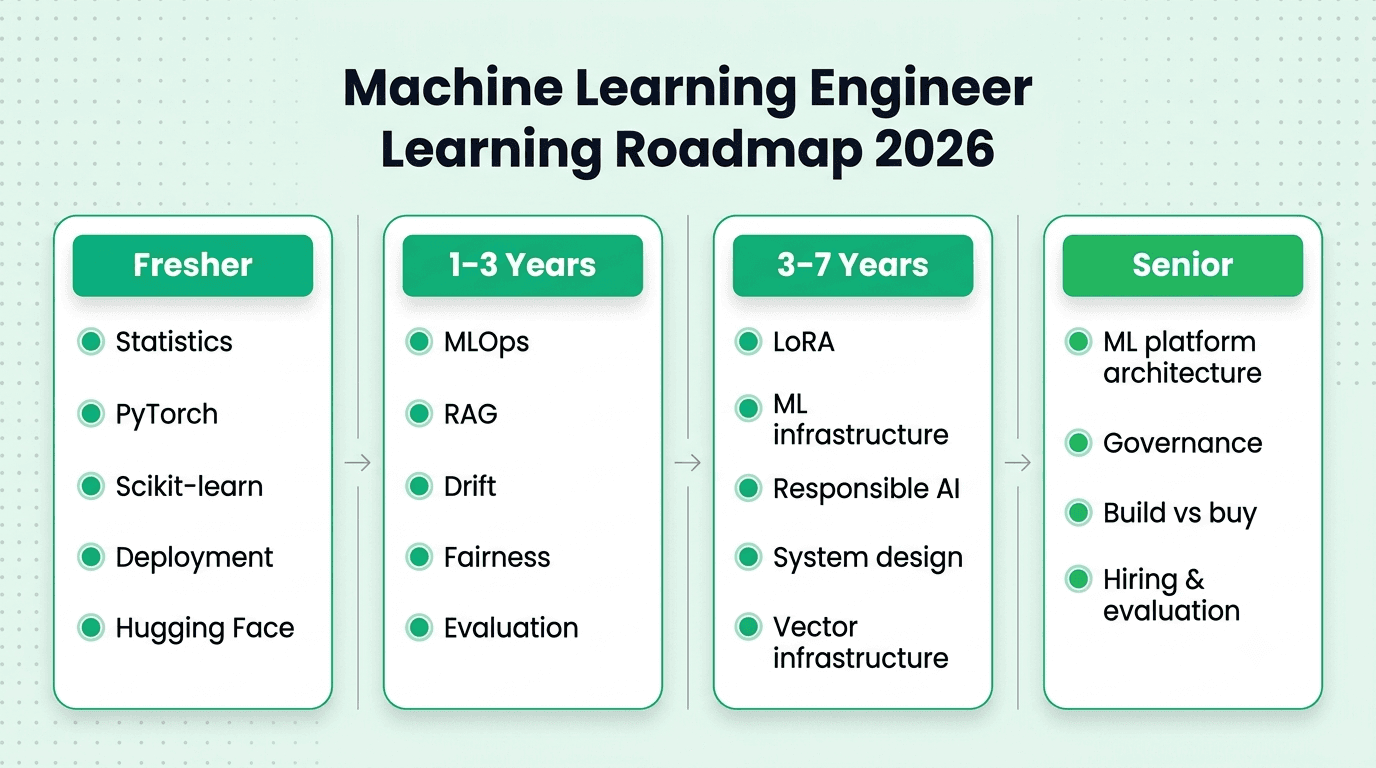
Learning Roadmap
For Freshers
1. Statistical foundations before any framework: understand bias-variance tradeoff, evaluation metrics for each task type, and the specific data splitting strategy appropriate for each problem type before writing any PyTorch code.
2. PyTorch fundamentals through the training loop: implement a complete training loop from scratch including data loading, forward pass, loss computation, backward pass, optimizer step, and validation loop without using a trainer API.
3. Scikit-learn and tree-based models for structured data: train gradient boosting models, evaluate them correctly, and understand feature importance before moving to deep learning.
4. One complete end-to-end ML project with a deployed model and basic monitoring, even at small scale using a free cloud tier.
5. The Hugging Face ecosystem: load a pretrained model, run inference, and perform basic fine-tuning on a text classification task.
For Professionals With 1 to 3 Years of Experience
1. MLOps fundamentals: build a reproducible training pipeline using MLflow for experiment tracking, Docker for environment consistency, and a simple deployment to a REST endpoint with logging.
2. RAG pipeline construction: build a complete RAG system for a real document collection, implement a systematic evaluation, and identify and address at least one failure mode.
3. Drift detection implementation: add feature drift monitoring to a deployed model and set up a trigger that fires when drift exceeds a threshold.
4. Fairness audit: measure demographic performance disparities on a classification model and implement one mitigation strategy, documenting the trade-offs accepted.
5. Advanced evaluation: practice identifying the evaluation methodology appropriate for at least three different ML problem types with non-trivial leakage risks.
For Professionals With 3 to 7 Years of Experience
1. LLM fine-tuning with parameter-efficient methods: implement LoRA fine-tuning on a meaningful task, evaluate the result against the base model properly, and document the training configuration and evaluation methodology.
2. Complete MLOps infrastructure: design and build a training orchestration pipeline, model registry, and automated retraining trigger for a production model.
Responsible AI program: conduct a full fairness audit for a production model, produce a model card, and establish the remediation criteria for performance disparities.
3. System design proficiency: practice designing complete ML systems including all MLOps components end to end, articulating the trade-offs in each design decision.
4. Vector infrastructure: design and deploy a vector search system with proper embedding evaluation, appropriate index selection, and an update pipeline.
For Senior Professionals
1. ML platform architecture: design the complete ML infrastructure for an organization including feature store, model registry, training orchestration, serving layer, and monitoring.
2. Responsible AI governance: establish the organizational framework for AI risk assessment, fairness evaluation requirements, and regulatory compliance documentation.
3. Build versus buy decisions: develop the evaluation framework for deciding which ML infrastructure components to build internally versus procure.
4. Hiring and evaluating other ML engineers using the judgment-based standards outlined in this guide rather than publication records or framework familiarity.
Self-Assessment Checklist
- I can read a training curve and validation curve and name the specific modeling problem the pattern indicates and what I would do about it.
- I can implement a complete PyTorch training loop from scratch without using a trainer API, including gradient clipping and a learning rate scheduler.
- I can design a RAG pipeline and specify the chunking strategy, embedding model selection criteria, and retrieval evaluation methodology with specific justifications.
- I have a deployed ML model with logging, drift detection, and a documented retraining trigger, not only a trained model in a notebook. I can design the correct evaluation methodology for a time-series forecasting task, a recommendation system task, and a classification task on imbalanced data.
- I can design the correct evaluation methodology for a time-series forecasting task, a recommendation system task, and a classification task on imbalanced data.
- I can explain what LoRA does at the parameter level and describe when to use it rather than full fine-tuning.
- I can measure demographic parity and equalized odds for a binary classification model and explain the mathematical constraint that prevents satisfying both simultaneously.
- I can identify at least three categories of bugs that AI coding assistants commonly introduce in ML code and describe how I catch each.
- I have at least one production ML system I can describe end to end, from data pipeline to monitoring, with specific design decisions and their justifications.
If fewer than six of these are checked, the learning roadmap above is your concrete preparation plan before applying to ML engineering roles.
Conclusion
Machine learning engineering in 2026 rewards a combination that has shifted significantly from the skills that defined the role in 2022: statistical diagnostic instincts that turn a metrics signature into a specific action, production ML discipline that builds monitoring and retraining into every deployed system, LLM engineering capability that goes beyond API calls to genuine system design and evaluation, and responsible AI literacy that treats fairness and compliance as engineering requirements rather than policy considerations.
None of these skills require a PhD or access to large-scale compute infrastructure. They require deliberate practice at the layer beneath tutorial projects: building systems that actually fail in production and learning what the failure reveals, implementing evaluation methodologies with the specific split strategies that prevent leakage, and designing monitoring systems that catch degradation before it becomes a business problem.
The gap between understanding these skills and demonstrating them fluently under interview pressure is the gap that practice closes. Explaining a training failure diagnosis, defending an evaluation methodology against a skeptical follow-up, or walking through a RAG system design with specific justifications for every technical choice: these are all rehearsable conversations. The candidates who practice them under realistic interview conditions, specifically the kind that include unexpected follow-up questions about mechanisms rather than conclusions, are consistently the ones who receive offers. That preparation is exactly what platforms like Mocklingo's AI mock interview practice are designed to support.
More Blogs
Sep 28, 2026
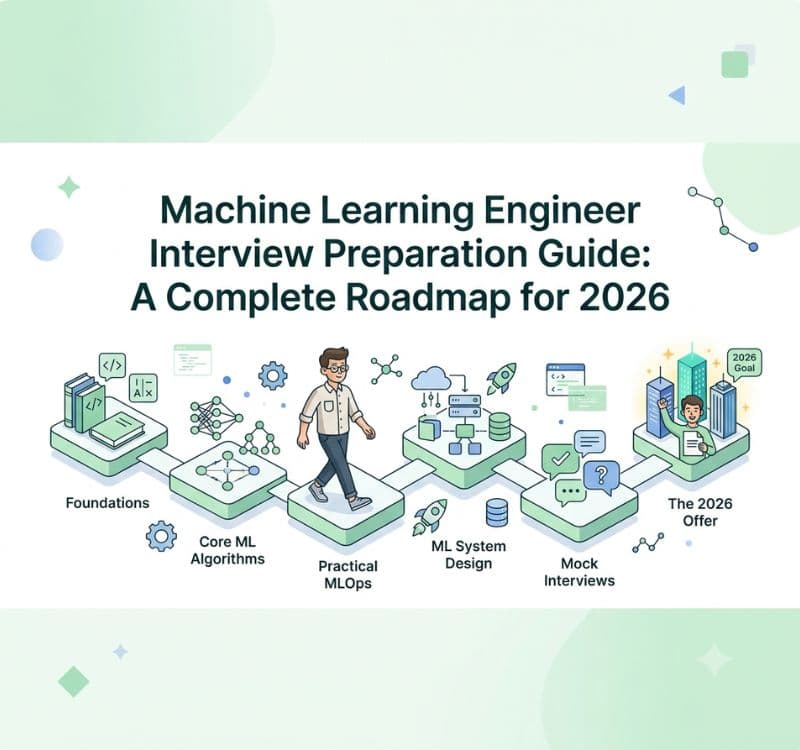
Machine Learning Engineer Interview Preparation Guide: A Complete Roadmap for 2026
27 min read