Loading...
Contents
Top Product Manager Skills Recruiters Look for in 2026
Sep 11, 202653 min readUpdated Oct 27, 2026
In 2026, recruiters hiring product managers prioritize customer discovery depth beyond surface-level user interviews, outcome-based prioritization reasoning that can withstand stakeholder challenge, data literacy that includes designing the right metrics before shipping a feature, technical literacy sufficient to understand API constraints and data model implications, product strategy connected to a business model rather than just a feature roadmap, valid experimentation design for A/B testing, and AI product literacy that includes knowing which problems AI solves well versus where it fails. Certifications are almost entirely irrelevant against a track record of shipped products with measurable outcomes. Fresher expectations center on structured thinking and intellectual honesty about what is not yet known. Senior expectations center on market-level strategy, cross-functional influence at the leadership level, and building product culture within a team.
Product manager interviews have a problem that no other role's interview quite shares: every candidate sounds articulate. Every candidate talks about users, data, and strategy. Every candidate describes past products as successes with quantified impact. The interviews blur together for experienced hiring panels because the language of product management is easy to learn and hard to distinguish from genuine competence until you ask the right follow-up question.
The right follow-up question is always specific. Not "how do you prioritize" but "walk me through a specific prioritization decision where you had good data pointing one way and strong stakeholder opinion pointing the other, and tell me exactly what you did." Not "how do you work with engineers" but "describe a technical constraint your engineering team identified that changed your product decision, and explain how you understood it deeply enough to make the right call."
This guide is built around the skills that survive specific follow-up questions in 2026, not the skills that sound good in a first answer. Every skill below is covered at the mechanism level: why recruiters prioritize it, what they are actually testing, and how to build it before your next interview.
FREE TO USE
25K+ INTERVIEWS4.8★ RATING68% IMPROVEMENT
Crack Your Dream Job
Real Interviews. Real Pressure. Practice until it feels easy.
- Seamless Interview Experience
- Resume & JD Questions
- Instant Personalized Feedback
How Hiring for Product Managers Has Changed Going Into 2026

The two biggest shifts in PM hiring are that AI literacy has become a genuine baseline expectation at most product companies, and that data literacy has moved from differentiator to table stakes, meaning candidates who cannot design and interpret metrics are now screened out rather than considered for coaching.
Several forces are reshaping what PM hiring looks like this year:
AI product literacy is now tested in almost every PM interview at companies building AI-adjacent products, which is most companies. Recruiters are not testing whether candidates know what a large language model is. They are testing whether candidates can reason about when an AI-powered feature will fail, how to design evaluation metrics for probabilistic outputs, and how to communicate uncertainty about AI behavior to users who expect deterministic software.
Continuous discovery has moved from a methodology niche into mainstream expectation. Recruiters increasingly ask candidates to describe their ongoing user research cadence rather than episodic research conducted before a project kicked off, because companies have learned that quarterly user research creates products built on stale assumptions.
The bar for technical literacy has risen. A product manager who cannot read basic API documentation, understand a simplified database schema, or reason about why a technically feasible feature might be technically inadvisable has become a meaningful concern rather than an acceptable gap at most tech-adjacent companies.
Outcome orientation is being tested more rigorously than ever. Recruiters have become skeptical of candidates who describe shipped features without connecting them to measured business outcomes, because the industry has spent years building products that were technically successful and commercially irrelevant.
Core Fundamentals
Customer Discovery and User Research Depth
Why Recruiters Prioritize This Skill
Product decisions made without genuine customer understanding produce features that solve the wrong problem elegantly. Recruiters have seen the consequences of this pattern repeatedly: a well-built product that users do not adopt, a roadmap full of features that customers requested individually but that collectively do not address their actual workflow problem, and a product strategy based on what the loudest customers asked for rather than what the largest segment of potential customers needs. Customer discovery depth is the skill that prevents all of these failures, and it is evaluated specifically rather than assumed from a candidate's having talked to users at some point.
What Recruiters Actually Expect in 2026
Not just "I conduct user interviews." Recruiters expect a candidate to describe a specific research methodology, explain why it was the right choice for the question being investigated, name the safeguards they used to prevent confirmation bias from contaminating the findings, and describe how contradictory signals from different users were reconciled into a coherent insight. Jobs-to-be-Done thinking has become a more common evaluative lens than persona-based thinking, because it focuses on the underlying motivation that drives behavior rather than a demographic profile that may not predict behavior at all.
Continuous discovery, the practice of maintaining an ongoing research cadence with real users rather than conducting research as a project phase, is increasingly expected as a description of how a candidate works rather than an advanced methodology they have heard about.
Interview Evaluation
Behavioral questions asking candidates to describe a specific user insight that changed a product decision they had already made, followed by probing questions about how the research was conducted and how the insight was validated. Case study rounds where candidates are asked to design a discovery plan for a product problem, evaluated on the specificity of the research questions, the choice of method, and the proposed analysis approach. Hiring managers specifically look for candidates who distinguish between what users say they want and what their behavior reveals they actually need.
Real Workplace Example
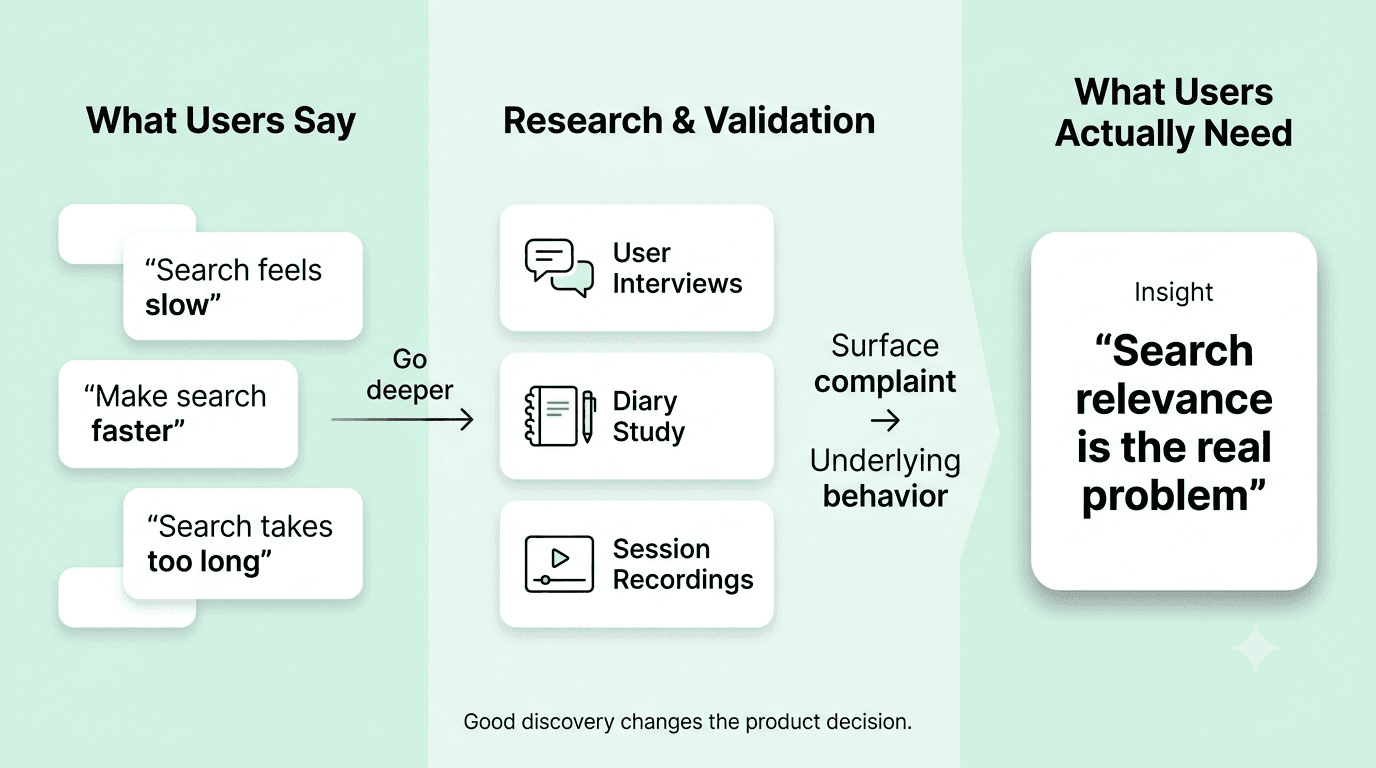
A product team believes their users want a faster search experience. User interviews confirm this: every user mentions search speed when asked about pain points. A PM with shallow discovery skills adds search speed to the roadmap. A PM with genuine discovery depth runs a diary study and session recordings alongside the interviews, and discovers that users mention speed because they associate the slowness with having to repeat searches after getting irrelevant results: the real problem is search relevance, not search latency. Fixing relevance eliminates the complaints about speed without touching the underlying infrastructure.
Fresher Expectations
Can design and conduct a basic user interview with a structured discussion guide, knows the difference between open and closed questions and why open questions generate more useful discovery data, and can synthesize findings from five to ten interviews into a coherent set of insights without cherry-picking quotes that confirm a prior hypothesis.
Mid-Level Expectations
Selects the research method appropriate to the research question, whether generative interviews, usability testing, diary studies, or contextual inquiry, and explains the reasoning for that choice. Can identify when survey data is being misinterpreted and when qualitative research findings are being overgeneralized. Maintains a continuous discovery rhythm with real users rather than conducting research only at project initiation.
Senior-Level Expectations
Builds a research infrastructure for a team including a participant panel, a research repository, and a cadence that makes customer insight continuously accessible to engineers and designers as well as PMs. Makes calls about when a product decision needs more research versus when it needs a shipped experiment, and distinguishes these clearly when presenting to leadership.
Common Mistakes
Conducting research with existing customers only and never with prospective customers who chose a competitor's product, which produces insights about how to satisfy current users without revealing why the product fails to attract new ones. Asking users what features they want rather than investigating the problem the user is trying to solve, which leads to a features roadmap rather than a solutions roadmap.
How to Build This Skill
Conduct five Jobs-to-be-Done interviews on any product you currently use, following the timeline reconstruction format where you ask users to walk you through the specific moment they decided to look for a new solution and the steps that led to their first use. Synthesize the findings into a written insight document and share it with someone who has not done the research, asking them whether they can act on the insights or whether the write-up is too vague. The act of making research communicable to someone who was not in the room is the skill that separates useful discovery from interesting conversations.
Example Interview Questions
"Tell me about a user insight that fundamentally changed a product decision you had already made. How did you find it, and how confident were you in it?" "How do you handle contradictory signals from different users in your research?" "Describe a situation where what users said they wanted and what they actually needed were different. How did you figure out the difference?"
Strong Sample Answer Direction
A strong answer names a specific research method, explains why it was chosen over alternatives for that specific question, describes at least one thing the research revealed that the team did not expect, and explains how the insight was validated before driving a decision. Vague answers about "talking to users regularly" score poorly because they cannot be distinguished from someone who attended customer calls without conducting disciplined research.
Prioritization Reasoning and Trade-off Articulation
Why Recruiters Prioritize This Skill
Every product manager has more requests, ideas, and opportunities than time to pursue them. Prioritization is not a one-time exercise before a planning cycle; it is a continuous judgment that a PM makes in every conversation, every sprint, and every resource discussion. Recruiters test prioritization specifically because a PM who cannot articulate and defend a prioritization decision under challenge becomes a bottleneck that lets the loudest stakeholder or the most recent request determine the roadmap rather than a coherent strategy.
What Recruiters Actually Expect in 2026
Not framework recitation. Every candidate knows RICE, MoSCoW, and the Kano model. What recruiters are testing is whether a candidate can explain why a specific framework was applied to a specific decision, what the framework missed that required a judgment call, and how they communicated the trade-off to stakeholders who disagreed with the outcome. Outcome-based prioritization, choosing work based on measurable impact on a business metric rather than feature delivery, is now the expected norm rather than an advanced practice.
Interview Evaluation
Prioritization exercises where candidates are given a list of competing requests and asked to prioritize them, followed by probing questions about what assumptions they made, what information they would want if they had more time, and how they would explain the bottom items on the list to the stakeholders who requested them. Hiring managers specifically look for candidates who can hold a prioritization decision under political pressure without immediately capitulating or becoming defensive.
Real Workplace Example
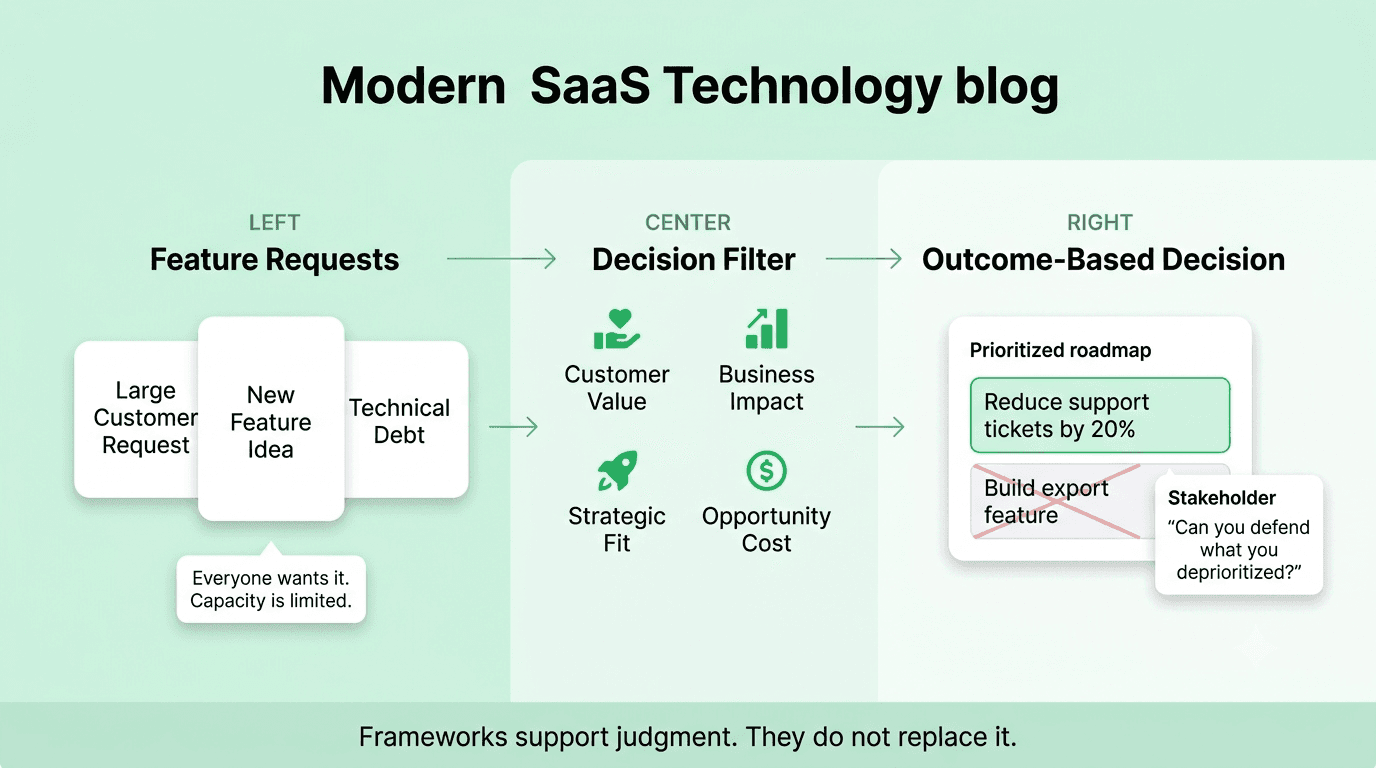
An enterprise customer worth significant annual recurring revenue requests a custom reporting feature. The sales team is pushing hard for it. The product team's analysis shows the feature would require six weeks of engineering time, serve only one customer, and have no applicability to any other segment. The PM who cannot hold a prioritization decision says yes to avoid the conflict. The PM who can hold one meets with the account team, explains the specific opportunity cost in terms of what the six weeks would otherwise produce for the broader customer base, and offers an alternative path: an export feature that gives the customer their data and lets them build the report themselves, which takes two weeks and creates value for multiple customers.
Fresher Expectations
Can apply a framework like RICE or impact versus effort mapping correctly to a set of options and explain the reasoning behind the scores assigned. Understands that prioritization frameworks are inputs to a decision, not substitutes for judgment, and can articulate what the framework does not capture.
Mid-Level Expectations
Makes prioritization decisions that can be traced back to a specific business metric or strategic goal, rather than decisions that reflect who asked loudest or most recently. Can defend a prioritization decision to a senior stakeholder who disagrees without either capitulating or escalating.
Senior-Level Expectations
Designs the prioritization process for a team, including the criteria used, the frequency of revisitation, and the mechanism for incorporating new information. Makes explicit the opportunity cost of every large commitment rather than presenting only the benefits. Uses prioritization as a communication tool to align leadership around strategy rather than as an internal planning exercise.
Common Mistakes
Treating prioritization frameworks as objective scoring systems rather than structured forcing functions for a judgment call. Presenting a prioritized list without discussing what was deprioritized and why, which leaves stakeholders without the information they need to understand the strategy. Building a roadmap of features without connecting it to a measurable outcome the features are expected to produce.
How to Build This Skill
Take any current or past product roadmap and rewrite each item in outcome language rather than feature language: instead of "add export functionality," write "enable self-service data access so customers no longer need to contact support for reports, reducing support ticket volume by 20 percent." Then re-prioritize the list based on the outcomes rather than the features and observe whether the order changes. In almost every case, it does.
Example Interview Questions
"You have three items with similar impact scores but one of them is strongly requested by your largest customer. How do you decide?" "Tell me about a time you had to deprioritize something a key stakeholder wanted. How did you communicate the decision?" "How do you prioritize between technical debt reduction and new feature development when engineering capacity is constrained?"
Strong Sample Answer Direction
A strong answer describes the specific criteria used, the specific trade-off accepted, and the specific conversation with the stakeholder who lost. It does not describe a prioritization that everyone agreed with, because prioritization decisions that everyone agrees with are not the ones interviewers are evaluating. The interesting story is always about a decision where someone was disappointed.
Technical and Analytical Skills

Data Literacy and Metrics Design
Why Recruiters Prioritize This Skill
A product manager who cannot design the right metric before a feature ships cannot know whether the feature worked after it ships. This is a foundational skill that has moved from differentiator to baseline expectation over the past three years as companies have scaled their analytics infrastructure and can now measure almost anything, but still frequently measure the wrong things. Recruiters test data literacy not to confirm a PM can use a BI dashboard, but to confirm they can identify which metrics are actually connected to business value and which ones are activity proxies that can be gamed without producing any real change.
What Recruiters Actually Expect in 2026
Fluency with the distinction between input metrics, output metrics, and outcome metrics: the specific understanding that a metric like "number of features shipped" measures activity, "number of active users" measures output, and "customer retention rate" measures the outcome the business actually cares about. The ability to define a North Star metric for a product or feature, identify the secondary metrics that are leading indicators of movement in the North Star, and specify the guardrail metrics that would signal the change is causing harm even if the primary metric is improving. Basic SQL fluency, sufficient to write a query that answers a product question rather than depending on a data analyst for every investigation.
Interview Evaluation
Metrics design questions that give a candidate a product scenario and ask them to define success, evaluated on whether they choose an outcome metric or an activity metric, whether they identify guardrail metrics, and whether they can explain what would make the metric misleading rather than informative. Take-home case studies that include a data set and ask candidates to identify the most important insight, tested on whether they find the real signal in the data or are distracted by surface-level patterns.
Real Workplace Example
A feature team ships a new onboarding flow and measures success using "onboarding completion rate," which increases significantly after the change. The PM declares success. A PM with real data literacy asks the follow-up question: what happened to seven-day activation among users who completed the new onboarding versus the old one? The data shows that onboarding completion increased because the new flow was shorter and easier to skip through, but seven-day activation, the metric that actually predicts long-term retention, decreased because users who breezing through the shortened flow were not actually set up to succeed with the product. The onboarding completion rate was a metric the team could improve without improving the outcome it was meant to measure.
Fresher Expectations
Understands the difference between vanity metrics and actionable metrics, can define a primary success metric for a feature before it ships and explain why they chose that metric, and knows that a metric can move in the desired direction without the business outcome improving.
Mid-Level Expectations
Designs a full measurement framework for a feature including primary metric, leading indicators, guardrail metrics, and a defined evaluation timeline. Can write basic SQL to answer a product question and can read and challenge the methodology of an analysis produced by a data analyst.
Senior-Level Expectations
Designs the North Star metric and metric hierarchy for a product area, evaluates the organizational incentives created by existing metrics and recommends changes when current metrics are driving the wrong behavior, and makes calls about when to trust data versus when to override it with judgment based on context the data cannot capture.
Common Mistakes
Choosing the metric that is easiest to measure rather than the one that most directly reflects the outcome the feature is supposed to produce. Reporting a metric improvement in a post-launch review without segmenting to understand which users drove the improvement, which often reveals that the feature helped one segment while harming another.
How to Build This Skill
Take any product you use and define its North Star metric, three secondary metrics that are leading indicators of the North Star, and two guardrail metrics that would signal harm. Then find a publicly available dataset for a similar product or market and practice writing the SQL query that would answer the product question you most care about from that data.
Example Interview Questions
"How would you define success for a new onboarding flow?" "Tell me about a time you discovered that a metric you were tracking was misleading. What did you do?" "What is the difference between a leading indicator and a lagging indicator, and give me an example of each for a subscription product?"
Strong Sample Answer Direction
A strong metrics answer names the primary metric, immediately raises the question of what could make it misleading, names a guardrail metric that would catch the most likely misleading scenario, and specifies a time horizon for evaluation. A weak answer names one metric with no discussion of how it could be manipulated or gamed.
Technical Literacy: APIs, Data Models, and Engineering Constraints
Why Recruiters Prioritize This Skill
A product manager who cannot understand technical constraints cannot make valid product decisions, because technical constraints often determine what is actually feasible, how long feasible things will take, and what the downstream implications of a decision are for parts of the system the PM is not directly working on. Recruiters test technical literacy specifically because its absence creates a specific failure mode: a PM who writes requirements without understanding their technical implications, producing specs that are either technically impossible, technically possible but architecturally regressive, or feasible in the short term but creating debt that slows the team for the next year.
What Recruiters Actually Expect in 2026
Not engineering ability. What is expected is the capacity to read and reason about basic technical artifacts: an entity-relationship diagram that shows how the data model is structured, an API documentation page that explains what data is available and at what rate, a system architecture diagram that shows how services depend on each other and where a proposed change would propagate. The ability to have a technical conversation with an engineer where the PM understands the constraint being described without needing a non-technical translation of every concept.
Interview Evaluation
Case studies where candidates are given a technical scenario and asked what product decisions it constrains. Questions about past experience where the candidate describes a technical constraint their engineering team raised and how it affected the product decision. Some companies include a lightweight technical exercise showing candidates a simple API or data model and asking what product questions it could and could not answer.
Real Workplace Example
A PM proposes a personalization feature that would show users content recommendations based on their individual behavior history. An engineering lead explains that the current data model stores user behavior at the session level rather than the user level, meaning individual user history is not accessible across sessions unless a user is logged in. A PM without technical literacy hears "this is complicated" and pushes for it anyway. A PM with technical literacy understands that the proposed feature requires a data model migration that affects multiple parts of the system, estimates the scope, weighs it against the expected personalization lift, and either adjusts the feature scope to work within the existing data model or makes the case for the migration as a foundational investment.
Fresher Expectations
Can read a basic API documentation page and understand what data is available, what authentication is required, and what the rate limits are. Understands what a database table is and why relationships between tables matter for what data can be queried together. Does not write requirements that assume technical capabilities without first confirming they exist.
Mid-Level Expectations
Can read a simplified entity-relationship diagram and identify what product questions the current data model cannot answer. Understands the difference between a front-end change and a back-end change in terms of deployment risk and timeline. Can participate in a technical architecture discussion at a conceptual level without needing every term translated.
Senior-Level Expectations
Participates in technical architecture decisions as a product perspective rather than deferring to engineering entirely. Can evaluate the product implications of different technical approaches when the engineering team presents options, and can make an informed trade-off between technical approaches based on their product consequences rather than their technical characteristics alone.
Common Mistakes
Asking engineering to estimate a feature without providing enough technical context for the estimate to be meaningful, then being surprised when the estimate changes after the technical investigation. Writing a spec that assumes a capability the API does not expose, discovered only during engineering investigation, which wastes a planning cycle.
How to Build This Skill
Read the complete API documentation for any product you currently use as a PM or a user. Find three things the API can answer and three things it cannot answer based on the available endpoints and data structures. Then draw a rough entity-relationship diagram of the implied data model based on the API. This exercise builds the instinct for connecting technical structure to product possibilities and limitations.
Example Interview Questions
"Describe a technical constraint your engineering team raised that changed a product decision you had already made." "If an engineer tells you a feature requires a database migration, what questions would you ask to understand the implications?" "How do you stay technically informed enough to have credible conversations with your engineering team without doing engineering work yourself?"
Strong Sample Answer Direction
A strong answer describes a specific technical constraint, explains what the PM understood about why it was a constraint rather than just that it was one, and describes how understanding the constraint led to a different and better product decision than the original proposal. A weak answer says "I rely on my engineers to flag technical constraints" without demonstrating any independent technical reasoning.
Experimentation Design and A/B Testing Validity
Why Recruiters Prioritize This Skill
Running an experiment is easy. Running a valid experiment that produces reliable conclusions is significantly harder. Recruiters test experimentation design because a PM who runs experiments without understanding statistical validity produces false confidence: a test that appears to show a positive result but was underpowered, ran too briefly, peeked at results during the test, or suffered from a novelty effect. A team that acts on invalid experimental results makes product decisions that feel data-driven but are no more reliable than guessing.
What Recruiters Actually Expect in 2026
Understanding of minimum detectable effect and why a test designed to detect a one percent lift requires many more samples than one designed to detect a ten percent lift, and why choosing the minimum detectable effect is a business decision, not a statistical one. Knowledge of the multiple comparison problem: running ten simultaneous experiments and accepting any result that passes the five percent significance threshold guarantees a false positive, and companies that run many experiments simultaneously need to account for this. The ability to identify when an experiment's results are being driven by a novelty effect rather than a genuine product improvement, which requires holding out a cohort of delayed-adoption users to check whether the lift persists over time.
Interview Evaluation
Experimentation case studies where candidates are asked to design a test for a specific product change, evaluated on whether they specify a primary metric, calculate an appropriate sample size, name the guardrail metrics, and identify the most likely sources of invalid results. Candidates who simply say "I would run an A/B test and measure conversion rate" without discussing any of the validity considerations score poorly on this evaluation.
Real Workplace Example
A team ships a redesigned product onboarding and runs an A/B test. After one week, the new variant shows a statistically significant twelve percent improvement in completion rate. The PM prepares to ship. A PM with valid experimentation instincts checks two things before declaring success: whether the test was run long enough to capture a full weekly cycle of user behavior, since onboarding behavior varies significantly between weekday and weekend signups, and whether the improvement is driven by new users who have genuinely different behavior or by existing users experiencing a novelty effect from the changed interface. The one-week test captured neither concern. The full four-week test with proper holdout groups shows a three percent improvement, meaningful but significantly smaller than the initial reading suggested.
Fresher Expectations
Understands the basic mechanics of an A/B test: control and treatment groups, random assignment, and a primary metric defined before the test runs. Knows that checking results before a predetermined end date invalidates the test by introducing optional stopping bias.
Mid-Level Expectations
Can calculate or reason about minimum detectable effect and the sample size required to detect it. Identifies the most likely threats to validity for a specific test design. Can explain the difference between statistical significance and practical significance and apply both to a launch decision.
Senior-Level Expectations
Designs the experimentation infrastructure and norms for a team: which decisions require an A/B test versus which can be made based on qualitative evidence or prior data, how to handle situations where a test would take longer than the business timeline allows, and how to build an organizational culture that accepts disappointing experimental results as valid learning rather than evidence of failure.
Common Mistakes
Peeking at experiment results before the predetermined end date and making a launch decision based on an interim result, which produces false positives at a rate far higher than the stated significance level. Treating a negative experiment result as a failure rather than as information about what users do not want, which is equally valuable as learning what they do want.
How to Build This Skill
Design a complete experiment plan for a feature change in any product you work on or use: define the primary metric, calculate the minimum sample size needed to detect a meaningful effect at 80 percent power, name three guardrail metrics, specify the duration the test must run to capture at least one full weekly cycle, and describe how you would distinguish a novelty effect from a genuine improvement. Compare your plan to how A/B tests are typically designed at your company and identify the gaps.
Example Interview Questions
"How do you decide how long to run an A/B test?" "You are running ten simultaneous A/B tests. What statistical concern does this create and how do you address it?" "An A/B test shows a positive result at 95 percent confidence but the effect size is 0.5 percent. Would you ship? How do you decide?"
Strong Sample Answer Direction
A strong answer on experimentation names the specific validity concern most relevant to the scenario described, explains the mechanism by which it would produce a false result, and proposes a specific design change that addresses it. An answer that only discusses significance levels without considering validity threats reveals experimentation awareness without experimentation depth.
Business and Strategic Skills
Product Strategy and Market Positioning
Why Recruiters Prioritize This Skill
A product manager who can only plan at the feature level cannot lead a product. Product strategy connects a roadmap to a market opportunity, a competitive position, and a business model, and the absence of this connection produces a roadmap that is locally coherent, meaning each feature makes sense on its own, but globally incoherent, meaning the collection of features does not add up to a product that wins a market. Recruiters evaluate product strategy specifically at senior and mid-senior levels because it is the skill that determines whether a PM can be trusted to run a product area independently versus needing constant strategic direction from leadership.
What Recruiters Actually Expect in 2026
The ability to size a market credibly using bottom-up estimation rather than top-down market report citation, because a bottom-up estimate reveals whether the PM understands the product's actual target customer rather than a broad market category. The ability to articulate a positioning statement that names the specific segment, the specific alternative they are currently using, and the specific differentiated value this product provides that the alternative does not. A connection between the product roadmap and the business model: understanding which parts of the roadmap drive acquisition, which drive retention, and which drive expansion revenue, and being able to explain why that allocation of investment matches the business's current growth lever.
Interview Evaluation
Strategy case studies where candidates are asked to evaluate a product or market situation and make a strategic recommendation, evaluated on whether the recommendation is connected to a specific competitive advantage or market insight rather than being generically "build more value for users." Portfolio review questions asking candidates to explain the strategic rationale for their past roadmap rather than describing features shipped, which tests whether they can articulate the strategy that the features were executing against.
Real Workplace Example
A B2B software company has a product that serves both small businesses and enterprise clients. The features requested by enterprise clients require compliance capabilities, audit logs, and role-based access control that are irrelevant to small business users. The features that would best serve small business users would simplify the interface in ways that reduce the flexibility enterprise users require. A PM with product strategy depth makes a recommendation: the product needs to choose a primary segment and optimize for it, because optimizing for both simultaneously will produce a product that is mediocre for each. They build the case for focusing on enterprise because that segment has significantly higher retention rates and contract values, then proposes a separate simplified product tier for small businesses rather than trying to serve both segments from a single feature set.
Fresher Expectations
Can articulate the target customer for a product and explain what specifically makes them the right target versus adjacent segments. Understands the difference between a feature and a product strategy and can connect a specific feature to the broader outcome it is trying to achieve.
Mid-Level Expectations
Can size a market using bottom-up estimation from first principles, write a positioning statement that specifically names competitive alternatives, and connect a product roadmap to a business model with a clear explanation of which metrics each initiative is expected to move.
Senior-Level Expectations
Makes market selection and segment focus decisions with explicit trade-off documentation. Presents product strategy to boards or executives in terms of market opportunity, competitive differentiation, and financial projections rather than feature timelines. Builds the analytical framework that guides strategic decisions for an entire product organization.
Common Mistakes
Citing a large total addressable market from a market research report without explaining what portion of that market the product can realistically capture and why. Writing a strategy document that describes the features to be built without explaining what competitive advantage will make those features win in the market rather than simply existing in it.
How to Build This Skill
Write a product strategy document for a product you manage or a product you admire, using the following structure: the specific target segment and why they are the right segment, the specific alternative they currently use, the specific reason this product wins against that alternative for this segment, the business model implications of the positioning, and a three-metric success definition connected to the business model. Share it with someone who knows the market and ask where the reasoning breaks down.
Example Interview Questions
"How would you size the market for a product that helps freelance graphic designers manage client invoicing?" "You are PM for a product that competes against a much larger incumbent with a much larger engineering team. What is your strategy?" "Tell me about a strategic decision you made that involved trading off one customer segment against another."
Strong Sample Answer Direction
A strong strategy answer names a specific competitive alternative and a specific reason to win, not a generic claim about being better designed or more user-friendly. A weak answer describes the product's features without connecting them to a market dynamic that explains why the product would win customers from an existing solution.
FREE TO USE
8k+ SESSIONS92% FLUENCY4.9★ RATING
Speak With Confidence
Real Conversations. Real Scenarios. Speak until it feels natural.
- Real-Time Speaking Practice
- Guided Conversation Flows
- Instant AI Feedback
AI and Emerging Skills

AI Product Literacy: Building, Evaluating, and Managing AI-Powered Features
Why Recruiters Prioritize This Skill
Nearly every product team is either building AI-powered features, evaluating whether to, or competing against products that have. A PM who cannot reason about when AI is the right solution, how to evaluate whether an AI feature is working, and how to communicate AI limitations to users cannot effectively lead AI product work, which means they cannot effectively lead product work at most companies in 2026. This is not a specialist skill. It is a mainstream product management expectation at companies of almost every type.
What Recruiters Actually Expect in 2026
Not model training or machine learning engineering. What is expected is the ability to distinguish problems that AI solves well from problems it handles poorly, understand that AI-powered features produce probabilistic rather than deterministic outputs and design the product experience accordingly, define evaluation criteria for an AI feature that go beyond accuracy to include precision, recall, and the cost of false positives versus false negatives for the specific use case, and communicate AI limitations and uncertainty to users in a way that builds appropriate trust rather than either overpromising or scaring users away.
Interview Evaluation
AI product case studies where candidates are given a problem and asked whether AI is the right solution, what the evaluation metric for the AI component should be, and how the product experience should handle the cases where the AI gets it wrong. These rounds test whether candidates understand AI as a capability with specific failure modes rather than as a magic feature that can be added to any product to make it better.
Real Workplace Example
A legal tech company wants to use an LLM to generate contract summaries. A PM who does not understand AI limitations scopes a feature where the AI generates a summary that the user reads as a substitute for reading the contract. A PM with AI product literacy recognizes that LLMs occasionally hallucinate plausible-sounding but incorrect information, which in a legal context could cause a user to rely on an incorrect summary in a decision. They scope the feature differently: the AI generates a summary, but the UI makes visible the specific clauses the summary was drawn from, allowing the user to verify any claim that matters to them. The product experience is designed around the AI's failure mode rather than assuming the AI is always correct.
Fresher Expectations
Understands the difference between a rule-based system and a machine learning model at a conceptual level, knows that AI models can produce incorrect outputs with high confidence, and can describe one product design pattern that accommodates AI uncertainty rather than hiding it from the user.
Mid-Level Expectations
Defines evaluation metrics for an AI feature that go beyond overall accuracy to include the cost of each error type, understands the difference between precision and recall and can explain the trade-off for a specific use case, and can design a product experience that degrades gracefully when the AI component fails rather than producing a broken user experience.
Senior-Level Expectations
Makes build versus buy versus partner decisions for AI capabilities, establishes the organizational framework for responsible AI product development including bias auditing and monitoring for model drift, and communicates AI product strategy to leadership in terms of business risk and opportunity rather than technical capability.
Common Mistakes
Scoping an AI feature without defining how the product behaves when the AI produces a wrong output, which reveals that the PM has not thought about the failure mode. Evaluating an AI feature using only overall accuracy without separating the cost of false positives from the cost of false negatives, which can produce a model that is technically accurate but practically harmful for the specific use case.
How to Build This Skill
Find a product that uses AI in a way you think is poorly designed, such as a recommendation system that consistently recommends items already purchased, a chatbot that confidently gives incorrect information, or an auto-complete that surfaces inappropriate suggestions. Write a two-page product critique explaining what the AI is getting wrong, what evaluation metric would have caught the problem, and how you would redesign the product experience to handle the failure case more gracefully.
Example Interview Questions
"We are considering adding an AI feature that categorizes customer support tickets automatically. How would you evaluate whether the AI is working well enough to ship?" "How do you decide when to use AI versus a rule-based system for a product feature?" "How would you design a product experience for a feature where the AI is right ninety percent of the time? What does the ten percent failure case look like to the user?"
Strong Sample Answer Direction
A strong AI product answer names the specific error type that matters most for the use case, explains the cost of that error type to the user or the business, and proposes an evaluation metric and a product design pattern that minimizes that specific error's impact. A weak answer discusses AI features in general terms without demonstrating awareness of how AI fails.
Communication Precision: PRDs, Strategy Documents, and Stakeholder Briefs
Why Recruiters Prioritize This Skill
A product manager's written output is the primary mechanism by which their thinking becomes other people's work. A PRD that is vague produces features built to an engineer's best guess. A strategy document without clear decision criteria produces a team that cannot make trade-off calls independently. A stakeholder brief that buries the key insight produces an executive who makes the wrong decision because the important context was in paragraph four. Recruiters evaluate written communication specifically because it is a force multiplier on everything else a PM produces: good thinking communicated poorly has the same organizational impact as poor thinking.
What Recruiters Actually Expect in 2026
The ability to write an acceptance criterion that is specific enough for an engineer to test without asking a follow-up question: not "the user can filter results" but "when the user selects more than one filter value within the same filter category, the results show items matching any of the selected values, not all of them, and the result count updates without a page reload." The ability to write a brief that leads with the decision being requested rather than the background the decision requires: the first sentence names what the reader needs to do, and the background appears only afterward for readers who need it. The ability to write a PRD that a new engineer joining the team could read and understand the product's goals, the user's problem, the success criteria, and the scope without needing a meeting to explain it.
Interview Evaluation
Writing exercises where candidates are given a product scenario and asked to write a brief, a spec section, or an acceptance criterion, evaluated on clarity, specificity, and whether the document makes the reader's job easier or harder. Portfolio reviews where candidates share past PRDs or strategy documents, evaluated on the quality of the writing as much as the quality of the strategy.
Real Workplace Example
A product team ships a form validation feature. The PRD says "the form should validate user input and show appropriate errors." Engineering implements client-side validation that blocks submission with an error message but clears the entered data when the user corrects one field and tabs to the next, because the spec was not specific about whether existing input should persist during validation. A week of testing uncovers this. A PM who writes precisely would have specified: "error messages appear inline below each invalid field without clearing or modifying the user's entered data in any other field, and the form retains all entered data until the user explicitly clears it."
Fresher Expectations
Writes acceptance criteria that name a specific user action, a specific system response, and a specific observable outcome rather than describing the feature at a capability level. Leads executive communications with the decision or action requested rather than with background context.
Mid-Level Expectations
Writes PRDs that an engineer new to the product could act on without a walkthrough meeting, calibrates the level of detail to the complexity and risk of the feature, and adapts writing style from technical spec to executive summary without losing the essential information in either format.
Senior-Level Expectations
Establishes writing standards for a product team including PRD templates, decision memo formats, and strategy document structures. Reviews other PMs' written work and provides specific feedback that improves both the document and the writer's craft over time.
Common Mistakes
Writing PRDs from the perspective of what the system should do rather than from the perspective of what the user should be able to accomplish. Confusing completeness with clarity: a long PRD that covers every edge case but is organized by feature rather than by user job produces specifications that engineering cannot navigate efficiently.
How to Build This Skill
Take the last three PRDs or specs you wrote and evaluate them against a single criterion: could an engineer who had never spoken with you implement this feature correctly from this document alone? For every place the answer is no, rewrite the relevant section with the specific detail that would make it unambiguous. Then share the rewritten version with an engineer and ask them to read it and flag any remaining ambiguities they would have to resolve with a question.
Example Interview Questions
"Write an acceptance criterion for a search feature that supports multi-word queries and should handle typos." "How do you tailor a communication about a product delay for an executive versus an engineering team?" "Walk me through a PRD you wrote that you are proud of. What specifically makes it good?"
Strong Sample Answer Direction
A strong answer on written communication gives a specific example of an ambiguity they identified in past writing, explains the downstream consequence that ambiguity would have caused if not caught, and describes the specific language pattern they changed to eliminate it. A weak answer talks about writing clearly without demonstrating awareness of what unclear writing actually produces in engineering or stakeholder behavior.
Skills Recruiters Value More Than Certifications
Product management certifications, including the most recognized ones from professional associations, teach the vocabulary and frameworks of the discipline. They do not teach judgment, which is the only thing product management interviews actually test.
A PM candidate who has a certification and no shipped products is in a weaker position than one with no certification and one shipped product they can discuss in depth, specifically the research decisions that drove it, the prioritization trade-offs made, the metrics used to evaluate it, and what they would do differently with current knowledge. The certification proves the candidate studied the framework. The shipped product proves the candidate can use the framework in a real environment with real constraints.
Certifications become slightly more relevant in one specific scenario: career switchers with no product management experience who need to demonstrate that they understand the discipline's vocabulary before an interview. Even in this case, a side project or advisory role that produced a real product decision is more compelling than a certificate.
The practical implication is this: spend the time and money budgeted for a certification on building a portfolio project instead, and write a case study of the product decisions made during that project. The case study will generate more interview conversations than the certificate.
Skills That Are Becoming Less Important
Feature-based roadmap planning, the practice of building a roadmap as a list of features to be shipped by quarter, is declining in favor of outcome-based roadmap planning where the roadmap states the metric to be moved and the hypothesis about how to move it. Candidates who present only feature-based roadmaps in interviews are increasingly evaluated as behind the current standard.
Waterfall-style requirements documentation, where a PM produces a complete specification before engineering begins, has been largely replaced by iterative discovery and delivery processes. Candidates whose PM experience is primarily in writing comprehensive upfront requirements will need to demonstrate adaptability to more iterative methods.
Story point estimation as a PM core skill is declining in importance. The debate about whether PMs should own story points is largely settled: they should not, and candidates who describe story point management as a core PM responsibility signal outdated process familiarity.
Project management skills at the task-tracking level, meaning ownership of Jira boards, sprint ceremonies, and ticket triaging, are increasingly separated from product management work. PMs who define their value primarily through process facilitation rather than product decisions are evaluated as potentially under-leveled for product management roles.
AI Is Changing Product Management
Which skills AI is replacing: Administrative documentation, meeting summaries, first-draft PRD structure, competitive feature lists, and user interview transcription are increasingly handled by AI tools that reduce the time PMs spend on documentation mechanics.
Which skills AI is enhancing: PMs with strong strategic thinking can now prototype, research, and synthesize far faster because AI tools reduce the time between a question and a first draft of the answer. Discovery research that previously required a researcher and a synthesis session can be accelerated significantly, freeing time for the judgment work AI cannot do.
Which human skills are becoming more valuable: The ability to ask the right question before using any tool, evaluate the quality of AI-generated analysis rather than accepting it uncritically, make judgment calls that require organizational context AI does not have, and build alignment among people who disagree are all becoming sharper PM differentiators.
How professionals should adapt: Treat AI tools as a fast but context-free research assistant. Use them to reduce the time between a strategic question and a first synthesis of available information, then invest that saved time in the work that requires organizational context: the stakeholder conversation, the trade-off decision, the strategy framing that connects a product to a business model.
Skills That Instantly Differentiate Candidates
A candidate who can describe a product decision they made that was unpopular, explain the specific data and reasoning that supported it, describe the stakeholder conversation that followed, and share the measured outcome of the decision stands apart from every candidate who describes only consensus decisions with universally positive outcomes.
A candidate who can describe a user research finding that surprised them and explain specifically why it was surprising, meaning it contradicted a prior assumption the team held, demonstrates the intellectual honesty and curiosity that distinguishes excellent product managers from competent ones.
A candidate who has shipped an AI-powered feature and can describe its failure cases, how the product was designed to handle them, and how the feature was evaluated against a metric that goes beyond overall accuracy is rare enough to be an immediate differentiator in 2026.
A candidate who can describe their metrics design methodology, specifically naming a guardrail metric they defined for a past feature and what it would have revealed if it had been breached, demonstrates data maturity that most candidates claim but cannot support with specifics.
Common Skill Gaps Recruiters Notice

Candidates who can describe user research conducted but cannot explain what insight that research produced that changed a decision they had already made, revealing that the research was confirmatory rather than exploratory.
Candidates who describe features shipped without connecting them to a measurable business outcome, making it impossible to evaluate whether the product work was effective.
Candidates who talk about working with engineering without being able to describe a specific technical constraint they understood deeply enough that it changed their product decision.
Candidates who describe prioritization using a framework but cannot explain the judgment call they made that the framework did not resolve, revealing that they follow a process without understanding when the process is insufficient.
Candidates who claim data-driven decision-making but have never defined a metric before shipping a feature, measuring only what was already being tracked rather than designing the measurement to answer the question the feature was built to answer.
Learning Roadmap
For Freshers
- Master one user research method deeply, specifically user interviewing with an open-ended, exploratory discussion guide, before trying to learn all methods at a surface level.
- Practice defining success metrics for hypothetical features before touching any product tooling, because metric design is a thinking skill before it is a technical one.
- Learn basic SQL to a level that allows writing a query to answer a product question without a data analyst as an intermediary.
- Read API documentation for any public API and practice identifying what product questions it can and cannot answer.
- Build a portfolio project, even a simple one, and write a case study that describes every major product decision made, not just the features shipped.
For Professionals With 1 to 3 Years of Experience
- Shift roadmap planning from feature-based to outcome-based: practice connecting every roadmap item to a specific metric hypothesis.
- Design and run one valid A/B experiment end to end, including pre-registration of the hypothesis, sample size calculation, and a post-test analysis that evaluates guardrail metrics alongside the primary metric.
- Build a stakeholder management story: identify one past situation where a stakeholder wanted something you believed was wrong, and practice articulating both the disagreement and the resolution clearly.
- Develop a working understanding of the technical architecture of the product you manage, specifically which services exist, what data is available in each, and what the most significant technical constraints are.
- Develop and document a personal product strategy for a product area you own, connecting the roadmap to the business model with explicit reasoning.
For Professionals With 3 to 7 Years of Experience
- Build market sizing ability using bottom-up methodology for a market you care about, and practice presenting the estimate with explicit assumptions that can be challenged.
- Develop AI product literacy by shipping or evaluating at least one AI-powered feature, including defining its evaluation metrics and designing the product experience for its failure cases.
- Lead a continuous discovery process for a product area, establishing a regular cadence and sharing weekly insights with the engineering and design team.
- Write a product strategy document that presents a segment focus decision with explicit trade-offs documented and connected to business model implications.
- Mentor a junior PM and use the mentoring relationship to clarify your own thinking about what makes a product decision good versus defensible.
For Senior Professionals
- Make a market selection decision with formal documentation of the opportunity, the competitive dynamics, and the organizational implications of the choice.
- Design the product development process for a team including discovery cadence, experimentation standards, and decision-right frameworks.
- Build and present a product strategy at the board or executive team level, connecting product roadmap to financial outcomes with quantified assumptions.
- Hire and evaluate other product managers using the judgment-based standards outlined in this guide rather than resume credentials alone.
Self-Assessment Checklist
- I can describe a user research finding that changed a product decision I had already made, naming the specific research method used and why it was chosen.
- I can articulate a prioritization decision where I deprioritized something a key stakeholder wanted, and explain the specific reasoning I used and the conversation I had.
- I can define the North Star metric, two leading indicators, and two guardrail metrics for any product area I own.
- I can write a basic SQL query to answer a product question without relying on a data analyst for every investigation.
- I can read a simplified entity-relationship diagram and identify what product questions the current data model cannot answer.
- I can design an A/B experiment that specifies minimum sample size, a predetermined end date, and the criteria under which I would stop the test early.
- I can articulate a positioning statement that names the specific target segment, the specific alternative they currently use, and the specific reason this product wins for that segment.
- I can describe an AI-powered feature with its specific failure cases, how the product experience was designed to handle those cases, and how the feature was evaluated against a metric beyond overall accuracy.
- I have a portfolio of written product work, PRDs, strategy documents, or case studies, that I can share with a hiring team as evidence of thinking quality.
If fewer than six of these are checked, the learning roadmap above is your concrete preparation plan before applying widely.
Portfolio or Resume Proof
| Skill | Resume | Portfolio | Interview Talking Point | |
|---|---|---|---|---|
| Customer discovery | Describe the research method used and the insight it produced, not just that user research was conducted | Share a specific user insight and the decision it changed, respecting any confidentiality constraints | Publish an anonymized research synthesis document showing findings and how they connected to product decisions | Name the research method, the surprising finding, and the decision it changed |
| Prioritization reasoning | Name the prioritization methodology used and the business outcome it was connected to, not just features shipped | Share a post on a prioritization framework you have used and a nuance you discovered in applying it | Publish a case study that includes a prioritization decision with the trade-off explicitly documented | Describe the stakeholder who disagreed and what you said to them |
| Metrics design | Frame past work around the business metric moved, not just the feature shipped | Share a post on a metric design decision and why the metric chosen was better than an obvious alternative | Include a metrics framework section in any published case study | Name the guardrail metric you defined and what it would have caught if breached |
| Technical literacy | Describe the technical constraints you navigated, not just the engineers you worked with | Share a post on something technical you learned that changed a product decision | Include a technical context section in PRD-based case studies | Describe the constraint, what you understood about it, and how it changed your decision |
| Experimentation | Describe the experiment design, not just that experiments were run | Share a post on an experiment result that was counter-intuitive and what it revealed | Publish an experiment design template you use, with annotations explaining each component | Describe the validity concern you designed around and how |
| Product strategy | Connect past product work to a market positioning statement or segment focus decision | Share a post on a strategic trade-off you made between two market segments | Publish a sanitized strategy document or a public product critique using strategic framing | Name the segment, the alternative it competed against, and the specific reason to win |
| AI product literacy | Describe AI features you built or evaluated with their failure cases and evaluation metrics | Share a post on an AI product design decision and the trade-off accepted | Publish a product critique of an AI feature that analyzes its failure cases and proposes improvements | Describe the error type that mattered most and how the product design addressed it |
| Writing precision | Share specific writing samples or link to published case studies | Share posts that demonstrate clear, structured thinking in product contexts | Build a portfolio site with case studies written to be read by hiring managers | Offer to share a PRD or strategy document during the interview process |
Conclusion
Product management in 2026 rewards a combination of skills that has shifted meaningfully from even two years ago: customer discovery that goes beyond periodic user interviews to continuous, disciplined research; metrics design that starts before a feature ships rather than measuring whatever is already tracked; technical literacy that makes engineering conversations substantive rather than interpretive; and AI literacy that treats AI as a capability with specific failure modes rather than a feature that makes products better by definition.
None of these skills require rare talent. They require deliberate practice at the layer beneath the frameworks and vocabulary that every PM candidate learns quickly. They require the intellectual honesty to conduct research that could disprove your hypothesis, the discipline to define a guardrail metric that could tell you a positive outcome is actually harmful, and the courage to hold a prioritization decision under political pressure because the data is clear even when the room is uncomfortable.
The gap between understanding these skills and demonstrating them fluently under interview pressure is the gap that deliberate, realistic practice closes. Describing a prioritization decision that someone disagreed with, explaining a user insight that surprised you, defending a metric design against a skeptical follow-up question: these are all rehearsable conversations, and the candidates who practice them with realistic pressure before their interviews are consistently the ones who walk out with offers. Platforms like Mocklingo's AI mock interview practice give you the environment to build that fluency before it matters, with follow-up questions that probe exactly the depth this guide has described.
FAQs
More Blogs

Oct 22, 2026
UI/UX Designer Interview Preparation Guide: A Complete Roadmap for 2026
38 min read

