Loading...
Contents
Will AI Replace Backend Developers in 2026?
Real Data Explained
Jun 23, 202622 min readUpdated Sep 29, 2026
If you're a backend developer, chances are you've searched something like "Will AI take my job?" at least once this year. You're not alone.
From LinkedIn discussions and Reddit threads to engineering team meetings, concerns about AI replacing software developers have become one of the biggest conversations in tech. With tools generating code in seconds and new AI announcements appearing almost every week, it's easy to assume that developer jobs are on the chopping block.
But headlines often tell a very different story from reality. Instead of relying on speculation, let's look at the actual data, industry trends, and hiring patterns shaping backend development in 2026.
FREE TO USE
25K+ INTERVIEWS4.8★ RATING68% IMPROVEMENT
Crack Your Dream Job
Real Interviews. Real Pressure. Practice until it feels easy.
- Seamless Interview Experience
- Resume & JD Questions
- Instant Personalized Feedback
The Numbers Everyone Is Talking About
One statistic frequently appears in discussions about AI and programming:
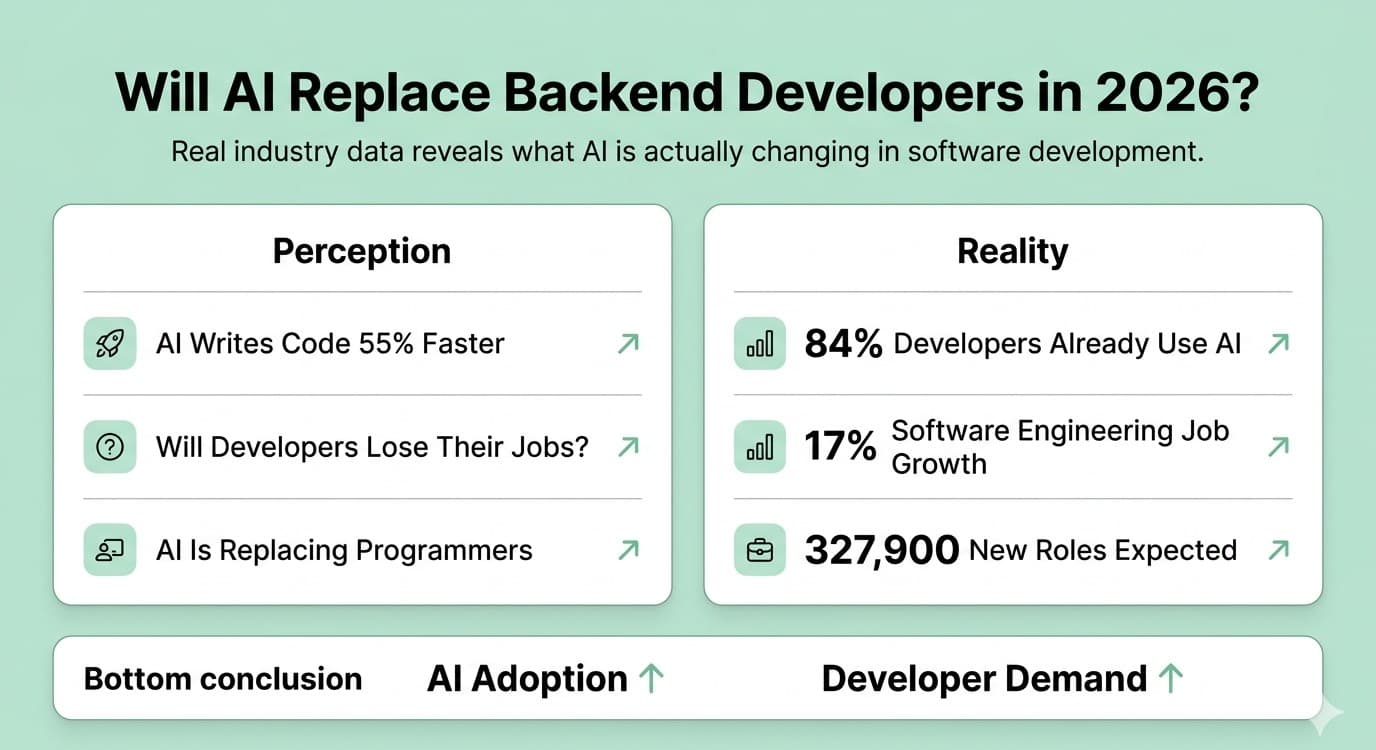
AI can help developers write code up to 55% faster.
At first glance, that sounds alarming. If code can be generated faster, doesn't that mean fewer developers are needed?
Not necessarily.
According to the 2025 Stack Overflow Developer Survey, 84% of developers already use AI tools in some form during development workflows. At the same time, software engineering jobs are still projected to grow by 17% through 2033, resulting in approximately 327,900 new roles entering the market.
Those numbers reveal something important.
AI adoption is increasing rapidly, yet demand for developers continues to rise.
The reason is straightforward. Faster development often leads to more products being built, more features being shipped, and more systems requiring maintenance. Businesses don't simply stop building software because developers become more productive. They usually build more software.
History has shown this pattern before. Better tools rarely eliminate skilled professionals. They raise expectations and expand what's possible.
What AI Is Actually Good At (And What It Isn't)
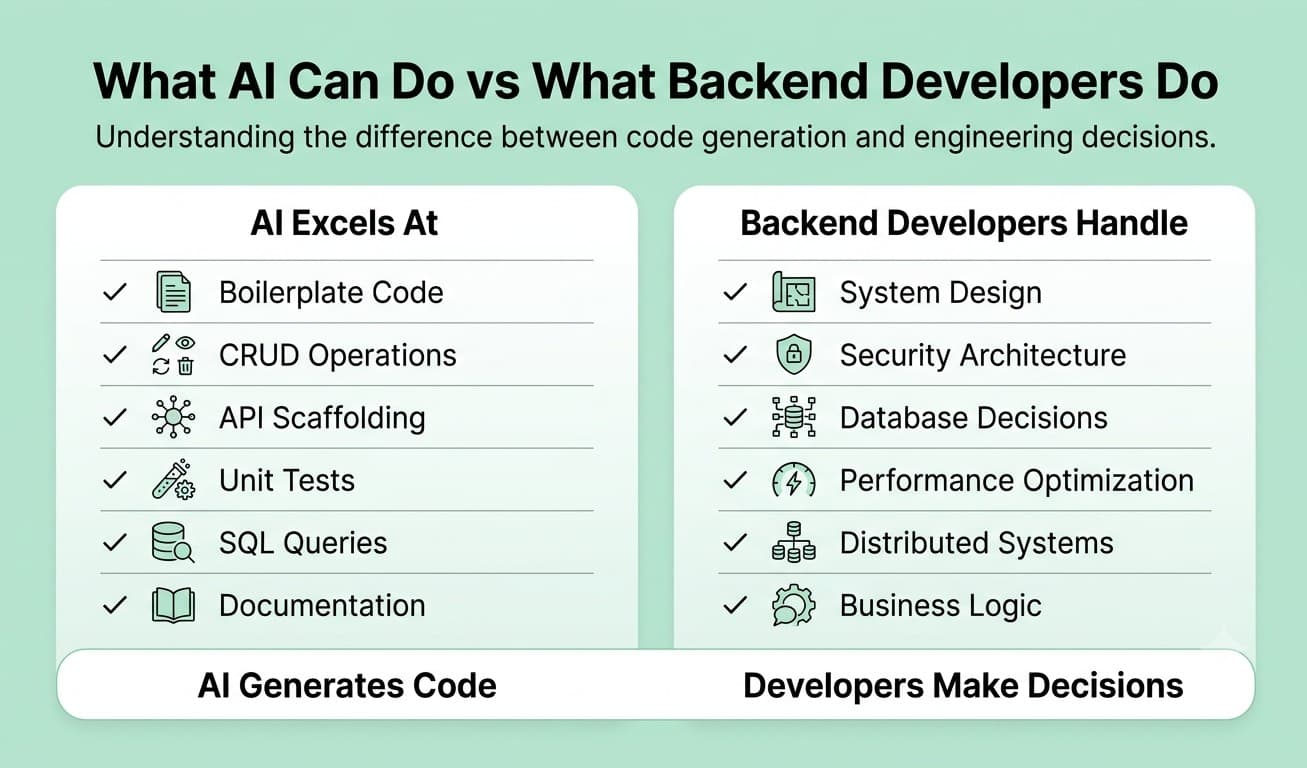
To understand AI's real impact on backend development, it's important to separate capabilities from marketing claims. Today's AI coding tools perform exceptionally well at: Generating boilerplate code Creating API scaffolding Writing basic CRUD operations Producing standard unit tests Generating simple SQL queries Explaining unfamiliar code snippets Anyone who has used GitHub Copilot, Cursor, or similar tools has experienced this firsthand. Tasks that once took thirty minutes can often be completed in a few minutes. The challenge begins when software moves beyond predictable patterns. A Purdue University study found that 52% of AI-generated programming answers contained inaccuracies, while industry security reports continue to show that AI-generated code frequently introduces vulnerabilities when accepted without proper review. Backend systems handle: Authentication and authorization Payment processing Customer data Security-sensitive operations Distributed transactions Infrastructure integrations Mistakes in these areas can cost companies thousands—or even millions—of dollars. This is why experienced developers rarely copy and paste AI-generated code directly into production. AI may generate the first draft, but human developers still review, validate, optimize, secure, and maintain the final implementation. In many teams, AI acts less like a replacement engineer and more like a highly efficient junior assistant.
Why Backend Development Is More Resistant to Automation
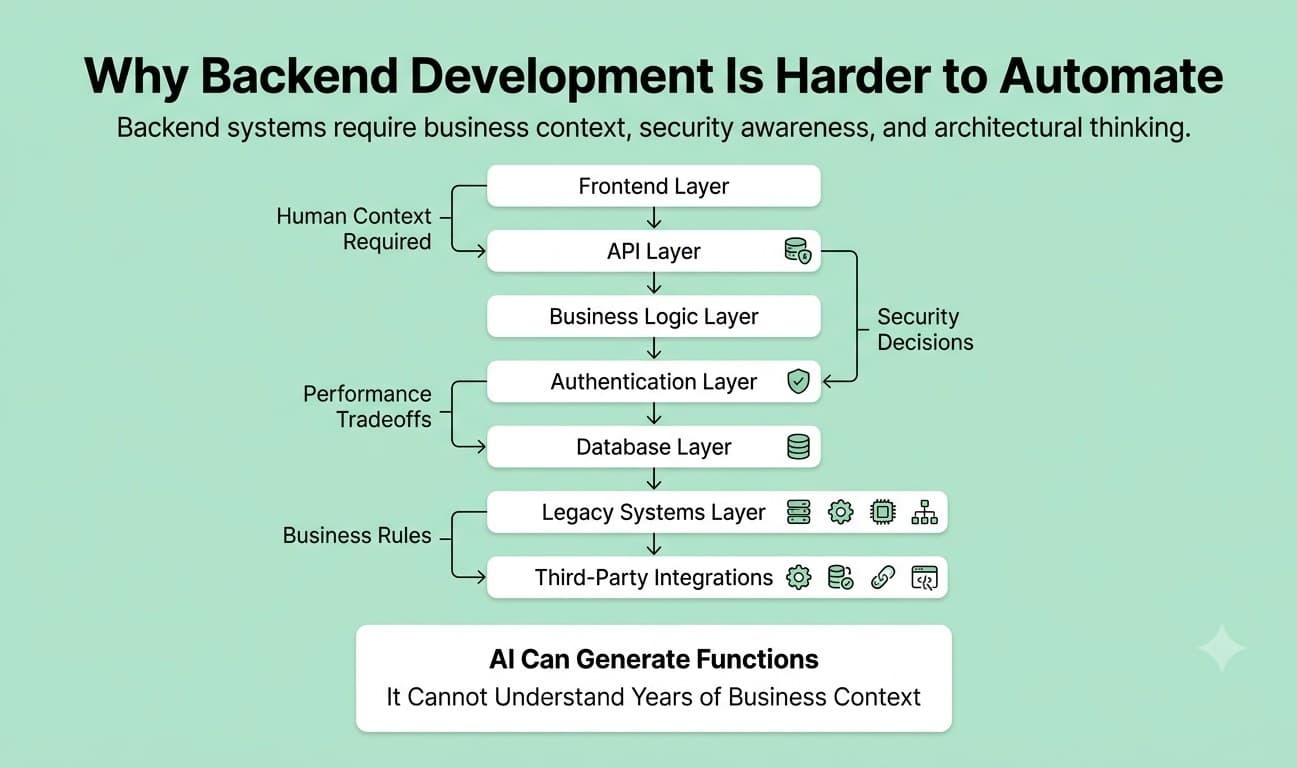
Not every area of software development faces the same level of automation risk. Frontend development often involves reusable UI patterns, components, and workflows that AI models have seen millions of times during training. This makes frontend tasks easier for AI to generate accurately. Backend development is different. A backend engineer isn't just writing code. They're making decisions about architecture, scalability, reliability, security, and data management. Consider a simple database migration. An AI tool can generate migration scripts. What it cannot fully understand is: Why the existing schema was designed a certain way Which legacy systems depend on specific behaviors How changes affect downstream services What performance bottlenecks may appear at scale What business risks are associated with the migration The deeper the business context becomes, the more valuable human judgment becomes. A senior backend developer working on a fintech platform, healthcare application, or large-scale SaaS product spends a significant portion of their time making decisions, not writing boilerplate code. And decision-making remains one of the hardest things to automate.
The Junior Developer Challenge Is Real
While fears of complete replacement are exaggerated, there is one area where AI is creating genuine pressure. Entry-level roles. Historically, junior developers learned by working on repetitive implementation tasks, bug fixes, basic APIs, and maintenance work. Those are precisely the areas where AI performs best today. As a result, some companies are becoming more selective about junior hiring. That doesn't mean junior positions are disappearing. It means expectations are changing. Employers increasingly want junior developers who can: Understand system behavior Review AI-generated code critically Debug issues independently Learn architecture concepts early Communicate technical decisions clearly The biggest risk isn't being replaced by AI. The biggest risk is competing only on tasks that AI can already perform reasonably well. Developers who focus on problem-solving and system understanding continue to stand out, regardless of experience level.
FREE TO USE
8k+ SESSIONS92% FLUENCY4.9★ RATING
Speak With Confidence
Real Conversations. Real Scenarios. Speak until it feels natural.
- Real-Time Speaking Practice
- Guided Conversation Flows
- Instant AI Feedback
What Real Companies Are Actually Doing
The popular narrative suggests companies are using AI to replace engineers. The reality is far more nuanced. Many organizations are adopting AI to improve engineering productivity rather than reduce engineering teams. Google has publicly stated that a significant portion of its codebase now involves AI-assisted development. However, company leadership has consistently emphasized that AI helps engineers move faster rather than replacing them outright. Across the industry, engineering teams are using AI for: Faster prototyping Code generation Documentation Testing assistance Internal tooling Meanwhile, developers spend more time on: Architecture reviews Security validation Performance optimization System reliability Technical decision-making A World Economic Forum report found that many developers see AI as a career accelerator rather than a career threat. In fact, growing demand for AI-related systems has created entirely new opportunities in infrastructure, backend engineering, MLOps, AI integration, and platform engineering. The nature of the work is evolving, but the need for experienced engineers remains strong.
The Skills That Matter Most in 2026
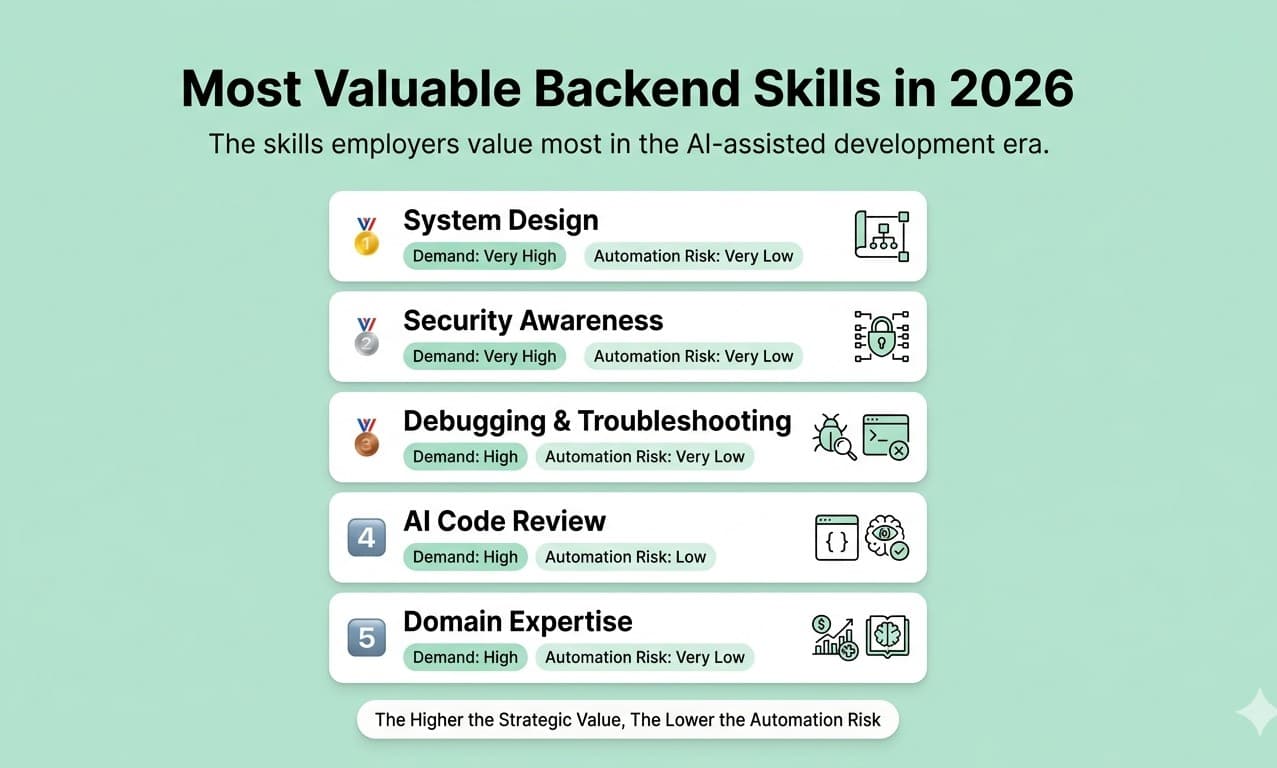
The backend developers seeing the most career growth today tend to share a common set of skills. Understanding how systems scale, communicate, and recover from failures is becoming increasingly valuable. AI can generate code. It cannot reliably design a resilient distributed architecture that serves millions of users. AI-generated code frequently requires security review. Developers who understand authentication, authorization, encryption, secure APIs, and vulnerability detection are becoming more valuable every year. One emerging challenge with AI-generated code is that it often looks correct while hiding subtle flaws. The ability to investigate production issues, trace failures, and identify root causes remains a highly human skill. A growing number of engineering teams now expect developers to review AI-generated code effectively. Knowing what AI gets wrong is becoming almost as important as knowing what it gets right. Developers who deeply understand industries such as fintech, healthcare, logistics, cybersecurity, or e-commerce bring context that AI simply doesn't possess. Business understanding is becoming a major competitive advantage.1. System Design
2. Security Awareness
3. Debugging and Troubleshooting
4. AI Code Review
5. Domain Expertise
A Better Way to Think About AI and Backend Development
Here is an analogy that captures the current moment well. When spreadsheet software arrived, everyone asked whether accountants were done for. The answer was no. What happened instead was that accountants who embraced the tools became dramatically more productive, and demand for financial analysis actually grew because the tools made it more accessible. The same pattern is playing out now. AI is the spreadsheet. Backend developers are the accountants. The ones who learn to work with the tool will pull ahead. The ones who ignore it or resist it will fall behind. But neither group is being eliminated.
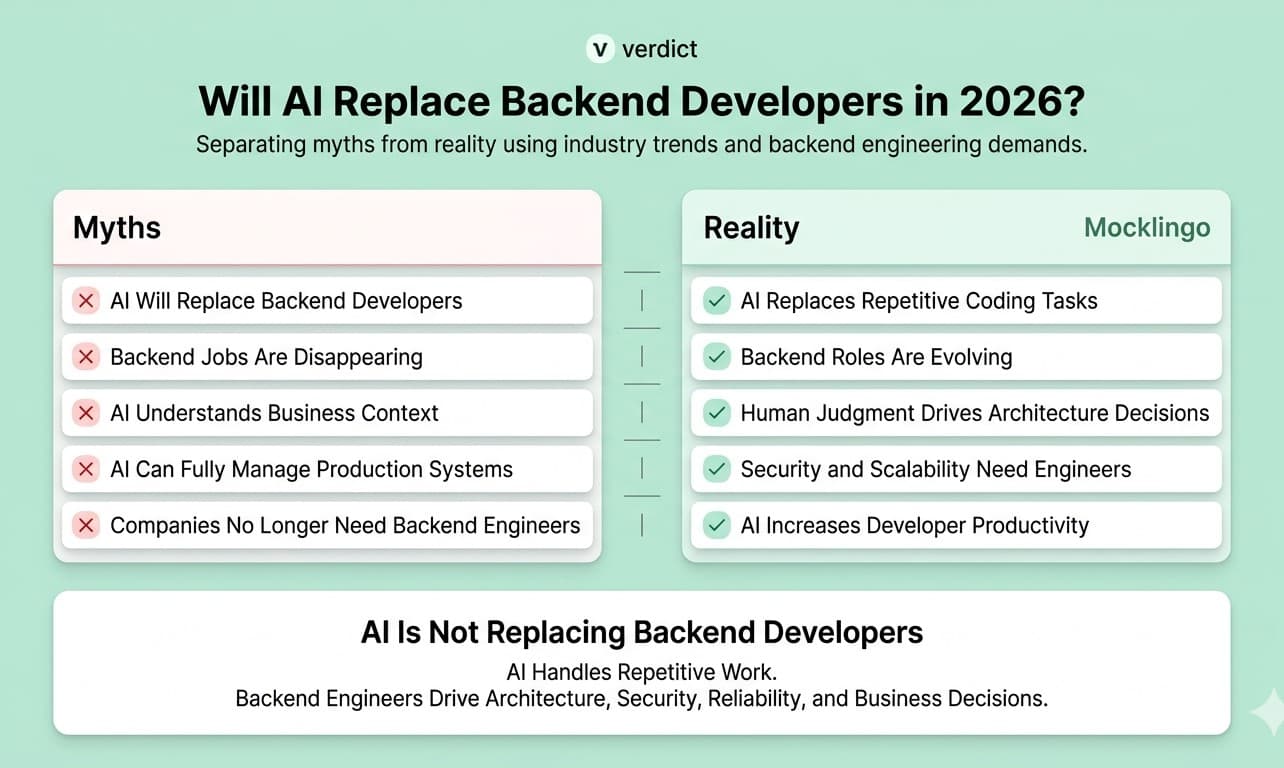
Will AI Replace Backend Developers in 2026?
The evidence suggests the answer is no. AI is changing how backend developers work, but it is not eliminating the profession. What is disappearing are some of the repetitive tasks that previously consumed large portions of a developer's day. At the same time, demand is growing for professionals who can: Design systems Evaluate trade-offs Secure applications Review AI-generated code Understand business requirements Make high-impact technical decisions AI-assisted development is also creating entirely new career paths. Roles such as AI Engineer, Platform Engineer, MLOps Engineer, and AI Solutions Architect continue to experience strong growth as organizations invest more heavily in AI-driven products and infrastructure. The future belongs to developers who learn how to combine technical expertise with AI-powered productivity.
Conclusion
If you are a backend developer reading this, here is the most practical takeaway. Start using AI tools seriously in your workflow if you have not already. Learn how to review and validate AI generated code. Deepen your understanding of system design and security. Build projects that demonstrate architectural thinking, not just the ability to produce working code. The developers winning right now are not the ones who write the most lines of code. They are the ones who make the best decisions. And AI cannot replace good judgment, at least not yet. Your job is not going away. But it is absolutely changing. The question is whether you are changing with it.
FAQs
More Blogs
Sep 30, 2026
React Developer Interview Preparation Guide: A Complete Roadmap for 2026
31 min read
