Loading...
Contents
Common Software Engineer Interview Mistakes to Avoid in 2026
Aug 3, 202612 min readUpdated Sep 21, 2026
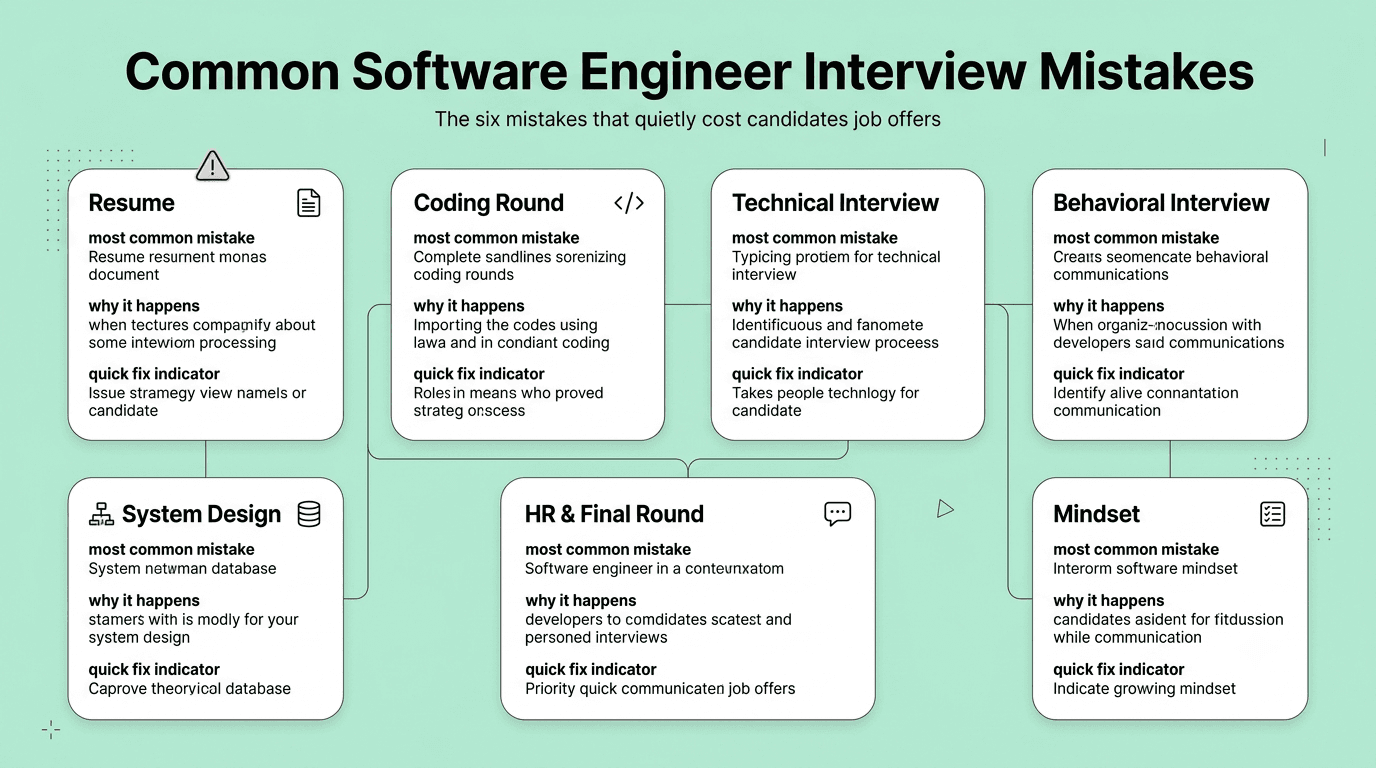
The most common software engineer interview mistakes include memorizing solutions instead of understanding them, neglecting communication during coding rounds, weak resumes that fail ATS screening, unprepared behavioral answers, ignoring system design fundamentals, and skipping mock interview practice. Most of these are fixable with awareness and a structured preparation plan.
Talented engineers lose interviews they were technically capable of passing more often than most people realize. It's rarely a lack of ability. It's usually a specific, avoidable mistake, an unclear explanation during a coding round, a resume that never made it past an ATS filter, or a behavioral answer that trailed off without a clear point.
This guide walks through the mistakes that come up most often across every stage of a software engineer interview, why they happen, and exactly how to fix each one. If you're actively preparing, pairing this with a software engineer mock interview is one of the fastest ways to catch these mistakes before a real interviewer does.
FREE TO USE
25K+ INTERVIEWS4.8★ RATING68% IMPROVEMENT
Crack Your Dream Job
Real Interviews. Real Pressure. Practice until it feels easy.
- Seamless Interview Experience
- Resume & JD Questions
- Instant Personalized Feedback
Why Small Mistakes Cost Good Candidates the Job
Small mistakes cost good candidates the job because interviewers are evaluating consistency, not just isolated moments of brilliance. A single unclear explanation, a disorganized resume, or an unprepared behavioral answer can outweigh strong technical ability if it happens at the wrong point in the process.
Interviewers rarely make hiring decisions off one big, obvious failure. More often, it's an accumulation of small, avoidable moments, a rushed answer, a resume that undersells real experience, a missed opportunity to explain reasoning clearly, that shape the overall impression. Recognizing these patterns ahead of time is often the difference between a rejection and an offer.
Resume and Application Mistakes
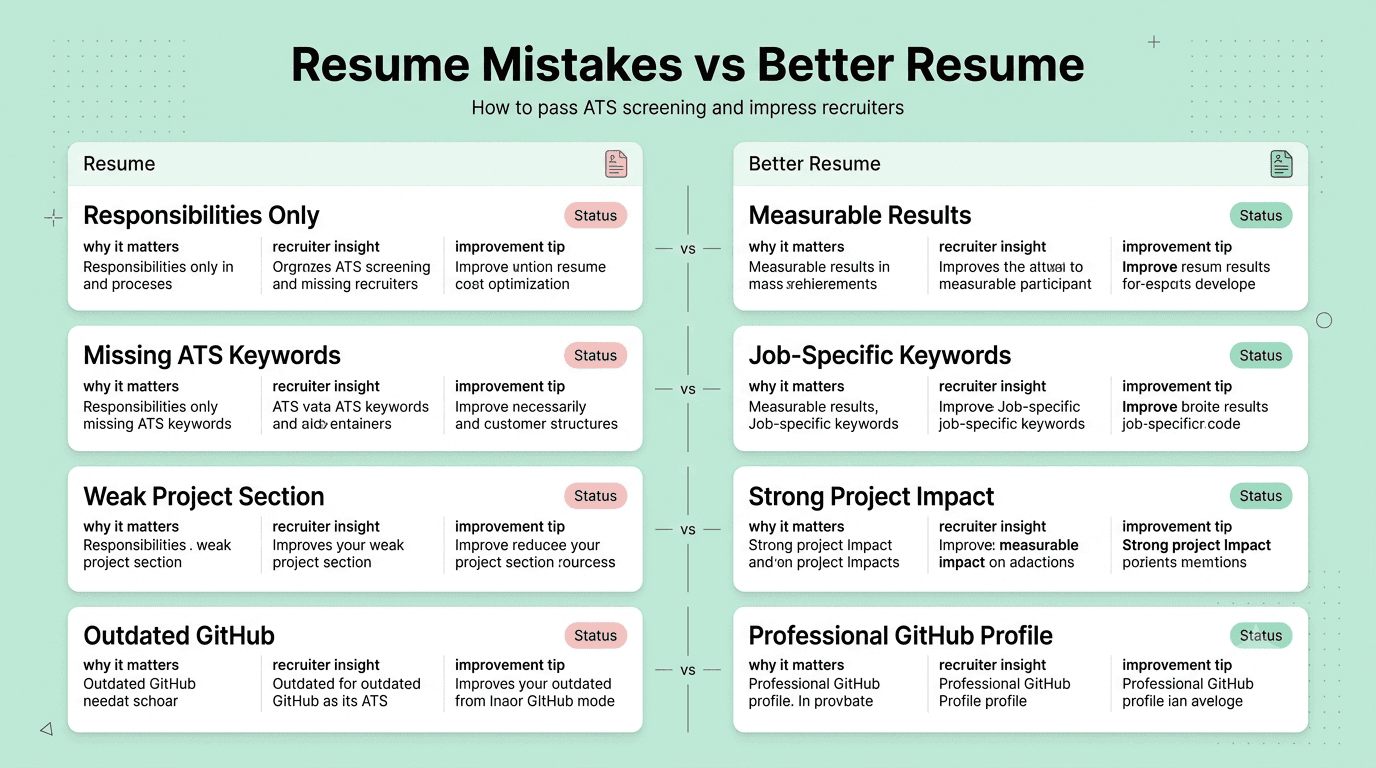
The most common resume mistakes in software engineering applications are generic descriptions without measurable results, missing keywords that fail ATS screening, disorganized project sections, and an outdated or inconsistent GitHub profile that doesn't match the resume's claims.
Mistake: Vague, results free descriptions Why it happens: Candidates default to listing responsibilities instead of outcomes, since it feels safer than quantifying impact. How to fix it: Rewrite each bullet point to include a measurable result, like a percentage improvement, a user count, or a time saved, instead of just describing the task.
Mistake: Missing keywords from the job description Why it happens: Candidates assume a strong resume speaks for itself without realizing many resumes are filtered by ATS software before a human ever sees them. How to fix it: Mirror the specific language and tools mentioned in the job description, as long as they genuinely reflect your experience.
Mistake: Disorganized or outdated GitHub Why it happens: Candidates focus heavily on the resume itself and forget recruiters often check linked profiles. How to fix it: Pin your strongest, most relevant repositories, write clear README files, and remove abandoned or incomplete projects that don't represent your current skill level.
Mistakes in the Coding Round
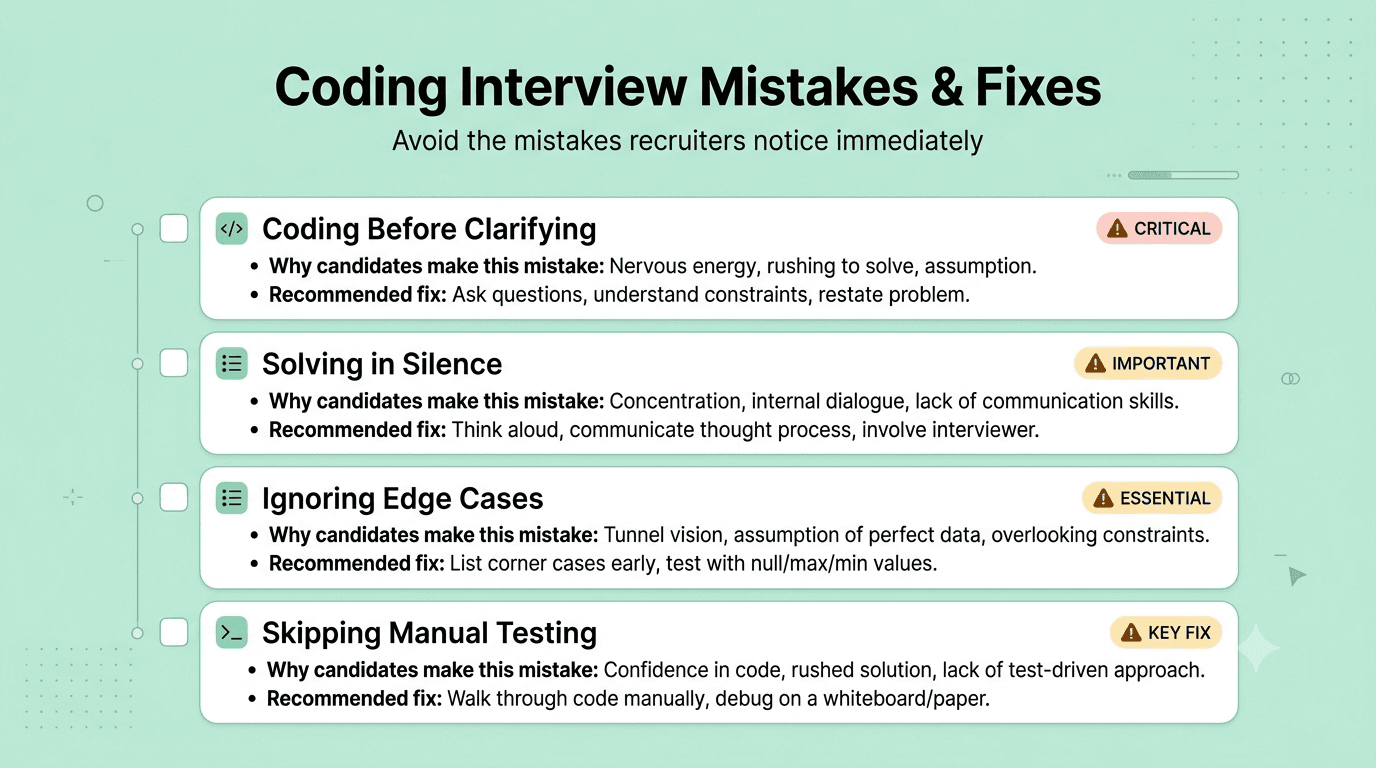
The most common coding round mistakes are jumping straight into code without clarifying the problem, staying silent while solving, ignoring edge cases, and failing to test the solution before declaring it finished.
Mistake: Coding before clarifying the problem Why it happens: Nerves push candidates to start typing immediately to show progress. How to fix it: Restate the problem in your own words and ask clarifying questions about input size, edge cases, and constraints before writing a single line.
Mistake: Solving in silence Why it happens: Candidates assume talking will slow them down or reveal uncertainty. How to fix it: Narrate your thought process as you work. Interviewers are evaluating your reasoning as much as your final answer, and silence gives them nothing to assess.
Mistake: Ignoring edge cases Why it happens: Candidates focus on getting a working solution for the obvious case and forget to stress test it. How to fix it: Before finishing, walk through empty inputs, duplicate values, and boundary conditions out loud.
Mistake: Not testing the solution Why it happens: Time pressure creates a rush to declare the problem solved. How to fix it: Trace through your code manually with a sample input before saying you're done, catching mistakes yourself instead of an interviewer finding them.
Mistakes in Technical Interviews
Common technical interview mistakes include giving textbook definitions without real examples, guessing instead of admitting a knowledge gap, and failing to connect answers back to practical, hands on experience.
Mistake: Reciting definitions without examples Why it happens: Candidates over rely on memorized study material instead of grounding answers in real work. How to fix it: Pair every definition with a specific example from a project, even a small one, to show applied understanding.
Mistake: Guessing instead of admitting a gap Why it happens: Candidates fear that saying "I don't know" will end the interview badly. How to fix it: Say clearly that you're less familiar with the topic, then reason through what you do know that's adjacent to it. Interviewers respect honest reasoning far more than confident guessing that turns out wrong.
Mistake: Disconnecting answers from real experience Why it happens: Purely theoretical study without hands on projects leaves candidates with nothing concrete to reference. How to fix it: Build at least one or two small projects specifically so you have real examples ready for technical questions.
FREE TO USE
8k+ SESSIONS92% FLUENCY4.9★ RATING
Speak With Confidence
Real Conversations. Real Scenarios. Speak until it feels natural.
- Real-Time Speaking Practice
- Guided Conversation Flows
- Instant AI Feedback
Mistakes in Behavioral Interviews
The most common behavioral interview mistakes are giving vague, unstructured answers, focusing only on team achievements without a clear personal contribution, and failing to prepare stories in advance, leading to rambling or incomplete responses.
Mistake: Vague, unstructured answers Why it happens: Candidates assume behavioral questions are less important than technical ones and under prepare for them. How to fix it: Use the STAR method, Situation, Task, Action, Result, to give every answer a clear beginning, middle, and measurable end.
Mistake: Describing team success without personal contribution Why it happens: Candidates worry that focusing on their individual role will sound self centered. How to fix it: Be specific about what you personally did within the team effort, interviewers need to know your actual contribution, not just the group outcome.
Mistake: Improvising instead of preparing stories Why it happens: Candidates assume they'll naturally recall a good example in the moment. How to fix it: Prepare three or four flexible stories in advance covering conflict, failure, leadership, and learning, so you're adapting a ready story rather than building one from scratch under pressure.
Mistakes in System Design Interviews
Common system design mistakes include jumping into a solution without clarifying requirements, over engineering a design for a simple problem, and failing to discuss trade offs, which is often what interviewers are evaluating most closely.
Mistake: Skipping requirement clarification Why it happens: Candidates feel pressure to start drawing a solution right away. How to fix it: Ask about scale, read versus write patterns, and consistency requirements before proposing any architecture.
Mistake: Over engineering the design Why it happens: Candidates want to showcase every advanced concept they know, even when the problem doesn't call for it. How to fix it: Start with a simple, working design and layer in complexity only as the interviewer pushes on scale or specific constraints.
Mistake: Not discussing trade offs Why it happens: Candidates present a single solution as the only correct answer instead of acknowledging alternatives. How to fix it: Explicitly mention what you're trading off, like consistency for availability, and explain why your choice fits the given requirements.
Mistakes During HR and Final Rounds
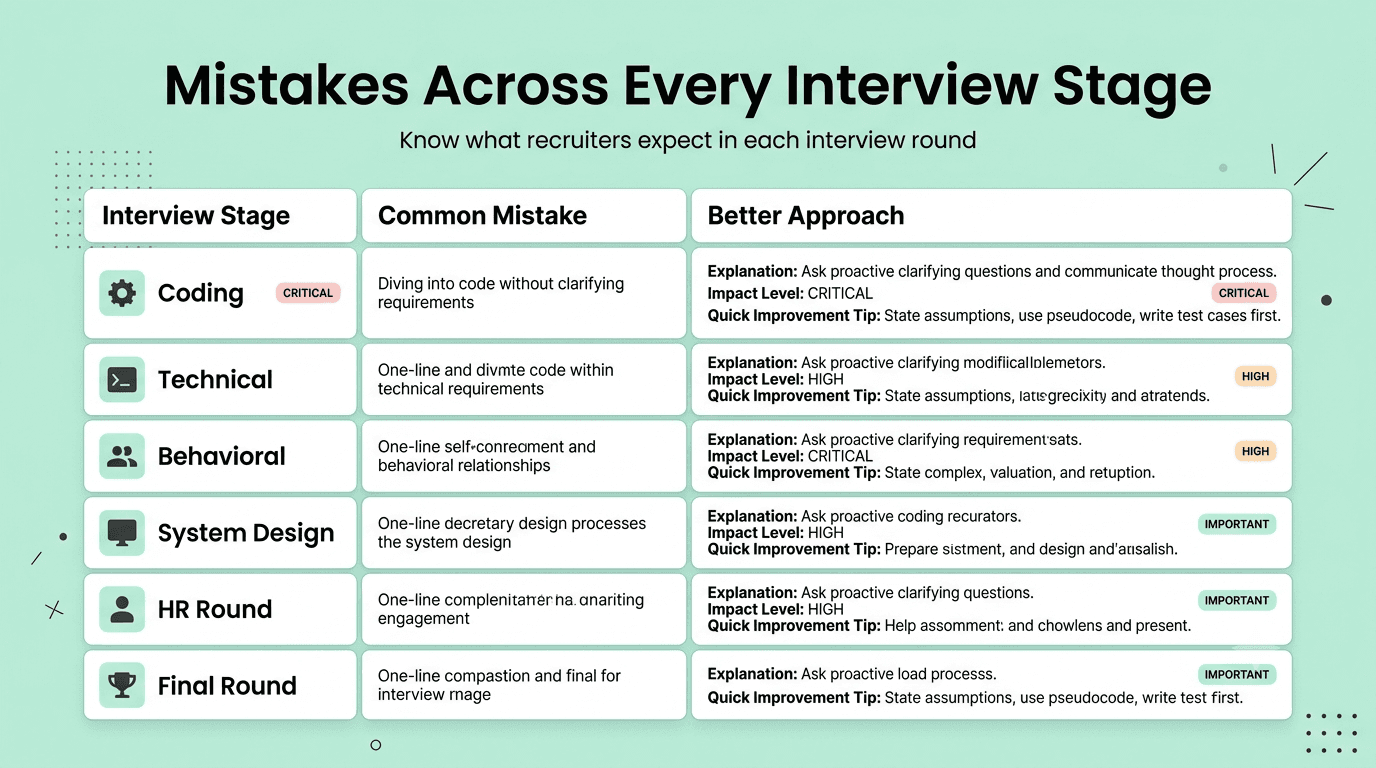
Common HR and final round mistakes include giving generic answers that could apply to any company, being unprepared to discuss salary expectations, and not asking the interviewer any questions at the end, which can read as disinterest even when it isn't.
Mistake: Generic, company agnostic answers Why it happens: Candidates reuse the same answers across multiple applications without tailoring them. How to fix it: Reference something specific about the company, a product, an engineering blog post, or a recent release, in your answers.
Mistake: Being unprepared for salary discussions Why it happens: Candidates avoid researching compensation ranges out of discomfort with the topic. How to fix it: Research typical ranges for the role and location beforehand so your answer is grounded rather than improvised.
Mistake: Not asking the interviewer questions Why it happens: Candidates assume the interview is over once their own answers are done. How to fix it: Prepare two or three specific questions in advance about the team, tech stack, or engineering culture.
Mindset Mistakes That Undermine Strong Candidates
Beyond specific answers, mindset mistakes like over preparing rehearsed scripts, avoiding mock interviews, and treating rejection as a final verdict rather than useful feedback quietly undermine otherwise strong candidates across the entire process.
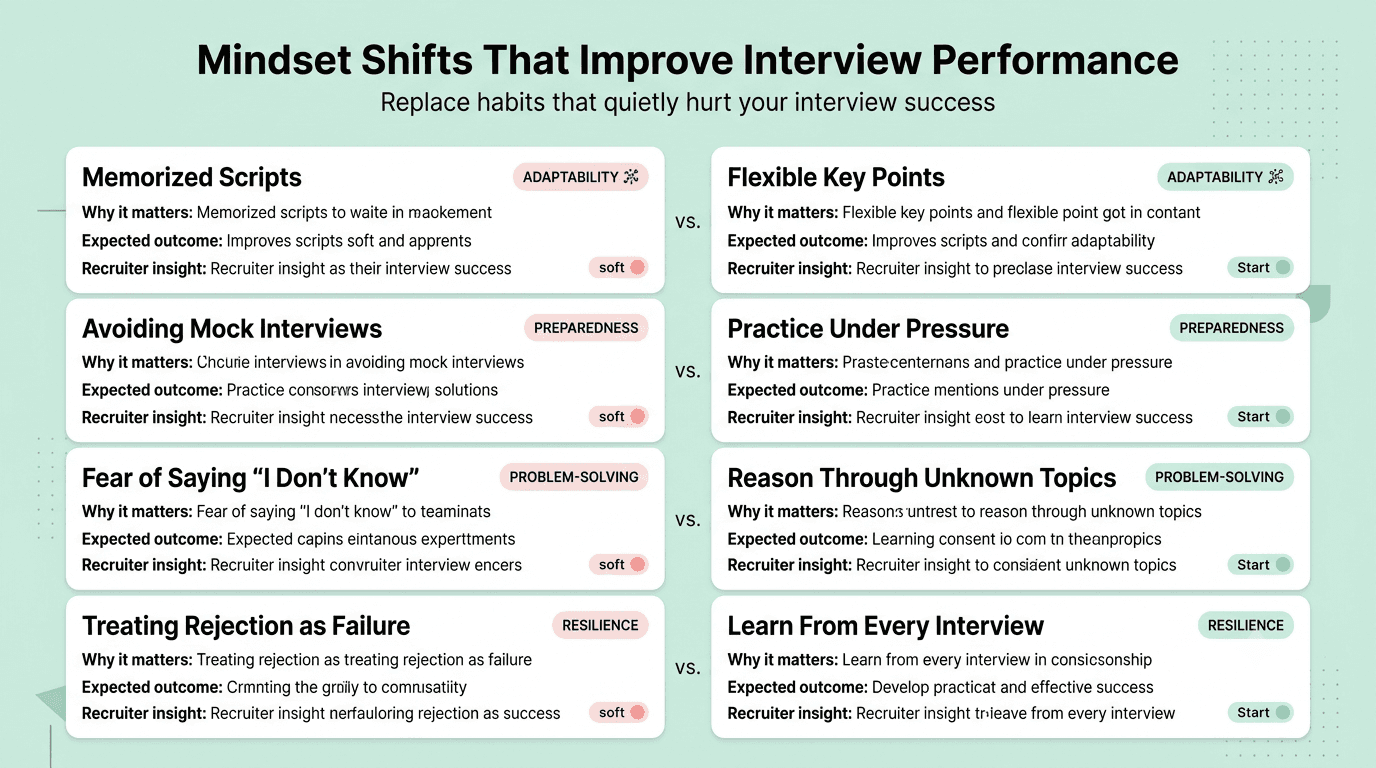
Mistake: Over rehearsing scripted answers Why it happens: Candidates believe a perfectly memorized answer is safer than a flexible one. How to fix it: Prepare key points rather than exact scripts, so you can adapt naturally when a question is phrased differently than expected.
Read More : TOP 50+ interview questions for software engineer interview
Mistake: Avoiding mock interviews Why it happens: Practicing alone feels less intimidating than simulating real pressure. How to fix it: Schedule at least one full mock interview before the real one, since reading and thinking through answers feels very different from saying them out loud under pressure.
Mistake: Treating rejection as a final verdict Why it happens: A single rejection feels like proof of inadequacy rather than one data point among many factors. How to fix it: Review what specifically didn't go well after each interview and adjust your preparation accordingly, treating each round as useful feedback rather than a final judgment.
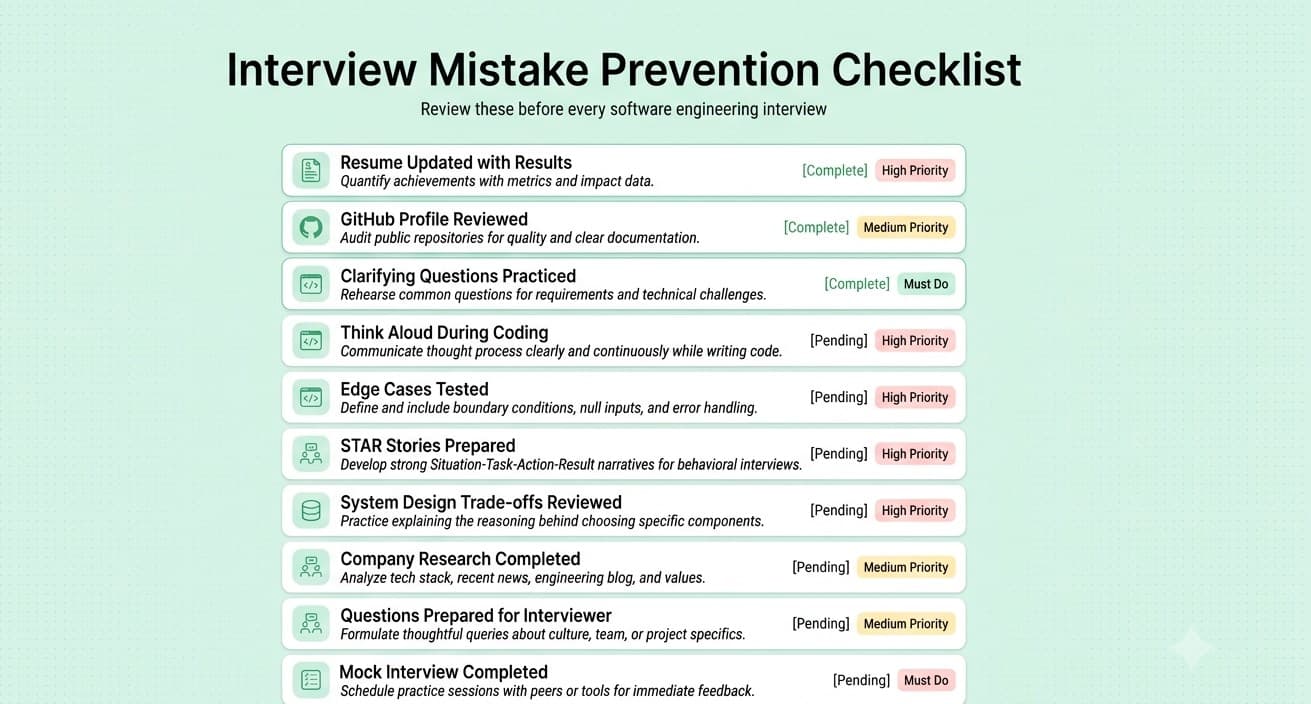
Mistake Checklist Before Your Next Interview
- Resume rewritten with measurable results, not just responsibilities
- GitHub profile cleaned up and aligned with resume claims
- Practiced clarifying questions before jumping into coding problems
- Practiced narrating your thought process out loud
- Prepared real examples to back up technical definitions
- STAR formatted behavioral stories ready for common scenarios
- Practiced discussing trade offs in system design answers
- Company specific research done for HR and final rounds
- Two or three questions prepared to ask the interviewer
- At least one full mock interview completed
Conclusion
Most software engineer interview mistakes aren't about missing knowledge, they're about how that knowledge gets communicated under pressure. Clarifying questions before coding, narrating your reasoning, preparing real examples and stories in advance, and practicing under realistic conditions closes the gap between what you know and how well you demonstrate it.
Start Your Free Software Engineer Mock Interview