Loading...
Contents
Top 50 Software Engineer Interview Questions and Answers (2026)
Jul 31, 2026159 min readUpdated Sep 13, 2026
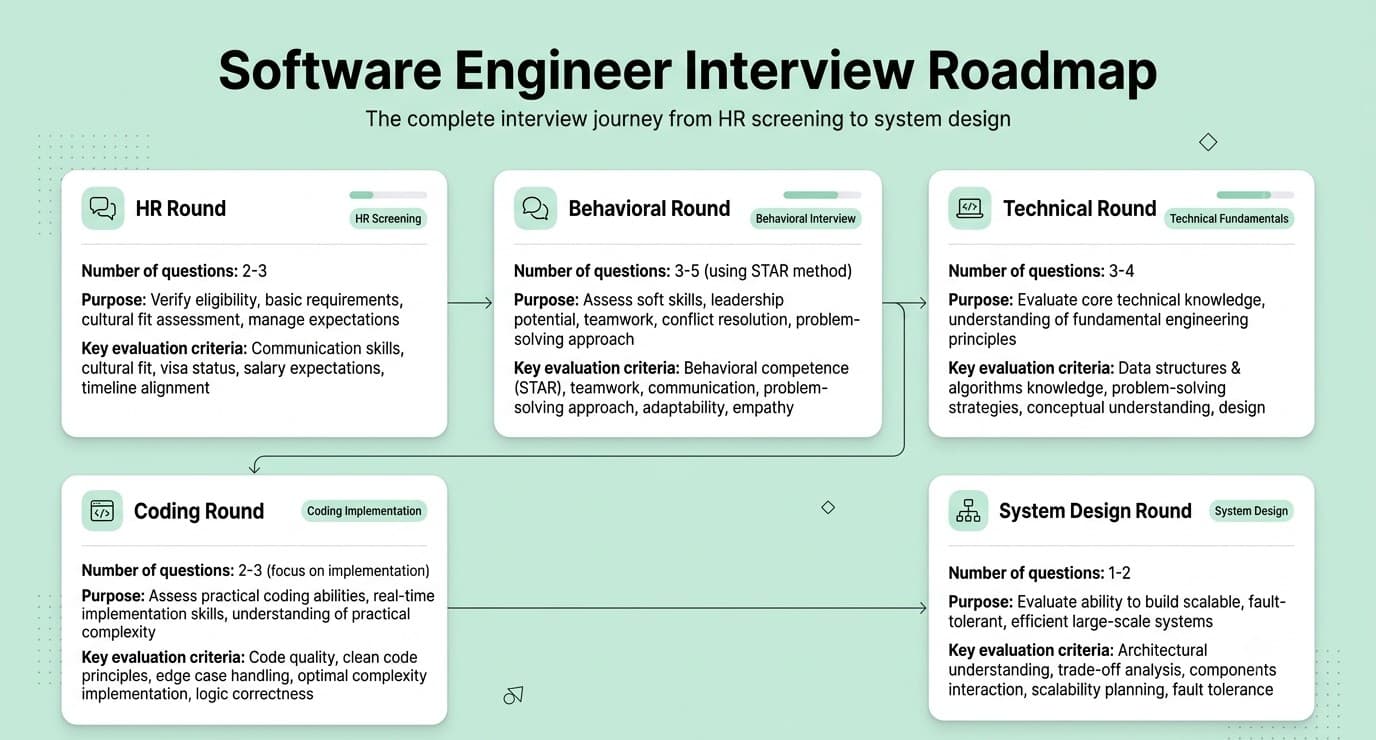
This guide covers the 100 most important software engineering interview questions, organized by topic and roughly ordered by frequency/importance within each category. Categories are sequenced from foundational to advanced, ending with behavioral and industry-trend questions.
Categories:
Data Structures & Algorithms Fundamentals
Object-Oriented Programming & Design Patterns
System Design
Databases
Networking & Web Fundamentals
Operating Systems & Concurrency
Hands-On Coding Challenges
Testing, DevOps & Best Practices
Scenario-Based & Behavioral Questions
Industry Trends
FREE TO USE
25K+ INTERVIEWS4.8★ RATING68% IMPROVEMENT
Crack Your Dream Job
Real Interviews. Real Pressure. Practice until it feels easy.
- Seamless Interview Experience
- Resume & JD Questions
- Instant Personalized Feedback
Part 1: Data Structures & Algorithms Fundamentals
Question 1
Question: What is the difference between an array and a linked list?
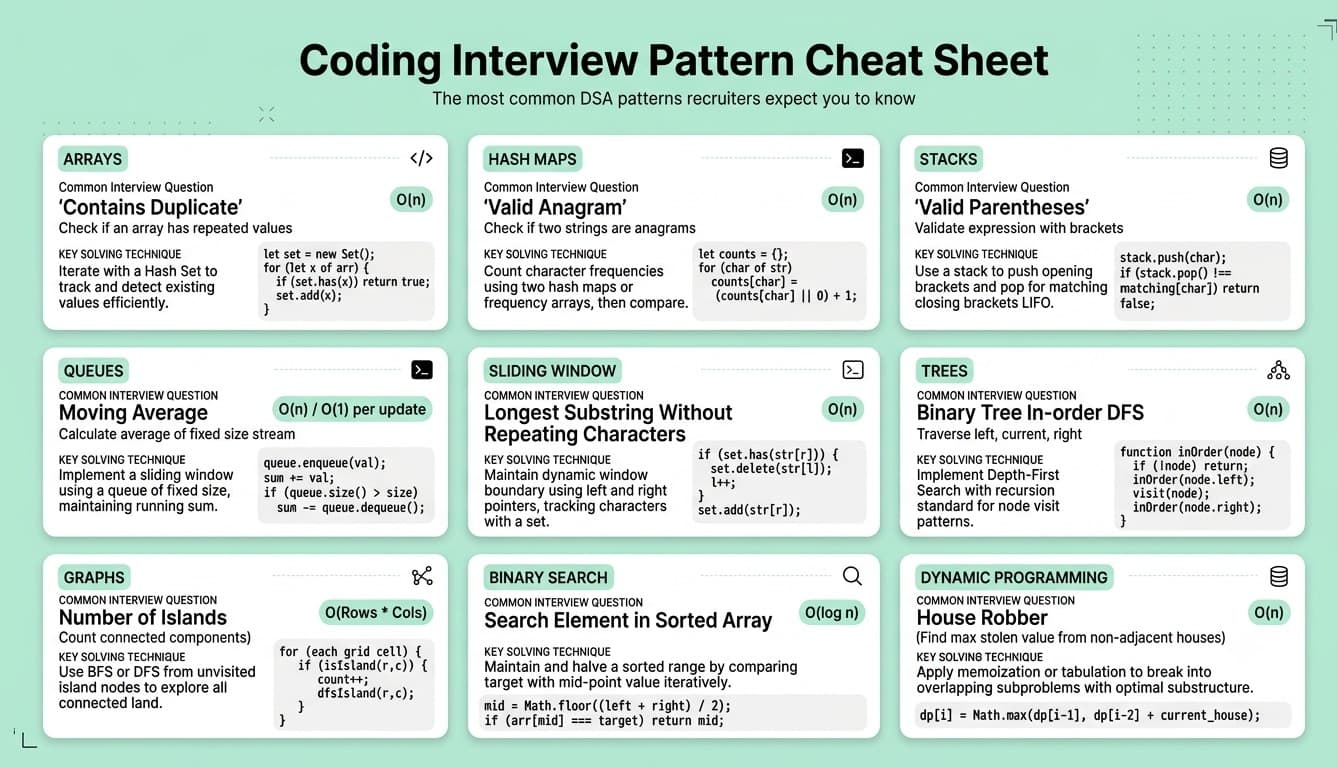
Answer: Arrays store elements in contiguous memory with O(1) index access but O(n) insertion/deletion (due to shifting). Linked lists store elements as nodes with pointers, giving O(1) insertion/deletion at a known position but O(n) access since you must traverse from the head.
Explanation: This tests understanding of memory layout and how it affects time complexity tradeoffs. Arrays trade flexibility for speed of access; linked lists trade access speed for flexible size and cheap insertion.
Real-World Example: A browser's back/forward history is often modeled as a doubly linked list (cheap insert/remove at the ends), while a fixed-size lookup table like a color palette uses an array for O(1) indexed access.
Common Mistakes: Candidates forget to mention cache locality (arrays are faster in practice due to CPU caching) or claim linked lists are "always better" for insertion without noting the O(n) cost of finding the insertion point.
Follow-up Questions: How would you reverse a singly linked list? What's the difference between a doubly linked list and a circular linked list? When would you choose a dynamic array over a linked list?
Question 2
Question: Explain time and space complexity (Big O notation).
Answer: Big O describes how an algorithm's runtime or memory usage grows relative to input size, focusing on the dominant term as input approaches infinity, ignoring constants and lower-order terms.
Explanation: It's a language for reasoning about scalability. Common orders: O(1), O(log n), O(n), O(n log n), O(n²), O(2^n) — interviewers expect you to identify these from code and explain why.
Real-World Example: A search feature using linear scan (O(n)) becomes a bottleneck at 10 million records, motivating a switch to a hash index (O(1)) or sorted structure with binary search (O(log n)).
Common Mistakes: Confusing worst-case with average-case, ignoring space complexity, or miscounting nested loops (e.g., missing that two sequential loops are O(n), not O(n²)).
Follow-up Questions: What's the time complexity of this code snippet? What's the difference between amortized and worst-case complexity? Can you have O(1) space but O(n) time, and vice versa?
Question: Explain time and space complexity (Big O notation).
Answer: Big O describes how an algorithm's runtime or memory usage grows relative to input size, focusing on the dominant term as input approaches infinity, ignoring constants and lower-order terms.
Explanation: It's a language for reasoning about scalability. Common orders: O(1), O(log n), O(n), O(n log n), O(n²), O(2^n) — interviewers expect you to identify these from code and explain why.
Real-World Example: A search feature using linear scan (O(n)) becomes a bottleneck at 10 million records, motivating a switch to a hash index (O(1)) or sorted structure with binary search (O(log n)).
Common Mistakes: Confusing worst-case with average-case, ignoring space complexity, or miscounting nested loops (e.g., missing that two sequential loops are O(n), not O(n²)).
Follow-up Questions: What's the time complexity of this code snippet? What's the difference between amortized and worst-case complexity? Can you have O(1) space but O(n) time, and vice versa?
Question 3
Question: How does a hash table work, and how are collisions handled?
Answer: A hash table maps keys to array indices via a hash function. Collisions (two keys hashing to the same index) are handled via chaining (linked list/tree per bucket) or open addressing (probing for the next free slot).
Explanation: Average-case O(1) lookup/insert/delete relies on a good hash function distributing keys evenly and a reasonable load factor triggering resizing.
Real-World Example: Language runtime dictionaries (Python dict, Java HashMap) are hash tables; Java's HashMap switches buckets from linked lists to red-black trees when a bucket grows too large to avoid worst-case O(n) chains.
Common Mistakes: Saying hash tables are "always O(1)" without acknowledging worst-case O(n) with poor hashing, or not knowing the difference between chaining and open addressing.
Follow-up Questions: How would you design a hash function for strings? What happens during resizing, and why is it costly? How would you implement a hash table that also preserves insertion order?
Question: How does a hash table work, and how are collisions handled?
Answer: A hash table maps keys to array indices via a hash function. Collisions (two keys hashing to the same index) are handled via chaining (linked list/tree per bucket) or open addressing (probing for the next free slot).
Explanation: Average-case O(1) lookup/insert/delete relies on a good hash function distributing keys evenly and a reasonable load factor triggering resizing.
Real-World Example: Language runtime dictionaries (Python dict, Java HashMap) are hash tables; Java's HashMap switches buckets from linked lists to red-black trees when a bucket grows too large to avoid worst-case O(n) chains.
Common Mistakes: Saying hash tables are "always O(1)" without acknowledging worst-case O(n) with poor hashing, or not knowing the difference between chaining and open addressing.
Follow-up Questions: How would you design a hash function for strings? What happens during resizing, and why is it costly? How would you implement a hash table that also preserves insertion order?
Question 4
Question: What is a binary search tree (BST), and what are its time complexities?
Answer: A BST is a tree where each node's left subtree contains smaller values and the right subtree contains larger values. Search, insert, and delete are O(log n) on average but degrade to O(n) if the tree becomes unbalanced (essentially a linked list).
Explanation: This tests understanding of tree invariants and why balance matters, leading naturally into self-balancing trees like AVL or Red-Black trees.
Real-World Example: Database indexes often use B-trees (a generalization of BSTs) precisely because they self-balance and minimize disk reads.
Common Mistakes: Forgetting to mention the unbalanced worst case, or confusing BST in-order traversal (yields sorted order) with pre-order/post-order.
Follow-up Questions: How does an AVL tree maintain balance? How would you validate whether a binary tree is a valid BST? How do you find the kth smallest element in a BST?
Question: What is a binary search tree (BST), and what are its time complexities?
Answer: A BST is a tree where each node's left subtree contains smaller values and the right subtree contains larger values. Search, insert, and delete are O(log n) on average but degrade to O(n) if the tree becomes unbalanced (essentially a linked list).
Explanation: This tests understanding of tree invariants and why balance matters, leading naturally into self-balancing trees like AVL or Red-Black trees.
Real-World Example: Database indexes often use B-trees (a generalization of BSTs) precisely because they self-balance and minimize disk reads.
Common Mistakes: Forgetting to mention the unbalanced worst case, or confusing BST in-order traversal (yields sorted order) with pre-order/post-order.
Follow-up Questions: How does an AVL tree maintain balance? How would you validate whether a binary tree is a valid BST? How do you find the kth smallest element in a BST?
Question 5
Question: Explain the difference between BFS and DFS, and when you'd use each.
Answer: BFS explores level by level using a queue, ideal for finding shortest paths in unweighted graphs. DFS explores as deep as possible using a stack (or recursion), useful for exploring all paths, detecting cycles, or topological sorting.
Explanation: Both are O(V+E) for traversal but differ in memory usage pattern and problem fit — BFS memory grows with the graph's "width," DFS with its "depth."
Real-World Example: BFS powers "shortest number of connections" features (like LinkedIn's "degrees of connection"); DFS is used in solving mazes or detecting circular dependencies in build systems.
Common Mistakes: Using DFS when the problem explicitly asks for the shortest path in an unweighted graph, or forgetting to track visited nodes (causing infinite loops in cyclic graphs).
Follow-up Questions: How would you detect a cycle in a directed graph? How does Dijkstra's algorithm differ from BFS? Can you do BFS/DFS iteratively vs. recursively — what are the tradeoffs?
Question: Explain the difference between BFS and DFS, and when you'd use each.
Answer: BFS explores level by level using a queue, ideal for finding shortest paths in unweighted graphs. DFS explores as deep as possible using a stack (or recursion), useful for exploring all paths, detecting cycles, or topological sorting.
Explanation: Both are O(V+E) for traversal but differ in memory usage pattern and problem fit — BFS memory grows with the graph's "width," DFS with its "depth."
Real-World Example: BFS powers "shortest number of connections" features (like LinkedIn's "degrees of connection"); DFS is used in solving mazes or detecting circular dependencies in build systems.
Common Mistakes: Using DFS when the problem explicitly asks for the shortest path in an unweighted graph, or forgetting to track visited nodes (causing infinite loops in cyclic graphs).
Follow-up Questions: How would you detect a cycle in a directed graph? How does Dijkstra's algorithm differ from BFS? Can you do BFS/DFS iteratively vs. recursively — what are the tradeoffs?
Question 6
Question: What is dynamic programming, and how do you recognize when to use it?
Answer: Dynamic programming solves problems by breaking them into overlapping subproblems, solving each once, and storing results (memoization or tabulation) to avoid redundant work.
Explanation: Look for two signals: optimal substructure (the optimal solution can be built from optimal solutions to subproblems) and overlapping subproblems (naive recursion recomputes the same values repeatedly).
Real-World Example: Sequence alignment in bioinformatics and spell-checkers use edit distance (a classic DP problem) to measure similarity between strings efficiently.
Common Mistakes: Jumping straight to code without first defining the recurrence relation, or using DP when a simpler greedy approach would suffice (and vice versa).
Follow-up Questions: What's the difference between top-down (memoization) and bottom-up (tabulation) DP? Can you solve the knapsack problem? How would you optimize a DP solution's space complexity?
Question: What is dynamic programming, and how do you recognize when to use it?
Answer: Dynamic programming solves problems by breaking them into overlapping subproblems, solving each once, and storing results (memoization or tabulation) to avoid redundant work.
Explanation: Look for two signals: optimal substructure (the optimal solution can be built from optimal solutions to subproblems) and overlapping subproblems (naive recursion recomputes the same values repeatedly).
Real-World Example: Sequence alignment in bioinformatics and spell-checkers use edit distance (a classic DP problem) to measure similarity between strings efficiently.
Common Mistakes: Jumping straight to code without first defining the recurrence relation, or using DP when a simpler greedy approach would suffice (and vice versa).
Follow-up Questions: What's the difference between top-down (memoization) and bottom-up (tabulation) DP? Can you solve the knapsack problem? How would you optimize a DP solution's space complexity?
Question 7
Question: What is the difference between a stack and a queue, and where are they used?
Answer: A stack is LIFO (last in, first out) with push/pop operations; a queue is FIFO (first in, first out) with enqueue/dequeue.
Explanation: These are foundational abstract data types underlying many algorithms — recursion implicitly uses a call stack, while task scheduling and BFS use queues.
Real-World Example: Browser undo functionality uses a stack; a print spooler or message broker (like a task queue) uses a queue to process jobs in order.
Common Mistakes: Confusing which end operations happen on, or not recognizing that a queue can be implemented using two stacks (a common interview exercise).
Follow-up Questions: How would you implement a queue using two stacks? What's a priority queue and how does it differ? How would you implement an LRU cache using a queue-like structure?
Question 8
Question: How would you find the kth largest element in an array?
Answer: The optimal general approach uses a min-heap of size k (O(n log k)), or Quickselect for average O(n) time. Sorting the whole array works but is O(n log n), less efficient for large n with small k.
Explanation: This tests whether candidates default to sorting versus recognizing more efficient specialized structures/algorithms for "kth element" problems.
Real-World Example: Finding the top k trending topics or top k highest-paid employees in a dataset uses this exact pattern.
Common Mistakes: Immediately sorting without considering heap or Quickselect, or implementing Quickselect incorrectly (mishandling the partition/pivot selection).
Follow-up Questions: What's the time complexity of Quickselect in the worst case, and how do you mitigate it? How would you find the kth largest in a stream of numbers?
Question: Explain recursion and how to avoid stack overflow issues.
Answer: Recursion is a function calling itself to solve smaller instances of a problem, with a base case to terminate. Stack overflow occurs when recursion depth exceeds the call stack's capacity; mitigations include converting to iteration, using tail-call optimization (where supported), or increasing stack size.
Explanation: Interviewers want to see you understand the call stack mechanics, not just write recursive code that "works" on small inputs.
Real-World Example: Recursive directory traversal (e.g., calculating folder sizes) can hit stack limits on deeply nested file systems, so production tools often use an explicit stack instead.
Common Mistakes: Missing or incorrect base cases causing infinite recursion, or assuming all languages optimize tail calls (most mainstream languages, like Python and Java, do not).
Follow-up Questions: How would you convert a recursive function to an iterative one? What is tail-call optimization, and which languages support it? How would you calculate the space complexity of a recursive algorithm?
Question 10
Question: What is a trie, and what problems is it good for?
Answer: A trie (prefix tree) stores strings character by character in a tree structure, allowing prefix-based operations like autocomplete in O(m) time, where m is the string length, independent of how many strings are stored.
Explanation: Tests knowledge beyond basic structures — tries are a go-to when the problem involves prefixes, dictionaries, or word search.
Real-World Example: Autocomplete in search engines and IDE code completion both commonly use trie-based structures.
Common Mistakes: Using a trie when a simple hash set would suffice (no prefix requirement), or not accounting for the space overhead of tries with large alphabets.
Follow-up Questions: How would you implement autocomplete using a trie? How does a trie compare to a hash set for word lookup? What's a compressed trie (radix tree) and why use one?
Part 2: Object-Oriented Programming & Design Patterns
Question 15
Question: Explain the four pillars of OOP.
Answer: Encapsulation (bundling data and methods, restricting direct access), abstraction (exposing essential behavior while hiding implementation), inheritance (deriving new classes from existing ones to reuse behavior), and polymorphism (objects of different types responding to the same interface differently).
Explanation: Foundational vocabulary for any OOP-based interview; interviewers want concrete examples for each, not just definitions.
Real-World Example: A payment system might define a PaymentMethod interface (abstraction/polymorphism) implemented by CreditCard, PayPal, and BankTransfer classes, each encapsulating its own validation logic.
Common Mistakes: Giving textbook definitions without examples, or confusing polymorphism with simple method overloading only (missing runtime/dynamic dispatch, i.e., overriding).
Follow-up Questions: What's the difference between compile-time and runtime polymorphism? When would you favor composition over inheritance? Can you give an example where inheritance caused a design problem?
Question 16
Question: What is the difference between composition and inheritance, and when should you use each?
Answer: Inheritance models an "is-a" relationship and reuses code by extending a base class; composition models a "has-a" relationship, building objects by combining smaller, independent components. Composition is generally favored for flexibility since it avoids tight coupling and deep hierarchies.
Explanation: This is one of the most-asked design questions because overusing inheritance is a very common real-world design flaw.
Real-World Example: Instead of a FlyingCar extends Car, Plane (multiple inheritance issues), you'd compose a Car with an Engine and a FlightModule component.
Common Mistakes: Defaulting to inheritance for code reuse alone without considering whether an "is-a" relationship actually holds (leading to fragile hierarchies).
Follow-up Questions: Can you give an example of the "fragile base class" problem? How does composition help with unit testing? What is the Liskov Substitution Principle and how does it relate?
Question: What is the difference between composition and inheritance, and when should you use each?
Answer: Inheritance models an "is-a" relationship and reuses code by extending a base class; composition models a "has-a" relationship, building objects by combining smaller, independent components. Composition is generally favored for flexibility since it avoids tight coupling and deep hierarchies.
Explanation: This is one of the most-asked design questions because overusing inheritance is a very common real-world design flaw.
Real-World Example: Instead of a FlyingCar extends Car, Plane (multiple inheritance issues), you'd compose a Car with an Engine and a FlightModule component.
Common Mistakes: Defaulting to inheritance for code reuse alone without considering whether an "is-a" relationship actually holds (leading to fragile hierarchies).
Follow-up Questions: Can you give an example of the "fragile base class" problem? How does composition help with unit testing? What is the Liskov Substitution Principle and how does it relate?
Question 17
Question: Explain SOLID principles.
Answer: Single Responsibility (a class should have one reason to change), Open/Closed (open for extension, closed for modification), Liskov Substitution (subtypes must be substitutable for base types), Interface Segregation (prefer many specific interfaces over one general one), and Dependency Inversion (depend on abstractions, not concrete implementations).
Explanation: SOLID is core to writing maintainable, testable object-oriented code, and interviewers commonly probe for real code smells that violate each principle.
Real-World Example: A ReportGenerator class that both computes data and formats PDF output violates Single Responsibility; splitting it into a ReportCalculator and ReportFormatter fixes it.
Common Mistakes: Reciting the acronym without being able to identify a violation in actual code, or over-applying SOLID leading to excessive abstraction for simple problems.
Follow-up Questions: Can you refactor this class to follow Single Responsibility? How does Dependency Inversion enable easier unit testing (via mocking)? What's an example of violating Liskov Substitution?
Question: Explain SOLID principles.
Answer: Single Responsibility (a class should have one reason to change), Open/Closed (open for extension, closed for modification), Liskov Substitution (subtypes must be substitutable for base types), Interface Segregation (prefer many specific interfaces over one general one), and Dependency Inversion (depend on abstractions, not concrete implementations).
Explanation: SOLID is core to writing maintainable, testable object-oriented code, and interviewers commonly probe for real code smells that violate each principle.
Real-World Example: A ReportGenerator class that both computes data and formats PDF output violates Single Responsibility; splitting it into a ReportCalculator and ReportFormatter fixes it.
Common Mistakes: Reciting the acronym without being able to identify a violation in actual code, or over-applying SOLID leading to excessive abstraction for simple problems.
Follow-up Questions: Can you refactor this class to follow Single Responsibility? How does Dependency Inversion enable easier unit testing (via mocking)? What's an example of violating Liskov Substitution?
Question 18
Question: What is the Singleton pattern, and what are its drawbacks?
Answer: Singleton ensures a class has only one instance and provides a global access point. Drawbacks include hidden dependencies, difficulty in unit testing (global state), and issues in multi-threaded environments if not implemented carefully (race conditions during lazy initialization).
Explanation: Tests both pattern knowledge and critical thinking about when patterns cause more harm than good — a strong candidate critiques the pattern, not just implements it.
Real-World Example: A logging service or configuration manager is often implemented as a singleton, though many modern frameworks prefer dependency injection over singletons for testability.
Common Mistakes: Implementing a non-thread-safe singleton (double-checked locking done incorrectly), or overusing singletons for things that should be dependency-injected instead.
Follow-up Questions: How would you make a singleton thread-safe in your language of choice? Why is Singleton sometimes called an anti-pattern? How would you unit test code depending on a singleton?
Question: What is the Singleton pattern, and what are its drawbacks?
Answer: Singleton ensures a class has only one instance and provides a global access point. Drawbacks include hidden dependencies, difficulty in unit testing (global state), and issues in multi-threaded environments if not implemented carefully (race conditions during lazy initialization).
Explanation: Tests both pattern knowledge and critical thinking about when patterns cause more harm than good — a strong candidate critiques the pattern, not just implements it.
Real-World Example: A logging service or configuration manager is often implemented as a singleton, though many modern frameworks prefer dependency injection over singletons for testability.
Common Mistakes: Implementing a non-thread-safe singleton (double-checked locking done incorrectly), or overusing singletons for things that should be dependency-injected instead.
Follow-up Questions: How would you make a singleton thread-safe in your language of choice? Why is Singleton sometimes called an anti-pattern? How would you unit test code depending on a singleton?
Question 19
Question: Explain the Factory pattern and when you'd use it.
Answer: The Factory pattern delegates object creation to a dedicated method or class rather than instantiating objects directly with new, decoupling client code from concrete classes and centralizing creation logic.
Explanation: Useful when object creation is complex, depends on runtime conditions, or when you want to program against interfaces rather than concrete types.
Real-World Example: A notification system might use a factory to return an EmailNotifier, SmsNotifier, or PushNotifier based on user preference, without the calling code knowing the concrete class.
Common Mistakes: Using a factory for trivial object creation where it adds unnecessary indirection, or confusing Factory Method with Abstract Factory.
Follow-up Questions: What's the difference between Factory Method and Abstract Factory patterns? How does the Factory pattern support the Open/Closed Principle? When would a simple constructor be preferable?
Question: Explain the Factory pattern and when you'd use it.
Answer: The Factory pattern delegates object creation to a dedicated method or class rather than instantiating objects directly with new, decoupling client code from concrete classes and centralizing creation logic.
Explanation: Useful when object creation is complex, depends on runtime conditions, or when you want to program against interfaces rather than concrete types.
Real-World Example: A notification system might use a factory to return an EmailNotifier, SmsNotifier, or PushNotifier based on user preference, without the calling code knowing the concrete class.
Common Mistakes: Using a factory for trivial object creation where it adds unnecessary indirection, or confusing Factory Method with Abstract Factory.
Follow-up Questions: What's the difference between Factory Method and Abstract Factory patterns? How does the Factory pattern support the Open/Closed Principle? When would a simple constructor be preferable?
Question 20
Question: What is the Observer pattern, and where is it used in real systems?
Answer: The Observer pattern defines a one-to-many dependency where a subject notifies all registered observers automatically when its state changes, decoupling the subject from specific observer implementations.
Explanation: Foundational to event-driven architectures and reactive programming — a very commonly asked pattern because it maps directly to real production systems.
Real-World Example: UI frameworks (React's state updates, or classic MVC view updates) and pub/sub messaging systems like Kafka topics are conceptual extensions of the Observer pattern.
Common Mistakes: Not considering memory leaks from observers that are registered but never unregistered, or confusing Observer with the Mediator pattern.
Follow-up Questions: How would you prevent memory leaks in an Observer implementation? What's the difference between Observer and Pub/Sub at scale? How does this pattern relate to reactive programming (RxJS, reactive streams)?
Question: What is the Observer pattern, and where is it used in real systems?
Answer: The Observer pattern defines a one-to-many dependency where a subject notifies all registered observers automatically when its state changes, decoupling the subject from specific observer implementations.
Explanation: Foundational to event-driven architectures and reactive programming — a very commonly asked pattern because it maps directly to real production systems.
Real-World Example: UI frameworks (React's state updates, or classic MVC view updates) and pub/sub messaging systems like Kafka topics are conceptual extensions of the Observer pattern.
Common Mistakes: Not considering memory leaks from observers that are registered but never unregistered, or confusing Observer with the Mediator pattern.
Follow-up Questions: How would you prevent memory leaks in an Observer implementation? What's the difference between Observer and Pub/Sub at scale? How does this pattern relate to reactive programming (RxJS, reactive streams)?
Question 21
Question: What is dependency injection, and why is it useful?
Answer: Dependency injection supplies a class's dependencies from the outside (via constructor, setter, or a DI framework) rather than the class creating them itself, decoupling components and improving testability.
Explanation: Central to modern application architecture (Spring, Angular, .NET) — interviewers check whether you understand the "why," not just the mechanics.
Real-World Example: A UserService that depends on a Database interface can be tested with a mock database injected in tests, and swapped for a different database implementation in production without changing UserService code.
Common Mistakes: Confusing DI with the broader concept of Inversion of Control (DI is one way to achieve IoC), or over-engineering small projects with heavy DI frameworks unnecessarily.
Follow-up Questions: What's the difference between constructor injection and setter injection? How does DI relate to the Dependency Inversion Principle? Can you implement simple DI manually without a framework?
Question: What is dependency injection, and why is it useful?
Answer: Dependency injection supplies a class's dependencies from the outside (via constructor, setter, or a DI framework) rather than the class creating them itself, decoupling components and improving testability.
Explanation: Central to modern application architecture (Spring, Angular, .NET) — interviewers check whether you understand the "why," not just the mechanics.
Real-World Example: A UserService that depends on a Database interface can be tested with a mock database injected in tests, and swapped for a different database implementation in production without changing UserService code.
Common Mistakes: Confusing DI with the broader concept of Inversion of Control (DI is one way to achieve IoC), or over-engineering small projects with heavy DI frameworks unnecessarily.
Follow-up Questions: What's the difference between constructor injection and setter injection? How does DI relate to the Dependency Inversion Principle? Can you implement simple DI manually without a framework?
Question 22
Question: Explain the difference between an abstract class and an interface.
Answer: An abstract class can have both implemented and unimplemented methods, and holds state (fields); a class can only inherit one abstract class. An interface (traditionally) declares method signatures without implementation and a class can implement multiple interfaces, enabling multiple inheritance of type.
Explanation: Language-specific nuances matter here (e.g., Java 8+ default methods blur the line) — interviewers want to see if you know the tradeoffs, not just syntax.
Real-World Example: A Shape abstract class might implement shared logic like describe() while leaving area() abstract; a Comparable interface defines only a contract that many unrelated classes can implement.
Common Mistakes: Saying "interfaces can't have any implementation" without acknowledging default/static methods in modern languages, or not knowing why multiple inheritance of implementation is disallowed in most languages (diamond problem).
Follow-up Questions: What's the diamond problem, and how do different languages resolve it? When would you choose an abstract class over an interface? How does this differ in Python (duck typing, ABCs) versus Java?
Question: Explain the difference between an abstract class and an interface.
Answer: An abstract class can have both implemented and unimplemented methods, and holds state (fields); a class can only inherit one abstract class. An interface (traditionally) declares method signatures without implementation and a class can implement multiple interfaces, enabling multiple inheritance of type.
Explanation: Language-specific nuances matter here (e.g., Java 8+ default methods blur the line) — interviewers want to see if you know the tradeoffs, not just syntax.
Real-World Example: A Shape abstract class might implement shared logic like describe() while leaving area() abstract; a Comparable interface defines only a contract that many unrelated classes can implement.
Common Mistakes: Saying "interfaces can't have any implementation" without acknowledging default/static methods in modern languages, or not knowing why multiple inheritance of implementation is disallowed in most languages (diamond problem).
Follow-up Questions: What's the diamond problem, and how do different languages resolve it? When would you choose an abstract class over an interface? How does this differ in Python (duck typing, ABCs) versus Java?
Question 23
Question: What is the Strategy pattern, and how does it differ from just using if/else?
Answer: The Strategy pattern encapsulates interchangeable algorithms/behaviors behind a common interface, letting you swap behavior at runtime without modifying the client code, adhering to the Open/Closed Principle — unlike if/else chains which require modification for every new case.
Explanation: Tests the candidate's ability to spot when conditional logic should be replaced with polymorphism for maintainability.
Real-World Example: A ride-sharing app's pricing engine might use different PricingStrategy implementations (surge, flat-rate, promotional) selected at runtime rather than a long if/else chain.
Common Mistakes: Over-engineering simple two-branch conditionals into a full Strategy pattern where it's unnecessary overhead.
Follow-up Questions: How does Strategy differ from the State pattern? Can you refactor this if/else block into Strategy pattern? How would you inject the right strategy at runtime?
Question: What is the Strategy pattern, and how does it differ from just using if/else?
Answer: The Strategy pattern encapsulates interchangeable algorithms/behaviors behind a common interface, letting you swap behavior at runtime without modifying the client code, adhering to the Open/Closed Principle — unlike if/else chains which require modification for every new case.
Explanation: Tests the candidate's ability to spot when conditional logic should be replaced with polymorphism for maintainability.
Real-World Example: A ride-sharing app's pricing engine might use different PricingStrategy implementations (surge, flat-rate, promotional) selected at runtime rather than a long if/else chain.
Common Mistakes: Over-engineering simple two-branch conditionals into a full Strategy pattern where it's unnecessary overhead.
Follow-up Questions: How does Strategy differ from the State pattern? Can you refactor this if/else block into Strategy pattern? How would you inject the right strategy at runtime?
Question 24
Question: What is method overloading vs. method overriding?
Answer: Overloading defines multiple methods with the same name but different parameter lists within the same class (resolved at compile time). Overriding redefines a parent class's method in a subclass with the same signature (resolved at runtime via dynamic dispatch).
Explanation: Basic but frequently tested vocabulary that also connects to the broader concept of polymorphism.
Real-World Example: A Logger class might overload log() to accept a string, an exception, or both; a subclass FileLogger might override a base log() method to write to disk instead of the console.
Common Mistakes: Confusing which is resolved at compile-time vs. runtime, or forgetting that overloading requires different parameter types/counts, not just a different return type.
Follow-up Questions: Can you overload based on return type alone? What is covariant return type in overriding? How does method overriding relate to the Liskov Substitution Principle?
Question: What is method overloading vs. method overriding?
Answer: Overloading defines multiple methods with the same name but different parameter lists within the same class (resolved at compile time). Overriding redefines a parent class's method in a subclass with the same signature (resolved at runtime via dynamic dispatch).
Explanation: Basic but frequently tested vocabulary that also connects to the broader concept of polymorphism.
Real-World Example: A Logger class might overload log() to accept a string, an exception, or both; a subclass FileLogger might override a base log() method to write to disk instead of the console.
Common Mistakes: Confusing which is resolved at compile-time vs. runtime, or forgetting that overloading requires different parameter types/counts, not just a different return type.
Follow-up Questions: Can you overload based on return type alone? What is covariant return type in overriding? How does method overriding relate to the Liskov Substitution Principle?
Part 3: System Design
Question 25
Question: How would you design a URL shortener (like bit.ly)?
Answer: Key components: a hash/encoding function (base62 encoding of an auto-incrementing ID, or hashing with collision checks) to generate short codes, a database (key-value store works well) mapping short codes to long URLs, a read-heavy caching layer (Redis) since reads vastly outnumber writes, and analytics tracking as a secondary concern.
Explanation: Tests the ability to identify the core bottleneck (extremely read-heavy traffic), choose appropriate data storage, and reason about uniqueness/collision handling at scale.
Real-World Example: Services like bit.ly or TinyURL use exactly this pattern — base62 encoding an incrementing counter keeps short codes compact and collision-free without needing a hash-collision-resolution scheme.
Common Mistakes: Over-focusing on hashing collisions instead of addressing the read/write ratio and caching strategy, or forgetting to discuss custom alias support and expiration.
Follow-up Questions: How would you handle 100,000 requests per second? How would you shard the database as it grows? How would you prevent malicious URL abuse (spam/phishing links)?
Question 26
Question: Walk me through designing a rate limiter.
Answer: Common algorithms: Token Bucket (allows bursts, refills at a fixed rate), Leaky Bucket (smooths traffic to a constant rate), Fixed Window Counter (simple but has edge-burst issues), and Sliding Window Log/Counter (more accurate, higher memory cost). Implementation typically uses Redis for distributed counting with atomic increment operations and TTLs.
Explanation: A very common system design and even coding question — tests understanding of the tradeoffs between accuracy, memory, and burst tolerance.
Real-World Example: API gateways (like AWS API Gateway or Stripe's API) use token bucket-style rate limiting to protect backend services from abuse while allowing short bursts of legitimate traffic.
Common Mistakes: Not considering distributed systems (rate limiting only in-memory on one server, which fails with multiple server instances), or ignoring race conditions in the counter increment logic.
Follow-up Questions: How would you make this rate limiter work across multiple servers? What happens if Redis goes down — how do you degrade gracefully? How would you rate-limit per-user vs. per-IP?
Question 27
Question: How would you design a scalable chat application (like WhatsApp)?
Answer: Core pieces: WebSocket or long-polling connections for real-time delivery, a message queue (Kafka) for reliable delivery and fan-out, a database optimized for write-heavy chat history (often a wide-column store like Cassandra), presence/online-status tracking, and push notification integration for offline users.
Explanation: Tests ability to reason about real-time communication, persistence, and horizontal scaling of stateful connections (a common systems challenge since WebSocket connections are stateful, unlike typical stateless HTTP).
Real-World Example: WhatsApp's architecture historically used Erlang for massive concurrent connection handling; most modern systems now solve this with connection gateways that route to backend services via a message broker.
Common Mistakes: Treating this like a typical stateless REST API design without addressing the challenge of maintaining millions of persistent connections, or forgetting message ordering and delivery guarantees (at-least-once vs. exactly-once).
Follow-up Questions: How would you ensure message ordering across devices? How would you handle a user with multiple active devices? How do you scale WebSocket connections across many servers?
Question 28
Question: What's the difference between horizontal and vertical scaling, and when would you use each?
Answer: Vertical scaling adds more resources (CPU, RAM) to a single machine — simple but has a hard ceiling and creates a single point of failure. Horizontal scaling adds more machines and distributes load — more complex (requires load balancing, data partitioning) but offers near-unlimited scale and better fault tolerance.
Explanation: Foundational scaling vocabulary; interviewers want to see you understand the operational complexity horizontal scaling introduces, not just that it "scales more."
Real-World Example: A startup's MVP database might scale vertically (bigger RDS instance) initially, but a company like Netflix scales horizontally across thousands of stateless microservice instances behind load balancers.
Common Mistakes: Assuming horizontal scaling is always the answer without acknowledging added complexity (distributed transactions, consistency, network partitions).
Follow-up Questions: How do you scale a stateful service horizontally? What's the role of a load balancer in horizontal scaling? How does database sharding relate to horizontal scaling?
Question: What's the difference between horizontal and vertical scaling, and when would you use each?
Answer: Vertical scaling adds more resources (CPU, RAM) to a single machine — simple but has a hard ceiling and creates a single point of failure. Horizontal scaling adds more machines and distributes load — more complex (requires load balancing, data partitioning) but offers near-unlimited scale and better fault tolerance.
Explanation: Foundational scaling vocabulary; interviewers want to see you understand the operational complexity horizontal scaling introduces, not just that it "scales more."
Real-World Example: A startup's MVP database might scale vertically (bigger RDS instance) initially, but a company like Netflix scales horizontally across thousands of stateless microservice instances behind load balancers.
Common Mistakes: Assuming horizontal scaling is always the answer without acknowledging added complexity (distributed transactions, consistency, network partitions).
Follow-up Questions: How do you scale a stateful service horizontally? What's the role of a load balancer in horizontal scaling? How does database sharding relate to horizontal scaling?
Question 29
Question: Explain the CAP theorem and its practical implications.
Answer: In a distributed system, you can guarantee at most two of Consistency (all nodes see the same data at once), Availability (every request gets a response), and Partition Tolerance (system continues despite network failures) — and since network partitions are unavoidable in practice, real systems choose between CP (consistent but may reject requests during a partition) and AP (available but may serve stale data).
Explanation: One of the most commonly asked distributed systems theory questions — interviewers want to see you connect the theory to real database choices.
Real-World Example: DynamoDB and Cassandra are typically tuned for AP (favoring availability, eventual consistency); traditional relational databases with synchronous replication (or systems like Zookeeper) favor CP.
Common Mistakes: Saying you can "choose all three," or not being able to name real systems/databases that exemplify CP vs. AP tradeoffs.
Follow-up Questions: What is eventual consistency, and how do applications handle it? What's the difference between CAP and the more nuanced PACELC theorem? Can you give an example of a system choosing CP over AP?
Question: Explain the CAP theorem and its practical implications.
Answer: In a distributed system, you can guarantee at most two of Consistency (all nodes see the same data at once), Availability (every request gets a response), and Partition Tolerance (system continues despite network failures) — and since network partitions are unavoidable in practice, real systems choose between CP (consistent but may reject requests during a partition) and AP (available but may serve stale data).
Explanation: One of the most commonly asked distributed systems theory questions — interviewers want to see you connect the theory to real database choices.
Real-World Example: DynamoDB and Cassandra are typically tuned for AP (favoring availability, eventual consistency); traditional relational databases with synchronous replication (or systems like Zookeeper) favor CP.
Common Mistakes: Saying you can "choose all three," or not being able to name real systems/databases that exemplify CP vs. AP tradeoffs.
Follow-up Questions: What is eventual consistency, and how do applications handle it? What's the difference between CAP and the more nuanced PACELC theorem? Can you give an example of a system choosing CP over AP?
Question 30
Question: How would you design a distributed cache?
Answer: Key design elements: consistent hashing to distribute keys across nodes (minimizing rehashing on scale changes), an eviction policy (LRU, LFU) per node, replication for fault tolerance, and a cache invalidation strategy (TTL, write-through, write-behind) to avoid stale data.
Explanation: Tests knowledge of caching strategies and the notoriously hard problem of cache invalidation ("there are only two hard things in computer science...").
Real-World Example: Redis Cluster and Memcached both use consistent hashing to shard keys across nodes, minimizing data movement when nodes are added or removed.
Common Mistakes: Using simple modulo hashing (causes massive rehashing when nodes change) instead of consistent hashing, or not addressing cache stampede (many requests hitting the DB simultaneously when a popular key expires).
Follow-up Questions: How would you prevent a cache stampede? What's the difference between write-through and write-behind caching? How would you handle cache invalidation across multiple cache nodes?
Question: How would you design a distributed cache?
Answer: Key design elements: consistent hashing to distribute keys across nodes (minimizing rehashing on scale changes), an eviction policy (LRU, LFU) per node, replication for fault tolerance, and a cache invalidation strategy (TTL, write-through, write-behind) to avoid stale data.
Explanation: Tests knowledge of caching strategies and the notoriously hard problem of cache invalidation ("there are only two hard things in computer science...").
Real-World Example: Redis Cluster and Memcached both use consistent hashing to shard keys across nodes, minimizing data movement when nodes are added or removed.
Common Mistakes: Using simple modulo hashing (causes massive rehashing when nodes change) instead of consistent hashing, or not addressing cache stampede (many requests hitting the DB simultaneously when a popular key expires).
Follow-up Questions: How would you prevent a cache stampede? What's the difference between write-through and write-behind caching? How would you handle cache invalidation across multiple cache nodes?
Question 31
Question: How would you design a news feed system (like Facebook or Twitter)?
Answer: Two main approaches: push (fan-out on write — precompute and push new posts to all followers' feeds immediately, fast reads but expensive writes for users with millions of followers) and pull (fan-out on read — compute the feed at request time by querying followed users' posts, cheaper writes but slower reads). Most large systems use a hybrid: push for regular users, pull for celebrities with huge follower counts.
Explanation: A classic system design question testing the write-vs-read tradeoff and ability to identify and handle "hot" edge cases (celebrity accounts).
Real-World Example: Twitter famously uses a hybrid fan-out model — pre-computing feeds for most users but pulling on-demand for accounts with millions of followers to avoid a write storm.
Common Mistakes: Only discussing one approach without acknowledging the celebrity/hot-key problem, or ignoring ranking/relevance algorithms that go beyond simple chronological ordering.
Follow-up Questions: How would you rank posts in the feed beyond chronological order? How would you handle a celebrity with 100 million followers posting? How would you design for eventual consistency in feed delivery?
Question: How would you design a news feed system (like Facebook or Twitter)?
Answer: Two main approaches: push (fan-out on write — precompute and push new posts to all followers' feeds immediately, fast reads but expensive writes for users with millions of followers) and pull (fan-out on read — compute the feed at request time by querying followed users' posts, cheaper writes but slower reads). Most large systems use a hybrid: push for regular users, pull for celebrities with huge follower counts.
Explanation: A classic system design question testing the write-vs-read tradeoff and ability to identify and handle "hot" edge cases (celebrity accounts).
Real-World Example: Twitter famously uses a hybrid fan-out model — pre-computing feeds for most users but pulling on-demand for accounts with millions of followers to avoid a write storm.
Common Mistakes: Only discussing one approach without acknowledging the celebrity/hot-key problem, or ignoring ranking/relevance algorithms that go beyond simple chronological ordering.
Follow-up Questions: How would you rank posts in the feed beyond chronological order? How would you handle a celebrity with 100 million followers posting? How would you design for eventual consistency in feed delivery?
Question 32
Question: How do you approach a system design interview question in general?
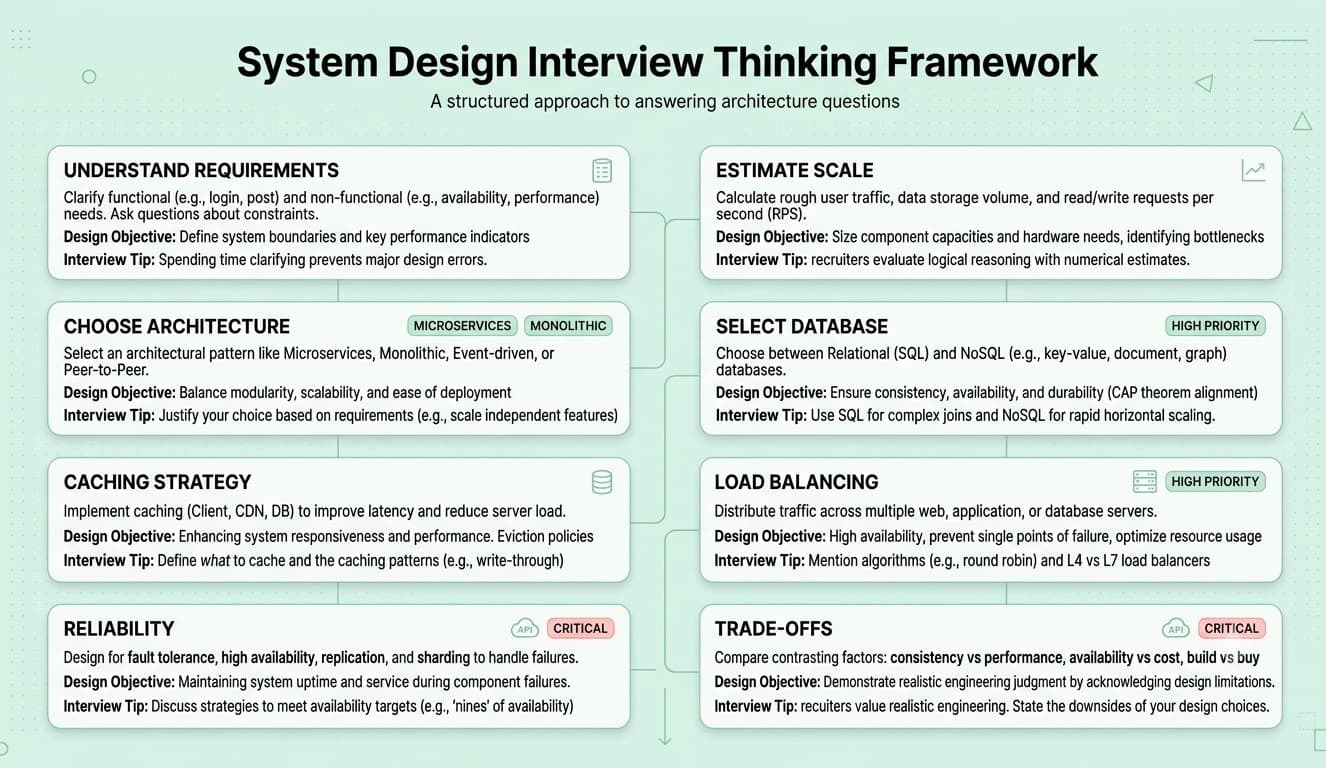
Answer: A structured approach: 1) Clarify requirements and scope (functional and non-functional, e.g., read/write ratio, latency, scale), 2) Estimate scale (back-of-envelope calculations for QPS, storage), 3) Design a high-level architecture (API, data model, major components), 4) Deep-dive into critical components (database choice, caching, load balancing), 5) Address bottlenecks and tradeoffs, 6) Discuss failure modes and monitoring.
Explanation: This meta-question tests process and communication as much as technical knowledge — interviewers are evaluating whether you can drive an ambiguous, open-ended conversation.
Real-World Example: In real engineering orgs, this mirrors an actual design-doc review process where a proposal is scoped, estimated, architected, and then critiqued by peers before implementation begins.
Common Mistakes: Jumping straight into a detailed database schema before clarifying requirements, or failing to manage time and going too deep on one component while ignoring others.
Follow-up Questions: How do you handle a requirement you weren't given (ambiguity)? How would you prioritize which components to deep-dive on given limited time? How do you incorporate non-functional requirements like security or cost?
Question: How do you approach a system design interview question in general?
Answer: A structured approach: 1) Clarify requirements and scope (functional and non-functional, e.g., read/write ratio, latency, scale), 2) Estimate scale (back-of-envelope calculations for QPS, storage), 3) Design a high-level architecture (API, data model, major components), 4) Deep-dive into critical components (database choice, caching, load balancing), 5) Address bottlenecks and tradeoffs, 6) Discuss failure modes and monitoring.
Explanation: This meta-question tests process and communication as much as technical knowledge — interviewers are evaluating whether you can drive an ambiguous, open-ended conversation.
Real-World Example: In real engineering orgs, this mirrors an actual design-doc review process where a proposal is scoped, estimated, architected, and then critiqued by peers before implementation begins.
Common Mistakes: Jumping straight into a detailed database schema before clarifying requirements, or failing to manage time and going too deep on one component while ignoring others.
Follow-up Questions: How do you handle a requirement you weren't given (ambiguity)? How would you prioritize which components to deep-dive on given limited time? How do you incorporate non-functional requirements like security or cost?
Question 33
Question: What's the difference between SQL and NoSQL databases, and how do you choose?
Answer: SQL (relational) databases enforce a fixed schema, support ACID transactions, and excel at complex queries/joins over structured data. NoSQL databases (document, key-value, wide-column, graph) offer flexible schemas and horizontal scalability, typically trading strict consistency for availability/partition tolerance, and are chosen when data is unstructured, access patterns are simple/high-volume, or massive horizontal scale is required.
Explanation: Tests whether the candidate makes data-driven architecture decisions rather than defaulting to one type reflexively.
Real-World Example: An e-commerce order/payment system (needing strong transactional guarantees) typically uses a SQL database, while a product catalog with varying attributes across categories, or a session store, often fits a document/key-value NoSQL store better.
Common Mistakes: Framing this as "NoSQL is always more scalable" without acknowledging modern SQL databases (e.g., with read replicas, sharding) also scale well, or picking NoSQL purely for trendiness rather than fit.
Follow-up Questions: How would you model a many-to-many relationship in a NoSQL document store? When would you use a graph database over a relational one? How would you migrate from SQL to NoSQL (or vice versa) with minimal downtime?
Question: What's the difference between SQL and NoSQL databases, and how do you choose?
Answer: SQL (relational) databases enforce a fixed schema, support ACID transactions, and excel at complex queries/joins over structured data. NoSQL databases (document, key-value, wide-column, graph) offer flexible schemas and horizontal scalability, typically trading strict consistency for availability/partition tolerance, and are chosen when data is unstructured, access patterns are simple/high-volume, or massive horizontal scale is required.
Explanation: Tests whether the candidate makes data-driven architecture decisions rather than defaulting to one type reflexively.
Real-World Example: An e-commerce order/payment system (needing strong transactional guarantees) typically uses a SQL database, while a product catalog with varying attributes across categories, or a session store, often fits a document/key-value NoSQL store better.
Common Mistakes: Framing this as "NoSQL is always more scalable" without acknowledging modern SQL databases (e.g., with read replicas, sharding) also scale well, or picking NoSQL purely for trendiness rather than fit.
Follow-up Questions: How would you model a many-to-many relationship in a NoSQL document store? When would you use a graph database over a relational one? How would you migrate from SQL to NoSQL (or vice versa) with minimal downtime?
Question 34
Question: How would you design a system to handle 1 million concurrent users?
Answer: Key strategies: horizontal scaling with stateless application servers behind a load balancer, a CDN for static assets, caching layers to reduce database load, database read replicas and sharding for write scaling, asynchronous processing via message queues for non-critical-path work, and connection pooling/efficient resource management at every layer.
Explanation: An open-ended scale question testing whether a candidate can reason across the whole stack rather than focusing narrowly on one layer.
Real-World Example: Streaming platforms handling live events (e.g., major sports broadcasts) combine CDN edge caching for video segments with autoscaled stateless API tiers to absorb concurrent viewer spikes.
Common Mistakes: Only discussing "add more servers" without addressing the database as the likely bottleneck, or ignoring the need for stateless application design to enable horizontal scaling in the first place.
Follow-up Questions: Where's the likely bottleneck at this scale, and how would you identify it? How would you handle a sudden 10x traffic spike (flash crowd)? How do you keep sessions consistent across stateless servers?
Question: How would you design a system to handle 1 million concurrent users?
Answer: Key strategies: horizontal scaling with stateless application servers behind a load balancer, a CDN for static assets, caching layers to reduce database load, database read replicas and sharding for write scaling, asynchronous processing via message queues for non-critical-path work, and connection pooling/efficient resource management at every layer.
Explanation: An open-ended scale question testing whether a candidate can reason across the whole stack rather than focusing narrowly on one layer.
Real-World Example: Streaming platforms handling live events (e.g., major sports broadcasts) combine CDN edge caching for video segments with autoscaled stateless API tiers to absorb concurrent viewer spikes.
Common Mistakes: Only discussing "add more servers" without addressing the database as the likely bottleneck, or ignoring the need for stateless application design to enable horizontal scaling in the first place.
Follow-up Questions: Where's the likely bottleneck at this scale, and how would you identify it? How would you handle a sudden 10x traffic spike (flash crowd)? How do you keep sessions consistent across stateless servers?
Question 35
Question: How would you design an API rate-limited, idempotent payment processing system?
Answer: Use idempotency keys (client-generated unique IDs per logical transaction) stored with the request result so retries return the original response instead of double-charging; combine with a state machine tracking payment status (pending, completed, failed) and a distributed lock or database unique constraint to prevent race conditions on concurrent retries.
Explanation: Tests understanding of idempotency, a critical but often overlooked concept for reliable distributed systems, especially around money.
Real-World Example: Stripe's API requires an Idempotency-Key header for exactly this reason — network retries on a timeout shouldn't result in duplicate charges.
Common Mistakes: Relying only on client-side retry logic without server-side deduplication, or not considering what happens if the idempotency key check and the actual charge aren't atomic.
Follow-up Questions: How would you handle a request that's still processing when a retry with the same idempotency key arrives? How long should idempotency keys be retained? How do you handle idempotency across distributed microservices?
Part 4: Databases
Question 36
Question: What is database normalization, and what are the tradeoffs of denormalization?
Answer: Normalization organizes data to reduce redundancy and prevent anomalies by splitting data into related tables (typically up to 3rd normal form). Denormalization intentionally introduces redundancy to reduce expensive joins and improve read performance, at the cost of update anomalies and extra storage.
Explanation: Tests understanding that database design is a tradeoff between write integrity/storage efficiency and read performance, not a "more normal is always better" rule.
Real-World Example: An analytics/reporting database (data warehouse) is often deliberately denormalized (star schema) for fast aggregate queries, while a transactional order-processing database stays normalized to avoid data inconsistency.
Common Mistakes: Treating normalization as strictly better in all cases, or not being able to explain a specific normal form (1NF, 2NF, 3NF) with an example.
Follow-up Questions: Can you explain 3rd normal form with an example violation? When would you denormalize a production schema? What's a star schema, and why is it used in data warehouses?
Question 37
Question: What are database indexes, and how do they work?
Answer: An index is a separate data structure (commonly a B-tree) that maps column values to row locations, dramatically speeding up lookups and range queries at the cost of additional storage and slower writes (since indexes must be updated on every insert/update/delete).
Explanation: One of the most practical, frequently-asked database questions since indexing is central to real-world performance tuning.
Real-World Example: Adding an index on a user_email column used in login queries can turn a full table scan (O(n)) into a near-instant lookup (O(log n)) on a table with millions of rows.
Common Mistakes: Assuming "more indexes are always better" without acknowledging write overhead and storage cost, or not knowing the difference between clustered and non-clustered indexes.
Follow-up Questions: What's the difference between a clustered and non-clustered index? How would you decide which columns to index? What is a composite index, and how does column order matter?
Question 38
Question: Explain ACID properties in database transactions.
Answer: Atomicity (a transaction fully completes or fully rolls back), Consistency (a transaction brings the database from one valid state to another, respecting constraints), Isolation (concurrent transactions don't interfere with each other's intermediate state), and Durability (once committed, changes survive system failures).
Explanation: Foundational transactional database vocabulary, frequently paired with follow-ups on isolation levels since "isolation" is where most nuance and real bugs live.
Real-World Example: A bank transfer (debit one account, credit another) must be atomic — if the credit fails after the debit succeeds, the whole transaction rolls back to avoid losing money.
Common Mistakes: Being unable to explain isolation levels beyond naming them, or confusing consistency in ACID (constraint enforcement) with consistency in CAP theorem (replica agreement) — these are different concepts despite the shared term.
Follow-up Questions: What are the different isolation levels, and what anomalies does each prevent? What is a dirty read, non-repeatable read, and phantom read? How does optimistic locking differ from pessimistic locking?
Question 39
Question: What is a JOIN, and what are the different types?
Answer: A JOIN combines rows from two or more tables based on a related column. Types: INNER JOIN (only matching rows), LEFT/RIGHT JOIN (all rows from one side plus matches from the other, NULLs where no match), FULL OUTER JOIN (all rows from both sides), and CROSS JOIN (Cartesian product).
Explanation: Core SQL competency question, often paired with a live query-writing exercise to test practical fluency, not just definitions.
Real-World Example: An e-commerce query joining orders and customers with a LEFT JOIN could surface customers with zero orders (useful for churn/re-engagement analysis), which an INNER JOIN would exclude.
Common Mistakes: Confusing LEFT and RIGHT JOIN direction, or writing a query that unintentionally produces a Cartesian product due to a missing/incorrect join condition.
Follow-up Questions: How would you find rows in table A that have no matching row in table B? What's the performance difference between a JOIN and a subquery? How does a self-join work, and when would you use one?
Question 40
Question: How would you optimize a slow SQL query?
Answer: Approach: run EXPLAIN/EXPLAIN ANALYZE to see the query plan and identify full table scans, add appropriate indexes on filtered/joined columns, avoid SELECT * (fetch only needed columns), rewrite correlated subqueries as joins where possible, and consider denormalization or caching for read-heavy repeated queries.
Explanation: A highly practical, frequently-asked question testing real debugging methodology rather than memorized rules.
Real-World Example: A dashboard query slow due to a missing index on a created_at filter column can go from several seconds to milliseconds after adding a targeted index, verified by comparing the before/after query plan.
Common Mistakes: Jumping straight to "add an index" without first profiling with EXPLAIN to confirm the actual bottleneck, which might be something else like a lock contention issue or an inefficient join order.
Follow-up Questions: How would you identify the query plan is doing a full table scan? What's the N+1 query problem, and how do you fix it? How do you decide between adding an index vs. rewriting the query.
Question 41
Question: What is the N+1 query problem, and how do you solve it?
Answer: The N+1 problem occurs when code fetches a list of N items with one query, then executes an additional query per item (N more queries) to fetch related data, instead of fetching everything efficiently in fewer queries. It's solved via eager loading (JOIN or a single batched query with WHERE id IN (...)), or using an ORM's built-in eager-loading features.
Explanation: An extremely common real-world performance bug, especially prevalent in applications using ORMs — a frequently asked practical question.
Real-World Example: Fetching a list of blog posts and then querying the author separately for each post (instead of joining posts with authors in one query) is a textbook N+1 bug that can turn 1 query into 101 for a 100-post page.
Common Mistakes: Not recognizing the pattern in ORM-generated code (since it's hidden behind abstraction), or over-correcting by eager-loading everything even when it's not needed, causing wasted data transfer.
Follow-up Questions: How would you detect an N+1 problem in production? How does GraphQL introduce or help with N+1 issues (DataLoader pattern)? What's the difference between eager loading and lazy loading?
Question 42
Question: What's the difference between a primary key, foreign key, and unique constraint?
Answer: A primary key uniquely identifies each row in a table (no NULLs, one per table, typically indexed). A foreign key enforces referential integrity by referencing a primary/unique key in another table. A unique constraint ensures column values are distinct but, unlike a primary key, can allow NULLs and a table can have multiple unique constraints.
Explanation: Basic relational database vocabulary, but interviewers often probe deeper into referential integrity behavior (cascading deletes, etc.).
Real-World Example: In an orders table, order_id is the primary key, customer_id is a foreign key referencing the customers table, and order_number (a human-readable identifier) might have a unique constraint.
Common Mistakes: Saying primary keys and unique constraints are functionally identical, missing the NULL-handling and cardinality differences.
Follow-up Questions: What happens when you try to delete a row referenced by a foreign key? What's ON DELETE CASCADE, and when is it risky to use? Can a table have a composite primary key?
FREE TO USE
8k+ SESSIONS92% FLUENCY4.9★ RATING
Speak With Confidence
Real Conversations. Real Scenarios. Speak until it feels natural.
- Real-Time Speaking Practice
- Guided Conversation Flows
- Instant AI Feedback
Part 5: Networking & Web Fundamentals
Question 43
Question: What happens when you type a URL into a browser and hit Enter?
Answer: High level: 1) DNS resolution translates the domain to an IP address, 2) the browser establishes a TCP connection (and TLS handshake for HTTPS), 3) the browser sends an HTTP request, 4) the server processes it and sends back an HTTP response, 5) the browser parses HTML/CSS/JS and renders the page, making additional requests for assets as needed.
Explanation: A classic "walk me through the stack" question that reveals breadth of understanding across networking, browsers, and web fundamentals.
Real-World Example: CDNs intercept step 2-4 by serving cached static content from an edge server geographically close to the user, dramatically reducing latency compared to hitting the origin server directly.
Common Mistakes: Skipping DNS resolution and the TLS handshake, or not mentioning caching (browser cache, CDN) at all.
Follow-up Questions: What's the difference between TCP and UDP, and why does HTTP use TCP? What is TLS/SSL and how does the handshake work? What is DNS caching, and where does it happen?
Question 44
Question: What's the difference between HTTP methods GET, POST, PUT, PATCH, and DELETE?
Answer: GET retrieves data (should be safe/idempotent, no side effects), POST creates a new resource (not idempotent, repeated calls may create duplicates), PUT replaces a resource entirely (idempotent), PATCH partially updates a resource (may or may not be idempotent depending on implementation), and DELETE removes a resource (idempotent — deleting twice has the same end state).
Explanation: Core REST API vocabulary; interviewers often probe idempotency specifically since it's frequently misunderstood.
Real-World Example: A payment retry mechanism should use PUT with a client-generated resource ID (or an idempotency key with POST) rather than a plain POST, to avoid creating duplicate charges on retry.
Common Mistakes: Claiming POST is idempotent, or confusing PUT (full replacement) with PATCH (partial update).
Follow-up Questions: Is DELETE idempotent — what does the response look like on a repeated call? How would you design an idempotent POST endpoint? What HTTP status codes would you return for each of these operations?
Question 45
Question: Explain the difference between REST and GraphQL APIs.
Answer: REST exposes multiple fixed endpoints per resource, often leading to over-fetching or under-fetching data (requiring multiple round trips). GraphQL exposes a single endpoint where clients specify exactly the fields/data they need in a query, reducing over/under-fetching but adding complexity in caching, query cost analysis, and potential N+1 query issues on the backend.
Explanation: A common architectural comparison question, especially at companies using GraphQL, testing whether the candidate understands real tradeoffs rather than treating GraphQL as strictly superior.
Real-World Example: A mobile app fetching a user profile with just a name and avatar (versus a full REST response with dozens of unused fields) benefits significantly from GraphQL's precise field selection, saving bandwidth on constrained mobile networks.
Common Mistakes: Presenting GraphQL as universally better without mentioning its added backend complexity (resolver N+1 problems, harder HTTP-level caching due to a single endpoint).
Follow-up Questions: How does GraphQL handle the N+1 query problem (DataLoader)? How would you cache GraphQL responses given it typically uses a single POST endpoint? When would REST still be the better choice?
Question 46
Question: What is CORS, and why does it exist?
Answer: CORS (Cross-Origin Resource Sharing) is a browser security mechanism that restricts web pages from making requests to a different origin (domain/protocol/port) than the one that served the page, unless the server explicitly allows it via response headers like Access-Control-Allow-Origin. It exists to prevent malicious sites from silently making authenticated requests to other sites on a user's behalf.
Explanation: A commonly misunderstood topic — many developers know how to "fix" CORS errors without understanding what the mechanism actually protects against.
Real-World Example: A frontend hosted on app.example.com calling an API on api.example.com requires the API to send Access-Control-Allow-Origin: app.example.com (or a wildcard for public APIs) in its response headers, or the browser will block the response from being read by the JavaScript.
Common Mistakes: Thinking CORS is a server-side security mechanism (it's enforced by the browser, not the server — the request often still reaches the server, but the browser blocks the response from being accessed), or setting Access-Control-Allow-Origin: * on endpoints handling sensitive authenticated data.
Follow-up Questions: What's a CORS preflight request, and when does the browser send one? Why shouldn't you use a wildcard origin with credentialed requests? How is CORS different from CSRF protection?
Part 6: Operating Systems & Concurrency
Question 47
Question: What is the difference between a process and a thread?
Answer: A process is an independent execution unit with its own memory space (isolated from other processes); a thread is a lightweight unit of execution within a process that shares the process's memory space with other threads. Threads are cheaper to create and switch between, but shared memory introduces synchronization challenges that processes avoid.
Explanation: Foundational OS vocabulary underlying nearly every concurrency discussion — interviewers check whether you understand the memory isolation tradeoff.
Real-World Example: A web browser typically runs each tab as a separate process (isolation, so one crashing tab doesn't take down the browser) while using multiple threads within a process for tasks like rendering and network I/O.
Common Mistakes: Saying threads are "always faster" without mentioning the synchronization overhead and bug risk (race conditions) that shared memory introduces.
Follow-up Questions: What is context switching, and why is it more expensive for processes than threads? What is a race condition, and how do you prevent one? What's the difference between multithreading and multiprocessing for CPU-bound work in Python (GIL)?
Question 48
Question: What is a deadlock, and how would you prevent one?
Answer: A deadlock occurs when two or more threads/processes are each waiting for a resource held by the other, creating a cycle where none can proceed. Prevention strategies include acquiring locks in a consistent global order, using timeouts on lock acquisition, avoiding nested locks where possible, and using deadlock detection algorithms in complex systems.
Explanation: A classic concurrency question testing both theoretical understanding (Coffman conditions) and practical prevention strategies.
Real-World Example: A classic real-world deadlock scenario is two database transactions each locking a row the other needs next (e.g., transferring money between two accounts in opposite order); most databases detect this and abort one transaction automatically.
Common Mistakes: Only naming "avoid it" without giving concrete prevention techniques, or confusing deadlock with livelock (threads actively responding to each other but still making no progress).
Follow-up Questions: What are the four Coffman conditions for deadlock? What's the difference between deadlock and livelock? How does a database detect and resolve deadlocks automatically?
Question 49
Question: Explain mutexes vs. semaphores.
Answer: A mutex (mutual exclusion lock) allows only one thread to access a critical section at a time and is typically owned by the thread that locked it (only that thread can unlock it). A semaphore maintains a count and allows up to N threads to access a resource concurrently, and can be signaled/released by any thread, not just the one that acquired it.
Explanation: Tests precise understanding of synchronization primitives beyond the general concept of "locking."
Real-World Example: A mutex might protect a single shared counter variable; a semaphore with count 5 could limit a connection pool to at most 5 concurrent database connections.
Common Mistakes: Using the terms interchangeably, missing the key distinction that a semaphore allows more than one holder and can be released by a different thread than the one that acquired it.
Follow-up Questions: What is a binary semaphore, and how does it differ from a mutex? What is a reentrant (recursive) lock, and when is it needed? How would you implement a connection pool using a semaphore?
Question 50
Question: How would you design a thread-safe singleton or shared counter?
Answer: For a shared counter, use an atomic increment operation (compare-and-swap based, avoiding locks entirely for simple operations) or protect the increment with a mutex. For a thread-safe singleton, use double-checked locking with proper memory barriers, a language-provided thread-safe lazy initialization mechanism (like Java's initialization-on-demand holder idiom), or eager initialization if the cost is acceptable.
Explanation: A hands-on concurrency question often extended into live coding — tests whether candidates understand subtle memory visibility issues, not just "add a lock."
Real-World Example: Metrics/counters in high-throughput systems (like request counters) commonly use atomic operations (e.g., AtomicInteger in Java, sync/atomic in Go) instead of full locks, since lock contention would become a bottleneck under high concurrency.
Common Mistakes: Implementing double-checked locking incorrectly (missing the volatile keyword in Java, which can allow a partially constructed object to be visible to another thread), or using a lock for simple increments where a lock-free atomic operation would be far more efficient.
Follow-up Questions: Why does double-checked locking require volatile in Java? What's a compare-and-swap (CAS) operation, and how does it enable lock-free programming? How would you benchmark whether a lock-free implementation is actually faster under real contention?
Part 7: Hands-On Coding Challenges
Question: Reverse a linked list (iteratively and recursively). Answer: Iteratively: maintain prev, curr, and next pointers, walking through the list and reversing each next pointer in place — O(n) time, O(1) space. Recursively: recurse to the end of the list, then reverse the pointer on the way back up — O(n) time, O(n) space due to the call stack. Explanation: One of the most frequently asked coding warm-ups, testing pointer manipulation fluency and whether candidates can articulate the space tradeoff between the two approaches. Real-World Example: While rarely done directly in production, the pointer-reversal pattern underlies undo-history implementations and certain in-place data restructuring operations. Common Mistakes: Losing the reference to the rest of the list before reassigning next (causing the list to break), or forgetting to update the head pointer at the end. Follow-up Questions: How would you reverse only a sublist between positions m and n? How would you reverse a doubly linked list? Can you reverse the list in groups of k nodes? Question: Implement an LRU (Least Recently Used) cache. Answer: Combine a hash map (for O(1) key lookup) with a doubly linked list (to track usage order, moving accessed items to the front and evicting from the back), achieving O(1) time for both get and put operations. Explanation: A very commonly asked design-and-code question testing the ability to combine two data structures to meet a combined performance requirement neither alone could achieve efficiently. Real-World Example: LRU eviction policies are used in real caching systems (CPU caches, Redis's allkeys-lru policy, browser caches) to keep the most relevant data in limited-size fast storage. Common Mistakes: Using only a hash map (loses order tracking) or only a linked list (loses O(1) lookup), or forgetting to update the linked list on both get (marks as recently used) and put. Follow-up Questions: How would you implement LFU (Least Frequently Used) instead? How would you make this cache thread-safe? How would this design change if entries also needed a TTL (time-to-live) expiration? Question: Given an array, find two numbers that add up to a target (Two Sum). Answer: Use a hash map to store each number's complement (target - number) as you iterate; for each new number, check if it's already in the map (meaning its pair was seen earlier) — O(n) time, O(n) space, versus O(n²) brute force. Explanation: One of the most iconic interview questions, used to test whether a candidate immediately reaches for a hash-map-based optimization over brute force nested loops. Real-World Example: The core pattern (single-pass hash map lookup for complements) generalizes to many "find a pair/combination matching a condition" problems in real data processing pipelines. Common Mistakes: Using nested loops (O(n²)) without recognizing the hash map optimization, or not handling duplicate values/indices correctly (e.g., using the same element twice). Follow-up Questions: How would you solve Three Sum (find three numbers that sum to a target)? What if the array is sorted — is there a more space-efficient approach? How would you return all pairs instead of just one? Question: Find the longest substring without repeating characters. Answer: Use the sliding window technique with a hash set (or hash map storing last-seen index): expand the window by moving a right pointer, and when a duplicate is found, shrink the window by moving the left pointer past the previous occurrence — O(n) time, O(min(n, alphabet size)) space. Explanation: A very common sliding-window pattern question that tests recognizing when a two-pointer approach beats brute-force substring generation (O(n³) or O(n²)). Real-World Example: Sliding window techniques like this underlie many text-processing and streaming-data problems, such as finding the longest sequence meeting a constraint in log analysis. Common Mistakes: Recomputing the substring from scratch for each window position instead of incrementally updating with a hash set/map, or mishandling the left-pointer jump when a duplicate is found (jumping incorrectly instead of to last_index + 1). Follow-up Questions: How would you find the longest substring with at most k distinct characters? How would you find all anagram start indices of a pattern within a string using a similar sliding window? What's the time complexity if the character set is very large (e.g., full Unicode)? Question: Implement a binary search algorithm and explain edge cases. Answer: Maintain low and high pointers; repeatedly check the middle element, narrowing the search range based on comparison with the target, until found or the range is empty — O(log n) time, O(1) space (iterative). Explanation: Deceptively simple, but a very high percentage of candidates make off-by-one errors — interviewers use this to test attention to detail and edge case handling. Real-World Example: Binary search underlies database index lookups, version-control "bisect" tools for finding the commit that introduced a bug, and any sorted-data lookup at scale. Common Mistakes: Integer overflow when computing the midpoint ((low + high) / 2 in languages with fixed-size integers — should use low + (high - low) / 2), or incorrect boundary updates (high = mid vs. high = mid - 1) causing infinite loops. Follow-up Questions: How would you find the first or last occurrence of a target in a sorted array with duplicates? How would you search in a rotated sorted array? How would you adapt binary search for a "search on the answer" optimization problem?Question 51
Question 52
Question 53
Question 54
Question 55
Part 8: Testing, DevOps & Best Practices
Question: What's the difference between unit, integration, and end-to-end tests? Answer: Unit tests verify a single function/class in isolation (fast, mocked dependencies); integration tests verify multiple components working together (e.g., service + database); end-to-end tests verify the entire system flow from a user's perspective (slowest, most realistic, most brittle). Best practice follows the "testing pyramid" — many unit tests, fewer integration tests, and a small number of E2E tests. Explanation: Fundamental testing strategy vocabulary; interviewers check whether a candidate can reason about the cost/confidence tradeoff at each level, not just define the terms. Real-World Example: A payment service might have hundreds of unit tests for calculation logic, dozens of integration tests verifying database interactions, and a handful of E2E tests confirming the full checkout flow works via the UI. Common Mistakes: Over-investing in E2E tests (slow, flaky, expensive to maintain) at the expense of unit tests, inverting the testing pyramid into an "ice cream cone" anti-pattern. Follow-up Questions: How would you handle flaky E2E tests in a CI pipeline? What's the difference between mocking and stubbing? How do you decide what to mock in an integration test versus a unit test? Question: What is CI/CD, and why is it important? Answer: Continuous Integration automatically builds and tests code on every commit/merge to catch integration issues early; Continuous Delivery/Deployment automates the release process so validated code can be deployed to production quickly and reliably (Delivery requires a manual approval step; Deployment is fully automatic). Together they reduce the risk and manual effort of shipping software, enabling faster, safer iteration. Explanation: Core DevOps vocabulary relevant to virtually every modern engineering role — interviewers check for practical familiarity, not just definitions. Real-World Example: A typical pipeline runs unit/integration tests and static analysis on every pull request (CI), then automatically deploys to a staging environment and, after passing further checks, to production (CD) — common in tools like GitHub Actions, Jenkins, or GitLab CI. Common Mistakes: Conflating Continuous Delivery and Continuous Deployment (the key difference is the manual gate before production), or not mentioning rollback strategies as part of a mature CI/CD pipeline. Follow-up Questions: What's the difference between Continuous Delivery and Continuous Deployment? How would you design a safe rollback strategy for a bad deployment? What is a blue-green deployment, and how does it reduce deployment risk? Question: How do you approach code review, both giving and receiving feedback? Answer: When reviewing, focus on correctness, readability, maintainability, and test coverage rather than purely stylistic nitpicks (ideally automated via linters); give specific, actionable, and respectful feedback, distinguishing must-fix issues from suggestions. When receiving feedback, treat it as improving the code (not a personal critique), ask clarifying questions on disagreements, and iterate quickly. Explanation: A behavioral-technical hybrid question testing collaboration skills, which are as important as raw coding ability in most engineering roles. Real-World Example: Well-run engineering teams often use PR templates and automated checks (linting, test coverage thresholds) to keep human review focused on logic and design rather than formatting debates. Common Mistakes: Giving vague feedback ("this is confusing") without actionable suggestions, or being purely nitpicky on style while missing substantive design/logic issues. Follow-up Questions: How do you handle a disagreement with a reviewer about a design decision? How do you review a very large pull request effectively? What would you do if you noticed a recurring pattern of issues from one team member? Question: What is technical debt, and how do you manage it? Answer: Technical debt refers to the implied cost of additional rework caused by choosing an expedient/quick solution now instead of a better, more thorough one — it's not inherently bad (sometimes a deliberate, reasonable tradeoff), but must be tracked and paid down deliberately to avoid compounding into a system that's hard to change. Explanation: Tests pragmatic engineering judgment — interviewers want to see the candidate frame debt as a strategic tradeoff, not just "bad code." Real-World Example: A startup might intentionally hardcode a business rule to ship an MVP quickly, then explicitly track it as debt (e.g., a ticket/comment) to refactor into a configurable rules engine once the product's direction is validated. Common Mistakes: Treating all technical debt as something to eliminate immediately, without recognizing that some debt is a reasonable, deliberate business tradeoff, or failing to make debt visible/tracked, letting it silently accumulate. Follow-up Questions: How would you prioritize paying down technical debt against new feature work? How do you communicate the cost of technical debt to non-technical stakeholders? Can you give an example of "good" technical debt you've deliberately taken on? Question: How would you debug a production issue you can't reproduce locally? Answer: Approach: gather context (logs, error rates, recent deployments/config changes, affected user segments), use observability tools (distributed tracing, metrics dashboards) to narrow down the failing component, check for environment-specific differences (config, data, load) between production and local, and consider adding targeted logging/feature flags to gather more data safely in production if needed. Explanation: A highly practical scenario question testing real debugging methodology and comfort operating without a perfect local reproduction, which is common in production incidents. Real-World Example: A "works on my machine" bug often turns out to be caused by a subtle production-only factor like a different config value, a race condition only triggered under real concurrent load, or a data edge case not present in local test data. Common Mistakes: Jumping to "add more logging and redeploy" as the first step without first exhausting existing observability data (logs, metrics, traces) that might already contain the answer. Follow-up Questions: How would you handle this issue if it's actively causing a production outage (time pressure)? What observability tools have you used for distributed tracing? How would you write a postmortem for this kind of incident?Question 56
Question 57
Question 58
Question 59
Question 60
Part 9: Scenario-Based & Behavioral Questions
Question: Tell me about a time you disagreed with a technical decision made by your team or manager. Answer: A strong answer uses a structured narrative (situation, your reasoning, how you raised the concern, the outcome) showing you voiced disagreement constructively with data/reasoning, remained open to being wrong, and ultimately committed to the team's decision (or escalated appropriately if it was a serious concern) rather than being obstructive. Explanation: Tests communication, collaboration, and whether the candidate can disagree productively without being either a pushover or combative — a strong signal for team fit. Real-World Example: A candidate might describe disagreeing with a proposed database choice, presenting benchmark data to support an alternative, and — after the team still chose the original option for valid reasons the candidate hadn't considered — fully committing to making that choice succeed. Common Mistakes: Choosing an example where the candidate was simply "right" and the team was "wrong" with no nuance, or an example that reflects poorly on collaboration (refusing to let go of the disagreement). Follow-up Questions: How did you know when to stop pushing and accept the team's decision? What would you have done if the decision turned out badly? How do you generally handle situations where you're overruled? Question: Describe a project that failed or didn't go as planned. What did you learn? Answer: A strong answer honestly owns the failure (without excessive self-blame or deflecting entirely onto others), clearly explains what went wrong and why, and — most importantly — articulates specific, concrete lessons applied to subsequent work. Explanation: Tests self-awareness, accountability, and growth mindset — interviewers are wary of candidates who claim they've "never really failed." Real-World Example: A candidate might describe underestimating the complexity of a migration project, missing the deadline, and afterward adopting a habit of explicitly identifying and derisking unknowns early in project planning (e.g., through spikes/prototypes) as a direct lesson learned. Common Mistakes: Choosing a "fake failure" that's actually a humblebrag (e.g., "I worked too hard"), or blaming the failure entirely on external factors/other people without any personal reflection. Follow-up Questions: What would you do differently if you faced the same situation again today? How did you communicate the failure to stakeholders? Did this experience change how you approach similar projects since? Question: How do you prioritize when you have multiple competing deadlines? Answer: A strong answer describes a concrete framework: assessing business impact and urgency of each task, communicating tradeoffs transparently with stakeholders/manager rather than silently overcommitting, and being willing to negotiate scope or timelines when everything genuinely can't be done. Explanation: Tests time management, communication, and judgment under pressure — important for roles with real-world ambiguity and competing priorities. Real-World Example: A candidate might describe a scenario with two features due the same week, proactively flagging the conflict to their manager with an impact analysis, and getting alignment on which to prioritize (or getting help/resources) rather than silently working overtime and delivering both poorly. Common Mistakes: Describing an approach that relies purely on individual heroics (working excessive hours) rather than communication and negotiation, which doesn't scale and signals poor judgment. Follow-up Questions: How do you handle a situation where your manager and a stakeholder disagree on priority? What do you do when a "quick task" turns out to be much bigger than expected mid-way through? How do you communicate a missed deadline proactively? Question: Describe a time you had to learn a new technology quickly to complete a project. Answer: A strong answer demonstrates a structured learning approach (identifying core concepts first, building a small proof-of-concept, leveraging documentation/community resources, and iterating), plus concrete evidence of successful application under a real deadline. Explanation: Tests learning agility, a critical trait given how fast technology changes — interviewers want evidence of an efficient, systematic learning process, not just "I read the docs." Real-World Example: A candidate might describe needing to learn a new cloud messaging service for a project, building a minimal proof-of-concept first to validate core assumptions before committing to the full implementation, catching a major limitation early that saved significant rework. Common Mistakes: Giving a vague answer without describing an actual learning process or method, or choosing an example that doesn't demonstrate meaningful depth (e.g., "I learned a new npm package" for a trivial task). Follow-up Questions: How do you evaluate whether a new technology is production-ready for your use case? How do you stay current with new technologies generally? What resources do you typically turn to first when learning something new? Question: How would you handle a situation where a teammate consistently submits low-quality code? Answer: A strong answer emphasizes direct, private, and constructive conversation first (assuming good intent — maybe they lack context or are under pressure), offering concrete help (pairing, resources, clearer standards), and escalating to a manager only if the pattern continues despite good-faith efforts to address it directly. Explanation: Tests interpersonal skills and conflict-navigation maturity, particularly relevant for senior roles involving mentorship or team leadership. Real-World Example: A candidate might describe noticing a newer teammate's PRs frequently lacking tests, offering to pair on their next feature to model the expected testing approach rather than only leaving critical review comments repeatedly. Common Mistakes: Jumping straight to escalating to a manager without attempting direct, constructive communication first, or being dismissive/judgmental in describing the teammate rather than assuming good intent. Follow-up Questions: What would you do if the direct conversation didn't improve things? How do you give critical feedback without damaging the working relationship? How would this differ if the teammate were more senior than you? Read More: Top software engineering skills recruiters look forQuestion 61
Question 62
Question 63
Question 64
Question 65
Part 10: Recent Industry Trends
Question: How is AI/LLM integration (e.g., Copilot-style tools, RAG, agents) changing software engineering practice? Answer: AI coding assistants accelerate boilerplate/scaffolding and increase individual productivity, but shift the engineer's core value toward system design, code review, prompt/context engineering, and validating correctness — since AI-generated code still requires careful review for subtle bugs, security issues, and architectural fit. Retrieval-Augmented Generation (RAG) and agentic workflows are increasingly used to build AI features grounded in proprietary data rather than relying purely on a model's training knowledge. Explanation: A very current trend question testing whether the candidate has hands-on experience and thoughtful perspective, not just buzzword familiarity. Real-World Example: Many engineering teams now incorporate AI code review assistants and use LLM-powered chat interfaces grounded in internal documentation (RAG) to speed up onboarding and reduce repetitive support questions. Common Mistakes: Either dismissing AI tools entirely or being uncritically enthusiastic without discussing real limitations (hallucination, security review needs, over-reliance risk for junior engineers' skill development). Follow-up Questions: How do you validate the correctness of AI-generated code before merging it? What are the security risks of AI coding assistants (e.g., leaking secrets, insecure code suggestions)? How might AI change the skills junior engineers need to develop? Question: What is the role of platform engineering and internal developer platforms in modern organizations? Answer: Platform engineering builds internal, self-service tooling (deployment pipelines, infrastructure provisioning, observability) that reduces cognitive load on product teams, letting them focus on business logic rather than infrastructure complexity — essentially treating infrastructure/tooling as a product with developers as internal customers. Explanation: A growing trend as organizations scale microservices and cloud infrastructure complexity — tests awareness of how large engineering orgs are organizing themselves beyond individual coding skill. Real-World Example: Companies increasingly build internal developer platforms (using tools like Backstage for a service catalog, or Kubernetes-based self-service deployment tooling) so product teams can deploy and manage services without deep infrastructure expertise. Common Mistakes: Confusing platform engineering with traditional DevOps/SRE without articulating the key difference (platform engineering focuses on building reusable self-service products, not just operating infrastructure). Follow-up Questions: How would you measure the success of an internal developer platform? What's the difference between platform engineering and SRE? How do you balance standardization (platform) with team autonomy? Question: How has the shift toward edge computing and edge functions affected application architecture? Answer: Edge computing runs code closer to the end user (at CDN edge locations) rather than centralized origin servers, dramatically reducing latency for certain workloads (auth checks, personalization, A/B testing logic) at the cost of more limited runtime environments and the added complexity of reasoning about globally distributed, eventually-consistent state. Explanation: Tests awareness of an infrastructure trend directly relevant to web performance and modern deployment platforms. Real-World Example: Platforms like Cloudflare Workers and Vercel Edge Functions let teams run lightweight logic (like redirect rules or personalization) at edge locations worldwide, shaving meaningful latency off requests compared to a single-region origin server. Common Mistakes: Treating edge computing as a universal replacement for traditional backend architecture without acknowledging its constraints (limited compute/memory, harder access to centralized databases, cold-start considerations). Follow-up Questions: What kinds of workloads are well-suited to edge functions, and which aren't? How do you handle database access from edge functions given the latency to a centralized database? What are the debugging/observability challenges specific to edge computing? Question: What's driving the growing adoption of infrastructure as code (IaC) and GitOps practices? Answer: Infrastructure as Code (tools like Terraform, Pulumi) defines infrastructure declaratively in version-controlled files, enabling repeatability, code review for infrastructure changes, and disaster recovery via reproducibility. GitOps extends this by using Git as the single source of truth for both application and infrastructure state, with automated reconciliation (e.g., via ArgoCD/Flux) ensuring the live environment matches the declared state. Explanation: Reflects the broader industry shift toward treating operations with the same rigor (version control, code review, automated testing) as application code — a common topic in DevOps-adjacent interviews. Real-World Example: Many organizations now require infrastructure changes to go through the same pull-request review process as application code, using Terraform plans to preview exactly what will change before applying, reducing the risk of manual, undocumented infrastructure drift. Common Mistakes: Treating IaC purely as a scripting convenience without recognizing its deeper value (auditability, drift detection, disaster recovery reproducibility, and enabling code review for infra changes). Follow-up Questions: How do you handle secrets management within an IaC workflow? What is configuration drift, and how does GitOps help prevent it? How would you structure Terraform modules for a multi-environment (dev/staging/prod) setup? Question: How are engineering teams adapting to increased focus on software supply chain security? Answer: Teams increasingly adopt practices like dependency vulnerability scanning (SCA tools), generating Software Bills of Materials (SBOMs), signing artifacts/commits, using minimal/hardened base container images, and enforcing least-privilege access in CI/CD pipelines — driven by high-profile supply chain attacks that compromised widely-used dependencies or build systems. Explanation: A rapidly growing area of concern given several major real-world incidents involving compromised dependencies or CI/CD pipelines — increasingly asked in interviews for roles touching infrastructure or security-conscious organizations. Real-World Example: Incidents involving compromised open-source packages or CI/CD pipeline breaches have pushed many organizations to adopt automated dependency scanning in CI (flagging known CVEs before merge) and to pin dependencies to specific verified versions/hashes rather than loose version ranges. Common Mistakes: Treating supply chain security as solely about scanning for known vulnerabilities (SCA) without considering build/pipeline integrity (e.g., could a compromised CI runner inject malicious code into an otherwise clean build?). Follow-up Questions: What is an SBOM, and why is it increasingly required by enterprise customers/regulations? How would you evaluate whether to trust a new open-source dependency before adding it? How do you secure secrets used within a CI/CD pipeline?Question 66
Question 67
Question 68
Question 69
Question 70
How to Use This Guide
Don't memorize word-for-word. Use the "Explanation" sections to build genuine understanding, then practice explaining answers in your own words out loud. Prioritize by role. If you're interviewing for a backend-heavy role, weight Parts 3, 4, and 6 more heavily. Frontend-focused roles should emphasize Part 5. Senior/staff roles should spend extra prep time on Parts 3 and 9. Practice the coding questions hands-on. Reading Part 7 isn't enough — actually write and run the code, including edge cases, ideally under mild time pressure to simulate interview conditions. Prepare your own stories for Part 9. Behavioral questions reward specificity — prepare 5-6 real stories from your experience that can flexibly answer multiple questions in this section (most behavioral questions are variations on a smaller set of underlying themes). Use follow-up questions as a self-check. After answering a question, try answering its follow-ups too — this is usually where interviews go deeper and where candidates get caught unprepared. Good luck with your interview preparation.