Loading...
Contents
Top Software Engineering Skills Recruiters Look for in 2026
Jul 28, 202615 min readUpdated Sep 8, 2026
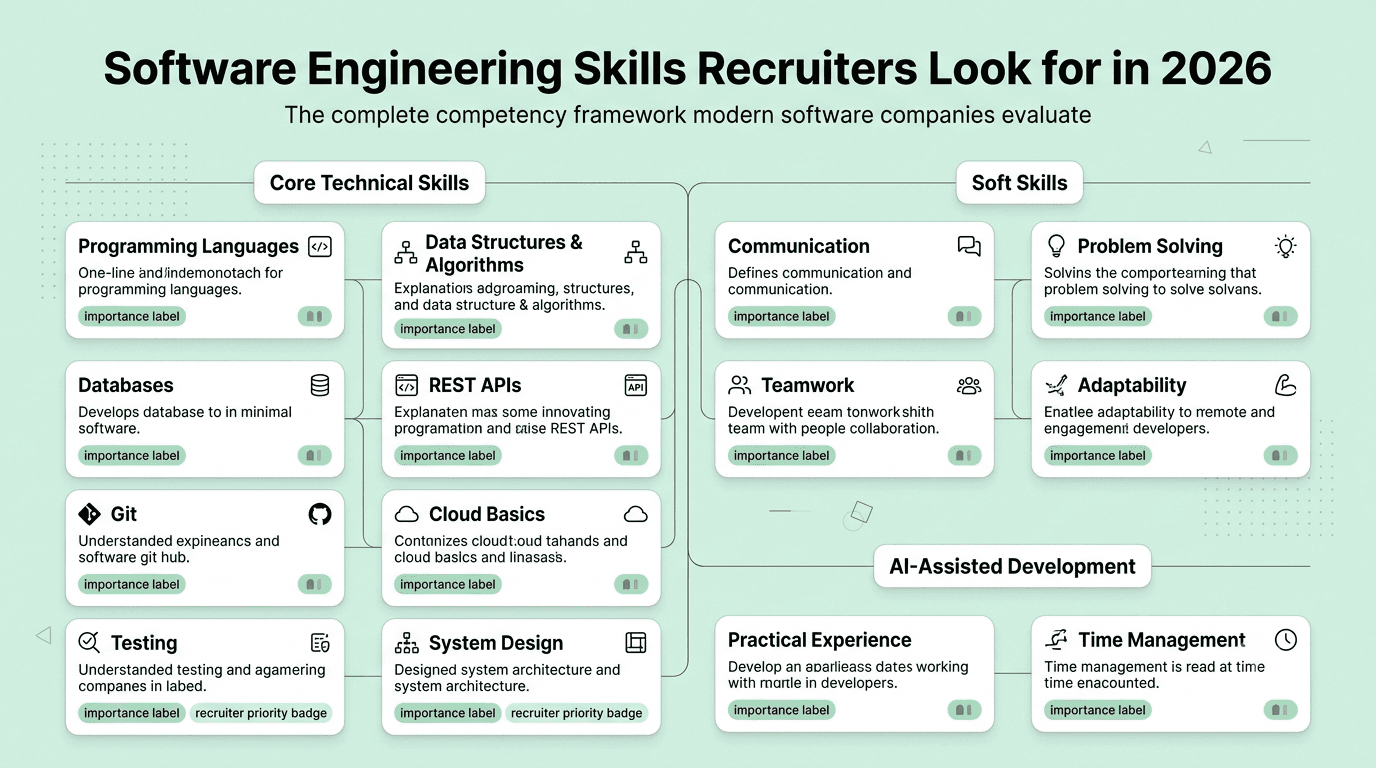
In 2026, recruiters look for software engineers who combine core technical skills like programming languages, data structures, databases, and cloud basics with soft skills like communication, adaptability, and problem solving. AI assisted development has raised the bar, since writing code is now only part of the job, understanding and directing it matters just as much.
In 2026, recruiters look for software engineers who combine core technical skills like programming languages, data structures, databases, and cloud basics with soft skills like communication, adaptability, and problem solving. AI assisted development has raised the bar, since writing code is now only part of the job, understanding and directing it matters just as much.
Software engineering hiring has shifted noticeably in the last couple of years. AI assisted development tools now handle a meaningful chunk of routine coding work, which means companies are hiring less for raw typing speed and more for judgment, the ability to review and direct AI generated code, debug complex systems, and communicate decisions clearly to a team.
Degrees still open doors, but they're no longer the deciding factor they once were. Recruiters increasingly prioritize demonstrated skill, whether that comes from a computer science degree, a bootcamp, open source contributions, or a strong personal project. Practical experience, the kind you can actually walk through in an interview, now carries more weight than a transcript.
This guide breaks down exactly which technical and soft skills recruiters are prioritizing in 2026, how to demonstrate each one, and what to focus on whether you're a fresher building your first resume or an experienced engineer growing into a more senior role.
FREE TO USE
25K+ INTERVIEWS4.8★ RATING68% IMPROVEMENT
Crack Your Dream Job
Real Interviews. Real Pressure. Practice until it feels easy.
- Seamless Interview Experience
- Resume & JD Questions
- Instant Personalized Feedback
Why Software Engineering Skills Matter More Than Ever
Software engineering skills matter more in 2026 because AI assisted development has changed what companies actually need from engineers. Hiring now favors demonstrated skill and practical experience over degrees alone, since the ability to apply knowledge to real problems is harder to fake than a resume line.
AI Assisted Development
Tools that generate, complete, and review code have become part of daily engineering work. This hasn't reduced the need for skilled engineers, it's raised the bar. Engineers now need to understand what the generated code is actually doing well enough to catch mistakes, security issues, and inefficiencies an AI tool might miss.
Hiring Trends
Companies are increasingly structuring interviews around applied problem solving rather than memorized syntax, partly because AI tools have made memorization far less valuable than it used to be. Recruiters want to see how you think when a problem doesn't match anything you've seen before.
Skills Over Degrees
A computer science degree remains useful, but it's no longer treated as proof of ability on its own. Recruiters increasingly ask candidates to demonstrate skills directly, through coding rounds, project walkthroughs, or portfolio reviews, regardless of educational background.
Practical Experience
Real, hands on experience, even from personal projects or open source contributions, often carries more weight in an interview than coursework alone. Recruiters want evidence you can build and ship something, not just describe how it theoretically works.
Core Technical Skills Every Software Engineer Needs
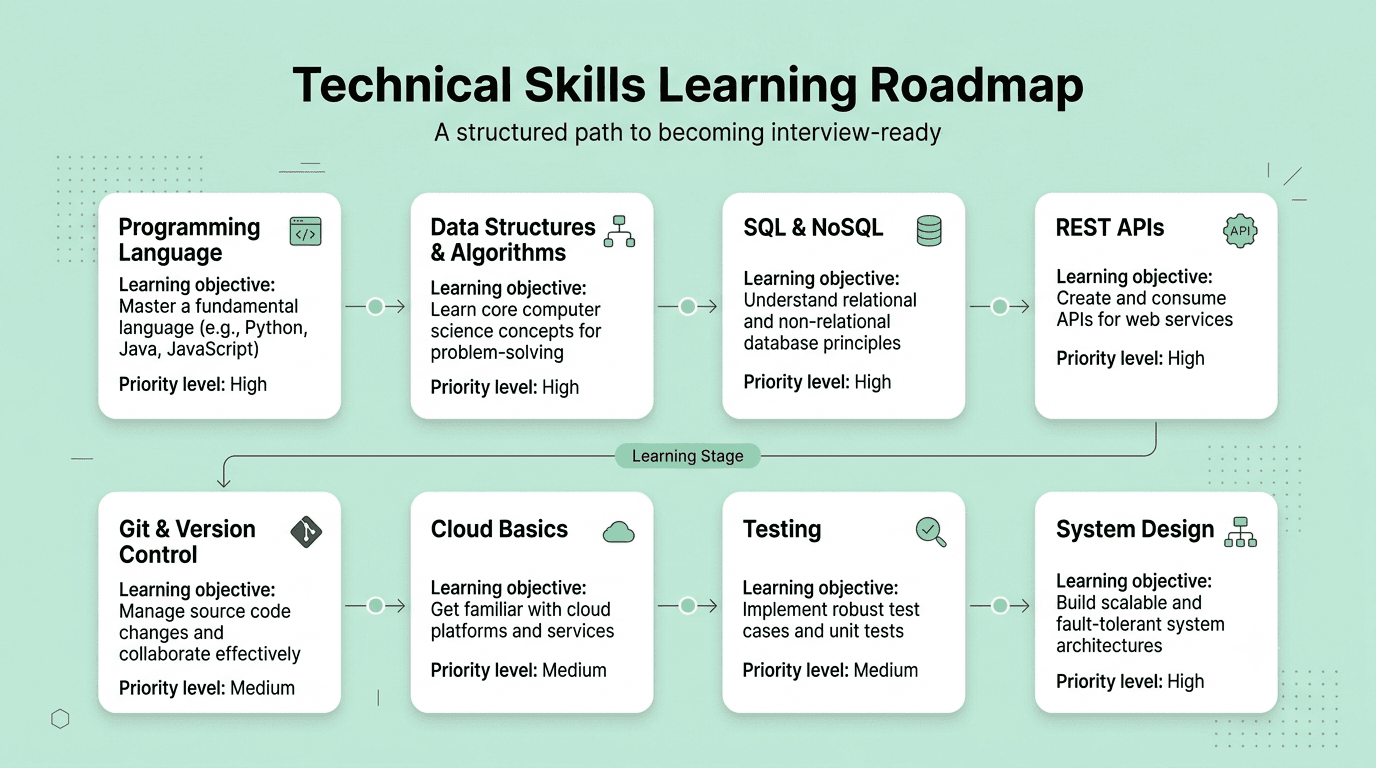
Core technical skills for software engineers in 2026 include proficiency in at least one major programming language, strong data structures and algorithms fundamentals, database knowledge across SQL and NoSQL, API design, version control, cloud basics, testing, and a working understanding of system design.
Data Structures and Algorithms
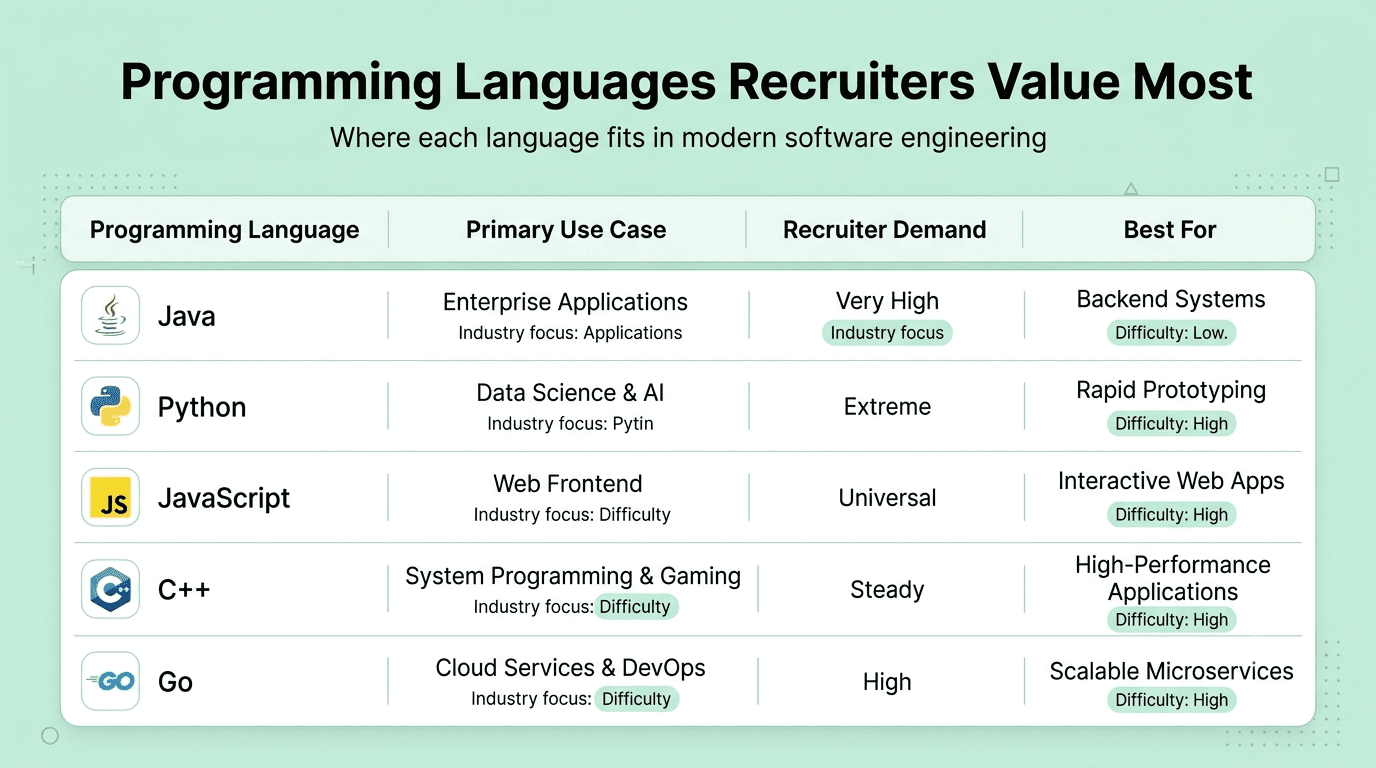
Programming Languages
Java
Why recruiters value it: Widely used in enterprise systems, banking, and large scale backend applications where stability matters.
Typical use cases: Backend services, Android development, and large enterprise platforms.
How to demonstrate proficiency: Reference a project involving multithreading, object oriented design, or a Java based backend service you've built or contributed to.
Python
Why recruiters value it: Readable, versatile, and dominant in data science, automation, and increasingly in AI and machine learning workflows.
Typical use cases: Backend APIs, data pipelines, scripting, and machine learning projects.
How to demonstrate proficiency: Discuss a project where you used Python for automation, data processing, or building an API, ideally with a measurable outcome.
JavaScript
Why recruiters value it: Powers both frontend and backend development through frameworks and Node.js, making it one of the most broadly applicable languages.
Typical use cases: Web applications, single page apps, and full stack development.
How to demonstrate proficiency: Walk through a web application you've built, focusing on how you handled state management or asynchronous logic.
C++
Why recruiters value it: Preferred for performance critical systems where memory management and speed matter most.
Typical use cases: Game engines, embedded systems, and high performance computing.
How to demonstrate proficiency: Talk through a project where performance optimization or memory management was a core challenge you solved.
Go
Why recruiters value it: Built for concurrency and simplicity, increasingly used in cloud infrastructure and microservices.
Typical use cases: Backend services, distributed systems, and cloud native applications.
How to demonstrate proficiency: Describe a microservice or concurrent system you've built, emphasizing why Go's concurrency model was a good fit.
Data Structures and Algorithms
This remains a foundational skill, not because interviews are obsessed with puzzles, but because it directly reflects your ability to solve problems efficiently. Focus your practice on three things: problem solving patterns you can recognize quickly, time complexity analysis you can explain clearly, and optimization thinking that goes beyond just getting a correct answer.
Databases
Recruiters expect comfort with both relational databases through SQL and non relational systems through NoSQL, along with a practical understanding of query optimization. Being able to explain why you'd choose one over the other for a specific use case matters more than memorizing syntax.
APIs
Modern engineering roles almost always involve working with APIs, whether building them or integrating with third party services. Recruiters look for familiarity with REST and increasingly GraphQL, along with a solid grasp of authentication methods and how to design reliable integrations.
Version Control
Git fluency is close to non negotiable at this point. Recruiters expect comfort with branching, merging, resolving conflicts, and working through pull requests as part of a normal team workflow, not just committing code alone.
Cloud Basics
Even for engineers not working directly in DevOps, a working knowledge of cloud platforms like AWS, Azure, or GCP has become expected. Understanding how applications are deployed, scaled, and monitored in the cloud shows you can operate beyond just writing local code.
Testing
Unit testing and integration testing skills signal that you write reliable, maintainable code, not just code that works once. Recruiters increasingly ask candidates to walk through how they test their own code, not just how they write it.
System Design
At a high level, recruiters want to know you can reason about scalability, trade offs, and architecture, even if deep system design expertise is expected more from mid level and senior candidates than freshers.
Essential Soft Skills Recruiters Evaluate
The most important software engineer soft skills are communication, problem solving, teamwork, adaptability, and time management. Recruiters evaluate these throughout the interview process, often through how you explain technical answers rather than through direct questions alone.
| Skill | Why It Matters | Example |
|---|---|---|
| Communication | Explains solutions clearly to both technical and non technical stakeholders | Walking through your reasoning during a coding round |
| Problem Solving | Finds efficient, well reasoned solutions under pressure | Debugging a production issue methodically |
| Teamwork | Supports effective collaboration in agile environments | Contributing actively during sprint planning |
| Adaptability | Keeps pace with new tools and technologies, including AI assisted workflows | Quickly picking up a new framework or AI coding tool |
| Time Management | Ensures consistent, reliable project delivery | Meeting sprint deadlines without sacrificing code quality |
FREE TO USE
8k+ SESSIONS92% FLUENCY4.9★ RATING
Speak With Confidence
Real Conversations. Real Scenarios. Speak until it feels natural.
- Real-Time Speaking Practice
- Guided Conversation Flows
- Instant AI Feedback
Skills Freshers Should Prioritize
Freshers should prioritize a simple roadmap: must learn skills like one strong programming language and core data structures, should learn skills like SQL and Git, and nice to have skills like cloud basics or a second language, which can come later.
Must Learn
- One programming language, learned deeply rather than several learned shallowly
- Core data structures and algorithms
- Git and basic version control workflows
- SQL fundamentals
Should Learn
- REST API design and integration basics
- Unit testing fundamentals
- Basic understanding of one cloud platform
Nice to Have
- A second programming language
- Exposure to system design concepts
- Familiarity with AI assisted development tools
Skills Experienced Engineers Should Develop
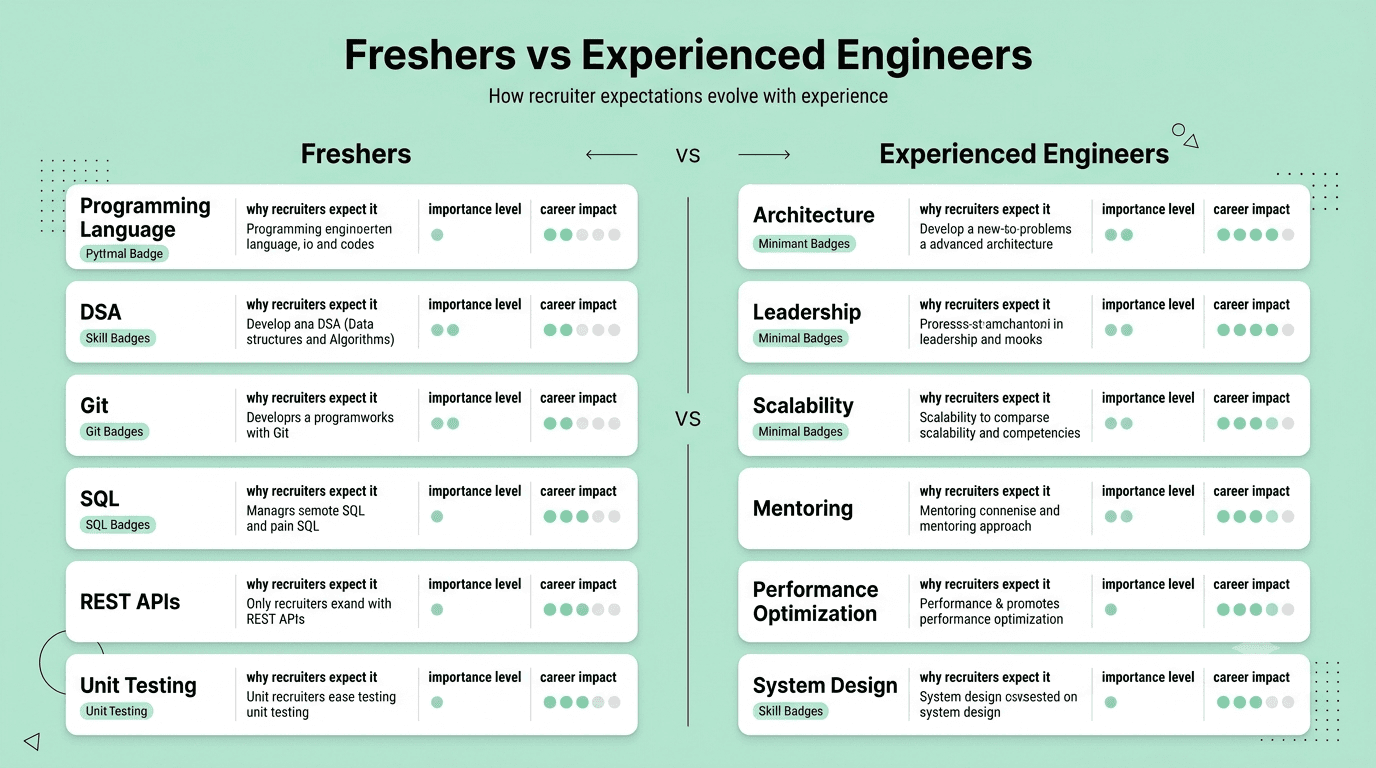
Experienced engineers should focus on skills that reflect growing ownership and impact, including architecture design, technical leadership, scalability thinking, mentoring, and performance optimization, since these are what separate senior roles from mid level ones in recruiter evaluations.
- Architecture: The ability to design systems that scale cleanly and remain maintainable as requirements grow.
- Leadership: Guiding technical decisions and influencing direction, even without a formal management title.
- Scalability: Deep, practical understanding of how systems behave and where they break under real load.
- Mentoring: Helping junior engineers grow, which recruiters increasingly view as a marker of senior level maturity.
- Performance Optimization: Identifying and resolving bottlenecks in existing systems, not just building new features.
How to Showcase These Skills on Your Resume
Showcasing software engineering skills on a resume means replacing vague descriptions with specific, measurable outcomes. Instead of listing what you were responsible for, describe what you actually built, improved, or fixed, with numbers attached wherever possible.
Bad: "Responsible for backend development and bug fixes."
Good: "Built a Python based backend service handling 10,000 daily requests and reduced average response time by 35 percent through query optimization."
Bad: "Worked with a team on a web application."
Good: "Collaborated with a four person team to ship a customer facing web application, owning the authentication and API integration layer."
Sample resume skills snippet: Technical Skills: Java, Python, SQL, REST APIs, Git, AWS, Unit Testing, System Design Fundamentals Highlighted Project: Designed and deployed a microservice that reduced processing latency by 40 percent, supporting over 50,000 monthly active users.
How to Build These Skills Faster
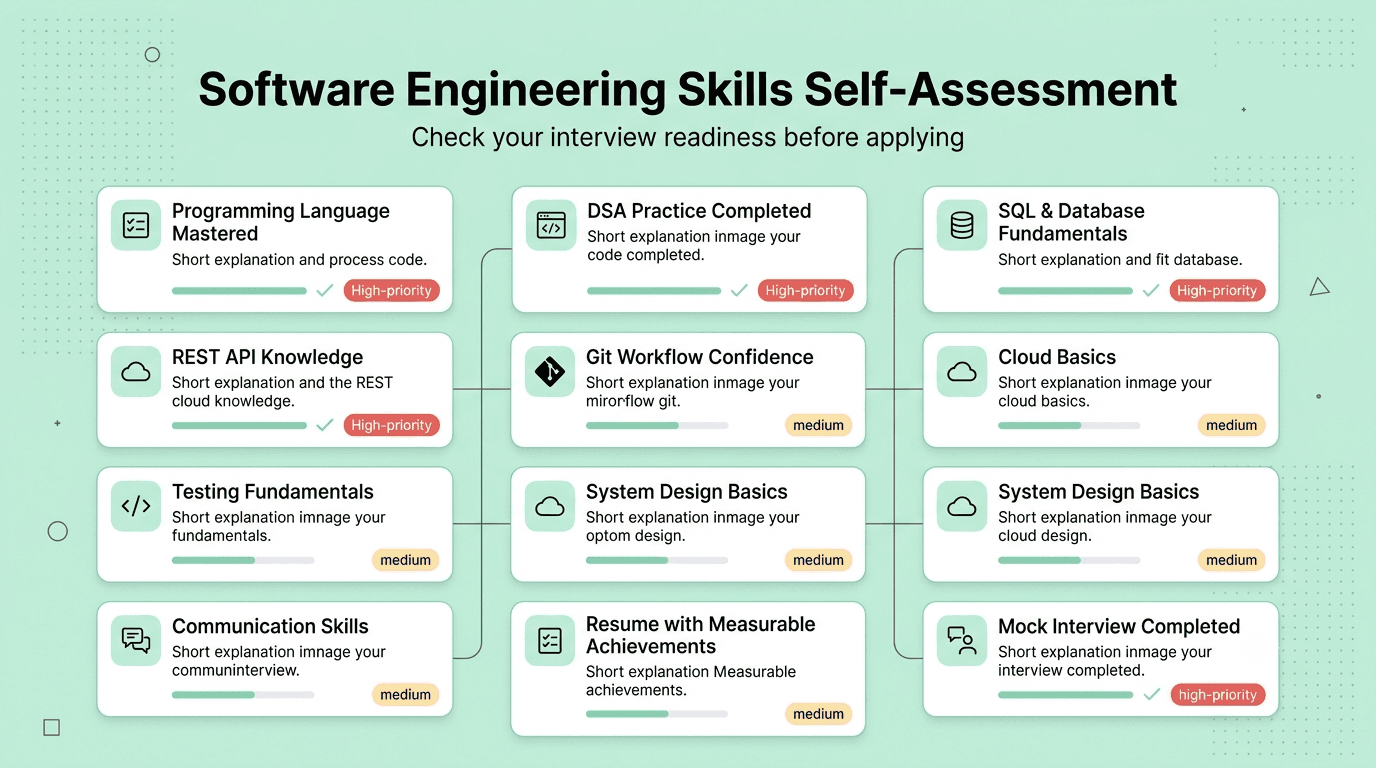
You can build software engineering skills faster through personal projects, open source contributions, relevant certifications, consistent coding practice, and mock interviews that force you to explain your reasoning under realistic pressure.
- Personal projects. Building something end to end, even a small one, teaches far more than tutorials alone.
- Open source contributions. Working on real, existing codebases exposes you to collaboration patterns and code quality standards you won't find in solo projects.
- Certifications. Cloud and language specific certifications, while not a substitute for experience, signal structured effort and can fill visible resume gaps.
- Coding practice. Consistent, daily practice across different problem patterns builds fluency faster than occasional long sessions.
- Mock interviews. Practicing under real time pressure, with follow up questions you can't fully predict, closes the gap between knowing a skill and performing it live.
Recruiter Skills Checklist
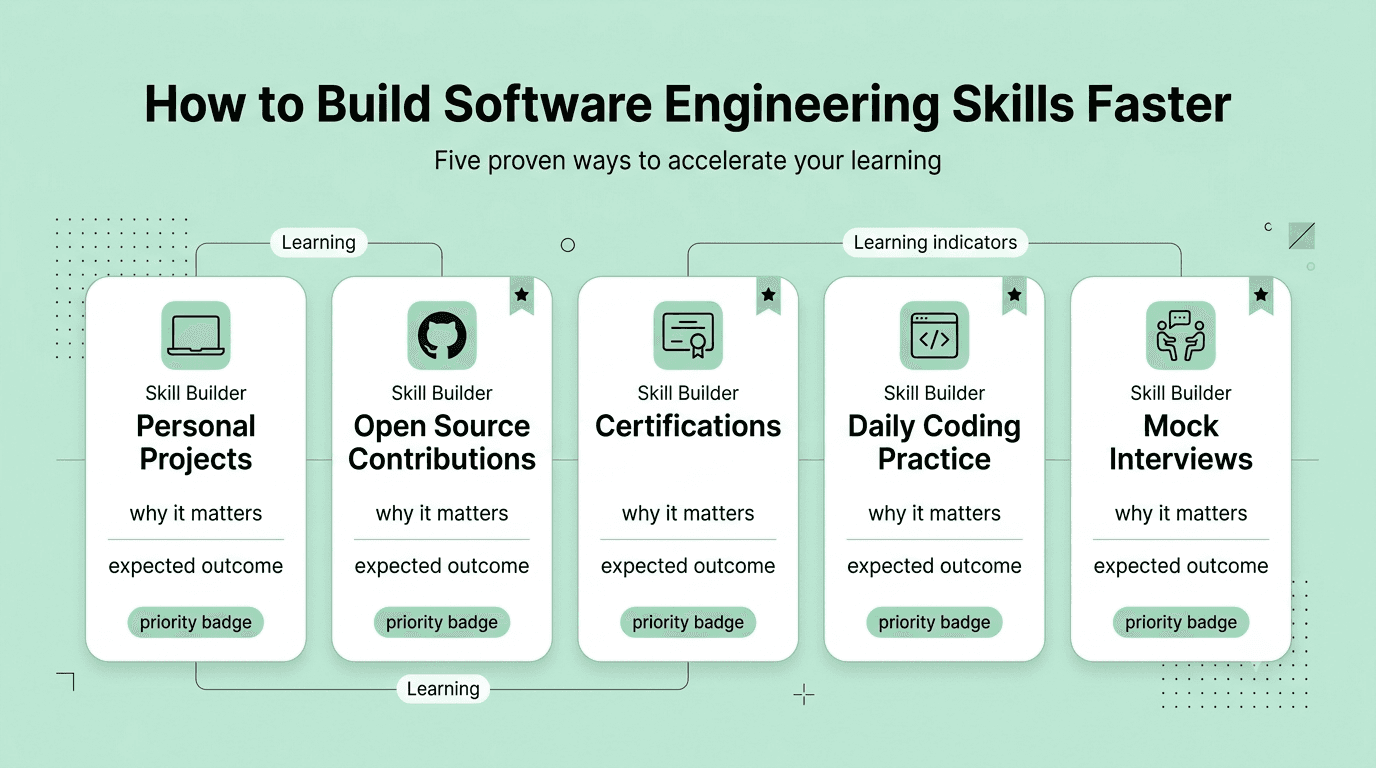
- One programming language mastered deeply
- Data structures and algorithms practiced consistently
- SQL and database fundamentals reviewed
- API design and integration understood
- Git and version control workflows practiced
- Cloud platform basics explored
- Unit and integration testing practiced
- System design fundamentals reviewed
- Communication and STAR style examples prepared
- Resume updated with measurable achievements
- Mock interview completed
Conclusion
The skills recruiters prioritize in 2026 reflect a broader shift in what engineering work actually looks like now, less about writing every line of code from scratch, and more about judgment, communication, and the ability to build and maintain systems that hold up under real conditions. Building a strong technical foundation alongside genuine soft skills, and demonstrating both clearly on your resume and in interviews, is what consistently separates strong candidates from the rest.